RISK ANALYSIS OF NOISE IN INDUSTRY MAKING CLOTHES
Análise do risco ruído em indústria de confecção de roupa
Daniela Dalapicula Barcelos(1) , Soraya Gama de Ataíde (2)
(1) University of Vila Velha – UVV, Vitórioa, ES, Brazil. (2) Specialization Course in Audiology CEFAC, Vitória, ES,
Brazil.
Conlict of interest: non-existent
determine the occurrence of Noise Induced Hearing Loss (NIHL), and is the most frequent cause of injury to the health of workers 3, present in many 4
lines of business, such as in industries, textiles, construction works, metallurgy, printing, sewing workshops, among other work environments 5.
The garment industry in the country has emerged from the process of national industrialization with textile production. Brazilian Association of Clothing 6 – With the evolution of the textile industry,
the modernization of the manufacturing sector, which currently has twenty-one different articles of clothing and accessories segments, according to the classiication of Abravest occurred. This is one of the sectors that soon developed in the country by requiring little technological level and small capital investment, in many regions, as occurred in the early industrialization of Brazil, this industry is the precursor of theindustrialization process.
With efforts to increase the amount of production and maintain the products competitiveness in the market, companies invest and modernize faster and faster their machines. The great need of skilled INTRODUCTION
Hearing is one of the noblest senses; its main function is linked to the acquisition and development of oral, essential language in interpersonal relations and the environment 1. Due to this importance, is
that scholars increasingly seek ways to prevent the occurrence of hearing loss, especially those caused by noise.
“Noise threatens hearing, health, learning and behavior,” says Nancy Nadler, spokesman for the Center for Hearing and Communication (CHC), responsible for the institution of the International Day of Awareness about Noise, affecting humans in physical, psychological and social level 2. At high
intensity and with continued exposure, noise can cause structural changes in the inner ear, which
ABSTRACT
Purpose: to get into an underexplored work environment and to identify if this environment might
bring hearing losses to the workers. Methods: the environment chosen is a garment factory located in Colatina, Espírito Santo/Brazil. The two noisiest areas of the factory were selected to be analyzed, as well as six employees that have been working there for ive years or so. The employees were asked to ill in a questionnaire on the hearing symptoms and then the audiometric tests taken for the
last ive years were compared. The analyzed areas produce noise from 83,5 to 97,8 dB. Results:
from the audiometric tests we could conclude that 83% of the workers did not have any hearing loss, although 16% had occupational loss, but this was classiied as stable. From the questionnaire we can conclude that 33% of the workers feel some kind of fatigue when exposed to high level sound for some time, 50% feel themselves stressed after their work shift, but none of them stated to hear any buzz nor insomnia, nor dificulty hearing other people. Conclusion: this work environment presents some risks to the hearing, once the employees are exposed to sound pressure levels during their work shifts, and the occupational hearing loss is evident although to a lesser extent – considering that the sample employees have been working there for at least ive years. Therefore, it is plain to understand the importance of studying a good variety of work environments to identify where prevention programs, like the HLPP (Hearing Loss Prevention Program) should be applied.
With the questionnaires, they were collected and discharged workers. The responses obtained through the questionnaire and analysis of audiometry were transformed into percentages and presented in this work by means of graphs.
RESULTS
1. Description Field of research: Synthesis of the infrastructure of the selected company
The analyzed company is located in the town of Colac in the state of Espírito Santo, and acts for clothes in the jeans, shirts, knitwear and social segment. It employs 368 staff, with workday of 9 hours / day (7am entry ace out ace 17:15 pm with 1 hour 20 minute stop for lunch). The measurements of each sector were provided by the company resulting from PPRA conducted by a Technical Work Safety, the company contracted to carry out the reviews: Cutting Sector I – 80.8 to 89.7 dB ( A) ; Sector Cut II – 80.8 to 82.2 dB ( A) ; Sector Sewing I – 79.9 to 89.2 dB ( A) , Sector Sewing II – 79.8 to 88.4 dB ( a) ; Sewing Sector III – 80.5 to 84.4 dB ( a) ; Sewing Sector IV – 79.8 to 84.1 dB (A ) ; Sector Sewing Pilot – 81.1 to 86.4 dB ( a) ; Salon Embroidery – 86.4 to 90.3 dB ( a) ; Limpadeiras industry – from 80.1 to 82.7 dB ( a) , Maintenance Sector I – 82.0 to 89.1 dB ( a) ; industry Corrosion / sanding – 81.9 to 86.1 dB ( a) ; Sector Boiler – 81.4 to 82.7 dB (A ) ; Finishing Sector I – 76.8 to 79.7 dB ( a), Sector II Finish – 80.4 to 89.4 dB ( a) ; industry Washing / Drying – 80.4 to 87.7 dB ( a) ; Sector Montage / Collage – 79.7 to 82.3 dB ( a) ; Sector area USED – from 88.4 to 98.2 dB ( a) ; Sector Ironing – 83.5 to 93.5 dB ( a) ; Sector General Administrative Services – 84.2 to 86.1 dB ( a) . The other sectors as Snap , Modeling , Styling, Efluent Treatment , Storage of Chemicals , Warehouse , Shipping , Chair , Human Resources , Billing , Purchasing , Accounts payable / receivable , Sales , Production Planning and Control , Guaritas , Canteen , Interfacing and Accounting , show measurements below 80 dB (A ) with no risk noise , however the PPRA other risks is described as gifts , heat, dust and solvents in their respective sectors , which were not listed because they are not subject of this study.
The company makes mandatory the use of individual protective shield sound, performing and training vouchers for their use, however, it can be observed that most workers do not use or even know the basic instructions on individual protectors. The company has an occupational physician who acts in certain on company time, and archiving in place of audiometric tests performed by specialized clinics, chosen for each contract.
manpower in diverse industry, due to the variety of productive stages in the industry, such as: warehouse of fabrics and trims, creating, modeling, enfesto, cutting, sewing, crafts, laundry, ironing, inishing, labeling , packaging, inal inspection and shipment 6; attracts people who search for a paid
service.
This niche market that has been growing steadily, it is underexplored in scientiic research as working conditions and occupational health. There is little explanation about this environment in the speech, and he presents some risk, especially hearing the employee.
Because of this question, the aim of this study is to verify the presence of noise in garment manufac-turing industry, since this risk is not widespread in research related to this work environment.
METHODS
The research, retrospective and documental study conducted in a company Tailoring located in Colatina-ES/Brazil.
The chosen industry has a total population of 368 employees. Through the Program of Environmental Risk Prevention supplied by them, noise measure-ments were analyzed in each sector, and thus raised the two sectors of higher risk noise, identiied as Ironing (six employees) and area USED (with four employees), totaling ten workers. After applying the exclusion criteria, only six workers were selected to participate in the study (four are workers Ironing and two workers are Used).
Exclusion criteria were: employees with less than ive years of service to the participating undertaking; workers in other sectors with less intensity noise or no risk and workers who declined to participate voluntarily in the study. With selected subjects, we analyzed the audiometric tests performed since the entrance exam to the current exam (2011) and can not therefore have fewer than ive tests for each worker (at least one test for each year), available at medical records iled in the sector responsible for this function. Audiograms were analyzed for normality and hearing loss, which are subdivided into occupa-tional and non-occupaoccupa-tional. Occupaoccupa-tional hearing loss found were analyzed for stability, worsening or triggering.
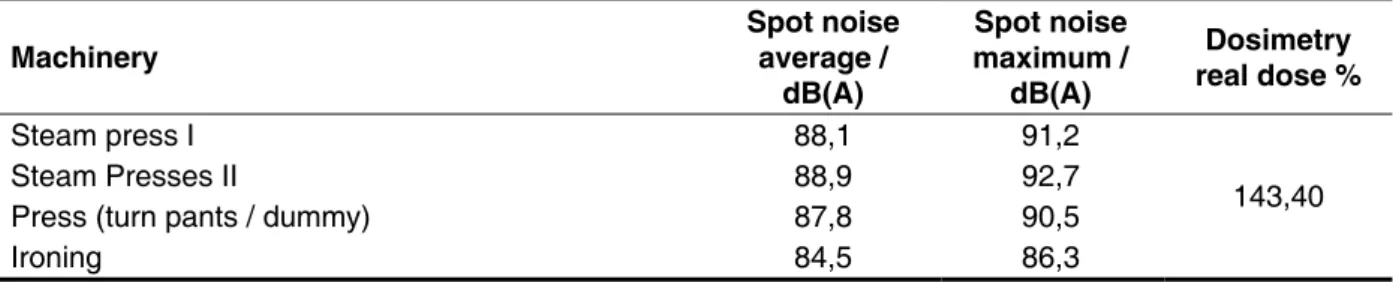
the greatest risk noise. The function of this sector is performing crossing clothing services, using the process of the steam press, noting the temperature and pressure of steam used and other related services. The consequences outlined in the Program for Prevention of Environmental Risks were: fatigue, irritability, headaches and decreased hearing. Table 2 lists the equipment used in this industry and their measurements.
The data found in measurements of the equipment used in sectors surveyed (Table 1 and 2) were analyzed and compared with the limits established by Norm 15 (NR15) and are available in Table 3.
1.1. Description of the sectors analyzed:
The sector identiied with higher noise level was the Sector Area USED, where it performs the operation through the dyeing process that describes Used by putting the garment in place to be dyed, apply the dye through the air pistol compressed, remove clothes once dyed, deposit it in a pre-determined location, and other related services. The consequences outlined in the Prevention of Environmental Risks for this sector were: fatigue, irritability, headaches, decreased hearing, and so on. The equipment used in this industry as well as the noise generated by them, are listed in Table 1.
The second area examined was the Ironing industry, identiied as the second sector presents
QUESTIONNAIRE
1. Personal data: 1.1 Age : ______ years
1.2 You are exposed to noise outside the work environment? ( ) YES ( ) NO
1.2.1 Name the places: ________________________________________________ ___________________________________________________________________ 2. Professional data:
2.1 How long have you worked at this company? ________________________ 2.2 Have you worked in another company, you was exposed to noise? ( ) YES ( ) NO 2.2.1 If yes: How long? ___________________
2.2 Current Work Day: 2.2.1 Entry: _______ hours 2.2.2: Output ______ hours 2.2.3 Lunch: _____ hours
3. In your current job, you have contact with chemicals (solvents) ( ) YES ( ) NO 3.1 Make use of Personal Protective Equipment? ( ) YES ( ) NO ________________ 3.2 If yes: Is there training to use? ( ) YES ( ) NO
3.3 Do you think that effective training? ( ) YES ( ) NO 4. Have any of the symptoms below:
4.1 Tinnitus? ( ) YES ( ) NO
4.2 Difficulty in understanding what people say? ( ) YES ( ) NO 4.3 Insomnia? ( ) YES ( ) NO
4.4 Sense of hearing loss? ( ) YES ( ) NO
4.4.1 If yes: How long have you been noticing this change? ________________ 4.5 Stress or irritation at the end of the workday? ( ) YES ( ) NO
4.5.1 If yes: What do you attribute this stress ? ____________________________ 4.6 Do you feel uncomfortable when exposed to loud sounds? ( ) YES ( ) NO
Machinery
Spot noise average /
dB(A)
Spot noise maximum /
dB(A)
Dosimetry real dose %
Used (cabin) Set Hood 96,5 97,8
353,08 Used (external) Hoods and Compressed Air - 1st job 96,1 98,2
2nd job 93,2 94,1
3rd job 88,4 92,7
Table 1 – Description of the equipment used in industry and their measurements Used
Machinery
Spot noise average /
dB(A)
Spot noise maximum /
dB(A)
Dosimetry real dose %
Steam press I 88,1 91,2
143,40
Steam Presses II 88,9 92,7
Press (turn pants / dummy) 87,8 90,5
Ironing 84,5 86,3
Table 2 – Description of the equipment used in industry and Ironing your measurements
Noise Level dB(A) Maximum Permitted Daily Exposure
85 86 87 88 89 90 91 92 93 94 95 96 98 100 102 104 105 106 108 110 112 114 115
8 hours 7 hours 6 hours 5 hours 4 hours e 30 minutes
4 hours 3 hours e 30 minutes
3 hours 2 hours e 40 minutes 2 hours e 15 minutes
2 hours 1 hours e 45 minutes 1 hours e 15 minutes
0% 20% 40% 60% 80% 100%
T innitus
Inso mnia
Sensatio n o f hearing lo ss
Stress o r irritatio n
D isco mfo rt when expo sed to lo ud so unds
0 20 40 60 80 100
Normal hearing
Occupational hearing loss Non-occupational hearing loss Figure 2 – with responses obtained through the questionnaire
Figure 3 – Chart showing the results of analysis of Audiometries
Of the six workers interviewed three complained of stress or irritation at the end of the workday, attributing the noise as the main factor. Two people reported discomfort when exposed to loud sounds and none of the respondents reported having tinnitus, insomnia or feeling of hearing loss / difi -culty in understanding what people say (Figure 2).
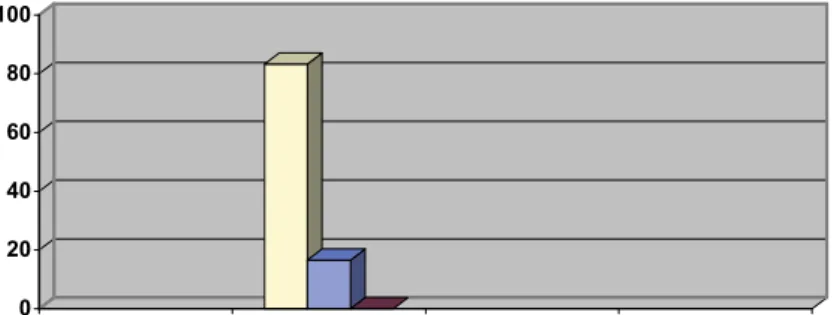
The sample analyzed, ive workers have a history of normality and has hearing loss. Hearing loss was found lodged in the chart above, speciied as occupational hearing loss, this loss is stable (Figure 3).
The age range of respondents was 28-51 years old, and this item was not used as a criterion for participation in research. The analyzed group has 5-24 years of service to the company, in general, the same industry. Only 16% of subjects reported exposure to noise outside the work environment, as justifying another job, the waiter service at parties at least three times a week. Two subjects make use of ear and reported that training for the same is eficient, an employee reports using the shield, but thinks ineffective training, while three oficials do not make use of ear training and complain.
DISCUSSION
During the 1980s, the noise was the main disease among metalworkers and affected more than 60% of category 7, and today is still rated as the most frequent
agent of occupational exposure 8-11, being described
as a major cause of sensorineural hearing loss in adults 12,13, usually bilateral, irreversible 4,8,11,14-16,
affecting the inner ear and / or auditory nerve 17, insidiously, slowly progressive changes
and producing symptoms only after several years 18.
This exposure can be very harmful, totally harmless or a measure of limits. The key issue is the duration of exposure, ie, the level of exposure determines the extent of the auditory effects of noise. All those working exposed to noise exceeding
85dBNPS and prolonged exposure should be monitored, which can be accomplished through pure tone audiometry 8,19.
The higher noise level of the equipment found in the analyzed sectors, generates noise of 98.2 dB (A) and considering the range of intensity to which employees are exposed (84.5 to 98.2 dB (A)), there that the exposure time, in a daily working hours exceeds the thresholds described in NR15 allowed.
Statistically, it is estimated that 15% of the exposed population constant noise of 90dB, eight hours per day, ive days per week, 50 weeks a year develop hearing damage after ten years 20. This
exposed to loud sounds. None of the respondents complained of hearing loss / dificulty understanding what people say. The age of the participants was not taken into account in this study, although it is relevant to correlate with complaints and investigate whether the absence of symptoms on exposure, is not beyond the short time working (most with only ive years of service in this industry ), the playfulness of the individual as well as the entire auditory system.
The diagnosis of noise-induced hearing loss of occupational origin depends on the audiogram and the proof of the existence of noise exposure in the workplace, considering the intensity and charac-teristics of the agent, and the manner and time of exposure, the general conditions health, age of the worker 37, and the type of noise (continuous or
inter-mittent) 11.
The causes and consequences of NIHL are already quite widespread general knowledge, although many do not follow guidelines for preventing this loss. However, some work environments still present dearth of information, because the current concern is facing the risk of grade 3 or 4, where the presence of noise is notorious companies, not taking into account other sectors, which even if not noticeable feature risks to workers’ health.
Although only one of the six analyzed workers present Noise Induced Hearing Loss, is adamant the literature the effects and consequences of hearing people exposed to noise. Therefore, consid -ering that the site poses risks to hearing, for better measurement of health problems, new research may be carried out using as target workers with ten or more years of services with noise exposure. Even though this study has shown low levels of claims or losses , described and analyzed in the participating workers would not rule out preventive workers presented here with normal hearing , and that may present a possible trigger NIHL is only visible after a few more years of continuous exposure . The environment selected for analysis (two sectors of clothing irm) exposes workers to thresholds above the tolerance limit. Considering this fact, the company should seek to prevent and resolve problems relevant to excessive exposure to the worker of this site is not affected.
According to the regulations of the Ministry of Labour, companies must maintain a Program Environmental Risk Prevention (NR9), in which the various risks involved in the work must be identiied and quantiied, from that information, direct the actions of the the Medical Control of Occupational Health (NR7), which shall carry out reviews of health workers 4.
Regarding the noise risk, there is a speciic program for its management , which consist of steps Exposure during working hours to noise above
permissible limits entitlement to punitive damages. Understanding is the Regional Labor Court of the 15th Region (Campinas, Brazil) 21, as in the case
of the seamstress who won damages from garment factory that operated in the laundry industry 22.
When the noise stops being just a causative agent of discomfort in the workplace to become a potentially harmful agent to the worker’s health, he will take a more speciic approach within the ield of occupational hygiene. Stands out in Annex 1 of NR 15 (Table 3), which describes the noise levels present in the work environment considered harmful to workers.
Auditory cause a major impact on people’s lives, which can lead them to social isolation 23, by
dificulties in participating in conversations, making frustrating any family gathering or social event 24,25.
Tinnitus is a symptom that often accompanies occupational hearing loss 26, dificulties in being
able to provide out of work contexts and negative inluence on the quality of life of workers and the people who surround 27,28. While none of the
candi-dates analyzed have complained of tinnitus, this symptom should not be disregarded because to discard it, one should irst examine the complaints of a larger population of workers exposed to noise and with more than ive years of exposure.
Besides the frequent auditory symptoms – namely hearing loss, dificulty understanding speech, tinnitus 29,30 and intolerance to loud sounds
– the worker carries PAIR also has complaints such as headache, dizziness and vertigo – because of the important changes that may occur in the labyrinthine structures, making the use of ear not only important to protect your hearing, but also for preservation of vestibular function 31 –irritability and
digestive problems 4. Are also listed in the literature,
symptoms such as hearing loss, ear fullness, earache, transient changes in blood pressure, stress 32, disturbances of vision, memory, sleep
and mood directly related to the exposure time, with sound pressure levels (SPL) and individual susceptibility 33,34, besides the reduction of speech
perception in noisy environments, television, radio, ilm, theater, sound warning signs, music and environmental sounds 35 and inability to relax 36.
Stress was reported by participants in this study who reported feeling irritation / stress at the end of the workday, showing parity with the symptoms presented in other research that also still reported insomnia and lack of attention to consequences of noise exposure 15.
agents for the hearing, which probably decreases discrimination against them with varying degrees of hearing loss, that when unemployed, face the difi -culty of achieving new employment 40, thus initiating
a process of social and psychological devaluation generated by unemployment.
Audiometric evaluation of workers is still the most effective way to determine the success of a Hearing Conservation Program. Compared with the annual audiometric results can detect changes or reinforcements in the proposed interventions, inding areas in which the hearing (collective and / or individual) protection has laws 38. The speech
therapist is a trained professional that making use of the knowledge that agents have about risk, the affected organ and audiological tests it performs, can develop or enhance important preventers’ practices in promoting hearing health of the population13.
One of the most talked about topics and worked by professional speech therapy and training is the use of Personal Protective Equipment that must be carefully considered, because most workers do not like to use them and end up creating some resis-tance . Most people exposed to noisy environments, do not know the risks that noise brings health , either for lack of information or as a result of the unpre-paredness of the company or in bad faith when it intends to gain something from the company. In this study speciically , we note that of the six subjects selected for study , only three are used ear plugs , one of which relates ind ineffective training , which leads us to think that the shield may be being used incorrectly and it disable its effect . However , even if this data is analyzed without questions still must be taken of the fact that three employees – half of the sample – not a daily use of the shield.
The hearing conservation programs in industry are an important way to prevent hearing loss. Hearing loss caused by noise is totally incurable today, but it is also absolutely avoidable 26,40.
CONCLUSION
This workplace noise risk has since recorded the sound pressure levels at which workers are exposed during the workday, and the presence of occupational hearing loss, even on a smaller scale – awarded to the minimum of ive years of services and the limited number of participants in research. as Assessment , Risk Management and Control ,
Management Audiometric ; Training and Educational Programs , among others . The objectives of this program are : To improve the quality of life of workers avoiding deafness and reducing extra– auditory effects caused by exposure to high noise levels and other risk agents for the hearing ; Early diagnosis for cases of occupational hearing loss , establishing effective measures , preserving the health of the worker; adapt the company to the requirements of the law ( Regulatory Standards Nos. 7 and 9. ) to be in compliance with occupational programs : Professional Proile for Social Security , the Medical Control of occupational health ; Prevention Program Environmental Risk ; Hearing Conservation Program
38. The Hearing Conservation Program also
consid-erably reduces the risk of accidents, since the risk of accidents is about twice as high among workers exposed to noise 35.
The relecting the implementation of the Hearing Conservation Program goes far beyond compliance. Develop educational programs is an act of intel-ligence, because it develops awareness, resulting in direct beneits for both the company and for the employee 3. For the viability of this program the
involvement of professionals in health and safety, industrial management and human resources of the company and the health of workers is necessary 39.
One way to make room for employees exposed themselves participate in programs, is through the Internal Accident Prevention Commission, which was created with the intention of staff to use as a tool for organization and better conditions of work and health as the risk analysis must rely on the experience, knowledge and participation of those undertaking the daily work and suffer its effects 7.
Therefore knowing the dificulties of individuals towards noise can be able to deploy an educa-tional process within a Program Hearing Loss Prevention 23.
6. Assis SF, Souza JF, Nascimento LC. Diagnóstico dos resíduos sólidos gerados pelas indústrias de confecção de Colatina/ES. Colatina: Centro Federal de Educação Tecnológica do Espírito Santo. 2008 Out 23 [acesso em 18 Out 2012]. Disponível em: http://pse.ifes.edu.br/prppg/pesquisa/jornadas/ jornada_2007_2008/pibiti/engenharias/pibiti%20 -%20eng%20-%20jonio%20-%20sarina%20-%20 146%20147.pdf
7. Mazzeu FJC, Demarco DJ, Kalil L. Segurança e saúde no trabalho. São Paulo: Unitrabalho-Fundação Interuniversitária de Estudos e Pesquisas sobre o Trabalho. Brasília – DF: Ministério da Educação. SECAD-Secretraria de Educação Continuada, Alfabetização e Diversidade, (Coleção Cadernos de EJA); 2007 [acesso em 2012 Jan 12]; [aproximadamente 64 p.]. Disponível em: http:// portal.mec.gov.br/secad/arquivos/pdf/10_cd_al.pdf 8. Santos CCS, Juchem LS, Rossi AG. Processamento auditivo de militares expostos a ruído ocupacional. Rev CEFAC [periódico na internet]. 2008 Mar [acesso em 2012 Ago 02];10(1):92-103. Disponível em: http://dx.doi. org/10.1590/S1516-18462008000100013
9. Dias A, Cordeiro R. Fração atribuível de acidentes do trabalho decorrentes da exposição ao ruído ocupacional em cidade do Sudeste do Brasil. Cad Saúde Pública [periódico na internet]. 2007 Jul [acesso em 2012 Jul 23];23(7):1649-55. REFERENCES
1. Botelho CT, Paz APML, Gonçalves AM, Frota S. Estudo comparativo de exames audiométricos de metalúrgicos expostos a ruído e ruído associado a produtos químicos. Rev. Bras. Otorrinolaringol. [periódico na internet]. 2009 [acesso em 2011 Fev 04];75(1):[51-7]. Disponível em: http://www.scielo. com.br
2. Farias VHV, Buriti AKL, Rosa MRD. Ocorrência de perda auditiva induzida pelo ruído em carpinteiros. Rev CEFAC [periódico na internet]. 2012 Mai [acesso em 2012 Jul 20];14(3):413-22. Disponível em: http:// dx.doi.org/10.1590/S1516-18462011005000119 3. Bramatti L, Morata TC, Marques JM. Ações educativas com enfoque positivo em programa de conservação auditiva e sua avaliação. Rev CEFAC [periódico na internet]. 2008 [acesso em 2012 Ago 02];10(3):398-408. Disponível em: http://dx.doi. org/10.1590/S1516-18462008000300016
4. Brasil. Ministério da Saúde. Perda auditiva induzida por ruído (Pair). Secretaria de Atenção à Saúde. Departamento de Ações Programáticas Estratégicas. Brasília: Editora do Ministério da Saúde. 2006.
5. Lima CG. Dossiê Técnico: Prevenção de perdas auditivas ocupacionais causadas por ruídos. Fundação Centro Tecnológico de Minas Gerais – CETEC. 2007 [acesso em 2011 Abri 12]. Disponível em: http://www.sbrt.ibict.br
RESUMO
Objetivo: veriicar a presença do ruído em indústria de confecção de roupas, visto que este risco
é pouco difundido nas pesquisas relacionadas a este ambiente de trabalho. Métodos: a empresa
escolhida foi uma fábrica de confecção de roupa localizada em Colatina no Espírito Santo/Brasil.
Foram analisados os dois setores com maior risco ruído na empresa, após a exclusão dos funcioná
-rios com menos de cinco anos de trabalho neste local, totalizamos uma amostra de seis funcioná-rios. Os trabalhadores selecionados responderam questionário sobre informações e sintomas auditivos e posteriormente, foram analisadas as audiometrias realizadas nos últimos cinco anos. Resultados:
por meio de medições realizadas nos setores analisados, constatou-se produção de ruído de 83,5
a 97,8 dB(A). Após observar o histórico das audiometrias, obteve-se 83% dos trabalhadores, des
-tes setores, sem perda auditiva, 16% com perda ocupacional, sendo classiicada como estável. Os dados levantados no questionário revelaram que 33% dos trabalhadores sentem-se irritados quando
expostos a sons elevados, 50% sentem-se estressados após a jornada de trabalho, e nenhum traba
-lhador relatou queixa de zumbido, insônia ou diiculdade em entender as pessoas. Conclusão: este
ambiente de trabalho apresenta risco ruído, uma vez constatados os níveis de pressão sonora no qual
os trabalhadores são expostos durante a jornada de trabalho, bem como a presença de perda audi
-tiva ocupacional, mesmo em menor escala – atribuído ao tempo mínimo de cinco anos de serviços prestados utilizado na pesquisa.
18. Pereira RT, Minette LJ, Magalhães BL, Abrantes BA, Silva EP, Souza AP. Avaliação ergonômica dos fatores ambientais de uma indústria de confecção na zona da mata mineira. UFV: III SAEPRO; 2007 [acesso em 2012 Jan 13]. Disponível em: http:// www.saepro.ufv.br/Image/artigos/SA04.pdf
19. Rocha EB, Azevedo MF, Filho JAX. Estudo da audição de crianças de gestantes expostas ao ruído ocupacional: avaliação por emissões otoacústicas – produto de distorção. Rev. Bras. Otorrinolaringol. [periódico na internet]. 2007 Jun [acesso em 2012 Jul 20];73(3):359-69. Disponível em: http://dx.doi. org/10.1590/S0034-72992007000300011
20. Rodrigues MAG, Dezan AA, Marchiori LLM. Eicácia da escolha do protetor auditivo pequeno, médio e grande em programa de conservação auditiva. Rev CEFAC [periódico na internet]. 2006 Dez [acesso em 2012 Jul 20];8(4):543-7. Disponível em: http://dx.doi.org/10.1590/S1516-18462006000400016
21. Costa JL. Perda auditiva por excesso de ruído no trabalho gera dano moral. Revista Consultor Jurídico. [base de dados na internet]. 2005 Jun 17 [acesso em 2012 Jul 20]. [7 páginas]. Disponível em: http://www.conjur.com.br/2005-jun-17/perda_ auditiva_ruido_trabalho_gera_dano_moral
22. Revista Consultor Jurídico. [base de dados na internet]. 2011 Mar 1 [acesso em 2012 Jan 13]. Costureira deve ser indenizada por perda auditiva; [1 página.]. c2011. Disponível em: http:// www.conjur.com.br/2011-mar-01/costureira- indenizada-perda-auditiva-decide-trt-rs
23. Bramatti L, Morata TC, Marques JM, Martini UG. Versão e adaptação para o português brasileiro do questionário: crenças e atitudes sobre prevenção de perda auditiva. Rev CEFAC [periódico na internet]. 2012 Fev [acesso em 2012 Ago 02]; 14(1):65-78. Disponível em: http://dx.doi. org/10.1590/S1516-18462011005000082
24. Signorini TA. Deiciência auditiva do idoso e sua implicação na comunicação. In: Gonçalves CGO, Mota PHM, Marques JM. Ruído e idade: análise da inluência na audição em indivíduos com 50 – 70 anos. Pró-Fono R. Atual. Cient. [periódico na Internet]. 2009 Mar [acesso 2011 Jul 02];21(1):57-62. Disponível em: http://www.scielo. br/scielo.phpscript=sci_arttet&pid=SOQO45687200 9000100010&Ing=pt
25. Mondelli MFCG, Rocha AB. Correlação entre os achados audiológicos e incômodo com zumbido. Arquivos Int. Otorrinolaringol. (Impr.) [periódico na internet]. 2011 Jun [acesso em 2012 Ago 02];15(2):172-80. Disponível em: http://dx.doi. org/10.1590/S1809-48722011000200009
26. Pfeiffer M, Rocha RLO, Oliveira FR, Frota S. Intercorrência audiológica em músicas após um Disponível em:
http://dx.doi.org/10.1590/S0102-311X2007000700016
10. Holanda WTG, Lima MLC, Figueiroa JN. Adaptação transcultural de um instrumento de avaliação do handicap auditivo para portadores de perda auditiva induzida pelo ruído ocupacional. Ciênc Saúde Coletiva [periódico na internet]. 2011 [acesso em 2012 Ago 02];16(1):755-67. Disponível em: http://dx.doi.org/10.1590/S1413-81232011000700006
11. Cézar MRV. Atuação do fonoaudiólogo na prevenção da perda auditiva induzida por ruído. CEFAC Recife [monograia na internet]; 2008 [acesso em 2012 Jul 15]; [aproximadamente 42 páginas]. Especialização em Audiologia. Disponível em: http://www.cefac.br/library/teses/6c632bfa6a15 36f760aad180eb36afae.pdf
12. Prudente MF, Costa EA. Exposição ao ruído ocupacional: alterações no exame de emissões otoacústicas. Rev. Bras. Otorrinolaringol. [periódico na internet]. 2006 Jun [acesso em 2012 Jul 20];72(3):362-6. Disponível em: http://dx.doi. org/10.1590/S0034-72992006000300011
13. Morata TC, Zucki F. Promoção da saúde auditiva diante de riscos ambientais: uma relexão da atuação e da produção cientíica na área. In: Morata TC, Zucki F. Caminhos para a saúde auditiva: ambiental – ocupacional. São Paulo: Plexus Editora; 2005. p.11-27.
14. Teles RM, Medeiros MPH. Peril audiométrico de trabalhadores do distrito industrial de Maracanaú – CE. Rev. Soc. Bras. Fonoaudiol. [periódico na internet]. 2007 [acesso em 2012 Jul 20];12(3):233-9. Disponível em: http://www.scielo.br/pdf/rsbf/v12n3/ a11v12n3.pdf
15. Faria CAR, Suzuki FA. Avaliação dos limiares auditivos com e sem equipamento de proteção individual. Rev. Bras. Otorrinolaringol. [periódico na internet]. 2008 [acesso em 2012 Jul 20];74(3):417-22. Disponível em: http://dx.doi. org/10.1590/S0034-72992008000300017
33. Ribeiro BL, Machado AA, Back DC. Perda auditiva induzida por níveis de pressão sonora elevados na indústria. CEFAC [monograia na internet]. 2009 [acesso em 2011 Jul 2];[aproximadamente 12 p.]. Disponível em: http://www.cefac.br/library/artigos/4 994382af80a4b40a3fdd9dea3e405e9.pdf
34. Ribeiro AMD, Câmara VM. Perda auditiva neurossensorial por exposição continuada a níveis elevados de pressão sonora em trabalhadores de manutenção de aeronaves de asas rotativas. Cad. Saúde Pública [periódico na Internet]. 2006 [acesso em 2012 Jul 20];22(6):1217-24. Disponível em: http://www.scielo.br/scielo
35. Lopes AC, Almeida AC, Mello ADP, Otubo KA, Lauris JRP, Santos CC, et al. Characterization of the Audiologic Thresholds in Workers of Funeral Urns. Int Arch Otorhinolaryngol. [periódico na internet]. 2009 [acesso em 2012 Ago 02];13(3):244-51. Disponível em: http://www.arquivosdeorl.org.br/ conteudo/pdfForl/13-03-02.pdf
36. Weber SR, Périco E. Zumbido no trabalhador exposto ao ruído. Rev. Soc. Bras. Fonoaudiol. [periódico na internet]; 2011 Dez [acesso em 2012 Ago 02]. 16(4): 459-65. Disponível em: http://dx.doi. org/10.1590/S1516-80342011000400016
37. Guida HL, Morini RG, Cardoso ACV. Avaliação audiológica em trabalhadores expostos a ruído e praguicida. Braz. j. otorhinolaryngol. (Impr.) [periódico na internet]. 2010 Ago [acesso em 2012 Ago 02];76(4):423-7. Disponível em: http:// dx.doi.org/10.1590/S1808-86942010000400003 38. Bernardi e Saldanha. 2003. In: Lima CG. Dossiê Técnico: Prevenção de perdas auditivas ocupacionais causadas por ruídos. Fundação Centro Tecnológico de Minas Gerais – CETEC. 2007 [acesso em 2011 Abri 12]. Disponível em: http://www.sbrt.ibict.br
39. Ministério da Previdência e Assistência Social. OS/INSS nº 608, 05/08/1998 – Aprova Norma Técnica sobre Perda Auditiva Neurossensorial por Exposição Continuada a Níveis Elevados de Pressão Sonora de Origem Ocupacional. In: Souza MHP, Mercuri AAS, Azevedo MF, Bernardi APA. Análise de emissões otoacústicas produtos de distorção em trabalhadores de uma indústria metalúrgica na cidade de Birigui. Rev CEFAC. [periódico na internet]. 2010 [acesso em 2012 Jul 20]. Disponível em: http://www.cefac.br/library/ artigos/f18097d018dd48c1f9743c47e7835710.pdf 40. Ogido R, Costa EA, Machado HC. Prevalência de sintomas auditivos e vestibulares em trabalhadores expostos a ruído ocupacional. Rev. Saúde Pública [periódico na internet]. 2009 [acesso em 2012 Jul 20];43(2):377-80. Disponível em: http://www.scielo. br/pdf/rsp/v43n2/7239.pdf
show de rock. Rev CEFAC [periódico na Internet]. 2007 [acesso em 2012 Jul 23];9(3):423-9. Disponível em: http://redalyc.uaemex.mx/src/inicio/ArtPdfRed. jsp?iCve=169313371017
27. Dias A, Cordeiro R. Interação entre grau de perda auditiva e o incômodo com zumbidos em trabalhadores com história de exposição ao ruído. Rev. Bras. Otorrinolaringol. [periódico na Internet]. 2008 Dez [acesso em 2011 Jul 01];74(6): 876-83. Disponível em: http://www.scielo.br/scielo. php?script=sci_arttext&pid=S00347299200800060 0010&lng=pt
28. Ganime JF, Silva LA, Robazzi MLCC, Sauzo SV, Faleiro SA. El ruido como riesgo laboral: una revisión de la literatura. Revista eletronica de enfermaria [periódico na internet]. 2010 [acesso em 2012 Jul 17];19 [aproximadamente 10 p]. Disponível em: http://scielo.isciii.es/pdf/eg/n19/pt_revision1.pdf 29. National Institute for Occupational Safety and Health. Preventing occupational hearing loss: a practical guide. In: Bramatti L, MorataTC, Marques JM. Ações educativas com enfoque positivo em programa de conservação auditiva e sua avaliação. Rev CEFAC [periódico na internet]. 2008 [acesso em 2012 Jul 20];10(3): 398-408. Disponível em: http:// dx.doi.org/10.1590/S1516-18462008000300016 30. Steinmetz LG, Zeigelboim BS, Lacerda AB, Morata TC, Marques JM. Características do zumbido em trabalhadores expostos a ruído. Rev. Bras. Otorrinolaringol. [periódico na internet]. 2009 Fev [acesso em 2012 Jul 20];75(1):7-14. Disponível em: http://dx.doi.org/10.1590/S0034-72992009000100002
31. Teixeira CS, Körbes D, Rossi AG. Ruído e equilíbrio: aplicação da posturograia dinâmica em indústria gráica. Rev CEFAC [periódico na internet]. 2011 Fev [acesso em 2012 Ago 02];13(1):92-101. Disponível em: http://dx.doi.org/10.1590/ S1516-18462010005000016
32. Boger ME, Branco AB, Ottoni ÁC. A inluência do espectro de ruído na prevalência de Perda Auditiva Induzida por Ruído em trabalhadores. Braz. j. otorhinolaryngol. (Impr.) [periódico na internet]. 2009 Jun [acesso em 2012 Ago 02];75(3):328-34.
Disponível em: http://dx.doi.org/10.1590/
S1808-86942009000300003
Received on: April 20, 2012 Accepted on: December 10, 2012
Mailing address:
Daniela Dalapicula Barcelos
Rua Dulce Brito Espíndula, 21, Ed. Praia de Capuba, apto 601
Jardim Camburi – Vitória – ES CEP: 29090-340