Chinese auriculotherapy to improve
quality of life of nursing team
Leonice Fumiko Sato Kurebayashi
I, Maria Júlia Paes da Silva
II Universidade de São Paulo, School of Nursing, Graduate Program in Nursing Adult Health. Sao Paulo-SP, Brazil.
Submitted: 04-11-2014 Approved: 07-12-2014
ABSTRACT
Objective: to evaluated the effi cacy of auriculotherapy for improving quality of life and reducing stress in nursing staff. Method:
single-blind radomizad clinical trail envolving 175 subjects randomized in: Control (G1), Protocol Group (G2) and without Protocol Group (G3). They were evaluated by the Stress Symptoms List and SF36v2 at baseline, after 12 sessions and follow up (30 days),
between January and July 2012. Results: both intervention groups reduced stress (p <0.05) with greater effect for G3 (d = 1.15).
G3 was also higher for improving life quality especially the physical domain (p = 0.05). Conclusion: individualized auriculotherapy
(G3) had greater effect compared to the protocol auriculotherapy (G2) for reducing stress and improving life quality.
Key words: Auriculotherapy; Nursing; Protocol; Quality of Life; Stress.
Leonice Fumiko Sato Kurebayashi E-mail: [email protected]
INTRODUCTION
The World Health Organization (WHO) has an important role in encouraging studies about the quality of life of popula-tion in the health area. In 1947, health was defined as state of physical, mental and social well-being, not merely being the absence of disease or illness and thus the quality of life idea was introduced, emphasizing its multidimensional
char-acter(1). Quality of life (QOL) was also conceptualized as the
individual’s perception of their position in the context of cul-ture, value system in which they live in and in relation to their
goals, expectations, standards and concerns(2).
On the other hand, quality of working life (QWL) involves physical, environmental, psychological work-related aspects, and may define life, status and personal aspects to the indi-vidual identity. The Quality of Working Life expression (QWT) has been reported both to the time of life of individuals in society, and for the moments of work, since the dissociation
between life and work is not possible(3).
Work triggers different degrees of motivation and satisfac-tion, and beyond that, it represents a source of survival, giving identity to the individual, integrating his/her personality, giv-ing him/her a reason to live. In this context, cargiv-ing for profes-sionals offering health services emerges as a key measure, as good results of their work attending people who depend on healthy work teams and, therefore, being able to promote a
humanized care(4).
Stress can, besides having a domino effect on the develop-ment of many diseases, impair quality of life and productivity of the human being, which generates large interest from indus-tries and society to determine their causes and the search for
methods for its reduction(5).
It is well known that the members of the nursing staff have been exposed to unhealthy work environments, and are of-ten subjected to poor working conditions with low quality of life. Even if the profession requires good physical and mental health, workers rarely receive necessary protection and
atten-tion to prevent accidents and diseases resulted from work(6).
Nursing professionals are responsible for 60% of health pro-grams actions and 70.7% of the services provided in hospi-tals, leaving it to the assistants and technicians most of the workforce(7).
In view of this information, the present study proposed to use the Chinese auriculotherapy to reduce stress levels and promote quality of life to the nursing staff of a general hospi-tal in the city of Sao Paulo. For traditional Chinese medicine, to obtain a more balanced and stable energy condition is a fundamental prerequisite for no diseases manifestation and auriculotherapy can be one of the unconventional practices of high acceptability, safety and efficacy, by recognizing its
posi-tive effects in physical, psychological and mental disorders(8).
Chinese auriculotherapy is one of the practices of tradi-tional Chinese medicine and is a method that uses specific points on the ear to treat various body disorders. It is indicated for the treatment of many painful, inflammatory, endocrine metabolic and urogenital system diseases, as well as function-al, chronic, infectious disease among others. Conventionally,
auriculotherapy may use semi-permanent or systemic needles
to stimulate the points(9). Seeds or magnets may also be used
for the same purpose(8).
The SF36 is a questionnaire with 149 items called Function-ing and Well-BeFunction-ing Profile (FWBP), which was tested on more than 22,000 American patients, as part of a health assessment study - The Medical Outcomes Study - MOS. It was designed to be a generic health instrument, which measures functional capacity, physical and emotional aspects, pain, mental health etc. The instrument was completed with eight sections
select-ed from the 40 sections includselect-ed in the MOS(10). In 1996, the
authors initiated a review of the SF36 and created the SF-36 v2 version and there is even shorter versions: SF-12, SF-12 v2 and SF-8. The validation of the generic questionnaire for assessing quality of life “Medical Outcomes Study 36-item Short-Form
Health Survey (SF-36)” was performed by Ciconelli in 1997(11)
and the translation and validation of the SF-36 in 1999
was performed by the same author.
As for the ethical and legal aspects, it is important to note that acupuncture has been established and recognized as a Nurse specialty by the Nursing Federal Council Resolution
197/97(12). And from 2006, Ordinance No. 971 approved the
National Policy on Integrative and Complementary Practices (PNPIC) defining acupuncture as multidisciplinary practice as a specialty of all higher education courses in the health area(13).
OBJECTIVES
To compare the efficacy of Chinese auriculotherapy per-formed with closed protocol and with no protocol to improve the quality of life of nursing staff who had medium and high levels of stress according to Vasconcelos’ Stress Symptoms List and to evaluate if the set of auricular points without protocol was able to reduce stress levels and improve mental and physi-cal domains of quality of life, according to the SF36v2.
MATERIAL AND METHODS
Trial design: Randomized Clinical Trial with 3 groups: con-trol group (no intervention), group with protocol and group without protocol.
Sample-size: In order to define the sample size, we used
the Vasconcelos’ Stress Symptoms List(14). The instrument was
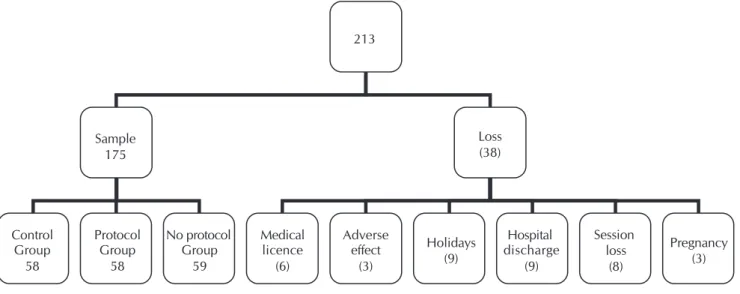
in other energy therapy; not taking anxiety or antidepressant medications; and not being pregnant. After exclusions, an ini-tial sample of 213 nursing professionals was obtained as pre-sented in the flowchart (Figure 1).
Data collection: Data collection instruments were: Vascon-celos’ Stress Symptoms List (VSSL) for the sample, a question-naire with sociodemographic data, diagnostic record of Tradi-tional Chinese Medicine and the SF36v2. Data collection was performed between January and July 2012 in the hospital, and the therapy sessions were carried out by a group composed of six acupuncturists nurses and an acupuncturist psychologist, trained by the same school and the same technique of Chi-nese Auriculotherapy.
Data collection procedures: The SF36v2 was applied at the baseline, after 12 sessions and 30 days after the end (follow-up). Intervention groups received 12 sessions (twice a week), with a duration of 5 to 10 minutes for
each session. The protocol group used the points -
shen-men, brainstem, kidney, liver yang 1 and 2. Shenmen
and brainstem points have soothing properties, kidney point has energy function and yang liver points 1 and 2
have the function to contain the rise of liver yang(9). The
no protocol group received the same number of sessions and points, but selection of the points would depend on the response of the subject to treatment. For the place-ment of semi-permanent needles, after reactive points were properly located, we proceeded to the cleaning of the ear with cotton and 70% ethyl alcohol and applica-tion of needles affixed with micropore tape.
Legal ethical-aspects: The development of the study fol-lowed the national and international standards of ethics in research involving human subjects and the requirements of Resolution n.196/96 of the National Health Council. It was approved by the Research Ethics Committee of the School of Nursing, University of Sao Paulo, protocol n.1042/2011 and by the Samaritan Hospital REC.
Data-analysis: Data were analyzed using SPSS 19.0, ANO-VA for repeated measures and Tukey’s test.
RESULTS
The average age of the group of 175 participants was 33.98 years (SD=7.85), with a minimum age of 21 years and a maxi-mum of 58 years. The average of stress at baseline was 61.48 (SD=20.53) corresponding to high level of stress. There were 161 subjects (92%) who were female, 93 (53.1%) nursing technicians, 82 (46.9%) nurses, 124 (70.9%) people without self-reported comorbidities, 51 (29.1%) with prior self-report-ed morbidities, 79 (45%) allocate to morning shifts, 37 (21%) allocated to afternoon shifts, 40 (23%) allocated to evening shifts and 19 (10.9%) with varied schedules.
The Cronbach’s alpha for VSSL1 was 0.918; the VSSL2 0.947 and VSSL3 was 0.955. Table 1 describes the averages and standard deviation levels of stress according to three dif-ferent groups (Table 1).
In the analysis of variance for repeated measures there were significant statistical differences between the average stress, in the second evaluation after 12 sessions (VSSL2) (F=21.92/ p=0.000) and in the follow-up of 30 days (F=7.59/0=0.001). In Tukey post hoc test we observed that, in the second evalua-tion (VSSL2), the differences were between the control group and the two intervention groups (p=0.000). And in the third evaluation (VSSL3), the differences were between the control and protocol group (p=0.004) and between the control and no protocol group (p=0.002) (Figure 2).
When assessing the effect size from the Cohen’ d index, we observed that no protocol group reached the best result index of 1.15, which is equivalent to the classification “very large ef-fect”, with great reduced levels of stress (36%) post-treatment (moment 2). The protocol group found an index of 0.79 (large effect) post-treatment, with medium reduction of stress levels (27%). Both groups were able to maintain the positive results 213
Sample 175
Loss (38)
Medical licence
(6)
Adverse effect
(3)
Holidays (9)
Hospital discharge
(9)
Session loss
(8)
Pregnancy (3) Control
Group 58
Protocol Group
58
No protocol Group
59
in the follow-up. The group without protocol remained at 0.77 (large effect) with an average stress reduction (27%). The pro-tocol group was able to maintain an index of 0.62 (medium effect), with medium reduction of stress percentage (22%).
Regarding SF36v2, Cronbach’s alpha in the first evaluation was 0.737. As the data at baseline in the physical domain were statistically different from each other (p=0.047) and the differ-ence was between the intervention with or without protocol (p=0.038), it was decided to perform statistical analysis from
the average difference found in 3 moments. Thus, the statistical analysis of average differences between moments 2-1 and 3-1. In ANOVA significant differences were found for average dif-ferences in physical domains between moments 3-1 (F=4.996/ p=0.008). In Tukey post hoc test, we found that the difference was between no protocol/control group. Therefore, to reduce physical symptoms in SF36v2, the individualized treatment in the no protocol group was effective, with a Cohens’ d index of 0.37, equivalent to a small effect. The results for the SF36v2 physical domain were 6% improvement in the group without protocol and 4% for the control group. Figures 3 and 4 illus-trate the evolution of physical and mental symptoms of SF36v2.
Significant differences were found for the averages of mental domain in the assessment of post-treatment, with significance at p=0.004. Conducting Tukey post hoc test, we showed that the difference was between the protocol/ control groups (p=0.033) and between no protocol/control groups (p=0.033). There was a statistically significant differ-ence between averages of the groups no protocol/control with Cohens’ d index 0.72 (Medium effect), corresponding to 17% improvement and for the protocol group, an index of 0.57 (Medium effect), equivalent to 15% improvement.
The most used auricular points in no protocol group repeated the points of the
Table 1 - Average and standard deviation of the stress levels in 3 moments. according to the 3 groups. São Paulo. 2012
N Average Standard
deviation
95% Confidence Interval
Minimum Maximum
VSSL1
1 58 57.76 17.64 53.12 62.40
2 58 62.26 21.50 56.61 67.91
3 59 65.00 22.62 59.11 70.89
Total 175 61.69 20.80 58.59 64.80
VSSL2
1 58 65.38 22.49 59.47 71.29
2 58 45.47* 21.53 39.81 51.13
3 59 41.41* 18.58 36.56 46.25
Total 175 50.70 23.30 47.22 54.17
VSSL3
1 58 63.21 26.85 56.15 70.27
2 58 48.50* 22.90 42.48 54.52
3 59 47.22* 23.87 41.00 53.44
Total 175 52.94 25.51 49.14 56.75
*significance of p <0.05 for the average stress levels of intervention groups compared to the control.
30 35 40 45 50 55 60 65 70
LSS1 LSS2 LSS3
Control Protocol No protocol
* **
Figure 2 - Changes in stress levels in 3 moments for the 3 groups, Sao Paulo, 2012
Regarding previous studies, the results were better in the no protocol group, the effect size for individuals with higher levels of stress when compared to the study conducted at the teaching
hospi-tal(8). Although the protocol is an
impor-tant step in the performance of scientific research, the rigid standards do not al-ways seem to be in line with the holistic perspective of classic Eastern practices. Scientific research can prove, in part, the effectiveness of auricular points, but does not seem to represent acupuncture
as it has been practiced for millennia(17).
This study was able to show the supe-riority of the effect size in response to the group of individualized care during six weeks of treatment, although these results were statistically the same as the protocol group. It is not clear whether this difference would be greater if treat-ment was extended for a longer time. It is suggested, therefore, that longitudinal studies are conducted so that they can evaluate the effect of individual auricu-lotherapy treatment, especially in peo-ple with higher stress levels.
As for SF36V2 instrument, it was found that the protocol was sufficient to improve the mental domain levels, as auricular points were indicated for the control of psychological and emotional
disorders. The shenmen and brainstem
points are indicated to reduce symptoms of anxiety, stress and other psychological
symptoms associated(14). The liver yang
points 1 and 2 are indicated to decrease the liver yang rising, considered a com-mon standard to emotional imbalance of stress, and the Kidney point is ener-getic and invigorating function according to Chinese medi-cine. However, the individualized treatment without protocol group was able to cover the physical and emotional symptoms of the subjects, as there was freedom of choice of five points during the course of the research, from diagnostics of the Tra-ditional Chinese Medicine. Most points used were the same as the protocol, although in order and different moments, the stomach and spleen points were added, which are points for
the treatment of gastric and intestinal disorders(9) and points
of musculoskeletal pain. Among some physical symptoms re-ported by Vasconcelos’ Stress Symptoms List are back pain and headache, associated with stressful situations.
Four aspects make up the physical domain of SF36v2: Func-tional Capacity, Pain, Physical and General Health Aspects. Acupuncture and auriculotherapy have been widely specified and used to reduce musculoskeletal pain and improve func-tional capacity. Studies of pain in nursing staff have been done
protocol group: shenmen (100%), kidney (96.6%), brainstem
(93.2%), liver yang 1 (83.1%), liver yang 2 (79.7%). Other points were also used frequently: stomach (96.6%), spleen (71.2%), liver (35.6%), endocrine (30.5%), lung (28.8%), apex (28,8%), cervical (27.1%) and lumbar (23.7%). There-fore, except for the auricular points of the stomach and spleen, which obtained higher prevalence of use, the five points of the protocol were, in fact, the common points of the two groups.
DISCUSSION
This study used a 5-point protocol and some of these points had already been used in other studies. These points showed to be effective for stress in 41 ICU nursing staff members using
semi-permanent needles(15); in 75 nursing staff of a teaching
hospital with seeds and needles(8); for anxiety and stress, in 71
technical vocational nursing students with needles(16).
Figure 3 - Averages of physical symptoms (PS) from SF36v2, according to 3 groups, Sao Paulo, 2012
Significance of p<0.05 in 3-1 difference between control and no protocol for the physical domain (PS). 42
43 44 45 46 47 48 49 50 51 52
SF1 SF2 SF3
*
Control Protocol No protocol
34 36 38 40 42 44 46
SM1 SM2 SM3
*
Control Protocol No protocol
Figure 4 - Averages of mental symptoms (MS) from SF36v2, according to 3 groups, Sao Paulo, 2012
regarding the impact of this problem on the quality of life of these professionals. In this context, a cross-sectional study was conducted with nursing staff to assess the prevalence of mus-culoskeletal pain and the correlation with quality of life. It was found that the prevalence of pain was found in 91.81%. Re-garding the anatomical regions, there was prevalence of neck pain (56%) and shoulders (56%). As reason for sick leave due to musculoskeletal pain, the main complaint was low back pain (34%). The group that did not report musculoskeletal pain showed better quality of life index in functional capacity, physical aspects, pain, vitality, social functioning and mental health(18).
As for the effectiveness of auricular acupuncture for the control of pain, a systematic review and meta-analysis includ-ed 17 clinical trials in English, eight for perioperative, four for acute pain and five for chronic pain, which used sham au-riculotherapy, placebo, control or medication use for pain. It was found that the auriculotherapy group was better than the control group when evaluating the reduction of pain intensity, managing to reduce the need for analgesics in the periopera-tive period. It has been shown effecperiopera-tive in the treatment of
various types of pain, even for postoperative pain(19).
The acupuncture or auriculotherapy points present electri-cal, histological and physiological implications since the ear has a particular structural profile with a rich vascular network and specific neurovascular bundles. Therefore, two facts seem to explain the use of the ear to diagnose and treatment: its peripheral innervation and possible interference of different central nerve sensory fibers originated in the brain stem and thalamus. When the ear is stimulated, for example, by an acu-puncture needle, seeds or heating, the stimuli are recorded by sensory receptors in the skin of the ear. The impulse is fed into the central nervous system, the brain. The stimulus in the right ear goes to the left half of the brain, because the nerve path goes through the white matter of the brain. For systemic acupuncture, neurophysiological evidence of the technique and its inhibitory action on pain, much deeper than auricular acupuncture has been studied. But certain points on the body and ear are both associated with the release of endorphins and enkephalins. The studies that have been done suggest that stimulation of auricular points can lead to elevation of the pain threshold at specific locations, however, the somatosen-sory points interrelation of the ear with specific brain regions
needs to be further investigated(9). The same question may
ex-tend to the effects of emotion and changes in cortisol levels, the hormone related to stress.
This study aimed to bring scientific research closer to clini-cal practice, without disfiguration and mischaracterization of the Chinese auriculotherapy and its theoretical rules, so that the results could minimally reflect the conditions under which these therapies are usually held. There is large complexity of performing a treatment in Chinese Medicine, with multiple di-agnostic possibilities of energy imbalance and the individual aspects of each patient must be carefully observed in every-day practice. This reality sometimes conflicts with scientific research that advocates the fundamental usage of closed
pro-tocols in randomized clinical trials(20).
The main contribution of this trial was to bring Chinese Auriculotherapy and Nursing to the scientific research field, proving, through evidence, the benefits that a relatively sim-ple, fast, safe and inexpensive technique can bring to the improvement of the nursing staff quality of life by reducing levels of stress, promoting health and preventing diseases. Thus, such benefits can be extended to patients and that au-riculotherapy should be recognized as a practice that can be complementary to nursing care. It is also intended that the findings of this research can contribute with the discussions on the relevance of the use of individualized treatments in Chinese auriculotherapy scientific research, so that the results reflect clinical practice findings more closely, commonly per-formed by acupuncturists professionals.
An important limitation of the study was the time of treat-ment. We suggest longitudinal studies to evaluate the long-term effects of the protocol and individualized auriculothera-py (no protocol) to improve quality of life and to reduce stress of nursing professionals.
CONCLUSION
The results of this research revealed the efficacy of Chinese auriculotherapy with better results for individualized treat-ment (no protocol group) compared to protocol treattreat-ment. Thus, obtaining higher percentage and larger effect size index for the improvement of quality of life and reduction of stress, both in physical and mental aspects. The main points chosen for the no protocol group were practically the same for the protocol framework, adding stomach and spleen points and musculoskeletal pain points for the symptoms reported during the research. It was concluded that the individualized treat-ment, when compared to the use of closed protocol points can extend the reach of Chinese auriculotherapy decreasing stress levels and improving quality of life in nursing staff.
REFERENCES
1. World Health Organization. Mental health: evidence and resear-ch department of mental health and substance dependence [In-ternet]. Geneva: WHO; 2012 [cited 2014 November 01]. Avai-lable from: http://apps.who.int/iris/bitstream/10665/77776/1/ WHO_MSD_MER_Rev.2012.03_eng.pdf?ua=1
3. Daubermann DC, Tonete VLP. Quality of work life of nurs-es in primary health care. Acta Paul Enferm [Internet]. 2012 [cited 2014 November 01];25(2):277-83. Available from: http://www.scielo.br/pdf/ape/v25n2/en_a19v25n2.pdf 4. Amaral RA, Moraes CW, Ostermann GT. Taking care of
who takes care: employees of a General Hospital. Rev SBPH. 2010;13(2):270-81.
5. Sadir MA, Bignotto MM, Lipp MEN.Stress and quality of life: the influence of some personal variables. Paidéia (Ri-beirão Preto). 2010 [cited 2014 November 01];20(45):73-81. Available from: http://www.scielo.br/scielo.php?pid= S0103-863X2010000100010&script=sci_arttext
6. Lorenz VR, Benatti MCC,Sabino MO. Burnout and stress among nurses in a University Tertiary Hospital.Rev Lati-noam Enferm. 2010;18(6):1084-91.
7. Machado MH, Vieira ALS, Oliveira E. Construindo o perfil da enfermagem. Enferm Foco (Brasília) [Internet] .2012 [acesso em 01 de novembro de 2014];3(3):119-22. Disponível em: file:///C:/Users/Cliente/Downloads/294-679-1-SM.pdf 8. Kurebayashi LFS, Gnatta JR, Borges TP, Belisse G, Coca
S, Minami A, et al. The applicability of auriculotherapy with needles or seeds to reduce stress in nursing profes-sionals. Rev Esc Enferm USP [Internet]. 2012 [cited 2014 November 01];46(1):89-95. Available from: http://www. scielo.br/pdf/reeusp/v46n1/en_v46n1a12.pdf
9. Landgren K. Ear acupuncture: a practical guide. Philadel-phia (US); Churchill Livingstone; 2008.
10. Ware JE Jr. SF-36 health survey update. Spine (Phila Pa 1976) [Internet]. 2000 [cited 2011 February 06];25(24):3130-9. Available from: http://www.ncbi.nlm.nih.gov/pubmed/1112 4729
11. Ciconelli RM, Ferraz MB, Santos W, Meinão I, Quares-ma MR. Brazilian-Portuguese version of the SF-36. A reliable and valid quality of life outcome measure. Rev Bras Reumatol [Internet].1999 [cited 2014 November 01];39(3):143-50. Available from: http://bases.bireme.br/ cgi-bin/wxislind.exe/iah/online/?IsisScript=iah/iah.xis&n extAction=lnk&base=LILACS&exprSearch=296502&in dexSearch=ID&lang=p
12. Conselho Federal de Enfermagem (BR). Resolução 197/1997. Estabelece e reconhece as terapias alternati-vas como especialidade e/ou qualificação do profissional de Enfermagem [Internet]. Diário Oficial da União 1997 [acesso em 12 de fevereiro de 2015]. Disponível em: http:// www.cofen.gov.br/resoluo-cofen-1971997_4253.html 13. Ministério da Saúde (BR). Portaria n.º 971, de 03 de maio
de 2006. Aprova a Política Nacional de Práticas Integrati-vas e Complementares (PNPIC) no Sistema Único de Saú-de. Diário Oficial da União 4 maio 2006;Seção 1. 14. Ferreira EAG, Marques AP, Matsutani LA, Vasconcellos
EG, Mendonça LLF. Assessment of pain and stress in fi-bromyalgia patients. Rev Bras Reumatol [Internet]. 2002 [cited 2014 November 01];42(2):104-10. Available from: http://medicina.fm.usp.br/fofito/fisio/pessoal/amelia/arti-gos/estressefm.pdf
15. Giaponesi ANL; Leão ER. A auriculoterapia como in-tervenção para redução do estresse da equipe de en-fermagem em terapia intensiva. Nursing (São Paulo). 2009;12(139):575-9.
16. Prado JM, Kurebayashi LFS, Silva MJP. Efficacy of au-riculotherapy for the reduction of stress in nursing stu-dents: a randomized clinical trial. Rev Latinoam Enferm. 2012;20(4):727-35.
17. Kurebayashi LFS, Freitas GF. Acupuntura multiprofissio-nal: aspectos éticos e legais. Barueri (SP): Yendis; 2011. 18. Vidor CR, Mahmud MAI, Farias LF, Silva CA, Ferrari JN,
Comel JC, et al. Prevalence of musculoskeletal pain among surgical nursing teams. Acta Fisiatr [Internet]. 2014 [cited 2014 November 01];21(1):6-10. Available from: file:///C:/ Users/Cliente/Downloads/en_v21n1a02%20(1).pdf 19. Asher GN, Jonas DE, Coeytaux RR, Reilly AC, Loh YL,
Mots-inger-Reif AA, Winham SJ. Auriculotherapy for pain manage-ment: a systematic review and meta-analysis of randomized controlled trials. J Altern Complement Med [Internet]. 2010 [cited 2014 November 01];16(10):1097-108. Available from: http://www.ncbi.nlm.nih.gov/pubmed/20954963 20. Birch SJ, Felt RL. O que é acupuntura. In: Entendendo a