1
Undergraduat e st udent , Universit y of São Paulo at Ribeirão Pret o, College of Nursing, WHO Collaborat ing Cent er for Nursing Research Developm ent , Brazil, Undergraduat e Research Scholarship from CNPq, em ail: [email protected] .br; 2 Nurse, Hospit al das Clínicas, Medical School, Universit y of São Paulo at Ribeirão Pret o, Brazil; 3 Nurse, PhD, Professor, e- m ail: am [email protected]; 4 Nurse, Full Professor, e- m ail: [email protected]. Universit y of São Paulo at Ribeirão Pret o, College of Nursing, WHO Collaborat ing Cent er for Nursing Research Developm ent , Brazil
Disponible en castellano/ Disponível em língua portuguesa SciELO Brasil w w w .scielo.br/ rlae
MEDI CATI ON PREPARATI ON AND ADMI NI STRATI ON: ANALYSI S OF I NQUI RI ES AND
I NFORMATI ON BY THE NURSI NG TEAM
Daniela Odnicki da Silv a1 Cr is Renat a Gr ou2 Adr iana I nocent i Miasso3 Sílv ia Helena De Bor t oli Cassiani4
Silv a DO, Gr ou CR, Miasso AI , Cassiani SHB. Medicat ion pr epar at ion and adm inist r at ion: analy sis of inquir ies and infor m at ion by t he nur sing t eam . Rev Lat ino- am Enfer m agem 2007 set em br o- out ubr o; 15( 5) : 1010- 7.
This study analyzed questions presented by nursing technicians and auxiliaries during m edication preparation and adm inistration. Data were collected through a form in which nurses who worked in the hospitalization unit of a general hospit al in São Paulo, Brazil, were asked t o t ake not es of any quest ions asked t o t hem . Most of t he 255 quest ions were relat ed t o m edicat ion dilut ion ( 103) . Regarding t he answers source, only 7.5% of answers were obt ained fr om phar m aceut ical pr ofessionals, 35. 5% of t he answ er s giv en by nur ses w as incor r ect or par t ially correct , which can const it ut e a fact or for m edicat ion adm inist rat ion errors. I n addit ion, t here are no pharm acist s present in hospitalization units of Brazilian hospitals. These professionals could, j ointly with nurses, facilitate m edication orient at ion t o nursing professionals during preparat ion and adm inist rat ion, as well as t o pat ient s t hem selves.
DESCRI PTORS: m edicat ion sy st em s; safet y m anagem en t ; m edicat ion er r or s
PREPARACI ÓN Y ADMI NI STRACI ÓN DE MEDI CAMENTOS: ANÁLI SI S DE
CUESTI ONAMI ENTOS E I NFORMACI ONES DEL EQUI PO DE ENFERMERÍ A
Est e est udio analizó las pregunt as present adas por t écnicos y auxiliares de enferm ería a los enferm eros durante la preparación y adm inistración de m edicam entos. Para recopilar los datos, se utilizó un form ulario entregue a los enferm eros de unidades de int ernación de un hospit al general del int erior del Est ado de São Paulo, Brasil, solicit ando que anot ar an las dudas que r ecibier an. La m ay or ía de las 255 pr egunt as est aba r elacionada a la disolución del m edicam ento ( 103) . Respecto a las respuestas, solam ente el 7,5% de estas fue obtenido a través de los profesionales de la farm acia. Se dest aca que el 35,5% de las respuest as em it idas por los enferm eros est aban incor r ect as o par cialm ent e cor r ect as, lo que puede const it uir un fact or par a er r or es en la adm inist r ación de m edicam ent os. Adem ás, no ex ist en far m acéut icos en las unidades de int er nación en los hospit ales br asileños. Estos podrían, en conj unto con los enferm eros, facilitar la orientación de los profesionales de enferm ería en cuanto a los m edicam ent os, en el m om ent o de su preparación y adm inist ración, y t am bién de los propios pacient es.
DESCRI PTORES: sist em as de m edicación; adm inist r ación de la segur idad; er r or es de m edicación
PREPARO E ADMI NI STRAÇÃO DE MEDI CAMENTOS: ANÁLI SE DE QUESTI ONAMENTOS E
I NFORMAÇÕES DA EQUI PE DE ENFERMAGEM
Est e est udo analisou os quest ionam ent os apr esent ados por t écnicos e aux iliar es de enfer m agem aos enferm eiros durant e o preparo e adm inist ração de m edicam ent os. Para colet a dos dados ut ilizou- se um form ulário ent r egue aos enfer m eir os de unidades de int er nação de um hospit al ger al do int er ior paulist a, solicit ando que an ot assem as d ú v id as d os p r of ission ais d a eq u ip e q u e lh e f ossem en d er eçad as. For am r eg ist r ad os p elos enfer m eir os 255 quest ionam ent os sendo que a m aior ia dest es est av a r elacionada à diluição do m edicam ent o ( 103) . Com relação às respost as dos enferm eiros às dúvidas, som ent e 7,5% dest as foram obt idas at ravés dos pr ofissionais da far m ácia. Ressalt a- se que 35,5% das r espost as em it idas pelos enfer m eir os est avam incor r et as ou par cialm ent e cor r et as podendo const it uir fat or par a er r os na adm inist r ação de m edicam ent os. Som ado a ist o, inexist em farm acêut icos nas unidades de int ernação nos hospit ais brasileiros, os quais poderiam , j unt am ent e com o enferm eiro, facilit ar a orient ação dos profissionais de enferm agem quant o aos m edicam ent os, no m om ent o do pr epar o e adm inist r ação dos m esm os, bem com o ao pr ópr io pacient e.
I NTRODUCTI ON
A
st udy carried out at 36 Am erican hospit alinst it ut ions dem onst r at ed t hat pot ent ially danger ous
er r or s occur m or e t han 40 t im es per day at a
300-bed h ospit al an d t h at , on t h e av er age, a pat ien t is
su b j ect t o t w o er r or s p er d ay( 1 ). Accor d in g t o t h e
Ag en cy f or Healt h car e Resear ch an d Qu alit y, m or e
t han 770, 000 hospit alized pat ient s suffer som e k ind
of d am ag e or d eat h ev er y y ear d u e t o an ad v er se
m edicat ion ev ent( 2 ).
I n Brazil, t he nursing t eam is responsible for
and car r ies out m edicat ion adm inist r at ion on a daily
basis at all healt h inst it ut ions. Therefore, t his act ivit y
is v er y im p or t an t f or t h is p r of ession al cat eg or y as
well as for t he client s. Nursing professionals’ pract ice
e v i d e n c e s s e v e r a l d o u b t s d u r i n g m e d i c a t i o n
p r e p a r a t i o n a n d a d m i n i s t r a t i o n . Th i s f a c t c a l l s
at t en t ion t o t h e im p or t an ce of t h e q u alit y of car e
delivery, t o t he need for scient ific research about t his
t hem e and t o a pr oblem t hat deser v es int er v ent ions
by healt h inst it ut ions.
Wr on gly adm in ist er ed m edicat ion can h ar m
t h e c l i e n t d u e t o f a c t o r s l i k e p h a r m a c o l o g i c a l
i n c o m p a t i b i l i t y, u n w a n t e d r e a c t i o n s a n d
p h a r m a c o l o g i c a l i n t e r a c t i o n s , a m o n g o t h e r s .
Pr ofessionals w ho adm inist er m edicat ion need t o be
aw ar e and sur e of t heir act ions and hav e k now ledge
a b o u t o r a c c e s s t o t h e n e c e s s a r y i n f o r m a t i o n .
I n cor r ect ly clar if ied d ou b t s an d d if f icu lt ies lead t o
u n c e r t a i n t y a n d i n s e c u r i t y, a n d t h i s s i t u a t i o n
r epr esent s a r isk fact or for t he occur r ence of er r or s
i n t h e m e d i ca t i o n a d m i n i st r a t i o n p r o ce ss. Th e se
asp ect s ev id en ce t h e n eed f or n u r ses t o su p er v ise
nur sing act iv it ies dur ing m edicat ion pr epar at ion and
adm inist r at ion, as t hey ar e t he only pr ofessionals in
t h e n u r sin g t eam w h ose ed u cat ion sh ou ld in clu d e
sufficient k now ledge t o conduct t his pract ice safely.
The great er t he nurses’ knowledge about t he
dr ugs t hey adm inist er, t he gr eat er t heir sk ills w ill be
t o d ev elop t h e m ed icat ion ad m in ist r at ion act iv it y3.
How ev er, d aily p r act ice h as b een sh ow in g an ot h er
r e a l i t y, a s t h e p r o f e ssi o n a l s d o n o t a l w a y s h a v e
sufficient k now ledge t o assum e t his r esponsibilit y. I n
t h i s r e sp e ct , a r e se a r ch4 a b o u t h o sp i t a l n u r se s’
k now ledge on specific dr ugs ident ified t hat 79.2% of
t h e i n t e r v i e w e d n u r s e s c o n s i d e r e d t h a t t h e
p h ar m acolog y su b j ect t h ey t ook w as n ot su f f icien t
f o r p r o f essi o n a l p r a ct i ce a n d 9 6 . 2 % i n f o r m ed a n
unsat isfact or y r elat ion bet w een t heor y and pr act ice.
Th i s f a ct e v i d e n ce s t h e r e l a t i o n b e t w e e n l a ck o f
k n o w l e d g e a n d t h e p r o b l e m o f m e d i c a t i o n
adm in ist r at ion er r or s.
Th u s , i t i s f u n d a m e n t a l f o r n u r s i n g
pr ofessionals t o k now about t he differ ent aspect s of
m edicat ion t reat m ent and, in case of doubt s, t o ask a
c o l l e a g u e , a n u r s e s u p e r v i s o r, a p h y s i c i a n o r a
phar m acist fr om t he hospit al phar m acy. Mor eov er, at
healt h inst it ut ions, updat ed infor m at ion needs t o be
a v a i l a b l e a b o u t d i f f e r e n t a s p e c t s o f m e d i c a t i o n
t h er a p y.
I n t he cont ext of healt h syst em s, m edicat ion
ad m in ist r at ion p r act ice, or ien t ed t ow ar d s saf e car e
d eliv er y t o p at ien t s, can b e u n d er st ood w it h in an
ecological approach. I n t his approach, healt h syst em s
ar e con sid er ed liv in g , t ech n olog ically com p lex an d
in cr easin g ly v u ln er ab le sy st em s, n eed in g f ix in g or
“ ecological r est orat ion”. Hence, ecological r est orat ion
is n eed ed t o st r en g t h en t h e saf et y of t h e h osp it al
environm ent . Research about pat ient safet y in healt h
sy st em s, w it hin t he ecological per spect iv e, has been
conduct ed in ot her count r ies, including Canada, w it h
a view t o ident ifying vulnerable point s in t he hospit al
en v i r o n m en t an d i n co r p o r at i n g p r act i ces t h at can
s t r e n g t h e n t h e c r e a t i o n o f s a f e s y s t e m s a t a n
appropriat e cost . Thus, ecological t hinking can provide
n ew k n ow ledge in or der t o im pr ov e t h e secu r it y of
healt h sy st em s, offer ing benefit s for pat ient s( 5- 6). To
o b t a i n a s a f e m e d i c a t i o n s y s t e m , a m o n g o t h e r
el em en t s, t h e ex ist en ce of a su f f icien t am ou n t of
qualified hum an resources becom es essent ial, as well
as adequat e physical inst allat ions, financial resources,
equipm ent and devices wit h appropriat e t echnology( 7).
I n v i ew o f t h e a b o v e, t h i s st u d y a i m s t o
ident ify and analy ze t he quest ions nur sing aids and
t echnicians who work at clinical hospit alizat ion, surgical
and int ensive care unit s ask nurses about m edicat ion
preparat ion and adm inist rat ion, as well as t he sources
and precision of t he nurses’ answers t o t he quest ions
pr esent ed by t he t eam .
METHODOLOGY
This is a descriptive and exploratory study. The
theoretical approach that guided the study developm ent
w as Ecological Think ing. This appr oach depar t s fr om
the hypothesis that the principles and techniques of good
ecological r est or at ion can be u sed t o sy st em at ically
security of the current health system( 5- 6). The application
of restoration concepts to patient safety research intends
t o int egr at e t he best for m s of sy st em ic t hink ing int o
cu r r e n t e n g i n e e r i n g sci e n ce s f o r h u m a n f a ct o r s,
organizational sciences and security sciences, with better
skills to “ think like” a system( 8).
Th e st u d y w as car r ied ou t at a u n iv er sit y
h ospit al locat ed in t h e in t er ior of São Pau lo St at e,
Br azi l . Th i s i n st i t u t i o n i s a cen t er o f r ef er r al an d
excellence in healt h care and delivers care of different
co m p l e x i t y l e v e l s a t t h e o u t p a t i e n t , sp e ci a l i z e d
procedure, hospit alizat ion and urgency unit s; including
cl i n i cal an d / or su r g i cal p r ev en t i on , t r eat m en t an d
r ehabilit at ion, besides com plem ent ar y diagnosis and
t r eat m ent ser v ices in differ ent m edical specialt ies. I t
is an aut onom ous ent it y, charact erized as a universit y
hospit al. The inst it ut ion is par t of t he Single Healt h
Sy st em ( SUS) an d it s goals ar e t each in g, r esear ch
an d m edical- h ospit al car e deliv er y.
Th e st u d y w a s ca r r i e d o u t a t a l l cl i n i ca l
h o sp i t a l i za t i o n , su r g i ca l a n d i n t en si v e ca r e u n i t s,
ex cluding out pat ient unit s. Thus, t he follow ing clinics
w e r e i n c l u d e d : m e d i c a l , p s y c h i a t r y, n e u r o l o g y,
im m u n olog y, d er m at olog y, p ed iat r ics, g y n ecolog y /
obst et r ics, adult and pediat r ic int ensiv e car e cent er,
k i d n e y t r a n sp l a n t u n i t , cl i n i ca l su r g e r y ( g e n e r a l ,
pr oct ology, opht halm ology, ot olar y ngology, head and
neck , chest , neur osur ger y, ur ology, vascular sur ger y,
gast r ic sur ger y, or t hopedics and plast ic sur ger y ) .
The st udy populat ion consist ed of t he nur se
su p er v i so r s o f t h ese h o sp i t al i zat i o n u n i t s an d t h e
sam ple included all nur ses w ho w er e w or k ing dur ing
t h e dat a collect ion per iod, ex cept for : pr ofession als
on holiday, m edical leave, t raining, not direct ly act ive
in pat ient car e and t hose w ho m anifest ed t hat t hey
were not int erest ed in part icipat ing or did not sign t he
consent t er m .
Dat a collect ion st art ed in t he second sem est er
of 2 0 0 4 , soon aft er t h e pr oj ect h ad been appr ov ed
b y t h e Re se a r ch Et h i cs Co m m i t t e e a t t h e st u d y
hospit al, during 30 consecut ive days. The nurses were
asked t o writ e down t he doubt s present ed by nursing
aids and t echnicians, relat ed t o m edicat ion preparat ion
and adm inist r at ion, in a dat a collect ion inst r um ent .
Th er ef o r e, t h ey r ecei v ed a f o r m w i t h t h e
following it em s: dat e, clinic, doubt s expressed by t he
n u r sin g aids an d t ech n ician s, r elat ed t o m edicat ion
t h er a p y, em p loy ee’s p r of ession al cat eg or y, an sw er
given t o clarify t he doubt and source t his inform at ion
w as obt ained fr om .
During one m ont h, every day, t he researchers
delivered t he form t o t he nurse in each shift , at each clin ic, set t in g a dat e t o r et u r n t h e com plet ed for m .
Th e n u r ses w h o ag r eed t o p ar t icip at e in t h e st u d y
w er e ask ed t o sign t h e Fr ee an d I n for m ed Con sen t
Ter m .
Th e o b t a i n e d d a t a w e r e i n s e r t e d i n a
dat abase, st ruct ured as an EXCEL worksheet , and t hen
t ransport ed for analysis in St at ist ical Package for t he Social Science soft w ar e ( SPSS, v er sion 1 1 . 5 ) .
RESULTS
The subj ect s’ wrot e down 270 quest ions, 255
of which were analyzed. I t was int erest ing t o observe t h at b ot h n u r sin g ( n u r ses f r om ot h er sect or s) an d
m edical colleagues asked t hese nurses for inform at ion
abou t m edicat ion t h er ap y. I t is h igh ligh t ed t h at all q u est ion s w er e p r esen t ed b y aid s an d t ech n ician s,
ex cept for nine, in w hich m edical t eam pr ofessionals
asked t he part icipant s, five in which ot her nurses asked t h e se q u e st i o n s a n d o n e si t u a t i o n i n w h i ch t h e
book k eeper ex pr essed t he doubt . Thus, in t ot al, 255
dou bt s w er e an aly zed.
Due t o t he large num ber and wide range, for t h e sa k e o f co n t e n t a n a l y si s, i t w a s co n si d e r e d
necessary t o cat egorize t he quest ions, wit h a view t o
facilit at ing t he underst anding of t heir m eanings. These cat egories covered t he following aspect s, in alphabet ic
or der : m edicat ion act ion; m edicat ion adm inist r at ion;
m edicat ion calculat ion; pat ient condit ions; m edicat ion dilu t ion ; m edicat ion in dicat ion ; m edicat ion in fu sion ;
dr ug int er act ion; gener ic or br and nam e; m edicat ion
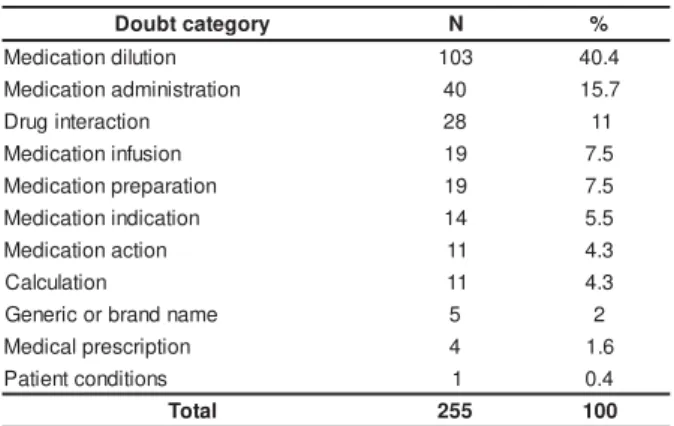
pr eparat ion and m edical pr escr ipt ion. Table 1 below
pr esen t s t h e cat egor ies of dou bt s pr esen t ed t o t h e nur se, t he num ber and per cent age fr equency.
Table 1 - Frequency dist ribut ion of quest ion cat egories pr esent ed t o nur ses. Ribeir ão Pr et o, SP, 2004
y r o g e t a c t b u o
D N %
n o it u li d n o it a c i d e
M 103 40.4
n o it a r t s i n i m d a n o it a c i d e
M 40 15.7
n o it c a r e t n i g u r
D 28 11
n o i s u f n i n o it a c i d e
M 19 7.5
n o it a r a p e r p n o it a c i d e
M 19 7.5
n o it a c i d n i n o it a c i d e
M 14 5.5
n o it c a n o it a c i d e
M 11 4.3
n o it a l u c l a
C 11 4.3
e m a n d n a r b r o c i r e n e
G 5 2
n o it p i r c s e r p l a c i d e
M 4 1.6
s n o it i d n o c t n e it a
P 1 0.4
l a t o
Th e m e d i c a t i o n d i l u t i o n c a t e g o r y, responsible for about 40% of doubt s, j oined quest ions
relat ed t o t he need for dilut ion and what dilut ing agent
sh ou ld b e u sed , t o t h e q u an t it y an d ex p ir y of t h e
d i l u t e d m e d i c a t i o n a n d t o t h e p o s s i b i l i t y o f
pr ecipit at ion . Ex am ples ar e:
Does ph en y t oin h av e t o be dilu t ed?; w h ich
dilut ing agent and w hat quant it y has t o be used t o
d ilu t e m ax cef ?; can d iazep am EV p r ecip it at e w h en
dilut ed?; can I dilut e an ant ibiot ic t hat alr eady cam e
fr om t he phar m acy dilut ed?; olanzapine com es in a
wrapping prot ect ed from light , when I adm inist er half
a t ablet , can I k eep t he ot her half unt il nex t t im e?;
w hat is t he st abilit y of m or phine aft er dilut ion?; how
can I dilut e am phot er icin B?
As show n in Table 1, a higher percent age of
doubt s is r elat ed w it h m edicat ion dilut ion.
Th e m e d ica t ion a d m in ist r a t ion cat eg or y
g r o u p s q u e s t i o n s r e l a t e d t o f l u i d s f o r o r a l
adm inist rat ion, t o t he adm inist rat ion t echnique, rout e
and t im e. St at em ent s include:
Medicat ion should be adm inist er ed w it h m ilk
or w at er ?, in w h at sit es can I adm in ist er h epar in ?;
can p er m et h r in b e ap p lied all ov er t h e b od y ?; can
r eglan also m e adm inist er ed I M?; phener gan: can it
be applied EV?; is prost igm in applied EV or I M? How
can I M m edicat ion be adm inist ered in t he vent roglut eal
r egion ?; can h epar in be adm in ist er ed I M?; can t h e
sam e h epar in t h at is applied EV be applied SC?; is
t he st art of t he act ion t im e t he sam e for t he SC and
EV rout es?; can phenyt oin be applied I M?; how can I
apply NPH and regular SC insulin at t he sam e t im e?
The t opic dr u g in t e r a ct ion j oined inquir ies
about t he int eract ion bet ween drugs and serum , ot her
d r u g s an d b lood d er iv at iv es. Th e f ollow in g can b e
m en t ion ed :
Can hem otherapy run with other serum s in Y?;
can I m ix anxiolyt ics and ant ipsychot ic m edicat ion in
the sam e application in the sam e site?; can I associate
NPH w i t h r e g u l a r i n su l i n ?; ca n I i n f u se so d i u m
bicarbonat e in a rout e where various drugs are being
infused?; can I adm inister parenteral Nutrition in Y with
ot her drugs?; can dopam ine run t oget her wit h serum
and elect rolyt es?; does heparin in cont inuous infusion
precipitate if it runs together with dorm onid and fentanyl?
The m e dica t ion in fu sion cat egor y cov er ed quest ions about t he infusion speed of m edicat ion in
t erm s of t im e. Exam ples of t his it em are:
Wh y can ’t clozap in e b e in cr eased f ast er ?;
what is t he m axim um t im e for am phot ericin infusion?;
can an an t i- f u n gu s agen t be in f u sed pu r ely in less
t h a n t h r e e h o u r s?; w h a t i s t h e i n f u si o n t i m e f o r
v a n c o m y c i n 1 g ?; w h a t i s t h e i n f u s i o n s p e e d o f
p h en y t oin ?
Th e m e d i c a t i o n p r e p a r a t i o n c a t e g o r y gr ou ped in qu ir ies abou t ph ot osen sit iv it y, gradu at ion
of sy r in ges an d equ ipm en t . Th e follow in g ex am ples
can be m ent ioned:
Sh ou ld I u se p h ot osen sit iv e eq u ip m en t t o
ad m in ist er am p h ot er icin ?; h ow can I p r ep ar e SF0 ,
4 5 % ?; w h en t w o t y p es of in su lin ar e u sed , w h ich
sh ou ld I aspir e f ir st ?; w h y can som e dr u gs n ot be
i n f u sed i n p l ast i c eq u i p m en t ?; h ow can I p r ep ar e
t i e n a m f o r a d m i n i st r a t i o n ?; h o w ca n I r e a d t h e
graduat ion of an insulin syringe?; how can I t ransform
t he pr escr ibed ser um v olum e t o be infused w it hin a
cer t ain t im e in m l/ hour in an infusion bom b?; can I
rem ove t he air from a syringe wit h enoxaparin before
adm in ist r at ion ?
Th e m e d i c a t i o n i n d i c a t i o n c a t e g o r y ap p r oach es asp ect s r elat ed t o t h e p u r p ose of t h e
m edicat ion . Ex am ples ar e:
What ’s t he purpose of cim et idine?; what ’s t he
pur pose of am it r ipt y line?; w hy is dex am et asone par t
o f t h e QT p r o t o co l ?; w h at d i sease i s l ev ad o p a o r
pr olopa used for ?; w hat ’s t he pur pose of am lodipine
because I ’ve never seen t hat m edicat ion?; AZT is used
for t r eat ing w hich disease?; w hen should t he pat ient
use r egular and int er m ediar y insulin?
Th e cat eg or y m e d ica t ion a ct ion con t ain s
q u e st i o n s r e l a t e d t o t h e e f f e ct s o f t h e d r u g , t o
phar m acological act ion, t o t her apeut ic act ion and t o
adv er se r eact ion s. Ex am ples ar e:
W h y s h o u l d i n j e c t a b l e p h e n e r g a n b e
a d m i n i st er ed i n st ea d o f i n j ect a b l e m i d a zo l a m , I s
r egular insulin fast - act ing?; is t her e a need for st r ict
BP con t r ol w h en t h e pat ien t r eceiv es h igh doses of
cor t icoids?; how does NPH/ Regular I nsulin act in t he
or g an ism ?
M e dica t ion ca lcu la t ion includes quest ions r elat ed t o m at h em at ical calcu lat ion s of m ed icat ion
doses and concent rat ions. Exam ples of t his it em are:
How can I adm inist er 20m g of solu- m edrol if
t he only form is 125m g?; how can I adm inist er 2m g
of r iv ot r il in d r op s? I s t h e d ose of t h is m ed icat ion
( I CU) correct ?; what is t he st andard dose of cisapride?
The t hem e ge n e r ic or br a n d n a m e j oined
inquir ies about m edicat ion nam es. Ex am ples ar e:
Wh at is t h e b r an d n am e of r an it id in e?; is
Fi n a l l y, i n t h e m e d i c a l p r e s c r i p t i o n
ca t e g o r y, q u e st i o n s w e r e g r o u p e d r e l a t e d t o t h e writ ing of t he prescript ion and t he form of t he drug:
How can I adm inist er konakion prescribed EV
i f t h e p h a r m a c y o n l y h a d t h e f o r m f o r I M
a d m i n i st r a t i o n ?; h o w m a n y m g o f n o v a m i n e a r e
p r escr ib ed ?
Th e i t e m p a t i e n t c o n d i t i o n s c o v e r e d q u est i o n s r el at ed t o m ed i cat i o n ad m i n i st r at i o n i n
accordance wit h t he pat ient ’s condit ions, for exam ple:
Th e p a t i e n t i s f a st i n g f o r su r g e r y , ca n I
adm in ist er an t i- depr ession m edicat ion ?
Som e q u est ion s t h e p r of ession als ask ed t o
t he nurses were not lit erally expressed because, when
f illin g ou t t h e f or m s, t h e n u r ses w r ot e dow n t h ese
doubt s as t opics ( drug int eract ion, m edicat ion dilut ion
f or ex am p le) , w h ich w er e t h en cat eg or ized as n ot v a lid ( 4 4 , 1 7 % ) . Hen ce, d o u b t s o r i n q u i r i es t h at l i t e r a l l y e x p r e sse d t h e p r o f e ssi o n a l s’ d o u b t w e r e
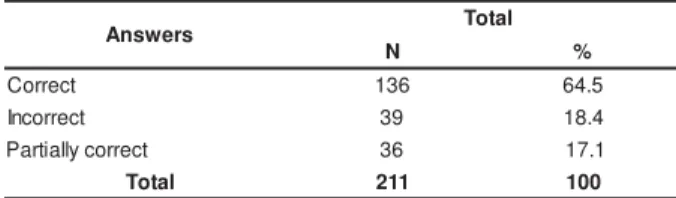
considered as valid ( 211.83% ) . Table 2 present s t he
c o r r e c t n e s s r a t i o o f t h e i n f o r m a t i o n t h e n u r s e s
supplied about t he present ed doubt s, considering valid
q u est ion s.
Table 2 - Correct ness of nurses’ answers t o inquiries.
Ribeir ão Pr et o, SP, 2004
m ent ioning CCI H, t he chem ot herapy cent ral, t he blood
b a n k ; l i t e r a t u r e ( 3 9 . 2 % ) , r e f e r r i n g t o t h e co n su l t at i o n o f n u r si n g an d p h ar m aco l o g y b o o k s,
not ebooks, drug package insert s, elect ronic dict ionary
of p h ar m aceu t ical sp ecialt ies ( DPS) , t h e h osp it al’s
st an d ar d i zat i o n m an u al , t h e u n i t ’s cen t r al v en o u s
cat het er prot ocol, int ernet , subj ect prot ocol, laborat ory
m anual, m edicat ion adm inist r at ion dilut ion guide and
courses, including t raining; m ixed ( 16.5% ) , in w hich
m o r e t h an o n e cat eg o r y w as m en t i o n ed , su ch as
book s and phar m aceut ical pr ofessionals for ex am ple,
phy sician and DPS, pack age inser t and phy sician. I n
23.5% of t he answers, t he source was not m ent ioned.
I n 49.8% of t he sit uat ions, nurses answ ered
t he t eam ’s doubt s based on t heir personal knowledge,
lit erat ure or inform at ion obt ained from colleagues from
ot her areas. I n only 7.5% of t he sit uat ions, t he nurses’
a n sw e r s w e r e b a se d o n i n f o r m a t i o n p r o v i d e d b y
ph ar m acist s, w h ich dem on st r at es t h at n u r sin g does
not ident ify t hem as t he appropriat e professionals for
pr ov iding t his infor m at ion.
DI SCUSSI ON
Com plex sy st em s lik e t h e h ealt h sy st em or
t he m edicat ion sy st em , including differ ent pr ocesses,
im plem ent ed t hrough planning and sequent ial act ions,
involve various professionals w it h dist inct at t ribut ions
an d display com bin at ion s of m u lt iple er r or s t h at by
t hem selv es do not r epr esent a consider able accident
risk. These errors are called lat ent and t heir behavior
varies according t o t he m ut abilit y of t he syst em , which
is an in t r in sic ch ar act er ist ic of t h eir ex ist en ce. Th e
sum of t he act ions ex er t ed by t hese differ ent er r or s
m ay or m ay not result in an accident( 7).
What t he m edicat ion adm inist r at ion pr ocess
i s co n cer n ed , i t ca n b e a f f i r m ed t h a t t h e l a ck o f
k n o w l e d g e a m o n g p r o f e ssi o n a l s i n v o l v e d i n t h i s
pr act ice can r epr esen t an er r or in t h e sy st em t h at
ent ails dam age of different int ensit ies for t he pat ient s.
This st udy evidenced t hat t he largest part of
t h e d o u b t s ( 4 0 . 4 % ) n u r si n g t ech n i ci an s an d ai d s
present ed t o nurses was relat ed t o m edicat ion dilut ion.
I n t h eir act ion s, n u r ses n eed t o r elat ed m edicat ion
d ilu t ion w it h p at ien t asp ect s, su ch as t h e d isease
( p a t i e n t s w i t h k i d n e y f a i l u r e , h y d r o e l e c t r o l y t i c
d i sor d er s, b l ood p r essu r e al t er at i on s) an d ag e. I f
per for m ed effect iv ely, t his assessm ent facilit at es t he
r ecover y pr ocess, as it does not per m it even gr eat er s
r e w s n
A Total
N %
t c e r r o
C 136 64.5
t c e r r o c n
I 39 18.4
t c e r r o c y ll a it r a
P 36 17.1
l a t o
T 211 100
I t sh ou ld b e m en t ion ed t h at an sw er s w er e
c o n s i d e r e d c o r r e c t i f t h e y p r o v i d e d s u f f i c i e n t i n f o r m a t i o n f o r s a f e m e d i c a t i o n a d m i n i s t r a t i o n ;
in cor r e ct if t h ey p r ov id ed in cor r ect in f or m at ion in v iew of t h e p r of ession al’s in q u ir ies, an d p a r t ia lly correct if t hey did not pr ov ide sufficient infor m at ion for t he safe adm inist r at ion of t he r espect iv e dr ug.
Table 2 shows t hat , am ong t he 211 quest ions
considered valid for analysis, 35.5% received incorrect
or part ially correct answers, which m ay have ent ailed
differ ent consequences for t he pat ient and deser v es
t o be analyzed by t he professionals and t he inst it ut ion.
Sou r ces of an sw er s t h e n u r ses gav e t o t h e
n u r sin g aid or t ech n ician w h o pr esen t ed t h e dou bt
in clu ded: m e d ica l p r of e ssion a ls ( 2 . 7 % ) in clu din g r e si d e n t s a n d h i r e d p h y si ci a n s; p h a r m a ce u t i ca l p r o f e ssi o n a l s ( 7 . 5 % ) ; n u r si n g p r o f e ssi o n a l s
h ar m t o or gan s an d sy st em s( 9 ). Mor eov er, it sh ou ld
b e r em i n d ed t h a t m ed i ca t i o n d i l u t i o n a l so v a r i ed
accor ding t o it s adm inist r at ion r out e.
I n v iew of t h e f act t h at ecological t h in k in g
p r e s u p p o s e s a m o r e r i g o r o u s e x p l o r a t i o n o f
t ech n ological aspect s, it is f u n dam en t al t o con sider
t h ei r ef f ect s i n h eal t h car e en v i r o n m en t s. I n t h i s
con t ex t , it is k n ow n t h at m edicat ion sy st em s u sin g
unit - dose t echnology r educe t he num ber of adv er se
m e d i ca t i o n e v e n t s b e ca u se , i n t h i s sy st e m , t h e
m edicat ion r eaches nur sing r eady for adm inist r at ion,
w i t h o u t t h e n e e d f o r f r a c t i o n i n g o r d i l u t i o n f o r
e x a m p l e( 1 0 ). H e n c e , c e n t r a l i z i n g t h e m e d i c a t i o n
pr epar at ion sit e can cont r ibut ion t o t he r educt ion of
m edicat ion er r or s r elat ed t o m edicat ion dilut ion.
Th e p r o f e ssi o n a l s’ d o u b t s r e l a t e d t o t h e
m edicat ion adm in ist r at ion t ech n iqu e also st ood ou t
( 15. 7% ) . Lack of t echnical k now ledge in m edicat ion
a d m i n i st r a t i o n ca n r e su l t i n m o r e o r l e ss se v e r e
com plicat ions. I n t he int ram uscular rout e for exam ple,
it can cause: int ense pain, nerve inj uries, hem at om as,
nodes, t issue necr osis, am ong ot her s( 11).
I n t h e m e d i c a t i o n a d m i n i s t r a t i o n
cat egor y, it w as found t hat m ost doubt s r efer r ed t o
t h e cor r ect r ou t e f or m ed icat ion ad m in ist r at ion . I n
lit er at u r e, r esear ch m en t ion s d eat h s as a r esu lt of
ad m in ist r at ion r ou t e er r or s, w h ose ch oice d ep en d s
on w h at ef f ect t h e ph y sician w an t s an d, h en ce, on
t h e pr escr ipt ion . Lit er at u r e r epor t s on t h e deat h of
eigh t pat ien t s, w h o r eceiv ed en dov en ou s in st ead of
oral m edicat ion, as prescribed( 12). Probable causes t hat
facilit at e t he occur r ence of r out e er r or s include: lack
of at t en t ion , lack of k n ow ledge, lack of ex per ien ce,
n eg lig en ce an d / or im p r u d en ce ( in com p let e r ead in g
of t h e pr escr ipt ion ) , am on g ot h er s. How ev er, in an
ecological appr oach, or ganizat ional condit ions r elat ed
t o t he sy st em m ust be t ak en int o account , such as:
act iv it y ov er load, in su fficien t n u m ber of em ploy ees,
i n a p p r o p r i a t e w o r k e n v i r o n m e n t a n d u n r e a d a b l e
m edical prescript ion( 13- 14). Thus, t he proposal is t o work
i n o r d e r t o i m p r o v e i n t e r n a l p r o c e s s e s a n d t h e
st ruct ure, as t his is of considerable im port ance in t he
occu r r en ce of er r or s.
Wh at q u est ion s ab ou t d r u g in t er act ion s is
c o n c e r n e d , t h e s e w e r e m a i n l y d i r e c t e d a t t h e
possibilit y of infusing t w o dr ugs at t he sam e t im e in
o n e a n d t h e sa m e v e n i p u n ct u r e . I n a st u d y o n
m e d i c a t i o n e r r o r s , c l i n i c a l l y s i g n i f i c a n t d r u g
i n t e r a ct i o n s w e r e o b se r v e d i n 1 0 % o f t h e 4 , 0 2 6
m edical pr escr ipt ions assessed( 10). I t is im por t ant t o
know about t he possibilit y t hat a drug will result in a
differ ent phar m acological answ er due t o concom it ant
adm inist rat ion w it h anot her, w it h a view t o achieving
t he est im at ed t r eat m ent r esult s for bot h dr ugs t hat
were adm inist ered, as well as t o avoid dam age t o t he
pat ien t .
Th e Med i cat i on i n f u si on cat eg or y i n cl u d ed
quest ions r elat ed t o t he infusion speed of t he dr ugs
in t er m s of t im e. I n t h is r esp ect , as r ev ealed in a
s t u d y a t t w o h o s p i t a l s , 4 8 % a n d 7 7 . 7 % o f t h e
pr ofessionals, at hospit als 1 and 2, r espect ively, did
not use t o wash t he cat het er when t hey inj ect ed m ore
t han one drug and used t o adm inist er t he m edicat ion
fast er t han r ecom m endat ions( 15).
Asp e ct s r e l a t e d t o p h o t o se n si t i v i t y a r e a
sour ce of doubt s. I n t his cont ex t , it is im por t ant t o
k now w het her dr ugs hav e t his char act er ist ic, so t hat
t hey can be st or ed in special pack ages and so t hat
inst r uct ions for handling t hem ar e st r ict ly r espect ed,
t h u s a v o i d i n g t h e l o s s o f t h e i r p r o p e r t i e s a n d ,
consequent ly, t heir act ion.
On e o f t h e c a u s e s o f m e d i c a t i o n
adm inist r at ion er r or s is insufficient k now ledge about
t he indicat ions of t he drug, which is anot her source of
doubt s( 13).
I n q u i r i e s w e r e m a d e r e l a t e d t o a d v e r s e
r eact ion s cau sed b y m ed icat ion u sag e, w h ich w er e
g r ou p ed u n d er Med icat ion act ion . I t is k n ow n t h at
t hese r eact ions can be av oided or m it igat ed t hr ough
st r ict m onit or ing( 14). Ther efor e, it is fundam ent al for
p r of ession als in v olv ed in m ed icat ion ad m in ist r at ion
t o hav e k now ledge about t heir phar m acok inet ics and
ph ar m acody n am ics, w h ich per m it s adequ at e pat ien t
assessm ent dur ing t r eat m ent and cont r ibut es t o t he
r educt ion of possible har m .
I nquir ies about how t o calculat e t he dose t o
be adm inist ered pict ure daily sit uat ions relat ed t o t he
lack of m at h em at ical sk ills, leadin g t o dose er r or s,
whose consequences can range from inefficacy of t he
desired t herapeut ic effect t o risk for t he pat ient ’s life.
I t is ev idenced in lit er at ur e about causes of
m ed i cat i o n ad m i n i st r at i o n er r o r s t h at d o se er r o r s
st an d ou t . I n t h e t ot al n u m ber of er r or s at a basic
healt h unit , 45% r epr esent ed dose er r or s, accor ding
t o n u r ses’ r ep or t s. Th ese er r or s can b e r elat ed t o
m e d i c a l p r e s c r i p t i o n a s p e c t s , s u c h a s t h e
i n a p p r o p r i a t e p l a cem en t o f t h e d eci m a l p o i n t f o r
exam ple ( which can result in an error t en t im es larger
or sm aller t han expect ed) , t o t he use of inappropriat e
pr epar at ion t o be consider ed, for ex am ple, a w r ong
concent r at ion of t he r econst it ut ed solut ion( 13).
Th e u se o f t h e g en er i c o r b r an d n am e i n
m edicat ion pr escr ipt ions and t he sim ilar it y of nam es
an d pack ages can r esu lt in in v olu n t ar y m ix - u ps by
h e a l t h p r o f e ssi o n a l s a n d co n se q u e n t d a m a g e t o
pat ien t s.
Dou b t s r elat ed t o t h e m ed ical p r escr ip t ion
also lead back t o t he issue of t he differ ent st eps in
m e d i ca t i o n a d m i n i st r a t i o n , w h i ch st a r t s w i t h t h e
m edical pr escr ipt ion; hence, in t his phase, an er r or
ca n a l so st a r t , w h e t h e r b y i n co r r e ct m e d i ca t i o n
se l e ct i o n , i n a d e q u a t e u sa g e i n st r u ct i o n s b y t h e
ph y sician s or u n r eadable pr escr ipt ion s.
As revealed in a st udy, m ore t han half of t he
par t icipant s ( six t h- y ear st udent s in hum an m edicine,
r esiden t s, gr adu at e st u den t s an d ph y sician s) eit h er
d id n ot r em em b er or d id n ot h av e sp ecif ic classes
ab ou t t h e elab or at ion of a m ed ical p r escr ip t ion( 1 6 ).
W h e n i n co m p l e t e , co n f u si n g o r u n r e a d a b l e , t h e
pr escr ipt ion can r esult in dam age or deat h( 17), w hich
highlight s how im port ant it is for physicians t o correct ly
elabor at e a pr escr ipt ion, w it h a v iew t o r educing t he
r isk s of m edicat ion er r or s.
Th e p lace of st u d y p r esen t s t h e elect r on ic
m e d i c a l p r e s c r i p t i o n s y s t e m . Th i s e n t a i l s t h e
ad v an t ag e of st an d ar d izin g m ed icat ion , as a lar g e
num ber of dr ugs ex ist in t he m ar k et . The elect r onic
pr escr ipt ion also const it ut es an im por t ant t echnology
t o pr om ot e a safe m edicat ion sy st em .
Tab l e 2 sh o w s t h at , o f t h e 2 1 1 q u est i o n s
considered valid for analysis, 35.5% received incorrect
or par t ially cor r ect answ er s, w hich m ay hav e caused
adv er se con sequ en ces f or pat ien t s. Du e t o t h e fact
t hat nurses are responsible for t he nursing t eam , t rust
is deposit ed in t hem wit h respect t o t echnical/ scient ific
k now ledge. This is pr ov ed by t he fact t hat t hey ar e
consult ed t o solve t he doubt s t hat arise in pract ice.
I t is highlight ed t hat lit erat ure const it ut es t he
m ain sour ce t o obt ain t he infor m at ion nur ses use t o
answ er t he quest ions t hey r eceiv e, w hile only 7. 5%
o f t h e a n sw er s w er e g i v en b a sed o n i n f o r m a t i o n
provided by t he pharm acist s, which dem onst rat es t hat
n u r si n g d o e s n o t i d e n t i f y t h e m a s p r o f e ssi o n a l s
capable t o provide t his inform at ion. This m ay be due
t o difficult ies t o get access t o t hem , as t hey are dist ant
from daily clinical pract ice, from nursing and m edical
colleagues, and also due t o t hese pr ofessionals’ lack
of availabilit y t o help in or der t o solve t hese doubt s,
oft en expressed by providing package insert s for help.
Thus, alt hough t he phar m acist is one of t he
m ost capable pr ofessionals, because ( s) he k now s all
aspect s of t he drugs and, t herefore, can give correct
i n f o r m at i o n , ( s) h e w as n o t i n d i cat ed as t h e m ai n
source t o clarify doubt s. Pharm acist s’ knowledge t urns
t h e m i n t o k e y e l e m e n t s i n t h e m e d i c a t i o n
ad m in ist r at ion p r ocess. How ev er, t h ey n eed t o b e
available in t he different sect ors of t he healt h syst em
an d be in v olv ed in all st eps of t h is pr ocess, w it h a
v iew t o pat ient safet y.
Dat a about dr ugs ar e com plex and dem and
pr ofessional updat ing, consider ing t he r ange of new
infor m at ion available in lit er at ur e and t he t echnology
i n v o l v e d i n t h e i r a d m i n i s t r a t i o n , i n c l u d i n g
p h a r m a ce u t i ca l a n d si m i l a r p r o d u ct s. Th e r e f o r e ,
p h a r m a c o k i n e t i c k n o w l e d g e , r a n g i n g f r o m t h e
n o m e n c l a t u r e t o t h e c h e m i c a l c o m p o s i t i o n ,
adm inist rat ion rout es, absorpt ion and collat eral effect s
is essent ial, as well as const ant updat ing( 18).
Th e iden t ificat ion of er r or s in pr ofession als’
k n o w l e d g e o n m e d i ca t i o n t h e r a p y i s a so u r ce o f
co n ce r n . Th e a cq u i r e d a n d a p p l i e d k n o w l e d g e i s
i m p o r t a n t t o i m p r o v e p a t i en t sa f et y. Ev i d en ce o f
doubt s in pr ofessional pr act ice, oft en clar ified in an
incor r ect or par t ially cor r ect w ay, cause concer n w it h
t h e s a f e t y o f p a t i e n t c a r e d e l i v e r y. W h e n n o t
appr opr iat ely clar ified, doubt s ar e im por t ant sour ces
of er r or and r isk for pat ient s.
Th e 2 4 - h o u r p r e s e n c e o f t h e c l i n i c a l
p h a r m a ci st a t t h e i n st i t u t i o n i s i m p o r t a n t , t h u s
gu ar an t eein g t h e com plicat ion an d dissem in at ion of
adequat e inform at ion about m edicat ion, as it is known
t h a t t h e l a ck o f i n f o r m a t i o n a b o u t m e d i ca t i o n i s
considered a fact or t hat cont ribut es t o t he occurrence
of m edicat ion errors, creat ing an unsafe environm ent
for pat ient s( 15).
CONCLUSI ONS
This st udy r ev ealed t hat nur sing t echnicians
an d au x i l i ar i es p r esen t ed 2 5 5 i n q u i r i es t o n u r ses
d u r in g m ed icat ion p r ep ar at ion an d ad m in ist r at ion ,
m ost of w h ich w er e r elat ed t o m ed icat ion d ilu t ion
( 40.4% ) . Wit h respect t o t he answers t o t hese doubt s,
o n l y 7 . 5 % w e r e o b t a i n e d f r o m p h a r m a c e u t i c a l
p r o f essi o n al s. I t i s h i g h l i g h t ed t h at 3 5 . 5 % o f t h e
n u r ses’ an sw er s w er e in cor r ect or par t ially cor r ect .
Th i s c a n c o n s t i t u t e a f a c t o r f o r m e d i c a t i o n
Th e sit u at ion pict u r ed in t h is st u dy r ev eals
t h e i m p o r t a n c e o f t r a i n i n g a n d k n o w l e d g e
im provem ent by nursing t echnicians, aids and nurses
about m edicat ion adm inist r at ion cont ent s, including,
m ed icat ion act ion , ad m in ist r at ion an d calcu lat ion ;
pat ient condit ions; m edicat ion dilut ion, indicat ion and
in f u sion ; d r u g in t er act ion ; g en er ic or b r an d n am e;
m edicat ion preparat ion; and t he m edical prescript ion.
I n addit ion , it is im por t an t t o h igh ligh t t h at dou bt s
m ay be clar ified er r on eou sly.
I n this context, the pharm aceutical professional
is needed, who needs to be present in the daily reality
of hospit als, near healt h t eam s and pat ient s.
Fu r t h er m o r e, i n st i t u t i o n a l m a n a g er s n eed
t o r e s t r u c t u r e t h e s y s t e m , i n o r d e r t o i m p r o v e
h u m a n r e so u r ce s a n d t h e w o r k e n v i r o n m e n t b y
pr om ot in g r ecy clin g an d t r ain in g cou r ses, in clu din g
t h e pr esen ce of t h e clin ical ph ar m acist , m edicat ion
d i l u t i o n p r o t o c o l s , a v a i l a b i l i t y o f u p d a t e d a n d
appr opr iat e lit er at u r e an d in t er n et access f r om t h e
cl i n i cs. Fi n al l y, t h i s r eq u i r es st r at eg i es t h at p l ace
t h e p a t i e n t a t t h e c e n t e r o f h e a l t h a c t i o n s ,
g u a r a n t eei n g q u a l i t y a n d sa f et y i n ca r e d el i v er y.
Th u s, a sa f e , e co l o g i ca l l y a d a p t e d a n d r e st o r e d
sy st em w ill b e g u ar an t eed t o all p r of ession als an d
p at i en t s.
REFERENCES
1 . Ba r k e r K, Fl y n n E, Pe p p e r G, Ba t e s D W, Mi k e a l RL.
Medicat ion er r or s obser v ed in 36 healt h car e facilit ies. Ar ch
I n t er n Med 2 0 0 2 ; 1 6 2 ( 1 6 ) : 1 8 9 7 - 9 0 3 .
2. Asht on KC, I yer PW. Medicat ion er r or s. A bit t er pill. Nur s
Lead er sh For u m 2 0 0 3 ; 7 ( 3 ) : 1 2 1 - 8 .
3. Opt iz SP. Com pr eendendo o significado da adm inist ração
d e m ed i ca m en t o s p a r a o s est u d a n t es d e Gr a d u a çã o em
En fer m agem . [ Disser t ação] . Ribeir ão Pr et o ( SP) : Escola de
En fer m agem de Ribeir ão Pr et o/ USP; 2 0 0 2 .
4. Sant ana ARCMBF. Conhecim ent o de enferm eiros de clínica
m édica e unidade de t erapia int ensiva de hospit ais escola da
r e g i ã o c e n t r o - o e s t e s o b r e m e d i c a m e n t o s e s p e c íf i c o s .
[ Disser t ação] . Ribeir ão Pr et o ( SP) : Escola de En f er m agem
de Ribeir ão Pr et o/ USP; 2 0 0 6 .
5. Marck PB. Et hics in hard places: The ecology of safer syst em s
in m odern healt h care. Healt h Et hics Today 2004; 14( 1) : 2- 5.
6. Marck PB. Et hics for pract it ioners: an ecological fram ew ork.
I n: St orch JL, Rodney P, St arzom ski R( edit ors) . Tow ard a m oral
hor izon: nur sing et hics for leader ship and pract ice. Tor ont o:
Pear son Edu cat ion Can ada 2 0 0 4 ; p. 2 3 2 - 4 7 .
7 . Coim b r a JAH. Con h ecim en t o d os con ceit os d e er r os d e
m edicação, ent r e aux iliar es de enfer m agem , com o fat or de
se g u r a n ça d o p a ci e n t e n a t e r a p ê u t i ca m e d i ca m e n t o sa .
[ Disser t ação] . Ribeir ão Pr et o ( SP) : Escola de En f er m agem
de Ribeir ão Pr et o/ USP; 2 0 0 4 .
8 . Mar ck P, Cassian i SHB. Teor izan do sobr e sist em as: u m a
t ar efa ecológica par a as pesquisas na ár ea de segur ança do
p a c i e n t e . Re v La t i n o a m En f e r m a g e m 2 0 0 5 s e t e m b r o
-ou t u b r o; 1 3 ( 5 ) : 7 5 0 - 5 3 .
9 . Te l l e s Fi l h o PCP, Ca s s i a n i S H B . A d m i n i s t r a ç ã o d e
m ed icam en t os: aq u isição d e con h ecim en t os e h ab ilid ad es
r eq u er id as p or u m g r u p o d e en f er m eir os. Rev Lat in o- am
En f er m ag em 2 0 0 4 ; 1 2 ( 3 ) : 5 3 3 - 4 0 .
10. Rosa MB. Erros de m edicação em um hospit al de referência
em Minas Gerais. [ Dissert ação] . Belo Horizont e ( MG) : Escola
d e Vet er in ár ia/ UFMG; 2 0 0 2 .
1 1 . Ca ssi a n i SH B. Er r o s n a m e d i ca çã o : e st r a t é g i a s d e
p r ev en çã o . Rev Br a s En f er m a g em 2 0 0 0 j u l h o - set em b r o ;
5 3 ( 3 ) : 4 2 4 - 3 0 .
12. Phillips J, Bean S, Brinker A, Holquist C, Honing P, Lee LY,
et al. Ret r ospect iv e an aly sis of m or t alit ies associat ed w it h
m e d i ca t i o n e r r o r s. Am J H e a l t h - Sy st Ph a r m 2 0 0 1 Oct ,
5 8 ( 1 ) : 1 8 3 5 - 4 1 .
1 3 . Car v alh o VT, Cassian i SHB. Er r os n a adm in ist ração de
m e d i c a m e n t o s : a n á l i s e d a s s i t u a ç õ e s r e l a t a d a s p e l o s
pr ofissionais de enfer m agem . Medicina 2000 j ulho- set em br o;
3 3 : 3 2 2 - 3 0 .
14. Ot ero López MJ, Mart ín R, Robles M, Codina C. Errores de
m e d i ca ci ó n . I n : Pl a n a s, MCG. ( Co o r d e n a d o r ) . Fa r m á ci a
Hospit alar ia. 2 . ed. Madr id: SEFH; 2 0 0 2 . p. 7 1 4 - 4 7 .
1 5 . O l i v e i r a RC. A n á l i s e d o s i s t e m a d e u t i l i z a ç ã o d e
m ed icam en t os em d ois h osp it ais d a cid ad e d e Recif e- PE.
[ Te se ] . Ri b e i r ã o Pr e t o ( SP) : Esco l a d e En f e r m a g e m d e
Rib eir ão Pr et o/ USP; 2 0 0 5 .
1 6 . Juang JYH. Av aliação do conhecim ent o far m acot er ápico
de m édicos e graduandos em m edicina hum ana. [ Dissert ação] .
Bot u cat u ( SP) : Facu ldade de Medicin a de Bot u cat u / Un esp;
2 0 0 3 .
1 7 . Coh en MR. Med icat ion er r or s: cau ses, p r ev en t ion an d
risk m anagem ent . Sudbury, Massachuset t s: Jones and Bart let t
Pu b l i sh er s; 1 9 9 9 .
1 8 . Ar cu r i EAM. Re f l e x õ e s so b r e a r e sp o n sa b i l i d a d e d o
en f er m ei r o n a a d m i n i st r a çã o d e m ed i ca m en t o s. Rev Esc
En f er m ag em USP 1 9 9 1 ag ost o; 2 5 ( 2 ) : 2 2 9 - 3 7 .