Functionality of patients with chronic obstructive
pulmonary disease: energy conservation techniques*
M ARCELO VELLOSO1, JOSÉ ROBERTO JARDI M2
* St udy carried out at t he Pulmonary Rehabilit at ion Cent er of the Universidade Federal de São Paulo (UNIFESP, Federal Universit y of São Paulo), São Paulo, Brazil.
1. Adjunct Prof essor in t he Depart ment of Physical Therapy at the Universidade Federal de Minas Gerais (UFM G, Federal Universit y of M inas Gerais) - Belo Horizont e, Brazil
2. Adjunct Prof essor in t he Pulmonology Department and Direct or of t he Pulmonary Rehabilit at ion Center of t he Universidade Federal de São Paulo (UNIFESP, Federal Universit y of São Paulo), São Paulo, Brazil
Correspondence t o: M arcelo Velloso. Cent ro de Reabilit ação Pulmonar da UNIFESP/ LESF. Rua dos Açores, 320 - CEP: 04032-060, São Paulo, SP, Brasil; Tel: 55 11 5572- 4301. Email: mvelloso@ uf mg.br
Submit ted: 8 April 2005. Accept ed, af ter review: 22 M arch 2006.
ABSTRACT
Chronic obstructive pulmonary disease is a progressive and debilitating disease that is typically diagnosed only after a long period of gradual worsening. Dyspnea is the symptom that most often interferes with the execution of professional, family, social and daily- life activities of patients with chronic obstructive pulmonary disease. Such limitations can lead to a sedentary lifestyle and worsen overall quality of life. This article aims to address the functional limitations these patients deal with in carrying out their daily- life activities, establishing guidelines that health professionals can use to help their patients achieve maximum functionality. Guidelines for the use of energy conservation techniques are widely used in pulmonary rehabilitation programs. However, these guidelines should also be used in outpatient clinics and hospitals. A great number of human activities involve the legs and arms. The arms are involved in virtually all everyday activities - from the most simple to the most complex. Some studies have shown that upper- body exercises in which the arms are not supported cause thoracoabdominal asynchrony and dyspnea in shorter times and with less oxygen consumption than in exercises involving the legs. Even simple tasks can result in high oxygen consumption and minute ventilation, which accounts for the sensation of dyspnea reported by the patients. In view of these facts, it is appropriate to evaluate the impact that such incapacity has on daily life in patients with chronic obstructive pulmonary disease. Techniques of energy conservation that can be used as tools to minimize the discomfort of such patients are herein discussed, and those considered most appropriate are highlighted.
INTRODUCTION
Chronic obst ruct ive pulmonary disease (COPD) i s a p r o g r essi ve, d eb i l i t at i n g d i sease t h at , unf ort unat ely, is only diagnosed af t er a long period of gradual worsening of sympt oms. However, it can be prevent ed and t reat ed.(1- 2)The sympt oms of
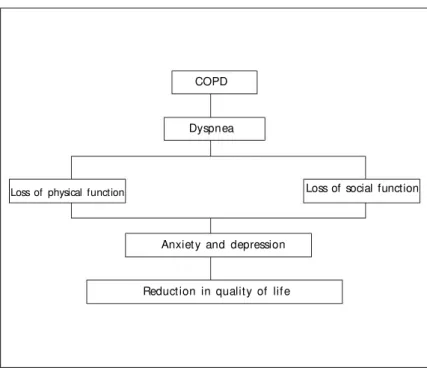
COPD, especially dyspnea, f requent ly int erf ere wit h various aspect s of t he lif e of t he pat ient , such as prof essional, f amily, and social act ivit ies, as well as act i vi t ies of dail y li vi ng (ADLs), l eadi ng t o depression and anxiet y, as well as t o a si gnif icant reduct ion in qualit y of lif e.(3- 4)
Energy conservat ion t echniques are t ools t hat have been u sed i n pu l m on ary rehab i l i t at i on programs wi t h t he aim of helping improve t he scenario described above. The idea is t o reduce t he energy expendit ure of t he pat ient s wit h COPD during t he perf ormance of t heir ADLs, decreasing t he sensat i on of dyspn ea an d i n creasi n g t he f unct ionalit y of t hese pat ient s.
ACTIVITIES OF DAILY LIVING
The ADLs are def ined as t asks of occupat ional perf ormance t hat a person carries out every day, t o prepare f or or as adjunct s t o t he t asks of t heir role in lif e. ADLs are act ivit ies relat ed t o personal care and include dressing oneself , eat ing, bat hing, hair combing, answering t he phone, communicat ing t h r o u g h w r i t i n g , h an d l i n g co r r esp o n d en ce, managing money and organizing books/ newspapers are all considered ADLs, as are act ivit ies relat ed t o physical mobilit y/ capacit y (t urning over in bed, sit t ing, moving about and going f rom one place t o anot her).(5)
The ADLs can be subdivided int o basic ADLs, which are t hose aut omat ically done every day by virt ually every human being (maint aining personal hygiene, bat hing, dressing, put t ing on shoes and walking around) and inst rument al ADLs, which are t hose more complex act ivit ies t hat demand more f unct ional independence (cooking, put t ing away ut ensils int o cabinet s, t idying up t he kit chen and washing clot hes).(6)
Alt hough t here are dif f erences regarding t he def init ions of ADLs, it is import ant t o bear in mind t hat pat ient s wit h COPD have more or less dif f icult y in perf orming t hem, depending on t he pulmonary and physical involvement t hey present . However,
in clinical pract ice, it is common f or pat ient s t o report great er dif f icult y in perf orming act ivit ies t hat involve t he upper limbs in relat ion t o t he lower lim bs, especially when t hose are used wit hout support .
REPERCUSSION OF ADLS IN PATIENTS
WITH COPD
Pat i en t s w i t h COPD u su al l y r ep o r t a disproport ionat e degree of f atigue when perf orming ADLs. In act ivities such as 'tying shoes' and 'combing hair', it has been demonst rat ed t hat COPD pat ient s develop an pat t ern of rapi d, irregu lar shall ow breat hing during t heir perf ormance, af t erwards breat hing rapidly and deeply. This post exercise pat t ern occurs due t o t he rapid and inef f ect ive shallow breat hing during t he bending and arm muscle exert ion involved in t he act ivit ies evaluat ed, r esu l t i n g i n p o st ex er ci se co m p en sat o r y
hyperventilation.
(7)Un su pport ed u pper- l im b exert ion leads t o t horaco- abdominal asynchrony and dyspnea in less t ime and wit h less oxygen consumpt ion t han do exercises involving t he lower limbs.(8)In t hese cases,
t he t horaco- abdominal asynchrony t hat occurs is not due t o diaphragmat ic f at igue.
The most common f unct ional ADLs involve t he upper and lower limbs. However, t he upper limbs are extensively used t o perf orm all t ypes of act ivit ies, f rom t he simplest t o t he most complex. Some of t he muscles t hat part icipat e in t he posit ioning of t he arms, such as t he t rapezoid, minor pect oral, scalene and int ercost al muscles, can have post ural and vent ilat ory f unct ions.(9)
Th ese f i n d i n gs w ere co n f i r m ed b y so m e aut hors,(11)who observed t hat t he t asks perf ormed
by t he unsupport ed upper limbs result in signif icant increases in met abolism and vent ilat ion, and t hat pat ient s wit h COPD respond t o t his demand by adopt ing a pat t ern of rapid, shallow breat hing. The aut hors showed t hat , in such cases, changes occur in t he pat t ern of respirat ory muscle recruit ment . During simple ADLs involving t he upper limbs, such as eat ing, brushing t eet h, combing hair, bat hing and dressing, t hese changes were f ound t o be relat ed t o t he percept ion of dyspnea and t o f at igue. The aut hors concluded t hat a f our- week program of upper- limb t raining leads t o improvement in t he perf ormance of t he ADLs.
Gen eral ly speaki ng, t here i s n o si gn i f i can t dif f erence bet ween clinically st able pat ient s wit h COPD and normal individuals of t he same age in t erms of t he energy expendit ure at rest , alt hough COPD pat ient s presen t great er relat i ve energy expendit ure per act ivit y.(12)
The perf ormance of relat ively simple t asks, such as sweeping, erasing a bl ackboard/ whit eboard, lif t ing pot s and changing light bulbs, result s in oxygen consumpt ion t hat is approximat ely 50% t o 60 % of t he m axi m al oxyg en u pt ake an d increases t he minut e vent ilat ion, wit h t he use of app ro xi m at el y 6 0 % t o 70 % o f t he m axi m al volunt ary vent ilat ion, which explains t he sensat ion of dyspnea and physical discomf ort experienced by pat ient s wit h COPD.(13)
Pat ien t s w it h COPD con sum e a signi f ican t port ion of t heir available energy t o perf orm simple ADLs. The sensat ion of dyspnea is signif icant ly more int ense in pat ient s wit h COPD t han in normal i n d i vi du al s, pri n ci pal l y du ri n g act i vi t i es t hat demand great er ef f ort , such as walking, walking while carryi ng weight and climbing at least t wo f light s of st airs.(14)
Pat ient s wit h moderat e t o severe COPD, as well as sedent ary pat ient s, while perf orming ADLs t hat involve t he upper and lower limbs (walking on a t readmill, lif t ing pot s, walking while carrying a 5 kg w ei ght , m aki n g m ovem en t s l i ke t he o n es i n showering, put ting on shoes, climbing st airs), present dynamic hyperinflat ion. This dynamic hyperinf lation can b e easi l y d et erm i n ed b y m easu ri n g t h e inspirat ory capacit y.(15- 16)
Pat ient s wit h COPD, when submit t ed t o t raining of t h e u pper an d l ow er l i m b s i n p u l m on ary
rehabilit at ion programs, report improvement in t he sensat ion of dyspnea while perf orming t heir ADLs. The exact reason f or t hese changes has yet t o be clarified. Various mechanisms, such as desensit ization t o dyspnea, improvement in physical condit ion, bet ter coordinat ion of the muscles involved in raising t he arms and met abolic muscle adapt at ions, are involved.(17)
EVALUATION OF ADLS AND THE USE OF
ENERGY CONSERVATION TECHNIQUES
Taking int o considerat ion t he f act t hat 78% of t h e pat i en t s w i t h COPD h ave dyspn ea w h en p er f o r m i n g ev er y d ay act i v i t i es, an d t h at approximat el y 55% of t hem require assist ance t o perf orm t hem,(18)it is highly appropriat e t o evaluat e,
in det ail, t he impact t hat COPD has on t he daily lif e of t hese pat ient s.(18)
Evaluat ing t he ADLs is not a simple t ask, and it is even more dif f icult when t he pat ient is brought t o a laborat ory and is asked t o perf orm a cert ain act ivit y in f ront of t he examiner. The evaluat ion of t he occupat ional perf ormance of a pat ient , in order t o det erm i ne t he def i ci en ci es t hat shou ld be t reat ed or t o which t he pat ient must learn t o adapt , consist s of syst emat ic observat ion, i nt erviews or bot h. When ADLs are t he f ocus, t he ideal is t o observe t hem at t he t ime of day at which and place in which t hey are perf ormed.(5)
Pat ient s submit t ed t o an evaluat ion should be classif ied as t o t heir f unct ionalit y, based on t he degree of dyspn ea t hey presen t , an d can be dist ribut ed as f ollows: Class I - minimal rest rict ion in t he perf ormance of ADLs and inst rument al ADLs rel at ed t o w o rk, l ei su r e an d soci al act i vi t i es (occurrence of dyspnea only during t he performance of t hose requiring great er physical exert ion); Class II - independent in virt ually all act ivit ies (present ing dyspnea when climbing st airs or when t he act ivit y involves bending); Class III - similar t o Class II, but wit h alt ered walking capacit y (cannot keep up wit h people of t he same age, set t ing t heir own pace); Class IV - dependent in some ADLs (dyspnea upon exert ion, requiring rest breaks during act ivit ies such as dressing, walking and climbing st airs - generally housebound, leaving home only when accompanied); Class V - conf ined t o bed or wheelchair (requiring assist ance in all act ivit ies).(19)
perf ormance of pat ient s in t heir ADLs is t o ask t hem t o mime t heir act ivit ies, perf orming t hem as if t hey w ere at ho m e, w i t h o u t i n t er f er en ce b y t h e examiner. During t he perf ormance of t he act ivit ies, t he examiner can have an idea of how long it t akes t he pat ient t o perf orm each act ivit y and of what body posit ion is adopt ed, as well as of t he changes in dyspnea, heart rat e and oxygen sat urat ion by p u l se ox i m et r y. T h e d at a co l l ect ed i n t h i s evaluat ion are import ant f or t he development of an orient at i on program designed t o modif y t he habit s of t he pat ient s, including t he use of energy conservat ion t echniques.
The Guidelines f or Pulmonary Rehabilit at ion Pr o g r am s o f t h e Am er i can Asso ci at i o n o f Cardi ovascu l ar an d Pu l m onary Rehabil i t at ion , published in 1993,(20)was one of the first international
document s t hat indicat ed t he need t o t each energy co n ser vat i o n t ech n i q u es d u r i n g p u l m o n ar y rehabilit at ion programs. These t echniques have t he object ive of decreasing t he energy expendit ure of t he pat ient s during t he perf ormance of t heir ADLs, consequent ly decreasing t heir sensat ion of dyspnea, i n creasi n g t h ei r f u n ct i on al perf or m an ce an d improving t heir qualit y of lif e.
I t i s cu rr en t l y recom m en d ed t hat en er gy conservat ion t echniques be used in all pulmonary rehabilit at ion programs in order t o decrease t he sensat ion of dyspnea, as well as t o prevent , reduce or delay dysf unct ion during t he perf ormance of ADLs, t hereby increasing t he f unct ional capacit y of t he pat ients. It is also necessary t o disseminat e these t echniques t o t he prof essionals who t reat t hese pat ient s in out pat ient clinics and hospit als, so t hat t hey can provide guidance on t he most ef f icient way t o perf orm ADLs, wit h less energy expendit ure, in order t o avoid discomf ort and dyspnea.
The use of energy conservat ion t echniques, t he adapt at ion of t he environment , and t he appropriat e post ure f or t he perf ormance of t he ADLs have proven ef f i ci ent i n redu ci n g t he sen sat i on of dyspnea, oxygen con sum pt i on , produ ct ion of carbon dioxi de and heart rat e of pat ient s wit h COPD. These f indings conf irm pat ien t report s of improvement in t heir perf ormance of ADLs.(21)Our
cl in ical experi ence, however, shows t hat t hese pat ient s have great dif f icult y in changing t heir lif est yle and adapt ing t o t he rout ine use of t hese t echniques in t heir daily lif e.
According t o some aut hors,(22)t he object ives of
energy conservat ion and t raining of ADLs are t he f ollowing: t raining diaphragmat ic breat hing, f irst at rest so t hat t he pat ient acquires t he percept ion of t he respirat ory movement s during inspirat ion and expirat ion and, lat er on, during t he perf ormance of t he t asks, avoiding t he brief periods of apnea t han can occur; t rain in g t he u pper li mbs, wi t h t he o b j ect i ve o f i n cr easi n g exer ci se t o l er an ce; programm in g act i vi t i es wi t h di st i nct l evels of demand, beginning wit h light , slow act ivit ies t hat require less energy expendit ure, such as personal hygiene activities perf ormed while sit ting, wit h upper limb support (brushing t eet h, combing hair, shaving, f ace washing, applying makeup), f ollowed by t hose perf ormed while sit t ing wit hout upper limb support (shaving armpit s and showering); simplif ying t he perf o rm an ce o f som e t asks by ad ap t i n g t he environment (elevat ing t he t oilet seat and inst alling support bars/ hand rails in t he bat hroom) or by using assist ive t echnology (long- handled shoe horns, long- handled combs, walkers wit h seat s and bags, et c.); eliminating unnecessary act ivit ies, such as dish drying (using a drain rack inst ead), drying af t er bat hin g (u si ng a pl u sh robe) an d shoe t yi n g (wearing slip- on shoes); inf orming pat ient s of t he import ance of asking f or help f rom f amily members, caregivers or ot hers, when necessary; organizing t ime, planning t he day/ week, calculat ing t he t ime spent in t he perf ormance of act ivit ies/ t he t ime n eeded f or rest an d en cou r agi n g t he u se of organizers; organizing t he environment so t hat t he mat erials t hat are going t o be used by t he pat ient are wit hin reach, t hat is, bet ween t he scapular and p el vi c g i rd l es, r edu ci n g t he n eed f o r b r oad movement s of t he upper limbs wit hout support , as well as avoiding bending; educat ing t he pat ient regarding t he most appropriat e post ures f or t he perf ormance of each t ask, adapt ing the way in which t he act ivit ies are perf ormed (using a t able, count er, or even t he bat hroom basin, t o support t he arms, as well as eliminat ing t he need t o bend over.
A
B
Figure 1 - A) Pat ient perf orm ing personal hygiene act ivit ies wit hout using
energy conservat ion t echniques; B) Pat ient perf orming personal hygiene act ivit ies using energy conservat ion t echniques
A
B
Figure 2 - A) Pat ient put t ing on shoes w it hout using energy conservat ion
t echniques; B) Pat ient put t ing on shoes using energy conservat ion t echniques
Figure 3- A) Patient putting away utensilson high shelves without
using energy conservation techniques; B) Pat ient putting away ut ensils on high shelves using energy conservat ion techniques
A
B
Figure 4 - A) Pat ient put t ing away ut ensils on low shelves
wit hout using energy conservat ion t echniques; B) Pat ient p u t t i n g aw ay u t en si l s o n l ow shel ves u si n g en erg y conservat ion t echniques
A
B
For pat ient s wit h COPD, t he adapt at ion of t he en vi ronm en t an d t he post u ral chan ge i n t he perf ormance of t he ADLs are of t en achieved in a simple manner. An example of t hat can be seen when t he bat hroom mirror i s lowered, t hereby prevent ing t he pat ient f rom perf orm ing personal hygiene in t he ort host at ic posit ion and wit h upper limbs wit hout support (Figure 1). Teaching pat ient s t o cross t heir legs while put t ing on and t aking of f shoes eliminat es t he need t o bend over during t his ADL (Figure 2). Organizing t he environment and
Figure 5- Flowchart represent ing t he cycle of loss of physical f unct ion of t he pat ient wit h COPD
COPD: chronic obst ruct ive pulmonary disease
perf orm t hese act ivit ies at a slower rhyt hm. Using t hese t echni ques can decrease t he dyspnea and discomf ort t hat t ypically lead pat ient s wit h COPD t o redu ce or even aban do n t hei r f u n ct i on al act ivit ies.
In summary, in order t o int ervene in an ef f icient manner in t he f unct ion of pat ient s wit h COPD, it is necessary t o implement an educat ional program (f or pat ient s and f amilies) in which t he various aspect s of COPD are analyzed, inclu ding t he use of energy conservat ion t echniques, as well as a program of upper- and lower- limb t raining.
REFERENCES
1 . So ci ed ad e Brasil ei ra d e Pn eu m o l og i a e Ti si ol o g i a. I I Co n sen so Brasi lei ro d e Do en ça Pu l m o n ar Ob st ru t i va Crôn ica. J Bras Pn eu m ol. 2004; 30 (su pl.) S1- S44. 2 . Celli BR, M acNee W; ATS/ ERS Task Force. St andards f or t he
diagnosis and t reat ment of pat ient s wit h COPD: a summary of t he ATS/ ERS posit ion paper. Eur Respir J. 2004;23(6):932-46. Errat um in: Eur Respir J. 2006;27(1):242. Errat um in: Eu r Respir J. 2006; 27(1):242.
3 . Herbert R, Gregor F. Qu alit y of lif e and coping st rat egies of clien t s w it h COPD. Rehabil Nurs. 1997; 22(4):182- 7. 4 . Tarrés PP. Un caso cl ín i co d e en f erm edad pu l m on ar
o b st ru ct i va cr ó n i ca (EPOC) I n : Lo p es BP, ed i t o res.
Terap i a o cu p aci o n al em g eri at ri a 1 5 caso s p rát i co s. M adri: Pan am erican a; 20 02 . p.22 1- 8.
5 . Tr o m b l y CA. Terap i a o cu p aci o n al p ara a d i sf u n ção f ísica. 2a. ed. São Pau lo: San t os; 1989.
6 . Art és RC, Tarrés PP. En f erm idad pu l m on ar obst ru ct iva crón ica In : M olin a PD, Tarrés PP. Terapia ocu paci on al en geriat ría: prin cipios y práct ica. Barcelon a: M asson ; 1 9 9 9 . p .9 9 - 11 0 .
7 . Tan gri S, Wo l f CR. The b reat h in g p at t ern in ch ro n i c obst ru ct ive lun g disease du rin g t he perf orm an ce of som e co m m o n dai ly act ivit i es. Chest . 19 73; 63 (1): 12 6- 7. 8 . Cel l i BR, Cr i m er G, Rassu l o J. Ven t i l at o r y m u scl es
recru it m en t du rin g u n su pport ed arm exercise in n orm al su b j ect s. J Ap pl Ph ysi o l. 19 8 8; 6 4(5 ): 1 9 36 - 41 . 9 . Cell i BR. The cli n ical u se of u pper ext rem it y exercise.
Cli n Chest M ed. 19 9 4; 15 (2): 3 3 9- 49 .
1 0 . Couser JI Jr, M art inez FJ, Celli BR. Respirat ory response and ven t ilat ory mu scle recru it m en t du rin g arm elevat ion in n orm al su bj ect s. Chest . 19 92; 101(2): 3 36- 4 0. 11 . Bau ldof f GS, Hof f m an LA, Sciu rba F, Zu llo TG. Hom
e-b ased , u pp er- arm exercise t rai n i n g f o r pat ien t s w it h ch ro n i c o b st ru ct i ve p u l m o n ary d i sease. Heart Lu n g . 1 9 9 6 ; 2 5 (4 ): 2 8 8 - 9 4 .
1 2 . Baarends EM , Schols AM , Panneman s DL, West ert erp KR, Wo u t ers EF. To t al f ree l ivi n g en ergy exp en d i t u re i n p at i en t s w i t h sever e ch ro n i c o b st ru ct i ve p u l m o n ary disease. Am J Respir Crit Care M ed. 1997; 155(2):549- 54. 1 3 . Vello so M , St el la SG, Cen don S, Si lva AC, Jardi m JR. M et abolic an d ven t ilat ory param et ers of f ou r act ivit ies o f d ai l y l i v i n g a cco m p l i sh ed w i t h ar m s i n COPD p at i en t s. Ch est . 2 0 0 3 ; 12 3 (4 ): 1 0 47 - 5 3 .
1 4 . Jeng C, Chang W, Wai PM , Chou CL. Comparison of oxygen co n su m p t io n i n p erf o rm i n g d ai l y act i vi t i es b et w een pat ient s wit h chronic obst ruct ive pulmonary disease and a healt hy populat ion . Heart Lu ng. 2003; 32(2):121- 30. 1 5 . Si lva CRS. An ál ise d a h i peri n su f l ação pu l m o n ar pel a
capacidade inspirat ória duran t e a realização de at ividades da vida diária em port adores de doença pulmonar obst rut iva cronica [t ese]. São Paulo: Universidade Federal de São Paulo; 2 0 0 3 .
1 6 . Nogu eira FR. An álise do com port am ent o da capacidade inspirat ória no t est e da cam inhada dos seis minut os e do degrau em pacien t es com doen ça pu lm on ar obst ru t iva cronica [t ese]. São Paulo: Universidade Federal de São Paulo; 2 0 0 3 .
1 7 . Ri es AL . T h e i m p o r t an ce o f exerci se i n p u l m o n ary reh abi li t at i on . Cli n Ch est M ed . 1 9 94 ; 1 5 (2 ): 3 27 - 37 . 1 8 . Garrod R, Best all JC, Paul EA, Wedzicha JA, Jones PW.
Developmen t an d validat ion of a st an dardized m easu re of act ivit y of daily living in pat ient s w it h severe COPD: t he Lon don Chest Act ivit y of Daily Living scale (LCADL). Respi r M ed. 200 0; 9 4(6 ): 58 9- 9 6.
1 9 . Berzin s GF. An occu p at io n al t herapy prog ram f or t he chron ic ob st ru ct i ve pu lm on ary d i sease p at ien t . Am J Occu p Th er. 1 97 0 ; 2 4 (3 ): 1 81 - 6 .
2 0 . Am erican Associat ion of Cardiovascu lar an d Pu lm on ary Reh ab i l i t at i o n . AACVPR. Gu i d el i n es f o r p u l m o n ar y rehabi lit at ion p ro gram s. Cham p ain g: Hu m an Kin et ics; 1993. p. 11- 23.
2 1 . Velloso M , Jardim JR. St udy of energy expendit ure during t he act ivit ies of daily livin g u sing an d n ot u sin g body posit ion recommended by energy conservat ion t echniques
COPD
Dyspnea
Loss of physical function Loss of social function
Anxiet y and depression
in COPD pat ient s. Chest . 2006;130(1): 126- 32.
2 2 . Ogd en LD, Deveen e C. COPD p ro g ram gu id eli n es f o r occu pat ion al t herapist s an d ot her healt h prof ession als. In : O' Dell- Rossi P, Brow n in g G, Barry J. Occu pat io n al
t herapy in pu lmon ary rehabilit at ion. M arylan d: Ram sco; 198 5. p .50- 8.