PRENATAL INTERVENTION FOR URINARY OBSTRUCTION AND
MYELOMENINGOCELE
HUBERT S. SWANA, RONALD S. SUTHERLAND, LAURENCE BASKIN
Department of Urology, University of California San Francisco, and Department of Surgery, Tripler Army Medical Center, San Francisco, California, USA
ABSTRACT
Widespread use of ultrasonography has resulted in an increase in the recognition of fetal hydronephrosis. The enthusiasm that accompanied early interventions has been tempered by the ex-perience and results obtained over the past 2 decades. The goal has remained the same: to identify patients with serious prenatal obstruction and to identify those which may benefit from intervention. Myelomeningocele remains a devastating congenital anomaly. Fetal and experimental studies sug-gested that patients with myelomeningocele could benefit from prenatal intervention. Advances in technology and perinatal management have made intervention for more complex malformations such as myelomeningocele possible. This article will review current knowledge and will detail rational management for the management of prenatal hydronephrosis. The current state of antenatal myelom-eningocele repair and the urologic implications will be described as well.
Key words: fetus; congenital abnormalities; prenatal diagnosis; myelomeningocele; intrauterine; surgery; fetoscopy
Int Braz J Urol. 2004; 30: 40-8
INTRODUCTION
During the past 2 decades pediatric urologists have begun acquiring patients with antenatally de-tected conditions. With the widespread use of mater-nal ultrasound, fetal hydronephrosis has become in-creasingly detected, and it comprises the most com-mon prenatally diagnosed malformation. The concept of the unborn child as a potential surgical patient has become firmly established (1). Fetal medicine has rapidly evolved since early experiences with the man-agement of fetal hydronephrosis. With time, the natu-ral history and pathophysiology of urinary tract ob-struction has become better understood. Improve-ments in diagnostic imaging tools, advances in fetal urine sampling, enhanced interventional techniques and equipment, and a better understanding of the risks and outcomes in these babies have helped to develop rational intervention and observation strategies.
Nev-ertheless, the management of the fetus with hydro-nephrosis has remained controversial.
The purpose of this article is to review ante-natal intervention and its history. The basics of normal fetal development will be integrated with the techniques used to diagnose disorders of the urinary tract. Par-ticular attention will be devoted to the diagnostic tech-niques of ultrasound, fetal urine sampling and amnio-centesis. Newer modalities such as fetal magnetic reso-nance imaging (MRI) will be described. Intervention for patients with myelomeningocele and the implica-tions for urinary tract function will be discussed. Meth-ods of intervention will be described along with their indications, contraindications, and complications.
SPECTRUM OF ANTENATAL DISORDERS: EMBRYOLOGY AND PATHOPHYSIOLOGY
distal obstruction affects normal renal development (2-7). By the 5th week of gestation, the ureteral bud rises from the mesonephric duct. It then begins to lengthen and canalize. Induction of the metanephric blastema occurs by the end of week 7. Primitive re-nal function begins between week 7 and 9, and by week 20, about 1/3 of the total number of nephrons are present. Nephrogenesis is complete by the 32nd week of fetal life, after which no demonstrable in-crease in the number of glomeruli is noted (8-10).
The spectrum of deleterious changes seen in antenatal urinary obstruction is the result of multiple factors. They include the time of onset, duration, and degree of urinary obstruction. In general the earlier the obstruction occurs the more disturbed the devel-opment of the fetal kidney (8). Renal dysplasia, the most severe form of renal injury and maldevelopment, has been attributed to a very early effect of elevated pressures in the urinary (2) and alternatively by ure-teral bud malposition with subsequent misconnection between the bud and the metanephric blastema (4,11). Without ureteral bud induction, the blastema fails to develop. One sees clusters of disorganized meta-nephric structures surrounded by abundant fibrous tissue. Ninety per cent of cases of renal dysplasia are associated with urinary obstruction during nephrogenesis. Sonography is highly specific for di-agnosing dysplasia and the demonstration of renal cysts in a fetus with known obstructive uropathy ef-fectively indicates the presence of dysplasia (12). The absence of cortical cysts, however, does not exclude renal dysplasia.
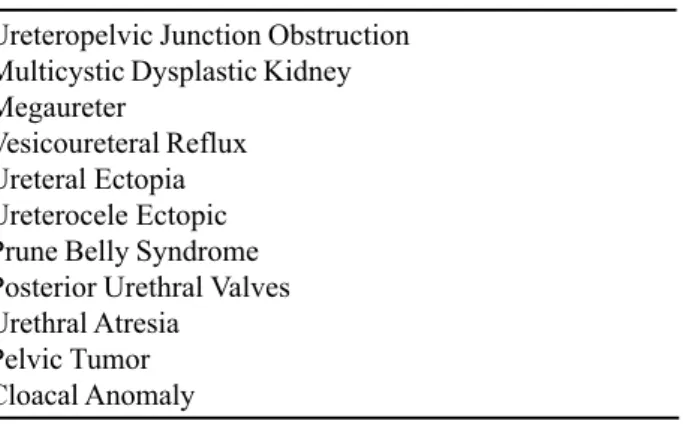
Dilation of the urinary tract can be due to, ureteropelvic junction obstruction (UPJO), congeni-tal obstructed and nonobstructed megaureter, multicystic kidney, duplication anomalies with up-per pole ectopia or obstructing ureterocele, and vesicoureteral reflux (VUR) (13). Obstruction of the upper urinary tract from physiologic ureterectasis or from UPJO is rarely complete. One must also exclude physiological hydronephrosis which usually sponta-neously resolves prior to delivery or within the first year of life (14) (Table-1).
More distal causes of obstruction include posterior urethral valves, urethral atresia, cloacal anomalies, and prolapsing, obstructing ureteroceles.
These entities can result in marked distortion of both ureters and kidneys as well as pathological bladder changes. The prune belly syndrome is rarely been associated with renal obstruction even though the urinary tract is massively dilated. Some have argued that the characteristic urinary tract dilation is a con-sequence of transient fetal urethral obstruction (15). Spinal cord and subsequent vertebral forma-tion begins at day 18 of gestaforma-tion. Neural tube in-folding (neurulation) occurs between 18 and 27 days of gestation and is normally followed by migration of mesodermal tissue around the developing spinal cord. The mesoderm gives rise to the vertebral arches, as well as the spinal and back musculature. The loca-tion, timing and extent of the abnormal closure lead to the varying degrees and levels of neural tube de-fects. Lesions can vary to include spina bifida occulta, (a closed tube defect), meningocele, (a protruding meningeal sac without neural elements), myelomen-ingocele (a menigeal sac with neural elements) and lipomeningocele (a meningeal sac with neural ele-ments and fatty tissue). Myelomeningocele is the most common neural tube defect. Lumbar vertebrae are most commonly involved followed by sacral, thoracic and cervical vertebrae in decreasing frequency. Fail-ure to close at the caudal end results in a distal defect with resultant lower limb paralysis and bladder dys-function (16). An Arnold-Chiari type II malformation occurs in up to 85% of children with myelomeningo-cele (MMC). There can be herniation of the cerebel-lar tonsils through the foramen magnum. This can result in obstruction of the fourth ventricle and ne-cessitates ventriculoperitoneal shunting.
Table 1 – Causes of prenatal hydronephrosis
Ureteropelvic Junction Obstruction Multicystic Dysplastic Kidney Megaureter
Vesicoureteral Reflux Ureteral Ectopia Ureterocele Ectopic Prune Belly Syndrome Posterior Urethral Valves Urethral Atresia
Urology morbidity in patients with MMC is significant. Myelodysplasia can result in a poorly com-pliant bladder, sphincteric dysfunction, secondary vesicoureteral reflux, a predisposition to urinary tract infections, possible renal scarring and renal failure (17). Urologic morbidity is the sequela of neurologic injury. The neurologic deficit seen in MMC is believed to be due to several factors. The first is defective develop-ment. Evidence supporting a secondary insult to the exposed spinal cord has resulted in a “two hit hypoth-esis”. Histologic findings support the idea that the ex-posed spinal cord is vulnerable to damage by physical trauma as the cord contacts the uterine wall. Physical trauma, and the toxic effects of amniotic fluid and meconium to the exposed spinal cord have been re-ported (18-20). Fetal lower limb movements have been described in fetuses with MMC at 16-17 weeks (21). Animal studies, in which laminectomy was performed at mid-gestation, compared in-utero repair to no treat-ment. The animals that underwent fetal intervention were spared flaccid paralysis and incontinence of urine and stool (22). Histologic specimens of bladder tissue from children with spina bifida reveal increased intra-cellular matrix between muscle bundles, decrease muscarinic receptor density abnormal smooth muscle growth, and decreased innervation (23-25). These fac-tors likely contribute to bladder dysfunction in human spina bifida patients.
DIAGNOSIS OF OBSTRUCTION
Ultrasound
The evolution of fetal intervention has paral-leled the advancements in ultrasound technology.
High resolution, real time imaging and the ability to choose focal zone depth have been major advances in ultrasonography (26). Fetal positioning plays a criti-cal role in the interpretation and understanding of the fetal anatomy. The prone fetus is in the optimal posi-tion for imaging the kidneys (1). While the kidneys can be seen as early as the 15th week reliable imag-ing is not possible until week 18 (26).
Hydronephrosis is the most common cause of an abdominal mass in the neonate, and antenatal sonography readily detects fetal urinary tract dilation (1). Pelviectasis is found in 18% of normal fetuses (27). Both caliectasis and an anteroposterior pelvic diameter of greater than 10 mm have been proven to be reliable predictor of fetuses in need of postnatal urologic evaluation (28,29). The Society of Fetal Urology has adopted a grading system form hydro-nephrosis, which is widely used by pediatric urolo-gists today (Table-2).
Prenatal sonography is very sensitive in dif-ferentiating ureteropelvic junction obstruction from other causes of obstruction and dilation (30,31).
While ultrasonography remains the primary imaging modality for the screening and evaluation of congenital abnormalities, it is not without limitations. Maternal obesity, oligohydramnios and suboptimal fetal position can make accurate imaging difficult. Early use of MRI was limited by slow acquisition times and was hampered by fetal motion. Newer meth-ods have been developed that can reduce acquisition times and provide excellent image quality without the need for fetal sedation or paralysis (32). MRI can provide images unaffected by fetal position, mater-nal obesity, oligohydramnics, or overlying bowel and Table 2 – Ultrasound grading scale of hydronephrosis
Grade Central Renal Complex Renal Parenchymal Thickness
0 Intact Normal 1 Slight splitting Normal 2 Evident splitting confined within renal border Normal 3 Wide plitting pelvis outside renal border. Calices uniformly dilated Normal 4 Further dilation of renal pelvis and calices Thin
possibly could provide a definitive diagnosis of ob-structive uropathy (33,34).
MRI seems to be superior in identifying the intracranial lesions such as agenesis of the corpus callosum, cerebellar dysplasia and holoprosencephaly that can accompany myelomeningocele (35). In the future, clinical decisions may be based on analysis of chemical and molecular events with MRI (36). Pres-ently, MRI is a useful adjunct to ultrasonography. MRI provides additional information in myelomeningo-cele, other complex fetal cases, and cases of hydro-nephrosis with indeterminate US studies.
Fetal Urine and Amniotic Fluid Testing
Invasive acquisition of fetal urine for analy-sis has become one of the most important measures of assessing fetal renal function. Measurement of fe-tal urine electrolytes and urinary proteins is a useful guide to the clinician in deciding whether prenatal intervention is indicated. Additional methods of as-sessing the overall status of the fetus include amnio-centesis, chorionic villus sampling, percutaneous umbilical blood sampling (all for karyotyping), as well as amniotic fluid volume and its biochemical con-stituent measurement.
Fetal urine is normally hypotonic reflecting developing glomerular and tubular function (37). The amniotic fluid, in comparison, is somewhat hy-pertonic, and is not as reliable an index of renal func-tion as the fetal urine. Determinafunc-tion of human fetal renal function is limited to simple concentration of specific urinary constituents. More physiologic mea-surements of glomerular function, while possible, are not routinely performed (38). Clearance of iothalamate has been done and shown to be non-predictive of renal outcome (10). Retrospective analysis of individual urine constituents have shown that a sodium of less than 100 mEq/L, osmolality less than 210 mOsm/L and chloride less than 90 mEq/L, if accompanied by lack of ultrasonographic evidence of dysplasia, are helpful in predicting re-sidual fetal renal function. By categorizing patients according prognosis, assessment of the potential efficacy of intervention ca be made (39). Elder et al. (39) and Johnson et al. (40) separately suggested that single determinations of urinary electrolytes may
not be useful. Johnson et al. (41) proposed providing transient relief of obstruction by vesicocentesis fol-lowed by sequential sampling (3 or 4 samples over several days) of urinary electrolytes. This was felt to provide an assessment of the severity of the renal in-jury and potential for reversibility of renal inin-jury. Those fetuses that experience an improvement in their biochemical parameters following decompression may benefit most from interventional therapy (41). Others have suggested that sampling of fetal urine electrolytes and osmolarity is not an optimal method to evaluate fetal renal function and recommend con-tinued search for a better substance (42-44). A serum marker, which has provided some clinical utility, is beta-2 microglobilin. It is excreted by the kidney with-out placental cross-over so that fetal levels represent fetal renal function. One can see an elevation in renal dysplasia (45). Other urinary constituents commonly associated with the presence of renal disease include proteins such as albumin, retinol binding protein, and N-acetyl-b-glucosaminidase have been studied (45). Unfortunately human fetal urine sampling lacks known control normals at different stages of devel-opment. Further limitation includes the inability to accurately and physiologically measure renal func-tion by fracfunc-tional excrefunc-tion of biochemical constitu-ents and glomerular filtration without risky invasive fetal and maternal testing (46).
INTERVENTIONAL TECHNIQUE
Current Indications and Contraindications
For most fetuses with obstructive uropathy, intervention is not necessary (47) (Figure-1). The se-lection criteria for fetal therapy of obstruction evolved such that patient selection is presently good enough to avoid intervention in patients who are either too well (no benefit) or too ill to recover (48). It has been conclusively shown that decompression in utero will restore amniotic fluid, which can prevent the devel-opment of fatal pulmonary hypoplasia. What seems less clear is whether or not in utero decompression can arrest or reverse cystic dysplastic changes caused by obstruction (48).
Figure 1 – The fetus with bilateral hydronephrosis. Treatment algorithm. (Courtesy of Doctor Nalin Gupta, Department of Neurosur-gery, University of California San Francisco, California USA)
to fetal intervention (1,49). In most cases with normal amniotic fluid volume, the mother should be followed by serial ultrasound examinations, and the fetus should be evaluated and treated postnatally. If moderate to severe oligohydramnios develops, the fetus should undergo complete prognostic evaluation to assess the potential for normal renal and pulmonary function at birth. If the ultrasound demonstrates presence of dys-plasia, aggressive obstetrical care or prenatal decom-pression is not indicated. When preserved renal func-tion is predicted, early delivery for postnatal decom-pression is indicated if the lungs are mature. Early de-livery usually does not compromise pulmonary func-tion as long as amniotic fluid volume has been main-tained (1). If the lungs are immature, however, in-utero decompression can be considered.
METHODS OF INTERVENTION
Urinary Tract
Early attempts at bladder decompression in the late 70’s and early 80’s attempted a
Seldinger-type procedure, but with limited success. A tight fit-ting double pigtail catheter placed over a puncture needle using a pusher worked; although it was far from ideal. Due to the difficulties in catheter place-ment, migration and plugging, Malecot-type and ex-ternal coil type catheters were developed.
Open fetal surgery began in the early 1980’s, and was performed on eight highly selected cases of obstructive uropathy from 18-24 weeks gestation. Unfortunately this method of treatment carried sig-nificant morbidity predominantly from preterm labor (47,48,50). As a result, open fetal surgery to correct urinary tract obstruction has not since been performed. In those early patients, open decompression proce-dures included cutaneous vesicostomy in 7 and bilat-eral ureterostomies in 1. Only 4 had prolonged return of normal amniotic fluid and had adequate pulmo-nary function at birth. Of these only two have normal renal function at ages 5 and 8 years (51).
MacMahon and associates reported a similar fetoscopic approach in a human fetus with prune belly syndrome and oligohydramnios at 17 + weeks. They used a Neodymium-Yag laser to create a vesicoamniotic shunt, which was successful at restoration of the amniotic fluid volume. The fistula closed by 33 weeks and the child was delivered early with normally developed lungs (53). Fetal cystocopy and valve ablation has been re-ported. Both antegrade and retrograde techniques have been reported. Flexible and rigid instruments were used as well. Significant fetal mortality was reported (54).
Myelomeningocele
Repair of MMC has been attempted both en-doscopically and through open surgery via a hystero-tomy. While technically possible, surgery for MMC is not presently being performed via a fetoscopic ap-proach. Fetoscopy is limited by the need for multiple port sites, which can lead to membrane fixation and rupture as the uterus enlarges. In addition it is diffi-culty to visualize large spinal defects and requires prolonged operative times (55).
Open fetal surgery requires careful planning (Figure-2). Attempts at enhancing fetal lung maturity are made through the use of preoperative glucocoritosteroid administration to the mother. Broad spectrum antibiotics and balanced anesthesia allow the procedure to take place. The amniotic fluid is re-moved and kept in sterile warm syringes. A standard neurosurgical closure is performed through an ap-proximately 8 cm hysterotomy. The neural placode is dissected from the adjacent arachnoid tissue and placed in the spinal canal. The dura is then dissected off for another layer of coverage. The skin then is freed for a final layer of closure. The amniotic fluid and added antibiotics are replaced and the uterus closed. Phophylactic tocolytics are then used (56).
Results and Complications
Urinary Tract
Early results of prenatal bladder shunting re-assured physicians that the procedures could be per-formed safely and that catheter drainage was well tolerated in most cases. Whether prenatal shunting improves outcome remains a different matter. Patient
A
B
Figure 2 – Fetal surgery for myelomeningocele. Pre-operative (A) and post- operative (B) images. (Courtesy of Doctor Nalin Gupta, Department of Neurosurgery, University of California San Francisco, California USA).
selection is critical. One must find a dilated urinary tract with severe enough obstruction to compromise renal and pulmonary function at birth, and yet not so severe that renal function cannot be salvaged with decompression (1).
Reviews by Coplen, McLorie and Baskin have shown several things. First, obstruction and dys-plasia are difficult to predict. Second, while techni-cally feasible, fetal interventions were associated with only a 47% survival rate and a 45% of fetuses had complications (39,56-58). Third, even though oligo-hydramnios could be reversed, the ability to sustain good renal function was variable. Lastly, specific pre-natal parameters that were effective in predicting good renal function have note been found (52,58).
preterm labor (50). Catheters can fail either by plug-ging. Incorrect placement despite ultrasound guidance has resulted in fetal injury, and death (59). Reinser-tions increase the risks of fetal injury and infecReinser-tions. Chorioamnionitis can sometimes resulting in preg-nancy termination (51).
Myelomeningocele
Prenatal surgery for myelomeningocele has yielded some unexpected outcomes. Tubbs et al. were not able to show improved lower extremity function in patients that underwent intrauterine intervention (59). Bruner et al. compared 29 fetal surgery pa-tients with 23 controls matched for level of defect, diagnosis, calendar time and practice parameters (60). They reported a statistically significant (P = 0.01) decrease in the need for ventriculoperitonel shunt placement and a lower incidence of hindbrain her-niation (P = 0.001). Patients who underwent fetal sur-gery did however have a higher risk of oligohydram-nios (48% vs. 4%; P = 0.001), and admissions for preterm contractions (50% vs. 9%; P = 0.002). They were also more susceptible to prematurity. Age at delivery was earlier (33 vs. 37 weeks; P < 0.001) and birth weight were lower (2171 vs. 3075 gm; P < 0.001) (56).
The effect of fetal intervention for myelom-eningocele on postnatal bladder function has been studied (57,58). Despite the early repair, patterns of abnormal bladder function were exhibited. One still sees poor compliance, poor detrusor contractility, detrusor-sphincter dysynergia, hydronephrosis and vesicoureteral reflux. The previously described glo-bal defect in bladder development makes success of fetal surgery to preserve or improve bladder function unlikely. Additional studies are ongoing.
CONCLUSIONS
The field of fetal medicine has grown over the past two decades. Well-defined animal studies have yielded clues to the natural history and patho-genesis of obstructive uropathy and the efficacy of interventional techniques to ameliorate the sequelae of such obstruction. With advances in technology, the complexity of anomalies, which can be treated, has
increased, as evidenced by the growing experience with fetal myelomeningocele repair. In addition these new scenarios provide new ethical challenges. Car-rying out procedures in human fetuses must continue to be appropriately cautious and circumspect. The uncertainties and true pathologic processes surround-ing urinary tract obstruction must continue to be ex-plored. More reliable methods of determining fetal renal function lay on the horizon. Interventional tech-niques continue to evolve and improve. Because of the potential risks for preterm labor and maternal com-promise, fetal surgery should continue to be performed only for carefully selected cases at centers that are equipped with a multidisciplinary health care team committed to ongoing, well-designed research proto-cols.
REFERENCES
1. Harrison M, Filly R: The Unborn Patient, 2nd ed. Phila-delphia, W.B. Saunders Co. 1991.
2. Beck AD: The effect of intra-uterine urinary obstruc-tion upon the development of the fetal kidney. J Urol. 1971; 105: 784-9.
3. Berman DJ, Maizels M: The role of urinary obstruc-tion in the genesis of renal dysplasia. J Urol. 1983; 128: 1091-6.
4. Barrett DM, Wineland RE: Renal cell carcinoma in multicystic dysplastic kidney. Urology. 1980; 15: 152-4.
5. Longino LA, Martin LW: Abdominal masses in the newborn infant. Pediatrics. 1958; 21: 596-604. 6. Glick PL, Harrison MR, Noall RA, Villa RL:
Correc-tion of congenial hydronephrosis in utero III. Early mid-trimester ureteral obstruction produces renal dys-plasia. J Pediatr Surg. 1983; 18: 681-7.
7. Bellinger MF, Comstock CH, Grosso D, Zaino R: Fe-tal posterior urethral valves and renal dysplasia at 15 weeks gestational age. J Urol. 1983; 129: 1238-9. 8. Gasser B, Mauss Y, Ghnassia JP, Favre R, Kohler M,
Yu O, et al.: A quantitative study of normal nephrogenesis in the human fetus: its implication in the natural history of kidney changes due to low ob-structive uropathies. Fetal Diagn Ther. 1993; 8: 371-84.
9. Potter E: Normal and Abnormal Development of the Kidney. Yearbook Medical. 1972.
RA, Callen PW: Management of the fetus with con-genital hydronephrosis II: Prognostic criteria selection for treatment. J Pediatr Surg. 1985; 20: 376-87. 11. King LR: The Management of Multicystic Kidney and
Ureteropelvic Junction Obstruction. In King L (ed.), Urologic Surgery in Neonates and Young Infants. Phila-delphia, W.B. Saunders Co. 1988; p. 140.
12. Mahony HS, Filly RA, Callen PW, Hricak H, Gobbus MS, Harrison MR, et al.: Fetal renal dysplasia: sonographic evaluation. Radiology. 1984; 152: 143-6. 13. Gordon AC, Thomas DFM, Arthur RJ, Irwing HC, Smith SE: Prenatally diagnosed reflux: a follow-up study. Br J Urol. 1990; 65: 407-12.
14. Anderson PAM, Rickwood AMK: Featurers of primary vesicoureteric reflux detected by prenatal sonography. Br J Urol. 1991; 67: 267.
15. Snow BW, Duckett JW: Prune Belly Syndrome. In: Gillenwater JY, Grayhack JT, Howards S, Duckett JW (eds.), Adult and Pediatric Urology, St Louis, Mosby. 1991; 2nd ed., p. 1921.
16. Moore KL, Persaud TVN: The Developing Human: Clinically Oriented Embryology. Philadelphia, W.B. Saunders Co. 2003; pp. 428-33.
17. Muller T, Arbeiter K, Aufricht C: Renal function in myelomeningocele: risck factors, chronic renal fail-ure, renal replacement therapy and transplantation. Curr Opin Urol. 2002; 12: 479-84.
18. Meuli M, Meuli-Simmeti C, Hutchins GM, Seller MJ, Harrison MR, Adzick NS: The spinal cord lesion in human fetuses with myelomeningocele: Implications for feta surgery. J Ped Surg. 1997; 32: 448-52. 19. Drewek MJ, Bruner JP, Whetsell WO, Tulipan N:
Quantitative analysis of the toxicity of human amni-otic fluid to cultured rat spinal cord. Ped Neurosurg. 1997; 27: 190-3.
20. Correia-Pinto J, Reis JL, Hutchins GM, Baptista MJ, Estevão-Costa J, Flake AW, et al.: In utero meconium exposure increases spinal cord necrosis in a rat model of myelomeningocele. J Ped Surg. 2002; 37: 488-92. 21. Korenromp MJ, van Good JD, Bruinese HW, Kriek R: Early fetal movements in myelomeningocele. Lan-cet. 1986; 8: 917-8.
22. Meuli M, Meuli-Simmen, Hutchins GM, Yingling CD, Hoffman KM, Harrison MR, et al.: In utero surgery rescues neurologic function at birth in sheep with spina bifida. Nat Med. 1995; 1: 342-7.
23. Shapiro E, Becich MJ, Perlman E, Lepor H: Bladder wall abnormalities in myelodysplastic children: a com-puter assisted morphometric analysis. J Urol. 1991; 145: 1024-9.
24. Gup DI, Baumann M, Lepor H, Shapiro E: Muscar-inic cholinergic receptors in normal pediatric and myelodysplastic bladders. J Urol. 1989; 142: 595-9. 25. Shapiro E, Seller MF, Lepor H, Kalousek DK, Hutchins
GM, Perlman EJ, et al.: Altered smooth muscle devel-opment in the lower genitourinary and gastrointestinal tract of the male fetus with myelomeningocele. J Urol. 1998; 160: 1047-53.
26. Merguuerian P: The evaluation of prenatally detected hydronephrosis. Mongraph Urol. 1995; 16: 1-5. 27. Hoddick WK, Filly RA, Mahony BS, Callen PW:
Mini-mal fetal renal pyelectasis. J Ultrasound Med. 1985; 4: 85-9.
28. Cendron M, Morin L, Crombleholme T: Early mini-mal fetal hydronephrosis: clinical outcomes and im-plications for management. American Academy of Pediatrics. Pediatric Urology Sections (Dallas, Texas). 1994; Abstract # 30.
29. Birken G, Vane D, King Dea: Adenocarcinoma arising in a multicystic dysplastic kidney. Pediatr Surg. 1985; 20: 619.
30. Manning FA, Harrison MR, Rodeck C: Catheter shunts for fetal hydronephrosis and hydrocephalus. N Engl J Med. 1986; 315: 336-40.
31. Yamashita Y, Namimoto T, Abe Y, Takahashi M, Iwamasa J, Mujazaki K, et al.: MR imaging of the fe-tus by a HASTE séquense. AJR. 1997; 168: 513-9. 32. Coakley FV, Hriak H, Filly RA, Barkovich AJ, Harrison
MR: Complex fetal disorders: effect of MR imaging on management-preliminary clinical experience. Ra-diology. 1999; 213: 691-6.
33. Aaronson OS, Hernanz-Schulman M, Bruner JP, Reed GW, Tulipan NB: Myelomeningocele: Preneatal evalu-ation – Comparison between transabdominal US and MR imaging. Radiology. 2003; 227: 839-43.
34. Levine D, Barnes PD, Madsen JR, Abbott J, Mehta T, Edelman RR: Central nervous system abnormalities assessed with prenatal magnetic resonance imaging. Obstet Gynecol. 1999; 94: 1011-9.
35. Tempany CMC, McNeil BJ: Advances in biomedical imaging. JAMA. 2001; 285: 562-7.
36. Woodard Jr: Neonatal and perinatal emergencies. In: Harrison JH, Gittes RF, Perlmutter AD, et al. (eds.): Campbell’s Urology, Philadelphia, W.B. Saunders Co. 1979, 4th ed., p. 1855.
37. Adzick NS, Sutton LN, Crombelhome TM, Flake AW: Successful fetal surgery for spina bifida. Lancet. 1998; 852: 1675-6.
in-tervention in obstructive uropathy: prognostic indica-tors and efficacy of intervention. Am J Obstet Gynecol. 1990;162:1239-44
39. Elder JS, O’Grady JP, Ashmead G, Duckett JW, Philipson E: Evaluation of fetal renal function: unreliability of fetal urinary electrolytes. J Urol. 1990; 144: 574-8.
40. Johnson MP, Corsi P, Bradfield W, Hume RJ, Smith C, Flake AW, et al.: Sequential analysis improves evalu-ation of fetal renal function in obstructive uropathy. Am J Obstet Gynecol. 1995; 173: 59-65.
41. Johnson MP, Bukowski TP, Reitleman C, Isada NB, Pryde PG, Evans ML: In utero surgical treatment of fetal obstructive uropathy: a new comprehensive ap-proach to identify appropriate candidates for vesicoamniotic shunt therapy. Am J Obstet Gynecol. 1994; 170: 1770-6.
42. Elder JS, Duckett JW, Snyder HM: Intervention for fetal obstructive uropathy: has it been effective? The Lancet. 1987; Oct 31, 8566: 1007-10.
43. Wilkins IA, Chitkara U, Lynch L, Goldberg JD, Mehalek KE, Berkowitz RL: The nonpredictive value of fetal urinary electrolytes: Preliminary report of out-comes and correlations with pathologic diagnosis. Am J Obstet Gynecol. 1987; 157: 694-8.
44. Mandell J, Blyth BR, Peters CA, Retik AB, Estroff JA, Benacerraf BR: Structural genitourinary defects detected in utero. Radiology. 1991; 178: 193-6. 45. Dommergues M, Muller F, Ngo S, Hohlfeld P, Oury
JF, Bidat L, et al.: Fetal serum beta-2-microglobulin predicts postnatal renal function in bilateral uropathies. Kid Int. 2000; 58: 312-6.
46. Longaker MT, Golbus MD, Filly RA, Rosen MA, Chang SW, Harrison MR: Maternal outcome after open fetal surgery. JAMA. 1991; 265: 737-41.
47. Adzick NS, Harrison MR: The unborn surgical patient. Curr Probl Surg. 1994; 31: 1-68.
48. Onen A, Jayanthi VR, Koff SA: Long term follow-up of prenatally detected severe bilateral newborn hydro-nephrosis initially managed nonoperatively. J Urol. 2002; 168: 1118-20.
49. Harrison MR, Adzick NS: The fetus as a patient. Sur-gical considerations. Ann Surg. 1991; 213: 279-91. 50. Crombleholme TM, Harrison MR, Golbus MS,
Longaker MT, Langer JC, Callen PW, et al.: Fetal in-tervention in obstructive uropathy: prognostic indica-tors and efficacy of intervention. Am J Obstet Gynecol. 1990; 162: 1239-44.
51. Estes JM, MacGillivray TE, Hedrick MH, Adzick NS, Harrison MR: Fetoscopic surgery for the treatment of
congenital anomalies. J Pediatr Surg. 1993; 27: 950-4. 52. Najmaldin A, Burge DM, Atwell JD: Fetal
vesicoureteric reflux. Br J Urol. 1990; 65: 403-6. 53. Quintero RA, Hume R, Smith C, Johnson MP, Cotton
DB, Romero R, et al.: Percutaneous fetal cystoscopy and endoscopic fulgaration of posterior urethral valves. Am J Obstyet Gynecol. 1995: 172: 206-9.
54. Olutoye OO, Adzick NS: Fetal surgery for myelomen-ingocele. Semin Perinatol. 1999; 23: 462-73. 55. Coplen DE: Prenatal intervention for hydronephrosis.
J Urol. 1997; 157: 2270-7.
56. McLorie G, Farhat W, Khoury A, Geary D, Ryan G: Outcome analysis of vesicoamniotic shunting in a com-prehensive population. J Urol. 2001; 166: 1036-40. 57. Holmes N, Harrison MR, Baskin LS: Fetal surgery for
posterior urethral valves: Long-term postnatal out-comes. Pediatrics. 2001; 108: E7.
58. Harrison MR, Golbus MS, Filly RA, Anderson RL, Flake AW, Rosen M, et al.: Feta hydronephrosis: se-lection and surgical repair. J Pediatr Surg. 1987; 22: 556-8.
59. Tubbs RS, Chambers MR, Smyth MD, Bartolucci AA, Bruner JP, Tulipan N, et al.: Late gestational myelom-eningocele repair does not improve lower extremity function. Ped Neuro Surg. 2003; 38: 128-32.
60. Bruner JP, Tulipan N, Paschall RL, Boehm FH, Walsh WF, Silva SR, et al.: Fetal surgery for myelomeningo-cele and the incidence of shunt-dependent hydroceph-alus. JAMA. 1999; 282: 1819-25.
Received: October 13, 2003 Accepted: November 17, 2003
Correspondence address: Dr. Laurence S. Baskin Department of Urology
UCSF, Children’s Medical Center 400 Parnassus Ave., Rm. 610
San Francisco, California, 94143-0330, USA Fax: + 1 415 476-8849