C
ASER
EPORT| R
ELATO DEC
ASO250
Autores
Paulo Roberto Santos1 Diego Levi Silveira Monteiro1
Paulo Henrique Alexandre de Paula1
Vicente Lopes Monte Neto1
1 Federal University of Ceará.
Data de submissão: 02/12/2013. Data de aprovação: 06/02/2014.
Correspondência para:
Paulo Roberto Santos. Faculdade de Medicina, Universidade Federal do Ceará, campus de Sobral.
Rua Tenente Amauri Pio, nº 380 apt. 900. Fortaleza, CE, Brazil. CEP: 60160-090.
E-mail: [email protected] Tel: (85) 9984-5941.
Fax: (85) 3461-1727.
Report of four cases of Bardet-Biedl syndrome
Relato de quatro casos da síndrome de Bardet-Biedl
Bardet-Biedl syndrome is rare. Although its diagnosis depends on cardinal clinical manifestations which appear in childhood, we report four cases of Bardet-Biedl syndrome lately diagnosed in a dialysis center. Three cases were diagnosed in end-stage renal disease patients when they started maintenance hemodialysis, and one case was diagnosed through screening among hemodialysis patients' relatives. Although pediatricians have more opportunity to diagnose the syndrome, nephrologists are important during the treatment, since renal failure is the main cause of death among Bardet-Biedl syndrome patients. Moreover, late diagnosis of the syndrome among patients with end-stage renal disease can help to detect new cases through the screening among hemodialysis patients' relatives.
A
BSTRACTA síndrome de Bardet-Biedl é rara. Embora seu diagnóstico seja baseado em manifestações cardinais que aparecem na infância, relatamos quatro casos de síndrome de Bardet-Biedl diagnosticados tardiamente em uma unidade de diálise. Três casos foram diagnosticados em pacientes com doença renal crônica ter-minal quando iniciaram hemodiálise de ma-nutenção, e um caso diagnosticado por meio de rastreamento dos parentes dos casos em diálise. Embora pediatras tenham mais opor-tunidade para diagnosticar a síndrome, nefro-logistas são importantes durante o tratamento, já que a insuficiência renal é a principal causa de óbito entre os pacientes com síndrome de Bardet-Biedl. Além disso, o diagnóstico tardio da síndrome entre pacientes com doença renal crônica terminal pode ajudar a detecção de ca-sos novos por meio do rastreamento de paren-tes dos pacienparen-tes em hemodiálise.
R
ESUMOPalavras-chave: diálise renal; doenças gené-ticas inatas; falência renal crônica; síndro-me de Bardet-Biedl.
Keywords: Bardet-Biedl syndrome; genetic diseases, inborn; kidney failure, chronic; renal dialysis.
I
NTRODUCTIONBardet-Biedl syndrome (BBS) is a rare autosomal recessive disorder. Its prevalence varies from 1:160,000 to 1:13,500, respectively, in northern Europe and in some communities in Kuwait.1 Higher incidence in Arab populations can be due to the fact of marriage being usual between relatives.2 BBS is part of a group of human genetic disorders of cilia function, and mutations of 17 genes are reported to be responsible for more than 80% of clinically diagnosed cases.3 Cilia are cellular structures of two classes: motile and immotile. Motile cilia generate movement of fluid. Defects of motile cilia can be manifested in the
form of bronchiectasis and infertility. On the other hand, immotile cilia function as sensory organelles and their defects are characterized clinically by retinitis pigmentosa, polydactyly, situs inversus, learning difficulties and cystic formation in kidneys, liver and pancreas. BBS is a disorder of immotile cilia.1
Major features of the syndrome are polydactyly, retinal dystrophy (generally causing blindness), central obesity, renal abnormalities and hypogenitalism in men. Minor features are learning difficulties, development delay, neurological deficits, facial dysmorphism, dental anomalies,
J Bras Nefrol 2014;36(2):250-253
Bardet-Biedl
251 hypertension. BBS diagnosis was finally suggested by
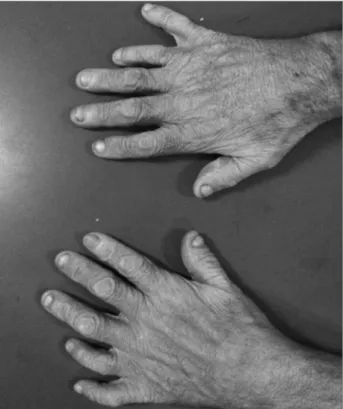
the presence of typical findings such as polydactyly (Figure 1), blindness, hypogenitalism and cognitive deficit. His parents were first cousins.
CASE 2
A 21-year old man was diagnosed as having ESRD during his first consultation with a nephrologist. The reason for referral was hypertension associated with high level of urea and creatinine. He was born with post-axial polydactyly. During childhood, cognitive deficit and visual deficiency were noted. He was treated since then as a case of idiopathic mental retardation. At the consultation with the nephrologist, hypogenitalism and obesity were noted besides cognitive deficit and blindness. He started HD two months after this first consultation.
CASE 3
A 38-year-old man born with polydactyly. He had learning difficulties in school. Diabetes was diagnosed at the age of 8, when he also started to complain of visual deficit. He became blind at the age of 15. He had been treated for diabetes during 15 years, after which he was referred to a nephrologist because of renal failure thought to be secondary to diabetic nephropathy. The sum of polydactyly, hypogenitalism, blindness, cognitive deficit and obesity led to the diagnosis of BBS.
CASE 4
Relatives of the above patients were screened for manifestations of BBS. A cousin of case 1 was found as having polydactyly, cognitive deficit, hypogenitalism, obesity and blindness, although with normal renal function. He is a 55-year-old man and is currently being monitored by our staff.
presence of four major features or three major plus two minor features establishes diagnosis of the syndrome.4 Among these manifestations, only post-axial polydactyly is apparent at birth. Obesity appears frequently during childhood, learning difficulties du-ring school age and visual difficulties by the teen years. Neither the incidence of BBS nor the prevalence of BBS among patients submitted to maintenance dialysis is known in Brazil. Due to the syndrome’s rarity and to the fact that diabetes and hypertension are usual manifestations of BBS, many times renal dysfunction caused by the syndrome can be misdiagnosed as diabetic nephropathy or hypertensive nephrosclerosis, hindering awareness of the true prevalence of BBS among dialysis patients. Renal failure is the most frequent cause of death in BBS patients.5
Our interest is to report four cases of BBS diagnosed late in life: three end-stage renal disease (ESRD) pa-tients without diagnosis until they started hemodialysis (HD), and one case discovered during screening among relatives of the three BBS patients under HD.
C
ASE REPORTSAll cases presented at least four primary features required for a clinical diagnosis of BBS (Table 1). All cases were diagnosed at the Dialysis Unit of Santa Casa de Sobral Hospital, in Sobral, state of Ceará, Brazil.
CASE 1
A 61-year-old man started HD during hospitalization because of disorientation due to uremia. During childhood, he presented learning difficulties and quit school. At the age of 8, he became blind. For three years before hospitalization, he had suffered from anemia and hypertension. Hypertensive nephroscle-rosis was the initial etiological hypothesis for ESRD, probably because of patient’s age and history of
Case Gender Age at
diagnosis Obesity
Retinal dystrophy
Mental
retardation Polydactyly Hypogenitalism
Renal
function Follow-up
Clinical status
1 Male 58 - + + + + On HD 41
months
Well-adapted to HD
2 Male 18 + + + + + On HD 32
months
Well-adapted to HD
3 Male 33 + + + + + On HD 54
months
Well-adapted to HD
4 Male 53 - + + + + Normal 16
months Very well
TABLE 1 CLINICALFINDINGSOFTHEBARDET-BIEDLSYNDROMEPATIENTS
J Bras Nefrol 2014;36(2):250-253
Bardet-Biedl
252
D
ISCUSSIONNone of the cases had an early diagnosis of BBS, even though cardinal manifestations of the syndrome were present since childhood in all of them. Three were diagnosed when they already had ESRD needing dialysis. The fourth case with normal function was found after screening among relatives of the cases on dialysis. Although currently there is no treatment for BBS, early diagnosis is important to guide the management of the child through regular assessment of blood pressure, weight, renal imaging studies and function, ophthalmologic examinations and psychological support. Even neonatal diagnosis is possible by combining prenatal detection of polydactyly with ultrasonography plus genetic studies shortly after birth.6 Gynecologists and pediatricians have more chance to make an early diagnosis of the syndrome. Nevertheless, nephrologists have a main role in the treatment of the syndrome, since renal failure is the most frequent cause of death among BBS patients.5 In particular, pediatric nephrologists should be prepared to suspect the syndrome when treating children with renal tract abnormalities.
The prevalence of hypertension and diabetes in BBS patients may lead to misdiagnosis of the primary renal disease among ESRD patients. For
example, initial diagnosis in cases 1 and 3 were, respectively, hypertensive nephrosclerosis and diabetic nephropathy. In a prospective study, hypertension and diabetes were present, respectively, in 66% and 32% of the SBB patients.5
Renal dysfunction is lacking in case 4. In a population survey in the United Kingdom, chronic kidney disease was found in only 5% of the BBS cases, but renal anomalies (parenchymal cyst, calyceal clubbing, fetal lobulation, scarring, unilateral agenesis, dysplastic kidneys, renal calculi, vesicoureteric reflux) were present in 46% of BBS patients.4
Despite the presence of mental retardation in all our cases, all patients are quite well adapted to daily life, probably because they all count on a good social support. Case 1 has close friends and cases 2 and 3 are cared for by their mothers. Case 1 works as a gardener and is very well-liked in his community. The other patients do not have work activity. Case 1 had panic attacks between the ages of 38 and 40, but not anymore. Case 2 is the youngest, has very good interaction with dialysis staff and likes to listen to soccer matches on radio. Case 3 has clear emotional immaturity and acts like a child. We have less information about the daily life of case 4, since he is an outpatient with less contact with our team.
None of our HD patients are on the transplant waiting list. In general, mental retardation is a relative contraindication for kidney transplant. However, the literature shows good transplant outcomes among BBS patients. In particular, steroid-free immunosuppressive therapy may be more appropriate due to the usual high body mass index among these patients.7
Finally, we are aware of increased incidence of obesity, hypertension, diabetes and renal cancer among heterozygote carriers.8,9 Thus, relatives of our BBS patients are closely followed in our ambulatory clinic.
In summary, BBS can be detected based on clinical manifestations without laboratory resources. Nephrologists can help to diagnose BBS among patients with renal failure. BBS cases in dialysis units can serve as indexes for the screening of the syndrome, and by doing so, provide more data on the prevalence of BBS in countries like Brazil, where there are no data on the incidence of the syndrome.
J Bras Nefrol 2014;36(2):250-253
Bardet-Biedl
253
R
EFERENCES1. Forsythe E, Beales PL. Bardet-Biedl syndrome. Eur J Hum Genet 2013;21:8-13. DOI: http://dx.doi.org/10.1038/ejhg.2012.115 2. Farag TI, Teebi AS. High incidence of Bardet Biedl syndrome
among the Bedouin. Clin Genet 1989;36:463-4. PMID: 2591073 3. Cardenas-Rodriguez M, Irigoín F, Osborn DP, Gascue C,
Katsanis N, Beales PL, et al. The Bardet-Biedl syndrome-related protein CCDC28B modulates mTORC2 function and interacts with SIN1 to control cilia length independently of the mTOR complex. Hum Mol Genet 2013;22:4031-42. DOI: http:// dx.doi.org/10.1093/hmg/ddt253
4. Beales PL, Elcioglu N, Woolf AS, Parker D, Flinter FA. New criteria for improved diagnosis of Bardet-Biedl syndrome: re-sults of a population survey. J Med Genet 1999;36:437-46. 5. O'Dea D, Parfrey PS, Harnett JD, Hefferton D, Cramer BC, Green
J. The importance of renal impairment in the natural history of Bardet-Biedl syndrome. Am J Kidney Dis 1996;27:776-83. PMID: 8651240 DOI: http://dx.doi.org/10.1016/S0272-6386(96)90513-2
6. Ashkinadze E, Rosen T, Brooks SS, Katsanis N, Davis
EE. Combining fetal sonography with genetic and allele pathogenicity studies to secure a neonatal diagnosis of Bardet-Biedl syndrome. Clin Genet 2013;83:553-9. DOI: http://dx.doi.org/10.1111/cge.12022
7. Sharifian M, Dadkhah-Chimeh M, Einollahi B, Nafar
M, Simforoush N, Basiri A, et al. Renal transplantation in patients with Bardet-Biedl syndrome. Arch Iran Med 2007;10:339-42.
8. Croft JB, Swift M. Obesity, hypertension, and renal disease in relatives of Bardet-Biedl syndrome sibs. Am J Med Genet 1990;36:37-42. DOI: http://dx.doi.org/10.1002/ ajmg.1320360109