Fisioter. Mov., Curitiba, v. , n. , p. - , Oct./Dec. Licenciado sob uma Licença Creative Commons DO): http://dx.doi.org. . / - . . .AO
[T]
Identification of changes in kinematics and electromyographic
parameters during dual-task gait: a comparative study
between young and elderly female subjects
[)]
Identii cação de alterações nos parâmetros cinemáticos
e eletromiográi cos durante marcha com dupla-tarefa:
um estudo comparativo entre jovens e idosas
[A]
Camilla Zamfolini Hallal[a],[b], Deborah Hebling Spinoso[b], Mary Hellen Morcelli[b], Ligia Cristiane Fonseca[b], Mauro Gonçalves[b], Nise Ribeiro Marques[b]*
[a] Faculdade de Educação Física e Fisioterapia, Universidade Federal de Uberlândia FAEF)-UFU , Uberlândia, MG, Brazil.
[b] Universidade do Estadual Paulista UNESP , )nstituto de Biociências, Rio Claro, SP, Brazil.
[R]
Abstract
Introduction: Falls during gait are one of the leading causes of death and injuries in elderly adults. Objective: This study aimed to compare the performance of young YG and elderly EG adults during
dual-task gait using a traffic light simulator according to kinematics and electromyographic parameters.
Materials and methods: young and elderly physically fit female subjects participated in this study.
The volunteers walked on a treadmill under two different conditions: normal gait M and dual-task gait
* CZ(: PhD, e-mail: [email protected] D(S: MSc, e-mail: [email protected] M(M: PhD, e-mail: [email protected] LCF: MSc, e-mail: [email protected] MG: PhD, e-mail: [email protected]
M . We recorded EMG signals from the rectus femoris RF , vastus medialis VM , vastus lateralis VL , biceps femoris BF , tibialis anterior TA , gastrocnemius lateralis GL and soleus SO . The following ki-nematic data were obtained: step length, step time and self-selected velocity. Data analysis was performed using Wilcoxon's, Mann-Whitney, T-student tests and T-student for independent samples. The level of
signifi-cance was set at p < . . Results: For both groups, there was greater muscle activation of the RF, VM, VL, BF
and SO during M than during M . The YG showed lower muscle activation of the RF, VM, BF and SO during M when compared to EG. The EG had smaller step length than the YG. The step length values detected during M were higher than the ones collected during M . During M , the YG showed higher step time com-pared to the EG. Elderly subjects walked at a lower self-selected velocity than young subjects. Conclusions:
Our findings suggest that dual-task gait modify the neuromuscular behavior in elderly subjects, increasing the risk of falls.
[P]
Keywords: Biomechanics. Electromyography. Kinematics. Gait.
[B] Resumo
Introdução: Quedas são eventos frequentes durante a marcha e são consideradas as principais causas de morte e lesões em idosos. Objetivos: O presente estudo teve por objetivo comparar o desempenho de jovens (GJ) e idosas (GI) durante a marcha com dupla tarefa cotidiana (simulador de semáforos) por meio de parâmetros cinemáticos e eletromiográficos. Materiais e métodos: Participaram do estudo 17 jovens e 18 idosas ativas. As voluntárias andaram sobre esteira em 2 condições distintas: marcha normal (M1) e marcha dupla tarefa (M2). Os sinais eletromiográficos foram coletados dos músculos reto femoral (RF), vasto medial (VM), vasto lateral (VL), bíceps femoral (BF), tibial anterior (TA), gastrocnêmio lateral (GL) e sóleo (SO). Os dados cinemáticos analisados foram comprimento de passada, tempo de passada e velocidade de preferência. Para a análise dos dados foram usados os testes de Wilcoxon, Mann-Whitney, o teste T-student e o T-student para amostras independentes. Foi adotado nível de significância de p < 0,05. Resultados: Os músculos RF, VM, VL, BF e SO apresentaram ativação muscular maior na condição M2 em relação à condição M1 no GI e GJ. O GJ apresentou ativação muscular menor do RF, VM, BF e SO na condição M2 que GI. Na condição M1 os valores de comprimento de passada encontrados foram maio-res que na condição M2. O tempo de passada para o GJ na condição M2 foi maior do que para o GI. Conclusões: Os idosos apresentaram velocidade de preferência menor que jovens. Nossos resultados sugerem que a marcha associada à dupla tarefa cotidiana, altera o comportamento neuromuscular do idoso, aumentando assim o risco de quedas. [K]
Palavras-chave: Biomecânica. Eletromiografia. Cinemática. Marcha.
Introduction
The aging process causes functional and structural changes in the body such as changes in sensory, motor and musculoskeletal systems, which compromise a person's ability to perform complex motor tasks and affect the performance of daily life activities , . The combination of these aging-associated changes greatly increases the risk of falls for older adults .
Fall is defined as an accidental event which results in an individual coming or dropping down to a lower position in relation to the start position . Falls are one of the leading causes of death and injuries in
elderly adults, and account for about % of cases of death in this population . )n Brazil, it is estimated that about . million elderly fall each year and, of these, . million suffer some kind of fall-retaled consequence . The occurrence of falls is potentially harmful because it contributes to the emergence of health problems and results in decreased quality of life and reduced social activities .
703 use some adaptive strategies such as reduced speed,
reduced stride length, reduction of the swing phase duration and decreased joint motion of the hip, knee and ankle , .
When gait is performed simultaneously with other cognitive or motor tasks, the performance of both tasks may be negatively affected because walking re-quires attention and high levels of cognition to esti-mate, plan and execute . Thus, if gait is performed in concurrence with another task, postural changes that increase the risk of falls may occur , , . Studies show that the influence of dual tasks on pos-tural control is bigger when the level of complexity of the task is high. Nevertheless, postural changes can also be observed during the performance of simple tasks such as daily living tasks .
Falls in the elderly can be prevented through the early detection of aging-related biomechani-cal changes that may alter gait pattern . Thus, the identification of temporal and spatial kinemat-ic changes in gait patterns caused by the perfor-mance of dual tasks and the assessment of lower limbs muscle activity in the elderly provide aids to guide the implementation of physical therapy in-tervention strategies. )n this sense, the aim of this study is to compare the performance of young and elderly female adults during dual-task gait according to kinematics and electromyographic parameters. Although there are a few studies in the literature investigating dual-task gait in elderly and young people, there are no studies assessing kinematics
and electromyographic variables during dual-task gait using of a traffic light simulator, as in this study. Thus, we hypothesized that when young and elderly adults perform dual-task gait, there is higher muscle activation of the lower limbs and more pronounced changes in step length and step time in the elderly when compared to young adults.
Materials and Methods
Participants
female volunteers participated in this study. They were divided into two groups according to their age: the young group YG and the elderly group EG . The YG was composed of female, physically active university students with a mean age of . ± . years. The EG was composed of female, physically active subjects at low risk of falls, with an average age of . ± . years and recruited from a physical activity community group for older adults. EG par-ticipants were classified according to their risk of falls using the Berg Balance Scale, which consists of tasks involving static and dynamic balance con-trol during the performance of functional tasks. The final score obtained on the scale predicts the risk of falls in the assessed elderly subjects . All elderly participants were at low risk of falls according to the Berg Balance Scale. The volunteers' characteristics are summarized in Table .
Table 1 - Volunteers' characteristics
Young adults Elderly adults p
Age (years) 21.47 (± 2.06) 65.33 (± 3.14) 0.00*
Body mass (Kg) 60.68 (± 5.93) 64.00 (± 1.55) 0.23
Height (m) 1.63 (± 0.05) 1.55 (± 0.05) 0.00*
Self-selected velocity (m/s) 0.95 (± 0.84) 0.70 (± 1.92) 0.00*
Note: * Signifi cant values (p < 0.05).
The inclusion criteria were based on the stud-ies by (ahn, Lee and Chou and Abbud, Li and Demont . These were presence of pain, fracture or serious injury to soft tissues in the six months preceding the study; and presence of neurological,
distance between the reflective markers placed on the right malleolus and the left metatarsus when the right calcaneus touches the ground , according to protocol adapted Kang & Dingwell .
EMG signals were collected at a (z sampling frequency and processed in MATLAB . ®. To create the linear envelope, we used a high pass filter of (z, a low pass of (z to k(z and a notch of (z. The rectified data were interpolated at points on the ten gait cycles of each gait condition. All the linear envelope values were normalized by the mean values obtained for each muscle during normal gait. The following kinematic data were obtained: step length, step time and self-selected velocity. Data were collected at a sampling frequency of fps and pro-cessed using an image analysis software Vicon® . - Peak Motus . The step length values were normalized by the size of the right lower limb of each volunteer. Statistical analysis was performed using PASW
sta-tistics . ®. Regarding the analysis of muscle activation
data, the Wilcoxon's test was used to compare the two different gait conditions within the same group and the Mann-Whitney test was used for comparisons between groups. With regard to the analysis of step length and step time, the T-student test was used to compare the two different gait conditions within the same group and the T-student for independent samples was used for comparisons between groups. Self-selected velocity data were analyzed using Mann-Whitney test. The level of significance was set at p < . .
Results
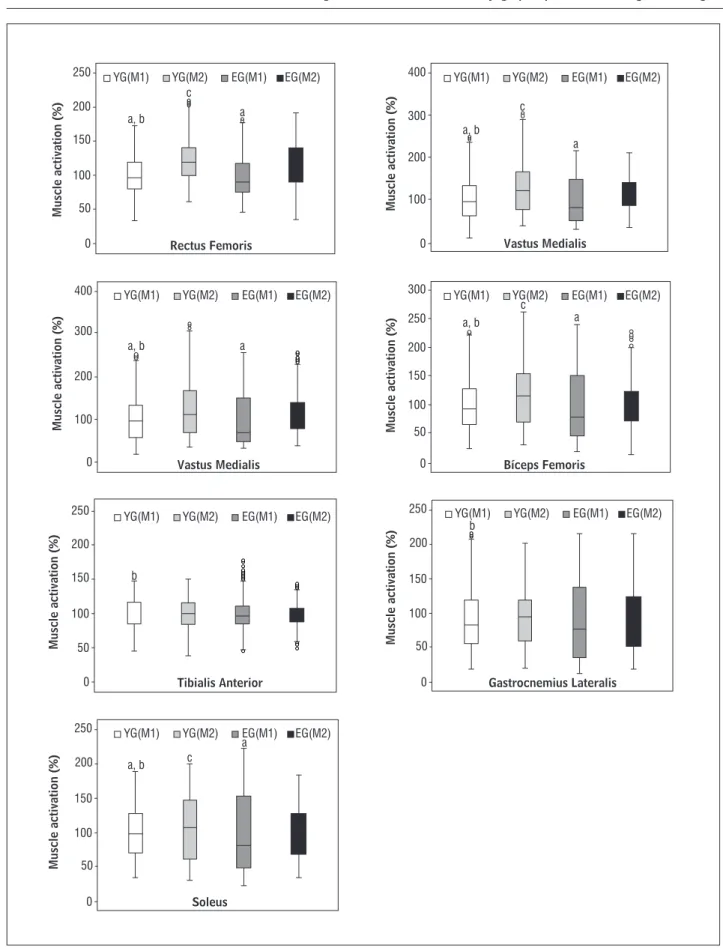
For both groups, there was significantly greater muscle activation of the RF, VM, VL, BF and SO during M than during M . The EG showed p = . for RF, VM, VL, BF and SO. The YG showed p = . for RF, VM, VL and SO and p = . for BF.
During M , the EG showed significantly greater muscle activation of RF, VM, VL, BF, TA, GL and SO p = . ; p = . ; p = . ; p = . ; p = . ; p = . ; and p = . , respectively than the YG. The YG showed significantly lower muscle activation of the RF, VM, BF and SO during M when compared to EG p = . ; p = . , p = . , and p = . , respectively . Figure shows maximum, minimum and median values of muscle activation of RF, VM, VL, BF, TA, GL and SO, respectively, for the YG and EG during M and M .
Instruments
EMG signals were recorded with a -channel telemetric EMG system Noraxon® MyoResearch, USA and further analyzed with Myoresearch soft-ware Noraxon®, USA . Kinematic data were collected in sagittal plane using a digital camera NV-GS Panasonic® at fps and an image analysis software
Vicon® . - Peak Motus . The gait test was performed on a Millennium Super ATL )NBRAMED® treadmill.
Procedures
EMG signals were collected throughout the gait test period. Surface electrodes Ag/AgCl; Meditrace® were arranged in bipolar configuration torecord sur-face EMGs for the following muscles, considering the Surface EMG for the Non )nvasive Assessment of Muscles SEN)AM rules: rectus femoris RF , vastus medialis VM , vastus lateralis VL , biceps femoris BF , tibialis anterior TA , gastrocnemius lateralis GL and soleus SO .
Kinematic data were collected in the sagittal plane with reflective markers placed on the right lateral malleolus and left medial malleolus, and between the first and second right and left metatarsals.
Before starting the gait test, the subjects got fa-miliarized with the treadmill by walking on it at their self-selected velocity . After familiarization, the test was started and volunteers walked on the tread-mill under two different conditions.
During the first condition normal gait, M , the volunteers were asked to walk on the treadmill at their self-selected velocity for three consecutive min-utes. The second condition dual-task gait, M was tested after M . During M , the volunteers were in-structed to walk on the treadmill at their self-selected velocity and, at the same time, pay attention to a ran-dom system of colored lights, similar to a traffic light. The instructions were to name the colors as the lights lit and they appeared.
Data analysis
705
Muscle activation (
%
)
Muscle activation (
%
)
Muscle activation (
%
)
Muscle activation (
%
)
Muscle activation (
%
)
Muscle activation (
%
)
Muscle activation (
%
)
Rectus Femoris Vastus Medialis
Bíceps Femoris
Gastrocnemius Lateralis Vastus Medialis
Tibialis Anterior
Soleus 250
200
150
100
50
0
400
200 300
100
0
250
200
150
100
50
0
400
300
200
100
0
50 300
200 250
100 150
0
50 200 250
100 150
0
50 200 250
100 150
0
a, b
a, b
a, b
a, b
a, b a
a
b
a
a
a c
c
c
c
YG(M1) YG(M2) EG(M1) EG(M2)
YG(M1) YG(M2) EG(M1) EG(M2)
YG(M1) YG(M2) EG(M1) EG(M2) YG(M1) YG(M2) EG(M1) EG(M2)
YG(M1) YG(M2) EG(M1) EG(M2)
YG(M1) YG(M2) EG(M1) EG(M2)
YG(M1) YG(M2) EG(M1) EG(M2)
b
Figure 1 - Median and quartiles values of muscle activation of RF, VM, VL, BF, TA, GL and SO for the EG and YG during normal gait and dual-task gait
Note: a Signifi cant difference between M1 and M2 in the same group. b Signifi cant difference between groups for M1. c Signifi cant difference
The EG had smaller step length than the YG during M and M p = . and p = . , respectively . Within the same group, only the EG showed signifi-cant differences between the results collected during M and M p = . . The step length values de-tected during M were higher than the ones collected during M Figure .
Elderly Subjects Young Subjects 50
M1 M2
70 130 150
90 110
Stride Length (
%
)
a,b
c
Figure 2 - Normalized values of step length
Note: a Signifi cant difference between M1 and M2 in the same group. b Signifi cant difference between groups for M1. c Signifi cant
difference between groups for M2.
During M , the YG showed significantly higher step time compared to the EG p = . . There was no significant difference between normal gait and dual-task gait in the same group p = . for the EG and p = . for the YG , nor significant difference be-tween groups during normal gait p = . . Table shows the mean and standard deviation values of step time for the EG and the YG during M and M .
The results show a significant difference in self-selected velocity between EG and YG, p = .
Figure .
Although risk factors for falls are multifactorial, more than % of falls in older persons occur dur-ing walkdur-ing , . The impact of cognitive function on gait pattern has been extensively studied in the last decade, as this activity is no longer considered to be an automatic task, but rather an activity with a growing recognition of cognition , .
YG EG
1.5
0.5
-0.5 1
0 2
*
Gait Speed(MS)
Figure 3 - Self-selected velocity (m/s) of the YG and EG Note:* Signifi cant difference (p ≤ 0.05).
Table 2 - Mean and standard deviation values of step time for young and elderly adults during normal gait and dual-task gait.
Young adults Elderly adults
Normal gait 1.175 (± 0.086) 1.129 (± 0.130)
Dual-task gait 1.160*(± 0.086) 1.055 (± 0.114)
Note: * Signifi cant difference between groups during dual-task gait.
The performance of a cognitive or motor dual-task during gait may affect the performance of both activities, depending on neuropsychological and motor resources, and on the priority and complex-ity of the tasks . Some authors claim that, when elderly people are exposed to situations that involve the simultaneous performance of motor and cognitive tasks, changes in postural control may occur, increas-ing the risk of falls in this population - . Thus, the aim of this study is to compare the performance of young and elderly female adults during dual-task gait according to kinematics and electromyographic parameters.
707 a cognitive resource that is necessary for proper gait performance. Therefore, activities that compromise attention may be associated with postural instabil-ity and disturbances in the performance daily living tasks, and may lead to falls .
Montero-Odasso et al. have examined kine-matic variables in elderly patients with mild cogni-tive impairment during normal gait and dual-task gait. Contrary to the results of this study, these au-thors found higher step time during dual-task gait. This difference may be due to the fact that, in the aforementioned study, gait analysis was performed on a platform, while in this study a treadmill was used. Thus, because subjects exercised at a constant treadmill velocity throughout the test self-selected velocity , only a limited number of kinematic adjust-ments due to speed changes have been made. This may have caused a reduction in step time that was probably due to an increase in cadence.
Another significant finding was that elderly sub-jects walked at a lower self-selected velocity than young subjects, which is in line with studies by Beauchet et al. and Yogev-Seligmann et al. . Verghese et al. believe that a cm/s decrease in gait velocity may be associated with a % increase in the risk of falls. )n a study conducted by Kang & Dingwell , self-selected velocity was similar in the young and elderly groups. This discrepancy between the results of the two studies is probably mainly due to individual characteristics of participants.
Although steps were taken to ensure maximum standardization of methodological procedures in this study, there are some limitations related to the interpretation of the results. The elderly women who participated in this study were classified as being at low risk for falls Berg Balance Scale and were physically active. Thus, as these characteristics may significantly interfere with the performance of the proposed tasks, the extrapolation of the results to sedentary elderly subjects and/or to elderly popula-tions at high risk for falls should be done with caution.
Conclusion
)n accordance with the proposed objectives of this paper, we did identify changes in kinematics and electromyographic parameters of young and elderly subjects during normal gait and dual-task gait. Thus, we conclude that age-related changes in dual-task VL, BF and SO during M than during M . According
to a study conducted by Nadkarni et al. , changes in gait parameters due to the simultaneous perfor-mance of cognitive tasks occur both in young and in elderly adults, although the gait adaptation strategy employed to maintain balance is different between these two groups. (owever, due to aging-related changes in sensory and motor functions, dual-task situations may represent a potential increased risk of falls for the elderly, given their reduced capacity to adapt when faced with challenging tasks - , . During M , the EG showed significantly greater muscle activation of all assessed muscles RF, VM, VL, BF, TA, GL and SO than the YG, which may indicate a deterioration of gait function in the elderly. Kang & Dingwell assessed the electromyographic ac-tivity in the VL, BF, TA and GM muscles medial gas-trocnemius of the lower limbs during normal gait in young and elderly patients, and found greater muscle activation of the VL, BF and GM in the last group of patients. These results can be explained by the fact that elderly people must use a greater percentage of their maximum strength to perform daily activi-ties, and thus, even during normal gait, they tend to activate more motor units than young individuals to walk safely .
During M , the EG had greater muscle activation of the RF, VM, VL, BF and SO than the YG, which shows that elderly people need to make greater neuromus-cular adjustments to maintain dynamic balance dur-ing the performance of challengdur-ing tasks . As a re-sult of this increased neuromuscular demand during the performance of activities that require a greater control over movements to maintain balance, the el-derly are more prone to developing muscle fatigue during gait, which enhances the risk of falls .
. Talbot LA, Musiol RJ, Witham EK, Metter EJ. Falls in young, middle-aged and older community dwelling adults: perceived cause, environmental factors and injury. BMC Public (ealth. ; : .
. (ollman J(, Youdas JW, Lanzino DJ. Gender differences in dual task gait performance in older adults. Am J Mens (ealth. ; .
. (ahn ME, Chou LS. Age-related reduction in sagittal plane Center of mass motion during obstacle cross-ing. J Biomech. ; : - .
. (ahn ME, Lee (J, Chou LS. )ncreased muscular chal-lenge in older adults during obstructes gait. Gait & Posture. ; : - .
. Abbud GAC, Li KZ(, Demont RG. Attentional requeri-ments of walking according to the gait phase and onset of auditory stimuli. Gait & Posture. ; : - . . Daele UV, (agman F, Truijen S, Vorlat P, Gheluwe BV,
Vaes P. Decreased in postural sway and trunk stiffness during cognitive dual-task in nonspecific chronic low back pain patients, performance compared to healthy control subjects. Spine. ; : - .
. Beauchet O, Dubost V, (errmann F, Rabilloud M, Gonthier R, Kressig RW. Relationship between dual-task related gait changes and intrinsic risk factors for falls among transitional frail older adults. Aging Clin Exp Res. ; : - .
. Chen CJ, Chou LS. Center of mass position relative to the ankle during walking: a clinically feasible detec-tion method for gait imbalance. Gait & Posture. ;
: - .
. Miyamoto ST, Lombardi Júnior ), Berg KO, Ramos LR, Natour J. Brazilian version of the Berg balance scale. Braz J Med Biol Res. ; : - .
. (ermens J(, Freriks B, Disselhorst-Klug C, Rau G. De-velopment of recommendations for SEMG sensors and sensor placement procedures. J Electromyogr Kinesiol. ; : - .
. Dingwell JB, Marin LC. Kinematic variability and local dynamic stability of upper body motions when walk-ing at different speeds. J Biomech. ; : - . . Kang (G, Dingwell JB. Separarating the effects of age
and walking speed on gait variability. Gait & Posture. ; : - .
gait patterns also alter the neuromuscular behav-ior of the elderly, affecting their ability to maintain dynamic balance during gait and thereby increasing the risk of falls.
Given that the identification of aging-related bio-mechanical changes in gait can help in the imple-mentation of strategies for falls prevention among older people, it is suggested that further studies are conducted with sedentary elderly subjects at high risk of falls, addressing the performance of other ev-eryday tasks during gait.
Acknowledgments
We are grateful to the CNPq, FAPESP and Fundunesp for their financial support.
References
. Kerrigan DC, Todd MK, Croce UD, Lipsitz LA, Collins JJ. Biomechanical gait alterations independent of speed in the healthy elderly: evidence for specific limiting im-pairments. Arch Phys Med Rehabil. ; : - . . Yen (C, Chen (L, Liu MW, Liu (C, Lu TW. Age effects
on the inter-joint coordination during obstacle-cross-ing. J Biomech. ; : - .
. Tucker MG, Kavanagh JJ, Morrison S, Barrett RS. What are the relations between voluntary postural sway measures and falls-history status in commu-nity-dwelling older adults? Arch Phys Med Rehabil.
; : - .
. Schultz BW, Lloyd JD, William E. The effects of ev-eryday concurrent task on overground minimum toe clearance and gait parameters. Gait & Posture.
; : - .
. Abreu SSE, Caldas CP. Velocidade de marcha, equilí-brio e idade: um estudo correlacional entre idosas praticantes e idosas não praticantes de um pro-grama de exercícios terapêuticos. Braz J Phys Ther.
; : - .
709 . Maki BE. Gait changes in older adults: predictors
of falls or indicators of fear. J Am Geriatr Soc. ; : - .
. Dubost V, Kressig RW, Gonthier R, (errmann FR, Aminian K, Najafi B, et al. Relationships between du-al-task related changes in stride velocity and stride time variability in healthy older adults. (um Mov Sci.
; : - .
. Montero-Odasso M, Casas A, (ansen KT, Bilski P, Gutmanis ), Wells JL, et al. Quantitative gait analysis under dual-task in older people with mild cognitive impairment: a reliability study. J NeuroEngineering and Rehabil. ; .
. Beauchet O, Allali G, Annweiler C, Bridenbaugh S, Assal F, Kressig RW, (errmann FR. Gait variability among healthy adults: low and high stride-to-stride variability are both a reflection of gait stability. Ger-ontology. ; : - .
. Yogev-Seligmann G, Rotem-Galili Y, Mirelman A, Dickstein R, Giladi N, (ausdorff JM. (ow does explicit prioritization alter walking during dual-task perfor-mance? Effects of age and sex on gait speed and vari-ability. Phys Ther. ; : - .
. Verghese J, (oltzer R, Lipton RB, Wang C. Quan-titative gait markers and incident fall risk in older adults. J Gerontol A Biol Sci Med Sci. ; :
- .
Received: / /
Recebido: / /
Approved: / /
Aprovado: / /
. Alexander NB, (ausdorff JM. Guest editorial: linking thinking, walking, and falling. J Gerontol A Biol Sci Med Sci. ; : - .
. Yogev-Seligmann G, (ausdorff JM, Giladi N. The role of executive function and attention in gait. Mov Disord.
; : - .
. Nordin E, Moe-Nilssen R, Ramnemark A, Lundin--Olsson L. Changes in step-width during dual-task walking predicts falls. Gait & Posture. ; : - . . Nadkarni NK, Zabjek K, Lee B, Mcllroy WE, Black SE.
Effect of working memory and spatial attention tasks on gait in healthy young and older adults. Motor Con-trol. ; : - .
. Bassey, EJ. Physical capabilities, exercise and aging. Reviews in Clinical Gerontology. ; : - . . Meuleman JR, Brechue WF, Kubilis PS, Lowenthal DT.
Exercise training in the debilitates aged: strength and functional outcomes. Arch Phys Rehabil. ; :
- .
. Kang (G, Dingwell JB. Dynamics and stability of mus-cle activations during walking in healthy young and older adults. J Biomech. ; : - .
. Fiatarone MA, Evans WJ. The etiology and revers-ibility of muscle dysfunction in the aged. J Gerontol.
; S: - .
. Schmitz A, Silder A, (eiderscheit B, Mahoney J, Thelen DG. Differences in lower-extremity muscular activa-ton during walking between healthy older and young adults. J Electromyogr Kinesiol. ; : - . . (elbostad JL, Leirfall S, Moe-Nilssen R, Sletvold O.
Physical fatigue affects gait characteristics in older persons. J Gerontol A Biol Sci Med Sci. ; A :