SY
STEMA
TIC REVIEW
Corresponding address: Kênia Kiefer Parreiras de Menezes – Avenida Presidente Antônio Carlos, 6627, Department of Physical Therapy of Universidade Federal de Minas Gerais, Campus Pampulha – Belo Horizonte (MG), Brazil – Zip Code: 31270-901 – Email: [email protected] – Finance source: None – Conlict of interests: Nothing to declare – Presentation: Dec. 2016– Accepted for publication: Mar. 2017.
Study developed at Universidade Federal de Minas Gerais, Belo Horizonte, Minas Gerais, Brazil.
1Physical therapist, expert in Orthopedic Physical Therapy by Universidade Federal de Minas Gerais – Belo Horizonte (BH), Brazil. 2Master in Rehabilitation Sciences, doctoral candidate by Universidade Federal de Minas Gerais – Belo Horizonte (BH), Brazil. 3Master in Rehabilitation Sciences, Doctoral candidate by Universidade Federal de Minas Gerais – Belo Horizonte (BH), Brazil.
ABSTRACT | Kinesio Taping (KT) has been used in the rehabilitation of post CVA patients and several recent studies have investigated its efects on the gait of these subjects, reporting promising results. We investigated the efects of the use of KT in the gait of stroke subjects through a systematic review of the literature. Searches were conducted on databases Medline, CINAHL, SPORTDiscus, Web of Science, LILACS and PEDro, without restrictions of date or language of publication. The articles were screened independently by two evaluators and disagreements were resolved by a third party. Methodological quality was assessed according to PEDro scale. When possible, outcome measures were analyzed using the program Comprehensive Meta-Analysis, version 3.0. We included 15 studies of low to moderate methodological quality (mean 4.7). For gait speed, we included 7 studies of low to moderate methodological quality in the meta-analysis that, under the model of ixed efects, found that the KT signiicantly increased the gait speed of post-stroke subjects in 0.05 m/s (95%CI 0.002 to 0.100; I2=0%; p<0.05). However, for the step length, functional mobility and balance no signiicant diference was found (p>0.05). This systematic literature review showed there are still no evidence about the use of KT in rehabilitation of post-stroke patients in order to improve the gait. Although gait speed, according to the meta-analysis, have shown a statistically signiicant gain, its value cannot be considered clinically relevant to patients. Keywords | Compression Bandages; Stroke; Gait; Rehabilitation; Review.
218
RESUMO | O Kinesio® Taping (KT) vem sendo utilizado na reabilitação de pacientes pós-acidente vascular encefálico (AVE) e vários estudos recentes têm investigado seus efeitos na marcha destes indivíduos, reportando resultados promissores. Investigou-se, por meio de uma revisão sistemática da literatura, os efeitos do uso do KT na marcha de indivíduos pós-AVE. As buscas foram realizadas nas bases de dados MEDLINE, CINAHL, SPORTDiscus, Web of Science, LILACS e PEDro, sem restrição de data ou idioma de publicação. Os artigos foram selecionados de forma independente por dois avaliadores e discordâncias foram resolvidas por um terceiro. A qualidade metodológica foi avaliada de acordo com a escala PEDro. Quando possível, as medidas de desfecho foram analisadas utilizando o programa Comprehensive Meta-Analysis, Versão 3.0. Foram incluídos quinze estudos de qualidade metodológica baixa a moderada (média de 4,7). Para velocidade de marcha, foram incluídos na metanálise sete estudos de qualidade metodológica baixa a moderada que, sob o modelo de efeitos ixos, encontrou que o KT aumentou signiicativamente a velocidade de marcha dos indivíduos pós-AVE em 0,05 m/s (95% IC 0,002 a 0,100; I2 = 0%; p<0.05). No entanto, para o comprimento do passo, mobilidade funcional e equilíbrio não houve diferença signiicativa (p>0,05). Esta revisão sistemática da literatura demonstrou que ainda não existem evidências sobre o uso do KT na reabilitação de pacientes pós-AVE com o objetivo de melhorar a marcha. Embora a velocidade de marcha, segundo a metanálise, tenha apresentado um
Efects of the Kinesio® Taping on the gait of stroke
subjects: a systematic review with meta-analysis
Efeitos do uso do Kinesio® Taping na marcha de indivíduos pós-acidente vascular encefálico:
uma revisão sistemática com metanálise
Efectos del uso de Kinesio® Taping en la marcha de invidíduos post-accidente cerebrovascular:
una revision sistemática con meta-análisis
ganho estatisticamente signiicativo, seu valor não pode ser considerado clinicamente relevante para os pacientes.
Descritores | Bandagens Compressivas; Acidente Vascular Cerebral; Marcha; Reabilitação; Revisão.
RESUMEN | El Kinesio® Taping (KT) que esta siendo utilizado en la rehabilitación de pacientes post-accidente cerebrovascular (ACV) y varios estudios recientes tienen investigado sus efectos en la marcha de estes individuos, reportándose resultados promisores. Se investigó por medio de una revisión sistemática de la literatura, los efectos de uso del KT en la marcha de individuos post-ACV. Las búsquedas fueron realizadas en las bases de datos Medline, CINAHL, SPORTDiscus, Web of Science, LILACS y PEDro, sin restricción de fecha o lengua de publicación. Los artículos fueron elejidos de forma independiente por dos evaluadores y desacuerdos fueron resueltos por un tercero. La calidad metodológica fue evaluada de acuerdo con la escala PEDro. Cuando posible, las medidas de conclusión
fueron analizadas utilizando el programa Comprehensive Meta-Analysis, versión 3.0. Fueron incluidos 15 estudios de calidad metodológica baja a moderada (media de 4,7). Para velocidad de marcha, fueron incluidos en el meta-análisis siete estudios de calidade metodológica baja a moderada que, bajo el modelo de efectos ijos, se observió que el KT aumentó signiicativamente la velocidad de marcha de los individuos post-ACV en 0,05 m/s (95% IC 0,002 a 0,100; I2=0%; p<0.05). Sin embargo, para la longitud de paso, movilidad funcional y equilibrio no hubo diferencia signiicativa (p>0,05). Esta revisión sistemática de la literatura demostró que aun no existan evidencias sobre el uso del KT en la rehabilitación de pacientes post-ACV con el objectivo de mejorar la marcha. Aunque velocidad de marcha, según el meta-análisis, tenga presentado un gano estadisticamente signiicativo, su valor no pudo ser considerado clinicamente relevante para los pacientes.
Palabras clave | Vendajes Compresivos; Accidente Cerebrovascular; Marcha; Rehabilitación; Revisión.
INTRODUCTION
he cerebrovascular accident (CVA) is deined as an acute neurological dysfunction of vascular origin with rapid onset of symptoms, which vary according to the afected region of the brain1. Among the damage caused by CVA, motor deiciencies are the most disabling2, limiting the performance of everyday activities such as the gait, for example. Among CVA survivors, only 15% report being able to walk outside the house 2 years after the injury and 70% have some dependency for the gait3. hus, this activity is considered as the most important by patients during rehabilitation, therefore it is a constant concern of therapists during this process3.
On the gait rehabilitation of stroke subjects, the physical therapist has some techniques in order to rehabilitate motor deiciencies and thus help the patient improve the movement standards4. One of these techniques, Kinesio Taping (KT) has been used in the rehabilitation of these individuals. Also known as elastic bandage, KT is made of cotton, which allows quick evaporation and drying without losing efectiveness, with acrylic adhesive capacity and activated by the body heat5. he KT mechanism of action is related to the direction and strength of pressure applied5. According to Kenzo Kase, creator of KT, application of the technique provides correction of muscle function by strengthening weak muscles, cutaneous stimuli
that facilitates or limits movement, aid in the reduction of edema by directing exudates towards lymphatic duct and lymph nodes, joint positioning correction for easing muscle spasms and pain reduction through neural pathway5-8. In addition, it also aims to improve the muscle physiology, proprioception, coordination and balance5-8.
hus, based on the facts mentioned, an update of the literature on the subject is needed. hus, the objective of this study was to conduct a systematic review of the literature to investigate the efects of KT use, through meta-analysis, in the gait of stroke subjects.
METHODOLOGY
Identiication and selection of studies
his study is a systematic literature review of randomized or controlled clinical trials. he searches held from January to July 2016 were conducted in the following databases: Medline, CINAHL, SPORTDiscus, Web of Science, LILACS and PEDro, without restrictions of date or language of publication. Search terms included words related to CVA, hemiplegia, hemiparesis, ischemia, KT and bandage, in addition to their respective terms in Portuguese, with speciic strategies for each base. he articles were screened independently by two evaluators and disagreements were resolved by a third party. Copies of the full texts of these studies were obtained and lists of references tracked by a manual search to identify other relevant studies. Unavailable copies were requested to authors via e-mail.
Evaluation of characteristics of the studies
• Quality: he methodological quality of included studies was assessed according to PEDro scale, described in the database Physiotherapy Evidence Database (www.pedro.org.au). he scale, composed of 11 items, was developed to classify the methodological quality (internal validity and statistical information) of randomized clinical trials. Each item, except item 1, contributes with a point for the total score of the scale, which ranges from 0 to 10 points. Scores of the studies described in the e-mail address from the database was used. Score of studies that were not included or not punctuated in PEDro database were carried out by the authors of this study.
• Participants: We included trials involving adult participants, after CVA, of both genders and no age limit. Information about the number of participants, gender, age and time after the stroke was recorded.
• Intervention: he experimental condition was the use of KT, without restriction of direction and pressure of application or bandage color, aiming to improve the stroke subjects. he control condition was none, a placebo intervention, conventional physical therapy or applying another technique for comparison of efects. • Outcome measures: Measures of interest were
any related to gait performance, such as speed, cadence, step length, balance etc.
Data analysis
Information about the method of studies (i.e. study design, participants, intervention and outcome measures) and results (i.e., number of participants and the mean/standard deviation of variables related to gait) were extracted by 2 independent evaluators and veriied by a third party. Post-intervention measures were used due to the availability of only these values in most studies, preferably using the ixed efects model. In the case of statistically signiicant heterogeneity (I2>40%), the efect size was analyzed using the random efects model. Analyses were carried out using the program Comprehensive Meta-Analysis, version 3.0. he critical value to reject H0 was set at a 5% signiicance level (2-tailed). Necessary information could not be found in the published version of the studies, additional details were requested to the corresponding author by e-mail. When data were not available to be included in the meta-analysis, the diference between the comparison groups was just described.
RESULTS
Characteristics of the included studies
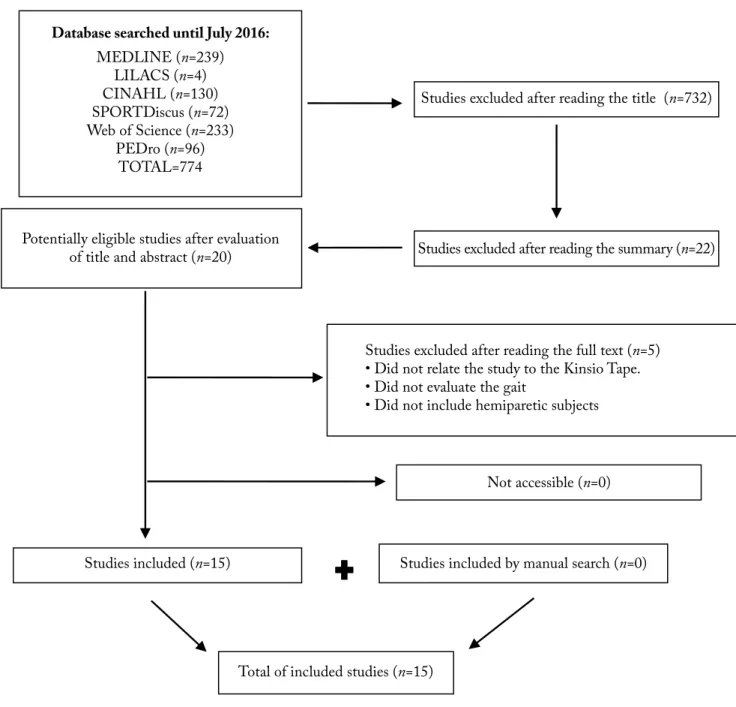
Database searched until July 2016:
MEDLINE (n=239) LILACS (n=4) CINAHL (n=130) SPORTDiscus (n=72) Web of Science (n=233)
PEDro (n=96) TOTAL=774
Studies excluded after reading the title (n=732)
Studies excluded after reading the summary (n=22) Potentially eligible studies after evaluation
of title and abstract (n=20)
Studies excluded after reading the full text (n=5) • Did not relate the study to the Kinsio Tape. • Did not evaluate the gait
• Did not include hemiparetic subjects
Not accessible (n=0)
Studies included (n=15) Studies included by manual search (n=0)
Total of included studies (n=15)
Figure 1. Flowchart of inclusion and exclusion of studies
he included studies are summarized in Chart 1, with 12 studies essays containing control and experimental groups and 3 studies containing only intervention group. Methodological quality of studies found ranged from low to high. he mean score achieved by studies at the PEDro scale was 4.7, ranging from 1 to 7 points. All studies were performed with convenience sample of patients who sufered stroke without limit of age or gender. Studies included 416 stroke patients, aged between 28 and 81 years old, grouped in mixed groups formed by men and women. Training programs varied from acute measures made with test before and after intervention up to 1, 2 and 3 months of follow-up. Among the studies that reported the application site of
KT, elastic tape was applied in the glutes, quadriceps, knee joint, patella, anterior and posterior tibial, ankle, biceps brachii and superior rotator cufs.
Efect of KT on the gait of stroke subjects
he descriptive results of all the studies are in Chart 1. In relation to meta-analysis, the efects of KT were evaluated for gait speed, step length, functional mobility and balance. Among the studies that evaluated these outcome measures, 5 that evaluated the gait speed 14,20,24,26,29 and 4 that evaluated the step length24,25,29,31
of mean values found or for not reporting the variability measures. hus, all studies included in the meta-analysis evaluated the gait speed and step length by the 10-meter walk test (7 studies), functional mobility by TUG (3 studies) and the balance by the Berg Balance Scale (5 studies).
For the speed gait, we included 7 studies of low to moderate methodological quality (PEDro mean of 4.6, varying from 3 to 5) that, under the ixed efects model, found that the KT signiicantly increased the gait speed of stroke subjects in 0.05 m/s (95%CI 0.002 to 0.100; I2=0%; p<0.05), when compared to no intervention
or placebo (Graph 1). However, also under the ixed efects model, the use of KT in stroke subjects did not signiicantly increase the step length (3 studies of low to moderate methodological quality, mean PEDro of 4.7–OM 0.03 95%CI – 0.01 to 0.07; I2=0%; p=0.19), functional mobility (3 studies of moderate to high methodological quality, mean PEDro of 5.3–OM 2.38 95%CI–5.99 to 1.23; I2=0%; p=0.20) and balance (5 studies of moderate to high methodological quality, mean PEDro of 5.2–OM 3.00 95%CI – 8.58 to 2.58; I2=18.3%; p=0.29), when compared with no intervention or placebo (Graph 2).
Chart 1. Summary of the included studies
Study / Score in
the PEDro scale Sample Objective Intervention Instruments/tests Results
Boeskov et al.14 / 2
32 acute stroke patients (9 women and 23 men), with an average age of 60 years old. No control group:
To investigate the KT effect in the anterior thigh and knee region on the maximum gait speed.
During 3 cycles, patients were told to walk 12 meters and measurements were made before and after the use of KT. Elastic KT was used applied to the anterior part of the thigh and knee.
10-Meter Walk Test
Use of KT has significantly improved the gait speed. Similarly, the number of steps taken during the 10MWT decreased significantly.
Carda et al.20 /7
69 stroke patients (35 women and 34 men), with an average age of 62 years old, divided into 3 groups: Group 1 – KT Group 2 – Serial Splint Group 3 – Stretching
To investigate the effect of different adjuvant treatments after botulinum toxin type a.
After the use of botulinum toxin in the Plantar flexors, the patients were randomly divided into 3 groups, accompanied by gait training for 30 minutes and plantar flexor stretching for 20 minutes 1 time per day for a week. Evaluations were made before the injections, 30 days and 90 days later.
6-minute walk test, 10-meter walk test and Functional Ambulation Categories.
Patients treated with KT for the first week had statistically significantly better and longer-lasting than those treated only with stretching.
Choi et al.23 / 5
30 patients (15 women and 15 men), with an average age of 54 years old, divided into 2 groups: Control: Neuromusucular Proprioceptive Facilitation Experimental: Neuromusucular Proprioceptive facilitation with KT application.
To compare the effects of KT on the joint angle of the knee joint and on the functioning of patients with hemiplegia resulting from stroke.
The experimental group received the proprioceptive neuromuscular facilitation 30 minutes during 4 weeks and KT. Elastic KT was applied to the patella for lower slide.
Berg Balance Scale and 10-Meter Walk Test.
The analysis demonstrated statistically significant improvement in balance and speed for the experimental group. There was also significant improvement among the groups on balance and gait speed compared to the control group.
Ekiz et al.21 / 5
24 patients (12 men and 12 women) with an average age of 51 years old, divided into 2 groups:
Control: without application of KT. Experimental: with application of KT.
To evaluate the effects of KT application on isokinetic muscular strength of the quadriceps, gait and functional parameters of stroke patients.
Both groups performed a conventional rehabilitation program 5 times a week for 4 weeks. Elastic KT was used on the vastus medialis, vastus lateralis and bilateral rectus femoris muscle.
6-minute walk test, 10-meter walk test, Berg Balance Scale, Timed Up and Go Test and Rivermead Mobility Index.
Compared to baseline levels, there has been significant improvement in gait, balance and gait speed of the KT group. However, there was no statistically significant difference between the groups.
Hillier et al.26 / 6
5 patients (2 women and 3 men), aged between 49 and 78 years old.
To investigate the potential effect of KT on ankle inversion control.
Patients were instructed to walk on a force platform during 6 gait cycles. Measurements were made before and after the use of elastic KT on the ankle during 2 days.
Force platform
There was improvement in the heel contact and ankle inversion control after using the KT.
Study / Score in
the PEDro scale Sample Objective Intervention Instruments/tests Results
Hwang et al.27 / 5
13 patients (9 men and 4 women) with an average age between 48 and 81 years old, exposed to 2 situations: with and without the KT.
To investigate the immediate effects of elastic sling made of KT on the standards of gait of stroke patients.
Patients were instructed to walk on a treadmill twice in each condition, with a 5-minute break between cycles.
Cadence, 10-Meter Walk Test, step length and stride length.
The condition that used the elastic sling had a statistically significant increase in the step length and speed gait compared to baseline values.
Hyun et al.28 / 5
30 patients (13 men and 17 women), with an average age of 53 years old, divided into 2 groups:
Control: application of placebo KT.
Experimental: with application of KT.
To determine the effects of KT Mulligan in balance and gait in acute stroke patients.
Measurements were made before and after the intervention with a 30-minute interval. The KT was applied on the knee joint of the experimental group and placebo KT in the knee joint of the control group.
Cadence, 10-Meter Walk Test, step length and stride length.
The balance in the dynamic position of the experimental group significantly improved after the KT application. The gait cadence, speed and length of the step also improved significantly. However, no significant differences were observed in the standing balance or gait balance for the control group compared to the group that used KT.
Karadag-Saygi et al.29 / 7
20 stroke patients (12 women and 8 men), with an average age of 60 years old, divided into 2 groups:
Group A – botulinum toxin and KT Group B – botulinum toxin and placebo KT
To evaluate the effect of KT as an adjuvant therapy to botulinum toxin on spasticity.
The KT was applied by a physical therapist after application of botulinum toxin. Home exercises were made twice a day for 20 minutes, for 4 weeks. The clinical evaluation was made before and after 2 weeks and 1, 3 and 6 months. KT was used applied on elastic ankle, tibialis anterior and gastrocnemius.
Step length and 10-meter walk test.
The KT group showed increase in the step length in the first month and increased gait speed after the first and the third month. However, there was no significant difference between the groups.
Kilbreath et al.30 / 4
15 acute stroke patients (10 men and 5 women) with an average age of 62 years old, exposed to 3 situations: without KT, with KT in the gluteus, and placebo KT.
To determine whether the KT in the glutei causes improvement of hip extension of the affected side during the phase of support for stroke people.
For each of the 3 conditions (without KT, elastic KT application on the gluteus, and application of placebo KT) subjects walked for 10 meters in a self-selected speed and as fast as possible, for 5 cycles, eliminating 2 cycles to avoid learning effect.
2D motion analysis, step length and 10-meter walk test.
KT in the gluteus caused a statistically significant improvement in hip extension with an increase in the step length in the affected side immediately after its application. In contrast, the placebo KT did not improve.
Kim et. al.22 / 5
30 stroke patients divided into 2 groups: Control: without application of KT. Experimental: with application of KT.
To evaluate changes in function and balance after application of KT in stroke patients.
KT was applied on the affected side in the quadriceps, tibialis anterior, biceps brachii and cuff rotators muscles. KT was used for 6 weeks and the gait evaluation and balance was made before and after.
Straight Line Walking Test, Berg Balance Scale and 10-Meter Walk Test.
There was no statistically significant difference in the straight line walking test and 10-meter test for the experimental group. There was also a statistically significant difference in the Berg Balance Scale and 10-meter walk test between the 2 groups. The experimental group showed a significant improvement in the Straight Line Walking Test and the 10-meter walk test compared to the control group.
Maguire et al.25 / 3
13 stroke patients (5 women and 25 men) with an average age of 64 years old, exposed to 4 situations: walking with nothing, with KT on hip abductors, using a cane and with the use of TheraTogs.
To investigate the effects of each condition in temporospatial parameters of gait.
During 6 gait cycles, the subjects walked with self-selected speed over a line. The electrodes were placed on the gluteus medius and the tensor fasciae latae.
Electromyography, 10-meter walk test and step length.
The combined use of KT in hip abductors and TheraTogs increased in a statistically significant way the muscle activity of the hemiplegic hip abductors and speed gait compared to baseline values.
Chart 1. Continuation
Study / Score in
the PEDro scale Sample Objective Intervention Instruments/tests Results
Nam et al.19 / 5
30 stroke patients (16 women and 14 men), with an average age of 64 years old, divided into 2 groups: Control: without application of KT. Experimental: with application of KT.
To investigate the influence of exercise on the ability of balance and gait function in stroke patients after application of KT.
Exercises 3 times a week for 6 weeks with elastic KT, applied to the ends of the affected lower side.
In the experimental group, KT was applied before the therapeutic exercises. In the control group, only the therapeutic exercises were performed.
Berg Balance Scale, Timed Up and Go Test and motion analysis system.
The intervention significantly improved Berg Balance scale scores and the Timed Up and Go test, as well as the duration of support phase during the gait in the experimental group compared to the control group.
Pratim24 / 1
30 chronic stroke patients (19 men and 11 women), aged between 40 to 60 years old, divided into 2 groups: Control: Conventional physical therapy Experimental: Conventional physical therapy with application of KT.
To evaluate the use of KT in the glutei of chronic stroke patients.
The control group performed a conventional program of treatment as strengthening, stretching, ground exercises and passive motion. The experimental group received the conventional treatment program associated with the use of KT on the affected gluteal side. All patients attended the sessions of physical therapy every day for 3 months. During the treatment, no medicine was used.
10-Meter Walk Test, step length, stride length, step width and cadence.
No significant difference was found between the groups. However, the intervention in the control group gained better results. There was significant improvement in the gait time and distance in both groups.
Reiter et al.31 / 5
18 stroke patients (7 women and 11 men) with age range from 28 to 70 years old, divided into 2 groups:
Group A – Botulinum toxin
Group B – Botulinum toxin and KT.
To evaluate the effectiveness of combined treatment for spastic foot using selective injections of botulinum toxin.
Group A – 190 to 320U injection of botulinum toxin in several calf muscles. Group B – 100U injection of botulinum toxin in the posterior tibial muscle, followed by elastic KT applied on the ankle and thigh.
10-Meter Walk Test and step length
The combination of small doses of botulinum toxin with KT use led to a reduction of heel inversion improving in a statistically significant manner the gait parameters.
Rojhani-Shirazi et al.15 / 6
40 patients (26 men and 14 women), with an average age of 49 years old, divided into 2 groups:
Control: without application of KT. Experimental: with application of KT.
To investigate the effect of KT on postural control in stroke patients.
All variableswere measured on the first day immediately after using the KT and 24 hours later in the experimental group, and on the first day and 24 hours later in the control group.
Berg Balance Scale, Timed Up and Go Test and force platform.
There was a statistically significant increase in the balance between the first day and 24 hours later in the KT group compared to the control group. The medial-lateral displacement of COP differed significantly after using KT in the experimental group compared to the control group.
Studies
Mean (95%CI)
Choi et al. 2013
Ekiz et al. 2015
Hwang et al. 2015
Hyun et al. 2015
Kilbreathet al. 2006
Kim et al. 2014
Maguire et al. 2010
-0.25 -0.13
Control Experimental
-0.00 -0.13 -0.25
Graph 1. Forest-plot for the efects of Kinesio Taping on gait speed of stroke subjects
St
udy
Mean (95%CI)Step length
Functional mobilty Hwang et al. 2015
Hyun et al. 2015
Kilbreathet al. 2006
Ekiz et al. 2015
Nam et al. 2015
Nam et al. 2015 Rojhani-Shirazi et al. 2015
Balance
Choi et al. 2013
Ekiz et al. 2015
Kim et al. 2014
Rojhani-Shirazi et al. 2015
Control Experimental
-0.25 -0.10 0.00 10.00 20.00
-0.25 -0.10 0.00 10.00 20.00
-0.25 -0.10 0.00 10.00 20.00
Graph 2. Forest-plot for the efects of Kinesio Taping in step length, functional mobility and balance of stroke subjects
DISCUSSION
his systematic review aimed to analyze the efects of KT during gait of stroke patients. he diiculty in gait is the most important contribution to the long-term disability due to factors such as speed and reduced step size, lack of balance and diiculty of changing the direction of displacement. he KT, according to its creators, would be an important tool in minimizing these deleterious efects caused by the CVA and, thereby improving the gait standard and quality of life of patients. However, signiicant diferences were found in the meta-analysis only for the gait speed of these individuals, inding no efect of KT on step length, functional mobility and balance of these patients.
For gait speed, a signiicant improvement of KT for stroke patients was found, based on 7 studies of low to moderate methodological quality. In addition, 5 studies could not be included in meta-analysis14,20,24,26,29, and their results were only described in this review. Among these 5 studies, 3 reported that the gait speed has signiicantly improved14,20,26. In addition, reduction in number of steps, increased joint stability of lower extremities, improvement in the contact of heel and ankle inversion control and reduction in duration of the step and of the swing phase with consequent reduction of the overall duration of the gait were also signiicant changes found in the KT groups14,20,26. Based on these results, the KT could be a useful complement to the physical rehabilitation allowing the increase of gain in the gait of these patients, with quicker results or in larger ranges during rehabilitation. However, although the results seem promising for this outcome measure, it is important to note that changes in gait speed lower than 0.1 m/s, although statistically signiicant as found in this review, are not considered clinically relevant32. his means that this increase in speed of 0.05 m/s is not an improvement that patients perceive as important. In addition, 2 studies found no signiicant improvement for the gait speed24,29, stressing that such results must still be better investigated. Finally, the methodological quality of the studies included in the meta-analysis is of low to moderate, which reinforces the caution in the interpretation of their results.
methodological quality. Furthermore, 4 studies could not be included in the meta-analysis24,25,29, 31, and their results were only described in this review. Among these 4 studies, there was no statistically signiicant improvement in stride length in 3 of them24,25,29, corroborating the results found in the meta-analysis. Finally, in relation to functional mobility and balance, signiicant improvement of KT for stroke patients were not found to both measures, based on 3 and 5 studies, respectively, of moderate to high methodological quality. However, it is also important to emphasize the methodological quality of the included articles; TUG and Berg Balance Scale are measures that include multiple tasks. In this way, the more complex is the execution of an activity, the greater the number of bodily functions involved and, thus, lower the likelihood of only one isolated intervention signiicantly enhance the performance in this activity.
Finally, other outcome measures, in addition to the ones investigated in the meta-analysis, were analyzed by these studies. Among these measures, we can mention the Functional Ambulation Categories, distance walked in the six-minute walk test, contact of heel and ankle inversion control, cadence, stride length, hip extension, Straight line walking test, electromyography and support phase duration, being that all of them had signiicant improvement in these studies. However, stride length, cadence and distance walked in the six-minute walk test, besides the Rivermead Mobility Index and step width were also investigated in other studies that found no signiicant improvement. hese results relect the disagreements present in the literature regarding the efectiveness of KT in stroke subjects. In addition, the range of outcome measures investigated and protocols applied makes diicult the implementation of the meta-analysis for all these variables reported, making it impossible to provide concrete and trustful answers.
Compared to previous studies, the indings of this review are in agreement with the previous systematic reviews that also found no efects of KT in stroke subjects16 and other populations11-13. Apparently, the growing use of KT is due mainly to massive marketing campaigns conducted by the media, ignoring the need for high-quality research, that is, scientiic evidence with clinically relevant results11. Some authors of clinical trials with KT even recommended the use of the technique, even when their data have identiied
nothing signiicant11. hus, professionals should carefully evaluate the costs and the efectiveness of this intervention when deciding for its use.
Finally, we can cite some strong and weak points of this systematic review. As limitations, irst, we highlight the low methodological quality of the included studies. In addition, there is also the low number of participants per group (from 9 to 20), the diversity of protocols and application sites of the KT, apart from the lack of information in some studies about the type of tape used and the application technique (direction, pressure and tape color). On the other hand, the heterogeneity between studies regarding the sample and outcome measures included in the meta-analysis was low. All studies included in the meta-analysis, for example, included only hemiparetic adult subjects with limited ambulation (<0.8m/s). In addition, for all outcome measures included in the meta-analysis, all studies investigated gait speed, step length, mobility and balance by the same tests, which enhances the accuracy of the results.
As a suggestion for future studies, we emphasize the need for randomized and well-controlled clinical trials, with patients and evaluators blinded and appropriate sampling calculus to clarify the real efects of KT on rehabilitation of gait of neurological patients. Only clinical trials of high methodological quality, summarized in a systematic review with meta-analysis could generate reliable results and thus establish whether the KT is a powerful tool for rehabilitation of ambulation stroke patients.
CONCLUSION
clarify whether, in fact, the KT is not efective in the rehabilitation of gait in this population.
REFERENCES
1. World Health Organization. Recommendations on stroke prevention, diagnosis, and therapy. Report of the WHO task force on stroke and other cerebrovascular disorders. Stroke. 1989;20(10):1407-31. doi: 10.1161/01.STR.20.10.1407. 2. Olney SJ, Richards CL. Hemiparetic gait following stroke.
Part I: characteristics. Gait Posture. 1996;4(2):136-48. doi: 10.1016/0966-6362(96)01063-6.
3. Skilbeck CE, Wade DT, Hewer RL, Wood VA. Recovery after stroke. J Neurol Neurosurg Psychiatry. 1983;46(1):5-8. doi: 10.1136/jnnp.46.1.5.
4. Chiou IL, Burnett CN. Values of activities of daily living: a survey of stroke patients and their home therapists. Phys Ther. 1985;65(6):901-6. doi: 10.1093/ptj/65.6.901.
5. Langhammer B, Stanghelle JK. Bobath or motor relearning programme? A follow-up one and four years post stroke. Clin Rehabil. 2003;17(7):731-4. doi: 10.1191/0269215503cr670oa. 6. Kase K, Wallis J, Kase T. Clinical therapeutic applications of
the Kinesio Taping method. Texas: Kinesio USA LLC, 2013. 7. Paoloni M, Bernetti A, Fratocchi G, Mangone M, Parrinelo L,
Del Pilar Cooper M, et al. Kinesio Taping applied to lumber muscles inluences clinical and electromyographic characteristics in chronic low back pain patients. Eur J Phys Rehabil Med. 2011;47(2):237-44.
8. Castro-Sánchez AM, Lara-Palomo IC, Matarán-Peñarrocha GA, Fernández-Sánchez M, Sánches-Labraca N, Arroyo-Morales M. Kinesio Taping reduces disability and pain slightly in chronic non-speciic low back pain: a randomised trial. J Physiother. 2012;58(2):89-95. doi: 10.1016/S1836-9553(12)70088-7. 9. Kaya E, Zinnuroglu M, Tugcu I. Kinesio taping compared to
physical therapy modalities for the treatment of shoulder impingement syndrome. Clin Rheumatol. 2011;30(2):201-7. doi: 10.1007/s10067-010-1475-6.
10. Bicici S, Karatas N, Baltaci G. Efect of athletic taping and kinesiotaping® on measurements of functional performance in basketball players with chronic inversion ankle sprains. Int J Sports Phys Ther. 2012;7(2):154-66. 11. Parreira PC, Costa LC, Hespanhol Junior LC, Lopes AD,
Costa LO. Current evidence does not support the use of Kinesio Taping in clinical practice: a systematic review. J Physiother. 2014; 60(1):31-9. doi: 10.1016/j.jphys.2013.12.008. 12. Morris D, Jones D, Ryan H, Ryan CG. The clinical
efects of Kinesio® Tex taping: a systematic review. Physiother Theory Pract. 2013;29(4):259-70. doi: 10.3109/09593985.2012.731675.
13. Mostafavifar M, Wertz J, Borchers J. A systematic review of the efectiveness of kinesio taping for musculoskeletal injury. Phys Sportsmed. 2012;40(4):33-40. doi: 10.3810/ psm.2012.11.1986.
14. Boeskov B, Carver LT, Essen-Leise A, Henriksen M. Kinesthetic taping improves walking function in patients
with stroke: a pilot cohort study. Top Stroke Rehabil. 2014;21(6):495-501. doi: 10.1310/tsr2106-495.
15. Rojhani-Shirazi Z, Amirian S, Meftahi N. Efects of ankle kinesio taping on postural control in stroke patients. J Stroke Cerebrovasc Dis. 2015;24(11):2565-71. doi: 10.1016/j. jstrokecerebrovasdis.2015.07.008.
16. Grampurohit N, Pradhan S, Kartin D. Eicacy of adhesive taping as an adjunt to physical rehabilitation to inluence outcomes post-stroke: a systematic review. Top Stroke Rehabil. 2015;22(1):72-82. doi: 10.1179/1074935714Z.0000000031.
17. Herbert R, Jamtvedt G, Hagen K, Mead J, Chlamers SI. Practical evidence-based physiotherapy. Edinburgh; New York: Butterwoth-Heinemann, 2008.
18. Thomas JR, Nelson JK, Silverman SJ. Métodos em pesquisas e atividade física. 6. ed. Porto Alegre: Artmed, 2012. 19. Nam CW, Lee JH, Cho SH. The efect of non-elastic taping
on balance and gait function in patients with stroke. J Phys Ther Sci. 2015;27(9):2857-60. doi: 10.1589/jpts.27.2857. 20. Carda S, Invernizzi M, Baricich A, Cisari C. Casting, taping
or stretching after botulinum toxin type. A for spastic equinus foot: a single-blind randomized trial on adult stroke patients. Clin Rehabil. 2011;25(12):1119-27. doi: 10.1177/0269215511405080.
21. Ekiz T, Aslan MD, Özgirgin N. Efects of Kinesio Tape application to quadriceps muscles on isokinetic muscle strength, gait, and functional parameters in patients with stroke. J Rehabil Res Dev. 2015;52(3):323-31. doi: 10.1682/ JRRD.2014.10.0243.
22. Kim WI, Choi YK, Lee JH, Park YH. The efect of muscle facilitation using Kinesio Taping on walking and balance of stroke patients. J Phys Ther Sci. 2014;26(11):1831-4. doi: 10.1589/jpts.26.1831.
23. Choi YK, Nam CW, Lee JH, Park YH. The efects of taping prior to PNF treatment on lower extremity proprioception of hemiplegic patients. J Phys Ther Sci. 2013;25(9):1119-22. doi: 10.1589/jpts.25.1119.
24. Pratim DB. A study of efects of gluteal taping on TD-parameters following chronic stroke patients. In J Phys Occup Ther. 2011;5(1):36-9.
25. Maguire C, Sieben JM, Frank M, Romkes J. Hip abductor control in walking following stroke – the immediate efect of canes, taping and TheraTogs on gait. Clin Rehabil. 2010;24(1):37-45. doi: 10.1177/0269215509342335.
26. Hillier SL, Masters R. Does taping control the foot during walking for people who have had a stroke? Intl J Ther Rehabil. 2005;12(2):72-7. doi: 10.12968/ijtr.2005.12.2.17458. 27. Hwang YI, An DH. Immediate efects of an elastic arm sling
on walking patterns of chronic stroke patients. J Phys Ther Sci. 2015;27(1):35-7. doi: 10.1589/jpts.27.35.
30. Kilbreath SL, Perkins S, Crosbie J, McConnell J. Gluteal taping improves hip extension during stance phase of walking following stroke. Aust J Physiother. 2006;52(1):53-6. doi: 10.1016/S0004-9514(06)70062-9.
31. Reiter F, Danni M, Lagalla G, Ceravolo G, Provinciali L. Low-dose botulinum toxin with ankle taping for the treatment of spastic equinovarus foot after stroke.
Arch Phys Med Rehabil. 1998;79(5):532-5. doi: 10.1016/ S0003-9993(98)90068-5.