Available online at www.postmodernopenings.com
e-ISSN: 2069–9387; ISSN–L: 2068–0236
Postmodern Openings
2016, Volume 7, Issue 1, June, pp. 107-130
Predicting Job Strain with Psychological
Hardiness, Organizational Support, Job
Control and Work Overload: An Evaluation
of Karasek’s DCS Model
Seçil BAL TAŞTAN
DOI:
http://dx.doi.org/10.18662/po/2016.0701.07
Covered in:
Predicting Job Strain with Psychological
Hardiness, Organizational Support, Job Control
and Work Overload: An Evaluation of Karasek’s
DCS Model
Seçil BAL TAŞTAN1
Abstract
This study focused on the investigation of how personal and situational factors and work related outcomes are associated. The study was built on “Karasek's
Model of Job Strain” called as DCS Model (Demand-Control-Support). It is aimed to assess how psychological hardiness, organizational support, job control and work overload are related with perceived job strain. In order to test the propositions of the study, an empirical study was performed in Turkey among the employees working in banking & finance organizations. According to the findings, psychological hardiness had moderate negative relationship with job strain, organizational support had strong negative relationship with job strain, job Control had strong negative relationship and work overload had strong positive relationship with job strain. The research findings were evaluated with their conceptual and practical implications.
Keywords:
Job strain, Psychological hardiness, Organizational support, Job control, Work overload, Demand-control-support model.
1 Assist. Prof. PhD, Marmara University, Faculty of Business Administration, Department
Postmodern Openings
1. Introduction
This study was built on Karasek's Model of Job Strain while predicting strain with job demands, personal and organizational resources, and control over work. Karasek proposed that work situations could be classified in terms of the balance they offer between the demands on the employee and level of control employee can exert over those demands, as a way to gain insight into the connection between type of occupation and health. The model was subsequently extended to consider support at work: the demand-control-support, or DCS model. Work characterized by high demands, low decision latitude, and low support decreases health and well-being. It is proposed that as a personal resource psychological hardiness—the tendency to derive meaning from stressful events—would be negatively related to job strain, while work overload as a job demand would be positively related with job strain. As it was proposed in the model of Karasek, having control over job would decrease the level of job strain and organizational support as a collection of feeling support from organization, coworkers, and supervisors would be negatively related with perceived job strain. Thus, in this study, it was suggested that as being personal, situational, demand and control factors the psychological hardiness, organizational support, work overload and job control would be related with individuals' negative outcomes of job strain at work. Initially, the study provides literature review and conceptual framework for explaining the scope and concepts of the study and for introducing the generated hypotheses of the study. Then, the study presents the methodology of the research design for examining the suggested relations as proposed in the conceptual research model.
2. Literature Review and Hypotheses Development 2.1. Job Strain
Stain is defined as affective states of the individual characterized by depleted emotional resources and lack of energy (Lee & Ashforth,
1996). Lazarus’ ―transactional theory‖ uses the concept of strain to
negative effects of stressful events at job. Strain can be defined as the response to stress that is manifested by the individual, and may include psychological strains such as depression or anxiety, or physical and biological strains such as disease (Karasek & Theorell, 1990). As such, job strain refers to a particular form of emotional distress arising in response to a situation involving perceived threat to an individual’s well -being at work.
Karasek (1979) proposed that job strain results from a combination of high psychological demands (such as having to work hard and fast) with little freedom to make decisions affecting work (e.g., fixed schedules; subordinate rank; piece-work pay schedule). Karasek’s DCS model classifies jobs into categories according to level of psychological demand, decision latitude or job control and perceived support from workplace. Building on this model, the potential individual and situational factors that may predict job strain has been investigated for the conceptual framework of this study.
2.2. Job Demand-Control-Support Model
Postmodern Openings
employee's control are high (i.e. so-called active jobs) (de Jonge et al., 2000, p.1318).
Further, the expanded three dimensional demand-control-support (DCS) model theory argued that the origins of work strain were situated primarily in the structural or organizational aspects of the work environment rather than in personal attributes or demographics (Karasek, 1979). The model predicted that employees with jobs combining high demands, low control, and low support from supervisors or co-workers were at the highest risk for psychological or physical disorders (job strain) (Johnson & Hall, 1988; Bruin & Taylor, 2006). There has been empirical support in the literature that the job strain can be an outcome of the interaction effects of the work dimensions. Empirical research on the DCS model have reported that studies have provided support for interaction effects between demand and control predicting strain (e.g., Schnall, Landsbergis, & Baker, 1994; Hurrell & McLaney, 1989; Perrewe & Anthony, 1990; Spector, 1987; Dollard et al., 2002). Based on the recent reviews of the DCS model (de Jonge & Kompier, 1997; Kristensen, 1995; Schaubroeck & Merritt, 1997; Rodrigues, Bravo, Peiro, & Schaufeli, 2001; Nomura, Nakao, Takeuchi, & Yano, 2009) it is argued that the framework is appropriate for further empirical investigation. Thus, this study has been built on DSC model framework proposing that employee job strain could be hypothesized with the job demands, personal and organizational resources, and control over work. In sum, the study focused on the investigation of how personal and situational factors and work related outcomes are associated with the negative work outcome of perceived job strain.
In the following section, the concepts that are examined as the factors predicting job strain will be introduced and the generated hypotheses of the study will be presented.
2.3. Psychological hardiness: A resource for coping with strain
stress-strain relationship and that ―given equal amounts of stress, stress-strain will be moderated by coping‖ (Richard & Krieshok, 1989, p. 118). On the other
side, cognitive appraisal or emotional regulation (Gross, 1998) effect an
individual’s subjective perception and evaluation of the strain as well as
its personal significance. As positive psychology approach asserted,
positive psychological capacities of individuals’ have roles in cognitive
appraisals and coping mechanisms related to any negative conditions (Seligman, 2002). Thus, these are the theories and models that have formed the theoretical basis of the relationship between psychological hardiness and job strain.
As being one of the personal resources, psychological hardiness is defined as the tendency to derive meaning from stressful events. In the late 1970s Kobasa (1979) introduced the concept of psychological hardiness and suggested that hardiness moderates the relationship between stressful life events and negative individual outcomes, such as illness, mental health, job stress, strain, etc. Psychological hardiness is a personality characteristics which function as a resistance resource in the encounter with stressful life events or work conditions (Kobasa, Maddi, & Kahn, 1982). Hardiness has been described as the ability to understand the external conditions accurately and to make a desirable decision about oneself (Shepperd & Kashani, 1991; Funk, 1992). It was also indicated that psychological hardiness is a set of mental qualities that has been found to distinguish resilient from non-resilient people (Bartone, 2012, p.1). Psychological hardiness plays a basic role in life quality and to create a balance among different dimensions of life. People who have low hardiness will hurt more by harmful elements in long term while people with high hardiness apparently have natural or acquirable security against the stressful elements of both workplace and life.
Postmodern Openings
life changes as less stressful (Kobasa, 1979) or from having more resources at their disposal to cope with life changes (Kobasa, 1982). In support of this assumption, Kobasa et al. (1982) indicated that hardy executives were more likely to remain healthy under conditions of high stress than were nonhardy executives. It was also mentioned that those high in psychological hardiness showed greater commitment – the abiding sense that life is meaningful and worth living (Contrada, 1989). Roth, Wiebe, Fillingim, & Shay (1989, p.136) reported that life events, fitness, hardiness, and health were significantly related while hardiness was found to have stress-resistance effects. The recent empirical studies have also reported the negative correlation of high psychological hardiness with negative individual outcomes (e.g., Britt, Adler, & Bartone, 2001; Bartone, 2012; Kalantar, Khedri, Nikbakht, &Motvalian, 2013; Khaledian, Hasanvand, & Pour, 2013). Klag & Bradley (2004) found a strong relationship between stressful daily experiences and mental health problems and reported that psychological hardiness had an intervening variable role in that relationship. Soderstrom, Dolbier, Leiferman, & Steinhardt, (2000) demonstrated that there was a significant association between hardiness from one side and perceived symptoms of mental health problems on other side. Another study found that having high score in hardiness was a valid predictor of self-efficacy and the individuals who were high in terms of hardiness also showed a better function with respect to indexes of mental health, anxiety, depression as well as physical complaints (Nishizaka, 2002). Consistent with those results, Schellenberg (2005) reported that coping strategies and psychological hardiness were negatively related with the effects of depression and increased physical and psychological wellbeing among the adults.
Consequently, based on the premise that psychological hardiness as a coping resource reduces the interactional effects of work demands and decreases the level of perceived job strain, we would expect job strain to be negatively correlated. The first hypothesis of this study is suggested as follows:
2.4. Organizational support
Social exchange theory viewed employment as the trade of effort and loyalty for tangible benefits and social rewards (e.g., Bateman & Organ, 1983; Brief & Motowidlo, 1986; Etzioni, 1961; Mowday, Porter, & Steers, 1982; Organ & Konovsky, 1989). When one person treats another well, the reciprocity norm obliges the return of favorable treatment. To the extent that both the employee and the employer apply the reciprocity norm to their relationship, favorable treatment received by either party is reciprocated, leading to beneficial outcomes for both employee and the employer (Rhoades & Eisenberger, 2002, p.698). Organizational rewards and favorable job conditions such as pay, promotions, job enrichment, fairness, supervisor support, rewards, and job conditions contribute to Perceived Organizational Support (POS) theory (Eisenberger, Huntington, Hutchison, & Sowa, 1986). Organizational support theory (Eisenberger et al., 1986; Shore & Shore,
1995) supposed that to determine the organization’s readiness to reward
increased work effort and to meet socio-emotional needs, employees develop global beliefs concerning the extent to which the organization values their contributions and cares about their well-being. An employee
believes that these contributions result from the organization’s,
supervisors, or co-workers' voluntary actions. According to POS theory, there are psychological processes underlying consequences of POS. On the basis of the reciprocity norm, POS should produce a felt
commitment to organization’s welfare and to help the organization reach
its objectives, the caring, approval, and respect resulted by POS should fulfil socio-emotional needs, increase social identity, increase employees’ performance, positive attitudes and coping with stressful work events (Rhoades & Eisenberger, 2002). These processes should have favourable outcomes both for employees (e.g., increased job satisfaction, heightened positive mood, decreased job strain, higher well-being) and for the organization (e.g., increased affective commitment and performance, reduced turnover).
Postmodern Openings
strain relationship. Several studies have addressed that perceived organizational support is helpful in reducing the traumatic consequences of work stress. Studies by Cropanzano, Howes, Grandey, & Toth (1997), Venkatachalam (1995), and Shrestha and Mishra (2014) showed that POS was negatively associated with strains experienced in the workplace. Furthermore, being a pioneering reference, as it was proposed in the model of Karasek (1979), organizational support as a collection of feeling support from organization, coworkers, and supervisors would be negatively related with perceived job strain. Organizational support theory provides predictions regarding antecedents and outcomes of POS and along with the framework of POS, various empirical studies have
been applied. Therefore, in this study, we attempted to investigate POS’s
hypothesized consequence and more elaborated studies in the literature have highlighted these relationships (e.g., Pcon, Salleh, & Senik, 2007; Harris, Harris, & Harvey, 2007; Dawley, Houghton, & Bucklew, 2010; Bogler & Nir, 2012; Weaver, 2015).
Thus, in support to the previous arguments, the second hypothesis of this study is suggested as follows:
H2: Organizational support is negatively related to perceived job strain.
2.5. Job control
As we have noted previously, Karasek’s (1979) DCS model classified jobs into categories according to level of psychological demand and of decision latitude or job control. This model theorizes that the
range of control over one’s environmental situation is a crucial
dimension in determining health on the one hand, and active behaviour/learning on the other (Karasek, Siegrist, & Theorell, 1998).
Job control is defined as ―the degree to which the job provides
substantial freedom, independence and discretion in scheduling the work
and in determining the procedures to be used in carrying it out‖
(Hackman and Oldham, 1975). It was argued that job control is a crucial
determinant of intrinsic motivation and it affects employees’ perceptions
of their authority to initiate, perform, and complete the tasks at work
(Fernet, Guay, & Senécal, 2004). This refers to a person’s level of control
Karasek, having control over job would decrease the level of job strain. Moreover, this context of high job control leads to active behavior in workers, to new learning, to challenge, to a sense of mastery, and self-efficacy (Karasek & Theorell, 1990; Theorell & Karasek, 1996). In their
study, Elovainio, Kivimäki, & Helkama (2001) reported that job control
had negative contribution to perceived job strain. In sum, high job control may have a potential to decrease job strain. Thus, the third hypothesis of this study is suggested as follows.
H3: Perceived job control is negatively related to perceived job strain.
2.6. Work overload
As mentioned previously, Karasek’s (1979) dynamic model of job strain regarded work overload as being the high demands of work which increase job strain. Work overload is defined as the perception that available resources such as time and energy are inadequate to meet the work demands and expectations of work senders(supervisors) (Leiter and Schaufeli 1996). Work overload describes a perception that a person has too much to do. In addition, work overload is defined as being asked to do too much work and being asked to do work that is too difficult (Ali and Farooqi, 2014, p.23).
Work overload has been cited as a major strain on employees’ physical and mental health and had negative effects on organizations’
Postmodern Openings
organization which negatively affected the job satisfaction and well-being. Further, Ilies, Dimotakis, & De Pater (2010) reported that high work overload negative effects on individuals' psychological and physiological reactions and emphasized that the implications of perceived work overload for well-being.
Thus, the forth hypothesis of the study is suggested as follows. H4: Work overload is positively related to perceived job strain.
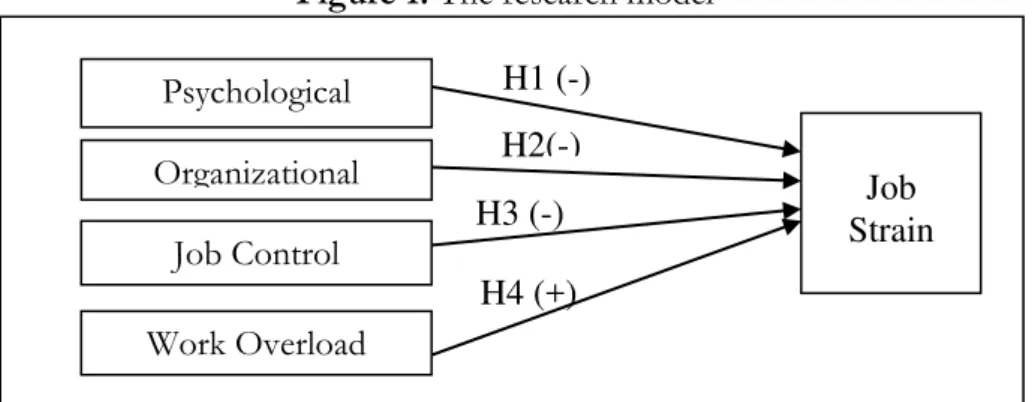
Consequently, the research model for this research study is presented with the below framework in Figure 1. The proposed model consists the independent variables of psychological hardiness, organizational support, job control, and work overload and the dependent variable of job strain.
Figure 1. The research model
3. The Methodology 3.1. Data and Sample
To test the propositions, a field survey using questionnaires was conducted between June 2015 and February 2016. Statistical population in this study included 252 banking&finance employees of seven banking&finance organizations in İstanbul-Turkey. The number of employees including in these seven bank&finance organizations was 290 employees. 252 questionnaires returned and none of the questionnaire forms were eliminated. 252 responses were used for data analyses, thus the response rate was 86% (=252/290). In terms of demographic findings, (69.7%) of respondents were females, and the remaining (30.3%) were males. In terms of the age group of respondents, 23.2% of
Psychological Hardiness Organizational
Work Overload
Job Strain H2(-)
H3 (-) H1 (-)
Job Control
them were between 22-29 years, whereas 26.5% fell into the 30-36 age group, whereas 49% were the 37-45 age group, only 1.3% were above 46. As for the educational levels of the banking & finance employees, the majority were university degree holders (89.9%), a few of the respondents had master degree (4,7%), and some of them has Higher Education degree from banking & insurance services programmes (5.4%).
3.2. Measurement Instruments
The self-rated questionnaire was designed to test the four hypotheses and consisted of 80 questions. Six-point Likert scales were used for measuring the items (from 1=Strongly Disagree to 6=Strongly Agree). The introduction section of the questionnaire asked the demographic variables of the respondents such as gender, age, education level, current position and years of service in the organizations. The measures used in the research are described as below:
"Measurement of Job Strain (12 items)": Goldberg’s (1978) 12 -item General Health Questionnaire (GHQ12) was selected to measure the feeling of job strain This measure is covering a range of psychiatric symptoms: somatic, anxiety, depression, self-esteem, stress, negative affectivity and social dysfunction (Tait, French & Hulse, 2003).
"Measurement of Psychological Hardiness (18 items)": The Personal Views Survey III-R is the most current version of personal
views based on Kabasa’s original PH scale (1979). 18 items measuring 3
sub-components were used. The scale measured commitment, control and challenge sub-component. However, the total hardiness score consistently had stronger correlation than any of its components supporting the contention that PH is a hierarchical construct subsuming the 3 subcomponents.
"Measurement of Work Overload (4 items)": 4 items of Moore’s (2000) Perceived Work Overload Scale were designed to measure work overload perceptions of the participants.
Postmodern Openings
"Measurement of Organizational Support (36 items)": 36 items
of Eisenberger et al.’s (1986) POS scale was used to measure support
from organization, supervisor, and co-workers.
4. Findings
4.1. Descriptive findings
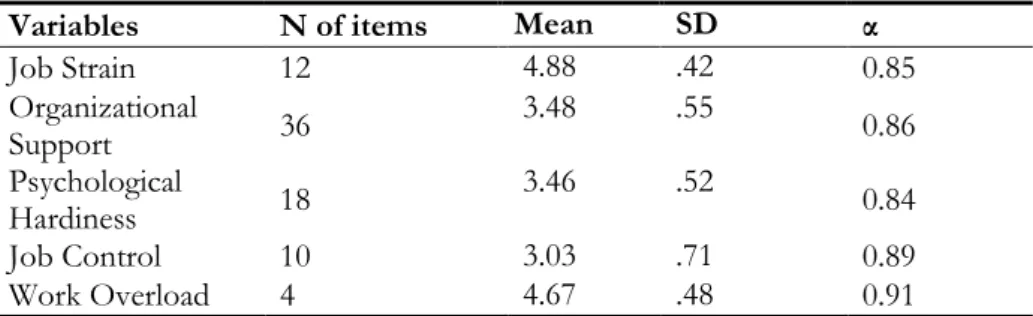
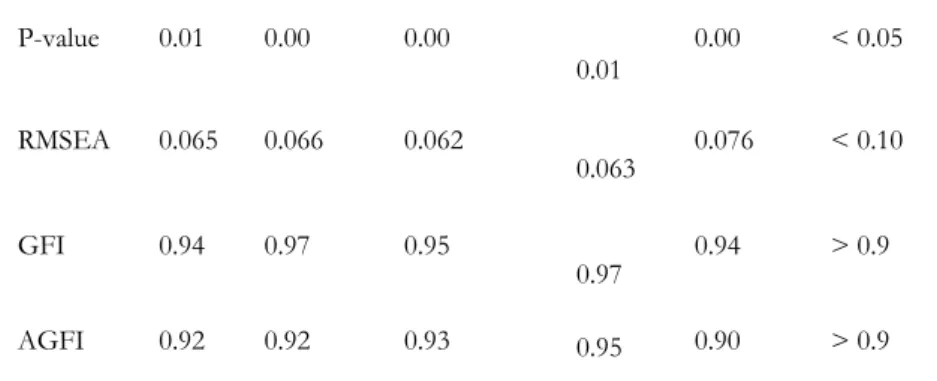
For reliability evaluation we utilized Cronbach's alpha. The Cronbach's alpha reliability of all the 5 variables were more than 0.7, which indicates that all the scales demonstrated good reliability (Table 1). Content and construct validity for evaluating the validity of the questionnaires. To test the content validity, after devising a framework for the questionnaire, we asked 5 professors to modify it if needed. These professors evaluated all the implemented criteria in the questionnaire and confirmed it. Further, Confirmatory Factor Analysis (CFA) was used to investigate the construction of the questionnaire. The results of the CFA of research variables indicated that all the mentioned criteria have been measured in these questionnaires. CFA results of the variables of revealed good fitness of the models, showing that the selected indicators were good representatives for each research variables (Table 2).
Table 1. Mean and Reliability values of the variables
Variables N of items Mean SD α
Job Strain 12 4.88 .42 0.85 Organizational
Support 36
3.48 .55
0.86 Psychological
Hardiness 18
3.46 .52
0.84
Job Control 10 3.03 .71 0.89 Work Overload 4 4.67 .48 0.91
Table 2. Fitness indices of research variables based on CFA
Fitness indices
Job
Srain Psy.Hard. Org.Support Job
Control Work
Overload Principle
P-value 0.01 0.00 0.00
0.01
0.00 < 0.05
RMSEA 0.065 0.066 0.062
0.063 0.076 < 0.10
GFI 0.94 0.97 0.95
0.97 0.94 > 0.9
AGFI 0.92 0.92 0.93 0.95 0.90 > 0.9
4.2. Test of hypotheses: the relations of psychological hardiness, organizational support, job control and work overload with job strain
For testing the hypotheses, Pearson's Correlation Analysis was conducted. According to Table 3 Psychological Hardiness had moderate negative relationship with job strain (r=-0.366; p< 0.01). Organizational Support had strong negative relationship with job strain (r=-0.594; p< 0.01). Job Control had strong negative relationship with job strain (r=-0.582; p< 0.01) and finally Work Overload had strong positive relationship with job strain (r=0.624; p< 0.01). The correlations indicated that the existence of perceived work overload is likely to
increase employees’ perceived job strain, while psychological hardiness,
organizational support and control over work are likely to decrease the level of perceived job strain. The documented results indicated that H1, H2, H3 and H4 were supported.
Table 3. Correlations between variables
Variables 1 2 3 4 5
1.Job Strain 1 -.366** -.582** -.594** .624** 2.Psy.Hard. -.366** 1 .233** .205** -.124** 3.Job control -.582** .233** 1 .225** -.208** 4.Org.Support -.594** .205** .225** 1 -.193** 5. W.overload .624** -.124** -.208** -.193** 1
Postmodern Openings
4.3. The contributions of psychological hardiness, organizational support, job control, and work overload on job strain
For assessing the contributions of the independent variables on job strain multiple regression analysis was performed. It was seen that there were significant positive impacts of perceived work overload on job strain. In addition, psychological hardiness, organizational support and job control had significant negative impacts on job strain. Table 4 displays the ANOVA results on the overall model and the results indicate significance (F = 42,563, p<0,05).
Table 4. Model summary of regression analysis
Model R R Square Adjusted
R Square
Std. Error of the Estimate
1 ,703(a) ,625 ,651 ,46575
Predictors: (Constant), work overload, organizational support, job control, psychological hardiness
Table 5. Summary results of coefficients of regression analysis
Dependent Variable: Job strain
Independent Variables Beta t Value P Value
Constant 1,726 0,020
Psy.Hardiness -0,344 3,719 0,010 Org.Support -0,537 2,223 0,000 Job Control -0,526 4,175 0,000 Work Overload 0,598 4,223 0,000
R=0,705; R²=0,638; F Value=52,563; p<0,05
The overall R2 is .628 suggesting that psychological hardiness,
organizational support, job control and work overload combine to explain approximately 64% of the variance in perceived job strain among the banking and finance staff. The results of Table 5 show that work overload statistically significantly contributed to job strain (β = 0.598, t = 4,223, p < 0,05). Psychological hardiness negatively contributes to perceived job strain and this construct also showed statistical significance
(β = -0.344, t = 3,719, p < 0,05). In addition, according to the beta
coefficients and p-values, organizational support (β = -0.537, t = 2,223, p
< 0,05) and job control (β = -0.526, t = 4,175, p < 0,05) also negatively
5. Conclusion and discussion
This study focused on the investigation of how personal and situational factors and work related outcomes are associated. The study
was built on ―Karasek's Model of Job Strain‖ called as DCS Model
(Demand-Control-Support). In the study, the role of job demands, personal and organizational resources, and control over work in their negative work outcome of perceived job strain was assessed. Building on Karasek's (1979) DCS model, the potential individual and situational factors that may predict job strain has been investigated for the conceptual framework of this study. For the aim of the study, an empirical study was conducted in Turkey by involving the participation of banking and finance staff working in seven banking & finance organizations located in Istanbul.
As a result of the survey, some hints were found regarding the potential associates of personal resources and situational factors of work and organization to perceived job strain. All four factors including
Karasek’s model and personal resource had significant moderate and
Postmodern Openings
found that banking & finance staff reported high perceived job strain (M=4.87) and low job control (M=3.02). This is a question for occupational health and modern empowering organization since the level of job strain has been found as relatively high. These results may provide implication for Turkish banking and finance sector. The findings of this study may contribute to the literature and the works on positive organizational behaviour and workplace stress. Thereby, this study may provide further guidance to organizations for developing strategies to cope with the problems of workplace stress, strain and high workload. It is suggested that when efficient strategies are implemented like training, job enrichment, job rotation, motivation and reward systems, the current problems of work overload and strain could be reduced. Thus, this study is valuable for addressing these problems and to offer some hints to overcome the problems of work overload which increase the job strain at work. It is believed that when the job strain is high, the employee performance, engagement, commitment and well-being are also expected to be effected negatively. Therefore, coping with work overload and job strain can be beneficial for the organizations for increasing employee health, well-being, satisfaction, performance and efficiency. As a concluding remark, it is suggested that unhealthy job work overload and job strain among the employees can ultimately influence their intellectual and social abilities which in turn effects the organizational health, performance and efficiency in long-term. By considering these issues, this study may provide implications for practice as well as the academic literature. By taking some appealing findings of the study, it is also seen that the findings of the study are consistent with the literature studies. The previous empirical and theoretical knowledge is supported with the results of this study and showed consistency with the previous implications.
large-scale organizations, sectors, education, health, etc. and also in different cities or countries for generalizing findings.
References
Ali, S., & Farooqi, Y.A. (2014). Effect of work overload on job satisfaction, effect of job satisfaction on employee performance and employee engagement: A case of public sector university of Gujranwala Division. International Journal of Multidisciplinary Sciences and Engineering, 5(8), 23-30.
Allred, K.D., & Smith, T.W. (1989). The hardy personality: Cognitive and physiological responses to evaluative threat. Journal of Personality and Social Psychology, 56(2), 257.
Bakker, A.B., & Demerouti, E. (2008). Towards a model of work engagement. Career development international, 13(3), 209-223.
Bartone, P.T. (2012). Social and organizational influences on psychological hardiness: How leaders can increase stress resilience. Security Informatics, 1(1), 1-10.
Bateman, T.S., & Organ, D.W. (1983). Job satisfaction and the good soldier: The relationship between affect and employee
―citizenship‖.Academy of management Journal, 26(4), 587-595.
Bogler, R., & Nir, A.E. (2012). The importance of teachers' perceived organizational support to job satisfaction: What's empowerment got to do with it?. Journal of Educational Administration, 50(3), 287-306.
Bozkurt, V., Aytaç, S., Bondy, J., & Emirgil, B.F. (2011). Job satisfaction,
role overload and gender in Turkey. Sociology Conferences, 44, 49-68.
Brief, A.P., & Motowidlo, S.J. (1986). Prosocial organizational behaviors.
Academy of management Review, 11(4), 710-725.
Britt, T.W., Adler, A.B., & Bartone, P.T. (2001). Deriving benefits from stressful events: the role of engagement in meaningful work and hardiness. Journal of occupational health psychology, 6(1), 53.
Collins, S. (2008). Statutory social workers: Stress, job satisfaction, coping, social support and individual differences. British Journal of Social Work, 38(6), 1173-1193.
Postmodern Openings
Cropanzano, R., Howes, J.C., Grandey, A.A., & Toth, P. (1997). The relationship of organizational politics and support to work behaviors, attitudes, and stress. Journal of Organizational Behavior,
18(2), 159-180.
Dawley, D., Houghton, J.D., & Bucklew, N.S. (2010). Perceived organizational support and turnover intention: The mediating effects of personal sacrifice and job fit. The Journal of Social Psychology, 150(3), 238-257.
De Bruin, G.P., & Taylor, N. (2006). Sources of work stress inventory: Technical manual. Jopie van Rooyen & Partners, Johannesburg.
De Bruin, G.P., & Taylor, N. (2006). Sources of work stress inventory: Technical manual. Jopie van Rooyen & Partners, Johannesburg.
de Jonge, J. (1995). Job autonomy, well-being and health: A study among Dutch health care workers. Unpublished Doctoral Dissertation, Datawyse, Maastricht.
de Jonge, J., Bosma, H., Peter, R., & Siegrist, J. (2000). Job strain, effort-reward imbalance and employee well-being: a large-scale cross-sectional study. Social science & medicine, 50(9), 1317-1327.
De Jonge, J., Dollard, M.F., Dormann, C., Le Blanc, P.M., & Houtman, I.L. (2001). The demand-control model: Specific demands, specific control, and well-defined groups. International Journal of Stress Management, 7(4), 269-287.
Dollard, M.F., & Winefield, A.H. (1998). A test of the Demand-Control/Support model of work stress in correcdonal oncers. Journal of Occupational Health Psychology, 3, 1-25.
Dollard, M.F., & Winefield, A.H. (1998). A test of the demand– control/support model of work stress in correctional officers.
Journal of Occupational Health Psychology, 3(3), 220-243.
Eisenberger, R., Huntington, R., Hutchison, S., & Sowa, D. (1986). Perceived organizational support. Journal of Applied Psychology, 71,
500–507.
Elovainio, M., Kivimäki, M., & Helkama, K. (2001). Organizational
justice evaluations, job control, and occupational strain. Journal of applied psychology, 86(3), 418.
Etzioni, A. (1961). Complex organizations: A sociological reader. New York: Holt, Rinehart and Winston.
Fernet, C., Guay, F., & Senécal, C. (2004). Adjusting to job demands:
Folkman, S., & Lazarus, R.S. (1986). Stress processes and depressive symptomatology. Journal of Abnormal Psychology, 95(2), 107.
Funk, S.C. (1992). Hardiness: a review of theory and research. Health Psychology, 11(5), 335.
Goldberg, D. (1978). Manual of the general health questionnaire. NFER Nelson.
Gross, J.J. (1998). The emerging field of emotion regulation: an integrative review. Review of General Psychology, 2(3), 271.
Hackman, J.R., & Oldham, G.R. (1975). Development of the job diagnostic survey. Journal of Applied psychology, 60(2), 159.
Harris, R.B., Harris, K.J., & Harvey, P. (2007). A test of competing models of the relationships among perceptions of organizational politics, perceived organizational support, and individual outcomes. The Journal of social psychology, 147(6), 631-656.
Hurrell, J.J., & McLaney, M.A. (1989). Control, job demands and job satisfaction. Control and Worker Health, 97, 103.
Ilies, R., Dimotakis, N., & De Pater, I.E. (2010). Psychological and physiological reactions to high workloads: Implications for well‐ being. Personnel Psychology, 63(2), 407-436.
Johnson, J.V., & Hall, E.M. (1988). Job strain, work place social support, and cardiovascular disease: a cross-sectional study of a random sample of the Swedish working population. American Journal of Public Health, 78(10), 1336-1342.
Jonge, J. de, & Kompier, M.A.J. (1997). A crirical examinadon of the Dcmand-Control-Support model from a work psychological perspective. International Journal of Stress Management, 4, 235
Kalantar, J., Khedri, L., Nikbakht, A., & Motvalian, M. (2013). Effect of Psychological Hardiness Training on Mental Health of Students.
International Journal of Academic Research in Business and Social Sciences,
3(3), 68-88.
Karasek, R.A. (1979). Job demands, job decision latitude, and mental strain: Implications for job redesign. Administrative Science Quarterly, 24, 285-308.
Karasek, R., & Theorell, T. (1990). Healthy work, stress, productivity and the reconstruction of working life. Basic Books, New York.
effort-Postmodern Openings
reward imbalance model (ERI). http://www.uni-duesseldorf.de/www/workstress/jointstatement.html.
Karimi, R., Omar, Z.B., Alipour, F., & Karimi, Z. (2014). The influence of role overload, role conflict and role ambiguity on occupational stress among nurses in selected Iranian hospitals. International Journal of Asian Social Science, 4(1), 34-40.
Khaledian, M., Pour, S.H., & Hasanvand, B. (2013). The relationship of psychological hardiness with work holism. International Letters of Social and Humanistic Sciences, (5), 1-9.
Klag, S., & Bradley, G. (2004). The role of hardiness in stress and illness: An exploration of the effect of negative affectivity and gender.
British Journal of Health Psychology, 9(2), 137-161.
Kobasa, S.C. (1979). Stressful life events, personality, and health: an inquiry into hardiness. Journal of Personality and Social Psychology,
37(1), 1-21.
Kobasa, S.C. (1982). The hardy personality: Toward a social psychology of stress and health. Social psychology of health and illness, 4, 3-32. Kobasa, S.C., Maddi, S.R., & Kahn, S. (1982). Hardiness and health: a
prospective study. Journal of Personality and Social Psychology, 42(1), 168.
Kristensen, T.S. (1995). The demand—control-support model: Methodological challenges for future research. Stress Medicine, 11,
17-26.
Lazarus, R.S., & Folkman, S. (1987). Transactional theory and research on emotions and coping. European Journal of Personality, 1(3), 141-169.
Lee, R.T., & Ashforth, B.E. (1996). A meta-analytic examination of the correlates of the three dimensions of job burnout. Journal of Applied Psychology, 81(2), 123-143.
Leiter, M.P., & Schaufeli, W.B. (1996). Consistency of the burnout construct across occupations. Anxiety, Stress, and Coping, 9(3), 229-243.
Maddi, S.R. (2004). Hardiness: An operationalization of existential courage. Journal of Humanistic Psychology, 44(3), 279-298.
Malik, M.I., Sajjad, M., Hyder, S., Ahmad, M.S., Ahmed, J., & Hussain, S. (2013). Role Overload: A Cause of Diminishing Employee Retention and Productivity. M.E. Journal of Scientific Research,
Malik, N. (2011). Study on job satisfaction factors of faculty members at university of Balochistan. International Journal of Academic Research,
3(1), 267-272.
Mansell, A., & Brough, P. (2005). A comprehensive test of the job demands‐control interaction: Comparing two measures of job characteristics. Australian Journal of Psychology, 57(2), 103-114. Moore, J.E. (2000). Why is this happening? A causal attribution approach
to work exhaustion consequences. Academy of Management Review,
25(2), 335-349.
Morter, J.R. (2010). Relationship of role overload to job satisfaction and intent to leave among acute care nurses. Unpublished Doctorate Dissertation, University of Phoenix, Department of Educational Leadership, U.S.A.
Mowday, R.T., Porter, L.W., & Steers, R. (1982). Organizational linkages: The psychology of commitment, absenteeism, and turnover. Academic Press: San Diego C.A.
Nishizaka, S. (2002). Kindergarten teachers' mental health: Stress, pre-school teacher efficacy, and hardiness. Japanese Journal of Educational Psychology, 50(3), 283-290.
Organ, D.W., & Konovsky, M. (1989). Cognitive versus affective determinants of organizational citizenship behavior. Journal of Applied Psychology, 74(1), 157-178.
Osipow, S.H., & Spokane, A.R. (1987). Manual for the occupational stress inventory. Odessa, FL: Psychological Assessment Resources. Paktinat, I., & Rafeei, I. (2012). Studying the effect of stress factors of on
the amount of customers dissatisfaction with using Structural Equation Model: A case from insurance companies in Kerman.
Interdisciplinary Journal of Contemporary Research in Business, 3(12), 108-116.
Park, K.O., & Wilson, M.G. (2003). Psychosocial work environments and psychological strain among Korean factory workers. Stress and Health, 19(3), 173-179.
Pcon, J.M., Salleh, A.H.M., & Senik, Z.C. (2007). Propensity to trust as a moderator of the relationship between perceived organizational support and job satisfaction. International Journal of Organization Theory and Behavior, 10 (3), 350-365.
Postmodern Openings
somatic complaints. Journal of Social Behavior and Personality, 5(3), 77.
Rhoades, L., & Eisenberger, R. (2002). Perceived organizational support: a review of the literature. Journal of Applied Psychology, 87(4), 698-718.
Richard, G.V., & Krieshok, T.S. (1989). Occupational stress, strain, and coping in university faculty. Journal of Vocational Behavior, 34(1), 117-132.
Rodríguez, I., Bravo, M.J., Peiró, J.M., & Schaufeli, W. (2001). The
demands-control-support model, locus of control and job dissatisfaction: A longitudinal study. Work & Stress, 15(2), 97-114.
Roth, D.L., Wiebe, D.J., Fillingim, R.B., & Shay, K.A. (1989). Life events, fitness, hardiness, and health: a simultaneous analysis of proposed stress-resistance effects. Journal of Personality and Social Psychology, 57(1), 136.
Schaubroeck, J., & Merritt, D.E. (1997). Divergent effects of job control on coping with work stressors: The key role of self-efficacy.
Academy of Management Journal, 40(3), 738-754.
Schellenberg, D.E. (2005). Coping and Psychological Hardiness and Their Relationship to Depression in Older Adults. PCOM Psychology Dissertations.
http://digitalcommons.pcom.edu/psychology_dissertations/124 Schnall, P. L., Landsbergis, P.A., & Baker, D. (1994). Job strain and
cardiovascular disease. Annual Review of Public Health, 15(1), 381-411.
Seligman, M.E. (2002). Positive psychology, positive prevention, and positive therapy. Handbook of Positive Psychology, 2, 3-12.
Shepperd, J.A., & Kashani, J.H. (1991). The relationship of hardiness, gender, and stress to health outcomes in adolescents. Journal of Personality, 59(4), 747-768.
Shore, L.M., & Shore, T.H. (1995). Perceived organizational support and organizational justice. Managing the Social Climate of the Workplace, 149-164.
Soderstrom, M., Dolbier, C., Leiferman, J., & Steinhardt, M. (2000). The relationship of hardiness, coping strategies, and perceived stress to symptoms of illness. Journal of behavioral medicine, 23(3), 311-328.
Spector, P.E. (1987). Method variance as an artifact in self-reported affect and perceptions at work: Myth or significant problem?.
Journal of Applied Psychology, 72(3), 438.
Tait, R.J., French, D.J., & Hulse, G.K. (2003). Validity and psychometric properties of the General Health Questionnaire-12 in young Australian adolescents. Australian and New Zealand Journal of Psychiatry, 37(3), 374-381.
Takeuchi, T., Nakao, M., Nomura, K., & Yano, E. (2009). Association of metabolic syndrome with depression and anxiety in Japanese men. Diabetes & metabolism, 35(1), 32-36.
Taştan, S.B. (2014a). The theoretical implications of job demands– resources model: A research study on the relations of job demands, supervisor support and job autonomy with work engagement. Atatürk University Journal of Economics and Administrative Sciences, 28(4), 149-195.
Taştan, S.B. (2014b). Predicting psychological strain with job demands and organizational injustice through the implications of job demand-control model and fairness theory. Postmodern Openings Journal, 5(4), 111-143.
Theorell, T., & Karasek, R.A. (1996). Current issues relating to psychosocial job strain and cardiovascular disease research.
Journal of Occupational Health Psychology, 1(1), 9-27.
Thiagarajan, P., Chakrabarty, S., & Taylor, R.D. (2006). A confirmatory factor analysis of Reilly's Role Overload Scale. Educational and Psychological Measurement, 66(4), 657-666.
Thompson, C.A., & Prottas, D.J. (2006). Relationships among organizational family support, job autonomy, perceived control, and employee well-being. Journal of Occupational Health Psychology,
11(1), 100-125.
Van der Doef, M., & Maes, S. (1999). The job demand-control (-support) model and psychological well-being: a review of 20 years of empirical research. Work & Stress, 13(2), 87-114.
Vanishree, P. (2014). Impact on role ambiguity, role conflict and role overload on job stress in Small and Medium scale industries.
Postmodern Openings
Venkatachalam, M. (1995). Personal hardiness and perceived organizational support as links in the role stress-outcome relationship: A person-environment fit model. Unpublished Doctoral dissertation, ProQuest Information & Learning.
Weaver Jr, C.P. (2015). Perceived Organizational Support and Job Overload as Moderators on the Relationship between Leadership Effectiveness and Job Satisfaction. Emerging Leadership Journeys, 8(1), 79-100.