SUMMARY
Objective: To estimate the association between night-shit work and high cardiovascular risk. Methods: Cross-sectional study carried out with 211 workers of both genders, aged between 30 and 64 years, working on the health campus of a public university in the state of Minas Gerais, Brazil. Night-shit work was deined as a work shit between 7 pm and 7 am, and high cardiovascular risk was calculated based on the Framingham score. he association between night-shit work and high cardiovascular risk was estimated by the prevalence ratio (PR) and its 95% conidence interval (95% CI) ater adjusting for poten-tial confounding factors, calculated by Poisson regression. Results: Night-shit work was performed by 38.4% of the individuals, and high cardiovascular risk was diagnosed in 28% of the sample. Hypertension was more prevalent among night-shit compared with day-shit workers (p < 0.05). In the bivariate analysis, night-shit work, passive and high job strain categories at the demand-control scale, work time > 120 months, schooling ≥ 9 years, family income ≥ 6 minimum wages, level 2 abdominal obesity, and triglycer-ide levels ≥ 150 mg/dL were associated with high cardiovascular risk (p < 0.05). Ater multivariate analysis, night-shit work remained independently associated with high car-diovascular risk (PR = 1.67; 95% CI = 1.10-2.54). Conclusion: he prevalence of high cardiovascular risk was 67% higher among night-shit workers. his association should be considered when discussing the promotion of workers’ health regarding changes in the work process.
Keywords: Night work; risk factors; cardiovascular diseases; public health; nursing.
©2012 Elsevier Editora Ltda. All rights reserved.
Study conducted at the Nursing School of Universidade Federal de Minas Gerais, Belo Horizonte, MG, Brazil
Submitted on: 07/29/2011 Approved on: 12/07/2011
Financial Support: Fundação de Amparo à Pesquisa do Estado de Minas Gerais (FAPEMIG)
Correspondence to: Adriano Marçal Pimenta Universidade Federal de Minas Gerais Escola de Enfermagem Departamento de Enfermagem Materno-Infantil e Saúde Pública Av. Professor Alfredo Balena, 190 CEP: 30130-100 Belo Horizonte – MG, Brazil [email protected]
Conlict of interest: None.
Night-shift work and cardiovascular risk among employees
of a public university
ADRIANO MARÇAL PIMENTA1, GILBERTO KAC2, RAFAELA ROCHA CAMPOSE SOUZA3, LUCIANA MARIADE BARROS ALMEIDA FERREIRA3, SALETE MARIADE FÁTIMA SILQUEIRA4
1 PhD in Nursing; Adjunct Professor, Departament of Maternal-Child Nursing and Public Health, Nursing School, Universidade Federal de Minas Gerais (UFMG), Belo Horizonte, MG,
Brazil
2 PhD in Public Health; Full Professor, Instituto de Nutrição Josué de Castro, Universidade Federal do Rio de Janeiro (UFRJ), Rio de Janeiro, RJ, Brazil
INTRODUCTION
Cardiovascular diseases (CVDs) represent a signiicant worldwide public health problem and are responsible for one-third of all deaths in the world’s population1.
In Brazil, this group of diseases accounted for 29.4% of all deaths in 2007, becoming the main leading cause of death2. Moreover, CVDs result in a high number of hos-pitalizations, generating great social and economic costs. According to the Ministry of Health, almost 20% of the to-tal amount spent to cover admissions carried out through the Brazilian Uniied Health System (Sistema Único de Saúde – SUS) in 2006 was used to pay for hospitalizations due to CVDs3. his group of diseases is also responsible for the high number of requests for early retirement due to disability, and the granting of medical leaves4.
Due to this epidemiological proile, the scientiic community has sought to identify the risk factors of CVDs in order to establish prevention, control, and treat-ment measures. hus, male gender5, age5, hypertension5, smoking5, hypercholesterolemia5, low levels of high-den-sity cholesterol (HDL-c)5, diabetes mellitus5, low level of schooling6, low income6, sedentary lifestyle7, obesity7, hy-pertriglyceridemia7, and psycho-emotional stress8 stand out as determinants of CVDs. Regarding this last risk factor, it seems to be related to greater reactivity of the cardiovascular system, contributing to the development of CVDs8.
In this context, many authors agree that the work-place is an important source of psycho-emotional stress, increasing the number of employees afected by CVDs8; one of the proposed models most commonly used world-wide to assess this exposure is Karasek’s9 demand-con-trol and social support.
Moreover, another important question on this subject is the time of exposure to a high job strain. In this sense, among the Japanese population there is a phenomenon known as “karoshi”, sudden death caused by overwork, which is becoming common, although the epidemiologi-cal evidence is limited10.
Another hypothesis, currently under investigation, concerns the relationship between night-shit work and CVDs. An extensive review of scientiic literature showed that night-shit workers are 40% more likely to be afect-ed by CVDs when comparafect-ed with those who work during the day11. hus, this is a topic of great relevance, as night-shit work has become common worldwide, with approx-imately 22% of the population of industrialized countries performing their work activities during this period12.
In Brazil, the efect of night-shit work on workers’ health has been investigated in outcomes such as quality of sleep, fatigue, and psycho-emotional stress13-15. Only one study that has addressed the relationship of night-shit work with hypertension16 was found, and high blood
pressure levels are only one component of the overall as-sessment of cardiovascular risk. he exact physiopatho-logical mechanism linking night-shit work and CVD is not yet completely understood; however, it is suspected that the main factor involved is the disturbance in the circadian rhythm17,18.
Considering that this subject has been little explored in the Brazilian population, this study aimed to examine the independent association between night-shit work and high cardiovascular risk.
METHODS
his is a cross-sectional epidemiological study carried out with employees of the health sciences campus of a public university in the State of Minas Gerais, which in-cludes academic units, the School of Nursing, the School of Medicine, and the Clinical Hospital.
In the academic units, employees are classiied as ad-ministrative staf (secretaries, drivers, cleaning staf, se-curity guards, etc.) and faculty. At the hospital there are college level professionals (doctors, nurses, psychologists, nutritionists, physical therapists, occupational therapists, pharmacists, dentists, social workers, biologists, etc.), technical level professionals (nurse technicians, labora-tory technicians), and the administrative technicians.
To meet the inclusion criterion, employees had to be between 30 and 65 years of age, as the Framingham score, the outcome variable of the present study can only be applied to this age range5. All employees who met this criterion were invited to participate in the study, totaling approximately 2,172 individuals, according to informa-tion from the human resources departments of the insti-tutions. his invitation was made through disclosure on the websites, information boards of academic units and of the Clinical Hospital, and by handing printed invitations to the heads of all the departments of the institutions.
During the period of data collection, which occurred between April and November 2010, 218 employees vol-untarily sought the research team. Participants who had any physical disability that precluded the measurement of anthropometric and clinical variables (n = 2), and preg-nant women or those within one year of the postpartum period, as this condition could inluence the results of an-thropometric measurements, especially body weight and waist circumference (n = 5), were excluded. hus, the inal sample consisted of 211 participants of both genders.
the necessary materials for data collection. For the mea-surement of plasma lipids [total cholesterol, high-density cholesterol level (HDL-c), low-density level cholesterol (LDL-c), very low-density level cholesterol (VLDL-c), and triglycerides] and glucose, participants were referred to a hired clinical laboratory and instructed to fast for 12 to 14 hours, to abstain from alcohol for 48 hours, and to restrict physical activity prior to blood collection.
he exposure variable was the work shit, i.e., the pe-riod of day when the participants performed their work activities, which was categorized as day-shit (between 7 am and 7 pm) and night-shit (between 7 pm and 7 am). In the case of individuals whose work shit included the two periods, the one in which the participants spent most of the time performing their work activities was considered. his situation was observed in only four participants.
he outcome variable was the cardiovascular risk calculated by the Framingham score, which features the following components: (a) age, (b) total cholesterol, (c) HDL-c, (d) systolic and diastolic blood pressure, (e) smoking, (f) diagnosis of diabetes. Each of these el-ements was scored according to their speciic values and the individual’s gender5. In this study, participants were classiied according to their cardiovascular risk as low/medium (< 20%) and high (≥ 20%).
Age was self-reported by the participant, while gen-der was evaluated by the interviewer.
he collected blood samples were centrifuged at the laboratory, and serum and plasma samples were stored in a refrigerator at 4°C and analyzed by regularly calibrated automated equipment (COBAS MIRA Plus, Roche). he concentrations of total cholesterol, triglycerides, and glu-cose were determined by enzymatic colorimetric meth-od. he concentration of HDL-c was measured by enzy-matic colorimetric method ater precipitation of LDL-c and VLDL-c by phosphotungstic acid and magnesium chloride19.
Blood pressure was measured ater explaining the procedure to the patient, who had rested for at least 5 minutes prior to measurement in a quiet environment; did not have a full bladder; had not practiced physical exercises 60 to 90 minutes before measurement; had not consumed alcohol, cofee or food or smoked for 30 min-utes before measurement; kept legs uncrossed, feet lat on the loor, leaned back on the chair, relaxed, and did not talk during the measurement20. In total, three mea-surements were made with two-minute intervals between them, using a calibrated mercury sphygmomanometer. At the end, the mean of three readings was recorded as a deinitive value for the data analysis.
Smoking was assessed by the following questions: “Are you or have you ever been a smoker, i.e., have you
smoked, throughout your life, at least 100 cigarettes?” and “How many cigarettes do you currently smoke per day?”. In case of positive answer and the reporting of a number in the second, the participant was classiied as a smoker. In case of positive initial response, but zero in the second, the participant was considered a former smoker. Finally, if the irst answer was negative, the par-ticipant was classiied as non-smoker. For the Framing-ham score calculation, nonsmokers and former smokers were grouped within the nonsmoker category.
Regarding the diagnosis of diabetes, hyperglycemia was chosen, using as reference value of fasting plasma glucose ≥ 100 mg/dL21.
he covariates included in this study were job strain/ demand-control, social support at work, number of working hours, time of work, years of schooling, month-ly famimonth-ly income, physical activity during leisure time, waist circumference, and plasma triglyceride levels.
he information about demand-control and social support at work were obtained through the question-naire proposed by Karasek9, which has been widely used in healthcare to assess the association with CVDs22, and has been validated in the Portuguese version for the Bra-zilian population23.
To characterize the job demand, the questionnaire had ive questions involving the following aspects: a) speed of work tasks performance; b) intense work; c) overwork; d) insuicient time to carry out work tasks; and e) conlicting demands. he questions had the fol-lowing response options: “oten,” “sometimes,” “rarely”, and “never or almost never”, and each one received a score of 1 to 4 (1 indicates low demand, and 4, high de-mand). he total score for work demand was obtained by adding the scores of each question, ranging from 5 to 20.
With respect to the control aspect of work, the ques-tionnaire had six questions: a) opportunity to learn new things at work; b) specialized skills/knowledge required for the work; c) decision-making power in the work pro-cess; d) repetitive work; e) power to choose the activi-ties to be performed; f) power to choose how to perform work activities. he response options and scores were the same provided for the demand alternatives at work (1 and 4 indicate low and high control, respectively). he total score for work control was obtained by adding up the scores for each question, ranging from 6 to 24.
he Karasek demand-control questionnaire also presents six questions about social support at work that involves the following aspects: a) working environment; b) relationship with other employees; c) support from co-workers; d) sym-pathy from co-workers when not having a good day; e) rela-tionship with bosses; f) satisfaction when working with co-workers. he questions had the following response options: “strongly agree”; “agree more than disagree”; “disagree more than agree”; and “strongly disagree”, and each one receives a score of 1 to 4 (1 indicates low support and 4 high support). he total score for social support at work was obtained by adding the scores for each question, ranging from 6 to 24.
To characterize the sample, this variable was dichoto-mized by dividing the scale into two halves, with the me-dian as reference. he bottom of the scale indicated low support and the upper, high support.
he duration of working hours was calculated from the total hours of work performed by the participants. Subse-quently, this variable was categorized as < 40 hours, 40 to 60 hours, and > 60 hours.
he time of work was evaluated from the total months during which the participant had performed work activities on the same work environment. his variable was catego-rized as < 60 months, 60 to 120 months, and > 120 months. he years of schooling were self-reported by the par-ticipant. his variable was categorized as < 8 years, 9 to 11 years, and ≥ 12 years.
he participants’ monthly family income was self-re-ported. hey were asked to report the sum of the monthly earnings of each member of the family who had any type of work activity. his variable was divided into minimum wages (MWs) and the reference value in November 2010 was R$ 510.00. Subsequently, the family income was cat-egorized as ≤ 2 MWs, 3 to 5 MWs, ≥ 6 MWs.
he estimation of physical activity measurement was performed using the long version of the International Physical Activity Questionnaire – IPAQ24, widely used at national and international levels. he data analysis consid-ered the “leisure physical activities” domain. he weekly frequency was multiplied by the time spent, in minutes, on each physical activity. hus, the weekly load of physical ac-tivity during leisure time was obtained, which subsequently was categorized as sedentary (0 minutes), 1 to 149 minutes, and ≥ 150 minutes.
Waist circumference (WC) was measured accord-ing to standard recommendations25. In total, three WC measurements were performed and the mean value was considered for the inal data analysis. An inelas-tic measuring tape was placed around the individual in the horizontal plane, positioning it at midpoint be-tween the lower margin of the last rib and the upper part of the anterosuperior iliac crest. he measure-ment was obtained at the end of a normal exhalation
to the nearest millimeter. Subsequently, the WC was categorized according to gender as normal [< 80 cm (female), < 94 cm (male)], risk level 1 [80 to 87.9 cm (fe-male), 94 to 101.9 cm (male)], risk level 2 [≥ 88 cm (fe(fe-male), ≥ 102 cm (male)]. Triglyceride levels were categorized as < 150 mg/dL and ≥ 150 mg/dL26.
Based on the information obtained in the interviews, a database was built using Epi Info release 3.3.2, and the analysis was developed using the Statistical Sotware for Professionals (STATA), release 10.0.
Sample characterization was performed by calculat-ing the absolute and relative frequencies of work shit categories, according to demographic, socioeconomic, lifestyle, anthropometric, biochemical, and work envi-ronment variables, as well as the Framingham score and its components. Statistical diferences were evaluated us-ing Pearson’s chi-square test.
he bivariate analysis was performed to assess the as-sociation between night-shit work and each covariate of interest (demand-control at work, social support at work, working hours, time at work, years of formal schooling, family income, physical activity at leisure time, WC, and plasma triglyceride levels) with high cardiovascular risk. he strength of associations was measured by prevalence ratios (PR) and their respective 95% conidence intervals (95% CI) using Poisson’s regression with robust variance. he independent association between night-shit work and high cardiovascular risk was assessed using Poisson’s multiple regression model with robust variance, considering as variables of adjustment the demand-con-trol at work, social support at work, number of working hours, time at work, years of formal schooling, monthly family income, physical activity during leisure time, WC, and plasma triglyceride levels. Except for the demand-control at work, all variables were used in the continuous format. hus, the PR and respective 95% CI were calcu-lated having as reference the category of day-shit work.
Moreover, the independent associations of the inter-actions between some covariables of interest (demand-control at work, social support at work, the time at work and working hours) and the night-shit work with high cardiovascular risk were tested. In all analyses, the level of statistical signiicance was set at 5% (p < 0.05).
he study was approved by the Committee of Ethics and Research in Humans of the Universidade Federal de Minas Gerais (Protocol No. 066/09). All participants signed the informed consent.
RESULTS
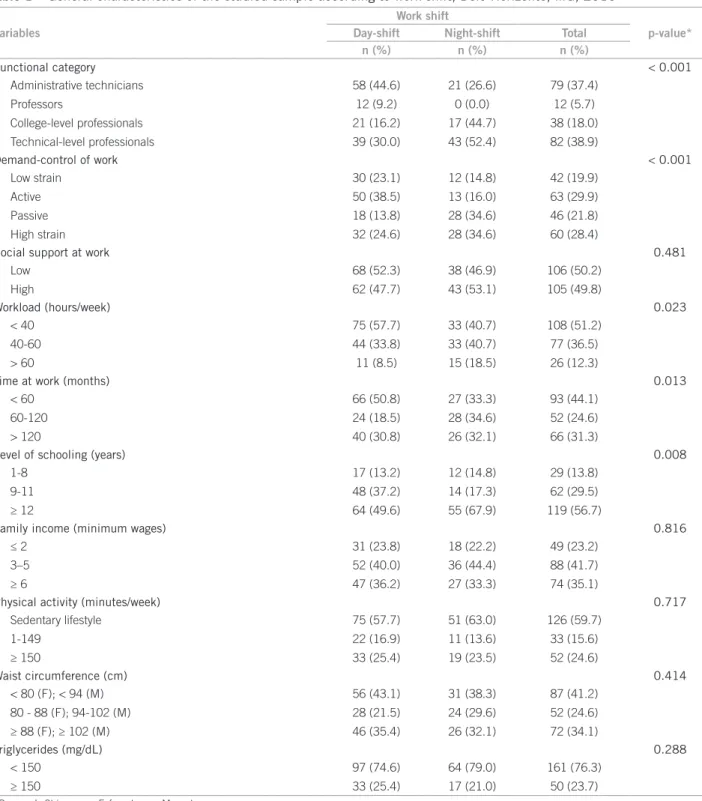
Most professionals were technicians or administrative staf, were classiied in the active and high strain catego-ries in the scale of demand-control at work, worked less than 40 hours a week, had worked less than 60 months in the current job, had 12 or more years of schooling, a fam-ily income of 3 to 6 minimum wages, and were sedentary. Level 2 abdominal obesity and hypertriglyceridemia were diagnosed in 34.1% and 23.7% of the total sample, re-spectively. here was a greater proportion of professional
of technical level, high strain at work, working hours > 60 hours per week, time at work > 60 months, and 12 and more years of schooling among night-shit workers (p < 0.05) (Table 1).
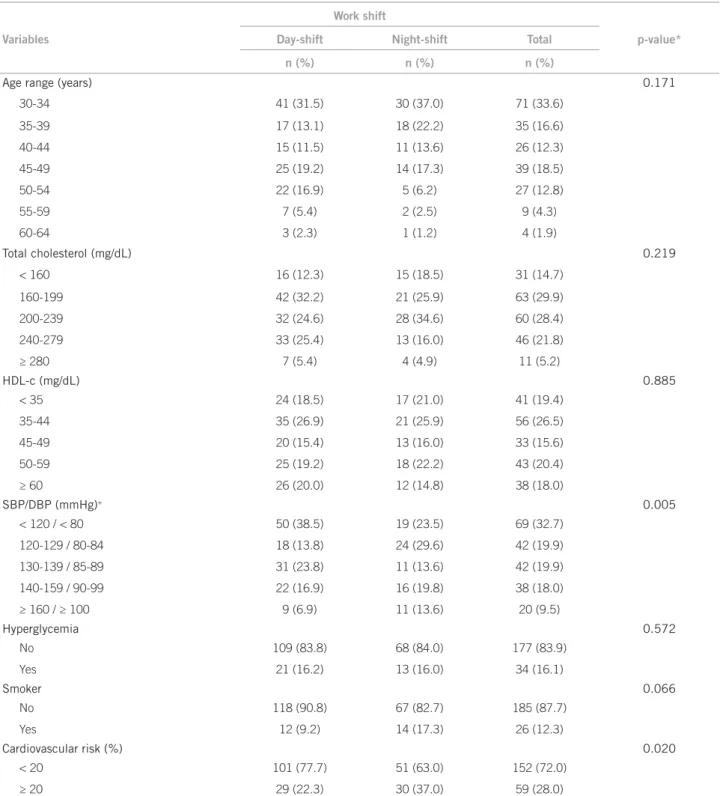
Most participants were young (< 40 years old). he prevalence of hypercholesterolemia and low HDL-c were 55.4% and 45.9%, respectively. Hypertension was observed in 27.5%, while hyperglycemia was diagnosed in 16.1% of the participants. Smoking was a characteristic reported by
Variables
Work shift
p-value*
Day-shift Night-shift Total
n (%) n (%) n (%)
Functional category < 0.001
Administrative technicians 58 (44.6) 21 (26.6) 79 (37.4)
Professors 12 (9.2) 0 (0.0) 12 (5.7)
College-level professionals 21 (16.2) 17 (44.7) 38 (18.0) Technical-level professionals 39 (30.0) 43 (52.4) 82 (38.9)
Demand-control of work < 0.001
Low strain 30 (23.1) 12 (14.8) 42 (19.9)
Active 50 (38.5) 13 (16.0) 63 (29.9)
Passive 18 (13.8) 28 (34.6) 46 (21.8)
High strain 32 (24.6) 28 (34.6) 60 (28.4)
Social support at work 0.481
Low 68 (52.3) 38 (46.9) 106 (50.2)
High 62 (47.7) 43 (53.1) 105 (49.8)
Workload (hours/week) 0.023
< 40 75 (57.7) 33 (40.7) 108 (51.2)
40-60 44 (33.8) 33 (40.7) 77 (36.5)
> 60 11 (8.5) 15 (18.5) 26 (12.3)
Time at work (months) 0.013
< 60 66 (50.8) 27 (33.3) 93 (44.1)
60-120 24 (18.5) 28 (34.6) 52 (24.6)
> 120 40 (30.8) 26 (32.1) 66 (31.3)
Level of schooling (years) 0.008
1-8 17 (13.2) 12 (14.8) 29 (13.8)
9-11 48 (37.2) 14 (17.3) 62 (29.5)
≥ 12 64 (49.6) 55 (67.9) 119 (56.7)
Family income (minimum wages) 0.816
≤ 2 31 (23.8) 18 (22.2) 49 (23.2)
3–5 52 (40.0) 36 (44.4) 88 (41.7)
≥ 6 47 (36.2) 27 (33.3) 74 (35.1)
Physical activity (minutes/week) 0.717
Sedentary lifestyle 75 (57.7) 51 (63.0) 126 (59.7)
1-149 22 (16.9) 11 (13.6) 33 (15.6)
≥ 150 33 (25.4) 19 (23.5) 52 (24.6)
Waist circumference (cm) 0.414
< 80 (F); < 94 (M) 56 (43.1) 31 (38.3) 87 (41.2) 80 - 88 (F); 94-102 (M) 28 (21.5) 24 (29.6) 52 (24.6) ≥ 88 (F); ≥ 102 (M) 46 (35.4) 26 (32.1) 72 (34.1)
Triglycerides (mg/dL) 0.288
< 150 97 (74.6) 64 (79.0) 161 (76.3)
≥ 150 33 (25.4) 17 (21.0) 50 (23.7)
*Pearson’s Chi-square; F, female sex; M, male sex.
12.3%, and high cardiovascular risk was present in 28% of the sample. he frequency of high cardiovascular risk was higher among night-shit workers, as well as the preva-lence of hypertension (p < 0.05). he proportion of smok-ers was also higher among night-shit worksmok-ers, although not statistically signiicant (p = 0.066) (Table 2).
In the bivariate analysis (Table 3), we observed that night-shit work (PR = 1.66, 95% CI = 1.08-2.55), the
passive (PR = 3.20, 95% CI = 1.14- 8.97) and high strain categories (PR = 4.90, 95% CI = 1.85- 12.96) on the scale of demand-control, the time at work > 120 months (PR = 1.69, 95% CI = 1.02-2.80), level 2 abdominal obesity [(WC ≥ 88 cm - female, WC ≥ 102 cm - male), PR = 3.07, 95% CI = 1.75- 5.38], and triglyceride levels ≥ 150 mg/dL (PR = 3.11, 95% CI = 2.08-4.65) were positively associated with high cardiovascular risk. In contrast, schooling of
Variables
Work shift
p-value*
Day-shift Night-shift Total
n (%) n (%) n (%)
Age range (years) 0.171
30-34 41 (31.5) 30 (37.0) 71 (33.6)
35-39 17 (13.1) 18 (22.2) 35 (16.6)
40-44 15 (11.5) 11 (13.6) 26 (12.3)
45-49 25 (19.2) 14 (17.3) 39 (18.5)
50-54 22 (16.9) 5 (6.2) 27 (12.8)
55-59 7 (5.4) 2 (2.5) 9 (4.3)
60-64 3 (2.3) 1 (1.2) 4 (1.9)
Total cholesterol (mg/dL) 0.219
< 160 16 (12.3) 15 (18.5) 31 (14.7)
160-199 42 (32.2) 21 (25.9) 63 (29.9)
200-239 32 (24.6) 28 (34.6) 60 (28.4)
240-279 33 (25.4) 13 (16.0) 46 (21.8)
≥ 280 7 (5.4) 4 (4.9) 11 (5.2)
HDL-c (mg/dL) 0.885
< 35 24 (18.5) 17 (21.0) 41 (19.4)
35-44 35 (26.9) 21 (25.9) 56 (26.5)
45-49 20 (15.4) 13 (16.0) 33 (15.6)
50-59 25 (19.2) 18 (22.2) 43 (20.4)
≥ 60 26 (20.0) 12 (14.8) 38 (18.0)
SBP/DBP (mmHg)+ 0.005
< 120 / < 80 50 (38.5) 19 (23.5) 69 (32.7) 120-129 / 80-84 18 (13.8) 24 (29.6) 42 (19.9) 130-139 / 85-89 31 (23.8) 11 (13.6) 42 (19.9) 140-159 / 90-99 22 (16.9) 16 (19.8) 38 (18.0)
≥ 160 / ≥ 100 9 (6.9) 11 (13.6) 20 (9.5)
Hyperglycemia 0.572
No 109 (83.8) 68 (84.0) 177 (83.9)
Yes 21 (16.2) 13 (16.0) 34 (16.1)
Smoker 0.066
No 118 (90.8) 67 (82.7) 185 (87.7)
Yes 12 (9.2) 14 (17.3) 26 (12.3)
Cardiovascular risk (%) 0.020
< 20 101 (77.7) 51 (63.0) 152 (72.0)
≥ 20 29 (22.3) 30 (37.0) 59 (28.0)
*Pearson’s chi-square; SBP, systolic blood pressure; DBP, diastolic blood pressure; +when pressures were in different categories, we chose the highest value.
9 to 11 years (PR = 0.50, 95% CI = 0.29-0.87) and ≥ 12 years (PR = 0.45, 95% CI = 0.28-0.73), family income ≥ 6 minimum wages (PR = 0.52, 95% CI = 0.29-0.93) were negatively associated with high cardiovascular risk.
Night-shit work remained independently associated
with increased cardiovascular risk ater multivariate ad-justment of the data (p = 0.005). hus, the prevalence of high cardiovascular risk among night-shit workers was 67% higher than that of day-shit workers (PR = 1.67, 95% CI = 1.10-2.54) (Figure 1).
Variables High cardiovascular risk p-value*
n % PR (95% CI)
Work shift
Day-shift 29 22.3 1.00
-Night-shift 30 37.0 1.66 (1.08-2.55) 0.021
Demand-control of work
Low strain 4 9.5 1.00
-Active 13 20.6 2.17 (0.76-6.21) 0.150
Passive 14 30.4 3.20 (1.14-8.97) 0.027
High strain 28 46.7 4.90 (1.85-12.96) 0.001
Social support at work
Low 24 22.6 1.00
-High 35 33.3 1.47 (0.94-2.29) 0.088
Workload (hours/week)
< 40 32 29.6 1.00
-40-60 20 26.0 0.88 (0.54-1.41) 0.589
> 60 7 26.9 0.91 (0.45-1.83) 0.788
Time at work (months)
< 60 20 21.5 1.00
-60-120 15 28.8 1.34 (0.75-2.39) 0.320
> 120 24 36.4 1.69 (1.02-2.80) 0.041
Level of schooling (years)
1-8 15 51.7 1.00
-9-11 16 25.8 0.50 (0.29-0.87) 0.013
≥ 12 28 23.5 0.45 (0.28-0.73) 0.001
Family income (minimum wages)
≤ 2 19 38.8 1.00
-3-5 25 28.4 0.73 (0.45-1.19) 0.208
≥ 6 15 20.3 0.52 (0.29-0.93) 0.027
Physical activity (minutes/week)
Sedentary lifestyle 38 30.2 1.00
-1-149 9 27.3 0.90 (0.49-1.68) 0.750
≥ 150 12 23.1 0.77 (0.44-1.35) 0.353
Waist circumference (cm)
< 80 (F); < 94 (M) 13 14.9 1.00
-80 - 88 (F); 94-102 (M) 13 25.0 1.67 (0.84-3.33) 0.143 ≥ 88 (F); ≥ 102 (M) 33 45.8 3.07 (1.75-5.38) < 0.001
Triglycerides (mg/dL)
< 150 30 18.6 1.00
-≥ 150 29 58.0 3.11 (2.08-4.65) < 0.001
*Poisson regression with robust variances; F, female sex; M, male sex.
Table 3 – Associations between night-shift work and the covariables of interest with high cardiovascular risk, Belo Horizonte,
Figure 1 – Prevalence ratio and 95% conidence interval for the association between work shift and high cardiovascular risk, Belo Horizonte, MG, Brazil, 2010.
UL 95% CI, upper limit of the 95% conidence interval; LL 95% CI, lower limit of the 95% conidence interval. Prevalence ratio adjusted for demand-control of work, social support at work, workload, time at work, years of schooling, family income, total physical activity during leisure time, waist circumference, and triglycerides levels.
Work shift
Prevalence ratio
Day shift 1.00 (reference)
2.54 - UL 95% CI
1.67 p = 0.005
Night shift 1.10 - LL 95% CI 3.00
2.00
1.00 2.75
1.75
0.75 2.50
1.50
0.50 2.25
1.25
0.25
0.00
DISCUSSION
In the present study, night-shit work was independently associated with high cardiovascular risk. he night-shit workers had a prevalence of cardiovascular risk that was 67% higher than in those who performed their work ac-tivities during the day, ater multivariate adjustment of data. herefore, night-shit work potentially increases the vulnerability to the occurrence of CVDs. Speciically in relation to the components of the Framingham risk score, hypertension and smoking were more prevalent among night-shit workers, although this association was slightly above the threshold for statistical signiicance of 5% (p = 0.066).
However, these results should be analyzed consider-ing the followconsider-ing aspects: a) the possible inluence of the “healthy worker bias”, as, in general, night-shit work is performed by individuals with better health status6; b) as this is a cross-sectional study, the certainty is decreased in the temporality and causality of these associations; how-ever, this is inherent to the study design.
In spite of these limitations, the present indings are consistent with those of other studies on the subject27,28, al-though no investigations that used the Framingham score as a marker of cardiovascular risk were found, which was the outcome variable of this study. In a research carried out in Italy, night-shit work was associated with cardiovascu-lar risk; however, the outcome marker used was metabolic syndrome, deined according to the International Diabetes Federation criteria27. A similar result was found in a cohort
with 45 years of follow-up carried out in England, in which night-shit work remained independently associated with cardiovascular risk factors, such as global and abdominal obesities, in addition to high levels of C-reactive protein, ater adjusting for socioeconomic variables and lifestyle habits, as well as occupational factors28.
Several scientiic studies published mainly from 1984 on, concluded that there is a strong association between night-shit work and CVD29,30, including the estimate that this exposure factor increases the risk for CVD by 40%11. Some cohort studies have also shown the association be-tween night-shit work and high risk for CVD31,32. In one, carried out with 5,517 Danish workers followed for 12 years, it was demonstrated that the professionals who per-formed their work activities during the night had a relative risk for CVD of 1.31 (95% CI = 1.06-1.63)31. In another study, which followed 6,711 Japanese workers for 14 years, there was a statistically signiicant increase in systolic and diastolic BP among night-shit workers. In some subjects, this increase was > 30%32. Results of a recently performed study with a longitudinal design showed, once again, that night-shit work increased the risk for CVD, further sup-porting this association33.
he biological plausibility of the association between night-shit work and CVD may be due to disturbance in the circadian rhythm, changes in metabolic and hormonal functions, and a higher prevalence of smoking and inad-equate diets18,29,30. he night-shit workers perform their work activities and rest at times that are opposite to the standard chronobiological pattern, i.e., sleeping during the period in which the body is prepared to engage in ac-tivities and working when physical and mental eiciency is generally low.
his change in the chronobiological pattern of the body generates chronobiological alterations in the normal circadian rhythm of blood pressure, which is characterized by a decrease in blood pressure at night, and an increase as soon as the day period starts34. herefore, from the luc-tuations that occur in blood pressure values, the circadian rhythm of night-shit workers undergoes changes in ampli-tude, i.e., the 24-hour standard curve changes. Instead of a decrease in the blood pressure value when evening period starts, the blood pressure remains at the same level expect-ed for the day period35. Constant exposure to the variation in the amplitude of the circadian rhythm is responsible, in the long run, for the increase in mean blood pressure of night-shit workers, increasing the risk of CVD34,35.
medical residents underwent ambulatory blood pressure monitoring (ABPM) during a 24-hour work shit in the emergency room, and during one day of normal work.
he mean 24-hour systolic and diastolic BP, and mean diastolic BP at rest were higher during night work in re-lation to day work (117 versus 113 mmHg, p < 0.05, 73 versus 69 mmHg, p < 0.05, 61 versus 58, p < 0.05, respec-tively). Furthermore, abnormally high BP mean values were more common in night-shit workers, in contrast with those working in daytime (19 versus 8, p < 0.05)16. In a survey of 1,838 female employees of a semiconductor manufacturing plant in northern Taiwan, it was observed that those who worked a ixed 12-hour night shit had signiicantly higher odds of developing arterial hyperten-sion (OR = 2.30; 95% CI= 1.20–4.40) than the women who worked during the day, ater multivariate adjustment for age, smoking, alcohol consumption, and working hours36.
Regarding the habit of smoking, although the asso-ciation was not signiicant in this study (p = 0.066), the number of smokers found among night-shit workers was almost twice of that found for day-shit workers. Other studies have also pointed out that smoking is more com-mon acom-mong night-shit workers32. Moreover, the risk of starting to smoke, regardless of the educational level, has shown to be higher among professionals who perform their work activities at night38.
he external validity of our indings should be inter-preted with caution, as the sample is not probabilistic. However, this study provides the following characteristics: a) reliable measurements obtained through appropriate techniques, stringently performed by trained interview-ers; b) adjustment of variables using multivariate analysis methods appropriate for the type of study design; c) high levels of strength of association.
CONCLUSION
In summary, we conclude that night shit work is associated with high cardiovascular risk. herefore, this result should be incorporated in the discussions on the promotion of workers’ health in relation to changes in the work process.
ACKNOWLEDGEMENTS
To the research subjects for their voluntary participation, and to the Fundação de Amparo à Pesquisa do Estado de Minas Gerais (FAPEMIG) for the inancial support grant-ed for this study. Gilberto Kac receives research grants by Conselho Nacional de Desenvolvimento Cientíico e Tec-nológico (CNPq).
REFERENCES
1. Lawes CM, Vander Hoom S, Rodgers A. International Society of Hyper-tension. Global burden of blood-pressure-related disease, 2001. Lancet. 2008;371:1513-8.
2. Ministério da Saúde (Brasil). Secretaria de Vigilância em Saúde. Departamen-to de Análise de Situação de Saúde. Saúde Brasil 2009: uma análise da situação de saúde e da agenda nacional e internacional de prioridades em saúde. Brasí-lia: Ministério da Saúde; 2010.
3. Ministério da Saúde (Brasil). Secretaria Executiva. Datasus. Informações de Saúde. Gastos com a saúde no Brasil. [cited 2009 Nov 24]. Available from: http://www.datasus.gov.br.
4. Azambuja MIR, Foppa M, Maranhão MFC, Achutti AC. Impacto econômico dos casos de doença cardiovascular grave no Brasil: uma estimativa baseada em dados secundários. Arq Bras Cardiol. 2008;91:163-71.
5. Expert Panel on detection, evaluation, and treatment of high blood choles-terol in adults. Executive summary of the hird Report of he National Cho-lesterol Education Program (NCEP) Expert Panel on detection, evaluation, and treatment of high blood cholesterol in adults (Adult Treatment Panel III). JAMA. 2001;285:2486-97.
6. Franks P, Winters PC, Tancredi DJ, Fiscella KA. Do changes in traditional coronary heart disease risk factors over time explain the association between socio-economic status and coronary heart disease? BMC Cardiovasc Disord. 2011;11:28.
7. ODonnell CJ, Elosua R. Cardiovascular risk factors. Insights from Framing-ham Heart Study. Rev Esp Cardiol. 2008;61:299-310.
8. Eller NH, Netterstrøm B, Gyntelberg F, Kristensen TS, Nielsen F, Steptoe A, et al. Work-related psychosocial factors and the development of ischemic heart disease: a systematic review. Cardiol Rev. 2009;17:83-97.
9. Karasek R, Brisson C, Kawakami N, Houtman I, Bongers P, Amick B. he job content questionnaire (JCQ): an instrument for internationally compara-tive assessments of psychosocial job characteristics. J Occup Health Psychol. 1998;3:322-55.
10. Iwasaki K, Takahashi M, Nakata A. Health problems due to long working hours in Japan: working hours, workers compensation (karoshi), and pre-ventive measures. Ind Health. 2006;44(4):537-40.
11. Knutsson A. Health disorders of shit workers. Occup Med (Lond). 2003;53:103-8.
12. Lee S, Mccann D, Messenger JC. Working time around the world: trends in working hours, laws and policies in a global comparative perspective. Lon-don/ Geneva: Routledge and ILO; 2007.
13. Takeyama H, Matsumoto S, Murata K, Ebara T, Kubo T, Tachi N, et al. Efects of the length and timing of nighttime naps on task performance and physi-ological function. Rev Saúde Pública. 2004;38:32-7.
14. Metzner RJ, Fischer FM. Fadiga e capacidade para o trabalho em turnos ixos de doze horas. Rev Saúde Pública. 2001;35:548-53.
15. Tepas DI, Barnes-Farrell JL, Bobko N, Fischer FM, Iskra-Golec I, Kaliterna L. he impact of night work on subjective reports of well-being: an explor-atory study of health care workers from ive nations. Rev Saúde Pública. 2004;38:26-31.
16. Fialho G, Cavichio L, Povoa R, Pimenta J. Efects of 24-h shit work in the emergency room on ambulatory blood pressure monitoring values of medi-cal residents. Am J Hypertens. 2006;19:1005-9.
17. Haus E, Smolensky M. Biological clocks and shit work: circadian dys-regulation and potential long-term efects. Cancer Causes Control. 2006;17:489-500.
18. Knutsson A, Bohhild H. Shitwork and cardiovascular disease: review of dis-ease mechanisms. Rev Environ Health. 2000;15:359-72.
19. Ciriades PGJ. Manual de Patologia Clínica. São Paulo: Atheneu, 2010. 20. Sociedade Brasileira de Cardiologia, Sociedade Brasileira de Hipertensão,
Sociedade Brasileira de Nefrologia. V Brazilian guidelines in arterial hyper-tension. Arq Bras Cardiol. 2007;89:24-79.
21. Sociedade Brasileira de Diabetes/SBD. Diretrizes da Sociedade Brasileira de Diabetes 2007: tratamento e acompanhamento do diabetes mellitus. Rio de Janeiro: Diagraphic; 2007.
22. Araújo TM, Graça CC, Araújo E. Estresse ocupacional e saúde: contribuições do Modelo Demanda-Controle. Ciênc Saúde Coletiva. 2003;8:991-1003. 23. Alves MGM, Chor D, Faerstein E, Lopes CS, Werneck GL. Versão
reduz-ida da “Job Stress Scale”: adaptação para o português. Rev Saúde Pública.
2004;38:164-71.
24. Craig CL, Marshall AL, Sjöström M, Bauman AE, Booth ML, Ainsworth BE. International physical activity questionnaire: 12-country reliability and valid-ity. Med Sci Sports Exerc. 2003;35:1381-95.
25. Lohman TG, Roche AF, Martorell R. Anthropometric standardization refer-ence manual. Champaign: Human Kinetics Books, 1988.
26. Sposito AC, Caramelli B, Fonseca FAH, Bertolami MC, Neto AA, Souza AD, et al. IV Brazilian guideline for dyslipidemia and atherosclerosis prevention: Department of Atherosclerosis of Brazilian Society of Cardiology. Arq Bras Cardiol. 2007;88:2-19.
27. Copertaro A, Bracci M, Barbaresi M, Santarelli L. Assessment of cardiovascular risk in shit healthcare workers. Eur J Cardiovasc Prev Rehabil. 2008;15:224-9. 28. homas C, Power C. Shit work and risk factors for cardiovascular disease: a study at age 45 years in the 1958 British birth cohort. Eur J Epidemiol. 2010;25:305-14.
30. Mosendane T, Mosendane T, Raal FJ. Shit work and its efects on the cardio-vascular system. Cardiovasc J Afr. 2008;19:210-5.
31. Tüchsen F, Hannerz H, Burr H. A 12 year prospective study of circulatory disease among Danish shit workers. Occup Environ Med. 2006;63:451-5. 32. Fujino Y, Isso H, Tamakoshi A, Inaba Y, Koizumi A, Kubo T, et al. A
Prospec-tive cohort study of shit work and risk of ischemic heart disease in Japanese male workers. Am J Epidemiol. 2006;164:128-35.
33. Brown DL, Feskanich D, Sánchez BN, Rexrode KM, Schernhammer ES, Lisa-beth LD. Rotating night shit work and the risk of ischemic stroke. Am J Epi-demiol. 2009;169:1370-7.
34. Mark A, Weiler SW, Schroder M, Otto A, Jauch-Chara K, Groneberg DA, et al. he impact of shit work induced chronic circadian disruption on IL-6 and TNF-α immune responses. J Occup Med Toxicol. 2010;5:18.
35. Tail-Klawe M, Klawe JJ, Zeomanczuk P, Szczepanska B, Sikorski W, Smieta-nowski M. Daily changes in cardiac and cardiovascular blood pressure compo-nents during breath holding episodes in obstructive sleep apnea patients ater day-shit and night-shit work. J Physiol Pharmacol. 2007;58:685-90. 36. Chen JD, Lin YC, Hsiao ST. Obesity and high blood pressure of 12-hour night
shit female clean-room workers. Chronobiol Int. 2010;27:334-44.
37. McCubbin JA, Pilcher JJ, Moore DD. Blood pressure increases during a simulated night shit in persons at risk for hypertension. Int J Behav Med. 2010;17:314-20.