Comparing Scoring and Fuzzy Logic Method for Teacher
Certification DSS in Indonesia
Purnama-Dewi1, Oka-Sudana2 and Darma-Putra3
1
Department of Information Technology, Udayana University Bali, 80361, Indonesia
2
Department of Information Technology, Udayana University Bali, 80361, Indonesia
3
Department of Information Technology, Udayana University Bali, 80361, Indonesia
Abstract
Graduation of teacher certification participants plays an important role in improving the quality of education in Indonesia. This paper presents a decision support system using a Scoring and Fuzzy Logic method to determine the participants graduation of teacher certification based on requirements fulfilled. Five criteria were used as the input of the system. In Fuzzy Logic method, each criteria is divided into three parts: low, medium and high; while scoring method is determined by using a 1 - 5 scale for each requirement fulfilled. Graduation and participants ranking using Scoring and Fuzzy Logic is the output of the system. In this paper, the assessment using Scoring and Fuzzy Logic showed different ranks and results in some scores, particularly in practice assessment by using scoring method for score 64,5 would not graduated the participants since the score of practice assessment is 65. While Fuzzy Logic would observe the scores of the four different methods, if those four criteria in the fuzzy were in high parts, then the participants graduated the tests. This means Fuzzy Logic more equitable to present decision and determine the ranks. In this paper was successful comparing Scoring and Fuzzy Logic method.
Keywords: Teacher Certification, Scoring, Fuzzy Logic.
1. Introduction
Education plays very important role for the citizens to improve human resources. A teacher education is one of important role in improving the quality of learning process to achieve the quality of education. A teacher as a professional staff requires an educator certificate through systematic process called Teacher Certification. A teacher certification is required in order to improve the professionalism of teachers in Indonesia.
Scoring is the grant of points for each fulfilled requirements [1]. Scoring system method will establish accurate data that is presented in the standarization eligibility score in the quantitative form. This eligibility is used as a requirement to take decision. Lotfi Zadeh, the
father of fuzzy logic decided to extend two-valued logic, defined by the binary pair {0, 1}, to the whole continuous interval [0, 1], thereby introducing a gradual transition from falsehood to truth [2]. Several approaches on fuzzy logic based edge detection have been reported based on fuzzy If-Then rules [3], [4]. The Mamdani rule base takes crisp inputs and produces crisp outputs. Mamdani rule base to model crisp system can be easily described by humans in terms of fuzzy variables.
2. Methodology
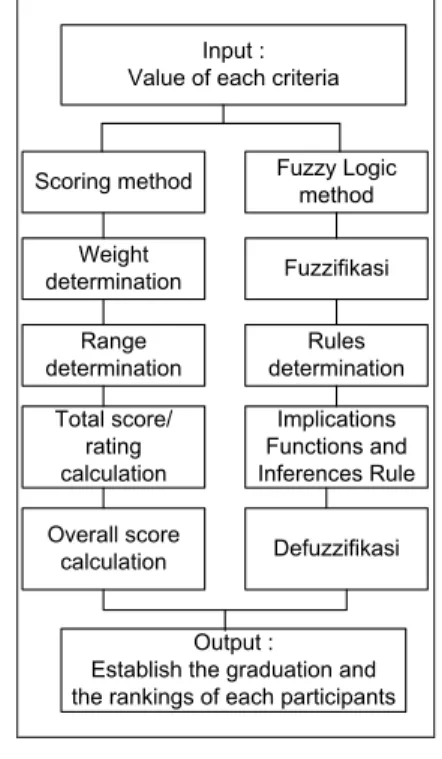
The overview diagram of this research is shown in Fig. 1.
Input : Value of each criteria
Scoring method Fuzzy Logic
method
Weight
determination Fuzzifikasi
Range determination
Total score/ rating calculation
Overall score calculation
Output :
Establish the graduation and the rankings of each participants
Rules determination
Implications Functions and Inferences Rule
Defuzzifikasi
Fig. 1 General Overview System
2.1 Criteria
Five criteria were used as the input of the system in the following terms: written test assessment, practice test learning, workshop's yielding assessment, participation in learning theory and practice assessment, and Colleague friend assessment. Those data are based on the criteria in the guidelines book 4 the implementation of PLPG Teachers Certification from the directorate general of higher education ministries of national education [7]. Each criteria rated by the assessor and colleague. The Assessor will evaluate the written test assessment, practice test assessment, workshop's yielding assessment, participation in learning theory and practice assessment; while the colleague will do the colleague friend assessment.
2.2 Scoring Method
Scoring is a number of points assigned for each fulfilled requirements. The teacher certification assessment using Scoring Method is determined by using a 1 - 5 scale for each requirement fulfilled [1]. The following table describes scoring and weights for each criteria:
Table 1: Weight Scoring System
Criteria Weight Question Scoring
Written test
assessment 25%
80 to 100 65 to 80 55 to 65 40 to 55 < 40
5 4 3 2 1
Practice test
assessment 30%
80 to 100 65 to 80 55 to 65 40 to 55 < 40
5 4 3 2 1
Workshop's yielding
assessment 25%
80 to 100 65 to 80 55 to 65 40 to 55 < 40
5 4 3 2 1 Participation in
learning theory and practice assessment
10%
80 to 100 65 to 80 55 to 65 40 to 55 < 40
5 4 3 2 1
A colleague friend
assessment 10%
80 to 100 65 to 80 55 to 65 40 to 55 < 40
5 4 3 2 1 In the Scoring Method each criteria has points that will be classified based on scoring (Table 1). The scoring result in each of criteria is used to acquire the total scores, by multiplying rates of assessment and scores for each criteria of. The formula to calculating the total score/rating as follows:
=
100 × (1)
After each criteria has a total score, it will be sum up to establish overall total score that is used to determine whether the participants of teacher certification graduated or not graduated the assessment. Overall total score is said graduated when generating value 3.5 to 5.0, if the result is less than the value of 3.5 will result in a conclusion that the participants did not graduated teacher certification. The formula to calculating the overall total score as follows:
= 1
The example of calculation with scoring method as follows
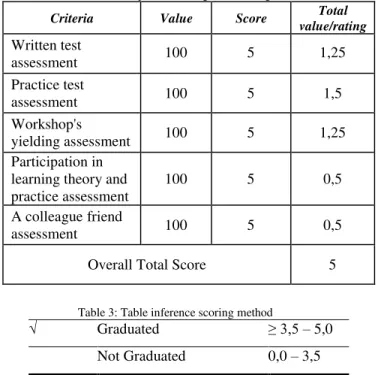
Table 2: Example calculating with scoring method
Criteria Value Score Total
value/rating Written test
assessment 100 5 1,25
Practice test
assessment 100 5 1,5
Workshop's
yielding assessment 100 5 1,25
Participation in learning theory and practice assessment
100 5 0,5
A colleague friend
assessment 100 5 0,5
Overall Total Score 5
Table 3: Table inference scoring method
√ Graduated ≥ 3,5 – 5,0
Not Graduated 0,0 – 3,5
2.3 Fuzzy Logic Method
Fuzzy logic represents a powerful approach to decision making [8], [9], [10]. In fuzzy logic method each criteria is divided into three parts, low, medium and high. Each of them using triangular and shoulder membership functions as an approach to produce a value in the method. On this
paper the fuzzy’s model which is utilized is fuzzy
Mamdani's method. Mamdani's method frequent also recognized by the name of method Max Min. To get output necessary 4 steps which is establishment of fuzzy set (fuzzification), rules's determination, implications functions application and inferences rule and the implication of assertion (deffuzification) [11].
Step 1 Fuzzification
In the assessment of teacher certification in PLPG form The Fuzzy Logic has 5 (five) input variables and an output variable. The following describes each of the input and output variables fuzzy logic method.
1. Written test assessment
Written test assessment variable is divided into three parts: low, medium, and high.
1
µ0
Written test assessment
40 50 60 70
35 45 55 65 75 80 85 90 95 100
Low Medium High
0
Fig. 2 Variable membership function graph on the written test assessment
Based on the picture shows the degree of membership on a scale that ranges from 0 to 55. The fuzzy area in the Fuzzy part applies within the ranges 55 to 65. Score ranges from 55 to 74 is an average score for the participants. The fuzzy area in the fuzzy high part applies on a scale that ranges from 65 to 100. The formula of variable membership function on the written test assessment as follows :
� ( ) =
1 ; 55
65−
10 ; 55 65
0 ; 65
� ( ) =
0 ; 55 80
−55
10 ; 55 65 75−
10 ; 65 75 � ( ) =
0 ; 65
−65
10 ; 65 75
1 ; 75 100
2. Practice test assessment
Practice test assessment is divided into three parts: low, medium, and high.
1
µ0
Practice assessment
40 50 60 70
35 45 55 65 75 80 85 90 95 100 0
Low Medium High
Fig. 3 Variable membership function graph on the learning practice assessment
The formula of variable membership function on the practice test assessment as follows :
� ( ) =
1 ; 60
70−
10 ; 60 70
0 ; 70
(5) (3)
(4)
� ( ) =
0 ; 60 80
−60
10 ; 60 70 80−
10 ; 70 80 � ( ) =
0 ; 70
−70
10 ; 70 80
1 ; 80 100
3. Workshop's yielding assessment
Workshop's yielding assessment is divided into three part, which are: low, medium, high.
1
µ0
Workshop's yielding assessment
40 50 60 70
30 45 55 65 75 80 85 90 95 100
Low Medium High
0
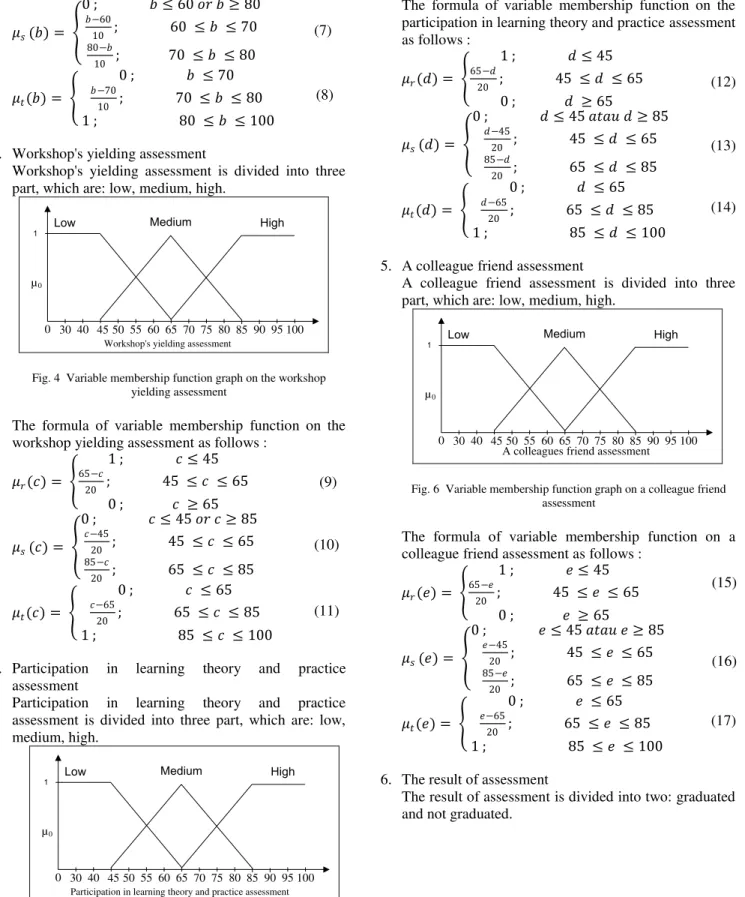
Fig. 4 Variable membership function graph on the workshop yielding assessment
The formula of variable membership function on the workshop yielding assessment as follows :
� ( ) =
1 ; 45
65−
20 ; 45 65
0 ; 65
� ( ) =
0 ; 45 85
−45
20 ; 45 65 85−
20 ; 65 85 � ( ) =
0 ; 65
−65
20 ; 65 85
1 ; 85 100
4. Participation in learning theory and practice assessment
Participation in learning theory and practice assessment is divided into three part, which are: low, medium, high.
1
µ0
Participation in learning theory and practice assessment
40 50 60 70
30 45 55 65 75 80 85 90 95 100
Low Medium High
0
Fig. 5 Variable membership function graph on the participation in learning theory and practice assessment
The formula of variable membership function on the participation in learning theory and practice assessment as follows :
� ( ) =
1 ; 45
65−
20 ; 45 65
0 ; 65
� ( ) =
0 ; 45 85
−45
20 ; 45 65 85−
20 ; 65 85 � ( ) =
0 ; 65
−65
20 ; 65 85
1 ; 85 100
5. A colleague friend assessment
A colleague friend assessment is divided into three part, which are: low, medium, high.
1
µ0
A colleagues friend assessment
40 50 60 70
30 45 55 65 75 80 85 90 95 100
Low Medium High
0
Fig. 6 Variable membership function graph on a colleague friend assessment
The formula of variable membership function on a colleague friend assessment as follows :
� ( ) =
1 ; 45
65−
20 ; 45 65
0 ; 65
� ( ) =
0 ; 45 85
−45
20 ; 45 65 85−
20 ; 65 85 � ( ) =
0 ; 65
−65
20 ; 65 85
1 ; 85 100
6. The result of assessment
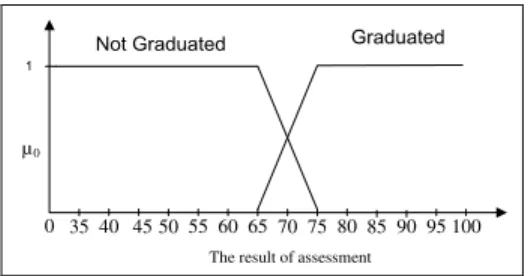
The result of assessment is divided into two: graduated and not graduated.
(7)
(14)
(17) (11)
(8)
(9)
(10)
(12)
(13)
(15)
1
µ0
The result of assessment
40 50 60 70
35 45 55 65 75 80 85 90 95 100 Not Graduated Graduated
0
Fig. 7 Variable membership function graph The result of assessment
The formula of the result of assessment as follows
� =
1 ; 65
75−
15 ; 65 75
0 ; 75
� =
0 ; 65
−65
15 ; 65 75
1 ; 75
Step 2 Rules Determination
Rules is qualitative statements applies into if then forms, thus clearly understandable. Rules DSS Teacher Certification in PLPG Form consists of 243 rules. The following are few Rules DSS Teacher Certification in PLPG Form.
(Rule 1) IF written test assessment = low AND learning test assessment = low AND workshop's yielding assessment = low AND participation in learning theory and practice assessment = low AND a colleague friend assessment = low THEN the result of assessment = not graduated
(Rule 6) IF written test assessment = low AND practice test assessment = low AND workshop's yielding assessment = low AND Participation in learning theory and practice assessment = medium AND a colleague friend assessment = high THEN the result of assessment = not graduated
(Rule 162) IF written test assessment = high AND practice test assessment = high AND workshop's yielding assessment = medium AND participation in learning theory and practice assessment = high AND a colleague friend assessment = high THEN the result of assessment = graduated
(Rule 243) IF written test assessment = high AND practice test assessment = high AND workshop's yielding assessment = high AND participation in learning theory and practice assessment = high AND a Colleague friend assessment = high THEN the result of assessment = graduated
Step 3 Implications Functions and Inferences Rule
Implications Functions
In Mamdani method, Minimum method applies as implications function. It combines each of degree of memberships from each if then rules that has been made into validity scale. The example of minimum method application in rule 99 as follows.
IF written test assessment = medium AND learning test assessment = low AND workshop's yielding assessment = medium AND participation in learning theory and practice assessment = high AND a colleague friend assessment = high THEN the result of assessment = not graduated.
99 = � ( )∩ � ( )∩ � ( ) ∩ �( )∩ � ( )
= min (� (83)∩ � (67)∩ � (74) ∩ �(89)
∩ � (90))
= min ( 0,15∩ 0,6∩ 0,8 ∩ 1 ∩1) = 0,15
The Inference Rules
Maximum method applies in the inferences rules is, as written.
� � = Max(� � ,� [�])
∶
� � = membership value of fuzzy solution to rules i � � = membership value of fuzzy consequent rules to i
The example of the inferences rules : The result of assessment
Not Graduated = 99 = 0,1 Graduated = M (a126, a108, a135) = M (0,1, 0,6 0,2)
= 0,6 Step 4 Deffuzification
In Mamdani method, deffuzification method can be chosen from another deffuzification methods. Centroid method applies in this paper. Crisp solution is earned by extracting center point ∗ output fuzzy area. The formula of score ∗ in general as follows:
∗= �( )
�
: Output score
∗ : Centre point output fuzzy area
�( ) : Membership function of fuzzy output area � : Range of fuzzy output area
(19)
(20)
The example of deffuzification
∗ = −1065 75
65 + −
65 10 71
65 +( 0,6
100
71 )
1+ 2+ 3 =211 ,25+124 ,2+1487 ,7
6,5+2,1+17,4
=1823,15 26 = 70,12
3. Experiments and Results
In this experiments, Fig. 8 dan 9 is system view on the calculation scoring and Fuzzy Logic Method to achieve participants rankings as showed in Fig. 10 and 11. Here is attached to the system view on the calculation scoring and fuzzy logic method.
Fig. 8 System view on the calculation scoring method
Fig. 9 System view on the calculation fuzzy logic method
The result of the scoring system ranking showed in the figure as follows.
Fig. 10 Scoring system ranking
Fig. 11 Fuzzy logic ranking
number 2 (Fig.10) and number 1 (Fig. 11). Ranking number 1 in Fuzzy shown rank reduction in Scoring into ranking number 2. Scoring ranking stated the participant was not graduated, while Fuzzy ranking indicated she was graduated.
The graduation requirements in Scoring emphasizes minimum graduation requirements to each method. One of the requirement in Scoring method is the participants ranking in the written test assessment variable is bigger or equal to score 60, and practice test assessment is bigger or equal to score 65. The graduation requirements in Fuzzy based on rules that contains rules of the assessor desire. Fuzzy method graduation requirements used 5 input variables within each variable consists three Fuzzy set, therefore were drawn 243 rules to determine participants graduation.
The calculation of the participant name Aida using Scoring (Fig. 8) and Fuzzy method (Fig. 9) shown its differences as result. Her total score of practice test assessment was 4,00 which was out of Scoring graduation range, therefore she was not graduated. Scoring method provided score 3 in practice test assessment criterion. Scoring method does not observe the other scores criteria in the high range. It is different with Fuzzy method with its two rules combination stated she was graduated.
1. IF written test assessment = high, AND practice test assessment = low AND workshop's yielding assessment = high AND participation in learning theory and practice assessment = high AND a colleague friend assessment = high THEN the result = graduated. 2. IF written test assessment = high, AND practice test
assessment = medium AND workshop's yielding assessment = high AND participation in learning theory and practice assessment = high AND a colleague friend assessment = high THEN the result = graduated. Based on that rules, it is concluded that she was graduated in teacher certification assessment. Fuzzy proves an equitable result because observe another four criteria. Based on the comparison above, it can be concluded that Fuzzy logic is more equitable to determine participants ranking than Scoring System method. Fuzzy Logic method observes overall used variables combined with Fuzzy rule in performing rankings and assessment result. If the rules combination score which stated graduated is bigger than the rules combination score which stated failed in the inference rules, thus it will show assessment result stated graduated. Based on this data, the writer concluded that Fuzzy logic is more equitable to determine the participants ranking than Scoring.
4. Conclusions
There is comparative relevant in Scoring and Fuzzy logic method in this paper. Fuzzy logic method is better than Scoring System because it is more flexible and equitable in showing the result and determining participants ranking. All fuzzy logic result showed flexibility, available to set in assessment criteria and the evaluation from the assessor also used in the fuzzy calculation. Fuzzy logic is simple
and easy to implement because “fuzzy” has similar
language with human being. Based on this data, the writer concluded fuzzy logic is new way in completing cases of Fuzzy.
Acknowledgments
Our thank goes to Department of Information Technology Udayana University, Bali, who has helped organize this research's Indonesia.
References
[1] Ernain, et al, “Sistem Pendukung Keputusan Pembiayaan Mikro berbasis Client Server Studi Kasus Pada Perusahaan
Pembiayaan Bandar Lampung”, Seminar Nasional Aplikasi
Teknologi Informasi (SNATI), 2011, ISSN. 1907 – 5022. [2] J. Jantzen, "Tutorial on Fuzzy Logic", Technical University
of Denmark, Department of Automation, Technical report number 98-E 868, 19 Aug 1998.
[3] C. W. Tao, et al, “A Fuzzy if-then approach to edge
detection”, Proc. of 2nd IEEE intl.conf. on fuzzy systems,
1993, pp. 1356–1361.
[4] Li. W, “Recognizing white line markings for vision-guided vehicle navigation by fuzzy reasoning”, Pattern Recognition Letters, 18: 771–780.
[5] Fakhry. Hussein, “A Fuzzy Logic Based Decision Support System for Business Situation Assessment and e-Business Models Selection”, Journal of Communications of the IIMA, Vol. 10, Issue 4, 2010.
[6] Lazim. Abdullah, and Mohd. Nordin. Rarhman, “Employee
Likehood of Purchasing Health Insurance using Fuzzy
Inference System”, IJCSI International Journal of Computer
Science Issues, Vol. 9, Issue 1, No 2, January 2012
[7] Tim Penyusun. Buku 4 Rambu-Rambu Pelaksanaan Pendidikan dan Pelatihan Profesi Guru (PLPG), Jakarta : Kementrian Pendidikan Nasional. 2011.
[8] L. A. Zadeh, “Fuzzy sets, Information and Control”, 8: 1965, pp. 338-353.
[9] A. Kaufmann, Introduction to the Theory of Fuzzy Subsets– Fundamentals Theoretical Elements, New York:Academic Press, Vol. 1 , 1975.
[10]L.C. Bezdek, Pattern Recognition with fuzzy Objective Function Algorithm, New York:Plenum Press, 1981. [11]S. Kusumadewi, Analisis & Desain Sistem Fuzzy
Ida Ayu Purnama Dewi studied Information Technology in Departement of Information Technology Udayana University since August 2008, and now woking her research for S.Ti. degree in Information Technology.
A.A. Kompiang Oka Sudana, S.Kom, MT received his S.Kom degree in Informatics Engineering from Institut Teknologi Sepuluh Nopember University in 1997, and his MT. degree in Informatics and Computer System from Gajah Mada University in 2001. He was Technical Manager at PT. INFOS Teknologi Indonesia (Software Developer) during April 2008-Sept. 2008, Information Technology Leader-Human Resources and General Affair Division at PT JAS Catering Internasional Airport Ngurah Rai Bali during April 2003-July 2006, Person in Charge of Technological and Professional Skills Development Sector Project (TPSDP)-Asian Development Bank (ADB) Loan, Batch II in Electrical Engineering Study Program during 2002-2006, and now he is lecturer at Managisterial Program of Electrical Engineering Departement of Udayana University, lecturer at Electrical Engineering Department (major in Computer System and Informatics) of Udayana University, lecturer at Information Technology Department of Udayana University, and member of Development Project Team of Academic Management Information System and Networking Implementation of Udayana University. His research experiences are in Analysis and Design of Information System Biometric Identification and Recognition.