Journal of Evolution of Medical and Dental Sciences/ Volume 3/ Issue 07/February 17, 2014 Page 1713
VARYING A V BLOCK COMPLICATING SNAKE BITE - A CASE REPORT
Vikas L1, Riyaz Ahmed2
HOW TO CITE THIS ARTICLE:
Vikas L, Riyaz Ahmed. Varying A V Block Complicating Snake Bite - A Case Report . Journal of Evolution of Medical and Dental Sciences 2014; Vol. 3, Issue 07, February 17; Page: 1713-1717,
DOI: 10.14260/jemds/2014/2047
ABSTRACT: Snake venom toxicities comprise mainly bleeding disorders and nephrotoxicity. Cardiotoxicity is a rare manifestation of snake bite. We describe the case of a previously healthy 23-year-old man who developed coagulopathy and AV node dysfunction following snake bite. Electrocardiography showed all variations of AV conduction dysfunction. This is the first account of AV node dysfunction caused by a snake bite with cardiotoxicity presenting as atrioventricular block. KEYWORDS: Sick sinus syndrome, snake bites, AV conduction blocks, neurotoxicity, AV dissociation.
INTRODUCTION: Snake bite is a common problem in rural areas of Asia, and the cause of several thousand deaths each year. Snake bite is usually characterized by a local tissue reaction, hemorrhagic manifestations, and nephrotoxicity; cardiac involvement is rare. There are number of case reports regarding myocarditis and myocardial infarction1 following snake bite but not many cases have been described with the involvement of the conducting system of the heart. Here we present a case with AV conduction abnormality following snake bite.
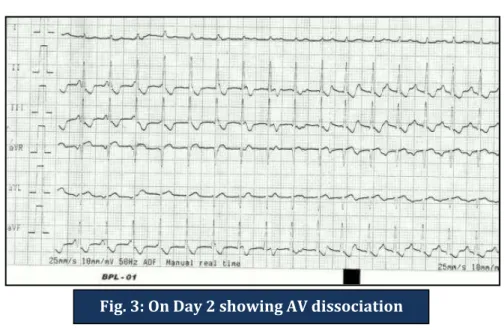
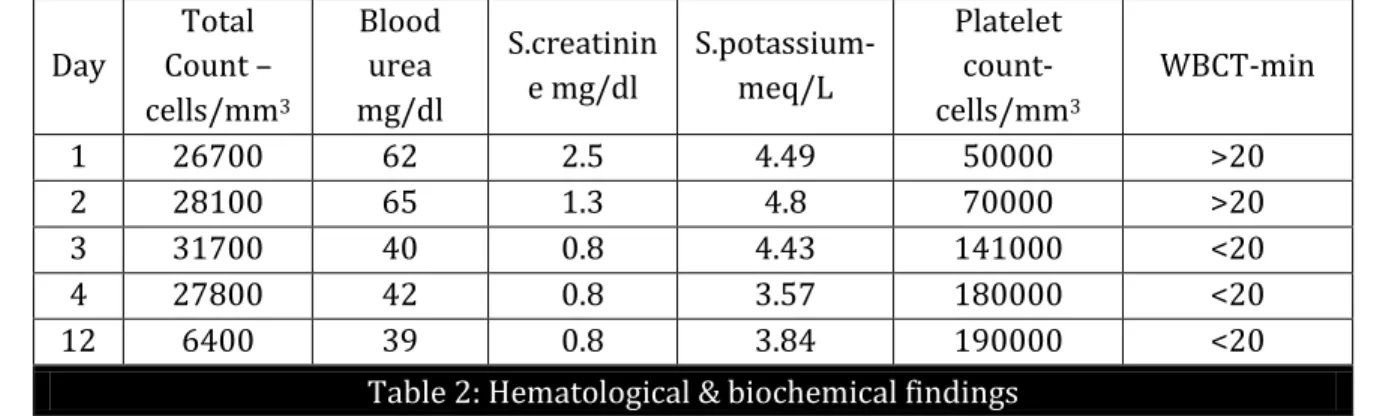
Case report A 23 year old male presented to emergency ward 24 hours after snake bite with history of blurring of vision, diplopia and decreased urine output. On admission his pulse was 54 beats/min, irregularly irregular. BP-120/70 mm of Hg, RR-14 breaths/min. On local examination fang mark was present over left 2nd toe with no signs of local reaction and systemic manifestation of envenomation. Investigations done on the same day revealed ECG with normal rhythm(fig 1), troponin T – negative, serum electrolytes were normal, WBC count- 26,700 cells/mm3, blood urea- 62 mg/dl, S.creatinine- 2.5 mg/dl, platelet count- 50,000 cells/mm3, WBCT> 20 mins (table 2). The patient was immediately started on IV fluids, ASV, antibiotics and analgesics. Inspite of giving ASV 10 hours later he complained of worsening of diplopia and patient developed tachypnea, cyanosis, ptosis, muscle weakness, fasciculations all suggestive of neuromuscular manifestations of envenomation. He was shifted to MICU and was intubated.
Journal of Evolution of Medical and Dental Sciences/ Volume 3/ Issue 07/February 17, 2014 Page 1714 Fig. 1: (at time of admission normal rate and rhythm)
Fig. 2: (Day 1- 10 hrs after admission showing 1st degree AV block)
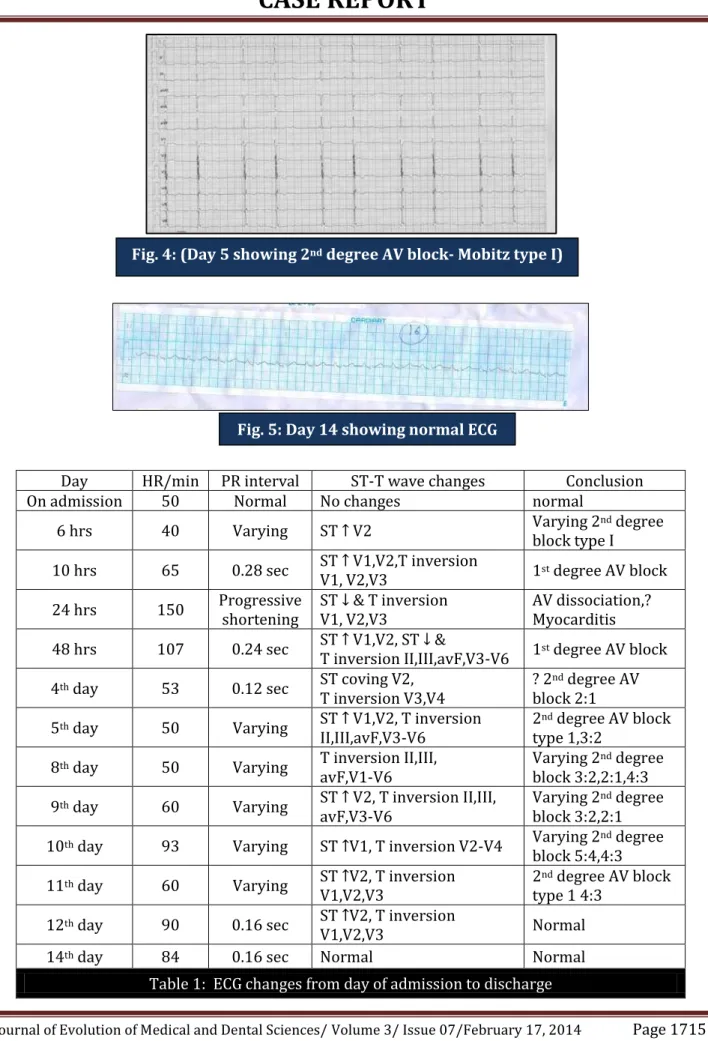
Journal of Evolution of Medical and Dental Sciences/ Volume 3/ Issue 07/February 17, 2014 Page 1715 Day HR/min PR interval ST-T wave changes Conclusion
On admission 50 Normal No changes normal
6 hrs 40 Varying ST ↑ V Varying 2nd degree
block type I
10 hrs 65 0.28 sec ST ↑ V ,V ,T inversion
V1, V2,V3 1st degree AV block
24 hrs 150 Progressive shortening
ST ↓ & T inversion V1, V2,V3
AV dissociation,? Myocarditis
48 hrs 107 0.24 sec ST ↑ V ,V , ST ↓ &
T inversion II,III,avF,V3-V6 1st degree AV block
4th day 53 0.12 sec ST coving V2, T inversion V3,V4
? 2nd degree AV block 2:1
5th day 50 Varying ST ↑ V ,V , T inversion II,III,avF,V3-V6
2nd degree AV block type 1,3:2
8th day 50 Varying T inversion II,III, avF,V1-V6
Varying 2nd degree block 3:2,2:1,4:3
9th day 60 Varying ST ↑ V , T inversion II,III, avF,V3-V6
Varying 2nd degree block 3:2,2:1
10th day 93 Varying ST ↑V , T inversion V -V4 Varying 2nd degree block 5:4,4:3
11th day 60 Varying ST ↑V , T inversion V1,V2,V3
2nd degree AV block type 1 4:3
12th day 90 0.16 sec ST ↑V , T inversion
V1,V2,V3 Normal
14th day 84 0.16 sec Normal Normal
Table 1: ECG changes from day of admission to discharge
Fig. 4: (Day 5 showing 2nd degree AV block- Mobitz type I)
Journal of Evolution of Medical and Dental Sciences/ Volume 3/ Issue 07/February 17, 2014 Page 1716 Day
Total Count – cells/mm3
Blood urea mg/dl
S.creatinin e mg/dl
S.potassium-meq/L
Platelet count-cells/mm3
WBCT-min
1 26700 62 2.5 4.49 50000 >20
2 28100 65 1.3 4.8 70000 >20
3 31700 40 0.8 4.43 141000 <20
4 27800 42 0.8 3.57 180000 <20
12 6400 39 0.8 3.84 190000 <20
Table 2: Hematological & biochemical findings
DISCUSSION: Cardiac complications and ECG abnormalities following snake bite has been reported number of times but not many case reports with involvement of conduction system of the heart has been described. In this case species of snake has not been identified and troponin T was negative. Varying AV block was observed from day1 to day 11 and ECG became normal on day 12.
ECG abnormalities or involvement of the myocardium has been observed following envenomation by a no of different species of snakes including viper berus, atractaspis engaddensis, Echis ocellatus and Calloselasma rhodostoma.
Explanation for ECG changes in our case might be because of various mechanisms. In a prospective study conducted by David G et al2 in Port Mores General hospital in PapuaNew Guinea between march 99 and june 99 they studied ECG’s of 9 patients envenomated by Elapid snakes in that 76 patints had ECG abnormalities,commonest abnormalities were septal T wave invertion and bradycardia including AV block. Bradycardia/10 AV block were seen in 2 of the taipan envenomation and 20 AV blockin one case bitten by death adder. ECG abnormalities are most likely to have been caused by a direct toxic effect of a venom component either on the heart or on the innervation of the heart.In Taipan bites taicatoxin a CCB might be responsible for the ECG abnormality.2
In a study done by Nayak KC et al in SP Medical College,Bikaner they studied 30 cases of snake bite cardiotoxicity was seen in 30% in that AV block in 3.3% only.3
Tony JC et al reported a case of acute MI complicating snake bite in a 47 year old man.It was presumed to be due to sarafotoxin in snake venom having vascular toxic effect leading to vasospasm in coronary vessels and also delay AVconduction.4
Various other mechanisms have been suggested –directly acting cardiotoxin5, myotoxin causing cardiac muscle damage,6 coronary vasospasm,7 electrolyte disturbance,8 severe hypotension9 and disturbance of autonomic innervation of the heart.
Journal of Evolution of Medical and Dental Sciences/ Volume 3/ Issue 07/February 17, 2014 Page 1717
cardiac monitoring even when the acute phase is over. Studies are required to elucidate the effect of snake venom on the electrophysiological properties of the cardiac cell membrane.
REFERENCES:
1. Aravanis C, Ioannidis P, Ktenas J. Acute myocardial infarction and cerebrovascular accident in a
young girl after a viper bite. Br Heart J. 1982; 47: 500–503.
2. David lallo,Andrew J Trevett,Nneka N wokolo, Ian F Laurenson, Sirus Naraqi,Isikevau, et al. ECG abnormalities in patients bitten by taipans and other elapid snakes in papua New Guinea. American Journal of Tropical Medicine and Hygiene,52, 525-531.
3. Nayak KC, Jain AK, Sharada DP, Mishra SN . Profile of cardiac complications of snake bite. Indian Heart Journal 1990 may-jun 42(3)185-8.
4. Tony JC,Bhat R .Acute Myocardial infarction following snake bite.Trop doct 1995;3:137.
5. Nayler,W.G.,Sullivan,A.T., Dunnet,J., Slade, A . M. & Trethewie,E .R.(1976).The effect of a cardiotoxic component of the venom of the indian cobra(naja nigricollis) on the subcellular structure and function of heart muscle.Journal of Molecular and cellular Cardiology,8,341-360. 6. Rowlands,J.B, Mastaglia,F.L, Kakales,B.A, & Hainsworth,D. (1969). Clinical & pathological
aspects of a fatal case of mulga (pseudechis australis) snake bite. Medical journal of Aurstralia, i,226-230.
7. Tibbak,J.,Sutherland,S.k, Rivere,R.A & Masei,P.P.(1992). The cardiovascular & haematological effects of purified prothrombin activator from the common brown snake (pseudogenic t) & their antagonism with heparin. Anaesthesia & Intensive care 20, 28-32.
8. Reid,H.A (1961). Myoglobinuria & sea-snake poisoning. British Medical Journal, i,1284-1289. 9. Myint-Levin, Warrell,D.A, Phillips,R.E, Tin-Nu, Swe Tunpe & Mauy-Mauy Lay (1985). Bites of
Russel viper in Burma: Heaomostatic, vascular, renal disturbance & response to treatment. Lancet, ii, 1259-1264.
AUTHORS:
1. Vikas L. 2. Riyaz Ahmed
PARTICULARS OF CONTRIBUTORS:
1. Assistant Professor, Department of Medicine, Mysore Medical College and Research Institute.
2. Senior Resident, Department of Medicine, Mysore Medical College and Research Institute.
NAME ADDRESS EMAIL ID OF THE CORRESPONDING AUTHOR:
Dr. Vikas L,
Door – 11, 9th Main,
6th cross, Brindavan First Stage, Mysore – 570020.
E-mail: [email protected]