ENVENOMATION BY THE MADAGASCAN COLUBRID SNAKE,
Ithycyphus miniatus
MORI A. (1), MIZUTA T. (2)
(1) Department of Zoology, Graduate School of Science, Kyoto University, Sakyo,
Kyoto, Japan; (2) Department of Biology, Faculty of Science, Toho University,
Funabashi, Chiba, Japan.
ABSTRACT: We report two cases of envenomation by a Madagascan
opisthoglyphous snake, Ithycyphus miniatus. In both cases, the snake bit the finger of
a human who was preparing an experiment by tying a string around the snake body.
Symptoms of the first case included temporal severe local pain and extensive
bleeding. In the second case, severe pain accompanying obvious local swelling was
caused and lasted for several hours. The present observations indicate that bite by I.
miniatus potentially causes serious physiological effects in humans although the
snake is basically calm and reluctant to bite.
KEY WORDS: Madagascar, Colubrid, Ithycyphus miniatus, envenomation,
opisthoglyph, Duvernoy's glands.
CORRESPONDENCE TO:
AKIRA MORI, Department of Zoology, Graduate School of Science, Kyoto University,
INTRODUCTION
Madagascan colubrid snakes show a high species diversity and endemism. Currently,
74 species are known, and all of them are endemic to Madagascan region (15).
Approximately half of them are opisthoglyphous snakes (6, 15), but their potential
dangerousness to human has been poorly demonstrated. Ithycyphus is a
medium-sized, arboreal Madagascan colubrid genus, which is comprised of five
species (6, 15). They have enlarged, grooved posterior maxillary teeth (1, 3), and
Phisalix (14) listed the genus under "venomous" snakes of Madagascar. Domergue
(3) observed that a chameleon seized by Ithycyphus oursi was paralyzed in two
minutes before swallowing, which suggests mild effects of its "venom" on prey. On the
other hand, there have been no reports that document effects of bite by Ithycyphus on
humans (4, 16, 17). Here, we report two cases of human envenomation by I. miniatus,
one of which caused local swelling and severe temporal pain.
CASES
On December 10, 2003, at 10:10 a.m., in the dry forest of Ampijoroa, Northwestern
Madagascar, a male I. miniatus (snout-vent length = 1086 mm, body mass = 374 g) bit
the right thumb of a man (33 years old, 53 kg) when he was trying to tie a hemp string
around the anterior part of the snake for the preparation of an experiment on
responses of birds to snake predators (Case 1). The enlarged posterior maxillary
teeth firmly embedded into the dorsal side of the medium segment of the finger. He
attempted to force to disengage the snake immediately, and when he successfully did
it, within 30 seconds after the bite, severe local pain and extensive bleeding started.
Because of the pain, he was not able to hold the snake with his right hand when he
intended to continue the experiment. No details were recorded thereafter, but he still
had difficulty to firmly grip a pencil approximately 8 hours after the bite although he did
not feel pain at that time. No obvious local swelling was recognized although little
attention was paid to confirm the occurrence of minor swelling.
mass = 103 g) bit the distal segment of the left fourth finger of a man (42 years old, 57
kg) on December 1, 2005, at 5:45 a.m., when he was loosening a hemp string that
was tied around the anterior part of the snake body for another experiment similar to
that mentioned above and in the same study place. The snake firmly seized the finger,
and its enlarged maxillary teeth deeply embedded into the finger cushion. To avoid
slashing hurt that would be caused by forced removal of the teeth, he let the snake
untouched and attempted to induce its voluntary release. However, the snake
continued the firm grasping, repeating chewing motions three or four times. Thus,
approximately 60 seconds after the bite he managed to disengage the snake teeth
deliberately so as not to cause slashing cut. When he successfully disengaged it, 1
minute after bite, he suddenly felt very severe sharp pain in his left finger so that he
was unable to put forth his strength in the left hand. The pain continued for the next
five minutes, but only slight bleeding was observed. Six minutes after the bite he
began to feel local throbbing pain as well as severe sharp pain in the finger so that he
hardly kept breathing. Then, he banded tissue paper around the finger to stop the
bleeding, when no swelling was recognized. When the tissue paper was removed,
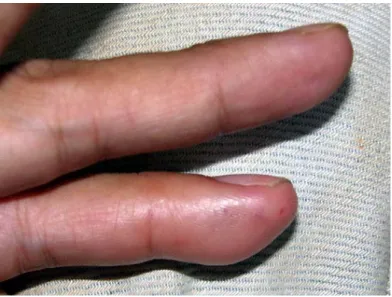
after 4 minutes, he noticed a slight swelling of the distal segment of the ring finger
(Figure 1). Severe pain began to abate 15 minutes after the bite, but swelling became
conspicuous with discoloration on the palm side of the distal segment of the left ring
finger. Thirty minutes after the bite, swelling extended to the basal segment of the ring
finger, but by then sharp pain had mostly diminished; instead, pain associated with
stiffness of the finger began. Forty-five minutes after the bite, swelling extended to the
distal part of the hand, and the basal part of the ring finger swelled enormously (Figure
2).
The patient started walking back to the campsite 55 minutes after the bite, and when
he arrived there after 10 min, he no longer felt sharp pain but continued feeling
throbbing pain and tenderness, and he noticed that the basal parts of his middle and
little fingers began swelling. In spite of the continuous local pain, he was able to have
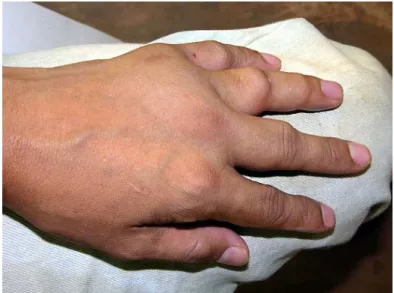
continued extending (Figure 3), and 165 minutes after the bite it covered the whole left
ring finger, distal half of the hand (both dorsal and ventral sides), and basal half of the
middle and little fingers accompanying intermittent severe throbbing and tenderness,
especially on the ring finger. Because of the stiffness, he was not able to move the
fingers. He lay down in the tent at 9:15 a.m. and took a nap between 10:45 and 11:55
a.m. The progress of swelling seemed to cease before he fell into sleep. While having
lunch, between 12:00 and 12:50 p.m., the progress of swelling completely stopped,
and only an intermittent local pain on the distal segment of the ring finger persisted.
He took another nap between 1:10 and 4:00 p.m., during when swelling and pain
rapidly started resolving. Approximately 12 hours after the bite, only an occasional
slight pain on the bite site remained, and he was able to bend the middle and little
fingers slightly. When he had dinner at 7:00 p.m., he felt slight stomach discomfort
and did not have much appetite although he felt no pain in the finger. He went to bed
at 9:00 p.m.
In the following morning, only a little swelling of the dorsal surface of the hand was
recognizable, and he was able to move the middle and little fingers normally. Although
he was not able to bend the ring finger completely, he felt no pain even if he moved
the finger. A little discoloration of the bite site was still recognizable. Forty-one hours
after the bite, slight pain occurred only when the bite site was touched and pressed
strongly. Swelling completely resolved at 12:00 a.m. on December 5. Slight pain in the
finger, which was only caused by strong pressure, completely diminished at 10:30 p.m.
on December 6.
Signs or symptoms of general systemic effects, such as dizzy and headache, were
not recognized in either case. Both patients were healthy when they were bitten, and
no medical treatment was conducted.
DISCUSSION AND CONCLUSIONS
Among the 18 colubrid genera currently described in Madagascar (15), physiological
(Madagascarophis and Mimophis) and one aglyphous (Leioheterodon) genera (2, 4,
5, 13). Serious local effects, such as swelling, blistering, and necrosis, have been
caused by Madagascarophis meridonalis (4). The present observation provides
another case of serious effects by a Madagascan colubrid bite accompanying
temporal local swelling and severe pain.
It is likely that the observed pharmacological effects were caused by the secretions
from Duvernoy's glands (4) although no explicit description of these glands in I.
miniatus is available (12). Kardong (8, 9) pointed out that refined definition and careful
use of the term "venom" are necessary at least when used in a biological context. It
would be safe to describe the present cases as human envenomation because there
is evidence that prey grasped by Ithycyphus seems to be quickly immobilized [or
possibly killed] (3), which fulfills the biological definition of "venom" (8, 9). Weak
envenomation effects in Case 1 may be probably due to the quick disengagement of
the snake, which might have an inefficient venom injection system (7, 10). Also,
extensive bleeding in Case 1 may be caused by the forced disengagement of the
fangs that cut the skin rather than by the pharmacological effects of the venom.
Severe pain in Case 2 suddenly starting only after the disengagement of the snake
may reflect the slow and inefficient delivery of venom associated with low-pressure
system and occlusion of the fang groove by the finger skin (7, 8, 10, 11).
The present report demonstrates that I. miniatus is a potentially harmful snake
capable of envenoming humans. Nonetheless, despite handling this species dozens
of times, we have never experienced a bite attempt, except for these two cases, in
which snakes were restrained for several minutes. It seems that the snake is basically
calm and attempts to bite only as a final resort. It is worth noting that the local belief by
Malagasy people that Ithycyphus can transfix humans (6) might have originated from
Figure 1: Beginning of swelling 12 min after the bite by Ithycyphus miniatus (Case 1).
The enlarged posterior maxillary teeth of the snake were embedded into the ventral
surface of the distal segment of the left ring finger for 60 s during the bite.
Figure 3: Maximum swelling of the left hand and fingers photographed 130 min after
the bite (Case 1).
ACKNOWLEDGEMENTS
We thank K. Kardong for his valuable comments on the manuscript. We are grateful to
Department de Biologie Animale, Faculte des Sciences, Université d'Antananarivo,
and Association Nationale pour la Gestion des Aires Protégées for their assistance to
the research project in Madagascar. The research in Madagascar was financially
supported by a grant-in-aid for International Scientific Research Program
(no.17405008) from the Ministry of Education, Culture, Sports, Science and
Technology, and in part by a grant for the Biodiversity Research of the 21st Century
COE (A14). Research of the second author was partially supported by a grant from
JSPS (the Japan Society for the Promotion of Science) research fellowships for
young scientists.
REFERENCES
1 BRYGOO ER. Les ophidiens de Madagascar. Mem. Inst. Butantan, 1982, 46,
19-58.
2 DOMERGUE CA. Un serpent venimeux de Madagascar: Madagascarophis
3 DOMERGUE CA. Notes sur les serpents de la région malgache VI. Le genre
Ithycyphus Günther, 1973; description de deux espéces nouvelles. Bull. Mus.
Natn. Hist. Nat., Paris, Ser. 4, Sec. A., 1986, 8, 409-434.
4 DOMERGUE CA. Un serpent venimeux de Madagascar. Observation de deux cas
de morsure par Madagascarophis (Colubridé opisthoglyphe). Arch. Inst.
Pasteur Madagascar, 1989, 56, 299-311.
5 DOMERGUE CA., RICHAUD J. Activité hémolytique des secrétions des glandes de
Duvernoy chez Lioheterodon (Colubridé aglyphe). Arch. Inst. Pasteur
Madagascar, 1971, 40, 145-148.
6 GLAW F., VENCES M. A Fieldguide to the Amphibians and Reptiles of Madagascar,
second ed. Zoologisches Forschungsinstitut und Museum, 1994, Alexander
Koenig, Bonn. 480p.
7 HAYES WK., LAVIN-MURCIO P., KARDONG KV. Delivery of Duvernoy's secretion
into prey by the brown tree snake, Boiga irregularis (Serpentes: Colubridae).
Toxicon, 1993, 31, 881-887.
8 KARDONG KV. Snake toxins and venoms: an evolutionary perspective.
Herpetologica, 1996, 52, 36-46.
9 KARDONG KV. Colubrid snakes and Duvernoy's "venom" glands. J. Toxicol. Toxin
Rev., 2002, 21, 1-19.
10 KARDONG KV., LAVIN-MURCIO PA. Venom delivery of snakes as high-pressure
and low-pressure systems. Copeia, 1993, 1993, 644-650.
11 KARDONG KV., YOUNG, BA. Fangs of snakes: How do open grooves inject
venom into enclosed spaces? Am. Zool., 1991, 31, 51A.
12 MCKINSTRY DM. Morphologic evidence of toxic saliva in colubrid snakes: a
checklist of world genera. Herp. Rev., 1983, 14, 12-15.
13 MORI, A. A case of envenomation by the Madagascan colubrid snake,
Leioheterodon modestus. Snake, 2002, 29, 7-8.
15 RAXWORTHY CJ. Introduction to the reptiles. In: GOODMAN SM., BENSTEAD JP.
(Eds.), The Natural History of Madagascar, University of Chicago Press,
Chicago, 2003, pp.934-949.
16 VIDAL N. Colubroid systematics: evidence for an early appearance of the venom
apparatus followed by extensive evolutionary tinkering. J. Toxicol. Toxin. Rev.,
2002, 21, 21-41.
17 WARRELL DA. Clinical toxicology of snakebite in Africa and the Middle East /
Arabian Peninsula. In: MEIER J., WHITE J. (Eds.), Handbook of Clinical
Toxicology of Animal Venoms and Poisons. CRC Press, Boca Raton, 1995,