Arquivos de Ciências do Mar
BATHING SUITABILITY AND ANTIMICROBIAL
SUSCEPTIBILITY OF ENTEROCOCOS IN TROPICAL
COASTAL WATERS
Balneabilidade e suscetibilidade antimicrobiana de
enterococos em águas tropicais
Norma S. Evangelista-Barreto1,2, Fátima C. T. de Carvalho1, Francisca G. R. de Menezes1, Camila M. Silva1, Rafael S. Rocha1, Oscarina V. de Sousa1, Regine H.S. Fernandes Vieira1
ABSTRACT
The bathing suitability of three beaches and the antimicrobial susceptibility proile of Enterococcus faecalis and E. faecium lineages to various antimicrobials were studied weekly for 14 weeks in the city of Fortaleza, Ceará, Brazil. The water of the beaches 1, 2 and 3 was considered unsuitable for bathing (40%, 60% and 80%, respectively). Enterococcus faecalis was the predominant species (63.5%) in the water of the three beaches, followed by E. faecium (36.5%). Most lineages (36.5%) were isolated in beach 2; 34.6% were isolated in beach 1, and 28.8% in 3. High antimicrobial resistance to nalidixic acid (94.3%), tetracycline (26.4%) and amicacine (26.0%) was observed. All strains showed 100% susceptibility to ampicillin and imipenem. Enterococcus faecalis was also susceptible to vancomycin and E. faecium to penicillin. Multiple resistance proile was observed in 88.5% (MAR >0.18) of the strains, three of which were resistant to six antimicrobials. Considering the resistance increase of autochthonous bacteria observed in the marine environment, special attention should be paid to the multiple resistance proile of the isolates.
Keywords: bathing suitability, Enterococcus faecalis, beaches, contamination.
RESUMO
A balneabilidade de três praias e o peril de susceptibilidade de estirpes de Enterococcus faecalis e E. faecium a diferentes antimicrobianos foram estudados semanalmente na cidade de Fortaleza, Ceará, durante 14 semanas. As águas das praias 1, 2 e 3 se apresentaram impróprias para balneabilidade em 40%, 60% e 80%, respectivamente. Enterococcus faecalis (63,5%) foi a espécie predominante em todos as praias, seguido de E. faecium (36,5%). Na praia 2 se isolou 36,5% das estirpes, seguido da praia 1 (34,6%) e praia 3 (28,8%). Elevada resistência foi observada para o ácido nalidíxico (94,3%), tetraciclina (26,4%) e amicacina (26,0%) e susceptibilidade a ampicilina e o imipenem. Enterococcus faecalis também foi susceptível a vancomicina e E. faecium a penicilina. Peril de multiresistência foi observado em 88,5% das cepas (índice MAR >0,18), tendo três cepas apresentado resistência a seis antibióticos. O peril de multiresistência dos isolados é preocupante uma vez que se tem observado o aumento da resistência em bactérias autoctones no ambiente marinho.
Palavras-chaves: balneabilidade, Enterococcus faecalis, praias, poluição.
INTRODUcTION
In the last years, the increase of demographic concentration in urban centers, mainly those located near lakes and coastal areas, have contributed to the increase of water-borne diseases caused by the evergrowing discharge of domestic sewage. Aquatic environments in general and beaches in particular are important for human recreation and are widely used for sports practice, sunbathing and swimming. Pollution in marine coastal ecosystems has become a serious environmental problem that affects developing as well as developed countries (Elofsson et al., 2003). Public health hazard monitoring involves mainly fecal coliform testing. However, the enterococci group has proved to be more sensitive as indicator of fecal contamination than Escherichia coli and thermotolerant coliforms for they survive longer and are more resistant in saline environments (Dufour, 1994).
Enterococci are widely distributed in the environment and can be found in soil, food, water, plants, animals, birds and insects (Blaimont et al., 1995). They are opportunistic pathogens responsible for most nosocomial infections and can cause endocardites and urinary tract infections in immuno-depressed individuals (Horner et al., 2005).
The increasing bacterial resistance to antibiotics has become a public health problem due to the fact that bacteria can be found in different niches. Among those niches, the aquatic environment is considered
the most eficient for the selection of resistant
populations, as well as for the exchange of resistance genes by means of mobile genetic elements, such as plasmids and transposons which encode resistance to antibiotics. The multiple drug resistance of an organism reduces the therapeutic options in both animals and humans (Alderman & Hastings, 1998).
For the above-mentioned reasons, the
quantiication and identiication of the multiresistant
lineages of the genus Enterococcus found in coastal waters is relevant to evaluate their contribution to the dissemination of resistance. The objetive of this study was to isolate and identify Enterococcusfaecalis and E. faecium lineages from three beaches (Diários, Meireles e Mucuripe) and to assess the susceptibility
proile of the isolates to various antimicrobials.
MATERIAls AND METhODs
sample location and collection
The three beaches studied are located on the waterfront of the city of Fortaleza, Ceará State.
Fourteen samples were collected and analyzed weekly from April to July 2007 at Diários Beach (1), Meireles Beach (2) and Mucuripe Beach (3) abreast of the Maceió Creek’s mouth. The total number of samples analyzed amounted to 42. Water samples were collected at 1 m depth in 1000 mL sterilized amber bottles and transported to the Microbiology laboratory at the Marine Science Institute (LABOMAR- Universidade Federal do Ceará, UFC) for immediate processing. The samples were always collected between 14:00 as 15:00 h irrespective of the tide.
Enterococcus quantiication and
strain isolation
Most probable number (MPN) estimates were obtained by multiple-tube technique using a
ive tube series and Azide Dextrose Broth- Difco.
After serial dilutions from 10-1 to 10-4, the tubes
were incubated at 35°C for 48 hours. The tubes with precipitation or clouding were inoculated in Agar M-Enterococcus (Difco) for 48 hours at 35ºC. The presence of turbidity and of characteristic strains of Enterococcus in the Agar M-Enterococcus medium was considered positive for bacterial growth. For the determination of the MPN of Enterococcus mL-1
the Hoskins tables were used (95% conidence limit).
The colonies with characteristics of Enterococcus in Agar M-Enterococcus were inoculated in Brain Heart Infusion Agar (BHI) (Oxoid) for biochemical
identiication. Morphological (Gram staining
reaction) and biochemical tests (catalase production, arginine utilization, growth at 10ºC and 45ºC, growth in 6.5% NaCl, pH 9.6 and in 0.04% telurite)
were used for bacterial identiication (Silva et al.,
2007). The same tests were performed on a strain of Enterococcus faecalis ATCC 25922.
Antibiogram
were set up in duplicate, and Enterococcus faecalis ATCC 25922 were used as standard quality control strains. The following antibiotics were tested:
nalidixic acid - NAL (30 μg), amicacin - AMI (30 μg), ampicillin - AMP (10 μg), cefalotin - CFL (30 μg), ceftriaxon - CRO (30 μg), erythromycin - ERI (15 μg), gentamicin - GEN (10 μg), imipenem - IMP (10 μg), penicillin - PEN (10 μg), tetracycline - TET (30 μg) and vancomycin - VAN (30 μg).
Multiple Antimicrobial Resistance
When applied to a bacterial isolate, multiple
antimicrobial resistance (MAR) is deined as a/b,
where a is the number of antibiotics to which the isolate is resistant, and b the number of antibiotics to which the isolate was exposed. Values higher than 0.2 indicate multiple resistance (Krumperman, 1983).
statistical analysis
The antibiogram results were expressed in a binomial matrix were 1 is resistance and 0 is sensitivityto the antimicrobials tested. A similarity dendrogram was built using the neighbor joining
UPGMA method with the BioDiversity Professional
Beta (McAleece et al., 1997) software package and Bray-Curtis analysis assimilarity matrix.
REsUlTs AND DIscUssION
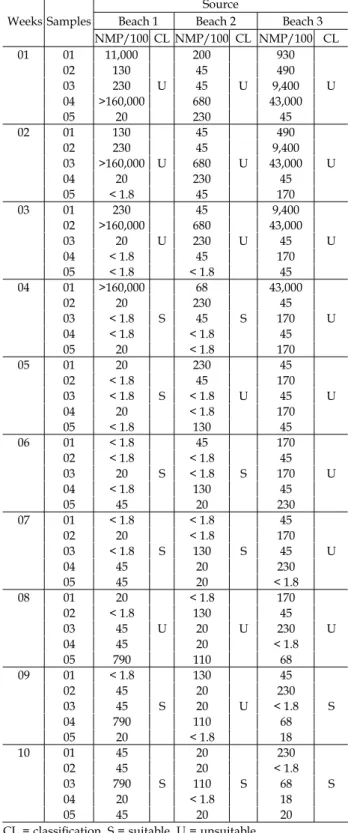
In Beach 1, bathing suitability was observed in 60% of the weeks, followed by Beachs 2 and 3 which were safe in 40% and 20% of the weeks, respectively. The combined analysis of Beaches 1 and 2 showed that they were suitable during 4 weeks (4th, 6th, 7th and 10th) (Table I). During the last week of the experiment, all three beaches were suitable for bathing. Therefore, water quality in Beach 1 was considered excellent or very good in 30% of the weeks. Water quality in Beach 2 was excellent in 20% of the weeks and very good or satisfactory in 10% of the weeks.
Resolution 274 (BRASIL, 2000) of the Brazilian National Environmental Council (CONAMA) establishes the suitability of marine and freshwater bathing sites for contact recreation, and grades the water at any given site as satisfactory when no more
than 400 enterococci/100 mL are found in 80% of the analyzed samples during the ive previous weeks. Water is graded as Excellent, Very Good, Satisfactory and Unsuitable, being the irst three
considered Suitable.
Table I - Most Probable Number (MPN) of Enterococcus per 100 mL in water samples of three beaches (Fortaleza, Ceará),
classi-ied according to the criteria of bathing suitability established by
CONAMA´s Resolution n° 274, 2000.
Weeks Samples
Source
Beach 1 Beach 2 Beach 3
NMP/100 CLNMP/100 CL NMP/100 CL 01 01 11,000 200 930
02 130 45 490 03 230 U 45 U 9,400 U 04 >160,000 680 43,000 05 20 230 45 02 01 130 45 490
02 230 45 9,400 03 >160,000 U 680 U 43,000 U 04 20 230 45 05 < 1.8 45 170 03 01 230 45 9,400
02 >160,000 680 43,000 03 20 U 230 U 45 U 04 < 1.8 45 170 05 < 1.8 < 1.8 45 04 01 >160,000 68 43,000
02 20 230 45 03 < 1.8 S 45 S 170 U 04 < 1.8 < 1.8 45 05 20 < 1.8 170 05 01 20 230 45
02 < 1.8 45 170 03 < 1.8 S < 1.8 U 45 U 04 20 < 1.8 170 05 < 1.8 130 45 06 01 < 1.8 45 170
02 < 1.8 < 1.8 45 03 20 S < 1.8 S 170 U 04 < 1.8 130 45 05 45 20 230 07 01 < 1.8 < 1.8 45
02 20 < 1.8 170 03 < 1.8 S 130 S 45 U 04 45 20 230 05 45 20 < 1.8 08 01 20 < 1.8 170
02 < 1.8 130 45 03 45 U 20 U 230 U 04 45 20 < 1.8 05 790 110 68 09 01 < 1.8 130 45 02 45 20 230 03 45 S 20 U < 1.8 S 04 790 110 68 05 20 < 1.8 18 10 01 45 20 230
02 45 20 < 1.8 03 790 S 110 S 68 S 04 20 < 1.8 18
05 45 20 20
CL = classiication, S = suitable, U = unsuitable.
sampling, and also to the sewage discharged into culverts and berths which might carry fecal bacteria into the sea (Vieira et al., 2007). In the 8th week, 80% of the samples collected in Beach 1 were within the allowed concentration of enterococci. Nevertheless,
the location was classiied as unsuitable for bathing
because, according to CONAMA´s Resolution, the value obtained in the last sample must not be higher
than 400 enterococci/100 mL (Table I). The water in
Beach 3 has been reported as unsuitable for primary contact recreation. The Maceió Creek´s water is an open sewage with foul smell and its direct drainage into the beach might be responsible for the observed water contamination (Vieira et al., 2003).
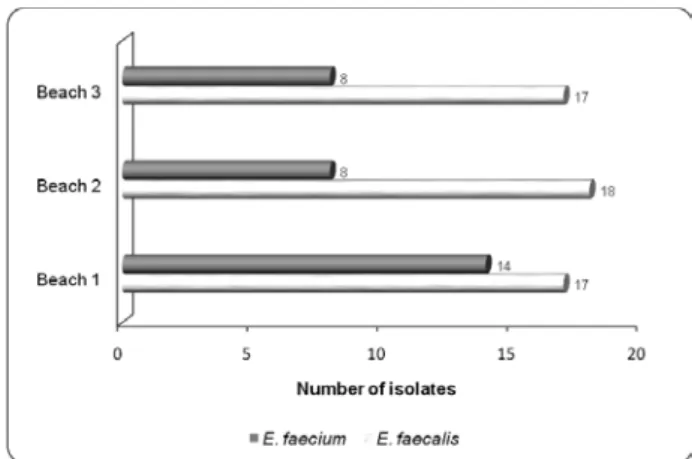
Of the 110 probable Enterococcus strains, 52
(63.4%) were identiied as E. faecalis and 30 (36.6%) as E. faecium (Figure 1), which amounts to 82 isolates. In Beach 1, a total of 31 isolates (37.8%) were found, followed by Beach 2 with 26 isolates (31.7%) and by Beach 3 with 25 isolates (30.5%). The independent analysis of the beaches showed that the presence of E. faecalis was 32.7%, 34.6% and 32.7% in Beaches 1, 2 and 3, respectively. For Enterococcus faecium, the presence of isolates in the same locations was 46.7%, 26.7% and 26.7%, respectively.
Despite the high number of species known today, 85-95% of the enterococci infections are caused by E. faecalis and 5-10% by E. faecium (Bender et al., 2009). The predominance of E. faecalis isolates when compared to E. faecium is in agreement with the
indings of Bonilla et al. (2006), according to which E. faecium, commonly found in the gastrointestinal tract and human feces, might be easily inactivated by environmental factors such as temperature or culture medium. These microorganisms have been found to be the main cause of infections in humans and present natural resistance to several antimicrobials (Tavares, 2000).
Beach 3 was the location with the highest
MPN/100 mL and therefore a higher number
of isolates was expected (Figure 1). The high concentration of thermo tolerant coliforms in the water (Evangelista-Barreto et al., 2007) may have
inluenced the enterococci MPN results.The presence of these bacteria at Beaches 1 and 2 can be due to their longer survival time when compared to E. coli and to thermotolerant coliforms (Dufour, 1994). Another aspect that should be taken into account is the fact that samples were always collected at the same time of the day, independently of the tide. At high tide, the sea water washes the sand and might thus have contributed to enhance the isolation of microorganisms.
In relation to the susceptibility proile to
antimicrobials, 52 strains were tested: 19 (36.5%) for E. faecium and 36 (63.5%) for E. faecalis. Ninety-eight percent of the selected strains were resistant, although all strains presented sensibility to ampicillin and imipinem. High resistance percentage was observed for nalidixic acid (94.3%), tetracycline (26.4%), amicacin (26.0%), erythromycin (17.0%), gentamicin (9.4%), penicillin (3.8%) and cefalotin (01.9%) (Table 2). The strains showed intermediate sensibility to all the antibiotics tested, excepting the betalactamic group (penicillin, ampicillin and imipinem) and were therefore considered resistant (Table II).
Assessing the susceptibility proile of the
genus Enterococcus is of importance because these microorganismshave been increasingly involved in opportunistic infections and multiresistant lineages have been isolated (Poeta et al., 2005). The most relevant resistance phenotypes are those related to aminoglycosides (streptomycin and gentamicin), betalactamics (amoxicillin and ampicillin) and
glycopeptides (teicoplanin and vancomycin) (D’Azevedo
et al., 2004).
Only one strain showed susceptibility to all antibiotics tested. One E. faecium strain presented intermediate resistance to vancomycin. This result is of concern considering that vancomycin is one of the few, if not the only, antibiotic effective for the treatment of E. faecium infections (Poeta et al., 2005). The high ampicillin susceptibility observed in our research has also been reported by other authors (e.g., Bender et al., 2009).
Most of the isolates were resistant to nalidixic acid (Table II). The resistance mechanism to quinolones is cromossomic and results from clone diffusion from mutagenic samples (Lima et al., 2006) that reach the environment through sewage and
through animal and human feces. However, Cabello et al. (2006) reported plasmid mediated antimicrobial resistance to quinolones between bacteria from aquatic and terrestrial environments. The observed resistance to macrolides and tetracyclin (Table II) is of importance, for these are alternative antibiotics to treat Enterococcus infections, which make them unsuitable for empirical antimicrobial therapy (Bender et al., 2009). According to Oliveira & Pinhata (2008), high transference of plasmid resistance mainly to tetracycline has been reported in bacteria isolated from marine sediments.
The high susceptibility of the isolates to
aminoglycosides is a genus-speciic property.
These antimicrobials show a sinergic effect when associated to betalactamics and glycopeptides. Notwithstanding, in the last years enterococci lineages with high resistance to aminoglicosides have been reported. That was also the case in the present study, where high resistance to amicacin was observed (Table II). The resistance results in the loss of synergism with betalactamics and glycopeptides and the consequent loss of bactericidal effect (Saraiva et al., 1997).
Considering that water bodies contain a great diversity of bacteria species, the study of autochthonous bacteria antimicrobial resistance in terms of the maintenance and transference of resistance genes to other bacteria, including pathogenic ones, improves our understanding
of the environmental dissemination of resistant microorganisms (Miranda & Zemelman, 2002). Domestic sewage draining into the sea or recrea-tional areas contributes to establishing routes for microorganisms carrying resistance genes.
Multiple antibiotic resistance (MAR) values are shown in Table III. From the 52 strains tested, 46 presented values equal to or higher than 0.18, which indicates resistance to one or two antibiotics (Table
III). Multiple resistance proile was observed in
94.7% of the strains isolated from Beach 2, followed by Beaches 1 with (88.8%) and 3 (80%). Isolates with MAR values of 0.54 were found in Beaches 1 and 2.
Table III - Number of isolates with multiple antibiotic resistance (MAR) in three beaches of Fortaleza, Brazil.
MAR Beach 1 Beach 2 Beach 3 Total 0.18 2 6 6 14 0.27 6 7 3 16 0.36 5 1 2 8 0.45 2 2 1 5 0.54 1 2 0 3 Total 16 18 15 46
Lineages with MAR varying from 0.18 (resistance to two antibiotics) to 0.54 (resistance to six antibiotics) in all but Beach 3 which presented a
maximum MAR of 0.45 (resistance to ive antibiotics)
(Table III). The presence of multiresistant E. faecalis and E. faecium in the aquatic environment has ecological and public health implications that justify further studies, mainly with respect Table II - Antimicrobial susceptibility proile according to disc diffusion method among
52 enterococcal isolates in three beaches in the city of Fortaleza, Brazil.
Antimicrobial agents
E. faecalis (33) E. faecium (19) Susceptible
N (%)
Intermediate N (%)
Resistant N (%)
Susceptible N (%)
Intermediate N (%)
Resistant N (%)
Aminoglycosides
- Gentamicin 32 (88.9) 01 (02.8) 3 (08.3) 13 (76.5) 02 (11.8) 02 (11.8) - Amikacin 19 (52.8) 07 (19.4) 10 (27.8) 09 (52.9) 04 (23.5) 04 (23.5)
Betalactamics
- Penicillin 34 (94.4) 0 2 (05.5) 17 (100) 0 0 - Ampicillin 36 (100) 0 0 17 (100) 0 0 - Cefhalotin 33 (91.7) 03 (08.3) 0 16 (94.1) 0 01 (05.9) - Ceftriaxon 22 (61.1) 14 (38.9) 0 11 (64.7) 06 (35.3) 0 - Imipenem 36 (100) 0 0 17 (100) 0 0
Tetraciclina
- Tetracycline 24 (66.7) 01 (02.8) 11 (30.5) 13 (76.5) 01 (05.9) 03 (17.6)
Macrolide
-
Erythromycin 17 (47.2) 13 (36.1) 6 (16.7) 07 (41.2) 07 (41.2) 03 (17.6)
Glycopeptides
-
Vancomycin 36 (100) 0 0 16 (94.1) 01 (05.9) 0
Quinolone
- Nalidixic
to resistance determinants in different species (Miranda & Zemelman, 2002). Isolates with multiple resistance had MAR values of 0.27 (resistance to three antibiotics) and were predominant in Beach 2. Most of the strains had MAR values of 0.27 (16 strains) and 0.18 (14 strains) (Table III). Multiple resistance to various antibiotics due to acquired resistance has been observed in E. faecium which is presently considered a serious nosocomial pathogen worldwide (Iversen et al., 2002).
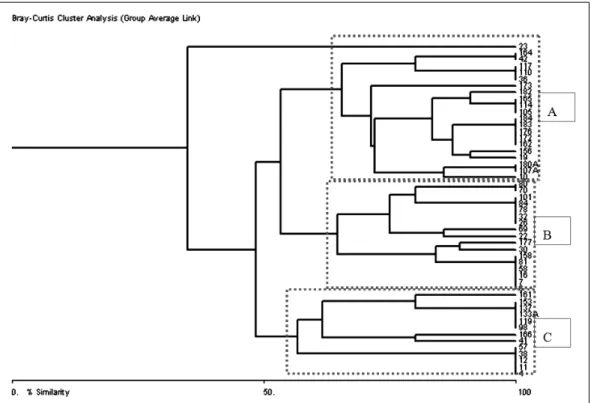
In terms of the susceptibility proile, the similarity coeficient for the nine antimicrobials
tested revealed that E. faecalis and E. faecium lineages formed three major groups. The highest similarity values (about 60%) were obtained in groups A and B, and the lowest in group C (Figure 2). The response
to the antimicrobials was not inluenced by the
isolated species of E. faecium and E. faecalis or by the location where the strains were isolated. Other factors such as untreated sewage discharged into marine
environments through rivers, soil or water modiies
the microbial environment causing changes that are still not well understood. The horizontal transference of resistance plasmids among or within species is another crucial factor for the appearance of populations of resistant bacteria in the aquatic environment.
cONclUsION
The low bathing suitability of the beaches under study due to the presence of fecal bacteria may have deleterious bearing on human health. Besides being a potential source of pathogenic agents, the contaminated water also contributes to the spread of multiresistant lineages and to the increase of antimicrobial resistance in autochthonous microorganisms.
Acknowledgments - The authors wish to thank Dr. Mabel Calina de França Paz, from the Federal Center of Technological Education (CEFETCE), for indicating students and the Sea Sciences Institute (Instituto de Ciências do Mar) for the use of their facilities.
REFERENcEs
Alderman, D.J. & Hastings, T.S. Antibiotic use in aquacuture: development of antibiotic resistance-potencial for consumer health risks. Int. J. Food Sci. Technol., Oxford, v.33, p.139-155, 1998.
Bender, E.A.; Freitas, A.L.P.; Reiter, K.C.; Lutz, L.
& Bath, A.L. Identiication, antimicrobial resistance
and genotypic characterization of Enterococcus spp. isolated in Porto Alegre, Brazil. Braz. J. Microbiol., São Paulo, v.40, p.693-700, 2009.
Blaimont, B.; Charlier, J. & Wauters, G. Comparative
distribution of Enterococcus species in feces and clinical-samples. Microb. Ecol. Health Dis., Oslo, v.8, p.87-92, 1995.
Bonilla, T.D.; Nowosielki, K.; Esiobu, N.; McCorquodale, D.S. & Rogerson, A. Species assemblages of Enterococcus indicate potential sourcesof fecal bacteria at a south Florida recreational beach. Mar. Pollut. Bull., Oxford, v.52, p.800-815, 2006. BRASIL. CONAMA (2000). Resolução no 274, de 29
de novembro de 2000, Conselho Nacional do Meio Ambiente. Diário Oicial [da] República Federativa do Brasil, Brasília.
Cabello, F.C. Heavy use of prophylactic antibiotics in aquaculture: a growing problem for human and animal health and for the environment. Environ. Microbiol., Oxford, v.7, p.1137-1144, 2006.
CLSI - Clinical and Laboratory Standards Institute. Performance Standards for Antimicrobial Susceptibility Testing; Sixteenth Informational Supplement – M100-S17. CLSI, 2007.
D’azevedo, P.A.; Dias, C.A.G. & Lemos, S.K.
Antimicrobial susceptibility among Enterococcus isolates from the city of Porto Alegre, RS, Brasil. Braz. J. Microbiol., São Paulo, v.35, n.3, p.199-204, 2004. Dufour, A.P. Bacterial indicators of recreational water quality. Can. J. Public Health, Ottawa, v.75, n.1, p.49-56, 1994.
Elofsson, K.; Folmer, H. & Gren, I.M. Management of
eutrophicated coastal ecosystems: a synopsis of the literature with emphasis on theory and methodology. Ecol. Econ., Amsterdam, v.47, p.1-11, 2003.
Evangelista-Barreto, N.S.; Sousa, D.B.R.; Ponte, V.M.P.; Viana, C.B.A.; Vieira, R.S.F. Caracterização microbiológica de algumas praias de Fortaleza, Ceará, in Anais do II Congresso de Pesquisa e Inovação da Rede Norte Nordeste de Educação Tecnológica, João Pessoa, 2007.
Horner, R.; Liscano, M.G.H.; Maraschin, M.M.;
Salla, A.; Meneghetti, B.; Dal Forno, N.L.F. & Righi, R.A. Antimicrobial susceptibility among isolates of Enterococcus from Hospital Universitário de Santa Maria. J. Bras. Patol. Med. Lab., Rio de Janeiro, v.41, n.6, p.391-395, 2005.
Iversen, A.; Kuhn, I.; Franklin, A. & Mollby, R. High prevalence of vancomycin-resistant enterococci
in swedish sewage. Appl. Environ. Microbiol., Washington,, v.68, p.2838–284, 2002.
Krumperman, P.H. Multiple antibiotic resistance indexing of Escherichia coli to identify hihg-risk sources of fecal contamination of foods. Appl. Environ. Microbiol., Washington, v.46, n.1, p.165-170, 1983.
Lima, R.M.S.; Figuereido, H.C.P.; Faria, F.C.; Picolli, R.H.; Bueno Filho, J.S.S. & Logato, P.V.R. Resistência a antimicrobianos de bactérias oriundas de ambiente
de criação e ilés de tilápias do Nilo (Oreochromis niloticus). Ciên. Agrotec., Lavras, v.30, p.126-132, 2006.
McAleece N.; Lambshead P.J.D.; Paterson G.L.J. &
Cage; J.D. Biodiversity Pro: Free Statistics Software
for Ecology. http://www.sams.ac.uk/ The Natural
History Museum & The Scottish Association for Marine Science. 1997.
Miranda, C.D. & Zemelman, R. Bacterial resistance to oxytetracycline in Chilean salmon farming. Aquaculture, Amsterdam, v.212, p.31-47, 2002.
Oliveira, A.J.F.C. & Pinhata, J.M.W. Antimicrobial resistance and species composition of Enterococcus spp. isolated from waters and sands of marine recreational beaches in Southeastern Brazil. Water Res., New York, v.42, p.2242-2250, 2008.
Poeta, P.; Antunes, T. & Rodrigues, J. Enterococcus spp. resistentes à vancomicina isolados de fezes de frangos, pombos, gamos e ratos. Arq. Bras. Med. Vet. Zootec., Belo Horizonte, v.58, p.412-414, 2005.
Saraiva, I.H.; Jones, R.N.; Erwin, M. & Sader, H.S. Avaliação da sensibilidade a antimicrobianos de 87 amostras clínicas de enterococos resistentes à vancomicina. Rev. Assoc. Med. Bras., São Paulo, v.43, n.3, p.217-222, 1997.
Silva, N.; Junqueira, V.C.A. & Silveira, N.F.A. Manual de métodos de análise microbiológica de alimentos. Editora Varela, 317 p., São Paulo, 2007.
Tavares, W. Bactérias gram-positivas problemas:
resistência do estailococo, do enterococo e do
pneumococo aos antimicrobianos. Rev. Soc. Bras. Med. Trop., Uberaba, v.33, n.3, p.281-301, 2000.
Vieira, R.H.S.F.; Nascimento, S.C.O.; Menezes,
F.G.R.; Nascimento, S.M.M. & Lucena, L.H.L.
Inluência das águas das galerias pluviais como fator da poluição costeira, Fortaleza, Ceará. Arq. Ciên. Mar, Fortaleza, v.36, p.25-29, 2003.