Coping with child violencein primary care:
how do professionals perceive it?
Enfrentar a violência infantil na Atenção Básica: como os profi ssionais percebem?
Enfrentar la violencia infantil enatención primaria: ¿cómo la perciben los profesionales?
Emiko Yoshikawa Egry
I, Maíra Rosa Apostólico
I, Teresa Christine Pereira Morais
II, Caroline Carapiá Ribas Lisboa
IIII Universidade de São Paulo, School of Nursing, Department of Public Health Nursing. São Paulo, Brazil.
II Universidade de São Paulo, School of Nursing, Postgraduate Program in Nursing. São Paulo, Brazil.
III Centro Universitário Adventista de São Paulo, Family Health Program. São Paulo, Brazil.
How to cite this article:
Egry EY, Apostólico MR, Morais TCP, Lisboa CCR. Coping with child violencein primary care: how do professionals perceive it?. Rev Bras Enferm [Internet]. 2017;70(1):113-19. DOI: http://dx.doi.org/10.1590/0034-7167-2016-0009
Submission: 01-22-2016 Approval: 09-01-2016
ABSTRACT
Objective: to know the perception of health professionals working in primary care about child violence, since this has increased progressively in the world, requiring every effort to intervene. Method:this is a qualitative, descriptive and exploratory study performed through interviews with professionals in primary care in a health district of São Paulo. The Alceste tool was used for analysis of data from the speeches. Results:perceptions of professionals point to the limits and diffi culties of the care network with coping; need for intersectoral action; violence situations identifi ed within the caresetting; and causes and effects of violence on child development. Conclusion: there is need for qualifi ed training of workers, health network organization for the provision of quantity and quality of care services, and fi nancial resources for coping with child violence.
Descriptors: Domestic Violence; Child Development; Primary Health Care; Coping; Health Care.
RESUMO
Objetivo:conhecer a percepção dos profi ssionais da saúde que atuam na Atenção Básica acerca da violência infantil, visto que a violência contra a criança tem aumentado progressivamente no mundo, requerendo todos os esforços para a intervenção.
Método:trata-se de estudo qualitativo, descritivo e exploratório, realizado por meio de entrevistas com os profi ssionais da Atenção Básica em um distrito de saúde do município de São Paulo, sendo utilizada a ferramenta Alceste para a análise dos dados oriundos dos discursos. Resultados: as percepções dos profi ssionais apontam para os limites e difi culdades da rede assistencial para o enfrentamento; necessidade de ações intersetoriais; situações de violências identifi cadas no âmbito dos atendimentos; e causas e repercussões da violência no desenvolvimento infantil. Conclusão:constatou-se que há necessidade de formação qualifi cada dos trabalhadores, organização da rede de saúde para oferta de serviços assistenciais em quantidade e qualidade e aporte de recursos fi nanceiros para o enfrentamento da violência infantil.
Descritores: Violência Doméstica; Desenvolvimento Infantil; Atenção Primária à Saúde; Enfrentamento; Assistência à Saúde.
RESUMEN
Objetivo: conocer la percepción de los profesionales sanitarios que trabajan en atención primaria sobre el abuso infantil, pués la violencia contra los niños ha aumentado de manera progressiva en el mundo, lo que requiere todos los esfuerzos posibles para la intervención.
Método: estudio cualitativo, descriptivo y exploratorio realizado a través de entrevistas con los profesionales de la atención primaria en un área sanitaria de São Paulo. La herramienta Alceste fue utilizada para el análisis de los datos de los discursos. Resultados: las percepciones de los profesionales apuntan a los límites y las difi cultades de la red de cuidado en el enfrentamiento; la necesidad de una acción intersectorial; situaciones de violencia identifi cadas dentro de la atención; y las causas y efectos de la violencia en el desarrollo infantil. Conclusión:hay necesidad de una formación cualifi cada de los trabajadores, la organización de la red de salud para la prestación de servicios de atención en la cantidad y la calidad, y los recursos fi nancieros para enfrentar la violencia contra los niños.
Descriptores:Violencia Doméstica; Desarrollo Infantil; Atención Primaria de Salud; Enfrentamiento; Cuidado de la Salud.
INTRODUCTION
The World Health Organization (WHO) defines violence against children and adolescents as every form of emotional and/or physical maltreatment, sexual abuse, negligence, neg-ligent or commercial treatment or other forms of exploitation, including the possibility of potential or real harm to their health, survival, development or dignity in the context of a relationship of responsibility, trust or power(1).
In Brazil, the concern for maltreatment in childhood from the perspective of epidemiology, prevention of risk factors and specialized care are still very recent, originating in the 1980s, at the same time that the theme of violence became relevant in public health(2).
Violence against children, whether it is in the form of abuse or negligence, it is incomprehensible to say the least, as they are beings who require protection and safety from the adult universe for their adequate development. As they find them-selves in a growth and development process, children and ad-olescents are more vulnerable to violence, which could have repercussions for their health(2).
Situations of violence can be significantly harmful to the health of individuals throughout time, thus increasing the im-portance of guiding actions and establishing strategies for com-prehensive care for the health of children, adolescents and their families, integrated to social and human right policies. Although being a privileged space for the identification, welcoming, ser-vice provision, notification, care and protection of children and adolescents in situations of violence, apart from guidance for families, the Sistema Único de Saúde (SUS – Unified Health System) network routinely encounters the challenge of dealing with complex questions about violence, which involve moral, ethical, ideological and cultural aspects(3).
In the context of health, this question must be approached with a focus on the perspective of those who are victims of vi-olence, aiming to provide both adequate care and relief from suffering and to think about ways to prevent occurrences, in the sense of developing an increased way to produce health and promote a healthy society(4).
Studies on domestic violence reveal both the lack of quali-fication of health professionals and the importance of their performance in the interruption of the cycle of violence, in the promotion of healthy inter-personal relationships, in the rec-ognition and notification of cases and in the health care and intervention required by both victims and perpetrators(5-6). This
qualification process and adequate instrumentalization – in the human sense of knowledge and in the sense of equipment and installed capacity – must be a part of policies on coping with violence against children(7-8).
The new knowledge acquired by the professionals involved in the services aimed at children who have suffered from vio-lence and their families can improve health practices, so that they are capable of reorganizing them to provide better health care. On the other hand, the reality of violence against chil-dren and its different forms of manifestation also highlight the need to increase health professionals’ knowledge, so that they
can understand and perform when facing the complex situa-tions that occur.
To understand and work while dealing with domestic vio-lence during childhood and adolescence represents a reality that has increasingly required health professionals to have an attitude, emphasizing the need to construct a theoretical-an-alytical framework that can enable it to be understood, con-sidering its complexity and different forms of manifestation(9).
OBJECTIVE
To identify health professionals’ perception of violence against children in Primary Care, aiming to support a program of specific qualification to cope with this phenomenon.
METHODS
Ethical aspects
The present study was approved by the research ethics committees of the University of São Paulo School of Nursing and City of São Paulo Department of Health, meeting the le-gal provisions from Resolution 196/96 issued by the National Health Council, which were in effect when this project was approved(10).
Theoretical-methodological framework
The Teoria da Intervenção Práxica da Enfermagem em Saúde
Coletiva (TIPESC – Theory of Nursing Praxis Intervention in
Community Health)(11), which is a productive
theoretical-meth-odological instrument from the perspective of theoretical con-struction for nursing interventions in the health-disease process of populations. As a method, it allows for a dynamic system-atization to identify and interpret a phenomenon integrated to social production and reproduction processes related to health and disease in a certain population. The TIPESC includes the following stages: identification of the objective reality, interpre-tation of the objective reality, intervention in the reality, and reinterpretation of the reality. The instruments used for data col-lection were adapted according to the systematization proposed by the TIPESC, more specifically associated with the stages of identification and interpretation of the objective reality.
Type of study
A descriptive qualitative study was performed(12), founded
on the Teoria da Intervenção Práxica da Enfermagem em
Saúde Coletiva (TIPESC)(11).
Methodological procedures
Study setting
The study setting was the District of Capão Redondo, con-nected to the City of Campo Limpo Department of Technical Health Surveillance of the South Health Coordination Office, in accordance with the organization of the Sistema Único de
Saúde (SUS – Unified Health System) in the city of São Paulo,
density of 19,549 inhabitants/km2 and growth rate of 0.77%
per year(13). The Family Health Strategy has been
implement-ed in 14 Primary Care Units (PCU), totaling 81 family health teams, whose percentage of coverage is currently 94.7%(13).
Data source
Interviews were conducted with District Primary Care professionals, between July 2013 and March 2014. The in-clusion criteria were as follows: to have worked in Primary Care for more than six months on a local, regional or central level; and to be available to answer the interview questions. There were no exclusion criteria. On the local level, partici-pants were 22 professionals who comprised Family Health teams (community health agents, nursing assistants, physi-cians and nurses), Health Unit managers who were respon-sible for questions of violence or members of the Núcleo de
Apoio à Saúde da Família (NASF – Family Health Support
Center) in three different PCUs. On the regional (District of Capão Redondo) and central levels (City of São Paulo De-partment of Health), three members of the coordination of-fice who were responsible for questions related to violence were interviewed.
Data collection and organization
Data collection was conducted with semi-structured inter-view guidelines where professionals had the opportunity to discuss the theme of violence against children, beginning with the description of a situation of violence experienced in their professional practice. Next, based on the situation described, they were asked to talk about the meaning of violence against children; the repercussions of violence for child development; notification of violence; the difficulties and facilitators to cope with violence against children; the contribution of institutions, professionals and public policies on health care for children who have been victims of violence. Interviews were conduct-ed by two researchers, recordconduct-ed, transcribconduct-ed and reviewconduct-ed by another researcher from this group. Interviewers were familiar with primary care units and other levels and researchers were introduced to participants by one of the researchers belonging to the District staff.
Data analysis
Participants’ speech was processed by the Alceste software (Lexical Analysis by Context of a Set of Text Segments)(14). This
program performs an automatic lexical analysis of texts and quantifies the most relevant structures, within their context of occurrence, indicating which phenomena will have a scien-tific interest.
The analysis of textual data classifies the statements, com-paring them to lexical profiles; in addition to considering the quality of the phenomenon studied, it provides criteria origi-nated from the material itself for its consideration as an indi-cator of a phenomenon of scientific interest(14). The following
two conditions are required for this analysis to be performed by Alceste: the corpus must show thematic coherence as a whole and the document must have a large volume so as to enable the statistical element to be considered(15).
RESULTS
The set of data produced from the texts processed by Al-ceste(14) identified 25 Initial Context Units (ICU), which were
compatible with the number of interviews conducted and processed by the software program. The corpus was divided into 1,011 Elementary Context Units (ECUs), which included 41,693 distinct forms or words, corresponding to 100% of the material made available. Moreover, a total of 762 ECUs were classified for analysis, which represents 98.51% of usage of the material submitted to such analysis.
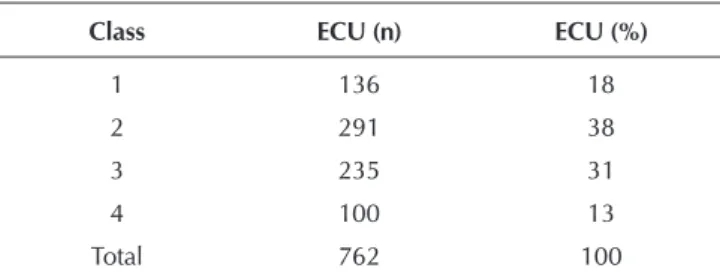
The ECUs classified for analysis were grouped into four lex-ical classes, according to the distribution described in Table 1:
Table 1 – Distribution of elementary context units, accord-ing to the classes generated by Alceste
Class ECU (n) ECU (%)
1 136 18
2 291 38
3 235 31
4 100 13
Total 762 100
Note: ECU = Elementary Context Units
Class 1 primarily includes the discursive content of ECUs referring to individuals on the central level (members of the city coordination office who were responsible for questions related to violence) in the 15 ECUs out of the 20 that comprise it. Classes 2, 3 and 4 mainly include discourses on the local level (community health agents, nursing assistants, physicians, nurses, managers and professionals responsible for questions related to violence or the Family Health Support Center), cor-responding to 70 ECUs out of the 72 that comprise them. The discourse of individuals on the regional level includes six ECUs in Classes 2, 3 and 4 and two ECUs in Class 1.
The standard analysis model was adopted, as it enables us to obtain results that are more in agreement with the corpus
interpretation.
The first and second descending hierarchical classification (DHC) performed by Alceste point to the structuring of the ICUs into two main thematic groups: the first group is com-prised by Classes 1 and 2 and refers to the limitations and difficulties found in health care services for situations of vio-lence against children and the need for intersectoral actions to fight these situations. The second group is comprised by Classes 3 and 4, pointing to situations of violence identified in the context of services and the causes and repercussions of violence for child development.
The contents from the discourse in Class 1, more in agree-ment with the limitations and difficulties of health care servic-es for situations of violence against children, indicate that the ways to cope with this are restricted by an insufficient health care network that lacks organization, financial resources and qualified professionals to deal with situations of violence. The performance of this network is hindered by a sector- and verti-cally-oriented logic of performing actions in the context of the city, a slow and unbalanced communication and exchange of information, and the reduced number of professionals who work with prevention.
The speech of the professionals interviewed show impor-tant aspects that corroborate the difficulties and limitations for work when dealing with situations of violence against chil-dren: the perception that there has been an increase in the number of reports on violence, the need for actions aimed at working with perpetrators, recommendation and referral to professionals who specialize in situations of violence, lack of knowledge that professionals working with direct health care have about the flow of referrals for the situations of violence identified, the need to strengthen primary care as reference and support for the identification of situations of violence, and the need for clearer directives on the flow of referrals and health teams’ greater knowledge about violence.
Caring for perpetrators themselves is a concern, we even manage to refer some, we have a good partnership with the
Department of Public Prosecution in the South [regional],
which is always close to our institutions in terms of de-mands; and whenever there is need for a leave, we only
need to take the case to them and the leave is ready (sic).
(par_02)
Especially to offer alternatives like conflict mediation, tech-niques like this. We have a partnership with the area of integrative practices, so the deal is that whenever there’s a course on this area of relaxation, circle dance, empower-ment, community therapy, there would be openings for the
people from the centers. (par_02)
While the numbers were low, there was a case in a PCU, then two, then another. Today we have 120 Primary Care Units in our area, so it was easy to work out these referrals. But the number of requests and needs has been increasing.
(par_02)
This morning we were discussing this with the technical area of mental health, that we need to construct and iden-tify professionals in this area who can make the referral, so that Primary Care Units can deal with these cases better.
(par_02)
Regarding Class 2, which deals with the need for intersec-toral actions to fight situations of violence against children, the speech of professionals reveals the difficulties, while at the same time pointing to alternatives. In this sense, the dif-ficulties refer to the following aspects: the lack of instruments to cope with questions related to violence during the qualifi-cation of nurses and other heath team professionals, fear of
exposure of professionals in areas with great violence and a bureaucratic support network, as these situations take a long time to be resolved. With regard to the alternatives, they point to the need to have a multi-professional team as reference in the PCU for questions of violence, greater support and integra-tion of local policies on social work, health, educaintegra-tion, safety, employment, income transfer and justice to cope with vio-lence and support for mothers who are also victims. Addition-ally, they emphasize the importance of health professionals in the notification of situations of violence, indicating a form of legitimization of the question of violence as a health priority.
There in an advantage, but because this is an area that in-volves a lot of violence, there may be fear of being exposed to retaliation. The advantage is the question of morals, a health unit where people have a high moral sense and don’t
tolerate this kind of thing. (par_18)
Because when we’re qualified, we don’t have tools to deal with this question of violence. To deal with this greater question, I think it goes beyond the biological question that
we focus on during our qualification. (par_21)
Class 3 included situations of violence identified in the sphere of health services, showing a higher number of situa-tions of negligence in the cases reported, followed by physical and subsequently sexual violence.
This was the worst act of violence that I’ve witnessed against a child. We’re not aware of time, this child cried a lot and one of the reasons was hunger, because I warmed some milk in a bottle at my neighbor’s and the boy gulped
it down. (par_04)
They came for a consultation with the nurse, when I be-gan to examine the child and saw that it even had burning
marks. (par_10)
Class 4, which dealt with the causes and repercussions of violence for child development, points to the following as the main causes: the high number of children, drug use by one or both parents, large families sharing the same space, early pregnancy and mental disorder in the family. Regarding the repercussions, participants’ speech revealed the association between violence and the development of mental disorders and violent acts in adulthood.
So children suffer the consequences because a drug addict
[…] he’s sick, so he can’t control his behavior well. (par_09)
If she’s not followed from an early age, she’ll turn into an adult who’ll treat others in the same way she was treated. If she doesn’t learn that this is wrong, she’ll think that this is common, that everyone is violent and scream and act like
this, that it’s normal behavior. (par_16)
She’s a child who’ll become violent at school, she’s a child that people will complain about, who’ll fight other kids on the streets, who’ll not learn how to express how they feel, who’ll
DISCUSSION
The need to have an efficient heath care network that meets the demand and qualifies professionals for this service, pro-ducing intersectoral actions, has been shown in many studies and official documents(16). Decree 936, issued on May 19th
2004 by the Ministry of Health, is the most symbolic official document, foreseeing the structuring of the National Network of Violence Prevention, Health Promotion and Establishment and Implementation of Violence Prevention Centers in States and Cities(17).
In the area of health, the Ministry of Health emphasizes the importance of regionalized health care networks, defined as integrated structures that provide health actions and ser-vices, institutionalized by public policy in a certain regional space, according to collectively planned work and the deep-ening of inter-dependent relationships among the participants involved(18).
Considering the fact that regionalized networks tend to offer better conditions for the implementation of health care comprehensiveness, the possibility of interaction among pub-lic popub-licies shows that the network organization must not be restricted to the health sector, as other sectors include determi-nants of the health-disease process(19).
In the area of health, based on the Community Health pro-posals, comprehensive health can be expanded to intersec-toral network actions, which must be regulated by three key organizational principles: that of integration of professional actions, in which there are specific professional actions that must be maintained, although in an interconnected way; that of interaction of professionals, organizing work in services so that there is effective communication among them; and that of integration among services such as institutions from different sectors(20). In this sense, according to professionals’ speech,
in-tersectoral actions need to be understood as the most relevant ones to cope with questions of violence against children. This is because the actions performed are restricted to specific sec-tors, without integration on local and regional levels.
Among the innumerable difficulties encountered when dealing with violence is the recognition that violence exists, or at other times that it is made visible, although the victim is blamed for having “provoked” such violence. Studies show that there is a naturalization of violence in general and that against children in particular, given the ways to interpret child-hood that have predominated in the history of civilizations for a long time. Moreover, there is little debate on the influence of gender and generation on the denaturalization of the phe-nomenon of violence against children, as some studies have already indicated the relevance of such categories(21).
The identification of this situation as negligence does not occur in an objective way, as it is mistaken for the lack of pro-vision of basic needs for children with the deprivations and needs resulting from situations of poverty. It is in this sense that the lack of preparation of professionals to deal with this question comes in, revealing the need to acquire a theoreti-cal-analytical framework which is capable of enabling the un-derstanding of the phenomenon of violence against children,
apart from the factors of vulnerability and protection common to different cultures and society(22).
Negligence is a type of violence that can be hardly defined, as it involves cultural, social and economic aspects found in each family or social group. Its identification can be facilitated by greater contact with families, so that their dynamics can be better understood. Primary Care teams represent an impor-tant resource to detect such situations, provided that they are well qualified. Home visits are a very efficient type of care, although depending on professionals who develop this activ-ity specifically(23).
Regarding the causes of intra-family violence, the follow-ing factors can be associated: family roles such as paternity and maternity during adolescence; overload of the mother or child role; pathologies such as alcohol and drug use; depres-sion; educational practices such as parents’ disagreements over the upbringing and lack of restrictions of their children; and aggressive behavior such as conjugal violence, violence between parents and children, and conflicts with laws. Fur-thermore, these factors show the vulnerabilities of family interactions(24).
When analyzing the speech of the professionals inter-viewed, we can perceive the way the causes and effects of violence are associated with individual and social deviations, somehow reducing the understanding of the phenomenon to families’ precarious material conditions, establishing a causal relation between poverty and violence, which emphasizes the culpability of these families for the failure of their members.
A study performed in a city of the metropolitan region of São Paulo showed other vulnerabilities in the recognition and coping with violence against children and adolescents in Pri-mary Care: to be afraid of the drug traffic in the area as a justification for not coping with it, generating feelings of fear and lack of safety; to feel threatened and not to report cases of violence; to consider the family context as private and thus not subject to intervention(25). However, there are studies
show-ing that aggressive relationships between adults and children, mainly parents and their sons/daughters, occur in environ-ments where family relationships are very violent.
In terms of the consequences of violence against children throughout the life on an adult, studies have shown the persis-tence of what is known as the “legacy” of violence. Martsolf and Draucker(26) performed a study on the influence of
ad-versities occurring during childhood on the life of survivors of child sexual abuse and observed that all of them involved some legacy. Such legacy is passed on to the new family both in terms of rejection of patterns of violence and perpetration. The authors emphasized the importance of the work of nurs-es, as they found that adults continued to mistrust others. A study(27) performed in Brazil, Mexico and Chile showed that
“men who had witnessed violence against their mothers per-petrated by male partners during childhood were more physi-cally aggressive towards their intimate partners in their life-time than those who had not been exposed to such violence”.
existing legislation; national and international policies; history of child development; changes in childhood as a generational category; questions involving the episteme of gender; and the consequences of institutional negligence towards coping with violence and institutional and multi-disciplinary possibilities of coping with this phenomenon.
Study limitations
The methodological limitation of the present study was the fact that the data collected were not immediately returned to participants. However, as the Tipesc was the continuous methodology used(11), both participants and health
profession-als of the city will be receiving such data.
Contributions to the area of nursing, health or public policy
The present study intends to contribute to a greater visibility of the phenomenon of violence against children in the context of health and nursing, showing the required qualification for several professionals who work in Primary Care, so that they learn how to cope with situations of violence against children and thus provide adequate care in the routine of their services.
FINAL CONSIDERATIONS
The results shown reflect the main characteristics of the ways to cope with violence against children in the context of health care services provided by professionals of Family Health and Primary Care teams on local, regional and central levels. To achieve this, the aspects that hinder network ac-tions are emphasized, according to an intersectoral perspec-tive. Participants’ speech indicate the need for training and qualification of professionals in several areas involved with situations of violence (health, justice, safety, social work) in the sense of improving the integration of their actions in a network, aiming to strengthen the rights of citizenship and guarantee full access to and quality of the services provided to children in situations of violence.
The adequate qualification of professionals in several areas, who are faced with situations of violence against children, has potentialities in terms of work processes, care, and spe-cific measures performed by them to develop and promote
interventions suitable for the moment of the cycle of violence, including the possibility of breaking this cycle. In the area of health, whether it is on the federal, state or municipal level, the health care network lacks sufficient services and the or-ganization, financial resources and qualified professionals to deal with situations of violence.
In the state and municipal spheres, there is great difficul-ty to guarantee implementation through the mobilization of power resources, so that political, institutional and bureau-cratic obstacles can be overcome. Thus, one may question whether rights are being protected, when insufficient invest-ment of public power has been made in human, financial and logistic resources that guarantee the rights of children and adolescents. Furthermore, an inexistent network to cope with different types of violence, care services and the guarantee of rights reveals the lack of a defined and effective flow for situ-ations of violence. With regard to the evident changes in the legal and political fields, these are not reflected on changes in cultural patterns, whose patriarchal values naturalize inequal-ities of power in the family environment, labeling violence against children as a less important problem, restricted to the domestic and private reality.
Finally, what we are seeking is the confluence of several aspects, aiming to maximize efforts that can introduce the ex-pected, required and effective changes in health care models and health work processes, which are focused on the needs of children exposed to violence. The aim is to seek the construc-tion and implementaconstruc-tion of comprehensive care and to devel-op the required conditions for protection, especially of those experiencing situations of extreme vulnerability to violence.
FUNDING
State of São Paulo Research Support Foundation (FAPESP) and Maria Cecília Souto Vidigal Foundation.
ACKNOWLEDGEMENTS
Authors would like to thank the City of São Paulo Depart-ment of Health and the Adventist University of São Paulo (UN-ASP) for the support in the development of research activities.
REFERENCES
1. Krug EG, Dahlberg LL, Mercy JA, Zwi AB, Lozano R, orga-nizadores. World report on violence and health. Geneva (CH): World Health Organization, 2002.
2. Sanchez RN, Minayo MCS. Violência contra Crianças e Adolescentes: Questão Histórica, Social e de Saúde. In: Lima CA, organizador. Violência faz mal à saúde. Brasília: MS, 2006. p. 29-38.
3. Brasil. Ministério da Saúde. Secretaria de Atenção à Saúde, Departamento de Ações Programáticas Estraté-gicas. Linha de cuidado para a atenção integral à saúde de crianças, adolescentes e suas famílias em situação de
violências: orientação para gestores e profissionais de saúde. Brasília: MS; 2010.
4. Souza ER, Jorge MHPM. Impacto da violência na infân-cia e adolescêninfân-cia brasileiras: magnitude da morbimor-talidade. In: Lima CA, organizador. Violência faz mal à saúde. Brasília: MS, 2006. p. 23-8.
v30n6/0102-311X-csp-30-6-1229.pdf
6. Salcedo-Barrientos DM, Miura PO, M VDias, Egry EY. How do primary health care professionals deal with preg-nant women who are victims of domestic violence? Rev Latino-Am Enfermagem [Internet]. 2014[cited 2015 Sep 18];22(3). Available from: http://www.scielo.br/pdf/rlae/ v22n3/0104-1169-rlae-22-03-00448.pdf
7. Sakata KN, Egry EY, Narchi NZ. The Brazilian Policy for re-duction of accidents and violence aligns with international perspectives? Rev Esc Enferm USP [Internet]. 2014[cited 2015 Sep 18];48(Esp):197-203. Available from: http://ww w.scielo.br/pdf/reeusp/v48nspe2/0080-6234-reeusp-48-n spe2-00197.pdf
8. Apostólico MR, Hino P, Egry EY. Possibilities for address-ing child abuse in systematized nursaddress-ing consultations. Rev Esc Enferm USP [Internet]. 2013 [cited 2015 Sep 18];47(2):318-24. Available from: http://www.scielo.br/ pdf/reeusp/v47n2/en_07.pdf
9. Cano MAT. Debaixo do mesmo teto: análise sobre a vio-lência doméstica. Ciênc Saúde Colet [Internet]. 2009[cit-ed 2015 Sep 18];14(5):1949-50. Available from: http:// www.scielo.br/pdf/csc/v14n5/38.pdf
10. Minayo MCS. O desafio do conhecimento. Pesquisa qual-itativa em saúde. 9ª ed. São Paulo: Hucitec; 2006. 11. Egry EY. Saúde coletiva: construindo um novo método em
enfermagem. São Paulo (SP): Ícone; 1996.
12. Prefeitura Municipal de São Paulo [Internet]. São Paulo: PMSP, 2014. [cited 2015 Sep 18]. Available from: http:// www.prefeitura.sp.gov.br/cidade/secretarias/saude/ atencao_basica
13. Brasil. Ministério da Saúde. Conselho Nacional de Saúde Brasil. Resolução nº 196, de 10 de outubro de 1996. Con-selho Nacional de Saúde [Internet]. 1996[cited 2015 Sep 18]. Available from: http://conselho.saude.gov.br/resoluc oes/1996/reso196.doc
14. Camargo BV. ALCESTE: um programa informático de análise quantitativa de dados textuais. In: Moreira ASP, Camargo BV, Jesuíno JC, Nóbrega SM, organizadores. Perspectivas Teórico-metodológicas em representações sociais. João Pessoa (PB): Ed. Universitária; 2005. p. 511-39.
15. Oliveira DC, Gomes AMT, Marques SC. Análise estatísti-ca de dados textuais: alguns princípios e uma apliestatísti-cação ao campo da saúde. In: Menin MSS, Shimizu AM, orga-nizadores. Experiência e Representação Social: questões teóricas e metodológicas. São Paulo (SP): Casa do Psicólo-go; 2005. p.157-200.
16. Graziano AP, Egry EY, Apostolico MR, Muraro HMS. Child sexual abuse: dimension of the problem in a Bra-zilian city. In: 2nd International Conference Child Abuse and Neglect, 2011 mai 11-14; Porto, Portugal. Porto (PT). 17. Brasil. Ministério da Saúde. Portaria n. 936, de 19 de maio
de 2004. Dispõe sobre a estruturação da Rede Nacional de Prevenção da Violência e Promoção da Saúde e a Implanta-ção e ImplementaImplanta-ção de Núcleos de PrevenImplanta-ção à Violência em Estados e Municípios. Brasília (DF): MS; 2004. 18. Brasil. Ministério da Saúde. Redes regionalizadas de
aten-ção à saúde: contexto, premissas, diretrizes gerais, agenda tripartite para discussão e proposta de metodologia para im-plementação. Versão para debate. Brasília (DF): MS; 2008. 19. Mattos RA. Os sentidos da integralidade: algumas
re-flexões acerca de valores que merecem ser defendidos. In: Pinheiro R, Mattos RA, organizadores. Os sentidos da integralidade na atenção e no cuidado à saúde. 4ª ed. Rio de Janeiro (RJ): Abrasco; 2006. p. 39-64.
20. Schraiber LB, D’Oliveira AFPL, Hanada H, Kiss L. As-sistência a mulheres em situação de violência: da trama de serviços à rede intersetorial. Athenea Digital [Internet]. 2012[cited 2015 Sep 18];12(3):237-54. Available from: http://www.redalyc.org/articulo.oa?id=53724611015 21. Egry EY, Fonseca RMGS, Oliveira MAC. Ciência, Saúde
Coletiva e Enfermagem: destacando as categorias gênero e geração na episteme da práxis. Rev Bras Enferm [Internet]. 2013[cited 2015 Sep 18];66(spe):119-33. Available from: http://www.scielo.br/pdf/reben/v66nspe/v66nspea16.pdf 22. Silva MAI, Ferriani MGC. Violência doméstica: do
vi-sível ao invivi-sível. Rev Latino-Am Enfermagem [Internet]. 2007[cited 2015 Sep 18];15(2) Available from: http:// www.scielo.br/pdf/rlae/v15n2/pt_v15n2a13.pdf
23. Apostólico MR, Nóbrega CR, Guedes RN, Fonseca RMGS, Egry EY. Características da violência contra a criança em uma capital brasileira. Rev Latino-Am Enfermagem [Inter-net]. 2012[cited 2015 Sep 18];20(2);[8 telas]. Available from: http://www.scielo.br/pdf/rlae/v20n2/pt_08
24. De Antoni C, Barone LR, Koller SH. Indicadores de risco e de proteção em famílias fisicamente abusivas. Psic Teor Pesq [Internet]. 2007[cited 2015 Sep 18];23(2):125-32. Available from: http://www.scielo.br/pdf/ptp/v23n2/a02v23n2.pdf 25. Andrade EM, Nakamura E, Paula CS, Nascimento R,
Bor-din IA. A visão dos profissionais de saúde em relação à violência doméstica contra crianças e adolescentes: um estudo qualitativo. Saude Soc [Internet]. 201 [cited 2015 Sep 18];20(1):147-55. Available from: http://www.scielo. br/pdf/sausoc/v20n1/17.pdf
26. Martsolf DS, Draucker CB. The legacy of childhood sexu-al abuse and Family adversity. J Nurs Scholarsh [Internet]. 2008 [cited 2015 Sep 18];40(4):333–40 Available from: http://www.ncbi.nlm.nih.gov/pmc/articles/PMC3152829/ pdf/nihms-314139.pdf