Received from Hospital Universitário da Universidade Federal do Maranhão (HU-UFMA), Brazil.
1. Orthopedic Physician; Traumatologist; Supervisor of the Residency Training Program in Orthopedics and Traumatology, Hospital Universitário da Universidade Federal do Mara-nhão (HU-UFMA)
2. Associate Professor of Anesthesiology, Pain and Health Care, UFMA; Responsible for HU-UFMA Pain Service and Instituto Maranhanse de Oncologia Aldenora Belo (IMOAB). 3. Associate Professor of Orthopedics and Traumatology, UFMA
4. Orthopedic Physician; Traumatologist; Chief of Orthopedics and Traumatology Service, HU-UFMA
5. MD; Member of the Academic Pain League, UFMA Submitted on June 16, 2011.
Approved on November 22, 2011. Correspondence to:
João Batista Santos Garcia, MD Avenida São Marcos, Lote 4, Quadra C Edifício Varandas do Atlântico, apto. 502 Ponta d’Areia
65077310 – São Luís, MA, Brazil
E-mail: [email protected]; [email protected] SCIENTIFIC ARTICLE
Analgesic Efficacy of the Intra-articular Administration of
S(+)- Ketamine in Patients Undergoing Total Knee
Arthroplasty
Hireno Guará Sobrinho
1, João Batista Santos Garcia, TSA
2, Jose Wanderley Vasconcelos
3,
José Carlos Amaral Sousa
4, Letácio Santos Garcia Ferro
5Summary: Guará Sobrinho H, Garcia JBS, Vasconcelos JW, Sousa JCA, Ferro LSG. Analgesic Efficacy of the Intra-articular Administration of S(+)- Ketamine in Patients Undergoing Total Knee Arthroplasty.
Background and objectives: Total knee arthroplasty (TKA) is associated with significant postoperative pain. Many intra-articular (IA) agents have been used for postoperative analgesia with inconsistent outcomes. Ketamine’s enantiomer S(+), S(+)- ketamine, was recently introduced commer-cially, with higher analgesic potency and less side effects than the racemic form. An experimental prospective randomized double-blind study was conducted to evaluate the analgesic efficacy of intra-articular S(+)- ketamine in patients undergoing primary TKA.
Method: In total, 56 patients were evaluated and allocated into three groups: Group A (n = 19) received 0.25 mg.kg-1 of S(+)- ketamine diluted in 20 mL of saline solution 0.9%; Group B (n = 17) received 0.5 mg.kg-1 of S(+)- ketamine diluted in the same way; and Group C (n = 20) received only 20 mL of intra-articular saline 0.9%, immediately after surgery and drain placement. All patients had access to rescue analgesic therapy, with the use of intravenous morphine alone. Evaluations were made 2, 6, 12, and 24 hours postoperatively, with measurement of pain intensity by Visual Analogue Scale (VAS), use of rescue medication by the evaluation of the time elapsed between the intra-articular injection of the solution and first dose of rescue, total consumption within 24 hours, and adverse effects.
Results: The S(+)- ketamine groups had lower pain scores compared with the saline group. The lowest dose of intra-articular S(+)- ketamine (Group A: 0.25 mg.kg-1) resulted in better pain scores and less rescue analgesia, with longer time to first request. Adverse effects were infrequent. The results with lower pain scores in groups using S(+)- ketamine are a trend, as there was no statistical significance between groups.
Conclusion: In this study, with this sample, the analgesic effect of IA S(+)- ketamine was not superior to saline solution in the postoperative period of TKA.
Keywords: Analgesia; Injections, Intra-articular; Ketamine; Isomerism; Arthroplasty, Replacement, Knee.
©2012 Elsevier Editora Ltda. All rights reserved.
INTRODUCTION
Severe pain is the main indication for total knee arthroplasty (TKA), which is successful in patients with advanced primary or secondary osteoarthritis when all non-surgical options have
been used without success 1,2. Even positive radiologic im-ages depend on a clinical correlation manifested by pain to be a surgical indication 1,2.
Several authors describe the postoperative period of such procedure as intensely painful and associated with high de-mand for analgesics 3,4,5. The use of systemic medications, central or peripheral blocks, and intra-articular analgesics for postoperative pain management have limitations related to special equipment and monitoring, in addition to significant adverse effects 6. Thus, promoting analgesia only at the site of surgical trauma with minimal systemic effects is an attrac-tive option 7.
Many intra-articular (IA) agents, such as morphine and bupivacaine, have been used for local anesthesia and post-operative analgesia in treatment and prevention of pain after knee surgeries. Ketamine has been of little use via IA. How-ever, studies suggest that this drug may be useful as an adju-vant analgesic administered by this route 8-11.
of ketamine, isomer S(+) ketamine, was recently released, which has similar properties to the racemic form, greater an-algesic potency, and fewer side effects, arousing a renewed interest in this drug 12.
S(+)- ketamine proved to be four times more potent than R(-) ketamine and produced adequate anesthesia in 95% of cases. The emergency reactions, such as delusions or hal-lucinations, decreased from 37% with R(-) ketamine to 5% with S(+)- ketamine. It is a good choice for postoperative an-algesia, with adequate power, safety of non-respiratory de-pression, neuroprotection (cerebral vasodilation), and cardiac protection 13.
Borner et al. 11 used IA S(+)- ketamine in postoperative (PO) knee arthroscopy and concluded that there was a reduc-tion on the level of subjective pain and opioid consumpreduc-tion compared with the application of IA bupivacaine and saline.
In a meta-analysis of 53 articles on ketamine, the authors found only four studies of S(+)- ketamine, none with admin-istration by the intra-articular route 14. The lack of published articles assessing the use of intra-articular S(+)- ketamine in PO of TKA leads us to consider this route as an option requir-ing a systematic and well-controlled study.
The aim of this study was to evaluate the analgesic effi-cacy of intra-articular S(+)- ketamine in patients undergoing primary total knee arthroplasty.
METHOD
Experimental prospective randomized double-blind study conducted at the Department of Orthopedics of the HU-UF-MA, from March 2009 to December 2010. Were included 60 patients referred for total knee arthroplasty, unilateral, with a diagnosis of primary osteoarthritis. It was found that samples with a minimum of 17 patients per group are needed in order to obtain an 80% chance of detecting a difference of 1 cm on a visual analgesic scale with a 5% confidence level 6.
Exclusion criteria were patients who refused to participate, classified as ASA IV or V by the American Society of Anes-thesiologists, with psychiatric illness, drug addicts, with cardio-vascular, respiratory, metabolic or neurological diseases, dec-ompensated, and with recognized allergy to anesthetics. Were also excluded patients who used postoperative analgesics other than the one recommended as rescue and those who were discharged before the first 24 hours postoperatively.
All procedures were performed under spinal anesthesia, which was administered by a staff anesthesiologist of the Hos-pital Universitário Presidente Dutra, with application of 15 mg of isobaric bupivacaine 0.5% without associated opioids. The use of benzodiazepines for patient sedation was allowed at the discretion of the anesthesiologist.
Limb preparation consisted of placing a pneumatic cuff at the root of the thigh, and the joint approach was performed through midline incision, with luxation and lateral rotation of the patella. Prosthesis model Insall III (Meta-Bio® and Baum-er®) was used, cemented, without inclusion of patellar pros-thesis.
After the procedure, local hemostasis was performed, with placement of suction drain through a different opening wound, followed by synthesis of the plans of the wound. Before com-plete closure of the skin, patients underwent intra-articular injection of the solution determined for each case. In all pa-tients, we waited 15 minutes before opening the drain.
Patients were assigned in groups A, B or C through a random selection of sealed envelopes, without the participa-tion of the investigator, patient, or surgeon. The soluparticipa-tion was prepared according to the group distribution and taken to the operating room identified only by the case number. Group A (n = 19) received 0.25 mg.kg-1 of S(+)- ketamine diluted in 20 mL of saline solution 0.9%; Group B (n = 17) received 0.5 mg.kg-1 of S(+)- ketamine diluted in the same way; and Group C (n = 20) received only 20 mL of intra-articular saline 0.9%, immediately after the procedure and drain placement.
All patients had access to rescue analgesia. Morphine alone was used at a dose of 5 mg IV, at the request of the pa-tient, with a minimum of four hours between doses. In case of moderate to severe pain in less than four hours or persistence of pain, an additional dose of 5 mg could be used, with anno-tation in protocol form, which consisted of patient’s identifica-tion and pain control and adverse events evaluaidentifica-tion.
Patient’s identification data were collected on age, sex, weight, height and time of operation.
Regarding pain control evaluation, systematic assessments were made at times t1 - 2 hours PO; t2 - 6 hours PO; t3 – 12 hours PO, and t4 - 24 hours PO. Measurement of local pain intensity at rest was performed using Visual Analogue Scale (VAS), previously instructed to patients. This scale consists of a 10 cm line in which one end (0 cm) indicates no pain and the other end (10 cm) indicates the worst possible pain 15.
The use of rescue medication was also assessed by the time (Tr) elapsed between the intra-articular injection of the solution and the first rescue dose and its total consumption within 24 hours, quantifying the number of doses taken.
Patients were asked about the emergence of adverse ef-fects through a questionnaire assessing dizziness, nausea, vomiting, itching and/or hives, restlessness, disorientation, depression, drowsiness, delirium, hallucinations, amnesia, and some other effects, voluntarily reported.
Results were tabulated in an electronic database program and exported to Stata 9.0TM for statistical analysis. To detect whether variables were normally distributed Shapiro-Wilk test was used followed by parametric tests for variables following a normal distribution and nonparametric for the others.
RESULTS
Among the 60 patients, one was lost in Group A and three in Group B due to the intravenous administration of non-rec-ommended analgesic and morphine during spinal anesthesia. Therefore, we assessed a sample of 56 patients, Group A (n = 19), Group B (n = 17), and Group C (n = 20). The mean duration of surgery was 128 minutes, with no statistically sig-nificant difference between groups for the studied variables sex, age, weight, and height (Table I).
Table II shows the mean value of pain intensity at different times “t” for each group analyzed. There was no statistically significant difference among S(+)- ketamine groups (A and B) and saline group (C).
Regarding the comparison of rescue medication, Group A had a lower consumption than Groups B and C, but with no statistical significance (p = 0.52). The average consumption over 24 hours was 2.47 morphine doses for Group A, 2.82 for Group B, and 2.9 for Group C. Graphic 1 shows the total consumption for each group throughout the study.
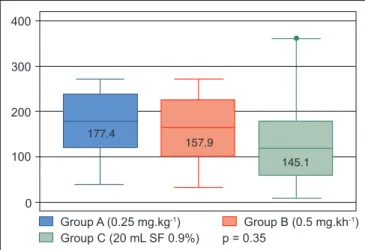
The time to the first dose of rescue analgesic was longer in Group A than in Groups B and C. There was a mean of 177.4 minutes for Group A, 157.9 for Group B, and 145.1 for Group C, with no statistical significance (p = 0.35). Graphic 2 represents the medians, the minimum and maximum values for the time in minutes in which patients requested morphine rescue.
Some adverse effects were observed, with nausea, dizzi-ness, and somnolence being the most prevalent, but with no statistical difference between groups, as shown in Table III.
Table III – Number of Patients (n) and Percentage (%) of Adverse Effects Found in Studied Groups
Collateral effects Group A Group B Group C p n % n % n %
Nausea 8 42.11 6 35.29 7 35.00 0.54
Dizziness 3 15.79 5 29.41 1 5.00 0.34 Drowsiness 1 5.26 4 23.53 4 20.00 0.57
Hallucination 1 5.26 0 0 1 5.00 0.65
Nightmares 1 5.26 0 0 0 0 0.32
Delirium 2 10.53 0 0 0 0 0.49
Chi-square test. Statistical significance at p < 0.05.
Table I – Anthropometric Data of Evaluated Patients
Variables Group A Group B Group C p (n = 19) (n = 17) (n = 20)
Gender (%)*
M 15.79 5.88 30 0.43
F 84.21 94.12 70 0.65
Age
(years)** 67.05 ± 7.04 64.12 ± 8.90 66.65 ± 8.27 0.72
Weight
(kg)** 66.85 ± 12.99 65.26 ± 10.47 67.87 ± 13.91 0.88
Height
(cm)** 151.42 ± 9.96 151.71 ± 6.11 150.95 ± 8.80 0.96
*Percentage. **Mean ± standard-deviation. Statistical significance when p < 0.05. ANOVA Test. Kruskal-Wallis Test. Chi-square Test. M: male; F: fe-male.
Table II – Mean Values ± Standard Deviation of Pain Intensity for Each Interval Measured by VAS
Variables Group A Group B Group C p (n = 19) (n = 17) (n = 20)
t1 (4.6 ± 3.8) (6.4 ± 3.0) (6.7 ± 3.0) 0.23
t2 (4.8 ± 2.9) (5.8 ± 3.1) (5.5 ± 3.1) 0.68 t3 (5.1 ± 2.8) (5.2 ± 3.0) (5.0 ± 2.8) 0.79
t4 (3.1 ± 2.4) (3.1 ± 2.3) (3.2 ± 2.8) 0.76
Values are expressed as mean ± standard deviation. Statistical significance at p < 0.05. Kruskal-Wallis test.
Group A (0.25 mg.kg-1) Group B (0.5 mg.kh-1)
Group C (20 mL SF 0.9%) 400
300
200
100
0
p = 0.35
Group A (0.25 mg.kg-1) Group B (0.5 mg.kh-1)
Group C (20 mL SF 0.9%) 5
4
3
2
1
Graphic 1 – Median and Quartiles of the Number of Doses of Mor-phine in the period of 24 h.
Graphic 2 – Median and Quartiles Regarding Time (minutes) of Res-cue analgesic in Studied Groups.
2.47
2,82 2,90
177.4
157.9
DISCUSSION
Many studies of IA medication use are for arthroscopic knee surgery, a procedure less painful than TKA, which used bupi-vacaine 16, morphine 17, clonidine 18, and magnesium 19 with satisfactory results. Ketamine is rarely used, but it has been reported as an analgesic able to produce effect in peripheral pain control 9,20-22.
The choice of S(+)- ketamine was based on analysis of studies demonstrating that this drug is an anesthetic and an-algesic agent with fast onset of action, with non-competitive blocking action on the N-methyl-D-aspartate (NMDA) re-ceptor, placing it at an unique level in combating the painful process 9,23,24. Due to the adverse effects following systemic administration, local application of NMDA antagonists has become a promising option. Subsequent studies have used intra-articular, topical or local injections of ketamine to mini-mize these effects, reduce pain and consumption of opioids in the postoperative period 24-26.
Similar to other studies, there was no difference between groups for age, sex, weight, height, and duration of sur-gery, which provides a sample with uniform demographic data 6,9,11,17,24,25,27-34.
The assessment of S(+)- ketamine analgesic efficacy was divided into direct and indirect; the first was based on com-parative analysis of pain scores obtained from VAS at time (t) between groups; in the second, we evaluated the comparison between groups with respect to time (Tr) for the first request of rescue analgesia and its total consumption.
Rosseland et al. 25, Borner et al. 11, and Garcia et al. 35 have used this type of analysis in their work, which follows the gen-eral trend of most studies on this topic. We believe this is the best way to evaluate the efficacy of therapy, because, where-as the effect of intervention with rescue analgesics tends to homogenize VAS scores, the analysis of indirect data allows characterizing the effectiveness of IA S(+)- ketamine with more reliability.
Patients were evaluated postoperatively at t1 (2h), T2 (6h), T3 (12h), and T4 (24h) based on earlier publications and as-sessment division of post-operative pain in three phases: ear-ly (0-2h) in which the residual effect of anesthesia/analgesia administered intraoperatively could lead to a bias in the study; intermediate (2-6h) in which the effect of these drugs usually start to decrease, and late (6-24h) in which the present anal-gesic effect would be predominantly local 36-38.
In order to reduce the influence of the anesthetic procedure in the evaluation of t1, we chose to administer spinal anes-thesia without the addition of opioids and with no use of local anesthesia. There was no association of analgesic drugs at any time of the procedure or postoperatively.
In direct evaluation, we found lower pain scores on VAS in Group A at t1 and t2 compared with other groups, but with no statistical significance. In Groups B and C, the assessment of pain scores from t1 to t4 showed a decreasing trend in the in-tensity of pain over time. There was no statistically significant difference between groups, although S(+)- ketamine groups (A and B) had lower pain scores.
Intra-articular morphine at high doses (10 mg) was tested on postoperative TKA, with lower pain scores, consumption, and time of rescue analgesia compared to placebo 35. Fu et al. 7, used morphine 5 mg, bupivacaine 15 mg, and betame-thasone 1 mL intra-articularly in postoperative TKA and found lower pain scores. Carvalho Junior et al. 39 showed that intra-articular and peri-incisional administration of bupivacaine, morphine, and epinephrine were ineffective in reducing post-operative pain in TKA. Ritter et al. 33 also used intra-articular morphine and bupivacaine on postoperative TKA and found no improvement in analgesia.
Dal et al. 9 used IA racemic ketamine at a dose of 0.5 mg.kg-1 and promoted prolonged and effective analgesia with few adverse effects, with similar results to those of neostigmine but no better than bupivacaine. Rosseland et al. 25 studied 77 patients after the use of racemic ketamine 10 mg IA and 10 mg intramuscular compared with saline solution 10 mL IA in knee arthroscopy and there was no difference between the group receiving racemic ketamine and saline, both through IA route.
We found no studies of IA S(+)- ketamine in postoperative TKA. There is a study by Borner et al. 11 in which IA S(+)- ket-amine was used, but in postoperative knee arthroscopy, and the authors concluded that the dose 0.25 mg.kg-1 decreased pain intensity and opioid consumption if compared with the administration of IA bupivacaine and saline. In our study, the dose of 0.25 mg.kg-1 showed a trend in reducing pain scores and opioid consumption, similar to Borner et al. 11, but there was no difference, both in statistics or in the procedure that generates more nociceptive stimuli.
Another way to test S(+)- ketamine would be through con-tinuous intra-articular injection by a catheter in the postop-erative period, at various doses, and not only one applica-tion immediately after the procedure. Bupivacaine was tested intra-articularly before and after knee arthroscopy, with better results in controlling pain when administered before surgery, suggesting a preemptive effect 40. Because ketamine has been reported as effective in controlling postoperative hyper-algesia, it could also be used before the procedure to evaluate a possible preemptive action, as well as pain could be evalu-ated weeks after surgery to test its effect on chronic pain after surgery.
The rescue analgesic could be administered by infusion pump and controlled by the patient to prevent administration or request delay. This may be a relevant observation when high pain scores are found at times t1 to t3 (≥ 4) associated with low demand for rescue analgesic (< 3). One aspect to be emphasized is the culture that pain should be part of the postoperative period and that, despite the explanations given to the patient, many remain passive or stoic regarding anal-gesic request.
interesting possibility would be the non-use of suction drain, which would guarantee the permanence of the whole solution injected into the joint. A recent study showed no benefit in the use of suction drain in postoperative TKA 41.
The mean consumption of rescue medication within the first postoperative 24 hours was the first variable assessed in the indirect evaluation, which showed a tendency toward lower value in Group A than Groups B and C. Similar results were found by Borner et al. 11 and Dal et al. 9 The second variable studied was “Tr” (time to first request of analgesic dose) in which the group with the lowest dose of S(+)- ket-amine had more prolonged analgesia, weighting longer to request rescue analgesia (177.4 min), with no statistical dif-ference though. This result differs from that of Dal et al. 9 who found a greater time to first analgesic dose in groups receiving racemic ketamine 0.5 mg.kg-1, with mean of 109.3 versus 63.3 min for the group receiving 20 mL of saline in postoperative knee arthroscopy.
There was occurrence of some adverse effects during the study, but none compromised its continuation. In previous work, the onset of side effects also was not a limiting factor for IA ketamine use 9,25. The few side effects can be explained by the relatively low dose used, intra-articular poor vascular-ization, degree of synovectomy during surgery, or effect only locally. Studies are needed to determine the optimal dose of intra-articular S(+)- ketamine and evaluate its plasma con-centration and its metabolites, in order to differentiate
sys-temic from peripheral effect. An example is the study by Joshi et al. 17 that assayed plasma morphine and found very low concentration, insufficient to promote postoperative analge-sia, which suggests only local effect.
To explain the lack of significance in pain scores between groups, we may consider some justifications, such as the small number of patients per group, residual effect of anesthetic due to the technique used, and possible preemptive effect of suba-rachnoid block, which could prevent the sensitization of spinal neurons and provide postoperative analgesia. Furthermore, the optimal dose and volume of S(+)- ketamine for intra-artic-ular use should be better determined. It is known that the com-monly used doses (5 mg.kg-1-intramuscularly or 1-2 mg.kg-1 intravenously) are not ideal, as dysleptic phenomena often occur in patients. The benefits of S(+)- ketamine exist when it is used in small doses (0.1 to 0.25 mg.kg-1) via parenteral route, due to its greater affinity for the NMDA receptors, which provides adequate analgesia and consumption reduction of analgesics postoperatively 12,41. In our study, the lowest dose of S(+)- ketamine (Group A: 0.25 mg.kg-1) showed the best trend toward reducing pain scores and also demonstrated the possibility of ketamine better effects at lower doses via intra-articular route.
REFERENCES
1. Palmer SH, Cros M – Total knee replacement. Disponível em: <http:// www. kneeclinic.com.au/papers/TKR/tkrchapter.htm>. Acesso em: 27 abr. 2008.
2. Feeley BT, Gallo RA, Sherman S, Williams RJ – Management of os-teoarthritis of the knee in the active patient. J Am Acad Orthop Surg, 2010;8:55-60.
3. Klasen J – Intra-articular, epidural, and intravenous analgesia after total knee arthroplasty. Acta Aneaesthesiol Scand, 1999;43:1021-1026.
4. Tanaka N – The efficacy of intra-articular analgesia after total knee arthroplasty in patients with rheumatoid arthritis and in patients with osteoarthristis. J Arthroplasty, 2001;16:306-311.
5. Pitimana-Aree S. – An economic evaluation of bupivacaina plus fen-tanyl versus ropivacaíne alone for patient-controlled epidural analge-sia after total-knee replacement procedure: A double-blinded rando-mized study. Reg Anesth Pain Med, 2005;30:446-451.
6. Al-Metwalli RR, Mowafi HA, Ismail SA et al. – Effect of intra-articular dexmedetomidine on postoperative analgesia after arthroscopic knee surgery. Br J Anaesth, 2008;3:395-399.
7. Fu P, Wu Y, Wu H et al. – Efficacy of intra-articular cocktail analgesic injection in total knee arthroplasty: a randomized controlled trial. The Knee, 2009;16:280-284.
8. Menigaux C, Guignard B, Fletcher D et al. – Intraoperative small-do-se ketamine enhances analgesia after outpatient knee arthroscopy. Anesth Analg, 2001;93:606-612.
9. Dal D, Tetik O, Altunkaya H et al. – The eficacy of intra-articular ke-tamine for postoperative analgesia in outpatient arthroscopic surgery. Arthroscopy, 2004;20:300-305.
11. Borner M, Bürkle H, Trojan S et al. – Intra-articular ketamine after arthroscopic knee surgery. Optimisation of postoperative analgesia. Anaesthesist, 2007;56:1120-1127.
12. Luft A, Mendes FF – S(+) Cetamina em baixas doses: atualização. Rev Bras Anestesiol, 2005;55:460-469.
13. Oliveira CMB, Sakata RK, Issy AM et al. – Cetamina e analgesia preemptiva. Rev. Bras. Anestesiol, 2004;54:739-744.
14. Bondok RS, El-Hady AM – Intra-articular magnesium is effective for postoperative analgesia in arthroscopic knee surgery. Br J Anaesth, 2006;3:389-392.
15. Elia N, Tramer MR – Ketamine and postoperative pain: a quantitative systematic review of randomised trials.Pain, 2005;113:61-70. 16. Huskisson EC – Measurement of pain. Lancet, 1974;2:1127-1131. 17. Parker R, Streem K, Schmitz L et al. – Efficacy of continuous
intra-articular bupivacaine infusion for postoperative analgesia after ante-rior cruciate ligament reconstruction. Am J Sports Med, 2007;35:531-536.
18. Joshi GP, McCarroll SM, Cooney CM et al. – Intra-articular morphine for pain relief after knee arthroscopy. J Bone Joint Surg, 1992;74-B:749-751.
19. Reuben SS, Connelly NR – Postoperative Analgesia for Outpatient Ar-throscopic Knee Surgery with intra-articular Clonidine. Anesth Analg, 1999;88:729-733.
20. Castro FE, Garcia JBS – Analgesia preemptiva com S(+) cetamina e bupivacaína peridural em histerectomia abdominal. Rev Bras Aneste-siol, 2005;55:28-39.
21. Carvalho WA, Lemônica L – Mecanismos Centrais de Transmis-são e de Modulação da Dor. Atualização Terapêutica. Rev Bras Anestesiol,1998;48:221-241
22. Garcia JBS – Cetamina: uma nova leitura. Prática Hospitalar, 2007;53:1-5.
23. Schmid RL, Sandler NA, Katz J – Use and efficacy of low-dose ke-tamine in the management o acute postoperative pain: a review of current techniques and outcomes. Pain, 1999;82:111-125.
24. Ayesh EE, Jensen TS, Svensson P – Effects of intra-articular ketami-ne on pain and somatosensory function in temporomandibular joint arthralgia patients. Pain, 2008;137:286-294.
25. Rosseland LA, Stubhaug A, Sandberg L et al. – Intra-articular (IA) catheter administration of postoperative analgesics. A new trial de-sign allows evaluation of baseline pain, demonstrates large variation in need of analgesics, and finds no analgesic effect of IA ketamine compared with IA saline. Pain, 2003;104:25-34.
26. Kress HG – The long-term antinociceptive effect of intratecal S(+) Ketamine in a patient with established morphine tolerance. Anaesth Analg, 2001;93:1018-1024.
27. Convery PN, Milligan KR, Quinn P et al. – Efficacy and uptake of ro-pivacaine and buro-pivacaine after single intra-articular injection in the knee joint. Br J Anaesth, 2001;87:570-576.
28. Sveticic G, Farzanegan F, Zmoos P et al. – Is the Combination of Morphine with Ketamine Better than Morphine Alone for Postopera-tive Intravenous Patient-Controlled Analgesia? Int Anesth Res Soc, 2008;106:287-293.
29. Samoladas EP, Chalids B, Fotiadis H et al. – The intra-articular use of ropivacaine for the control of post knee arthroscopy pain. J Orthop Surg Res, 2006;17:1-4.
30. Toftdahl K, Nikolajsen L, Haraldsted V et al. – Comparison of peri- and intra-articular analgesia with femoral nerve block after total knee ar-throplasty: a randomized clinical trial. Acta Orthop, 2007;78:172-179. 31. Vendittoli PA, Makinsen P, Drolet P et al. – A multimodal analgesia
protocol for total knee arthroplasty. A randomized, controlled study. J Bone Joint Surg (Am), 2006;88:282-289.
32. Reilly KA, Beard DJ, Barker KL et al. – Efficacy of an accelerated recovery protocol for Oxford unicompartmental knee arthroplasty: a randomized controlled trial. Knee, 2005;12:351-357.
33. Ritter MA, Koehler M, Keating EM et al. – Intra-articular morphine and/ or bupivacaine after total knee replacement. J Bone Joint Surg (Br) 1999;81:301-303.
34. Busch CA, Shore BJ, Bhandari R et al. – Efficacy of peri-articular mul-timodal drug injection in total knee arthroplasty. A randomized trial. J Bone Joint Surg (Am), 2006;88:959-963.
35. Garcia JBS, Barbosa Neto JO, Vasconcelos JW et al. – Eficácia analgésica do uso de dose alta de morfina intra-articular em
pacien-tes submetidos à artroplastia total de joelho. Rev Bras Anestesiol, 2010;60:1-6.
36. Gupta A, Axelsson K, Alvin R et al. – Postoperative pain following knee arthroscopy: The effects of intra-articular ketorolac and/or mor-phine. Reg Anesth Pain Med, 1999;24:225-230.
37. Rosseland LA – No evidence for analgesic effect of intra-articular morphine after knee arthroscopy: A qualitative systematic review. Reg Anesth Pain Med, 2005;30:83-98.
38. Souza RH, Issy AM, Sakata RK – Analgesia intra-articular com morfi-na, bupivacaína ou fentanil após operação de joelho por videoartros-copia. Rev Bras Anestesiol, 2002;52:34-39.
39. Carvalho Jr L, Rezende PM, Castro CAC et al. – Bupivacaine, epine-phrine and morphine for post-total knee arthroplasty analgesia. Rev Bras Ortop, 2006;41:347-351.
40. Tuncer B, Babacan A, Arslan M – The pre-emptive analgesic effect of intra-articular bupivacaine in arthroscopic knee surgery. Acta Anaes-thesiol Scand, 2005;49:1373-1377.