Sofi a Gaspar Cruz
I, Maria Manuela Frederico Ferreira
III Coimbra Hospital and University Center, Vascular Surgery Service. Coimbra, Portugal.
II Coimbra Higher Nursing School, Scientifi c-Pedagogical Unit of Fundamental Nursing. Coimbra, Portugal.
How to cite this article:
Cruz SG, Ferreira MMF. Knowledge management in Portuguese healthcare institutions. Rev Bras Enferm [Internet]. 2016;69(3):461-8. DOI: http://dx.doi.org/10.1590/0034-7167.2016690311i
Submission: 05-01-2015 Approval: 12-08-2015
ABSTRACT
Knowledge management imposes itself as a pressing need for the organizations of several sectors of the economy, including
healthcare. Objective: to evaluate the perception of healthcare institution collaborators in relation to knowledge management
in the institution where they operate and analyze the existence of differences in this perception, based on the institution’s
management model. Method: a study conducted in a sample consisting of 671 collaborators from 10 Portuguese healthcare
institutions with different models of management. In order to assess the knowledge management perception, we used a score
designed from and based on items from the scores available in the literature. Results: the perception of moderate knowledge
management on the healthcare institutions and the statistically signifi cant differences in knowledge management perception
were evidenced in each management model. Conclusion: management knowledge takes place in healthcare institutions, and
the current management model determines the way staff at these institutions manage their knowledge. Descriptors: Knowledge; Knowledge Management; Health Services Administration; Health Facilities; People.
RESUMO
A gestão do conhecimento impõe-se como uma necessidade premente para as organizações de vários setores da economia,
inclusive do setor da saúde. Objetivo: avaliar a perceção dos colaboradores de instituições de saúde relativamente à gestão
do conhecimento na instituição onde atuam e analisar a existência de diferenças nessa perceção, em função do modelo de
gestão da instituição. Método: estudo realizado numa amostra de 671 colaboradores de dez instituições de saúde portuguesas,
com diferentes modelos de gestão. Para avaliar a perceção de gestão do conhecimento, utilizamos uma escala construída a
partir de itens de escalas disponíveis na literatura. Resultados: evidenciam perceção de moderada gestão do conhecimento nas
instituições de saúde e diferenças estatisticamente signifi cativas na perceção de gestão do conhecimento, em cada modelo de
gestão. Conclusão: a gestão do conhecimento ocorre nas instituições de saúde, e o modelo de gestão vigente infl uencia a forma
como elas gerenciam o seu conhecimento.
Descritores: Conhecimento; Gestão do Conhecimento; Gestão de Serviços de Saúde; Instituições de Saúde; Pessoas.
RESUMEN
La gestión del conocimiento constituye necesidad apremiante para organizaciones de varios sectores económicos, incluyendo
al sanitario. Objetivo: evaluar la percepción de colaboradores de instituciones de salud respecto de la gestión del conocimiento
en la institución donde actúan, y analizar existencia de diferencias en dicha percepción, en función del modelo de gestión
institucional. Método: estudio sobre muestra de 671 colaboradores de diez instituciones de salud portuguesas, con diferentes
modelos de gestión. Para evaluar la percepción de gestión del conocimiento, utilizamos una escala construida a partir de
ítems de escalas disponibles en la literatura. Resultados: se evidencia percepción de moderada gestión del conocimiento en
las instituciones de salud, y diferencias estadísticamente signifi cativas en percepción de gestión del conocimiento, en cada
Knowledge management in Portuguese healthcare institutions
INTRODUCTION
In a time marked by rapid and constant changes, competi-tiveness in organizations has become more and more depen-dent on new processes and market leadership. Whether or not it can lead to a unique set of resources that are difficult for competitors to copy, they must be mobilized as a creative range of distinctive skills and innovating capacities that can be constantly translated into new products. As a result of such requirements, and management as well, knowledge has emerged as a necessary solution for any kind of organization capable of coping with this issue.
Although the literature indicates a relationship between knowledge management and organizational performance based on the creation and maintenance of sustainable and competitive advantages, current knowledge management practices are not consistent enough and, in the majority of
cases, not formalized(1). This reality is cross-sectional to the
organization of several sectors of activity.
In the case of healthcare institutions, consisting of inten-sive knowledge, it is easy to recognize that knowledge man-agement will have an impact on organizational performance. Furthermore, following successive reform measures in which the Portuguese Healthcare System has been targeted due to excessive costs and the demand for improving organizational efficiency in a more and more competitive sector, knowledge management becomes a promising approach.
Consequently, vis-à-vis the lack of empirical studies in the healthcare context, it is relevant to study the reality of healthcare institutions in relation to knowledge management, particularly through a framework of different management models. Although it is still uncommon to find healthcare in-stitutions structured around knowledge management projects, all of them will have initiatives that can be accommodated within its scope. In this sense, getting to know the perception of healthcare institution collaborators on knowledge manage-ment in the institution they operate helps to guide policies and organizational actions and support the decision-making of managers who pursue this area.
The globalization of the economy, fast-paced changes, and increasing competitiveness have generated consider-able impacts on organizational structure, imposing the need for rethinking new organizational strategies in a manner that concentrates efforts on factors and programs that effectively represent an opportunity for differentiation.
The traditional dynamics of production are no longer enough to provide answers to current societal demands, char-acterized by an economy based on information and knowl-edge. Given this context, knowledge emerges as an innovat-ing and differentiatinnovat-ing factor for organizations as the main
source of sustainable competitive advantages(2-3) capable of
facing the challenges of modern society. The true essence of the importance of this resource lies in its intangibility and its intrinsically incorporated nature in other words, on tacit knowledge. A tacit rather than explicit knowledge, which con-sists of skills and susceptible facts to be formally transmitted, is a kind of personal and subjective knowledge, as far as under-standing the competencies, judgments, and intuitions individ-uals possesses, but that are hard to formalize, communicate,
and share(4). It is precisely from the inimitability and inherent
difficulty of transferring tacit knowledge aspects considered fundamental for sustaining organizational competitive advan-tages that the importance of strategy conferred to a knowledge
economy arises(5).
In this respect, one of the challenges managers in any organi-zation face is to retain their collaborators and, as a consequence, to offer growth opportunities in exchange for their commitment
to reaching the organization’s goals(6), because the main
organi-zational competitiveness differential lies with people.
However, in order to have knowledge converted into com-petitive advantage, more than just existing it is necessary to have it continuously comprehended, created, distributed, stored,
shared, and used by the organization’s collaborators(7). In other
words, “the mere presence of knowledge in the company ag-gregates little value, if it is not accessible and used as one of the
most important resources”(8). Hence the importance of
manage-ment. In fact, even if knowledge could be treated as a product resulting from a good management in other area, for instance, a good human resources management, this incidental manage-ment is not coordinated, not broad enough and, consequently,
it does not constitute a model for sustained success(9). Out of the
awareness that a casual approach to knowledge is not enough for organizations to succeed in the current and future economy came the need to accept organizational knowledge manage-ment as a key issue for dealing with managemanage-ment.
Although, since ancient times, knowledge has been the basis and result of human actions, the assertion and seman-tic conjugation among knowledge management concepts is
relatively new(10-11), an aspect that is controversial if it lacks
conceptual stability.
Knowledge management has been defined under different perspectives, coexisting in the core literature as a plurality of conceptualizations. One of the clear definitions in the litera-ture, and that we share, defines knowledge management as:
the creation and development of internal organizational conditions that bring together all processes related to knowl-edge (e.g., its creation/acquisition, sharing/dissemination, storage, recovery, use) in a sense of reaching the goal of the organization(12).
Sofia Gaspar Cruz E-mail: [email protected]
CORRESPONDING AUTHOR
diferente modelo de gestión. Conclusión: la gestión del conocimiento existe en las instituciones de salud, el modelo de gestión
practicado influye en la forma en la cual las instituciones gestionan su conocimiento.
With a limited research history and tradition, knowledge management has been gaining an unparalleled, consistent, and important place not only in the academic environment, but also in the business world, as it has become recognized as a key element for organizational competitiveness. It is pre-cisely due to this relationship between knowledge manage-ment and organizational performance, as a consequence of the creation of sustainable competitive advantages, that the growing interest in knowledge management has arisen.
This interest is also applicable to healthcare organizations, as a result of the need to develop sustainable competitive
ad-vantages over time(13).
According to the literature, several advantages seem to come from the implementation of organizational knowledge management programs in healthcare institutions, in particular in the improvement of decision-making, reduction in medical
errors, improvement of quality of care, and cost reduction(14),
which directly and indirectly seem to contribute to the effi-ciency and economic sustainability of the healthcare system.
The tangible adoption and implementation of knowledge management programs in the healthcare sector in institutions providing healthcare are promising. It is estimated that a well-implemented knowledge management program will change the efficiency of the healthcare system throughout the next few decades “into a more cost-effective, error-averse, and
ac-countable public resource”(15).
The context in which healthcare organizations operate is marked by the complexity of healthcare systems, by the sub-stantial growth in scientific knowledge, by the impact of medi-cal errors, by high investments in technology, and by emerg-ing competitiveness associated with the implementation of new management models efficiency gains. Thus, it seems particularly suitable for the implementation of knowledge management.
In the literature, some studies indicate a moderate applica-bility of organizational processes relate to knowledge in
Por-tuguese organizations(7,11,16-17). However, these studies were
developed in the local, industrial, and hotel sector framework, with a notorious lack of empirical studies on knowledge man-agement in the healthcare sector, despite the advantages rec-ognized. Thus, it is important to learn more about the reality of Portuguese healthcare institutions regarding knowledge management.
Focusing on efficiency, cost control, and competitiveness, we have seen, especially from the second half of the 1980s throughout Europe and Portugal is no exception a set of re-form measures in healthcare systems. Among other aspects, these measures led to the adoption of new management mod-els, namely, the corporatization of hospitals and the creation of groups of healthcare centers, in which matrix organizations are based on family healthcare units. These new and modern management models are aimed at providing more efficiency, precision, organizational and managerial flexibility; reduced bureaucracy, autonomy, and responsibility; and continuous improvement in healthcare quality.
A recognition of the importance of management knowledge as the main source of competitive advantages, applicable to
any kind of organization during broad implementation of new management models in National Healthcare Service institu-tions, adds more value to the study on knowledge manage-ment perception in several healthcare institution models. This presupposes that the management model of healthcare units plays a key role in different practices and in its own context.
Thus, these research objectives can be defined as the evalu-ation of the collaborators’ perceptions on healthcare institu-tions according to knowledge management in the institution they operate in and an analysis of the differences in percep-tion of the healthcare institupercep-tion management model.
METHOD
Type of study: Quantitative and cross-sectional
Sample
Different collaborators (nurses, physicians, operational and administrative staff, and diagnosis and therapy technicians) from 10 Portuguese public healthcare institutions participat-ed and were organizparticipat-ed into three management models: the Public Administration Sector (PAS) sector; Corporate Public Enterprise (CPE); and a Family Healthcare Unit model (FHU). The selection of the healthcare institutions by the researcher was based on accessibility/proximity criterion and the current management model. The questionnaires were distributed to all collaborators, as long as they had at least six months of pro-fessional practice in the healthcare institution, because prior to this time, the respondents would not have the necessary information to express an informed opinion. Data collection took place in different healthcare institutions during the sec-ond half of September and December of 2009, and mid-January and at the end of March of 2010.
Data collection tool
The questionnaire consisted of two set of questions. The first included the knowledge management score, using items from measurement tools available in the literature, and the second referred to the socio-demographic and professional characterization of the respondents. The initial version of the knowledge management score started with 69 items; howev-er, 10 items were eliminated following the pretest, whereas the Cronbach’s alpha value moved from 0.947 to 0.949. Con-sequently, this resulted in a set of 59 items integrating the final version of the data collection tool. Using a Likert scale of 5 points (from 1 – strongly disagree to 5 – strongly agree), the respondents were asked to indicate the extent of agreement in relation to the set of assertions intended for evaluating the occurrence of knowledge management in public healthcare institutions. The items were encoded in such a way that the higher values represented a higher perception of knowledge management in the healthcare institution in question.
Ethical-legal considerations
directors of healthcare groups, or coordinators of family healthcare units where the study took place. Procedures were also adopted for obtaining an informed consent form from study participants. Each questionnaire was followed by an in-formation sheet indicating the title and scope of the study, the objectives, and contact information for the main researcher. In this information sheet, guarantees were given to the respon-dents with regard to the confidentiality and anonymity of data handling, aspects that were again reinforced at the beginning of the questionnaire. The return of the completed question-naire meant acceptance to participate in the study.
Procedures
The distribution of the questionnaires was carried out by the researcher through the delivery of envelopes, with the data collecting tool, to the individuals responsible for the institution’s personnel, or to a key person in each institution unit or department who turned out to be valuable not only in distributing the questionnaires to the rest of the personnel, but also getting the questionnaires back. The period of time agreed upon between distribution and collection of the ques-tionnaires was from two to three weeks.
Data handling
The collected data were analyzed with Statistical Package for the Social Sciences (SPSS) software, version 18 for Win-dows, establishing a level of statistical significance of 5% (p ≤ 0.05). Descriptive statistics were used with measures of cen-tral tendency and dispersion and inferential statistics (ANO-VA), whereas the conditions for using parametric tests were guaranteed. In addition to an interval scale for the knowledge management variable (dependent variable), its distribution was normal, as confirmed by the normally distributed Kol-mogorov-Smirnov test, with a Lilliefors correction (p = 0.200).
RESULTS
Respondent characterization
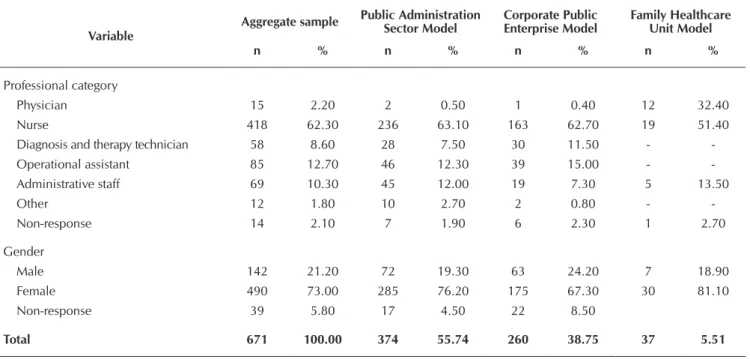
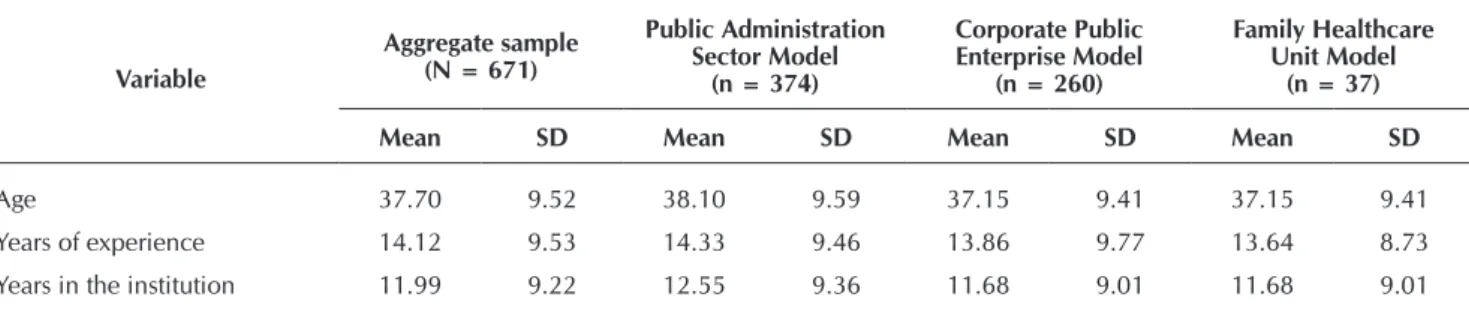
The survey was conducted among 671 collaborators from 10 Portuguese public healthcare institutions. Of these, 374 (55.74%) held positions in PAS healthcare model institutions, 260 (38.75%) held positions in CPE healthcare model institu-tions, and 37 (5.51%) held positions in FHU healthcare mod-el institutions (Table 1). In rmod-elation to the professional group, most respondents were nurses (62.30%), 12.70% were op-erational assistants, 10.30% were administrative staff, 8.60% were diagnosis and therapy technicians, and 2.20% were phy-sicians. Regarding years in the career and years in the health-care institution, the survey presents a mean value of 14.12 years (standard deviation [SD] = 9.53) and 11.99 years (SD = 9.22), respectively (Table 2).
Providing details on the characterization of the respon-dents by management models, the PAS model referred to the professional group: 63.10% were nurses; 12.30% were operational assistants; 12% were administrative staff; 7.50% were diagnosis and therapy technicians; and 0.50% were phy-sicians (Table 1). In relation to gender, most individuals were female (76.20%).
As Table 1 shows, in the CPE model the female gender also predominated (67.30%). As for the professional group, nurses predominated (62.70%), followed by operational assis-tants (15.00%), diagnosis and therapy technicians (11.50%), administrative staff (7.30%), and finally, physicians (0.40%). In relation to respondent age, the mean value was 37.15 years (SD = 9.41) (Table 2). As for professional experience, the mean was 13.86 years (SD = 9.77%), whereas the years in the institution assumed a mean value of 11.68 (SD = 9.01).
Similar to the previously mentioned models, in the FHU model the female gender predominated (81.10%) (Table 1).
Table 1 – Sample characterization according to professional category and gender, aggregate and by management model
Variable
Aggregate sample Public Administration
Sector Model
Corporate Public Enterprise Model
Family Healthcare Unit Model
n % n % n % n %
Professional category
Physician 15 2.20 2 0.50 1 0.40 12 32.40
Nurse 418 62.30 236 63.10 163 62.70 19 51.40
Diagnosis and therapy technician 58 8.60 28 7.50 30 11.50 -
-Operational assistant 85 12.70 46 12.30 39 15.00 -
-Administrative staff 69 10.30 45 12.00 19 7.30 5 13.50
Other 12 1.80 10 2.70 2 0.80 -
-Non-response 14 2.10 7 1.90 6 2.30 1 2.70
Gender
Male 142 21.20 72 19.30 63 24.20 7 18.90
Female 490 73.00 285 76.20 175 67.30 30 81.10
Non-response 39 5.80 17 4.50 22 8.50
0.63) (Table 4). The results show that, according to the per-ception of several organizational participants surveyed, higher knowledge management takes place in the FHU and, in turn, the PAS healthcare institution model was the lowest.
DISCUSSION
The knowledge management mean value obtained from the sample of healthcare institutions during the study (3.37 ± 0.62, on a scale from 1 to 5), similar to what happens in Portuguese or-ganizations in general, shows that knowledge management takes place in Portuguese healthcare institutions, even though not in a structured manner, revealing some isolated initiatives.
Knowledge management is a relatively new subject area, still approached in its initial stages in the healthcare sector. Healthcare institutions have been late in adopting the knowl-edge management concept, and are just now starting to take
the first approaches to this field(18). For instance, in the United
Kingdom, few hospitals have implemented knowledge manage-ment; however, due to its growing importance, particularly for improving the quality of decision-making, UK healthcare insti-tutions have been encouraged to develop structured systems
based on knowledge(19). The visibility of the implementation
and development of knowledge management in the healthcare As for the professional group they belonged to, 51.40% of
the individuals were nurses, 32.40% were physicians, and 13.50% were administrative staff. The mean age of the re-spondents was 37.15 years (SD = 9.41). Regarding the profes-sional experience variables and years in the institution, the mean was 13.64 years (SD = 8.73) for the former and 11.68 years (SD = 9.01) for the latter (Table 2).
Knowledge management perception on healthcare institutions According to the perception of several organizational play-ers questioned, the knowledge management mean value in public healthcare institutions is 3.37 ± 0.62 (scale varies be-tween 1 and 5), whereas the minimum mean value is 1.58 and the maximum mean value is 4.96 (Table 3).
Drawing a comparison in the healthcare institutions based on the management model, differences in the perception of knowledge management in each model were verified, and these differences were statistically significant (Table 4). The highest mean value of knowledge management was registered in the sample related to the FHU (4.28 ± 0.36), followed by the value related to the sample from the CPE healthcare in-stitution model (3.42 ± 0.53). On the other hand, the low-est mean value of knowledge management was registered in the sample from the PAS healthcare institution model (3.25 ±
Table 2 – Sample characterization according to age. years of experience and years in the institution. aggregate and by man-agement model
Variable
Aggregate sample (N = 671)
Public Administration Sector Model
(n = 374)
Corporate Public Enterprise Model
(n = 260)
Family Healthcare Unit Model
(n = 37)
Mean SD Mean SD Mean SD Mean SD
Age 37.70 9.52 38.10 9.59 37.15 9.41 37.15 9.41
Years of experience 14.12 9.53 14.33 9.46 13.86 9.77 13.64 8.73
Years in the institution 11.99 9.22 12.55 9.36 11.68 9.01 11.68 9.01
Note: SD = Standard deviation.
Table 3 – Knowledge management dispersion scale and mean values (N = 671)
Variable Minimum Maximum Mean SD
Knowledge Management 1.58 4.96 3.37 0.62
Note: SD = Standard deviation.
Table 4 – Knowledge management mean values in several management models. according to the perception of the organiza-tional collaborators. and the ANOVA Test
Variable
Corporate Public Enterprise Model
(n = 260)
Public Administration Sector Model
(n = 374)
Family Healthcare Unit Model
(n = 37)
Anova
Mean SD Mean SD Mean SD F P value
Knowledge management 3.42 0.53 3.25 0.63 4.28 0.36 54.451
sector is virtually zero(20), and this might have to do with the fact
that many healthcare institutions’ top managers do not have a
clear picture of this concept(21). As expected, empirical studies
that reflect the reality of knowledge management in the health-care sector are virtually nonexistent, not only on the national level, but also in the international context.
However, despite the lack of national studies on knowledge management in the healthcare sector, the results obtained in the current study show certain points in line with the empirical stud-ies conducted on private and public organizations in Portugal from other areas of activity. Study results developed in the in-dustrial sector(11,16), hotel sector(17), and local public sector(7) show
a moderate applicability of organizational processes related to knowledge in the organizational structure of respective organi-zational contexts. Yet, current knowledge management practices have been lacking in consistency and, for the most part, are not
formalized(1). Tackling this issue, a study conducted in 2011
in-volving 289 organizations from several areas of activity in Portu-gal showed that the vast majority of organizations still have an in-formal approach to knowledge management, whereas only one
in 10 organizations opt for a strategic approach(22).
Consequently, at a time when private management policies and practices are comprehensively implemented by public healthcare institutions, based on the argument that it is essential to increase the efficiency, effectiveness, and quality of healthcare systems, such results can only become possible if all organi-zational collaborators become involved in the reform process, providing their knowledge, particularly the tacit knowledge, the major strength for improving organizational performance. In this respect, and based on the results obtained, we have to admit that knowledge management is already an integral part of the organizational life of healthcare institutions, but it is up to their managers to optimize the existent practices, integrating them into a knowledge management structured project that allows maxi-mizing the potential of all collaborators with the goal of achiev-ing organizational objectives.
Keeping in mind that the way each healthcare institution is organized and operates is supported by the current management model, this same model can determine the way a healthcare unit establishes and develops a set of needed and supporting con-ditions for the organizational processes related to knowledge in other words, the way the institution manages its knowledge.
The knowledge management mean value, obtained in the sample related to each of the management models in our analysis, confirms what was not said, allowing to distinguish healthcare institutions in accordance with the management model. According to the perception of the organizational collaborators, the knowledge management mean values are 3.42 ± 0.53 in the sample of the CPE healthcare institution model, 3.25 ± 0.63 in the sample of the PAS healthcare in-stitution model, and 4.28 ± 0.36 for the FHU, with signifi-cant differences from a statistical point of view. Data related to the knowledge management mean values obtained from each management model allow us to draw a few conclusions. However, as the results are read, it should be kept in mind that while FHU refer to primary healthcare, the CPE and PAS models are related to differentiated healthcare (hospitals).
Comparing the perceptions of organizational collaborators on the three knowledge management models, a higher knowl-edge management mean value is shown in the FHU sample, reflecting not only on the fact that the FHU have an under-lying management philosophy that, somehow, translates into the corporatization of the services, but also the unit dimen-sion (“dimendimen-sion” meaning the number of collaborators). The “unit dimension” variable was not formally an object of study analysis; however, it could be relevant for the implementation of knowledge management projects. This variable has been included in some knowledge management studies, but above all as a component of statistical description, and not formally as an explanatory variable. Despite the notorious lack of stud-ies analyzing the relationship between the dimension of the institution and knowledge management, a study conducted with industrial sector organizations revealed the nonexistence of statistically significant differences in knowledge
manage-ment perceptions of the company dimension(16). Regardless of
the obtained result, and taking knowledge management as a commitment and involvement of all collaborators, we consid-ered that the development of conditions that allow develop-ing, promotdevelop-ing, and using all of its potential in achieving the organization’s objective optimizing knowledge could be more easily applied in institutions with smaller numbers of collabo-rators, prerequisites that deserve further research.
Comparing the knowledge management mean value with the hospital models (CPE and PAS), the results shown here also leave the impression that, based on corporate management principles and requirements, the organization and management of public healthcare institutions seem to constitute the managerial form that most contributes to their knowledge management. Although the reform measures in the PAS tend to shape the process of narrow-ing the gap between organizational and financial management in the state corporate sector(23), the traditional rules of public services
that still play a major role in the PAS seem to limit knowledge management initiatives/practices.
In view of the above, it is possible to assert that the public healthcare institution model is relevant to knowledge manage-ment, particularly the management models guided by corpo-rate principles.
However, the current research shows some limitations. The first is the small sample size related to FHU. Therefore, it is important to replicate the study in larger samples, particularly in relation to the FHU samples. Other limitations that under-pin the study are the exclusive use of a questionnaire as the single source of data collection. The use of other additional measurements for instance, an interview with top managers of healthcare institutions would have allowed greater substantia-tion for some of the achieved results.
optimize current knowledge management initiatives and prac-tices, in line with organizational strategy, in order to achieve institutional objectives. Furthermore, measures that support the current reform of the Portuguese healthcare system seem to be facilitators of the implementation of knowledge manage-ment. In other words, knowledge management seems to have the road paved toward its own implementation in the context of Portuguese healthcare institutions.
However, it is important to emphasize that the results ob-tained must be put in perspective in the context of an explor-atory study, as a first approach to a field of study that is rather unknown, taking into consideration its complexity and broad scope. Also crucial is the need and relevance of carrying out longitudinal studies that allow the confirmation (or not) of some of the main findings that guided this study. Furthermore, the study of context variables is equally relevant, especially the analysis of their relationship to knowledge management aimed at contributing to the success of the implementation of knowledge management programs in healthcare institutions, thus avoiding frustration, as has happened with some of the projects implemented in other areas of activity.
CONCLUSION
The current study was developed in an attempt to evalu-ate the perception of knowledge management in healthcare
institutions, not only in the sense of recognizing the value and importance of knowledge as a consequence of its manage-ment in the productive processes of any organization, but also seizing the moment in which reform measures are becoming widespread under the new public management, cross-section-al to hospitcross-section-als and groups of hecross-section-althcare centers, in achieving efficiency and sustainability in the healthcare system.
The results obtained allow the conclusion that, similar to what takes place in other areas of activity (industrial, hotel, and local level), moderate initiatives at the knowledge management level also occur in healthcare institutions, although not as a structured project, in line with an organizational strategy.
The management model of the healthcare unit was deci-sive for knowledge management, as different perceptions of knowledge management could be drawn from each ment model. It was at the healthcare institutions with manage-ment models based on private corporate policies and practices that the higher mean values were found related to knowledge management. This shows that institutions guided by those principles are the ones with a greater number of conditions or activities that bring about knowledge creation, exchange, storage, recovery, and use. Consequently, the options that are bringing about the current reform of the Portuguese healthcare system, with emphasis put on the corporatization of hospitals and the creation of FHU, seem to be creating the right condi-tions for the implementation of knowledge management.
REFERENCES
1. Brito EJO. Gestão do conhecimento e qualidade como vectores de competitividade na administração pública lo-cal [tese]. Coimbra: Faculdade de Psicologia e Ciências da Educação, Universidade de Coimbra; 2010.
2. Ahmadi F, Shirzade J. Identify factor that impact on develop of knowledge management in automobile industry. IJCRB [Internet]. 2011[cited 2012 Mar 21];2(10):327-40. Available from: http://connection.ebscohost.com/c/articles/59973601/ identify-factor-that-impact-develop-knowledge-manage ment-automobile-industry
3. Asl NA, Goodarzi M, Sajjadi SN, Benesbordi A. The rela-tionship between organizational culture and knowledge management in the Islamic Republic of Iran´s National Olympic Committee. IJ-ARBSS [Internet]. 2012[cited 2012 Mar 21];2(1):1-5. Available from: http://www.hrmars.com/ admin/pics/432.pdf
4. Nonaka I, Takeuchi H. The knowledge creating company: how Japanese companies create the dynamics of innova-tion. New York: Oxford University Press; 1995.
5. Schultze U, Stabell C. Knowing what you don’t know? Discourses and contradictions in knowledge management research. J Manage Stud [Internet]. 2004[cited 2012 Mar 21];41(4):549-73. Available from: http://onlinelibrary.wiley. com/doi/10.1111/j.1467-6486.2004.00444.x/abstract
6. Ruthes RM, Cunha ICKO. [Competencies of the nurse in the management of cognitive and capital knowledge]. Rev
Bras Enferm [Internet]. 2009[cited 2012 Mar 21];62(6):901-5. Available from: http://www.scielo.br/pdf/reben/v62n6/ a16v62n6.pdf Portuguese.
7. Brito EJO. Gestão do conhecimento e qualidade: estudo empírico sobre gestão do conhecimento em câmaras municipais que adotaram a gestão pela qualidade [disser-tação]. Coimbra: Faculdade de Psicologia e Ciências da Educação, Universidade de Coimbra; 2003.
8. Rossetti AG, Morales ABT. O papel da tecnologia da in-formação na gestão do conhecimento. Ci Inf [Internet]. 2007[cited 2012 Mar 21];36(1):124-35. Available from: http://www.scielo.br/pdf/ci/v36n1/a09v36n1.pdf
9. Kluge J, Stein W, Licht T. Gestão do conhecimento: segundo um estudo da McKinsey & Company. Cascais: Principia; 2002.
10. Alvesson M, Karreman D. Odd couple: making sense of the curious concept of knowledge management. J Man-age Stud [Internet]. 2001[cited 2012 Mar 21];38(7):995-1018. Available from: http://onlinelibrary.wiley.com/ doi/10.1111/1467-6486.00269/abstract
11. Monteiro SJF. Gestão do conhecimento: contributos para a conceptualização e operacionalização [dissertação]. Porto: Faculdade de Psicologia e de Ciências da Educa-ção, Universidade do Porto; 2007.
13. Arias JM, Hernández GC. Gerencia y competencias dis-tintivas dinâmicas en instituciones prestadoras de servi-cios de salud. Rev Gerenc Polit Salud. 2008;7(15):131-54.
14. El Morr C, Subercaze J. Knowledge management in health care. In: Cunha MMC, Tavares AJ, Simões R, edi-tors. Handbook of research on developments in e-health and telemedicine: technological and social perspectives. USA: IGI Global; 2010. p. 490-510.
15. Guptill J. Knowledge management in health care. J Health Care Finance [Internet]. 2005 Spring[cited 2012 Mar 21];31(3):10-4. Available from: http://www.ncbi.nlm.nih. gov/pubmed/16080410
16. Cardoso L. Gerir conhecimento e gerar competitividade: estudo empírico sobre a gestão do conhecimento e o seu impacto no desempenho organizacional [tese]. Coimbra: Faculdade de Psicologia e Ciências da Educação, Univer-sidade de Coimbra; 2003.
17. Cardoso PMA. Gestão do conhecimento em organiza-ções hoteleiras do distrito de Viseu [dissertação]. Aveiro: Departamento de Economia, Gestão e Engenharia Indus-trial, Universidade de Aveiro; 2005.
18. Kothari A, Hovanec N, Hastie R, Sibbald S. Lessons from the business sector for successful knowledge management in health care: a systematic review. BMC Health Services Research [Internet]. 2011[cited 2012 Mar 21];11. Available from: http://www.biomedcentral.
com/1472-6963/11/173
19. Lin C, Tan B, Chang S. An exploratory model of knowl-edge flow barriers within healthcare organizations. In-form Manage. 2008;45:331-9.
20. Chen YH, Liu CF, Hwang HG. Key factors affecting health-care professionals to adopt knowledge management: the case of infection control departments of Taiwanese hos-pitals. Expert Syst Appl [Internet]. 2011[cited 2012 Mar 21];38(2011):450-7. Available from: https://ir.nctu.edu.tw/ bitstream/11536/26149/1/000282607800052.pdf
21. Arboleda GI. Percepción que los gerentes tienen acerca de la gestión del conocimiento en las instituciones de salud, Valle de Aburrá, 2011. Rev Fac Nac Salud Pública [Inter-net]. 2014[cited 2012 Mar 21];32(2):42-53. Available from: http://aprendeenlinea.udea.edu.co/revistas/index.php/fnsp/ article/view/13232/0
22. Neves A. Estudo gestão do conhecimento em Portugal 2011 [Internet]. 2011[cited 2015 Jan 21]; Available from: http:// knowman.pt/wp-content/uploads/docs/D2012A-GCemPor-tugal2011.pdf