Luciana Paiva
I, Daniele Alcalá Pompeo
II, Márcia Aparecida Ciol
III, Glendha Oliveira Arduini
IV,
Rosana Aparecida Spadoti Dantas
V, Eva Claudia Venâncio de Senne
I, Lídia Aparecida Rossi
VI Universidade de São Paulo, Ribeirão Preto College of Nursing. Ribeirão Preto, São Paulo, Brazil.
II Faculdade de Medicina de São José do Rio Preto, Specialized Nursing Department. São José do Rio Preto, São Paulo, Brazil. III University of Washington, School of Medicine, Department of Rehabilitation Medicine. Seattle, United States of America.
IV Universidade Federal do Triângulo Mineiro, Graduate Program in Nursing. Uberaba, Minas Gerais, Brazil. V Universidade de São Paulo, Ribeirão Preto College of Nursing, General and Specialized Nursing Department.
Ribeirão Preto, São Paulo, Brazil.
How to cite this article:
Paiva L, Pompeo DA, Ciol MA, Arduini GO, Dantas RAS, Senne ECV, et al. Health status and the return to work after traffic accidents. Rev Bras Enferm [Internet]. 2016;69(3):416-22. DOI: http://dx.doi.org/10.1590/0034-7167.2016690305i
Submission: 05-22-2015 Approval: 11-28-2015
ABSTRACT
Objective: to compare the health status of traffi c accident victims, at hospital discharge and after six months, and to analyze the predictive variables of their health status and return to work. Method: observational, longitudinal study. Data were collected through interviews and medical records of 102 patients with a mean age of 33 years; with the majority being men and victims of motorcycle accidents. The variables were analyzed by means of validated tools, student’s t-test, multiple linear regression, and logistic regression. Results: there was an improvement of perception in the patients’ health status six months after hospital discharge and functional capacity. The individuals who returned to work showed better health-related quality of life evaluation.
Conclusion: improvement of the perceived health status six months after hospital discharge was found. Factors that infl uenced the patients’ return to work were not identifi ed.
Descriptors: Traffi c Accidents; Quality of Life; Rehabilitation; Work; Trauma.
RESUMO
Objetivo: comparar o estado de saúde de vítimas de acidente de trânsito, na alta hospitalar e após 6 meses, bem como analisar as variáveis preditoras do estado de saúde e retorno ao trabalho. Método: estudo observacional, longitudinal. Dados coletados por entrevistas e consulta aos prontuários, com 102 pacientes com média de idade de 33 anos; a maioria, homens e vítimas de acidente motociclístico. As variáveis foram avaliadas por instrumentos validados, analisadas por teste “t” de Student, regressão linear múltipla e regressão logística. Resultados: houve melhora da percepção do estado de saúde 6 meses após alta associada à idade, medida geral do estado de saúde imediatamente após a alta e capacidade funcional. Os indivíduos que retornaram ao trabalho apresentaram melhor avaliação da qualidade de vida relacionada à saúde. Conclusão: constatou-se melhora da percepção do estado de saúde 6 meses após a alta. Não foram identifi cados fatores que infl uenciaram o retorno ao trabalho.
Descritores: Acidentes de Trânsito; Qualidade de Vida; Reabilitação; Trabalho; Trauma.
RESUMEN
Objetivo: comparar el estado de salud de víctimas de accidentes de tránsito al alta hospitalaria y seis meses después, y analizar las variables predictoras del estado de salud y de retorno al trabajo. Método: estudio observacional, longitudinal. Datos recolectados por entrevistas y consulta de historias clínicas, con 102 pacientes, media etaria de 33 años, mayoritariamente hombres, víctimas de accidente motociclístico. Variables evaluadas por instrumentos validados, analizadas por test “t” de Student, regresión lineal
Health status and the return to work after traffic accidents
Luciana Paiva E-mail: [email protected]
CORRESPONDING AUTHOR
INTRODUCTION
Traffic accidents represent a serious and complex public health problem in Brazil. They have been on the rise with economic and technological development of modern societ-ies and can have social and economic implications, since they predominate in young and economically active populations(1).
The increasing number of accidents places a tremendous burden on the health system in all assistance sectors, since costly and long hospitalization periods are part of the reha-bilitation of traffic accident victims who suffered injuries in several body regions. The sequelae of the injuries can affect quality of life and the return to work after the trauma, charac-terized as a chronic condition.
Over the last decades, Health-Related Quality of Life (HRQoL) has been used as a synonym of health status per-ceived by the individual and could be defined as related to how much the emotional, social, and physical well-being is affected by an illness and subsequent treatments(2).
The sequelae resulting from traffic accidents cause a negative impact on the individual’s life and can lead to a de-crease in functional capability and work capacity(3); therefore,
HRQoL can be used as an indicator of the post-trauma re-covery process. In a previous study, associations were found among individuals’ capacity to return to previous activities, including age, severity of the trauma, level of education and type of job, social support, and participation in rehabilitation programs. With an aim at comparing the health status of traf-fic accident victims at hospital discharge and after 6 months, as well as analyzing the predictive factors of the health sta-tus and the return to work, a connection was found between risk factors described in the literature and the return to work. The authors also investigated whether the trauma mechanism, functional capacity, anxiety, and depression at hospital dis-charge played a key role in the general health status of traf-fic accident victims, and their return to work six months after hospital discharge.
METHOD
A longitudinal cohort study was carried out in a General Hospital of Minas Gerais, Brazil, and concluded in July 2014, after approval of the institution’s Ethics Committee. The re-search objectives were presented to possible participants, guaranteeing the confidential nature of their information. All individuals that agreed to participate in the study signed a free and informed consent form.
Sample: inclusion and exclusion criteria
The sample size was limited to the period of data col-lection, based on human resources and time available for conducting the study. It included individuals over 18 years of age, victims of moderate or serious trauma by traffic ac-cidents (with New Injury Severity Score ≥ 15) and with cognitive conditions that would allow them to participate in the study.
Tools used for collecting data
Clinical and sociodemographic data questionnaire to eval-uate the following information: demographics (date of birth for subsequent calculation of age, gender, marital status, edu-cation, and activity); hospitalization (data of admission and discharge, and complications); trauma characteristics (date and time of the accident, type of accident [pedestrian, bicycle, motorcycle, car, truck, bus]; body regions struck [head and neck, face, chest, abdomen, extremities or pelvic waist, and external surface]; and data on return to work [unaffected or affected activities due to the trauma and those who did not return to work activities])(4).
• Abbreviated Injury Scale(AIS): All injuries described in the participants’ medical records were entered into a coding system, according to the AIS. This code identi-fies the body region, the anatomical structures and the specific natures of the injury, and the injury level and severity(5).
• New Injury Severity Score (NISS): This scoring system was used to determine the severity of the trauma. It was calculated by summing the squares of the AIS values as-signed to the three most serious injuries, regardless of the body segment. The NISS value varies from 0 to 75, with scores higher or equal to 15, including moderate and minor traumas(5).
• Perceived Health Status (PHS): The PHS score was car-ried out by a numeric visual analog scale. Patients an-swered the following question: “If you were to give a grade to your health status today, what grade would you give?” The answer was assigned in a horizontal analog scale of 100 millimeters, with zero placed at the left end (worst possible health status).
• Hospital Anxiety and Depression Scale – HADS: This scale evaluated the symptoms of anxiety and depres-sion in patients with physical illnesses. It has 14 items, whereas seven assess symptoms of anxiety (HADS-A sub-scale) and seven evaluates symptoms of depression (HADS-D). Each item can be measured from zero to múltiple y regresión logística. Resultados: Hubo mejora de la percepción del estado de salud 6 meses después del alta, asociada a edad, medida general del estado de salud, inmediatamente después del alta y capacidad funcional. Los individuos que retornaron al trabajo presentaron mejor evaluación de calidad de vida relacionada a la salud. Conclusión: se constató mejora de percepción del estado de salud 6 meses después del alta. No fueron identificados factores que influyeron en el regreso laboral.
three, with maximum score of 21 for each scale. High-er values indicate highHigh-er presence of symptoms in the specified sub-scale(6).
• Katz Index: This tool evaluated functional capacity. The scale consists of six items that measures individuals’ per-formance in self-care activities: eating, sphincter control, shifts, personal hygiene, capacity to get dressed, and to take a shower. Each item receives score zero (indepen-dent) or one (depen(indepen-dent), and the sum of the items adds to a maximum of 6 points. Participants with total score between zero and two were classified as independent, and those with higher or equal to three points were con-sidered dependent(7).
• Medical Outcome Survey 36-item short (SF-36): The as-sessment of HRQoL six months after hospital discharge was conducted applying the SF-36 tool version adapted and validated for the Portuguese language(8). The SF-36
consists of 36 items, whereas one item assesses health changes over time and 35 evaluate distinct health as-pects arranged into eight dimensions. For each dimen-sion, the SF-36 items are coded, grouped, and trans-formed into a score of zero (worst health status) to 100 (highest health status)(8).
Procedures
The medical records of individuals hospitalized due to a traffic accident were evaluated by one of the researchers for the characterization of the severity of the trauma using the NISS tool. After agreeing to participate in the research, an in-dividual interview was conducted in the care unit at the time of discharge from hospital. The tools were applied always fol-lowing the same order: clinical and sociodemographic data questionnaire, PHS, HADS, and Katz Index. Six months af-ter discharge, the same tools and the SF-36 were applied in the participants’ residences. Data were collected by a single researcher.
Statistics and result analysis
Basic descriptive frequency analysis for categorical and nominal variables and central tendency and dispersion for nu-merical variables were carried out. Considering the reduced number of traumas classified as “pedestrians” and “bikers”, these categories were grouped for analysis. To compare the general health status at the time of hospital discharge and six months later, Student’s t-test was used in paired samples and the mean was estimated, adopting a confidence interval of 95% for the difference of the general health status between the two periods. In order to evaluate the associations between the general health status six months post-discharge and the “trauma mechanism and general health status”, “functional capacity”, “anxiety and depression assessed at the time of hospital discharge” variables, multiple linear regression was applied, using as reference the trauma mechanism by motor-cycle accident, for being considered as the most frequent oc-currence. The proportion (and 95% confidence interval) of victims that returned to work six months after hospital dis-charge was estimated.
In order to study the associations between return to work six months post-discharge and the trauma mechanism and the gen-eral health status, functional capacity, anxiety and depression variables, measured at the time of hospital discharge, logistic regression was applied to calculate the gross odds ratio between response variable and each explanatory variable, having the odds ratio adjusted by the equation model of logistic regression. Significance was established at 0.05. All analyses were conduct-ed using IBM SPSS Statistics, version 21.0 for Mac.
RESULTS
From October 2011 to October 2012, 102 patients were recruited within the inclusion criteria of the study. The studied group had a mean age of 33 years (SD = 12.7), with preva-lence of male individuals (78.4%), with poor education (mean of 8.4 years of study [SD = 3.4]), with partners (58.9%), and mean household income of 3.8 (SD = 3.2) minimum wages, and with a mean loss of 1.2 minimum wage in the household income after the traffic accident.
In the classification of traumas as moderate and serious, the mean NISS was 18.5 (variation from 16 to 43). In relation to trauma mechanism, the most common vehicle involved in the accidents was motorcycles (60.8%). Crashes involving cars and heavy vehicles (trucks and buses) represented 26.5% of the accidents, and 12.7% involved bikers and pedestrians.
From the 102 patients, most (69.6%) had injury in a single body region, with 37.2% on the external surface (abrasions, bruises, and skin lacerations). Lower extremities were the most traumatized body regions (86.3%), followed by the upper ex-tremities (12.7%), chest (9.8%), head (7.8%), and face (4.9%). Length of hospital stay varied from 2 to 59 days, with a mean of 11 days (SD = 10.7%). During hospital stay, the most common complications were nosocomial infections (11.7%), with surgical site infections being the most prevalent.
Mean perceived health status for the traffic accident victims was 69.1% (SD = 22.9) at the time of hospital discharge, and 76.6 (SD = 19.2) six months after discharge, with a statisti-cally significant difference (p = 0.01).
Individuals showed low values for anxiety six months af-ter hospital discharge when compared to the moment of discharge, with means of 5.1 (SD = 3.2) and 6 (SD = 3.7), respectively. The participants presented higher scores with symptoms of depression six months after discharge, with a mean of 4.0 (SD = 3.8), when compared to the moment of hospital discharge, when the mean was 2.4 (SD = 2.9).
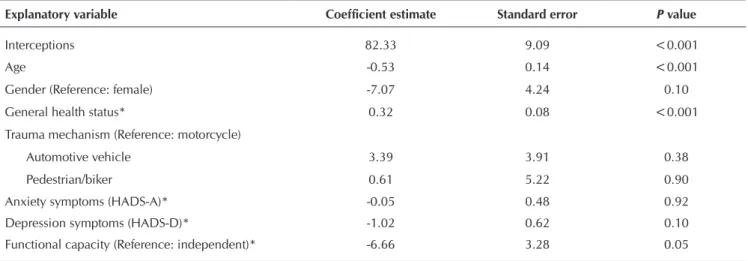
Multiple linear regression analysis was applied for the gen-eral health status model at six months, with the following ex-planatory measures at hospital discharge: gender, age, trauma mechanism (using dummy variables for the three categories), general health status (continuous), functional capacity (binary: independent or dependent), and symptoms of anxiety and de-pression (continuous). The results are shown in Table 1.
Multiple linear regression indicated that age (p < 0.001), general health status score (p < 0.001), and functional capac-ity (p = HADS-D 0.05) were statistically significant to explain the variation in general health status six months after hospital discharge. The regression model shows that an increase in the measuring unit of the general health status at hospital discharge increases on average 0.3 points in the general health status score six months after the first evaluation (with all the remaining vari-ables being equal). Furthermore, according to the model, an individual classified as dependent had, on average, a general health status of 6.7 points lower than the individuals classified as independent. The remaining variables inserted in the model (gender, trauma mechanism, anxiety and depression measured
during hospital discharge) were not statistically significant. The tested model explained about 33% of the measured variance of general health status six months after hospital discharge.
Of the 102 participants of this study, 53 had returned to work six months after hospital discharge and, therefore, the estimate for returning to work in the population of victims of traffic accident in Triângulo Sul was 52% (CI 95%: 42.3% - 61.7%). As for the patients who returned to work, five (4.9%) underwent jobs changes because of post-traumatic conditions.
Multiple logistic regression was applied to evaluate the factors that could influence return to work. No single factor included in the model showed association with return to work (Table 2).
Table 1 – Analysis of the multiple linear regression having as response variable the score of general health status six months after hospital discharge, and explanatory variables measured at hospital discharge, Uberaba, Minas Gerais, Brazil, October 2011 to October 2012
Explanatory variable Coefficient estimate Standard error P value
Interceptions 82.33 9.09 <0.001
Age -0.53 0.14 <0.001
Gender (Reference: female) -7.07 4.24 0.10
General health status* 0.32 0.08 <0.001
Trauma mechanism (Reference: motorcycle)
Automotive vehicle 3.39 3.91 0.38
Pedestrian/biker 0.61 5.22 0.90
Anxiety symptoms (HADS-A)* -0.05 0.48 0.92
Depression symptoms (HADS-D)* -1.02 0.62 0.10
Functional capacity (Reference: independent)* -6.66 3.28 0.05
Note: * Variables measured at the time of hospital discharge. Hospital Anxiety and Depression Sub-scale (HADS – A and HADS-D).
Table 2 – Results from the logistic analysis (in terms of adjusted odds ratios) using return to work within six months (yes/no) as response variable and variables measured at hospital discharge as explanatory variables, Uberaba, Minas Gerais, Brazil, October 2011 to October 2012
Variables measured at hospital discharge
Odds ratio
Confidence limits at 95%
P value
Lower Higher
Age 0.97 0.94 1.01 0.12
Gender (Reference: female) 2.02 0.67 6.08 0.21
Anxiety symptoms (HADS- A) 0.95 0.84 1.08 0.44
Depression symptoms (HADS-D) 0.99 0.84 1.16 0.87
Functional capacity
(Reference: Independent)
Dependent 1.61 0.69 3.77 0.27
High trauma mechanism
(Reference: Motorcycle)
Automotive vehicle 1.52 0.35 6.64 0.57
Biker/pedestrian 0.60 0.16 2.28 0.44
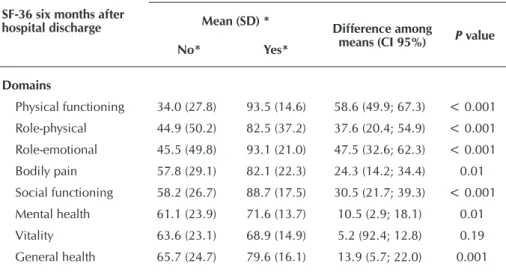
The results obtained in the evaluation of health-related quality of life, six months after traffic accident victims were discharged from hospital, showed that individuals who re-turned to work presented better evaluation in all domains, ac-cording to return to work.
The domains perceived as the most affected for the indi-viduals who returned to work were vitality, mental health, and general health, with mean scores of 68.9 (SD = 14.9), 71.6 (SD = 13.7), and 79.6 (SD = 16.1), respectively (Table 3). For the victims who did not return to work, the most affected domains were physical functioning, physical, and role-emotional, with mean scores of 34.0 (SD = 27.8), 44.9 (SD = 50.2), and 45.5 (SD = 49.8), respectively. Comparing the group of patients according to the means observed in each domain of the tool, the group that returned to work presented higher values for all the domains and vitality only was not statistically significant (p = 0.19) (Table 3).
Evaluating the health-related quality of life six months af-ter discharge, the group of patients that returned to work pre-sented higher values for all the domains, and the statistically significant domains were: physical functioning (p < 0.001), role-physical (p < 0.001), role-emotional (p < 0.001), bodily pain (p = 0.01), social functioning (p < 0.001), mental health (p = 0.01), general health (p = 0.001).
DISCUSSION
Young adults, men, and an economically active population were predominant in this study. The data confirm the studies developed by other authors(1,9-10). The predominance of this
population is due to greater exposure of young adult men to
risks of accidents, probably because they drive mostly in ur-ban areas and show social and cultural behaviors that predis-pose them to risks of injuries and deaths, such as driving at high speeds and consuming alcoholic beverages(9).
In the last few years, a noticeable increase in risk of death by accident involving motorcycles was observed(11).
Urbaniza-tion process has led to an exponential growth in the number of motorcycles used as means of transportation, since it provides speed (although not always within the legal speed limits), mobil-ity, low cost, and can be used as a working tool, such as the case of “motoboys” and “mototaxis”(12). In this study, motorcycles
were the most common vehicle involved in accidents (60.8%), which probably contributed to an increased incidence of trauma in lower and upper limbs. The number of assistances provided to motorcyclists with skin injuries and bone fractures, especially in the lower and upper limbs, is on the rise(10-11).
The nature of the injuries and the severity of the trauma can in-fluence the length of hospital stay, type of treatment, and the condi-tions for hospital discharge(13). In
this study, most of the victims remained hospitalized between 2 and 10 days (65.7%), similar to what has been observed in the literature as well(14).
The most common compli-cations were nosocomial infec-tions (11.7%). The presence of this complication influence the morbimortality of patients who remain hospitalized, and it can be related to the period of hospital stay, disease sever-ity, nutritional conditions, and the nature of the diagnosis and/ or therapeutic procedures(15).
The fact that participants evaluated the perceived health status as better six months after hospital discharge can be re-lated to their access to rehabili-tation. Most of the trauma vic-tims might have recovered their health status six months after the trauma, or this period could have been sufficient for adapting to the post-trauma condi-tions, as others authors found(16).
Trauma reduces health-related quality of life in the medium and long term(17). This fact can be associated with anatomical and
physiological changes at the time of the trauma, and psychologi-cal and social aspects involved in the initial assistance provided to the trauma and to rehabilitation. Some variables may influence quality of life after the trauma, such as: extent of the sequelae, pain, access to rehabilitation, and social-economic condition(17).
In relation to the analysis of explanatory variables of the health status perceived six months after hospital discharge, age, general health status score, and functional capacity at discharge were statistically significant, with a positive association.
Table 3 – Comparison of the SF-36 domains six months after hospital discharge in relation to returning to work, Uberaba, Minas Gerais, Brazil, October 2011 to October 2012
SF-36 six months after hospital discharge
Test of difference among groups
Mean (SD) *
Difference among
means (CI 95%) P value
No* Yes*
Domains
Physical functioning 34.0 (27.8) 93.5 (14.6) 58.6 (49.9; 67.3) < 0.001
Role-physical 44.9 (50.2) 82.5 (37.2) 37.6 (20.4; 54.9) < 0.001
Role-emotional 45.5 (49.8) 93.1 (21.0) 47.5 (32.6; 62.3) < 0.001
Bodily pain 57.8 (29.1) 82.1 (22.3) 24.3 (14.2; 34.4) 0.01
Social functioning 58.2 (26.7) 88.7 (17.5) 30.5 (21.7; 39.3) < 0.001
Mental health 61.1 (23.9) 71.6 (13.7) 10.5 (2.9; 18.1) 0.01
Vitality 63.6 (23.1) 68.9 (14.9) 5.2 (92.4; 12.8) 0.19
General health 65.7 (24.7) 79.6 (16.1) 13.9 (5.7; 22.0) 0.001
In other studies on quality of life of victims of traffic ac-cidents in general, the utmost severity of the trauma was predictive of worst quality of life, presence of symptoms of anxiety and depression, and decrease in social and family interaction with difficulty to returning to work(3).
In this study, 53 victims of traffic accidents (52%) re-turned to work six months after hospital discharge. Stud-ies show that multiple trauma victims returned to work ac-tivities and the return to work rates vary between 60% and 90%, in the first and second year after the trauma, respec-tively(18). The percentage in this study was low and could be
attributed to the follow-up period of just six months after hospital discharge, when maybe most individuals were still undergoing rehabilitation.
There was a mean decrease of 1.2 minimum wages in household income in the first six months after the accident. This reduction may be related to work leave without pay, in case of individuals who did not have an employment con-tract or received lower illness benefit, if compared to the minimum wage. The traumatic injuries resulting from ac-cidents require, in many cases, prolonged sick leave during rehabilitation, which could lead to significant consequenc-es related to socio-profconsequenc-essional marginalization(19). In these
authors’ view, returning to work is a complex problem that interferes in quality of life; it depends on the individual, pa-thology, rehabilitation, and social-economic environment. In addition, it represents a serious social cost, in terms of health care provision, medical leaves, and absenteeism.
In a longitudinal cohort study conducted in Australia, traffic accident victims, who were evaluated between two and eight months after the trauma and showed injuries in the lower limbs, returned to work on average 12 weeks after hospital discharge (CI 95%: 5.7 - 18.3). In the same study, the victims that presented injuries in other body regions, ex-cept for the extremities, returned to work three weeks after hospital discharge (CI 95%: 2 - 4)(20).
In a meta-analysis on orthopedic injuries, there was mod-erate evidence related to age, gender, and severity effects of the injury for returning to work, whereas level of edu-cation and job type were important factors that influenced productivity(21).
Several factors related to trauma may interfere in return to work, among them: type of initial injury and severity and presence of head trauma. In addition, there are more predictive factors for returning to work six months after the accident, among them: presence of physical or neuro-psy-chological impairments and persistent pain(19). The present
study did not find associations between age, gender, symp-toms of anxiety, sympsymp-toms of depression, functional capac-ity and trauma mechanism changes, and return to work.
In this study, six months after hospital discharge, indi-viduals who returned to work showed better evaluation in all SF-36 domains. On the other hand, the most affected do-mains, in the case of the victims that did not return to work, were physical functioning, role-physical, and role-emotion-al. In addition, a statistically significant difference was also observed in the evaluation of the perceived health status of
traffic accident victims six months after hospital discharge, according to return to work, related to bodily pain, physical functioning, role-physical, general health, social function-ing, role-emotional, and mental health. Only vitality was not statistically significant.
There are few studies showing a relationship between re-turn to work of traffic accident victims and quality of life. The most common situation has been to evaluate the results related to the SF-36 domains of victims in general. In a study conducted with multiple trauma victims, one year after the trauma, the domains that showed lower mean scores were role-physical, bodily pain, and vitality. The domains that received higher mean scores were social functioning, role-emotional, and general health(22). In a study carried out with
traumatic spinal cord injury resulting from traffic accidents, the domains “role-emotional” and “mental health” were af-fected, demonstrating unbalance between mind and body, leading to decreased quality of life reflected in all domains, especially social functioning(16).
In a study conducted with a general population sample in Brazil, individuals who indicated some chronic health prob-lem showed worst health status when compared to healthy individuals, and the means in the eight domains were statis-tically significant(2).
This study shows as limitation the follow-up period of just six months. Other follow-up studies for a longer period are necessary for evaluating the final functional result of re-habilitation. In addition, the sample size was limited to time restriction for conducting the study.
The evaluation of the health status perception during hospi-tal discharge can provide subsidies for the multi-professional team to organize the health care process, thus allowing the identification of patients who could face greater adaptation difficulty. The results of this study exposed the great chal-lenges that nurses face dealing with decreasing in-hospital infection rates, which contribute to the severity of trauma and rehabilitation, especially promoting self-care to older patients with increased functional capacity limitations. New studies are necessary for allowing further research on the relation-ships between perceived health status and return to work, for the identification of factors that could be potentially revised.
CONCLUSION
REFERENCES
1. Magalhaes AF, Lopes CM, Koifman RJ, Muniz PT. Preva-lence of self-reported traffic accidents in Rio Branco, Northern Brazil. Rev Saúde Públ [Internet]. 2011[cited 2013 Nov 10];45(4):738-44. Available from: http://www. scielo.br/pdf/rsp/v45n4/en_2498.pdf
2. Cruz LN, Fleck MP, Oliveira MR, Camey SA, Hoffmann JF, Bagattini AM. et al. Health-related quality of life in Bra-zil: normative data for the SF-36 in a general population sample in the south of the country. Ciênc Saúde Colet [Internet]. 2013[cited 2015 Nov 10];18(7):1911-21. Avail-able from: http://www.scielo.br/pdf/csc/v18n7/06.pdf 3. Andersson AL, Dahlback LO, Bunketorp O. Psychosocial
aspects of road traffic trauma: benefits of an early interven-tion? Injury [Internet]. 2005[cited 2015 Nov 10];36(8):917-26. Available from: http://www.ncbi.nlm.nih.gov/pubmed/ 15998512
4. Souza JC, Paiva T, Reimão R. [Quality of life of road truck drivers]. J Bras Psiquiatr [Internet]. 2006[cited 2015 Nov 10];55(3):184-9. Available from: http://www.scielo.br/ pdf/jbpsiq/v55n3/v55n3a02.pdf
5. AAAM. Abbreviated injury scale 2005: update 2008. Bar-rington; 2008.
6. Botega NJ, Bio MR, Zomignani MA, Júnior CG, Pereira WAT. Transtornos de humor em enfermaria de clínica médica. Rev Saúde Públ [Internet]. 1995[cited 2015 Nov 10];29(5):355-63. Available from: http://www.scielo.br/ pdf/rsp/v29n5/04.pdf
7. Lino VTS, Pereira SEM, Camacho LAB, Filho STR, Buks-man SS. [Cross-cultural adaptation of the Independence in Activities of Daily Living Index (Katz Index)]. Cad Saúde Pública [Internet]. 2008[cited 2013 Nov 10];24(1):103-12. Available from: http://www.scielo.br/pdf/csp/v24n1/09. pdf Portuguese
8. Ciconelli RM, Ferraz MB, Santos W, Meinão I, Quaresma MR. Tradução para a língua portuguesa e validação do ques-tionário genérico de avaliação de qualidade de vida SF-36 (Brasil SF-36). Rev Bras Reumatol [Internet]. 1999[cited 2013 Nov 10];39(3):143-50. Available from: http://www.ufjf.br/ renato_nunes/files/2014/03/Valida%C3%A7%C3%A3o-d o-Question%C3%A1rio-de-qualidade-de-Vida-SF-36.pdf 9. Abreu AMM, Jomar RT, Thomaz RGF, Guimarães RM, Lima
JMB, Figueiro RFS. Impacto da Lei seca na mortalidade por acidentes de trânsito. Revista de Enfermagem da UERJ [In-ternet]. 2012[cited 2013 Jun 10];20(1):21-6. Available from: http://www.facenf.uerj.br/v20n1/v20n1a04.pdf
10. Pasquale MD. Outcomes for trauma: is there an end (re-sult) in sight? J Trauma. 2008;64(1):60-5.
11. Hefny AF, Barss P, Eid HO, Abu-Zidan FM. Motorcycle-related injuries in the United Arab Emirates. Accid Anal Prev [Internet]. 2012[cited 2015 Nov 10];49:245-8. Avail-able from: http://www.sciencedirect.com/science/article/ pii/S0001457511001229
12. Soberg HL, Roise O, Bautz-Holter E, Finset A. Returning to work after severe multiple injuries: multidimensional function-ing and the trajectory from injury to work at 5 years. J Trauma [Internet]. 2010[cited 2015 Nov 10];71(2):425-34. Available
from: http://www.ncbi.nlm.nih.gov/pubmed/21045746
13. Araújo TG, Rieder MM, Kutchak FM, Filho JWF. Readmis-sions and deaths following ICU discharge: a challenge for intensive care. Rev Bras Ter Intensiva [Internet]. 2013[cit-ed 2013 Jun 10];25(1):32-8. Available from: http://www. scielo.br/pdf/rbti/v25n1/en_07.pdf
14. Andrade LM, Lima MA, Silva CHC, Caetano JA. Acidentes de motocicleta: características das vítimas e dos acidentes em hos-pital de Fortaleza – CE, Brasil. Rev RENE [Internet]. 2009[cited 2011 May 11];10(4):52-9. Available from: http://www.reposito rio.ufc.br:8080/ri/bitstream/123456789/4411/1/2009_art_m alima.pdf
15. Couto RC, Pedrosa TMG, Nogueira JM. Infecção hospitalar e outras complicações não-infecciosas da doença: epidemio-logia, controle e tratamento. 3. ed. Rio de Janeiro: MEDSI; 2003.
16. Vall J, Braga VAB, Almeida PC. Study of the quality of life in people with traumatic spinal cord injury Arq Neu-ropsiquiatr [Internet]. 2006[cited 2011 Jan 10];64(2):451-5. Available from: http://www.scielo.br/pdf/anp/v64n2b/ a19v642b.pdf
17. Alves ALA, Salim FM, Martinez EZ, Passos ADC, Carlo MMRP, Scarpelini S. Quality of life in trauma victims six months after hospital discharge. Rev Saúde Públ [Inter-net]. 2009[cited 2013 Jun 10];43(1):154-60. Available from: http://www.scielo.br/pdf/rsp/v43n1/6952.pdf
18. Parreira JG, Gregorut F, Perlingeiro JAG, Solda SC, Assef JC. Análise comparativa entre as lesões encontradas em moto-ciclistas envolvidos em acidentes de trânsito e vítimas de outros mecanismos de trauma fechado. Rev Assoc Med Bras [Internet]. 2012[cited 2013 Jun 10];58(1):76-81. Available from: http://www.scielo.br/pdf/ramb/v58n1/v58n1a18.pdf
19. Fort E, Bouffard E, Charnay P, Bernard M, Boisson D, Laumon B et al. Return to work following road accidents: factors associated with late work resumption. J Reha-bil Med [Internet]. 2011[cited 2013 Jun 10];43(4):283-91. Available from: http://www.medicaljournals.se/jrm/ content/?doi=10.2340/16501977-0670&html=1
20. Fitzharris M, Bowman D, Ludlow K. Factors associated with return-to-work and health outcomes among survivors of road crashes in Victoria. Aust N Z J Public Health [Internet]. 2010[cited 2013 Jun 10];34(2):153-9. Available from: http://on linelibrary.wiley.com/doi/10.1111/j.1753-6405.2010.00500. x/abstract;jsessionid=B133762902CCD0A2E85525CBB6CA 3E6D.f01t03
21. Clay FJ, Newstead SV, Mcclure RJ. A systematic review of early prognostic factors for return to work following acute orthopaedic trauma. Injury [Internet]. 2010[cited 2013 Jun 10];41(8):787-803. Available from: http:// www.ncbi.nlm.nih.gov/pmc/articles/PMC3299034/pdf/ prm17035.pdf