453
O
ri
gi
na
l
a
rt
ic
le
s
1 Universidade Estadual de Campinas, Faculdade de Ciências Médicas, Programa de Pós-graduação em
Gerontologia. Campinas, São Paulo, Brasil. Correspondence
Roberta dos Santos Tarallo [email protected]
Abstract
Introduction: Understanding the multidimensionality of attitudes originating from exchanges
between different generations is fundamental for the establishment of intergenerational cooperation and the reduction of stereotypes and prejudices. Objective: To obtain the semantic and cultural equivalence of the Intergenerational Exchanges Attitude Scale (IEAS). Method: Two translators translated the scale from English into Portuguese. A third translator synthesized these two translations. The synthesized version was back-translated into English. From the observations of the initial and back translations, a semantic version of the scale was consolidated, which was applied to 32 professionals who developed intergenerational activities (elderly/children) and activities directed at elderly persons only. Following application, a version of the scale that was culturally adapted for the Portuguese language was obtained. Results: The scale was alterered due to cultural refinement, with differences in the following items: 4) around and near; 6) overprotective and highly protective; 8) be around and to want to get close to; 11) earn and obtain; 13) have warm relationships and to relate affectionately; 17) affection and fondness; 18) form a good team and are good companions; 20) feel sick and get irritated. The responses used are evaluative statements of positive or negative attitudes about the exchanges that take place between children and the elderly, based on a Likert scale of just five points. Conclusion: The Intergenerational Exchanges Attitude Scale (IEAS) has been adapted and validated for the Brazilian population and is known as the “Escala de Atitudes em relação a Trocas Intergeracionais” (Scale of Attitudes in Relation to Intergenerational Exchanges) (EATI). It can be a useful tool for programs featuring activities involving children and the elderly, as well as for professionals working and developing strategies in this field.
Key words: Validation
Studies; Intergenerational Relations; Attitude; Child; Elderly.
http://dx.doi.org/10.1590/1809-98232016019.150002
Semantic and cultural equivalence of the Intergenerational Exchanges
Attitude Scale (IEAS)
Roberta dos Santos Tarallo1
Anita Liberalesso Neri1
454 rev. Bras. geriatr. gerOntOl., riOde JaneirO, 2016; 19(3):453-463
INTRODUCTION
In the most commonly accepted view of human development, old age is the opposite of childhood. The former is characterized as a phase of loss, weakness, distancing and disease, while the latter is a stage of growth and opportunities.1 Although changes in the traditional paradigms and engagement of the elderly are evident in a number of situations, there is a strong association with dependency, isolation, lack of productivity, impairment, disability, decline and death.2-4 This dichotomy regarding aging is mediated by individual and social attitudes and beliefs.5,6
Attitudes regarding old age form part of a conceptual field that includes believes, prejudices and stereotypes.6 Attitudes are learnt socially and serve to predict, explain, guide and regulate the thoughts, feelings and individual and collective actions of people, groups and social situations.7-9 These attitudes manifest themselves through neutral, negative or positive assesments of varying intensity.10 Negative attitudes against people from other groups, caused by a lack of information and an absence of social contact, are important determinants.2
Beliefs can refer to biased perceptions, intuitions, illusions and cognitive distortions. When these beliefs exist, they are associated with prejudices and stereotypes, which are expressed by means of generalization and simplification.6,10-12 Such simplification is manifested as real or perceived characteristics that are selected or highlighted as they are the only attributes that define a certain group.6 In the process of generalization, characteristics observed in a few individuals are assigned to the members of a category and are then treated as typical of the whole group.6,7
Understanding the multidimensionality of attitudes towards intergenerational exchanges and the relationships that exist between the precursors of behavior and their multiple causes is critical to establishing good relations between children and the elderly.
In Brazil, scientific investment in investigating attitudes towards children, the elderly and the relationships between them is scarce. To measure attitudes toward aging, the most commonly used instrument is the Escala de Crenças e Atitudes em Relação à Velhice (Beliefs and Attitudes About Old Age Scale); consisting of 30 items, each based on two opposed adjectives.13 To evaluate the attitudes of children in relation to old age, the Avaliação de Atitudes de Crianças em Relação a Idosos (the Evaluation of Attitudes of Children in Relation to The Elderly), a semantic differential scale consisting of 14 bipolar adjectives, is used.1
However, there are no Brazilian instruments that identify attitudes to the exchanges that occur between the elderly and children, such as the Intergenerational Exchanges Attitude Scale (IEAS). This scale was created by Stremmel et al.14 in the USA to measure attitudes towards intergenerational exchanges. Containing 24 items allocated into five orthogonal factors, the IEAS includes: 1) 10 items regarding the relationship between the elderly and children (example: “Children and older adults make good companions”); 2) four items about the perception children have of older adults (example: “Children think older adults are boring”); 3) four items about the attributes of children (example: “Children are too selfish to be around older adults”); 4) four items about the attributes of older adults (example: “Older adults are not tolerant of messy children”); 5) three items about control and power (examplo: “Children cheat older adults at games”). The responses to the items of the scale are evaluative statements of positive or negative attitudes about intergenerational exchanges. The Likert format response categories allocate points from 7 (completely agree) to 1 (completely disagree) and vary from 24 to 168 points. High scores indicate a more positive attitude in relation to intergenerational exchanges.14
Semantic and cultural equivalence of the IEAS 455
The IEAS has achieved high total scale internal consistency based on Cronbach's alpha coefficient (0.89). In terms of individual factors, the Cronbach's alpha coefficient was 0.60 for control and power; 0.65 for children’s attributes, 0.66 for older adult’s attributes; 0.70 for the perception of children about older adults; and 0.86 for the relationship between children and older adults. The degree of variance was approximately 13%, and the correlation between the items of the factors of the scale varied from 0.31 to 0.55.14,15
The scale was validated for the Japonese language by Murayama et al in 2011.18 In this study, the reliability between the IEAS evaluators was established based on the kappa coefficient (0.60~0.90) only for the factors attributes of older adults and relationship between children and older adults.16
When comparing the data from the Japanese survey with the US study, it was observed that the attributes of older adults and the relationship between children and older adults factors had similar coefficients.14-16 It should be noted that the attributes of older adults factor is related to the reflection of stereotypes and prejudices regarding this group and the relationship between children and older adults factor is directly aimed at intergenerationality.
Given the importance of measuring attitudes towards intergenerational exchanges and the absence of a specific Brazilian instrument to assess the exchange between older adults and children, the semantic and cultural equivalence of the IEAS into Portuguese is necessary.
The objective of the present study was to achieve semantic and cultural equivalence between the Intergenerational Exchanges Attitude Scale (IEAS)14 and its Brazilian counterpart, the Escala de Atitudes em relação a Trocas Intergeracionais (the Scale of Attitudes in Relation to Intergenerational Exchanges - EATI).
METHODS
Cultural adaptation is a process that considers linguistic and cultural questions in order to adapt a scale for use in different contexts. Making the protocols suitable for each culture and cultural adaptation are necessary to produce effects similar to the original instrument.19,20 The items cannot simply be linguistically translated, but should be adapted for the culture in question, considering different languages and symbols. The objective is to maintain the validity of the instrument in a different scenario from where it originated. To achieve equivalence between the original source and the version in another language, the transcultural adaptation of a questionnaire requires the use of unique, specific and rigorous method.19-21
The guidelines proposed by Beaton et al.19 have been perfected from other procedures and techniques and are widely used for the cultural adaptation of measures of health and from other knowledge fields. The cultural and semantic equivalence of the IEAS was carried out from December 2012 to March 2014. The following five stages were performed during the research.
In the first stage, the scale was translated into Brazilian Portuguese. Two translations were carried out by independent translators, who did not exchange information with one other. One was familiar with the theme of the scale and the other had no prior knowledge of the elderly or intergenerational issues, beliefs and attitudes. One translator was a female Brazilian anthropologist and Portuguese-English bilingual. The other was a male Brazilian linguist, English teacher and translator of technical texts.
456 rev. Bras. geriatr. gerOntOl., riOde JaneirO, 2016; 19(3):453-463
Portuguese-English bilingual, created a synthesis of the two translations. A detailed report has been prepared with the description of the discrepancies that occurred and the reasons for the choices made.
With the synthesized Portuguese version prepared, the third stage involved completion of the back-translations. Two versions were prepared by two back-translators, whose mother tongue was English, the same language of the original scale, without access to the published version of the scale. One back-translator was a British architect who had lived in Brazil for more than ten years. The other back-translator was a linguist from the USA who had also lived in Brazil for over ten years.
The fourth stage was the consolidation of a semantically acceptable version of the scale in Brazilian Portuguese. This step was performed by a committee of experts which reviews all such translations and reaches a consensus on any discrepancies. Due to the short period of time involved and the limited possibilities of reuniting the group, an expert linguist in English-Portuguese translations, who was given all the versions of the scale, produced a report which resulted in the adapted, semantically equivalent version, following the approval of all involved.
The last stage was the pre-test, usually applied in a group of 30 to 40 people, in order to test the validity and quality of the content.19 After completing the scale, each subject was interviewed and asked about the meaning of each item and the chosen answer. This process ensures that the version will also be equivalent in terms of its application.
The final version culturally adapted to Brazilian Portuguese was submitted to a convenience sample composed of 32 professional volunteers. Twenty of these subjects worked with elderly persons while 12 developed intergenerational activities involving the elderly and children. Twenty-three were female and seven male, and age varied from 24 to 64 years. All were university graduates. In a single, individual interview, respondents were invited to read and comment on each item of the scale.
The present study was approved by the Ethics Research Committee of the Medical Sciences School of the Universidade Estadual de Campinas (Campinas State University) (CAAE: 30881414.9.0000.5404). All the participants were made aware of the study and signed a Free and Informed Consent Form, as determined by Resolution nº 466/2012 of the Conselho Nacional de Saude (the National Health Council).
RESULTS
Se
m
an
tic a
nd c
ult
ura
l e
qu
iva
len
ce o
f t
he I
EA
S
457
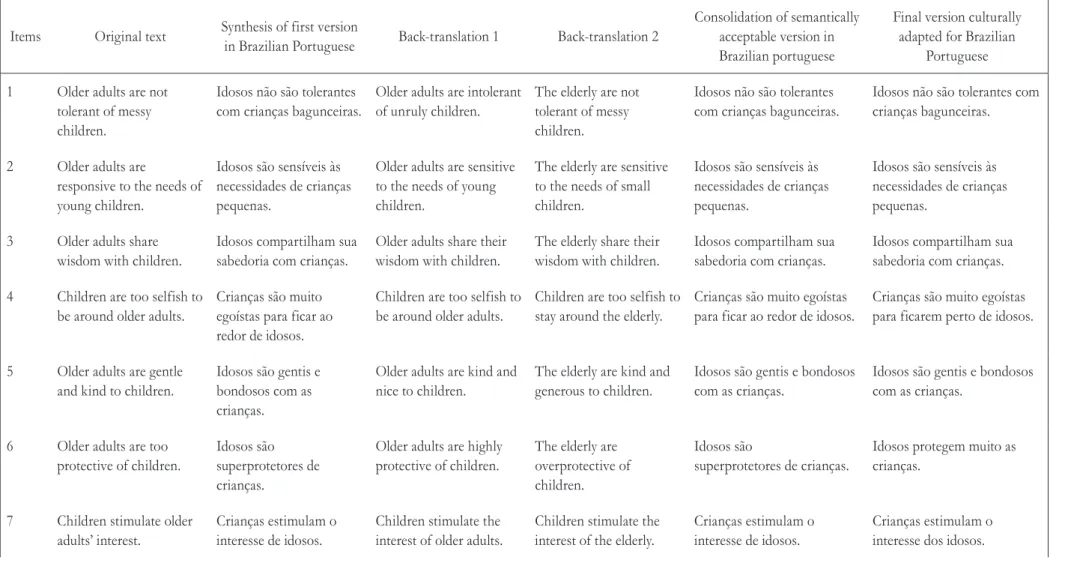
Continues on next page Table 1. Results of the progress of semantic and cultural validation of the Intergenerational Exchanges Attitude Scale (IEAS) for Brazilian Portuguese. Campinas, São Paulo, 2014.
Items Original text Synthesis of first version
in Brazilian Portuguese Back-translation 1 Back-translation 2
Consolidation of semantically acceptable version in Brazilian portuguese
Final version culturally adapted for Brazilian
Portuguese
1 Older adults are not
tolerant of messy children.
Idosos não são tolerantes com crianças bagunceiras.
Older adults are intolerant of unruly children.
The elderly are not tolerant of messy children.
Idosos não são tolerantes com crianças bagunceiras.
Idosos não são tolerantes com crianças bagunceiras.
2 Older adults are
responsive to the needs of young children.
Idosos são sensíveis às necessidades de crianças pequenas.
Older adults are sensitive to the needs of young children.
The elderly are sensitive to the needs of small children.
Idosos são sensíveis às necessidades de crianças pequenas.
Idosos são sensíveis às necessidades de crianças pequenas.
3 Older adults share
wisdom with children.
Idosos compartilham sua sabedoria com crianças.
Older adults share their wisdom with children.
The elderly share their wisdom with children.
Idosos compartilham sua sabedoria com crianças.
Idosos compartilham sua sabedoria com crianças.
4 Children are too selfish to
be around older adults.
Crianças são muito egoístas para ficar ao redor de idosos.
Children are too selfish to be around older adults.
Children are too selfish to stay around the elderly.
Crianças são muito egoístas para ficar ao redor de idosos.
Crianças são muito egoístas para ficarem perto de idosos.
5 Older adults are gentle
and kind to children.
Idosos são gentis e bondosos com as crianças.
Older adults are kind and nice to children.
The elderly are kind and generous to children.
Idosos são gentis e bondosos com as crianças.
Idosos são gentis e bondosos com as crianças.
6 Older adults are too
protective of children.
Idosos são superprotetores de crianças.
Older adults are highly protective of children.
The elderly are overprotective of children.
Idosos são
superprotetores de crianças.
Idosos protegem muito as crianças.
7 Children stimulate older
adults’ interest.
Crianças estimulam o interesse de idosos.
Children stimulate the interest of older adults.
Children stimulate the interest of the elderly.
Crianças estimulam o interesse de idosos.
45 8 r ev . B ra s . g er ia tr . g er On tO l ., r iO de J an eir O , 2 01 6; 1 9(3 ):4 53 -4 63
Continuation of Chart 1
Continues on next page
Items Original text Synthesis of first version
in Brazilian Portuguese Back-translation 1 Back-translation 2
Consolidation of semantically acceptable version in Brazilian portuguese
Final version culturally adapted for Brazilian
Portuguese
8 Children ask too many
questions to be around older adults.
Crianças fazem muitas perguntas para ficar por perto de idosos.
Children ask too many questions to be around older adults.
Children ask too many questions to remain around the elderly.
Crianças fazem muitas perguntas para ficarem por perto de idosos.
Crianças fazem muitas perguntas a fim de se aproximarem de idosos.
9 Older adults are too
lenient with children when they misbehave.
Idosos são tolerantes demais com crianças quando elas se comportam mal.
Older adults are over tolerant with children when they misbehave.
The elderly are far too tolerant of children when they behave badly.
Idosos são tolerantes demais com crianças quando elas se comportam mal.
Idosos são tolerantes demais quando crianças se comportam mal.
10 Children cheat older
adults at games.
Crianças trapaceiam os idosos nos jogos.
Children cheat older adults on games.
Children cheat when playing games with the elderly.
Crianças trapaceiam os idosos nos jogos.
Crianças trapaceiam os idosos nos jogos.
11 Older adults have
difficulty earning a child’s respect.
Idosos têm dificuldades em ganhar o respeito de uma criança.
Older adults find it hard to gain the respect of a child.
The elderly find it difficult to earn the respect of a child.
Idosos têm dificuldades em ganhar o respeito de uma criança.
Idosos têm dificuldade em conseguir o respeito de crianças.
12 Older adults and children
help each other.
Idosos e crianças ajudam uns aos outros.
Older adults and children help each other.
The elderly and children help each other out.
Idosos e crianças ajudam uns aos outros.
Idosos e crianças ajudam uns aos outros.
13 Older adults and children
have warm relationships.
Idosos e crianças têm relacionamentos afetuosos.
Older adults and children have affectionate relationships.
The elderly and children have affectionate relationships.
Idosos e crianças têm relacionamentos afetuosos.
Idosos e crianças se
relacionam de forma afetuosa.
14 Children feel insecure
around older adults.
Crianças sentem-se inseguras perto de idosos.
Children feel insecure around older adults.
Children feel insecure close to the elderly.
Crianças sentem-se inseguras perto de idosos.
Crianças se sentem inseguras perto de idosos.
15 Children think older
adults are boring.
Crianças acham que os idosos são chatos.
Children think older adults are boring.
Children think the elderly are boring.
Crianças acham que os idosos são chatos.
Se m an tic a nd c ult ura l e qu iva len ce o f t he I EA S 459
Continuation of Chart 1
Items Original text Synthesis of first version
in Brazilian Portuguese Back-translation 1 Back-translation 2
Consolidation of semantically acceptable version in Brazilian portuguese
Final version culturally adapted for Brazilian
Portuguese
16 Older adults enjoy
activities with children.
Idosos gostam de atividades com crianças.
Older adults enjoy activities involving children.
The elderly like to join in with children’s activities.
Idosos gostam de atividades com crianças.
Idosos gostam de atividades com crianças.
17 Children and older adults
naturally feel affection toward one another.
Crianças e idosos naturalmente sentem afeição uns pelos outros.
Children and older adults have a natural affection for each other.
Children and the elderly naturally feel affection for one another.
Crianças e idosos
naturalmente sentem afeição uns pelos outros.
Crianças e idosos sentem naturalmente afeto uns pelos outros.
18 Children and older adults
make good companions.
Crianças e idosos fazem boa parceria.
Children and older adults get along well together.
Children and the elderly make a good team.
Crianças e idosos fazem boa parceria.
Crianças e idosos são bons companheiros.
19 Children and older adults
have fun together.
Crianças e idosos se divertem juntos.
Children and older adults have fun together.
Children and the elderly have fun together.
Crianças e idosos se divertem juntos.
Crianças e idosos se divertem juntos.
20 Older adults get sick
around children.
Idosos ficam doentes perto de crianças.
Older adults fall ill around children.
The elderly get sick when close to children.
Idosos passam mal perto de crianças.
Idosos ficam nervosos quando estão perto de crianças.
21 Children think older
adults are ugly.
Crianças acham que os idosos são feios.
Children think older adults are ugly.
Children think the elderly are ugly.
Crianças acham que os idosos são feios.
Crianças acham que os idosos são feios.
22 Children are too active
for older adults.
Crianças são muito agitadas para os idosos.
Children are too agitated for older adults.
Children are too excitable for the elderly.
Crianças são muito agitadas para os idosos.
Crianças são muito agitadas para os idosos.
23 Older adults are too
frail to be around young children.
Idosos são muito frágeis para ficar por perto de crianças pequenas.
Older adults are too frail to be around young children.
The elderly are too frail to remain around small children.
Idosos são muito frágeis para ficarem por perto de crianças pequenas.
Idosos são muito frágeis para ficarem perto das crianças pequenas.
24 Children think older
adults are dumb.
Crianças acham os idosos bobos.
Children think older adults are silly.
Children think the elderly are stupid.
Crianças acham os idosos bobos.
Crianças acham que os idosos são bobos.
460 rev. Bras. geriatr. gerOntOl., riOde JaneirO, 2016; 19(3):453-463
The first version of the EATI consists of the synthesis, grouping and rejection of concepts and words used in the first two translations. The following divergent items and terms were identified, along with the concept chosen: 2) between responsáveis (responsive) and sensíveis (sensitive), sensiveis was chosen; 5) between amorosos (loving) and bondosos (kind), bondosos was chosen; 9) between complacentes (accomodating) and tolerantes (tolerant), tolerantes was chosen; 11) between ganhar (earn) and obter (obtain), obtain was chosen; 13) between caloroso (warm), cordias (cordial) and afetuoso (affectionate), afetuoso was chosen; 17) between afeição (affection) and afeto (affective), afeição was chosen; 18) between companheiros (companions) and parceria (team), team was chosen; 22) between ativas (active) and agitadas (excitable), agitadas was chosen.
With respect to the back-translations, it was noted that the expressions older adults and elderly have the same meaning as idoso or velho in Portuguese. Between idoso and velho, idoso was chosen, as in many contexts the word velho has a more negative connotation than the word idosos. Divergencies were identified in the text of nine items (1; 6; 9; 11; 16; 18; 20; 22; 24) by two independent back-translators. However, following joint analysis of these items, it was concluded that there was no semantic divergence, or in other words, the terms were equivalent.
Based on the suggestions of the committee of professionals, a number of alterations were made aimed at cultural refinement. The items which changed were: 4) ao redor (around) and perto (near) – perto was chosen; 6) superprotetores (overprotective) and protegem muito (highly protective) – protegem muito was chosen; 8) ficarem por perto (be around) and afim de se aproximarem (to want to get close to) – afim de se aproximarem was chosen; 11) ganhar (earn) and conseguir (obtain), conseguir was chosen; 13) tem relacionamentos afetuosos (have warm relationships) and se relacionam de forma afetuosa (relate affectionately) – se relacionam de forma afetuosa was chosen; 17) afeição (affection) and afeto (fondness) – afeto was chosen; 18) fazem boa parceria (form a good team) and são bons companheiros (are good companions) – sao bons companheiros was chosen; 20) passam mal (get sick) and ficam nervosos (get irritated) – ficam nervosos was chosen.
The professionals considered the EATI to be a general scale, with statements that depend on the context, profile, values and interests of the participants and professionals. Some professionals highlighted the following terms as biased/ prejudiced: item 4 (egoista - selfish); 14 (inseguras - insecure); and item 21 (feios - ugly). These items were not altered as it was considered that while it was possible to agree that such content is prejudiced, these are common terms in which many people refer to children and the elderly.
Following the suggestions of the professionals, a seven point Likert scale was adopted instead of the seven points of the original scale, in order to facilitate understanding of the respondents regarding the EATI measurements. As a result, the score could now range from 24 to 120 points. Higher scores indicate more positive attitudes towards intergenerational exchanges.
DISCUSSION
The equivalence of the EATI was indicated by the semantic and cultural assessments that were carried out in different stages, which enabled the translation and adaptation of the Brazilian version, entitled the Escala de Atitudes em relação a Trocas Intergeracionais (Scale of Attitudes in Relation to Intergenerational Exchanges - EATI).14
The cross-cultural adaptation evaluated and achieved the equivalence of the EATI in the following fields: semantic and idiomatic, corresponding to the same meaning of words and the use of expressions; conceptual, which verified the theoretical construct; cultural, which considered the situations presented in the scale; and in terms of criteria, which evaluated the normative interpretation of the items of the scale under study.19-21
Semantic and cultural equivalence of the IEAS 461
The negative attitudes in relation to the older adults referred to in the EATI express physical conditions, intolerance, ugliness and aspects of mood and personality, as exemplified in items: 1) Older adults are not tolerant of messy children; 21) Children think older adults are ugly; 23) Older adults are too frail to be around young children; and 24) Children think older adults are dumb. Recent bibilographic reviews published by Guerra & Caldas22 and by Spielman8 have shown that beliefs and negative attitudes towards older adults are associated with physical fatigue, decreased physical beauty, mental degeneration, disease, inactivity, disability, dependence and worthlessness.
A survey of 70 older adults conducted in Rio de Janeiro registered the presence of negative attitudes to old age. Through the free recall of test words, the elements of disease, prejudice, sadness, difficulty, abandonment, discrimination, loneliness, peevishness, exclusion, being oldfashioned and tired were used to refer directly or peripherally to older adults. On the other hand, in the same study, experience was invoked as a central element that characterized older adults and wisdom, love and dedication were also present.23
In the EATI, a positive attitude in relation to experience, knowledge and wisdom is present in item 3 ("Older adults share wisdom with children"). A study of 35 older adults from Kwahu-Tafo, in Gana, found wisdom, prudence, discipline and selflessness to be the main virtues of the elderly, as wisdom and life experience allow counseling in certain situations and problems. These characteristics also describe more positive attitudes toward aging.24
The positive attitudes described in the EATI (item 5 - “Older adults are gentle and kind with children”) are similar to data found in a study on this topic in Brazil. Research by Todaro1 with 248 children aged 7 to 10 years, submitted to post-test intervention, indicated more positive attitudes of children toward aging, especially in terms of social and personal relations, that is, being considered good-humored, accepting, valued, nice, friendly and generous. A more recent study in São Carlos in the state of São Paulo with 54 children aged
seven to ten years, found that they considered older adults “nice” and felt they were friendly and generous.25 A study in Italy of 32 older adults and 114 children identified that, after an intervention with intergenerational activities, the attitudes of children toward older adults were more positive, especially regarding functionality, considering them to be more active and stronger and in terms of social representations, seeing them as wiser, more friendly and respectful.26
Other EATI items also tend to express more positive attitudes, such as: 2) Older adults are responsive to the needs of small children and 6) Older adults protect children. Older people, particularly grandmothers, are seen as protectors of children, especially in terms of support and help when parents are absent. A study conducted in the United States with 124 grandparents confirmed these positive attitudes toward aging, especially in characteristics associated with attention, protection and also the concern that grandparents have for their grandchildren, especially in matters relating to custody, health and education.27
Regarding the positive attitudes towards the exchanges that occur between the elderly and children, Brazilian and international surveys have highlighted the idea that children and the elderly can interact and live together in a caring manner. A study in Tokyo, Japan, of older adults aged 71-101 years and children 5 and 6 years found that during and after taking part in culturally traditional activities practiced together, there were differences in the facial expression, involvement and behavior of the participants, who started to interact in a more affectionate way with smiles and constructive dialogue.17 A study by Lima,28 in the Serviço Social do Comércio (Commercial Social Services - SESC), with 42 participants, among them older adults, adults, adolescents and children, found that when cooperative interaction is maximized during intergenerational activities, participants tend to help each other towards common goals.
462 rev. Bras. geriatr. gerOntOl., riOde JaneirO, 2016; 19(3):453-463
adults enjoy activities with children; 17) Children and older adults naturally feel affection toward one another; 18) Children and older adults make good companions; 19) Children and older adults have fun together. Negative attitudes are described in the following attitudes of the EATI: 4) Children are too selfish to be around older adults; 8) Children ask too many questions to be around older adults; 10) Children cheat older adults at games; 11) Older adults have difficulty earning a child's respect; 15) Children think older adults are boring; 22) Children are too active for older adults. A study by Ferrigno,29 carried out at SESC São Paulo involving people aged from 10 to 68 years, identified the need for strategies to deal with certain conflicts, such as disrespect and intolerance. Reality must not be masked and conflict cannot be denied. Agreements should be encouraged and the flexibility of everyone involved sought. It is vital to stimulate a culture of solidarity through dialogue.29
The present study identified limitations, such as the scarcity of Brazilian literature on the subject, especially with regard to the perceptions of older people in relation to the younger generation. Finally, the need to investigate the validity of the EATI by correlating it with a consolidated equivalent instrument widely used in Brazilian Portuguese should be stressed. It is also necessary to carry out an assessment of the psychometric
properties of the instrument, so that the validation process can reflect such elements.
FINAL CONSIDERATIONS
It can be concluded that the Intergenerational Exchanges Attitude Scale (IEAS) has been adapted for the Brazilian population and entitled the Escala de Atitudes em relação a Trocas Intergeracionais (Scale of Attitudes in Relation to Intergenerational Exchanges) (EATI) after the semantic and cultural equivalence of the scale was carried out. However, there is still a lack of results in relation to the psychometric properties and other validation steps.
The EATI can be a useful tool for Geriatrics and Gerontology with regard to the awareness of perceptions of attitudes in relation to intergenerationality and the relationship between different generations. This instrument can be used in programs that feature activities among children and the elderly, as well as in the work of professionals who develop strategies of this type.
It is expected that the semantic and cultural equivalence of the EATI will foster new studies on attitudes relating to intergenerational exchanges, thus increasing scientific knowledge on this subject. Reflection and debate on intergenerational relationships offers an interesting opportunity to demystify old age and the aging process.
REFERENCES
1. Todaro MA. Desenvolvimento e avaliação de um programa de leitura visando à mudança de atitudes de crianças em relação a idosos [tese]. Campinas: Faculdade de Educação da Universidade Estadual de Campinas; 2008.
2. Gluth S, Ebner NC, Schmiedek F. Attitudes toward younger and older adults: the German aging semantic differential. Int J Behav Dev 2010;34(2):147-58.
3. Fonseca GG. Acercamiento cultural intergeneracional: propuestas desde la comunicación para la interrelación entre jóvenes y adultos mayores en Segovia [dissertação]. Espanha: Universidade de Valladolid; 2011.
4. Randler C, Vollmer C, Wilhelm D, Flessner M, Hummel E. Attitudes towards the elderly among german adolescents. Educ Gerontol 2014;40(3):1-9.
5. Neri AL, Cachioni M, Resende CM. Atitudes em relação à velhice. In: Freitas EV, Py L. Tratado de geriatria e gerontologia. Rio de Janeiro: Guanabara Koogan; 2002. 2002. p. 972-80.
Semantic and cultural equivalence of the IEAS 463
7. Neri AL. Idosos no Brasil: vivências, desafios e expectativas na terceira idade. São Paulo: Editora Perseu Abramo. 2007. Atitudes e preconceitos em relação à velhice; p.33-46
8. Spielman B. Elderly, social attitudes toward. In: Encyclopedia of Applied Ethics. 2nd ed. London: Elsevier; 2012 p. 56-62.
9. Suh S, Choi H, Lee C, Cha M, Jo I. Association between knowledge and attitude about aging and life satisfaction among older Koreans. Asian Nurs Res 2012;6:96-101.
10. Cachioni M, Aguilar LE. Crenças em relação à velhice entre alunos da graduação, funcionários e coordenadores-professores envolvidos com as demandas da velhice em universidades brasileiras. Rev Kairós 2008;11(2):95-119.
11. Neves CFO. Estereótipos sobre idosos: representação social em profissionais que trabalham com a terceira idade [dissertação]. Covilhã: Universidade da Beira Interior; 2012.
12. Neri AL. Atitudes em relação à velhice: evidências de pesquisa no Brasil. Gerontologia 1997;5(3):130-9.
13. Neri AL. Envelhecer num país de jovens: significados de velho e velhice segundo brasileiros não idosos. Campinas: UNICAMP;1991.
14. Stremmel AJ, Travis SS, Kelly-Harrison P. Development of the Intergenerational Exchanges Attitude Scale. Educ Gerontol 1996;22(4):317-28.
15. Travis SS, Stremmel AJ, Kelly-Harrison P. Attitudes toward intergenerational exchanges among administrators in child and adult day care centers. Educ Gerontol1997;23(8):775-87.
16. Jarrot SE, Morris MM, Burnett AJ, Stauffer D, Stremmel A, Gigliotti CM. Creating Community capacity at a shared site intergenerational program: “Like a Barefoot Climb Up a Mountain”. J Intergener Relationsh 2011;9(4):418-34.
17. Morita K, Kobayashi M. Interactive programs with preschool children bring smiles and conversation to older adults: time-sampling study. BMC Geriatr 2013;13(11):1-9.
18. Murayama Y, Fujiwara Y, Yasunaga M, Takeuchi R, Nonaka K, Yajima S, et al. Development of a japanese version of the Intergenerational Exchanges Behavior Scale. J Jpn Soc Intergener Stud 2011;1(1):27-37.
19. Beaton DE, Bombardier C, Guillemin F, Ferraz MB. Guidelines for the process of cross-cultural adaptation of self-report measures. Spine 2000; 25(24):3186-91.
20. Viana HB. Adaptação e validação da escala ASKAS: aging sexual knowledge and atitudes scale em idosos brasileiros [tese]. Campinas: Universidade Estadual de Campinas, Faculdade de Educação Física; 2008.
21. Almeida ST. Tradução, adaptação cultural e validação da versão em português do Brasil do Selection, Optimization and Compensation Questionnaire (SOCQ) para uso entre idosos sedentários e atletas master [tese]. Porto Alegre: Pontifícia Universidade Católica do Rio Grande do Sul, Instituto de Geriatria e Gerontologia; 2013.
22. Guerra ACLC, Caldas CP. Dificuldades e recompensas no processo de envelhecimento: a percepção do sujeito idoso. Ciênc Saúde Coletiva 2010;15(6):2931-40.
23. Dos Santos VB, Tura LFR, Arruda AMS. As representações sociais de “pessoa velha” construídas por idosos. Saúde Soc 2013;22(1):138-47.
24. Van der Geest S. Grandparents and Grandchildren in Kwahu, Ghana: The Performance Of Respect. Africa 2004;74(1):47-61.
25. Luchesi BM, Dupas G, Pavarini S. Avaliação da atitude de crianças que convivem com idosos em relação à velhice. Rev Gaúcha Enferm 2012;33(4):33-40.
26. Gaggioli A, Morganti L, Bonfiglio S, Scaratti C, Cipresso P, Serino S,et aç. Intergenerational Group Reminiscence: a potentially effective intervention to enhance elderly psychosocial wellbeing and to improve children's perception of aging. Educ Gerontol 2014;40(7):486-98.
27. McGowen MR, Ladd L, Strom RD. On-line assessment of grandmother experience in Raising Grandchildren. Educ Gerontol 2006;32:669-84.
28. Lima CR. Programas Intergeracionais: um estudo sobre as atividades que aproximam as diversas gerações [dissertação]. Campinas: Universidade Estadual de Campinas, Faculdade de Educação; 2007.
29. Ferrigno JC. O conflito de gerações: atividades culturais e de lazer como estratégia de superação com vistas à construção de uma cultura intergeracional solidária [tese]. São Paulo: Universidade de São Paulo, Instituto de Psicologia; 2009.