Relection 963
-963
THE INTERVIEW: FOUNDATIONS OF HERMENEUTICS AND
PSYCHOANALYSIS
Carlos Augusto Monguilhott Remor1, Lourdes de Costa Remor2
1 Ph.D. in Production Engineering. Associate Professor I of the Department of Psychology, Federal University of Santa Catarina
(UFSC). Santa Catarina, Brazil. E-mail: [email protected]
2 Ph.D. in Engineering and Knowledge Management. Employee with the Santa Catarina State Health Department. Santa
Catarina, Brazil. E-mail: [email protected]
ABSTRACT: This study presents a relection regarding a methodology of construction and analysis of interview, based on both the
hermeneutics of Habermas and Thompson and on Freud-Lacanian psychoanalysis. From the conjunction and disjunction of hermeneutics to psychoanalysis, the authors aimed to build a foundation from the deconstruction of interviews and their analysis, showing that it is possible to apply these theories. The results obtained with the practical application of hermeneutics and psychoanalysis in the study were different than initially expected. The convergence of concepts was evidenced, although the authors used different terms. Even the colloquial language, when broadened by the interpretation of the authors, showed that the speeches were supported by the technical referential. The results exceeded expectation, demonstrating the feasibility of the application of these foundations in studies of this nature.
DESCRIPTORS: Interviews. Methodology. Psychoanalysis. Interpretation.
A ENTREVISTA: FUNDAMENTOS DA HERMENÊUTICA E DA
PSICANÁLISE
RESUMO: Este trabalho apresenta uma relexão acerca de uma metodologia de construção e análise de entrevista, baseada, por um
lado, na hermenêutica de Habermas e Thompson e, por outro, na psicanálise freudo-lacaniana. A partir da conjunção e disjunção da hermenêutica com a psicanálise, procurou-se construir uma fundamentação da elaboração de entrevistas e de sua análise, em que se seja possível aplicar tais teorias. Os resultados obtidos com a aplicação prática da hermenêutica e da psicanálise, numa pesquisa, foram diferentes do que, inicialmente, se pensava encontrar. Foi constatada a convergência dos conceitos, ainda que os pesquisados utilizassem diferentes termos. Mesmo a linguagem coloquial, quando aprofundada pela interpretação dos autores, mostrou que as falas estavam sustentadas no referencial técnico. Os resultados ultrapassaram os objetivos, indicando ser viável a aplicação desses fundamentos em pesquisa dessa natureza.
DESCRITORES: Entrevista. Metodologia. Psicanálise. Interpretação.
LA ENTREVISTA: FUNDAMENTOS DE LA HERMENÉUTICA Y DEL
PSICOANÁLISIS
RESUMEN: El actual trabajo presenta una relexión sobre la metodología de la construcción y análisis de la entrevista, basada, por
una parte en la hermenéutica de Habermas y de Thompson y por parte, en el psicoanálisis freudo-lacaniano. De la conjunción y de la disjunción de la hermenéutica con el psicoanálisis, procurase construir una fundamentación de la elaboración de entrevistas y de su análisis donde sea posible aplicar tales teorías. Los resultados logrados con el uso práctico de la hermenéutica y del psicoanálisis en una pesquisa habían sido diferentes de lo que, inicialmente, se había pensado encontrar en la investigación, excediendo los objetivos establecidos previamente
INTRODUCTION
This article is the result of two doctoral stud-ies from the Federal University of Santa Catarina. One speciically regards the theory of interpreta-tion in psychoanalysis and hermeneutics, whereas the other applied aspects of depth hermeneutics1
and the hermeneutics of a statement,2 as well as
some foundations of Freud-Lacanian psychoanaly-sis to support the study method. The irst study3
provided the theoretical support, while the second4
aimed at applying it in practice, with the criteria as pillars of the method.
The irst study presents the trajectory of in-terpretation from its pillars in hermeneutics, high-lighting its journey as a concept of psychoanalysis, which began with the search for meanings, up to and including its current attempt to reach true Lacanian meaning through the intervention intro-duced by Lacan called ‘forçage’, which no longer
implicates the relevance of meaning.3
The second study presents a usage proposal of an auditing report in the support of health man-agement, so that this report could instrumentalize the decision-making process. The auditing process in the SHS in Santa Catarina was used as an exam-ple. Based on the characteristics and the concept of the service, it was concluded that auditing cannot be standardized, considering that its main object is not standardized either. This journey was sup-ported by the adapted method, used in question-ing durquestion-ing the interview and data analysis of the study, which agrees with its functions of listening and interpretation by the auditor. 4
The study that applied the theory in practice utilized the interview. Since there was no model for this format, the authors aimed to adapt the relationships of a statement2 to the steps of depth
hermeneutics,1 in addition to some interpretation
procedures of Freud-Lacanian psychoanalysis. Depth hermeneutics provides a methodological opening in which “the researcher may analyze the social-historical and space-temporal context that surrounds the studied phenomenon, in addition to undertaking analyses of discourse, content, semiotics or any formal standard that may be necessary”.5:87
Hermeneutics and psychoanalysis are gen-erally not grouped together since their directions are different. “Hermeneutics starts from the fact that every object ield of study is always also a subject-ield, because there is an appropriation of this ield in the sociocultural coniguration of the
subjectivity”.6:175 In general terms, hermeneutics is
based on the principle that there is truth in the text to be found through interpretation, whereas psy-choanalysis, despite seeking to interpret as well, considers this truth to be only an attribution of the subject. Using two theories that take different directions, the authors aimed to build a foundation for the elaboration of interviews and their analysis, one in which it would be possible to apply aspects of both theories. Based on this concept, the study in which the interview was applied used as its method of analysis and elaboration an interpre-tation based on foundations of hermeneutics and psychoanalysis, ultimately demonstrating results that exceeded the previously established goals.
The authors contextualized here the inter-pretation from the point of view of hermeneutics and Freud-Lacanian psychoanalysis and used the descriptive method as their methodological procedure in the construction of this article, aimed at showing that this theoretical procedure may change practice. The descriptive study supposes that its results must promote practice changes.7
The intention was to show that the journey of a study is the most important, since it may lead to results that were not expected previously. It has a personal order, which resides in the expectation of the researcher. It may not agree with what is believed in the studied ield or in the objective reality. The application of hermeneutics and psychoanalysis in the foundation of the elabora-tion and applicaelabora-tion of the interview, and in the analysis of the data obtained from it, made the difference between what was expected and what was achieved.
HERMENEUTICS
The term hermeneutics, from the Greek word
hermeneuein, refers to a theory or philosophy of
interpretation, making it possible to understand the study object far beyond its simple supericial appearance. The Greek word hermeios derives
from the god Hermes who, in Greek mythol-ogy, was the discoverer of language and writing. Hermes discovered the object used to represent human comprehension, to achieve the meaning of things and transmit it these meanings to one another. The term “hermetic” comes from Hermes and means something hidden or inaccessible.8
Hermes performed a function of transmutation in representation: transforming what humans did not understand into something that could be understood through comprehension capability.3
As a methodology, this interpretation is ap-plicable to areas as diverse as history, religion, art, psychology, language studies and psychoanalysis, among others. Its long journey dates back to the efforts of the Greeks to understand their poets, up until the exegesis of the sacred scriptures that required more systematized interpretation, given their eminently metaphorical character. Besides these examples, dream interpretation in ancient times, such as the well-known interpretation of Pharaoh’s dream that originated the saying regarding “fat cows and lean cows” designating times of abundance and times of scarcity, are another example. In current times this methodol-ogy involves multiple senses and areas, such as psychoanalysis and hermeneutics.9
Currently, interpretation in its broad mean-ing is used in all ields of human knowledge, since it is an integrating part of language. It is common in colloquial language for divergences to be expressed by sentences similar to the state-ment that says it is a “question of interpretation”. It does not seem that it can really be absent from
the lived experience, since there is some compre-hension when it is contextualized; in other words, when in a text which implicates reading and, thus, interpretation.4
The German philosopher Hans-Georg Ga-damer (born in 1900) stated in Truth and Method that interpretation, before becoming a method, was the expression of a human situation: the in-terpreter who approaches a work is already situ-ated in the horizon opened by it. Interpretation is, primarily, the elucidation of the relationship between the interpreter and the tradition from which the interpreted object proceeds.10
Similar to Freud in his studies regarding dreams, in which interpretation aimed to reveal their meaning, hermeneutics also aims at reveal-ing, discovering and perceiving the deepest mean-ing of what is presented, in a rough way, in the manifested reality. Its search points out a hidden unmanifested meaning within a text. Therefore, hermeneutics could comprise a study method or tool through which it is possible to really know the human being and the reality in which he lives, as well as his story and his own existence.3
Depth hermeneutics is described as a meth-odological referential for the analysis of symbolic forms. It is described as a referential that evi-dences the fact that the object being analyzed is a signiicant symbolic construction that requires interpretation.1
PSYCHOANALYSIS
Based on his clinical practice involving listening to patients, Freud was the father of psy-choanalysis, aiming to understand/interpret their complaints, symptoms, inhibitions and anxieties.
It is possible to state that psychoanalysis is a theory that emerged from a practice that broke apart from psychiatry, the neurology of the XIX century and, in general terms, the science of that time. It separated itself from the constituted knowledge and has become something stable since its inception. The third great narcissistic wound suffered by western knowledge, through the decentering of knowledge and the conscious mind, as it were, was included in the midst of those wounding pieces of knowledge of human vanity: the planet was no longer the center of creation (as shown by Copernicus), and human beings were close relatives of monkeys (Darwin).11 As for the
The object of psychoanalysis may be divided into two great axes, one of sexuality and the other of the unconscious. So-called sexual curiosity is known by all, which instigates a search for a piece of knowledge linked to an object, or a piece of knowledge regarding the object. They exist side by side in the unconscious without inluencing each other, exempt from contradiction. There is also no place in it for denial, doubts or uncertain-ties. Nothing is past or forgotten. The processes in this system are timeless, do not alter over time and have no reference to time.13
The term “unconscious” preceded Freud. Nevertheless, the use of the same word, in differ-ent contexts, does not indicate that they mean the same thing. They may be incompatible, or even opposites, in different contexts. Such is the case with this term, which became the registered mark of psychoanalysis. The Freudian unconscious has no relationship to the “unconscious” before it.14
HERMENEUTICS AND
PSYCHOANALY-SIS AS FOUNDATIONS FOR THE
ELABO-RATION OF INTERVIEW QUESTIONS
The art of text comprehension inds a foun-dation in the theory of Habermas2, according to
whom “the epistemology is engaged in the rela-tionship between language and reality, whereas the hermeneutics has to be engaged, at the same time, in the triple relationship of a statement that works: as expression of a speaker’s inten-tion; as expression for the establishment of an interpersonal relationship between speaker and listener; as expression regarding something in the world”.2:40-41
Furthermore, it refers to a fourth possibility, “the relationship between a given statement and all other possible statements, in other words a text, is not understood if the reasons the author could have mentioned are not clear”.2:40-41
This understanding of the triple relation-ship of a statement expresses the idea that the researchers require this comprehension to lead the interviews. The interviews may be applied from an outline of questions with the least amount of structure, consisting of open-ended questions so that the interviewee’s freedom is strengthened and, consequently, the interviewer may redirect subsequent questions. The interviews cannot be structured because they would have to be based on a previous piece of knowledge that has not yet
been obtained and will only be uncovered through this method, whose characteristic is necessarily uncertain.
This apparent bias is purposeful and is tended to collect from the interviewee as much in-formation as possible, with the minimum amount of organization. It is the interpreter’s role to later organize the raw data diluted in the discourse of the interviewees in order to allow some compre-hension.
This way of proceeding is not new and has its epistemic base in teachings from philosophy to psychology. Lacan says that in the place of the
docta ignorantia, which since Socrates has gone
through Nicholas of Cusa and Montaigne, restat-ing “all I know is that I know nothrestat-ing.”15 This
uncertainty is based on the platonic foundation of learned ignorance, which is the acknowledgement of not knowing. This status of not knowing is the starting point, but is not necessarily the destina-tion. The point is to create questions based on this state of unknowing. Based on this, it is necessary to consider that it is not known, and it is not pos-sible to know, what the best question to ask is. This is the reason why the questionnaire must be as unstructured as possible.
In this light, it is possible to conclude that the desire to know the right question to ask is in agreement with the possibility of believing that one knows what the best answer is or, minimally, hopes for a more speciic answer – which, under this circumstance, would be a bias.
However, this is not to say that the questions of the interviews do not have their place because the corresponding answers are not known. The answer is always an interpretation of the reality, mediated by the interviewer’s question. The in-terviewee has an interpretation of the reality; the interviewer has his own. When the interviewer asks a question of the interviewee, what matters most is that the interpretation of the interviewer interferes as little as possible with the answer of the interviewee.4
According to these characteristics of the hermeneutic method, it is not necessary to engage in a pilot interview. The pilot interview would be performed for the purpose of adjusting questions and that goes, again, towards structuring the questionnaire, which is contrary to this method.4
criticized by Habermas, as there is no possibility of neutrality in the language.2
From this perspective, the way of conceiving the world is the way of putting it into words or, in other words, representing it. If words build fact, this depends on the linguistic horizon of the speaker. The way it is described is the construction.4
HERMENEUTICS AND
PSYCHOANALY-SIS AS ANALYPSYCHOANALY-SIS FOUNDATIONS
In addition to what has been mentioned by the interviewee, other possibilities that the speech offers but which have not been stated also matter in data analysis– such as what is known as latent or subjective content.
Considering what is expressed explicitly, it is easy to reach an understanding in a more direct way, unless this explicit speech implies something else. Therefore, the explicit is almost synonymous with the objective; on the other hand, what is implicit, alluded to, metaphorized or connotative tends to be seen as subjective.4
Subjectivity is often understood as some-thing mystical, deep, esoteric, obscure, and/or hermetic. The task of the method based on herme-neutics aims to seek out the alluded to, referred or connoted, in order to reach what becomes the objectiied.4 This is the reason why it is important
to perform the interview, because only through speech it is possible to express this enormous range of meanings that remain inhibited, unsaid or even restricted in written discourse – this can-not be expected to appear through the use of questionnaires.
Speaking and writing do not share the same structure. Their effects and range also differ. This fact is mentioned in literature by the character of Mário de Andrade, in Macunaíma, when he cites
in the Letter to the Icamiabas that “on this land, people write in a language and speak in a differ-ent one”.16:66
Languages are expressive forms that allow some access to reality, as a mediator and as a rep-resentative. Speech is text, and comprehension is reading. From the written word it is possible to read, which allows interpretation to take place. At the same time a word relates subject to object, it also separates them. Reading is capable of mediat-ing between subject and object.4
In order to proceed to data analysis, based on the theories of hermeneutics and the
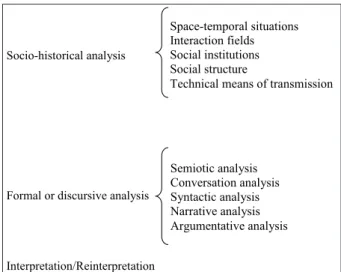
Freud-Lacanian psychoanalysis, it is possible to use some methodological steps of Depth Hermeneutics, whose forms are divided into Socio-historical, Formal or Discursive Analysis and regard Inter-pretation and Re-InterInter-pretation, indicated as ways to analyze the study data using the theory of a statement of Habermas2 and aspects of
psycho-analysis that were not found in any other authors. It is an inevitable human characteristic to try to understand all the time. Therefore, in psy-choanalysis it is common to refer to the self as a “machine for making sense”. This psychic entity cannot withstand experiencing anything that does not provide the possibility of attributing some sense and, therefore, feeling more comfortable and believing itself to be the owner of the situation.
In social research there is a potential feed-back, since a study may affect the studied condi-tions. However, Thompson claims that this is not an undesirable problem, but instead offers the possibility of knowing the socio-historical scope, since human beings are part of the history and not mere observers.3:359-360
The hermeneutics theory of Habermas, despite not providing methodological steps that facilitate its application, allows adaptation of the methodological steps of the depth hermeneutics referential, which consists of socio-historical, for-mal or discursive analysis, as presented in igure 1:
Socio-historical analysis
Formal or discursive analysis
Interpretation/Reinterpretation
Space-temporal situations Interaction fields Social institutions Social structure
Technical means of transmission
Semiotic analysis Conversation analysis Syntactic analysis Narrative analysis Argumentative analysis
Figure 1 - Referential model of the depth
hermeneutics3
performed when the relationship that every sub-ject had or has to the theme inluences the meaning construction.
The semiotic analysis searches for the mean-ing of each concept for each subject. It is seen as “the study of the relationships between the ele-ments that compose the symbolic form, or sign, and the relationships between its elements and those of the broader system to which the symbolic part, or sign, may be part (...) however, this type of analysis is, at best, a partial focus for the study of the symbolic forms. It is irst interested in the internal constitution of the symbolic forms, with its distinctive elements and interrelationships”.1:370-371
Still regarding the symbolic matter, the con-versation analysis refers that “the methodological or key principle of conversation analysis is study-ing instances of the lstudy-inguistic interaction in the concrete situations in which they occur, and pay-ing close attention to the way they are organized, highlighting some of the systematic or ‘structural’ characteristics of the linguistic interaction”.1:372
The syntactic analysis mostly agrees with the rhetorical analysis. Rhetorical igures also agree in large part with the syntax structures. Thus, “this type of analysis concerns the practical syntax or the practical grammar – not the grammar of the grammarians, but the grammar or syntax that acts in the everyday discourse”.1:372 Colloquialism
supports this fact.
The narrative analysis “may be considered, in general terms, to be a discourse that narrates a sequence of events”.1:373 It concerns the telling of
a story, presenting the place that each interviewer has in the context of the studied object and show-ing the way each of them expresses themselves.
The argumentative analysis, the last phase of the formal or discursive analysis, shows the deductive standards that the subject generally uses in this discourse. It concerns the suggested aspects, those that are not expressly stated. They are “discourse forms, as linguistic supra proposi-tional constructions that may comprise thinking chains that may be reconstructed in several ways. These thinking chains are generally not actual valid arguments, in the traditional meaning of formal or syllogistic logic; they are, irst of all, built as inference standards that lead from one theme or topic to another, in a more or less convincing, more or less implicit way”.1:374
In the speeches or in the discourses, the quality of the argument is a fundamental point
of analysis. Important questions to be raised by the argumentative analysis are whether it was supported adequately and allowed people to be persuaded.
The description of the interviewee’s speeches is the irst interpretation, made by the interviewer. At a second stage, the analysis of this description is a reinterpretation, indicating that “the methods of the discursive analysis proceed through the analysis; they break, divide, deconstruct, and try to reveal the standards and effects that constitute and operate within a symbolic or discursive symbolic. Interpretation is build upon this analysis, as well as upon the results of the socio-historical analysis. However, the interpretation involves a new way of thinking, developed through synthesis, through the creative construction of possible meanings. (...) as strict and systematic as the methods of the formal or discursive analysis may be, they cannot eradicate the need for the creative construction of the meaning; that is, an interpretative explanation of what is represented or said. (...) located within the referential of the depth hermeneutics, the inter-pretation process may be mediated by the methods of the socio-historical analysis, as well as by the methods of the formal or discursive analysis”.1:375
Once the interviews were concluded, it was possible to proceed to data analysis, presenting the descriptions of the speeches. Some categories that are considered to be relevant for reinterpretation are then selected.
The analysis is performed, using aspects of hermeneutics, not only as meaning interpretation but also aimed at its deconstruction through psy-choanalysis. Hermeneutics aims at the search for meaning, whereas psychoanalysis seeks its decon-struction. These two theoretical axes, despite being opposites, provide a foundation for the intended interpretations. In order to deconstruct a meaning, it is irst necessary to seek it.
This approach using both hermeneutics and psychoanalysis, despite representing a paradox, can be used as an instrument to broaden the analy-sis of speeches. It aims at appropriating what has been found without being actively searched for; in other words, it does not concern what has been previously searched for, since then it would be considered as something pre-conceptualized. It is based on the famous quote taken by Lacan, from Picasso: “I do not search, I found”.17:149
The answers serve as a base for the construc-tion and creaconstruc-tion of other quesconstruc-tions. Its funcconstruc-tion is to open the possibility for the interviewee to express his/her opinion on the theme, rather than giving a strictly factual answer. This form of interview follows the fundamental principle of psychoanalysis, in which interviews are necessar-ily non-directional. This absence of focus is useful for research, as it allows the theme orientation to be decided by the experiences of the interviewees, rather than by the interviewer’s will.
FINAL CONSIDERATIONS
Hermeneutics, with the help of psychoanaly-sis, has allowed a clearer form of comprehension regarding interview results that until now have been treated based on the quantitative approach. These results provide direction and new variables, even if individual, allowing for a greater range of comprehension. These points that can be analyzed neither in questionnaires nor in closed interviews bring forth important questions that have not been considered by the researchers.
Although the quantitative question is important, this conjunction and disjunction of hermeneutics and psychoanalysis may ill this gap, regarding both the understanding and accuracy of qualitative questions obtained through interviews that are characteristic of any text.
The use of interviews in research, under this perspective, allows the interpretation of the material provided by the interviewees, either towards a convergence of the same meaning or in the opposite direction, differently from what happens in the use of a questionnaire or any other instrument of written registration. In the case of the study that used the interview, this procedure allowed many terms used in the answers to be understood as designating the same meanings, which signiicantly modiied the study results. It is also easy to conclude that the opposite may happen, since the same term used in different
situations can often connote very distinct, or even opposite, meanings.
The conirmation of the results of the second study mentioned in this article was provided by the use of interpretation through hermeneutics and psychoanalysis, as well as the interview shaped by these methods. An instrument in which the data would be obtained only through the writ-ten record would not allow the same results.
The interview, in the collection of data in a study, was considered to be fundamental to show a distorted situation, which provided a different idea from what actually occurred. Initially, the in-terviewer understood that the interviewees did not differentiate between certain concepts of the object theme of the study. Nevertheless, the analysis of the interviews allowed this idea to change, since this impression was only related to the effects of colloquialism in everyday speech. The situation allowed by the interview process could search out colloquialism in order to interpret it and conclude that the terms used, despite being different on the surface, converged in the same direction.
Finally, the results obtained through inter-views with the practical application of hermeneu-tics and psychoanalysis were different than what was initially expected. The careful interpretation of each datum, from the objective, subjective, stated or unstated statements characterized the richness of the study and its results.
REFERENCES
1. Thompson JB. Ideologia e cultura moderna: teoria crítica na era dos meios de comunicação de massa. 7ª ed. Rio de Janeiro (RJ): Vozes; 2007.
2. Habermas J.Consciência moral e agir comunicativo.
Rio de Janeiro (RJ): Tempo Brasileiro; 2003.
3. Remor CAM. Da hermenêutica à psicanálise [tese]. Florianópolis (SC): Universidade Federal de Santa Catarina, Programa de Pós-Graduação em Engenharia de Produção; 2002.
4. Remor LC. Auditoria de conhecimento em saúde [tese]. Florianópolis (SC): Universidade Federal de Santa Catarina, Programa de Pós-Graduação em Engenharia e Gestão do Conhecimento; 2009. 5. Veronese MV, Guareschi PA. Hermenêutica de
profundidade na pesquisa social. Ciências Sociais Unisinos. 2006; 42(2):85-93.
6. Junges JR. O nascimento da bioética e a constituição do biopoder. Acta Bioeth. 2011; 17(2):171-8.
8. Gaarder J. O mundo de Sofia. São Paulo (SP): Companhia das Letras; 1995.
9. Freud S. A interpretação dos sonhos. In: Obras completas. IV. Rio de Janeiro (RJ): Imago; 1976. 10. Gadamer, HG. Verdade e método: traços
fundamentais de uma hermenêutica filosófica. Petrópolis (RJ): Vozes; 1997.
11. Freud S. Uma diiculdade no caminho da psicanálise. In: Obras completas XVII. Rio de Janeiro (RJ): Imago; 1976.
12. Harari R. Psicoanálisis in-mundo. Buenos Aires (AG): Kargieman; 1994.
13. Freud S. O inconsciente. In: Obras completas. XIV. Rio de Janeiro (RJ): Imago, 1976.
14. Lacan J. Seminário 11: os quatro conceitos fundamentais da psicanálise. Rio de Janeiro (RJ): Jorge Zahar, 1985.
15. Lacan J. Seminário 19: ...ou pire. In: Lacan 2000. [CD-ROM]. Buenos Aires (AG): R.D. Ediciones Electrónicas; 2000. Inédito [Publicação para circulação interna].
16. Andrade M. O herói sem nenhum caráter. 21ª ed. Belo Horizonte (MG): Itatiaia, 1985.
17. Lacan J. Seminário 7: a ética da psicanálise. Rio de Janeiro (RJ): Jorge Zahar, 1988.
Correspondence: Carlos Augusto Monguilhott Remor Rua Presidente Coutinho, 212, ap. 101
88015-230 – Centro, Florianópolis, SC, Brasil E-mail: [email protected]