- 800 - Original Article
SPATIAL ANALYSIS OF THE INDICATORS AGREED FOR SCREENING
CERVIX CANCER IN BRAZIL
Raíla de Souza Santos1, Enirtes Caetano Prates Melo2, Keitt Martins Santos3
1 Nurse. PIBIC/CNPq Colleger of the Universidade Federal do Estado do Rio de Janeiro (UNIRIO). Rio de Janeiro, Brazil. E-mail: [email protected]
2 Doctor in Sciences. Adjunct Professor IV in the Department of Nursing and Public Health at the Nursing School Alfredo Pinto (EEAP) of the UNIRIO. Rio de Janeiro, Brazil. E-mail: [email protected]
3 Master´s degree student at the Nursing Post Graduation Program of the EEAP/UNIRIO. Rio de Janeiro, Brazil. E-mail: [email protected]
ABSTRACT: Although cervix cancer is a highly preventable and curable disease, it shows high mortality rate in the country. The study analyzes the spatial distribution of the indicators agreed for cervix cancer, in Brazil, between 2006 and 2009. Ecological study that used data from the Information System of Cervical Cancer and the Information System on Mortality. Although structured and with indicators improvement, the program is still below the targets agreed in some States, forming an uneven pattern of indicators performance, in the country. Regional differences showed some failures on women screening, population coverage, quality of cytologic samples and mortality rate stability. States that are below the targets agreed need to optimize resources and provide access to the women who are not included in the screening program.
DESCRIPTORS: Uterine neoplasm. Health basic indicators. Public health nursing.
ANÁLISE ESPACIAL DOS INDICADORES PACTUADOS PARA O
RASTREAMENTO DO CÂNCER DO COLO DO ÚTERO NO BRASIL
RESUMO: O câncer do colo do útero, embora seja uma doença curável e altamente previsível, apresenta elevado índice de mortalidade no país. Teve como objetivo analisar a distribuição espacial dos indicadores pactuados para o câncer do colo do útero no Brasil, no período de 2006 a 2009. Estudo ecológico que utilizou dados do Sistema de Informação do Câncer do Colo do Útero e Sistema de Informação sobre Mortalidade. Apesar de estruturado e com melhoras nos indicadores, o programa ainda se encontra abaixo das metas pactuadas em alguns Estados, conigurando um padrão desigual de desempenho dos indicadores no território brasileiro. As diferenças regionais mostraram falhas na captação de mulheres, na cobertura populacional, na qualidade das amostras do exame citológico e estabilidade da taxa de mortalidade. Estados que se encontram abaixo das metas pactuadas precisam otimizar os recursos e promover acesso às mulheres que não estão inseridas no programa de rastreamento.
DESCRITORES: Neoplasias uterinas. Indicadores básicos de saúde. Enfermagem em saúde pública.
EL ANÁLISIS ESPACIAL DE LOS INDICADORES ACORDADOS PARA
DETECCIÓN DE CÁNCER DE CUELLO UTERINO EN BRASIL
RESUMEN: El cáncer de cuello de útero, a pesar de ser una enfermedad altamente prevenible y curable, presenta alta tasa de mortalidad en el país. Este estudio tuvo como objetivo analizar la distribución espacial de los indicadores acordados para el cáncer del cuello de útero en Brasil entre 2006 y 2009. Estudio ecológico que utilizó datos de Sistema de Información del Cáncer de Cuello de Útero y Sistema de Información sobre la Mortalidad. Se considera que, si bien estructurado y con mejoras en los indicadores, el programa está todavía bajo las metas acordadas en algunos estados, que forman un patrón irregular de los indicadores de resultados en Brasil. Las diferencias regionales mostraron fallas en la detección, la cobertura de la población, la calidad de las muestras citológicas y la estabilidad en la tasa de mortalidad. Los Estados que están bajo las metas acordadas necesitan optimizar recursos y facilitar el acceso a las mujeres que no están incluidas en el programa de rastreamiento.
INTRODUCTION
Cancer is a leading cause of morbidity and mortality worldwide, registering annu-ally, around 10 million new cases and 6 million deaths.1 In Brazil, it is among the leading causes of death in all macro-regions, together with circulatory system disease, external causes, perinatal and infectious diseases. Two indicators characterize it as a public health problem in the
country: irst, the gradual increase of incidence
and mortality by cancer in proportion to the demographic growth and socioeconomic devel-opment, and second, the challenge it poses to the health system, especially to ensure people’s access to diagnosis and treatment.
The cervix cancer has approximately 500.000 new cases per year worldwide and cor-responds to about 15% of all female cancers. It is the second most common type among women, being responsible for the death of about 230.000 women per year.1 It is the third leading cause of cancer death in women, in Brazil, and the most common type in some less developed areas of the country. It is concentrated mainly in the group of women over 35 years old.2 Different from what happens in developed countries, where mortal-ity from cervical cancer has decreased, it still represents a major cause of death in the female population of the poorest countries.3 The risk factors are closely related to women´s daily life with low economic status, and the big number of
cases can be attributed to the lack or deiciency
of preventive actions because the implementa-tion of an effective screening program remains a challenge.4
Cervix cancer presents a great potential for prevention and cure due to its slow evolution that goes through detectable and curable phases,¹ but some problems in the performance of the screen-ing program undermine the achievement of the proposed goal.4
In Brazil, the Ministry of Health recom-mends the Pap test as screening strategy. The
irst two tests should be performed annually, and
later, after two consecutive negative results, every three years. Screening is recommended from the age of 25 for women with active sexual life, and until 64 years old. After this age, it is interrupted when women had at least two consecutive
nega-tive tests over the past ive years.5 It is estimated to achieve a reduction of 80% on cervix cancer mortality, through the screening of women who
are part of the highest risk group. So, it is neces-sary to ensure comprehensive care and screening program quality.6
Cancer mortality is inluenced by clinical
and socioeconomic factors, as well as the avail-ability and quality on the assistance provided.6
Professionals in the ield of nursing, who work
in management and planning of screening programs or direct assistance for women, par-ticipate in all of the steps involving prevention, early detection and treatment of cervix cancer.2-5 In this sense, these professionals are committed to reducing intra-regional inequalities and pro-viding not only individual, but also collective care quality.
A key issue for analysis and planning, in the health sector, is the surveillance of the main factors responsible for the increase of morbidity and mor-tality. The monitoring of indicators agreed, which aim at organizing care networks in the states, al-lows identifying relevant regional differences that
conigure access problems of the population, in
the country. It is noted there is a growing interest on incorporating the geographic element in the analysis of events related to health. Since it allows detecting contrasts between groups of population,
trends and deined spatial patterns that contribute
to the understanding of the problem to be investi-gated, guiding and directing concrete actions from the health services.7-9 The spatial analysis has been applied in different research areas, among them, the investigation of distribution patterns on health disorders and their relationship with the environ-mental risk factors, such as sanitation conditions, housing and air pollution. The ecological studies are included among the important applications of spatial analysis.7-9
This study aims to analyze the spatial dis-tribution of indicators agreed for cervix cancer, in Brazil, between 2006 and 2009.
METHODOLOGY
This is an ecological study in which the unit of analysis is the population belonging to a
deined geographic area. Such design often uses
population database and seeks to evaluate how the environmental and social context may affect the health of population groups.7
Performance indicators are indirect measures of quality, and they are used as monitoring instru-ment to indicate processes or services requiring more direct evaluation. Aspects related to the care quality of cervix cancer preventing program were assessed from national databases, namely: Information System of the Cervical Cancer Control (SISCOLO), between 2006 and 2009; the Information System on Mortality (SIM), between 2002 and 2009; the 2000 census and population estimates of the Foundation Brazilian Institute of Geography and Statistics (FIBGE). Although it is not a universal system, the SISCOLO allows the coverage monitoring of Pap tests, follows up cases in women´s population, holding informa-tion on cytopathology and histopathology tests that are performed through the public network of services.
The quality assessment of the process is related to the activities performed by the provid-ers of diagnostic, therapeutic and rehabilitation care.10-11 The indicators used for monitoring and evaluation of cervix cancer control were: reason to the performed examinations and target popu-lation, women screening without previous cytol-ogy, percentage of unsatisfactory samples and proportional distribution of Pap tests according to the age.
The offer of examinations was analyzed through the reason indicator of performed tests and target population that corresponds to the population coverage of tests, and it is represented by the ratio between the total number of performed tests and target population (women from 25 to 59 years) in a particular location and period.
The screening of women without previous cytology consists of the percentage of women, from 25 to 59 years, examined without previous cytology in relation to the target population, in a particular location and period of time. This indica-tor is not agreed.
The percentage indicator of unsatisfactory samples represents the number of unsatisfactory samples in relation to the total number of tests
per-formed, in speciic location and period. A sample
is considered unsatisfactory when it does not have conditions to read the blade for diagnosis. The World Health Organization recommends indexes of unsatisfactory samples below the threshold of 5%, however, the national goal is not to exceed the threshold of 1%.
The proportional distribution indicator of Pap tests by age group allows evaluating the par-ticipation of women from 25 to 59 years, which is the age group at greatest risk for a high-grade lesion in the detection action. In this case, three age groups must be considered with age lower or equal to 24 years, from 25 to 59 years and older or equal to 60 years.
Indicators related to results evaluation refer to the effect on actions and procedures they had on patients’ health status, i.e. the change on current and future patient´s health status. The concept of result corresponds to changes in the group
under higher risk, to the inal product of care
provided.10-11 The result component was assessed through the mortality rate indicator for cervix cancer, between 2002 and 2009. It consists of the relation between the total number of women´s deaths due to cervical cancer and the female popu-lation, in a particular location and period of time. The indicator estimates the woman´s risk of dying from cervix cancer and it scales the magnitude of the disease.
Data processing and results mapping were performed through the open code program TAB for Windows – TabWin, developed by DATA-SUS.
The project was submitted and approved by the Research Ethics Committees of the Na-tional School of Public Health of the Founda-tion Oswaldo Cruz (Opinion nº. 133/06, CAAE 0131.0.031.000-06).
RESULTS
In Brazil, it was performed annually, in the public system and between 2006 and 2009, around 10.249.000 Pap tests. Of this total, about 68% (7.004.000 tests) were performed in the age group considered as priority (from 25 to 59 years).
National goal = or > 0.3 tests/year
Source: Information System on Cervix Cancer Control – SISCOLO: from 2006 to 2009.
Figure 1 - Ratio of tests performed and target population. Brazil, from 2006 to 2009
Regarding women screening without previ-ous cytology, an indicator it is not agreed, it was found that the highest values remain in the North
Indicator not agreed
Source: Information System on Cervix Cancer Control – SISCOLO: from 2006 to 2009.
Figure 2 - Screening of women without previous cytology. Brazil, from 2006 to 2009
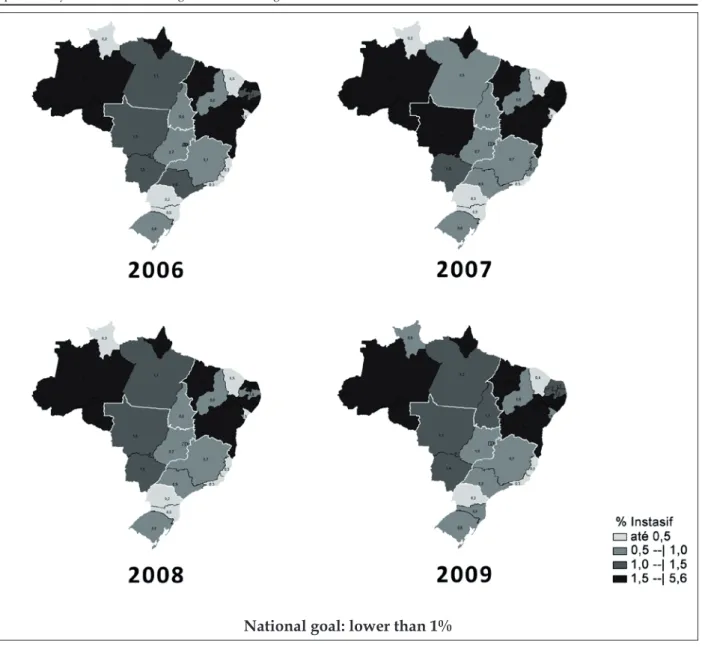
The mean percentage of unsatisfactory samples in the North and Northeast regions was elevated. The states of Acre, Amazonas, Pernam-buco, Maranhão and Amapá recorded a percent-age of unsatisfactory samples above 3%.
Maran-hão is highlighted due to a percentage of 5.6% of unsatisfactory samples, in 2009. There is a well
National goal: lower than 1%
Source: Information System on Cervix Cancer Control – SISCOLO: from 2006 to 2009.
Figure 3 - Percentage of Unsatisfactory samples. Brazil, from 2006 to 2009
In Brazil, the gross mortality rate for cervi-cal cancer, between 1979 and 1999, maintained a growing trend (from 3.44/100.000 in 1979, it increased to 4.67/100.000 in 1999). Since 2002, it is observed a trend of stabilization in the mortal-ity rate, even though it preserved regional
Goal: Reduce mortality by 30%
Source: Information System on Mortality – SIM/SUS.
Figure 4 - Gross mortality rates by cervix cancer. Brazil, from 2002 to 2009
Regarding the proportional distribution of Pap tests by age group, in the states of the North and Northeast regions, there was more offering of tests for women in the group age considered as priority, particularly in Tocantins and Piauí, with an increase of 7% and 6% respectively. In
Chart 1 - Proportional distribution of Pap tests according to the age group. Brazil, from 2006 to 2009
Federation Unit < = 24 years 25 to 59 years >= 60 years
2006 2007 2008 2009 2006 2007 2008 2009 2006 2007 2008 2009
Rondônia 22,00 21,02 20,12 20,07 73,92 73,92 74,47 74,21 4,67 5,06 5,41 5,72 Acre 22,94 21,64 20,52 20,41 74,07 74,07 75,27 75,35 4,34 4,29 4,21 4,24 Amazonas 25,85 23,94 22,78 22,43 70,68 70,68 71,72 71,91 5,08 5,39 5,50 5,66 Roraima 24,23 24,61 23,30 22,06 70,03 70,03 71,09 72,13 5,11 5,36 5,62 5,81 Pará 20,89 20,63 20,19 20,43 73,18 73,18 73,81 73,70 5,52 6,19 5,99 5,87 Amapá 20,96 20,82 20,88 20,45 74,13 74,13 73,54 73,80 5,15 5,05 5,58 5,74 Tocantins 19,85 18,79 19,87 18,90 67,33 67,33 74,02 74,57 9,03 13,88 6,11 6,53 Maranhão 20,20 20,86 20,16 19,50 71,32 71,32 73,08 73,14 9,70 7,82 6,75 7,37 Piauí 21,39 20,66 21,42 20,43 65,44 65,44 70,60 71,20 15,12 13,91 7,98 8,37 Ceará 23,75 23,26 22,66 22,35 70,37 70,37 70,84 71,07 6,35 6,37 6,50 6,58 Rio Grande do Norte 22,20 21,90 21,50 20,65 71,80 71,80 72,05 72,42 6,02 6,29 6,45 6,93 Paraíba 22,16 21,67 21,10 20,52 72,33 72,33 72,82 73,17 5,77 6,00 6,08 6,31 Pernambuco 19,94 19,74 19,08 18,40 72,78 72,78 73,08 73,32 7,53 7,47 7,84 8,27 Alagoas 22,58 21,05 21,26 20,63 73,48 73,48 73,38 73,95 4,87 5,46 5,36 5,42 Sergipe 22,24 22,37 21,63 20,82 72,75 72,75 73,88 74,27 4,98 4,88 4,49 4,91 Bahia 19,09 20,62 19,45 18,86 71,93 71,93 72,59 73,08 15,62 7,45 7,95 8,06 Minas Gerais 17,28 16,84 16,28 15,93 75,05 75,05 75,07 75,10 7,74 8,10 8,65 8,97 Espírito Santo 18,62 18,43 17,24 16,58 73,54 73,54 74,03 74,29 9,75 8,03 8,73 9,12 Rio de Janeiro 19,91 16,98 18,43 18,02 63,49 63,49 71,37 71,29 9,29 19,53 10,20 10,69 São Paulo 19,01 15,88 18,58 17,99 59,20 59,20 72,05 72,18 12,89 24,92 9,36 9,83 Paraná 18,65 17,68 17,01 16,61 74,00 74,00 74,33 73,87 7,53 8,32 8,66 9,52 Santa Catarina 17,38 16,80 18,28 18,23 65,97 65,97 73,58 73,23 14,70 17,23 8,14 8,55 Rio Grande do Sul 17,46 17,09 16,64 16,52 70,99 70,99 73,19 73,42 9,41 11,92 10,17 10,05 Mato Grosso do Sul 21,59 21,32 20,13 19,61 71,40 71,40 72,02 72,18 6,96 7,28 7,85 8,20 Mato Grosso 20,97 20,33 19,83 19,49 74,20 74,20 74,38 74,39 5,19 5,46 5,79 6,12 Goiás 19,75 19,69 19,38 18,87 72,92 72,92 73,40 73,96 8,20 7,39 6,89 7,17 Distrito Federal 22,42 19,68 20,39 19,85 73,92 73,92 72,74 73,10 5,79 6,40 6,87 7,05
Total 20,86 20,16 19,93 19,43 71,12 71,12 73,05 73,27 7,86 8,72 7,01 7,30
Source: Information System of the Cervix Cancer Control – SISCOLO: from 2006 to 2009.
DISCUSSION
The indicators have remained relatively stable over the analyzed period, with a slight improvement in performance. It is noted rel-evant regional and intra-regional differences, in the Brazilian territory. The pattern reveals large disparities, regions with the worst socioeconomic conditions show low performance of indicators agreed to the cervix cancer control. The protocols on the performance of the prevention program on cervix cancer showed, as fundamental elements to the program effectiveness, women´s coverage, monitoring and also integration with the Primary Care System.12
The screening program for cervix cancer presents restricted performance nationwide. The performance of developed countries that achieved reduction on incidence and mortality rates is attributed to the effectiveness of screen-ing programs. Therefore, it is important to note
the appropriate coverage and quality of the program. Despite well-established protocols, not all of the developed countries could achieve the performance considered as appropriate; in devel-oping countries like Brazil, the screening is still performed in opportunistically and uneven ways, and it comes with low coverage.12-13
In Brazil, cervix cancer appears as a priority to the National Policy on Oncology Care. Since 2006, the Ministry of Health emphasizes its im-portance through the Pact for Health, and these indicators are agreed priority actions and strate-gies for health care, in Brazil.14-16
Ma-ranhão, Distrito Federal, Alagoas, Rio de Janeiro, Bahia and Amazonas. Regions with the worst socioeconomic conditions showed an unfavorable pattern in the distribution of this indicator, which seems to reveal a low offer of cervical screening in relation to the target population. Conversely, it is observed low ratios in some regions with bet-ter conditions and service offerings. The unusual character of this pattern can be explained by the greater coverage of supplemental health and lower dependence on the public system. Besides
relecting the distance between the current offer
of cervical screening and the need to achieve the goal set.12-13
Even if this igure proves the capability to
offer exams for the target population, it will be necessary to consider the previous cytology and time of previous cytology. Regional and intra-re-gional differences need to be highlighted because they show problems of geographical access to the population, signaling to areas with rates below the targets agreed, in Brazil.
North, Northeast and Midwest regions showed high percentage of women screening
without previous cytology relecting tests per
-formed for the irst time. This indicator expresses
the capacity of expansion and maintenance on exams offering, in the care system. Low ratios may
relect lower capability for screening or, on the
other hand, it indicates that the program has good coverage and, therefore, the screening of women without cytology will be low. It is important to relate this indicator with the current coverage of each state.
In some cases, low screening indicates inad-equate offering of examinations, low capacity for sensitization and geographical access problems to the services.
Besides the regional inequalities mentioned, another study comparing the coverage and inequi-ties of such tests, in countries with different levels of economic development, noted that Brazil has an average coverage of more than 70%. However,
when it is stratiied by socioeconomic status, it
is noted that in low-income women the effective coverage is below 60%. But, in women with higher income, it can be observed an effective coverage of approximately 90%. Regarding the coverage of such tests, it appears that besides the regional inequalities mentioned, there are also inequities related to social strata.12
The quality of early detection method was as-sessed through the percentage indicator of
unsat-isfactory samples, classiied as a complementary
indicator and included, in 2006, in the Pact for Health.14 The regions with the worst performances were Northeast, North and Midwest. The propor-tion of unsatisfactory samples is mainly associated with problems in the collection stage of tests and samples preservation. In 2009, the state of Mara-nhão recorded 5.6% of unsatisfactory samples in the public system, which is a standard considered unacceptable by the WHO. In Brazil, the goal is to avoid exceeding 1% of unsatisfactory samples. The Pap test has achieved good compliance as screening method, however, many factors might
inluence directly or indirectly on the quality of
the result. These factors include steps from the material collection and clinical data record to the laboratory diagnostic of the sample.17-18
Mortality rates were stable and around 5%.
During the period, it was veriied a dispersion
of deaths with more concentration in the North, Northeast and Midwest regions. Rio de Janeiro is the state with the highest mortality rate for this
speciic cancer. The distribution of the mortality
rate allows analyzing, in part, the impact of the prevention program, access to the health services, quality of diagnosis and treatment, women´s accession to the screening program.14,16 For the country, achieving lower mortality rates means to achieve an effective screening and increase survival rates.
Regarding the proportional distribution of Pap tests by age group, there is, in a general way, maintenance of the pattern observed throughout the analyzed period, and focusing the tests from 25 to 59 years old. South and Southeast regions increased the examinations offerings over the analyzed period for women in the age group of risk, revealing better planning and management articulation.
The location of services affects the possibili-ties to use them, and more extensive displacements for treatment compromise the effectiveness of the program. The stability and concentration of such tests offering, examination frequency, unneces-sary repetitions in areas with greater offering, the increase of unsatisfactory samples percentage in regions with higher rates of incidence and con-centration of performed tests on women outside the recommended age group interfere in the per-formance of the health system. And, it appears to contribute consistently in the modest impact on
speciic mortality recorded in the last 15 years.
the access to health services is a major limitation to cover the target population. Differentiation in the use of health services, i.e. in the attitude of
looking for them, gain access and beneit from the received service, relect individual inequalities in
the risk of illness and death, as well as differences in the person´s behavior before the disease and characteristics of services offering that each society provides to its members.19
Spatial analysis showed regional and intra-regional differences that are relevant to the Bra-zilian territory. Regions with the worst socioeco-nomic conditions present low performance of the indicators agreed for the control of cervix cancer. It is necessary more investment and implementa-tion from other strategies in order to ensure the compliance with the goals, program quality and coverage increase of those regions that are below the agreed targets.
The high coverage and lexibility for the use
of large databases, in several designs of investiga-tion, mark their advantages. From these bases, building quality measures of health care represent an effort that today integrates a great volume of research aimed at evaluating the quality and health technologies. Still, in cases where problems compromise the validity of quality measures on the care process, these bases may represent an
auxiliary tool in the identiication of variations
in care standards that must be investigated on a larger scale. It is noted that there is a close relation between the quality of available pieces of informa-tion, in the information systems, and quality of the provided care. In this study, an aspect to be considered is the analyzed time interval, which is considered restricted to the program performance evaluation to prevent cervix cancer.
CONCLUSION
Cell changes in the cervix cancer evolution, in most cases, slowly and over a period ranging from 10 to 20 years. Therefore, it is a kind of can-cer that favors woman´s screening and treatment, being inadmissible to lose her during the period of disease development. The development of strategies for screening cervix cancer implies to overcome obstacles related mainly to screening, coverage and performance. The persistence of high mortality rates, in some regions, points to shortcomings in the program´s effectiveness.
The evaluation of some pointers detected gaps in women´s screening, population coverage,
samples quality of cytological tests and, especially, the stability with slight increase in the mortal-ity rate, over the years. Moreover, some aspects related to the offering and access to services and procedures are extremely important, particularly in underdeveloped countries, to the effectiveness of screening programs, as well as social, cultural and demographic factors.
Strategies to the execution of several policies for cancer control, in the world, rely heavily on the development stage of these countries and their territorial, socio-cultural and economic particulari-ties. In Brazil, the territorial dimension, structure of the health care system and socioeconomic fac-tors are constraints of its own strategy, and it must be adapted to the national characteristics and con-ditions. The inclusion of the geographic element, through its important contribution in identifying areas and situations of risk, opens the possibility of redirecting health actions, especially on areas where there is greater social exclusion.
ACkNOwLEDGMENT
To the National Council of Technical and
Scientiic Development (CNPq).
REFERENCES
1. World Health Organization. National Cancer Control Programmes. Policies and managerial guidelines. 2nd ed. Geneva: WHO; 2002.
2. Ministério da Saúde (BR). Instituto Nacional de Câncer, Secretaria de Assistência à Saúde. Viva Mulher - câncer de colo do útero: informações técnico gerenciais e ações desenvolvidas. Rio de Janeiro (RJ): MS; 2002.
3. Robles SC. Introduction to the special issue: timely detection of cervical cancer. Bull Pan Am Health Organ. 1996 Dec;30(4):285-9.
4. Zeferino LC, Costa AM, Panetta K, Jorge JPN. Screening da neoplasia cervical. J Bras Ginecol. 1996, 106(11-12):415-9.
5. Instituto Nacional do Câncer. Diretrizes Brasileiras para o Rastreamento do Câncer do Colo do Útero – atualização 2011. Rio de Janeiro (RJ): INCA; 2011. 6. Silva SED, Vasconcelos EV, Santana ME, Lima VLA,
Carvalho FL, Mar DF. Representações sociais de mulheres amazônidas sobre o exame papanicolau: implicações para a saúde da mulher. Esc Anna Nery Rev Enferm. 2008 Dez; 12(4):685-92.
8. Oliveira EXG, Melo ECP, Pinheiro RS, Noronha CP, Carvalho MS. Acesso à assistência oncológica: mapeamento dos fluxos origem-destino das internações e dos atendimentos ambulatoriais. O caso do câncer de mama. Cad Saúde Pública. 2011 Fev; 27(2): 317-326.
9. Melo ECP, Carvalho MS, Travassos C. Distribuição espacial da mortalidade por infarto agudo do miocárdio no município do Rio de Janeiro, Brasil. Cad Saúde Pública. 2006 Jun; 22(6):1225-36. 10. Board HCS. Performance measurement: accelerating
improvement [online]. Washington: The National Academies Press; 2006 [acesso 2010 Out 5]. Disponível em: http://books.nap.edu/openbook. php?record_id=11517&page=170
11. Tanaka O, Melo C. Avaliação de programas de saúde do adolescente: um modo de fazer [online]. São Paulo: Edusp; 2001 [acesso 2010 Set 28]. Disponível em: http://www.bireme.br/bvs/adolec/P/ textocompleto//adolescente/indice.htm
12. Ministério da Saúde (BR). Departamento de Apoio à Descentralização, Secretaria Executiva. Manual de Instrução SISPACTO. Módulo federal. Brasília (DF): Ministério da Saúde; 2008.
13. Gakidou E, Nordhagen S, Obermeyer Z. Coverage of cervical câncer screening in 57 countries: low average levels and large inequalities. Plos Medicine. 2008; 5(6):863-68.
14. Ministério da Saúde (BR). Portaria n°. 325 de 21 de fevereiro de 2008. Estabelece prioridades, objetivos e metas do Pacto pela Vida para 2008, os indicadores de monitoramento e avaliação do Pacto pela Saúde e as orientações, prazos e diretrizes para a sua pactuação. Diário Oicial da União. 22 fev; 2008. 15. Martins LFL, Thuler LCS, Valente JG. Cobertura
do exame de papanicolaou no Brasil e seus fatores determinates: uma revisão sistemática da literatura. Rev Bras Ginecolog Obstet. 2005; 27(8):485-92. 16. Ministério da Saúde (BR). Departamento de Atenção
Básica, Secretaria de Atenção à Saúde. Política Nacional de Atenção Básica. Brasília (DF): Ministério da Saúde; 2006.
17. Américo CF, Chagas ACMA, Lopes EM, Dias LMB, Lima TM, Moura ERF, et al. Análise da inluência do acondicionamento diferenciado de lâminas para colpocitologia no resultado laboratorial. Texto Contexto Enferm. 2010 Abr-Jun; 19(2):343-50. 18. Tavares SBN, Amaral RG, Manrique EJC, Sousa
NLA, Albuquerque ZBP, Zeferino LC. Controle da qualidade em citologia cervical: revisão de literatura. Rev Bras Cancerol. 2007; 53(3):355-64.
19. Pimentel AV, Panobianco Almeida AM, Oliveira ISB. Percepção da vulnerabilidade entre mulheres com diagnóstico avançado do câncer do colo do útero. Texto Contexto Enferm. 2011 Jun; 20(2):255-62.
Correspondence: Raíla de Souza Santos Rua Dr. Xavier Sigaud, 290, 3º andar - sala 308 22290-180 – Praia Vermelha, Rio de Janeiro, RJ, Brasil E-mail: [email protected]