Point of View
Pre-participation Screening of the Young Athlete: is this the Time for
an Agreement?
Roberto Peidro
1, Victor Froelicher
2, Ricardo Stein
3Universidad de Buenos Aires1, Buenos Aires - Argentina; Stanford University School of Medicine, VA Palo Alto Health Care System2, Palo Alto -
Estados Unidos; Laboratório de Fisiopatologia do Exercício, Hospital de Clínicas de Porto Alegre - Universidade Federal do Rio Grande do Sul3,
Porto Alegre, RS - Brazil
Mailing address: Ricardo Stein •
Rua João Caetano 20/402 - Petrópolis - 90470-260 - Porto Alegre, RS - Brazil E-mail: [email protected], [email protected]
Manuscript received June 5, 2010; revised manuscript received June 10, 2010; accepted September 14, 2010.
Keywords
Exercise; sports; medical examination.
the best interval between PPS. In Italy, according to a federal law since 1982, mandatory PPS covers all citizens practicing organized and competitive sports. The Italians have a model that includes clinical history, physical examination and a resting 12-lead electrocardiogram.
Pelliccia et al3 demonstrated that the inclusion of the
electrocardiogram in the PPS was effective in detecting the most common structural diseases, mainly arrhythmogenic right ventricle dysplasia (ARVD) and hypertrophic cardiomyopathy (HCM). Nevertheless, athletes of all Italian national teams undergo an echocardiogram, as a first step during their PPS. Corrado et al4, in a non-randomized temporally sequential
comparison, showed an 89% reduction in sudden death in Italian athletes in the Veneto region from 1981 to 2004.
On the other hand, in United States of America (USA), the Italian PPS model, which is accepted both by FIFA and the International Olympic Committee, among others, has not been implemented by the American Societies of Cardiology and of Sports Medicine. Their main objection to it lies in the fact that they consider that the incorporation of the ECG in all athletic PPS (for more than 10 million athletes) will not be cost-effective, due to its high false-positive rate. However, when considering European data, Wheeler et al5 analyzed the
cost/effectiveness of incorporating the resting 12-lead ECG to the PPS in American athletes. They agreed on the fact that the PPS with the ECG saves 2.06 lives per year per 1,000 athletes, evaluated at an additional cost of U$ 89.00 per athlete and at a cost/effectiveness rate of U$ 42,900 per year of life saved. Maron et al6 described 1,866 sudden deaths in young
athletes between 1980 and 2006, which led to a 6% annual increase, considering the prevalence before and after 19936.
This higher percentage of sudden death could be related to an increase in the number of notifications due to technological advances (eg. the Internet). The above authors considered that the sudden death rate among American athletes was not higher than the ones observed in the Veneto region (Italy) in the last years, even though in the USA, the ECG is not mandatory7.
Furthermore, the sudden death incidence in Veneto was higher than that observed in the USA in the period preceding the mandatory PPS in Italy. However, the prevalence of sudden death was similar to those seen these last years in both countries. Some relevant aspects should be considered: 1) the actual incidence of sudden death in the USA could be underestimated due to the lack of a compulsory registry. 2) It is not possible to know whether or not the Italian PPS implementation in the USA would lower the already low incidence of sudden death7.
Introduction
At each new season, physicians are asked about the need for pre-participation screening (PPS). At the beginning of a new school semester, with the higher demand for recreational sports at gyms and parks, there is an increase in medical clearance for practice. The reason for the medical evaluation to be carried out before engaging in exercise/ sports is to detect cardiovascular problems, which could have serious consequences with intense physical activity. These consequences include sudden death, which has occurred even on the playing field.
Sudden death among young athletes (13 to 35 years old) is a rare occurrence (0.5 to 2.0/100,000 athletes/year), but it is apparently twice as common in athletes when compared to non-athletes of the same age1. Competitive sports alone are not
responsible for the cardiovascular event when it occurs, being a trigger in someone with an occult cardiovascular disease2.
When PPS is planned, important steps should be taken: 1) the testing should be validated and generally accepted; 2) even though the disease is in its asymptomatic phase, the exams should be seen as necessary; 3) it should not cause any harm to the patient; 4) it should be cost-effective; and, 5) test characteristics should be acceptable. It is worth pointing out that items 4 and 5 are the ones more often discussed when athletic PPS is the issue. Technological advances offer us a large variety of complementary exams, which can make more diagnoses possible. Thus, the implementation of these practices must follow rigorous criteria, always making sure that the end result is to help the athlete.
It is known that there are controversies about which should be the most adequate model for the PPS. Moreover, it is not totally clear whether there is a real need to extend the PPS to individuals practicing sports for recreation, if children should be routinely evaluated and which would be
Point of View
Peidro et al Pre-participation screening of the young athlete
Arq Bras Cardiol 2011;96(3):e50-e52
As previously mentioned, one of the major obstacles frequently cited in order not to add the 12-lead ECG to the USA PPS is related to its sub-optimal specificity8. It could
generate a high number of false-positive results, demanding additional tests, thus potentially causing psychological and economic harm. A European Society of Cardiology document9 included new criteria to reduce the false-positive
rate. When these new criteria were employed, the specificity of the ECG increased from 90% to 96% in college athletes at Stanford University10.
There are some particularities in the USA: a) the cost of the ECG is very high, b) there is a high number of recreational athletes, c) the number of doctors specialized in exercise cardiology and/ or sports medicine is small in relation to the number of athletes. Therefore, the Italian PPS model would be difficult to be implemented nationwide. Countries such as Argentina and Brazil do not have a large number of well-trained doctors. Nevertheless, if only the Wheeler et al5 data were considered, the economic
burden for the ECG use in developing countries would be much lower than that in the USA and Europe.
Thus, how is the PPS dealt with in countries such as Argentina and Brazil? In truth, the sports and club associations have very different strategies regarding this subject. Some do not ask for anything and others require only a medical certificate in which the words “able to” are to be written on. On the other hand, there are some that ask for a variety of tests, ranging from ECG and laboratory and image exams to exercise testing and/or echocardiogram.
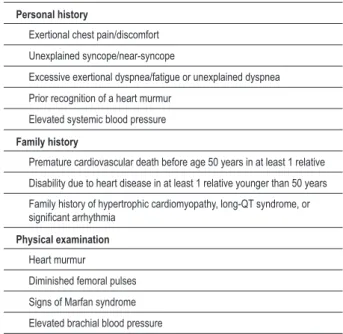
Knowing in advance that it will not be an easy task, we suggest that the government work with and give strong support to: medical associations, heads of sports institutions, politicians, public health agents, epidemiologists and private partners, among others. This means joining efforts to produce a uniform PPS model, as Italy once successfully did. A first step may be to adopt the standard 12 points of the AHA cardiovascular screening exam/questions (Table 1) or something similar and whenever possible, make the ECG available.
Potential Conflict of Interest
No potential conflict of interest relevant to this article was reported.
Sources of Funding
There were no external funding sources for this study.
Study Association
This study is not associated with any post-graduation program.
Table 1 - American Heart Association (AHA) 12 points
Personal history
Exertional chest pain/discomfort
Unexplained syncope/near-syncope
Excessive exertional dyspnea/fatigue or unexplained dyspnea
Prior recognition of a heart murmur
Elevated systemic blood pressure
Family history
Premature cardiovascular death before age 50 years in at least 1 relative
Disability due to heart disease in at least 1 relative younger than 50 years
Family history of hypertrophic cardiomyopathy, long-QT syndrome, or signiicant arrhythmia
Physical examination
Heart murmur
Diminished femoral pulses
Signs of Marfan syndrome
Elevated brachial blood pressure
Any positive response or inding of the following 12 elements should prompt
further cardiovascular testing.
References
1. Corrado D, Pellicia A, Bjornstad HH, Vanhees L, Biffi A, Borjesson M, et al. Cardiovascular pre-participation screening of young competitive athletes for prevention of sudden death: proposal for a common European protocol. Eur Heart J. 2005;26(5):516-24.
2. Corrado D, Basso C, Rizzoli G, Schiavon M, Thiene G. Does sports activity enhance the risk of sudden death in adolescents and young adults? J Am Coll Cardiol. 2003;42(11):1959-63.
3. Pelliccia A, Di Paolo FM, Corrado D, Buccolieri C, Quattrini FM, Pisicchio C, et al. Evidence for efficacy of Italian national pre-participation screening programme for identification of hypertrophic cardiomyopathy in competitive athletes. Eur Heart J. 2006;27(18):2196-200.
4. Corrado D, Basso C, Pavei A, Michieli P, Schiavon M, Thiene G. Trends in sudden cardiovascular death in young competitive athletes after implementation of a preparticipation screening program. JAMA. 2006;296(13):1593-601.
5. Wheeler M, Heidenreich P, Froelicher V, Hlatky M, Ashley E. Cost-effectiveness of preparticipation screening for prevention of sudden cardiac death in young athletes. Ann Intern Med. 2010;152(5):276-86.
6. Maron BJ, Doerer JJ, Haas TS, Tierney DM, Mueller FO. Sudden deaths in young competitive athletes: analysis of 1866 deaths in the United States, 1980-2006. Circulation. 2009;119(8):1085-92.
7. Maron BJ, Haas TS, Doerer JJ, Thompson PD, Hodges JS. Comparison of USA and Italian experiences with sudden cardiac deaths in young competitive athletes and implications for preparticipation screening strategies. Am J Cardiol. 2009;15(2):276-80.
8. Baggish AL, Hutter AM Jr, Wang F, Yared K, Weiner RB, Kupperman E, et al. Cardiovascular screening in college athletes with and without electrocardiography: a cross - sectional study. Ann Intern Med. 2010;152(5):269-75.
9. Corrado D, Pelliccia A, Heidbuchel H, Sharma S, Link M, Basso C, et al. Recommendations for interpretation of 12-lead electrocardiogram in the athlete. Eur Heart J. 2010;31(2):243-59.
10. Le VV, Wheeler MT, Mandic S, Dewey F, Fonda H, Perez M, et al. Addition of the electrocardiogram to the preparticipation examination of college athletes. Clin J Sports Med. 2010;20(2):98-105.