Instituto de Saúde Coletiva da Universidade Federal de Mato Grosso e Instituto do Coração do Hospital das Clínicas da FMUSP
Mailing address: Edimar Alcides Bocchi - Rua Oscar Freire, 2077/161 - 05409-011 São Paulo, SP – E-mail: [email protected]
Objective - Exercise training programs have been proposed as adjuncts to treatment of heart failure. The effects of a 3-month-exercise-training-program with 3 exercise sessions per week were assessed in patients with stable systolic chronic heart failure.
Methods - We studied 24 patients with final left ventri-cle diastolic diameter of 70±10mm and left ventricular ejection fraction of 37±4%. Mean age was 52±16 years. Twelve patients were assigned to an exercise training group (G1), and 12 patients were assigned to a control group (G2). Patients underwent treadmill testing, before and after exercise training, to assess distance walked, heart rate, systolic blood pressure, and double product.
Results - In G2 group, before and after 3 months, we observed, respectively distance walked, 623±553 and 561± 460m (ns); peak heart rate, 142±23 and 146± 33b/ min (ns); systolic blood pressure, 154±36 and 164±26 mmHg (ns); and double product, 22211± 6454 and 24293±7373 (ns). In G1 group, before and after exercise, we observed: distance walked, 615±394 and 970± 537m (p<0.003) peak heart rate, 143±24 and 143±29b/min (ns); systolic blood pressure, 136±33 and 133±24 mmHg (ns); and double product, 19907± 7323 and 19115±5776, respectively. Comparing the groups, a significant differen-ce existed regarding the variation in the double product, and in distance walked.
Conclusion – Exercise training programs in patients with heart failure can bring about an improvement in physical capacity.
Key words: exercise training, exercise, heart failure
Arq Bras Cardiol, volume 79 (nº 4), 357-62, 2002
Mário Sérgio Vaz da Silva, Edimar Alcides Bocchi, Guilherme Veiga Guimarães, Carlos Roberto Padovani, Maria Helena Gaíva G. da Silva, Shirley Ferreira Pereira, Ronaldo Ducchesi Fontes
Cuiabá, MT - São Paulo, SP - Brazil
Benefits of Exercise Training in the Treatment of Heart
Failure. Study with a Control Group
Heart failure is currently an important public health problem. One percent of the population is estimated to have it and 1/5 die every year, at the ratio of 3/1,000 inhabitants/ year. In the United States, heart failure occurs in about 2.2 million people, and contributes to over 500 thousand s hos-pitalizations and, approximately, 250 thousand deaths every year 1,2. In the State of Mato Grosso, these values represent an average of 9,000 hospitalizations and 350 deaths annual-ly, according to Sistema Único de Saúde (Single Health Sys-tem) (Secretaria Estadual de Saúde do Mato Grosso) (State Health Ministry).
Despite the progress in the treatment of heart failure, high mortality and morbidity still occur 3. Exercise training programs are among the recommended procedures to redu-ce morbidity and, in some situations, mortality 4-6. Generally, procedures, which are not always available, and are expen-sive and complex are used for individual assessment of the benefits of the programs, such as ergospirometry, among others. This has limited their broad use in the community. On the other hand, in our community, no investigations have been performed and published about the beneficial role of exercise training programs in patients with heart failu-re apart from isolated cases, without a control group. Cultu-ral factors and patients’own characteristics, such as age, ethnicity, etc., could influence possible beneficial results.
The objective of this investigation was to study the effect of exercise on the physical capacity of patients with heart failure, using a program of easy application and low cost in the community instead of complex investigations.
Methods
Hospital Júlio Müller, Cardiology Institute of Mato Grosso, and Posto de Saúde do Bairro Osmar Cabral (Public health service of Osmar Cabral Court).
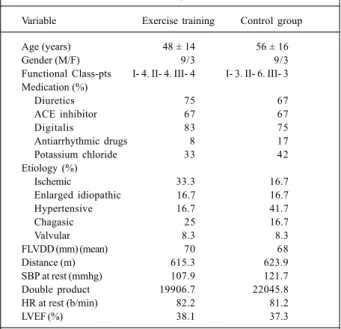
All patients who were sent to the cardiology ambula-tory unit had on echocardiography final left ventricle dias-tolic diameter ≥ 60mm and ejection fraction ≤ 45%, with signs and symptoms of heart failure. They were invited to take part in the study by the cardiologist as long as they did not have any of the exclusion criteria, which were clinical insta-bility in the last 3 months, uncontrolled atrial or ventricular arrhythmia, myocardial infarction in the last 3 months, angi-na or any other manifestation of ischemia, hypertrophic myocardiopathy, restrictive myocardiopathy, cardiopathy that required surgical correction, pulmonary disease, pri-mary valvulopathy, associated disease involving the ability to exercise, blood hypertension, and difficulty in complying with the protocol. Of the 35 patients selected, 24 (18 men and 6 women) agreed to take part in the research and were sent to the Cardiology Institute of Mato Grosso to undergo in-vestigation for diagnosis, improvement of the available therapeutics, and treadmill testing. Afterwards, they were sent to the physical trainer to develop the study. Patients’ characteristics are found in table I. All patients gave their written consent to take part in the study, approved by the ethics committee of the Federal University of Mato Grosso. Medication remained unchanged during the application of the exercise program in both groups.
The 24 patients in the study were randomly assigned to 2 different groups: group 1 was formed by 12 patients undergoing the exercise-training program, and group 2 was formed by 12 patients who were not undergoing the exerci-se-training program. Both groups were followed equally by the same treatment team, except regarding the training. Se-lection of groups was performed using systematic probabili-ty sampling 7. Groups were comparable in their characteris-tics (tab. I). We determined in both groups at the beginning of the investigation and at the end of the training period ma-ximum distance walked on the treadmill (in meters), heart rate (in b/min) at rest and at peak exercise, systolic blood pressu-re at pressu-rest and at peak exercise (in mmHg), and calculation of double product (systolic blood pressure x heart rate).
The treadmill protocol used to assess patients was the modified Naugthon8. We used the electric treadmill Ecafix, model EG 700X, for the treadmill test, connected to an Acer Mate computer, with the program Ecafix cardio perfect
(Ecafix 3-4 ST), model number A25374, with continuous mo-nitoring of heart rate and of an electrocardiogram. Blood pressure was assessed with the auscultatory method with a mercury column sphygmomanometer. After 2 minutes in the upright position without exercise, patients were encoura-ged to perform exercises until symptoms (fatigue or dysp-nea) made them unable to continue the test.
The exercise training program of patients lasted 3 months, at 3 times a week. Each session lasted 30 to 60 minu-tes 9-11. Exercises were performed at the Hospital Santa Cruz during the morning.
Based on the results obtained on the initial treadmill
test, exercise training was programmed over the 3 months on an individual basis for each patient. It was a specific exercise-training program, seeking to establish an intensity of variable work at 60% to 80% of the peak heart rate 12-17. The intensity of the exercises was controlled and monitored through a cardiac monitor, Polar model Accurox, program-med for the patient to walk at a target heart rate. Target heart rate was assessed with the Karvonem formula, where values of peak heart rate found on the treadmill test and of heart rate at rest of patients are also present, ie, target heart rate = % of work x (peak heart rate – heart rate at rest) + heart rate at rest. We tried to reach the percentage estimated at training in rela-tion to peak heart rate assuring that it was in the ideal inten-sity and was not below or above the programmed inteninten-sity, assuring, therefore, greater safety. The machine set off an alerting device automatically. In addition to heart rate moni-toring, the intensity of exercises was assessed with the Borg scale for rating of effort 14,18,19. The exercise training method used was at intervals 18-21.
Exercise training consisted of walks and localized exer-cises in the arms and extensions of upper and lower limbs, with their own resistance (arms, legs, and trunk) or with external resistance (dumb-bell) with performance of isoto-nic contractions (contraction and relaxation of skeletal muscle). These had the purpose of complementing the wal-king exercises, and also the stretching exercises of the great muscle groups and flexibility of the main joints (shoulder, elbow, hips, knees, and ankle) of the body 11,18.
During the exercise training program and with the improvement of patients’ conditioning, some programs had
Table I - Characteristics of the patients who did and did not participate in the exercise-training program in the beginning of
the investigation
Variable Exercise training Control group
Age (years) 48 ± 14 56 ± 16
Gender (M/F) 9/3 9/3
Functional Class-pts I- 4. II- 4. III- 4 I- 3. II- 6. III- 3 Medication (%)
Diuretics 75 67
ACE inhibitor 67 67
Digitalis 83 75
Antiarrhythmic drugs 8 17
Potassium chloride 33 42
Etiology (%)
Ischemic 33.3 16.7
Enlarged idiopathic 16.7 16.7
Hypertensive 16.7 41.7
Chagasic 25 16.7
Valvular 8.3 8.3
FLVDD (mm) (mean) 70 68
Distance (m) 615.3 623.9
SBP at rest (mmhg) 107.9 121.7 Double product 19906.7 22045.8 HR at rest (b/min) 82.2 81.2
LVEF (%) 38.1 37.3
some alterations. For example, in performance, the patient in-creased walking speed (intensity), or inin-creased distance walked (training volume) (1) gradually increasing exercise length up to 60 minutes and (2) increasing the percentage of workload, also gradually, up to 80% of the maximum heart rate 19,20.
Analysis of the comparison of the variation percenta-ges between the groups was performed using the nonpara-metric Mann-Whitney test 9.
Studies of distance walked, heart rate, and double pro-duct were performed with the multivariate analysis of mean profiles in both groups of patients with heart failure (con-trol and exercise group). Assessments were made at 2 diffe-rent times (beginning of the study and in the end of the stu-dy), and we observed the similarity regarding the mean pro-file of the groups, effects of the groups at the beginning and at the end, and the effects of the initial and final moment in each group 21. Discussion of data obtained through statis-tical analysis was performed at 5% significance 21.
The group comparison was performed at the begin-ning of the exercise traibegin-ning program, through the variables age, calculated using the nonparametric Mann-Whitney test, and gender, calculated using the Goodman test, for contrast of multinomial populations 10.
Results
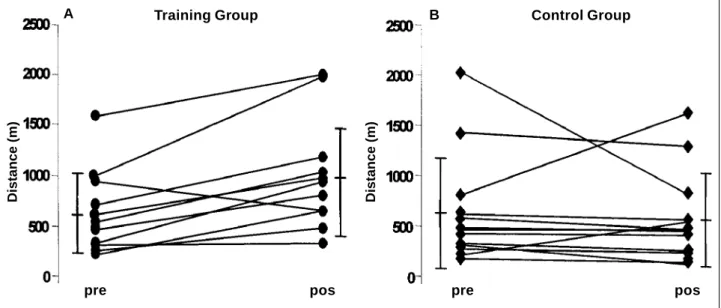
In G2 group, the distance walked at the beginning of the study and after 3 months was 624±553m and 561±460m, respectively, with a variation of –17±86% (p=ns). In G1 group, the distance walked at the beginning of the study and after 3 months was 615±394m and 970±537m, respec-tively (p<0.003), with a variation of 76±71% (fig. 1).
Of the 12 patients in G1, 11 increased distance walked at the end of the program in comparison with the beginning. In G2 group, only 2 patients were able to increase the
distan-ce walked and the other 10 decreased the distandistan-ce walked in comparison with the beginning.
In the control group, heart rate at rest in the beginning of the study and after 3 months was 82±13 and 87±16, res-pectively (p<0.05), with a variation of 7±20%. In G1 group, heart rate at rest in the beginning of the study and after 3 months was 82±15 and 78±14, respectively (p<0.05), with a variation of –8±-29% (fig. 2). In G2 group, heart rate at peak exercise at the beginning of the study and after 3 months was 142±23 and 146±33, respectively (p=ns), with a varia-tion of 3±25%. In G1, heart rate at peak exercise at the begin-ning of the study and after 3 months was 143±24 and 143±29, respectively, with a variation of –0.02±25% (p=ns) (fig. 3).
Although variation in peak heart rate was not statisti-cally different in G1, it decreased on average 15bpm after 3 months of training in 7 of the 12 patients, whereas in G2, it increased in 8 patients.
In G2, double product at rest at the beginning of the study and after 3 months was 9767±1452 and 11102±3012, respectively, with a variation of 12±24% (p=ns). In the exer-cise training group, double product at rest at the beginning of the study and after 3 months was 8885±1991 and 8269± 1729, respectively (p<0.05), with a variation of –8.47± 23.50%. In G2, double product at the beginning at peak exercise and after 3 months was 22046±6309 and 24293± 7373, respectively, with a variation of 17±68%. In G1, double product at peak exercise at the beginning of the study and after 3 months was 19907±7323 and 19115±5776, respective-ly, with a variation of –19±27% (fig. 4).
In G2, 8 patients had a mean increase of 6295 of the double product, whereas in G1, 10 patients had decreases in double product of 3984.
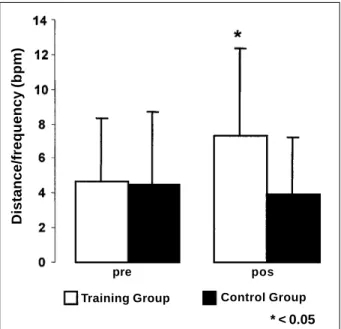
At peak exercise in G2, distance walked/maximum exercise heart rate ratio before and after the 3 months was, respectively, 4.5±4.2 and 3.9±3.3m/b/min-1(p=ns) (fig. 5). At Fig. 1 - Distance walked before (Pre) and after 3 months in the exercise training group (a) and in the control group (b).
Distance (m) Distance (m)
Training Group Control Group
pre pos pre pos
peak exercise in G1, the distance walked/maximum exercise heart rate ratio before and after the training period was, res-pectively, 4.6±3.7 and 7.3±4.9m/b/min-1(p<0.0003).
During the study period, 5 patients from G1 changed NYHA Functional Class, and at the end of the exercise training program, patients were classified as the following Functional Classes: 8 were Class I, 2 were Class II and 2 were Class III. In G2, 2 patients required hospital admission and 1 patient died. In the exercise group, none of the patients required hospital admission or died.
Discussion
Our results demonstrate that a simple and easy to apply exercise program can increase distance walked during exercise, reduce double product at peak exercise, and
in-crease distance walked/heart rate ratio in patients with heart failure, in comparison with the control group. Treadmill as-sessment of exercise benefit is also possible in heart failure. Application of the program was safe, had high compliance, and the exercise group had fewer occurrences of events.
The increase in distance walked in the exercise group, together with greater effort tolerance and improvement in physical capacity, is similar to the results published by other authors, despite the small number of patients with an ischemic etiology, in our investigation 22-25. Increase in exer-cise load was similar to that described by Wielenga et al 25, Tyni-Lenné et al 26, Belardinelli 27 , and Oliveira et al 28. Our exercise-training program was also similar to that reported by Wielenga et al 25, Tyni-Lenné et al 26, who used aerobic Fig. 2 - Heart rate at rest before (Pre) and after 3 months in the exercise group (a) and in
the control group (b).
Training Group Control Group
pre pos
Heart rate at rest (bpm)
Fig. 3 - Peak exercise heart rate before (Pre) and after 3 months in the exercise training group (a) and in the control group (b).
Training Group Control Group
pre pos
Peak Heart rate (bpm)
Fig. 5 - Distance walked/heart rate ratio before (Pre) and after 3 months in the exercise group and in the control group.
Training Group Control Group
pre pos
* < 0.05
Distance/frequency (bpm)
Fig. 4 - Double product at rest and exercise before (Pre) and after 3 months in the exercise group (a) and in the control group (b).
Training Group Control Group
pre pos
programs with local exercises. We believe that these results are due to the increase in muscle mass, greater peripheral blood flow during exercise, metabolic alterations, including improvement in the oxidative capacity of skeletal muscles, histology and biochemical alterations, as well as improve-ment in ergoreflex 28-30.An increase also occurred in local strength and aerobic metabolism efficacy, because these patients have fatigue and effort intolerance as limiting factors 31,32. Additionally, aerobic training enhances phy-sical capacity, peak oxygen consumption, peak voluntary ventilation, and respiratory efficacy. As previously shown, distance walked is a marker of a worse prognosis and worse clinical condition, and it is possible that an increase in dis-tance walked is accompanied by a reduction in patients’ mortality, especially those with an ischemic etiology and improvement in quality of life. The several mechanisms from which training in the ischemic group may reduce mortality include development of collateral circulation, reduction in neuro-hormonal and anti-inflammatory activity, alteration of vascular complacence, increase in HDL-cholesterol and improvement in lipid profile, reduction of other risk factors for coronary disease, increased number of hospital visits, and greater compliance with treatment protocols 28,33-36.
Our data on heart rate with exercise are similar to those published by other authors 29,37. Peak heart rate in our study was similar to that described by Oliveira et al 28. The expla-nation for the uniformity in the results of heart rate seems to be the similarity in Functional Class of patients with heart failure. In the exercise training program, heart rate is the same to that reported by Coats et al 14 , Sullivan et al 36, and Shephard et al 37,who used similar exercise training pro-grams. As already reported, patients who took part in the ae-robic exercise training tolerated a greater workload without increasing peak heart rate. The mechanism, which could explain the reduction in heart rate to the same workload, is probably the increase in vagal tonus and reduction in cate-cholamine levels with a reduction in sympathic tonus and baroreflex improvement, and greater R-R variability 39,40.
The decrease in double product with exercise was simi-lar to that reported by other authors 40. Uniformity of results
is expected, once the population was similar and the respon-ses were chronotropic, and blood pressure was similar. Ho-wever, it was different from that reported by Shephard et al 37, which included changes in quality of life determined by the analysis of emotional alterations, fatigue, or dyspnea. The mechanisms by which exercise decreases double product is through a gain in physical capacity, causing a decrease in heart rate, without increasing blood pressure, probably be-cause peripheral blood flow is increased and a tendency exists for vascular resistance to decrease during exercise, enhancing the number of capillaries and reducing fiber/ capillary ratio 40,.
The limitations of this study are the small number of patients, short follow-up period, and the different etiology of the patients with heart failure, even taking into account the significant results. A short follow-up period does not show if and how the beneficial effects are maintained over time; however, the simplicity of our method enables a high compliance rate with the treatment, which is probably the great limitation of these long-term protocols.
The present study shows the possibility of applying and developing with benefits a simple program of exercise training at health institutions, with possibilities of monito-ring results. Exercise-training programs can promote bene-ficial psychological effects and a better quality of life.
In conclusion, exercise-training programs are rarely re-commended in the community for patients with heart failure, due to fear of worsening of the symptoms during exercise. Our results are the first to demonstrate, in our community, through random study and a control group that exercise-training programs can enhance physical capacity in patients with heart failure, which is shown by the increased distance walked. The reduction in heart rate could indicate a decrease in neuro-hormonal activation. It has not been determined if increased physical capacity is associated with a better prog-nosis; however, the small number of adverse events in the exercise group is cause for optimism. Clinical benefits, if confirmed by other studies in our community, could indicate that exercise- training programs must be routinely applied in select patients with heart failure.
1. Bocchi EA. Situação das indicações e resultados do tratamento cirúrgico da in-suficiência cardíaca. Arq Bras Cardiol 1994; 63: 523-30.
2. II Diretrizes da Sociedade Brasileira de Cardiologia para o Diagnóstico e Tratamento a Insuficiência Cardíaca. Arq Bras Cardiol 1999; 72 (supl. I). 3. Bocchi EA, Bacal F, Bellotti G, Carrara D, Ramires JAF. Efeitos do carvedilol (Bloqueador
b1b2a1) na insuficiência cardíaca refratária. Arq Bras Cardiol 1998; 71: 169-73. 4. Jennings GL, Esler MD. Cirulatory regulation at rest and exercise and the functional
assessment of patients with congestive heart failure. Circulation 1990; 81: 5-13. 5. Braith RW, Mills RM Júniors. Exercise training in patients with congestive
he-art failure, how to achieve benefits safely, Postgraduate Med 1994; 96: 119-30. 6. Arakaki H, Magalhães HM. Programas supervisionados em reabilitação cardio-vascular - abordagem de prescrição de exercício. Rev SOCESP 1996; 6: 23-30. 7. Bolfarine H, Bussab WO. Elemento de Amostragem, SINAPE, 11, 1994. Anais, 161. 8. Naughton J, Balke B, Nagle F. Refinements in method of evaluation and physical conditioning before and after myocardial infarction. Am J Cardiol 1964; 14: 837-43.
References
9. Siegel S, Castellan Jr. NJ. Non Parametric Statistics for the Behavioral Sciences. 2nd ed. New York: McGraw-Hill, 1988: 321.
10. Neto TLB. Fisiologia do exercício aplicada ao sistema cardiovascular. Rev SOCESP 1996; 6: 6-10.
11. Oliveira JF, Salvetti X. Programas não supervisionados em reabilitação cardiovas-cular - abordagem da prescrição de exercício. Rev SOCESP 1996; 6: 31-9. 12. Buchler RDD, Ferraz AS, Menghelo RS. Princípios gerais e aplicações de
reabilitação. Rev SOCESP 1996; 6: 11-22.
13. Pollock ML, Wilmore JH, Foxii SM. Exercícios na Saúde e na Doença; Avaliação e Prescrição para Prevenção e Reabilitação, 1ª ed. Rio de Janeiro: Medsi, 1986. 14. Coats AJS, Adamopoulos S, Meyer TE, et al. Controlled trial of physical training
in chronic heart failure. Circulation 1992; 85: 2119-31.
15. Wilmore JH, Costill DL. Physiology of sport and exercise. Human Kinetcs 1994; 1: 176.
and heart failure. Relation of the severity of the disease to the anaerobic threshold and the respiratory compensation point. Arq Bras Cardiol 1999; 73: 339-8. 17. American College Sports Medicine - Principles of exercise prescription. In: Guidelines
of Exercise Testing and Prescription. 4ª Ed. New York: Lea & Febiger, 1991. 18. Yazbek PJ, Battistella LR. Condicionamento físico do atleta ao transplantado;
aspectos multiciplinares na prevenção e reabilitação cardíaca, 1ª ed. São Paulo: Savier e Associação Paulista de Medicina, 1994.
19. Magnusson G. Comparison of isotonic and isometric training in patients with chronic heart failure. In: World Congress on Heart Failure - Mechanism and Management. Proceedings, 1998.
20. Morrison DF. Multivariate Statical Methods. New York: McGraw-Hill, 1976. 21. The Solvd Investigators. Effect of enalapril on survival in patients with reduced
left ventricular ejection fractions and congestive heart failure. N Engl J Med 1991; 325: 293-302.
22. Oliveira MTJ, Guimarães GV, Barreto ACP. Teste de 6min em insuficiência cardíaca. Arq Bras Cardiol 1996; 67: 373-4.
23. Silva CES, Seixas MA, Moreira MM, Ortiz J. Insuficiência cardíaca congestiva -Novos métodos de avaliação da função ventricular. Rev SOCESP 1999; 9: 818. 24. Beltner V, Weiner OH, Yussuf S, et al. Prediction of mortality and... patients with
left ventricular dusfunction. JAMA 1993; 270: 1702-7.
25. Wielenga RP, Coats AJS, Mosterd WL, et al. The role of exercise training in chronic heart failure. Heart Review 1997; 78: 431-6.
26. Tyni-Lenné R, Gordon A, Jansson E, et al. Skeletal muscle endurance training improves peripheral oxidative capacity, exercise tolerance, and health - related quality of life in women with chronic congestive heart failure secundary to either ischemic cardiomyopathy or idiopathic dilated cardiomyopathy. Am J Cardiol 1997; 80: 1025-9.
27. Belardinelli R. Moderate Physical activity should be prescribed along with appropriate drug therapy for patients with congestive heart failure who are stable. Circulation 1999; 99: 1173-82.
28. Oliveira JF, Salvetti X, Almeida D, Salles A, et al. Freqüência cardíaca no limiar anaeróbio em insuficiência cardíaca. IV congresso brasileira de ergometria e reabilitação cardiovascular. Arq Bras Cardiol 1998; 70: 137.
29. Yamani MH, Wells L, Massie BM. Relation of the nine-minute self-powered treadmill test to maximal exercise capacity and skeletal muscle function in patients with congestive heart failure. Am J Cardiol 1995; 76: 788-92. 30. Hambrecht R, Fiehn E, Adams V, et al. Effects of exercise training on muscle
alterations in patients with chronic heart failure. In: World Congress on Heart Failure - Mechanism And Management. Proceedings, 1998.
31. I Consenso Nacional de Reabilitação Cardiovascular, na fase crônica da evolução clínica. Arq Bras Cardiol 1997; 69: 267-91.
32. Cohn JN. Prevention of heart failure. Cardology 1999; 92(suppl 1): 22-5. 33. Bol E, Vries WR, Mosterd WL, Wielenga RP, Coats AJ. Cardiopulmonary
exer-cise parameters in relation to all-sause mortality in patients with chronic heart fai-lure. J Cardiol 2000; 72: 255-63.
34. Wright DJ, Tan LB. The role of exercise testeting in the evaluation and manage-ment of heart failure. Postgrad Med J 1999; 75 (886): 453-8.
35. Kiilavuori K, Toivonen L, Näveri H, et al. Reversão das alterações autonômicas pelo treinamento físico por avaliação através da variabilidade da freqüência car-díaca na insuficiência carcar-díaca crônica. Eur Heart J 1995; 16: 490-5. 36. Sullivan MJ, Higginbotham, MB, Cobb FR. Increase exercise ventilation in
patients with chronic heart failure: intact ventilatory control despite hemody-namic and pulmonary abnomalities. Circulation 1988; 77: 552-9.
37. Shephard RJ, Kavanagh T, Mertens DJ. On the prediction of physiological and psychological responses to aerobic training in patients with stable congestive heart failure, J Cardiopul Rehabil 1998; 18: 45-51.
38. Sellier P. Overview of the results of exercise training studies in heart failure. In: World Congress on Heart Failure - Mechanism and Management. Procee-dings 1998.
39. Yazbek PJ, Santomauro AC, Silva PRS, et al. Resposta cronotrópica e pressórica nas miocardites em portadores de insuficiência cardíaca durante prova ergomé-trica. correlação das variáveis espirométrica ao esforço. Arq Bras Cardiol 1993; 60: 405-10.