Brazilian Journal of Physics, vol. 38, no. 3B, September, 2008 507
Charged Higgs Production at Photon Colliders in 2HDM-III
Susana S´anchez,∗ J-Alexis Rodr´ıguez, and Roberto Mart´ınez Department of Physics, Universidad Nacional de Colombia†
(Received on 14 April, 2008)
We study charged Higgs production in the processγγ→A0→W−H+. The processes γγ→A0 are loop mediated in a 2HDM. This is due to the fact that photons only couple directly to charged particles and the Higgs only couples to particles with mass acquired via Higgs mechanism. Although in MSSM the contribution from the processγγ→A0is too small, it has been found that in a more general 2HDM it could be enhanced. On the other hand, the bosonA0can decay inW−H+at tree level and the charged Higgs can decay in fermions. So, the whole process under study isγγ→A0→(W−→lν)(H+→fifj)in 2HDM-III. Evidence about charged Higgs existence could demonstrate that structure of the Higgs sector has several multiplets.
Keywords: Two Higgs Doublet Model; Photon Collider; 2HDM; Higgs
I. INTRODUCTION
The Standard Model of particle physics (SM) has been succesful in explaining experimental data so far. However, the Higgs sector of the model is experimentally unknown. This fact has lead many theorists to suggest that the sector could be non-minimal, and today it is common to study extensions of the SM scalar sector. The simplest extension is the Two Higgs Doublet Model (2HDM)[1, 2], which involves two scalar doublets in the process of electroweak symmetry breaking. After the symmetry breaking, there are five physical Higgs particles: two charged HiggsH±, two CP-evenH0,h0, and one CP-oddA0. The charged particlesH±are characteristic of the models with two Higgs doublets and its discovery would be a clear signal of physics beyond the SM.
A promising alternative for the search of new physics lies on the collisions of photons that will be present at ILC (Inter-national Linear Collider). The ILC is the next greatest project to be developed after the LHC (Large Hadron Collider). The photons will be produced by Compton retrodispersion, and earlier studies show that production of neutral scalars by pho-ton collisions present a considerable probability of detection. Besides, photons couple directly to charged particles, soγγ high energy collisions could provide a better understanding of several aspects of the SM and its extensions[4].
explaining experimental data so far. However, the Higgs sector of the model is experimentally unknown. This fact has lead many theorists to suggest that the sector could be non-minimal, and today it is common to study extensions of the scalar sector in the SM. The simplest extension is the Two Higgs Doublet Model (2HDM)[1, 2] which involves two scalar doublets in the process of electroweak symmetry breaking. After the symmetry breaking, there are five physical Higgs particles: two charged HiggsH±, two CP-even Higgs H0,h0, and one CP-odd HiggsA0. The charged HiggsH±is characteristic of the models with two higgs doublets and its
∗Electronic address:[email protected]
†Ciudad Universitaria, Bogot´a, Colombia
discovery would be a clear signal of physics beyond the SM.
sector. The ILC (International Linear Collider) is the next greatest project to be developed after the LHC (Large Hadron Collider). There will be studied collisions of photons produced by Compton retrodispersion. This collisions present a promising alternative for the search of new physics. Earlier studies show that production of neutral scalars by photon collisions presents a considerable probability of detection. Besides, photons couple directly to charged particles, so high energy collisions provide a better understanding of several aspects of the SM and its extensions[4].
In this work we study the process γγ→A0 →(W−→ lν)(H+→ fifj)in the frame of a general 2HDM. The first
section presents a brief overview of the 2HDM, focusing in the third type (2HDM-III). The next section contains the ex-pressions used in the calculations. The third section contains the obtained results and finally the conclusions are drawn.
II. THE TWO HIGGS DOUBLET MODEL TYPE III
The minimal extension of the Higgs sector of the SM con-sists in adding a second scalar doublet with the same quantum numbers than the first one[2, 3]. We denote them by:
Φ1= µ
φ+1 φ0 1
¶
Φ2= µ
φ+2 φ0 2
¶
, (1)
hΦ1i0= v1 √
2, hΦ2i0= v2 √
2. (2)
The most general gauge invariant lagrangian which couples both Higgs fields with fermions is:
−
L
Y = ηU,0i j Q¯0iLΦ˜1U0jR+η D,0
i j Q¯0iLΦ1D0jR + ξUi j,0Q¯0
iLΦ˜2U0jR+ξ D,0
i j Q¯
0
iLΦ2D0jR + ηEi j,0l¯iL0Φ˜1E0jR+ξ
E,0
i j l¯
0
508 Susana S´anchez et al.
whereηU,DandξU,Dare non-diagonal mixing matrices 3×3,
˜
Φi=iσ2Φi, (U,D)R are right-handed fermion singlets, QL
are left-handed fermion doublets, and the index 0 indicates that the fields are not mass eigenstates.
In the most general case, both Higgs doublets couple with the up and down sectors, and therefore they contribute simul-taneously in the proccess of mass generation for quarks. This case leads to FCNC (Flavor Changing Neutral Currents) at tree level, because it is impossible to diagonalize simultane-ously both matricesηandξ. This general case is known as 2HDM type III. However, FCNC proccesses at tree level are highly supressed by the experiment. In order to avoid their existence, Glashow and Weinberg[3] designed the following set of discrete symmetries:
Φ1→Φ1andΦ2→ −Φ2,
DjR→ ∓DjRandUjR→ −UjR. (4)
The condition of invariance under this discrete symmetry leads to two cases:
• By usingDjR→ −DjR, matricesηU,0andηD,0have to
be eliminated from the lagrangian. In this caseΦ1 de-couples in the Yukawa sector and onlyΦ2gives masses to sectors up and down. This case is known as 2HDM type I.
• By usingDjR→DjR, matricesηU,0andξD,0 must be
eliminated from the lagrangian. In this caseΦ1couples to the down sector and Φ2 gives masses to up sector. This case is known as 2HDM type II.
The 2HDM-III is the only 2HDM that allows FCNC proccesses at tree level. Precission tests of the SM model show a great aggreement with the FCNC parameters, except for the phenomenon of neutrino oscillation. Besides, the FCNC processes don’t seem to violate any fundamental law. We study the 2HDM-III because it has a more rich phenomenology, and it is possible to find the first two types as limit cases of this one.
In the 2HDM-III, a rotation of the scalar fields does not change the physical content of the model[3]. This rotation can get rid of the VEV of one doublet. If we takehΦ2i=0, it is found that tanβ=0. This is known as thefundamental parameterization. We denote the VEV of the first doublet as hΦ1i=v.
For a better study of the FCNC processes, Cheng, Sher and Yuang (CSY) propose an anzats for the Yukawa matrices such that
ξi j= √m
imj
v λi j (5)
This anzats obeys to the fact that couplings between fermions and the Higgs particle in the SM are proportional
to the mass of the fermion. Parametersλi jcould change the
hierarchy between fermionic couplings and because of this it is expected that they would be∼1. Restrictions over param-eters have been obtained in references [3, 5, 8]. The most relevant are:
ξ2
µτ ∈ [7.62×10⁻⁴; 4.44×10⁻²]
ξττ ∈ [−1.8×10⁻²; 2.2×10⁻²]
ξµµ ∈ [−0.12; 0.12] ξµe ∈ [−0.39; 0.39] λbb ∈ [−6; 6]
λtt ∈ [− √
8;√8]. (6)
III. THE PROCESSγγ→A0→W+H−→lνfifj
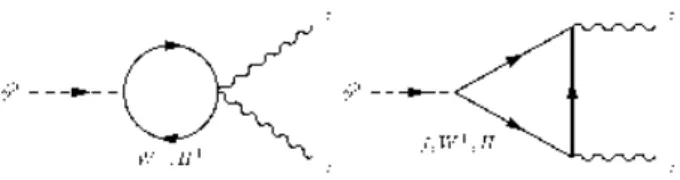
Loops contributing in neutral Higgs production are shown in Fig. 1 and the decayA0→H±W∓ exists at tree level in the framework of the 2HDM-III. The process H− →qiq¯j
has been studied in 2HDM-III[7], and under the restrictions mentioned above, it has been found that the most relevant decay isH−→tb¯.
FIG. 1: Contributing diagrams in the processγγ→A0
The decay width of the processγγ→A0is given by
Γ¡
γγ→A0¢= α
2g2 1024π3
m3
A0 mW2
¯ ¯ ¯ ¯ ¯
∑
i
NCe2iF(τ)RA
0
i ¯ ¯ ¯ ¯ ¯ 2
. (7)
The factorRAi0is the relative coupling between the 2HDM-III and the SM, the kinematical factor isτ=4m2i/m2
A0, the functionF(τ)is defined as:
F(τ) =−2τ(1+ (1−τ)f(τ)), (8) and the function f is:
f(τ) =
−1 4 ¯ ¯ ¯Ln
³ 1+√1−τ
1−√1−τ
´ −iπ¯¯
¯ 2
τ<1
ArcSin µq
1
τ
¶2
τ≥1
. (9)
Brazilian Journal of Physics, vol. 38, no. 3B, September, 2008 509
FIG. 2: Decay width of the processγγ→A0to one loop forλbb=1 andλtt=
√ 8
restrictions mentioned in equation 6. It is found that changes inλbbdo not have a big impact on the results, while changes
inλtt are considerable. It is found also that the decay width
increases with theA0mass. So we will considerλ
bb=6 and
values formA0 >600GeV.
The decay width for the processA0→W−H+is given by
Γ(A0→W−H+) =cos
2αm3
H+
64πv2 ×
s
1− µ
mW−+mA0 mH+
¶2 s 1−
µ
mW−−mA0 mH+
¶2
3
, (10)
where α is the mixing angle of the Higgs eigenstates, v is the vacuum expectation value as defined in the fundamental parameterization.
It has been found that the most relevant decay of the charged Higgs into fermions for this model is the decay into tb¯quarks[7]. This is given by
Γ(H+→tb¯) =3m
2
H+Ktb2
16πv2 × "Ã
1−m 2
t +m2b
m2
H+
!
−4λttλbb
m2tm2b m2
H+
#
× |~pH(mt,mb)|, (11)
whereKtb is the CKM matrix element, and|~pH(1,2)|is
de-fined as:
|~pH(m1,m2)|= s
1− µm
1+m2 mH
¶2s 1−
µm 1−m2
mH ¶2
. (12)
The cross section for the whole process is calculated as
σ(γγ→A0→τντtb¯) = (13)
8πΓ(γγ→A
0)Γ(A0→τν
τtb¯) (E2
γγ−m2A0)2+Γ2A0m2A0
g(λλ′)
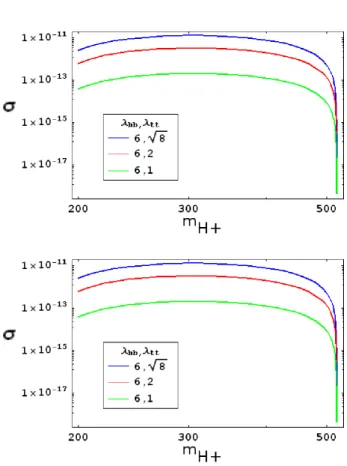
Figures 3 and 4 show the cross section for the processγγ→
A0→W+H−→(τντ)(tb¯), usingEγγ=1000GeV.
IV. CONCLUSSIONS
FIG. 3: Cross section (in barns) of the processγγ→A0→W−H+→
eνetb¯for different values ofλtt, usingmA0=600GeV andλbb=6
We found the cross section for the process γγ → A0 → W+H− → (τντ)(tb¯) in the frame of the 2HDM-III. Results are shown in Figs. 3 and 4. It is found that the cross section takes values between 1pb and 10pb for the parametersλbb=6, λtt=
√
8 andmA0 =600GeV. For a higher value ofmA0 we get higher values of the cross section, between 10pb and 100pb. For lower values of the parameter λtt, we still get cross section values between 0.1pb and 10pb.
Finally, we can say that for two Higgs doublets models type III, the contribution of the processγγ→A0→W−H+→eνetb¯
510 Susana S´anchez et al.
FIG. 4: Cross section (in barns) of the processγγ→A0→W−H+→
eνetb¯for different values ofλtt, usingmA0=800GeV andλbb=6
help to diferentiate between the MSSM and a more general 2HDM. Besides, evidence of the charged Higgs existence would demonstrate the multiple doublets structure of the Higgs sector.
Acknowledgments
R.M acknowledges to Banco de la Rep´ublica for the finan-cial support in the development of this work.
[1] H. C´ardenas,Decaimientos en dos cuerpos del bos´on de Higgs cargado en el 2HDM-III(2006).
[2] J. F. Gunion, H. E. Haber, G. Kane, and S. Dawson,The Higgs hunter’s guide(1990), Addison-Wesley Publishing Company. [3] R. A. Diaz Sanchez, Phenomenological analysis of the Two
Higgs Doublet Model(2002), arxiv.org:hep-ph/0212237. [4] International Linear Collider, Reference Design Report,Machine
Overview v5.1.
[5] C. Jimenez, J. A. Rodriguez, and R. Martinez,Light Higgs bo-son production in the Two Higgs Doublet Model type III, Unpub-lished,2008.
[6] S. Moretti, The W±h decay channel as a probe of charged
Higgs boson production at the Large Hadron Collider (2000), arxiv.org:hep-ph/0003178.
[7] H. C´ardenas,Decaimientos en dos cuerpos del bos´on de Higgs cargado en el 2HDM-III(2006).
[8] R. A. Diaz, R. Martinez, and C. E. Sandoval, arXiv:hep-ph/0311201, 2003. R. A. Diaz, R. Martinez, and C. E. Sandoval, arXiv:hep-ph/0406265, 2003. R. A. Diaz, R. Martinez, and J-A. Rodriguez, arXiv:hep-ph/0103050, 2001.