PROPOSAL TO REPRESENT THE UNESCO
THESAURUS FOR THE SEMANTIC WEB
APPLYING ISO-25964
Juan-Antonio Pastor-Sánchez (1)
(1) University of Murcia, Faculty of Communication and Documentation, [email protected]
Abstract
This paper shows how has been applied ISO-25964 standard to represent the UNESCO thesaurus through semantic web technologies. Based on the works done by the UNESKOS project, has been analyzed the joint use of SKOS and ISO-THES ontologies to represent thesauri according to the data model of the ISO-25964 standard. The result has been an RDF dataset, accessible as Linked Open Data, using SKOS
and ISO-THES with the properties of a vocabulary developed in the context of UNESKOS project. The conclusions point, among other aspects, a review of SKOS and adoption of ap-propriate technologies that facilitate the development of fu-ture works and research lines focused on the alignment of vocabularies.
Keywords: UNESCO Thesaurus; SKOS; Semantic Web;
ISO-25964; ISO-THES; UNESKOS
1 Introduction
Actually, SKOS is the most used ontology to represent interoperables Knowledge Organization Systems in the Semantic Web (Pastor-Sánchez, et al., 2012). SKOS was developed in a first stage into the SWAD-EUROPE project between 2002 and 2004. Finally was adopted as W3C recommendation in 2009 (W3C, 2009). Along its development the main purpose was the representation of a wide variety of controlled vo-cabularies into a simple way, i.e. Thesauri.
For many years the normative references for the elabo-ration of thesauri was the 5964:1985 and ISO-2788:1986 standards. Some minor revisions was done regarding structural and terminological elements, main-ly with the ANSI/NISO Z-39-19:2005. First proposals of deeply changes about the concept of Thesaurus was done by the British Standard BS-8723. As a result of those works, currently Thesauri are seen as a tool for the terminological control and the information retrieval that complains interoperability mechanism between different types of knowledge organization systems.
The Use Cases and Requirement document, redacted during the SKOS creation process, considered the ISO-5964/2788 standards. However, ISO-25964 was
pub-lished after SKOS has came as an standard “de facto”
in the context of the Semantic Web for thesaurus pub-lishing. This implies difficulties for the deployment of thesaurus conforms to ISO-25964 in Semantic Web.
Since the publication of ISO-25964 the need to adapt SKOS to the new standard was identified. For this, a
working group are developing the ISO-THES ontology that complements SKOS and complains the properties of ISO-25964 for representing any kind of Thesaurus (Isaac and De Smedt, 2015).
The UNESKOS project exists since 2012 with the aim to offer SKOS versions of both, the Proposed Interna-tional Standard Nomenclature for Fields of Science and Technology and the UNESCO Thesaurus. The project applies the Linked Open Data principles (Pastor-Sánchez, et al., 2013). This work is about the update of UNESKOS project for the UNESCO Thesaurus and its publication as a SKOS dataset, available according to Linked Open Data principles and conforms to ISO-25964 standard. First, the methodology followed is described. Next section exposes the obtained results to apply ISO-THES and a comparative respect the previ-ous SKOS version is done. Finally the paper points the conclusions and several future work lines.
2 Methodology
In order to update the SKOS representation of the UNESCO thesaurus have been analyzed the elements of the ISO-THES ontology. Next, it has been defined the mapping between such elements and the structure of the UNESCO Thesaurus. The two SKOS versions of the Thesaurus have been compared to check the viabil-ity of the new modeling.
using regular expressions (Schrenk 2012 p.49-75) to obtain normalized text files for each language.
These files were processed to obtain a representation of the thesaurus using SKOS and ISO-THES. Additional-ly, the algorithm implemented for this purpose have distinguished between existing concepts in the previous version and those newly created to maintain the URI of existing concepts and collections.
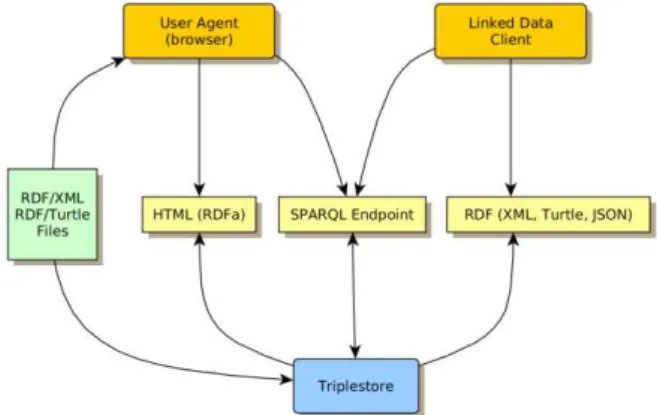
After this process, the RDF/Turtle and RDF/XML seri-alization were obtained and used to update the thesau-rus data in the triplestore. It should be noted that the RDF data stored in the triplestore are used to generate the serialization in different formats and for a SPARQL Endpoint as shown in Figure 1.
Figure 1: Functional diagram for data access of UNESKOS project. Source: PASTOR-SÁNCHEZ et al., 2013.
After this update was necessary to adapt the script to generate the HTML view to display the new elements used for modeling the thesaurus, specifically those cor-responding to ISO-THES ontology and the ad-hoc properties developed for the UNESKOS project.
3 THES Ontology: Confluence of
ISO-25964 and SKOS
One of the most significant features of SKOS is the definition of two levels of representation: the concep-tual level and the lexical level. The class skos:Concept allows to define concepts to which terms are associated in different languages by assigning preferred labels (skos:prefLabel), alternative labels (skos:altLabel) and hidden labels (skos:hiddenLabel).
Using the terminology from the thesaurus standards, before ISO-25964, preferred labels correspond with descriptors and alternative labels with non-descriptors.
The hierarchical and associative semantic relationships are defined in the conceptual level. That is, the con-cepts, not the labels, are the elements connected by semantic relationships. These relationships identify generic (skos:broader), narrow (skos:narrower) and
related (skos:related) concepts. This approach allows an efficient maintenance and application in indexing tasks of thesauri, since with SKOS a change in the concepts labeling does not imply any change in the structure of the semantic relations.
Additionally SKOS provides other constructs to define grouping structures, such as concept schemes (skos:ConceptScheme) and collections (skos:Collection) with its corresponding properties.
The definition and maintenance of the lexical level of the thesaurus with the new standard ISO-25964 can be relatively complex, due to the existence of equivalence relationships between terms (USE/USE+ and UF/UF+) that complement the relationships between terms and concepts (isNonPreferredlabelFor, isPreferred-labelFor).
These relationships allows to define the equivalence between a non-preferent composed term ( SplitNon-PreferredTerm) with several preferred terms ( Pre-ferredTerm) using a composed equivalence relation-ship (CompoundEquivalence). SKOS has no elements to define these equivalences, not even with SKOs-XL (SKOS eXtension for Labels).
On the other hand, the part two of ISO-25964 standard deals the interoperability of thesauri with other con-trolled vocabularies. A typology of equivalences be-tween concepts of different vocabularies is defined:
• Exact equivalence: both concepts, in source and tar-get vocabularies, represent the same idea and both
have identical scope. Example: “Mad cow disease” and “Bovine spongiform encephalopathy”.
• Inexact equivalence: concepts that have overlapping scopes, or a small difference of connotation or
con-text of use. Example: “seats” and “chairs”.
• Partial equivalence: concepts with a close meaning although one is slightly broader than the other. Ex-ample: "Aircraft" and "Air-planes".
• Hierarchical mappings: this mapping is used when one concept is clearly broader than the other. Exam-ple: “Netherlands” and “Holland”.
• Associative mappings: this mapping is used when it is not possible define any equivalence or hierarchical mapping between two concepts, but are semantically
related. Example: “Photographs” and “Photogra-phers”.
Equivalence can be defined between two concepts of different thesauri (simple equivalence) or when a con-cept of a thesaurus is represented by combining several concepts in another thesaurus (compound equivalence).
explicitly reflected in the data model of the standard, but can be derived from hierarchical and associative relationships.
SKOS allows interconnection of vocabularies, but only for simple equivalences. It does not include the new composite equivalence of the new ISO standard. The property skos:exactMatch provide the mechanism to define the ISO exact equivalence, while skos:closeMatch is used for inexact or partial equiva-lences. The properties skos:broadMatch, skos:narrowMatch and skos:relatedMatch are used for the hierachical and associative mapping relation-ships.
Therefore, there are many similarities between the new ISO-25964 standard and SKOS:
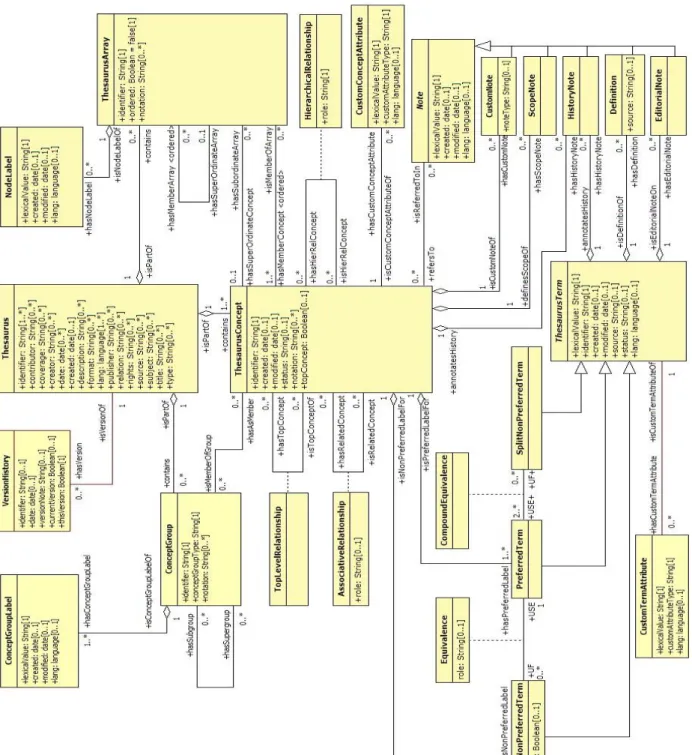
1. Both offer models of representation that can be applied to the development of information retrieval applications as shown in Figure 2 in Appendix.
2. The thesaurus is structured into two levels: concep-tual and terminological (lexical).
3. ISO-25964 and SKOS have higher structures for concepts grouping. It is possible to represent the-saurus, concept groups and concept arrays with the ISO model. SKOS provides skos:ConceptScheme and skos:Collection to represent such structures.
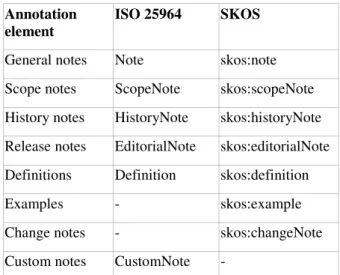
4. Annotation elements are almost identical in both (see table 1).
Anyway we must consider that the new ISO standard was published when SKOS had been widely deployed to publish controlled vocabularies in the Semantic Web. An ontology has been developed to facilitate the interoperability, which reuses elements of SKOS to represent thesaurus in the Semantic Web context ac-cording to ISO-25964 (Isaac; de Smedt, 2015).
It also defines a number of elements for expressing the semantic richness of the ISO model. This paper is not intended to present in detail the ISO-THES ontology, however it is essential to point out some of the general characteristics:
• The SKOS and SKOS-XL classes are reused to rep-resent concepts, concept schemes and collections.
Two new grouping structures are defined:
“Thesau-rus Array” (iso-thes:ThesaurusArray) and
“Con-cept Group” (iso-thes:ConceptGroup). The proper-ties to link concepts with concept schemes, arrays, collections and concept group are also re-used and/or defined.
• The object properties to represent the semantic rela-tionships between concepts are reused. However, It is necessary to define sub-properties from skos:broader, skos:narrower and skos:related in order to achieve the potential of the ISO data model
and represent different types of hierarchical and as-sociative relationships.
• The ISO standard defines generic, partitive and in-stances hierarchical relationships with a more pre-cise semantics than skos:broader and skos:narrower. In any case it is possible to define the ISO hierarchical relationships as sub-properties of SKOS hierarchical relationships.
• The SKOS labeling and annotation properties are totally reused. In addition, SKOS-XL is essential to define the elements to represent the composite equivalence of ISO-25964.
Annotation element
ISO 25964 SKOS
General notes Note skos:note
Scope notes ScopeNote skos:scopeNote
History notes HistoryNote skos:historyNote
Release notes EditorialNote skos:editorialNote
Definitions Definition skos:definition
Examples - skos:example
Change notes - skos:changeNote
Custom notes CustomNote
-Table 1: Comparison between ISO-25964 and SKOS annota-tion elements
4. Proposal of representation of UNESCO
Thesaurus
The biggest problems encountered by the team of the UNESKOS project were associated with the modeling of the UNESCO Thesaurus with SKOS. More specifi-cally, the main difficulty lay in the representation of the knowledge areas and micro-thesauri, since SKOS does not provide any native element for a direct repre-sentation of these structures.
At the beginning of the project four options were stud-ied, discarding the alternative that included the use of ISO-THES, since this ontology was in the initial stage of its design. It was decided to represent the whole thesaurus as a concept scheme. Areas and micro-thesauri was represented as collections. Areas was connected to the thesaurus using skos:inScheme and micro-thesauri with their respective areas and concepts with skos:member.
For example, assuming that <S> represents the UNESCO Thesaurus, <S1> represents the knowledge
-thesaurus “Educational sciences and environment” and <C02240> represents the concept “Learning” the
rep-resentation was done as follows:
<S> rdf:type skos:ConceptScheme . <S1> rdf:type skos:Collection ; skos:inScheme <S> ; skos:member <S105> . <S105> rdf:type skos:Collection ; skos:member <C02240> . <C02240> rdf:type skos:Concept
However, the first modeling version of the UNESCO Thesaurus with SKOS had some deficiencies from the point of view of its publication as Linked Open Data. These deficiencies limit the capacity to find infor-mation from the links between the elements of the vo-cabulary. More specifically: SKOS has no property to define a link from a concept to the collection to which it belongs.
In the case of the UNESCO Thesaurus this means that it is not possible to determine the micro-thesaurus to which a concept belong, considering only the explicit RDF data about the concept. The first solution de-signed in the UNESKOS project obtains this infor-mation from a SPARQL query. However, we under-stand that an approach based purely on Linked Open Data requires an explicit statement for the relationship between a concept and the collection to which belongs.
Furthermore, another deficiency was identified regard-ing the definition of the top concepts of a micro-thesaurus. This aspect is of great importance because the top concepts are the starting point for exploring the hierarchical structure. In the current modeling, this information is obtained from the intersection of two sets: the first one formed by all concepts of thesaurus defined as top concepts and the second one formed by all concepts that belong to certain collection. Applying exclusively SKOS it is impossible to determine the top concepts of a micro-thesaurus using the RDF data of a collection.
As in the previous case, this problem was solved using SPARQL queries. The query to obtain the primary concepts for micro-thesaurus "Education Policy" can be seen en the example code 1 in Appendix.
However, a software that discover SKOS concepts based only on links between resources can not get this information.
These limitations affect the representation of the da-taset, the process of obtaining a complete description using the statements of the concerned resource only and the RDFa markup (W3C, 2015) of the HTML seri-alization of the thesaurus.
To solve these problems three solutions was analyzed:
Option A) Inclusion of a reverse semantic markup in HTML view. This is done using the rev attribute. This RDFa attribute is used to specify inverse relationships between two resources from the object to the subject of the RDF statements (see example code 2 in Appendix). The rev attribute reserverses semantics of subject and object.
Option B) Application of Concise Bounded Applica-tion: This technique include along with the description of a resource (Stickler, 2005), other statements in which the described resource is an object (see example code 3 in Appendix). It can be seen a description through the RDF statements in which the concept in the subject. A statement in which this resource is the object to denote the membership to a micro-thesaurus is also included. This option is controversial, because the community of developers and the dataset publishers do not have a single line of thought in this regard [1].
Option C) Application of ISO-THES ontology and definition of an Ad-hoc vocabulary with complemen-tary properties (Pastor-Sánchez, 2015). Using both would express the relationships between elements of the thesaurus in both directions.
Options A and B were discarded, since it was consid-ered that option C supposed a single solution with a more general approach. Thus, the problems of repre-sentation, resource description and semantic mark-up of HTML view were solved simultaneously.
In order to apply ISO-THES, the following modelling criteria were established:
• The whole thesaurus is represented by a concept scheme (skos: ConceptScheme).
• Areas and micro-thesauri are defined as groups of concepts (iso-thes: ConceptGroup).
• The areas are linked to the thesaurus using the prop-erty iso-thes:microThesaurusOf.
• Micro-thesaurus are linked with areas by iso-thes:supergroup and vice versa with iso-thes:subgroup.
• To indicate the concepts that belong to a micro-thesaurus has been applied the property skos:member.
• The property uneskos:memberOf have been de-fined as inverse of skos:member to represent the micro-thesaurus to which a concept belongs.
• The property uneskos:mainConcept have been de-fined to represent the top concepts of a micro-thesaurus.
The definition of properties uneskos:mainConcept, uneskos:mainConcept and uneskos:memberOf flects the intention of facilitating the discovery of re-sources directly from the HTML view because RDFa is used for semantic markup. Without these properties it is impossible to determine:
• The top concepts of an iso-thes:ConceptGroup class resource. The properties skos:hasTopConcept and skos:topConceptOf can represent the top con-cepts of concept schemes only, while iso-thes:ConceptGroup is a subclass of skos:Collection.
• The micro-thesaurus to which a concept belongs. It is important to distinguish between this and the pos-sibility of indicating the concepts contained into a micro-thesaurus, for which skos:member is used. The definition of the relationship uneskos:memberOf, lets to define a link from the concept to its micro-thesaurus, while skos:member define the link from the micro-thesaurus to the con-cept.
Consequently, using the new modeling, the representa-tion shown at the beginning of this secrepresenta-tion would be as follows:
<S> rdf:type skos:ConceptScheme . <C02240> rdf:type skos:Concept ; uneskos:memberOf <S105> ; uneskos:mainConceptOf <S105> . <S1> rdf:type iso-thes:ConceptGroup ; iso-thes:microThesaurusOf <S> ; iso-thes:subGroup <S105> .
<S105> rdf:type iso-thes:ConceptGroup ; iso-thes:superGroup <S1> ;
skos:member <C02240> ;
uneskos:mainConcept <C02240> .
Thesaurus <S> is represented as a Concept Scheme. Knowledge Area <S1> and micro-thesaurus <S105> are represented as concept group using the class iso-thes:ConceptGroup.
Area <S1> is linked with the Thesaurus <S> using the property iso-thes:microThesaurusOf and the iso-thes:subGroup defines the inverse relationship.
Merbership of micro-thesaurus <S105> to the knowledge area <S1> is defined through the iso-thes:superGroup, using iso-thes:subGroup for the inverse link.
The property uneskos:memberOf establishes the membership of the concept <C02240> with the micro-thesaurus <S105>.
Finally properties uneskos:mainConceptOf and uneskos:mainConcept define <C02240> as top con-cept of the micro-thesaurus <S105>.
5 Conclusions
After creating the new representation of the UNESCO thesaurus, it has been observed that there has been no substantial changes from the previous version (the the-saurus still having 4408 concepts). The administrators of the UNESCO Thesaurus contacted with the team of UNESKOS project to identify and resolve inconsisten-cies found during the first modeling version of RDF data set. Since January 2013, the HTML version of the UNESCO thesaurus at UNESKOS project has received more than 80,000 visits.
During the modeling work with ISO-THES, the UNESKOS team could check the suitability of this ontology respect to the data model of the ISO 25964 standard. There is no doubt in this regard. However, in the author's opinion SKOS would require a review to incorporate into its core the inverse relationship of skos:member and the possibility of identifying top concepts into the collections. This would make it un-necessary to use uneskos properties: uneskos:memberOf, uneskos:Mainconcept and uneskos:mainConceptOf defined for semantics expres-siveness in the context of the Linked Open Data publi-cation.
Currently are being evaluated the adoption of Apache Jena Fuseki to support the triplestore of the UNESKOS project. The ARC2 framework, which runs on PHP and MySQL, has been quite reliable and efficient, but its evolution has stopped and the incorporation of SPARQL 1.1 is not provided, which limits the devel-opment of UNESKOS project.
A search engine based on Apache Solr is under devel-opment. This could solves many of the problems posed by the use of spelling and lexical variants of the terms entered in the query. Apache Solr in aligning vocabu-laries is being applied, with results that seems interest-ing, but only based on the lexical structure of the vo-cabularies. A future research line may be the vocabu-laries alignment through the structure of semantic rela-tionships.
Notes
(1) For more information about the implications of Concise Bounded Description and different approaches: http://linkeddatabook.com/editions/1.0/#htoc43
References
British Standards (2005).BS 8723-2:2005 Structured vocabularies for information retrieval. Guide. Thesauri. London: British Standards Institution, 2005.
British Standards (2007). BS 8723-4:2007 Structured Vocabularies for information retrieval. Guide. Interoperability between vo-cabularies. London: British Standards, 2007.
ISO (1985). ISO 5964:1985 Guidelines for the establishment and development of multilingual thesauri. Geneva: International Or-ganization for Standardization. 1985.
ISO. 1986. ISO 2788:1986 Guidelines for the establishment and development of monolingual thesauri. Geneva: International Or-ganization for Standardization, 1986.
ISO (2011). ISO 25964-1:2011 Thesauri and interoperability with other vocabularies. Part 1: Thesauri for information retrieval. Geneva: International Organization for Standarization, 2011. ISO (2013). ISO/DIS 25964-1:2013 Thesauri and interoperability
with other vocabularies. Part 2: Interoperability with other vo-cabularies. Geneva: International Organization for Standardiza-tion, 2013.
ISO TC46/SC9/WG; Isaac, Antoine (2013). Correspondence be-tween ISO 25964 and SKOS/SKOS-XL Models. http://www.niso.org/schemas/iso25964/correspondencesSKOS. Isaac, Antoine; De Smedt, Johan (2015). [ISO-THES] //
http://pub.tenforce.com/schemas/iso25964/skos-thes (2015-10-01).
Pastor-Sánchez, Juan Antonio (2015). UNESKOS Vocabulary // http://skos.um.es/TR/uneskos/
Pastor-Sánchez, Juan Antonio; Martínez-Méndez, Francisco Javier; Rodríguez-Muñoz, José Vicente (2012). Aplicación de SKOS
para la interoperabilidad de vocabularios controlados en el en-torno de linked open data. // El profesional de la información, 21:3 (mayo-junio 2012) 245-253.
Pastor-Sánchez, Juan-Antonio; Martínez-Méndez, Francisco-Javier; López-Carreño, Rosana; Rodríguez-Muñoz, José Vicente (2013). UNESKOS: publicación como Linked Open Data de la Nomenclatura Internacional de Ciencia y Tecnología y del Te-sauro UNESCO. // I Congresso ISKO Espanha e Portugal/XI Congresso ISKO Espanha // http://eprints.rclis.org/24272 (2015-10-01).
Schrenk, Michael (2012). Webbots, spiders, and screen scrapers: A guide to developing Internet agents with PHP/CURL. San Fran-cisco: No Starch Press, 2012.
Stickler, Patrick (2005). CBD - Concise Bounded Description. W3C
Member Submission 3 June 2005 //
http://www.w3.org/Submission/2005/SUBM-CBD-20050603 (2015-10-01).
W3C (2009). SKOS simple knowledge organization system refer-ence. W3C Recommendation 18 August 2009. Miles, Alistair; Bechhofer, Sean (eds.) // http://www.w3.org/TR/skos-reference (2015-10-01).
W3C (2015). RDFa Core 1.1 Third Edition: Syntax and processing rules for embedding RDF through attributes. W3C Recommen-dation 17 March 2015. Adida, Ben; Birbeck, Mark; McCarron, Shane; Herman, Ivan (eds) // http://www.w3.org/TR/2015/REC-rdfa-core-20150317 (2015-10-01)
__________________________________________________
Appendix
SELECT ?concept {
FROM <http://skos.um.es/unescothes/> {
?concept skos:topConceptOf <http://skos.um.es/unescothes/CS001>. <http://skos.um.es/unescothes/COL110> skos:member ?concept . }
}
Example code 1:
<div id="node" about="http://skos.um.es/unescothes/C01184" typeof="skos:Concept"> <h2><span property="skos:prefLabel" xml:lang="en">Economics of education</span> <small>(http://skos.um.es/unescothes/C01184)</small></h2>
...
<h3>Microtesauri</h3> <ul rev="skos:member">
<li resource="http://skos.um.es/unescothes/COL115">
<strong>MT</strong> <a href="http://skos.um.es/unescothes/COL115/html"> 1.15 Educational planning</a>
</li> </ul> ... </div>
Example code 2:
unescothes:C01184 rdf:type skos:Concept ;
skos:prefLabel "Экономика образования"@ru, "Economía de la educación"@es, "Économie de l'éducation"@fr, "Economics of education"@en ;
skos:inScheme unescothes:CS000 ; skos:topConceptOf unescothes:CS000> ;
skos:narrower unescothes:C01280, unescothes:C01256, unescothes:C01232,
unescothes:C01224, unescothes:C01221, unescothes:C01197, unescothes:C01196 ; skos:related unescothes:C01284, unescothes:C01180 ;
skos:scopeNote "Экономические методы, применяемые в образовательных системах."@ru,
"Techniques de l'économie appliquées au système éducatif."@fr, "Técnicas de la economía aplicadas al sistema educativo."@es .
unescothes:COL115 rdf:type skos:Collection; skos:member unescothes:C01184 .