Joana Amorim Carvalho
Enterprise Architecture as Enabler of
Organizational Agility – A Municipality
Case Study
13
Joana Amorim Car
valho
Dissertação de Mestrado
Mestrado em Engenharia e Gestão de Sistemas de Informação
Trabalho realizado sob a orientação do
Professor Doutor Rui Dinis Sousa
Universidade do Minho
Escola de Engenharia
Joana Amorim Carvalho
Enterprise Architecture as Enabler of
Organizational Agility – A Municipality
Case Study
Acknowledgments
ACKNOWLEDGMENTS
This project was only possible with the help, contribute and support of many people to
whom I would like to express my most sincere thanks and gratitude.
First of all, I would like to thank my advisor, Professor Rui Dinis Sousa, for the availability,
advices and commitment to this work. For guiding me and keeping my focus when new research
alternatives were presented, and for sharing his useful experience in the area.
To Vitor Martins from CMP, for his insights and effort to make this project possible and
for always presenting solutions when research was taking new directions. To José Maria
Rodrigues, also from CMP, for his explanations on how things work at CMP and his availability in
answering my doubts. To all CMP workers who in some way contributed to this project.
To my family, especially my parents, João and Ana for their help, incentive and patience
not only through this project but also during my academic years. To my brother Alex for showing
me that we can always aim for better.
To Jorge, for his support, incentive and motivation to help me get through hard and easy
times. For always being present and available and for always making me laugh.
Finally, to all my colleagues and friends, with special regard to Sérgio, Ricardo and Rui
for making this a not so lonesome project and for the fun times during work breaks that kept our
spirits high.
Abstract
ABSTRACT
Organizations are forced to constantly adapt and strive in a volatile environment. Not only
in the private sector but also in the public one, ever-growing responsibilities and legal constraints
require organizations to be efficient and agile. Any organization willing to succeed must rely in
information technology to achieve efficiency and agility, what makes alignment between business
strategy and information technology a key issue. Enterprise Architecture (EA) may be a way of
achieving that alignment as it provides a set of principles, methods and models for a wide,
integrated view of an enterprise’s organizational structure, business processes, information and
IT systems.
Several theoretical models in the literature highlight many benefits of EA, but few
empirical studies have been done to verify those benefits. One of the most cited benefits is
organizational agility.
Having first to find evidence of the existence and use of components of an EA in a big
municipality – Câmara Municipal do Porto (CMP), the research moved on to evaluate the EA
impact on organizational agility using data collection methods such as document analysis,
questionnaires, interviews and observations of the work environment. Qualitative and quantitative
tools were created since no material was available to undertake the necessary analysis. The
research process was done in three sequential phases as proceeding to the next phase
depended on previous findings.
Our study at CMP shows increased efficiency and agility from using and improving EA.
Besides the verification of organizational agility benefits, also some suggestions for EA
improvements to CMP result from our research. Both for enterprise architects and academics
researching EA, this work provides empirical evidence of EA as an enabler of organizational
agility.
Keywords: Enterprise Architecture, Organizational Agility, Business-IT Alignment, Local
Public Administration.
Resumo
RESUMO
As organizações são constantemente pressionadas a sobreviver e a adaptarem-se num
ambiente volátil. Isto acontece tanto no sector privado como no público onde o acréscimo de
responsabilidades e restrições legais obrigam as organizações a serem ágeis e eficientes.
Qualquer organização que queira ter sucesso deve tirar partido das Tecnologias de Informação
(TI) para atingir a eficiência e agilidade desejadas. Isto torna o alinhamento entre a estratégia de
negócio e as TI um aspecto fulcral. A Arquitetura da Organização poderá ser uma forma de
atingir o alinhamento necessário uma vez que oferece um conjunto de princípios, métodos e
modelos para uma visão alargada e integrada da estrutura organizacional, processos de negócio,
informação e sistemas de TI de qualquer organização.
Existem vários modelos teóricos que destacam os benefícios da Arquitetura da
Organização mas poucos estudos empíricos que os comprovem. Um dos benefícios mais
referidos é a agilidade organizacional.
Este estudo decorreu na Câmara Municipal do Porto (CMP) começando na procura de
evidências da existência e utilização de componentes de uma Arquitetura da Organização. A
investigação evoluiu para a avaliação do impacto que a Arquitetura da Organização tem na
agilidade organizacional. Para tal foram utilizados diversos métodos de recolha de dados como
análise documental, questionários, entrevistas e observações do ambiente de trabalho. Devido à
falta de material para realizar este tipo de análise, foram criadas ferramentas qualitativas e
quantitativas. O processo de investigação foi feito em três fases sequenciais e dependentes.
Este estudo revelou um aumento da eficiência e agilidade na CMP pela utilização e
optimização da Arquitetura da Organização. Foram feitas algumas sugestões de melhoria da
Arquitetura da Organização para a CMP. Para arquitetos empresariais e académicos nesta área
de investigação, este estudo proporciona suporte empírico à Arquitetura da Organização como
facilitadora da agilidade organizacional.
Table of Contents
TABLE OF CONTENTS
Acknowledgments ... iii
Abstract ... v
Resumo ... vii
Table of Contents ... ix
List of Figures ... xiii
List of Tables ... xv
List of Acronyms and Abbreviations ... xvii
1. Introduction ... 1
1.1. Contextualization and Motivation ... 1
1.2. Objectives and Expected Results ... 3
1.3. Methodology Approach ... 4
1.3.1. Search Strategy for Literature Review ... 4
1.3.2. Study Methodology ... 5
1.4. Document Structure ... 7
2. Enterprise Architecture and Organizational Agility: Literature Review ... 9
2.1. Enterprise Architecture ... 9
2.1.1. Enterprise Architecture Frameworks ... 14
2.1.1.1. Zachman Framework ... 15
2.1.1.2. TOGAF ... 17
2.1.1.3. FEA ... 19
2.1.2. Enterprise Architecture Benefits ... 21
2.3. Enterprise Architecture Contribution to Organizational Agility ... 25
2.3.1. Enterprise Architecture Benefits Model ... 25
2.3.2. Firm Performance Assessing Network ... 26
2.3.3. Enterprise Architecture Benefits and Layers ... 27
2.3.4. The Enterprise Architecture Benefit Realization Model ... 29
3. Study Description ... 33
3.1. Considerations ... 33
3.1.1. Language ... 33
3.1.2. Research Scope ... 34
3.2. The Organization ... 34
3.3. Research Methodology ... 38
3.2.1. Phase 1 – Enterprise Architecture Artefacts at CMP ... 43
3.2.2. Phase 2 – Enterprise Architecture Use at CMP ... 45
3.2.2.1. Questionnaire ... 45
3.2.2.2. Interview ... 47
3.2.3. Phase 3 – Change Situation and the Use of Enterprise Architecture ... 52
4. Results Analysis and Discussion ... 57
4.1 Phase 1 – Enterprise Architecture Artefacts at CMP ... 57
4.2 Phase 2 – Enterprise Architecture Use at CMP ... 58
4.2.1. Enterprise Architecture Development ... 61
4.2.2. Enterprise Architecture Impact and Benefits ... 63
4.2.3. Enterprise Architecture Use ... 69
4.2.4. Enterprise Architecture in a Change Situation ... 79
4.3. Phase 3 – Change Situation and the Use of Enterprise Architecture ... 81
4.4 Results Discussion ... 86
Table of Contents
4.4.2. Firm Performance Assessing Network ... 88
4.4.3. Enterprise Architecture Benefits and Layers ... 89
4.4.4. The Enterprise Architecture Benefit Realization Model ... 90
5. Conclusion ... 91
5.1. Objectives and Expected Results ... 92
5.2. Limitations ... 93
5.3. Future Work ... 93
References ... 95
Annexes and Appendixes ... 99
Annexes ... 100
1 - CMP Macro Processes Network ... 100
2 - Questionnaire Answers ... 101
3 - Phase 2 Interview Transcriptions ... 107
4 - Phase 3 Interview Transcriptions ... 133
Appendixes ... 159
A - Questionnaire Sent to DMSI Workers. ... 159
B - Interview from Phase 2 ... 167
List of Figures
LIST OF FIGURES
Figure 1 - Case Study Research Cycle ... 6
Figure 2 - Zachman Framework ... 16
Figure 3 - TOGAF Architecture Content Framework ... 18
Figure 4 - TOGAF Architecture Development Method ... 19
Figure 5 - Federal Enterprise Architecture ... 20
Figure 6 - Enterprise Architecture Benefits Model ... 26
Figure 7 - Firm Performance Assessing Network ... 27
Figure 8 - Enterprise Architecture benefits and Layers ... 28
Figure 9 - Architecture Benefits Model for Espinosa, Boh and Delone Work ... 28
Figure 10 - Enterprise Architecture Benefit Realization Model ... 30
Figure 11 - CMP Organogram ... 35
Figure 12 - DMSI Organogram ... 38
Figure 13 - Study Phases ... 43
Figure 14 - Enterprise Architecture by CMP ... 44
Figure 15 - Enterprise Architecture Artefacts at CMP ... 58
Figure 16 - Questionnaire Respondents Gender ... 59
Figure 17 - Questionnaire Respondents Age ... 59
Figure 18 - Questionnaire Respondents Educational Level ... 60
Figure 19 - Questionnaire Respondents Role ... 60
Figure 20 - Roles Categorization ... 61
Figure 22 - Firm Performance Assessing Network. Results Discussion. ... 88
Figure 23 - Enterprise Architecture Layers and Benefits Association. Results Discussion. ... 89
Figure 24 - The Enterprise Architecture Benefit Realization Model. Results Discussion. ... 90
List of Tables
LIST OF TABLES
Table 1 - TOGAF architectural domains ... 17
Table 2 - Questionnaire Objectives and Phases ... 46
Table 3 – First Interview Respondents Characterization ... 48
Table 4 - EAVF Translation to English and Portuguese ... 50
Table 5 - Coding for the First Interview ... 52
Table 6 - Second Interview Respondents Characterization ... 54
Table 7 - Coding for the Second Interview ... 55
Table 8 - Questionnaire Respondents Roles Categories ... 61
Table 9 - Questionnaire - Section 3 Answers ... 65
Table 10 - Questionnaire - Section 3 Answers by Responsibility ... 68
Table 11 - Questionnaire - Section 2 Artefacts Knowledge Answers ... 70
Table 12 - Questionnaire - Section 2 Artefacts Knowledge Answers by Responsibility ... 71
Table 13 - Questionnaire - Section 4 Artefacts Use by Managers Answers ... 73
Table 14 - Questionnaire - Section 4 Artefacts Use by Operational Personnel Answers ... 75
Table 15 - Questionnaire - Section 5 Other Documents and Models Suggested ... 77
Table 16 - Questionnaire - Section 5 Difficulties Presented by Respondents ... 78
Table 17 - Questionnaire - Section 5 Benefits Presented by Respondents ... 79
List of Acronyms and Abbreviations
LIST OF ACRONYMS AND ABBREVIATIONS
BSC
Balanced Score Card
CMP
Câmara Municipal do Porto (Oporto Municipality)
DMSI
Direção Municipal de Sistemas de Informação (IS Unit)
EA
Enterprise Architecture
EAVF
Enterprise Architecture Value Framework
FEA
Federal Enterprise Architecture
GeSI
Gestão de Sistemas de Informação (Software to Manage IS)
IS
Information Systems
ISA
Information Systems Architecture
IT
Information Technology
ITIL
Information Technology Infrastructure Library
RISI
Regulamento Interno de Sistemas de Informação (IS Internal Rules)
Introduction
1. INTRODUCTION
This chapter gives an introduction to the main topics of this work. A contextualization is
done considering the current political and economical environment, and the motivation that
drives this work exploring the reasons for its development and its relevance in todays’ research.
Research question, objectives and expected results are presented as well as the methodology
approach taken to do this project. The last section of the chapter presents a brief overview of the
entire document giving a short description of each chapter.
1.1. Contextualization and Motivation
The economic situation lived in the last years led usually stable organizations to review
their way of operating, and nowadays forces them to suffer major transformations if they want to
survive in this volatile environment. Organizations are required to do more with less, to be more
innovative, to manage continuous change, to anticipate market shifts, to use information as a
strategic weapon, and to create a sustainable infrastructure (PriceWaterHouseCoopers, 2008).
Organizations need to be more efficient and prepared to deal with organizational changes.
Government agencies, and specifically, local public administrations, are no exception. For these
organizations there is a constant strive to better serve citizens and improve internal efficiency,
while keeping up with the continuous ever-changing city structure and social context. Besides,
competence transfers from Portuguese central administration to local administrations has
brought the latters more responsibilities, more legislation, and the need for more capabilities in
answering citizens’ demands. To have an efficient organization, Information Technology (IT) is
imperative to achieve higher efficiency, quality, and better management
(PriceWaterHouseCoopers, 2008). It facilitates the integration and management of different parts
of the organization, enabling them to pursue a common business strategy and achieve
organizational objectives (Tallon & Pinsonneault, 2011). The fit between IT and business strategy
is called strategic business-IT alignment and is considered a top priority to Information Systems
(IS) researchers and practitioners (Obitz & Babu, 2009; Tallon & Pinsonneault, 2011; Tamm,
Seddon, Shanks, & Reynolds, 2011). This priority has also been realized by government agencies
(Gregor, Hart, & Martin, 2007). A way of achieving alignment is by the development and use of
enterprise architecture (EA). Every organization will benefit from the use of enterprise architecture
in different ways, but Tamm et al. (2011) consider that, those undergoing greater rates of
organizational change will feel these benefits more strongly. To develop and maintain EA there
are several EA frameworks that can be used. Some of them are: The Zachman framework, The
Open Group Architecture Framework (TOGAF), or the Federal Enterprise Architecture (FEA) to
name just a few.
EA will provide a long-term and organization wide vision of business processes and IT
systems in great detail, improving operational excellence, customer intimacy and strategic agility
(Tamm et al., 2011). Although it brings great advantages, EA is merely a means to achieve
business alignment and agility. It does not guarantee success because it depends on several
factors ranging from top management commitment to artefacts maintenance (Sessions, 2007).
Organizational agility is perceived as an outcome or a benefit of alignment (Sessions,
2007; Tallon & Pinsonneault, 2011). If the use of an EA is proved to enable alignment,
presumably it will also allow the organization to be more adaptive, while still working effectively
(Obitz & Babu, 2009), and anticipate future changes in order to be ready for them
(PriceWaterHouseCoopers, 2008). This latter reasoning is the background thought guiding this
work.
Academic activity in this area has been almost exclusively related to applied aspects of
EA, such as how to plan and represent it. What are the benefits of EA for an organization? Why is
it useful? These questions need to be studied and supported by empirical evidence going beyond
exploratory studies where benefits are presented as claims or deductions (Lange, Mendling, &
Recker, 2012; Tamm et al., 2011). The benefit relations need to be studied in more depth,
recurring to both qualitative and quantitative studies (Tamm et al., 2011).
With these research needs in consideration, a real study of the contribution that
enterprise architectures can give to organizational agility is required. Studies in this area are
necessary and contributions to enlighten on the subject of organizational agility and enterprise
architecture are welcome to both academic and practitioners.
Introduction
environment, forced to a constant pressure to change from external and internal sources. For
these reasons, local public administration will be the organization type chosen to study in this
project. More specifically, Câmara Municipal do Porto (CMP) is the studied organization and in
more detail one of its units – Direção Municipal de Sistemas de Informação (DMSI).
A case study was developed at CMP to understand the impact EA has on organizational
agility. Even though a single organization was studied, possible generalizations will be considered.
1.2. Objectives and Expected Results
This section defines the objectives that will guide this project and explains their
emergence. But before defining objectives, a main research guideline needs to be presented and
so, the first goal of this work is to answer the following research question:
“How does enterprise architecture enable organizational agility in public administration?”
To answer this question, two objectives were defined. Without knowledge on the existing
EA at the organization under study, no evaluation can be made on its contribution to
organizational agility. It is relevant to understand what the enterprise has defined as EA and what
documentation it provides in order to identify relevant artefacts that could have had an impact on
change scenarios. With this in mind, the first objective defined to develop this work is:
Understanding the existing enterprise architecture (O1).
Only after achieving this objective can we make some conclusions on the positive or
negative influence EA has on organizational agility. Which leads to the second objective: Evaluate
the contribution of EA to organizational agility (O2).
These are the two main objectives that will guide this research. Each one encompasses a
series of tasks that will serve as orienting lines to successfully achieve those objectives.
Besides objectives, expected results were also delineated. At the end of this project, the
following results are expected:
•A document that presents the aspects of EA that influence organizational agility in the
case of a local public administration;
•Recommendations on how to improve the enterprise architecture at a local public
administration to better achieve organizational agility.
The expected results presented, were thought of in a broad way. The first one is external
to the enterprise and intends to be a contribution to the research area on this topic. The second
one intends to be a contribution to the enterprise where the study will be developed.
1.3. Methodology Approach
Any research project must follow a plan in order to run efficiently and without delays. It
helps guiding the research process and ensures a clear and rigorous line is followed.
Understanding the methods or best practices that better apply to the project is also necessary.
This section presents how literature search was done to ground this project and the specific
research methodology applied.
1.3.1. Search Strategy for Literature Review
In order to have a strong literature review in the EA topic, a search strategy was
necessary. This strategy would influence the quality of the literature review (Brocke, Simons, &
Niehaves, 2009) and ensure the focus of the project was kept.
The main concepts associated with this work exist since the late 80’s when the first
references to EA appeared, justifying why papers since that time are used as references.
Fundamentally, the key point was to reference the authors who first introduced the concepts and
those who are more relevant in their research area. Apart from the fundamental concepts, more
recent documents and developments in the field were searched to give an overview of the state of
the art.
The literature search process started with the definition of some keywords or expressions
for the searching procedure, such as, Enterprise Architecture, Organizational Agility, and EA
Frameworks. The Portuguese expressions
Arquitetura Organizacional and Arquitetura
Empresarial were also used. All of these concepts were the starting point and the base for the
rest of the search. Then, it was decided which search engines would be used considering those
best known in the academic world and the university repository even though little to no research
has been done in the EA area in Portugal:
Introduction
· Google Scholar - http://scholar.google.com/;
· RepositoriUM - https://repositorium.sdum.uminho.pt/;
Search was conducted in these search engines using the keywords previously defined.
From that search, articles were filtered by date and relevance (number of citations). Those
articles with no interest for the project were removed and from the remaining articles, their
references were analysed for authors who cite these works in order to get relevant papers that
were not captured in the initial search.
Some main authors had previously been identified for their relevance in the research
practice and their ideas. These are the cases of Zachman for the introduction of the EA concept,
Ross for recent prominent work done in the area and Tamm, between others, for practical
studies done in the area of EA benefits.
1.3.2. Study Methodology
From the starting point of this project, a case study at CMP was defined as the best
research strategy. The following logical step was to understand what Case Study Research was,
how it was prepared, what methods and tools could be used and what was the best process to
attain the proposed objectives. This section will briefly describe the followed strategy, and what
methods and tools were used, and how the process was conducted.
Taking in consideration the research question this project intends to answer, the need for
practical examples, and a deep understanding and explanation of how EA works, the approach
chosen was Case Study Research.
This approach is adequate to the intended work because case study is more relevant if
the object of study requires an extensive in-depth description of some social-phenomenon (Yin,
2009), interpreted in a specific social, cultural, and political setting (Simons, 2009). Analysing
and interpreting how people think, feel and act gives many insights and understanding on the
case (Simons, 2009). The phenomenon is not isolated from its context but instead is in relation
with its context (Symon & Cassell, 1998). How CMP uses EA and how it enables organizational
agility require methods such as interviews and document analysis, characteristic of Case Study
Research.
Currently, there are some concerns about Case Study Research. It is sometimes seen as
sloppy for not having a systematic procedure, which does not mean a procedure does not exist or
cannot be proposed. A second concern is that case studies provide little basis for scientific
generalization – Case studies, like experiments, are generalizable to theoretical propositions but
not to populations or universes. More case studies of the same type and following the same
procedure need to be done in order to prove that generalization (Yin, 2009).
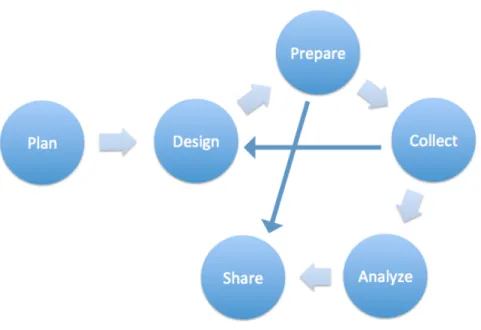
Any case study follows six iterative steps, Figure 1, which allows for corrections and
alterations during the study.
Figure 1 - Case Study Research Cycle (Yin, 2009)
A research design is necessary since it is a blueprint for the research, dealing with four
problems: what questions to study, which data is relevant, which data to collect and how to
analyse the results (Yin, 2009). There are four components important in case study research:
study question, its propositions (when existing), the logic linking the data to the propositions and
the criteria for interpreting the findings.
The techniques used in this study include document analysis to understand the current
EA state at CMP and interviews to understand the use given to those EA artefacts as well as to
identify change situations lived inside the organization and how those artefacts where useful in
the situations referred. Interviews were done to important stakeholders inside CMP. Besides
Introduction
support the findings obtained from the previous techniques. Although surveys may be considered
a research approach per se (Yin, 2009), in this situation will be used just as a data collection
technique.
When doing Case Study Research, some ethical issues must be taken into account.
There are three key ethical concepts: confidentiality, negotiation, and accessibility. These will be
explored in the Study Description Chapter. As in every research project, several more general
ethical considerations must be taken in account and for that the AIS Code of Research Conduct
(Davison, Munro, & Straub, 2003) was followed.
1.4. Document Structure
The organizing logic of a document is an important factor on helping to understand any
project. The document structure must follow a logical order that allows the reader to move from
one chapter to the next understanding and gaining more insight about the project. This section
presents the structure of this research report.
The second chapter, Literature Review, introduces the main concepts this work revolves
around and the most referenced authors in the area. The evolution of the EA concept and its link
to organizational agility are the focus of the chapter. It ends with the state of the art about
theoretical studies done in the area.
Chapter three presents the study description and the research methodology in more
detail as well as methods and tools used. It begins with a short description of the studied
organization and evolves to the practical study, differentiating the various study phases.
Following the study description, the results analysis and discussion must be done.
Chapter four introduces the obtained results in each phase of the study and ends with a
discussion of results in light of the theory presented in the literature review.
Chapter 5, Conclusion, finishes the report presenting the main conclusions that have
been reached, discusses project limitations and possible future work.
Literature Review
2.
ENTERPRISE
ARCHITECTURE
AND
ORGANIZATIONAL
AGILITY:
LITERATURE
REVIEW
Enterprise architecture and organizational agility are the main concepts addressed by
this work. In this chapter these two concepts will be explained and related. Previous related
studies will be taken into account to understand what has already been done in this area of
research and what still needs to be done.
2.1. Enterprise Architecture
As a first approach to the concept of EA, the two words can be analysed separately with
the purpose of understanding each one. The term architecture has been in use since the time of
the roman empire and can be generally defined as “the complex or carefully designed structure
of something” (Oxford, n.d.). It has had a long history and its principles are used in many areas.
As to the term enterprise, many definitions exist. The definition presented by CIO Council (2002)
that defines enterprise as “an organization (or cross-organizations entity) supporting a defined
business scope and mission. Includes interdependent resources (people, organizations and
technology) that must coordinate their functions and share information in support of a common
mission (or set of related missions)” will be considered. Still having this definition of enterprise in
account, the term organization will be used throughout this document with the same meaning as
enterprise, except in the cases where it is described as being part of the enterprise.
The concept of architecture applied in the context of enterprises emerged in 1987 and
was introduced by J.A. Zachman (1987) in his article “A Framework for Information Systems
Architecture”. Initially, the author, referred to it as Information Systems Architecture but then
evolved the concept to what it is today, enterprise architecture. According to Zachman (2009),
this evolution came later, when he thought people would be more willing to accept the full
meaning of EA.
Zachman (1987) states the need to look at organizations as a complete system
integrating business and technology instead of two separate parts of the same organization. With
this in mind, the concept of EA arises as a means to solve two problems that, according to
Zachman, were and still are limiting the broad aspect of organizations. Sessions (2007) presents
the two problems as follows:
• Systems complexity - Enterprises spend a great amount of their capital in information
technology systems. The complexity of these systems keeps on increasing without
offering any real value to the enterprise;
• Lack of alignment between business and technology systems.
It is now important to clarify the meaning of EA. Many definitions have appeared in the
past years and an evolution of the concept can be perceived across these definitions. The various
existing definitions for this concept are an indication that this area of study still needs further
research. Many of the definitions consider only part of the architecture or focus only on some
parts of the enterprise. For the purpose of this work, only broad definitions were considered.
Zachman (1987) was the first to answer the big question. What is Enterprise
Architecture? He does not agree with the existence of a single EA but instead he says there is a
set of them depending on the function you perform inside the enterprise. Depending on your job,
you will define a different architecture. The various architectures defined inside the same
enterprise are then different but additive and complementary.
This definition is very wide and is not enough to satisfy or respond to the two problems
EA emerged to resolve. Taking into account the need to align business and IT systems, new and
more specific definitions arose. The CIO Council (2002) presented a definition encompassing the
strategic aspect of EA focusing on the mission of the enterprise and all the information,
technology and processes needed to support that mission. This definition also includes the fact
that EA has a baseline architecture, a target architecture and a sequencing plan. Based on this
last part of the definition, Slot (2010) presents EA as “the practice of applying a standard
approach for and describing in a standard way the current and/or future structure and behaviour
for an organization's processes, personnel and organizational sub-units, information systems and
technical infrastructure”.
Literature Review
(2000) definition for EA as “the fundamental organization of a system embodied in its
components, their relationships to each other, and to the environment, and the principles guiding
its design and evolution” (Jen & Lee, 2000). Based on this last definition, Winter & Fischer
(2006) evolved it to a broader concept by applying this same definition but using the term
enterprise or corporation instead of system and relating it to its partners, customers and
suppliers.
Gregor, Hart, & Martin (2007) presented their definition based on the ISO 15704:2000
standard, “Industrial Automation Systems – Requirements for Enterprise Reference Architectures
and Methodologies”, that states that EA is a descriptive representation of the various enterprise
parts’ structure and the way they are organized. It takes into account data, information, systems,
technologies, designs and business processes.
All these definitions focus mostly either on business-IT alignment or information
technology aspects. A more comprehensive definition can help to understand this complex
concept. Thinking of EA as the definition and representation of a high-level view of an enterprise’s
business processes and IT systems, can simplify the concept without withdrawing its importance
or significance. The business processes and IT systems interrelationships, and the extent to
which they are shared by the different parts of the organization should also be clear in the EA
(Tamm et al., 2011). Or, from a similar point of view: “EA is the organizing logic for business
processes and IT infrastructure, reflecting the integration and standardization requirements of the
company’s operating model. The enterprise architecture provides a long-term view of a
company’s processes, systems, and technologies so that individual projects can build capabilities
- not just fill immediate needs” (Ross, Weill, & Robertson, 2006).
This latter definition given by Ross and colleagues (2006), considers EA as a discipline
an enterprise must have to build an effective foundation for execution. Besides EA, an operating
model and an IT engagement model are also required. The operating model describes how the
company wants to thrive and grow. Then, the EA is built taking the operating model in
consideration. Lastly, the IT engagement model is the governance mechanisms system, that
ensures business and IT projects achieve both local and companywide objectives, and it
influences project decisions so that EA can guide individual solutions.
EA is often represented in principles, policies and technologies choices (Ross et al.,
2006) as well as models and methods (Lankhorst, 2012). EA is not a system but instead a
documentation of the various systems of the organization (Espinosa, Boh, & DeLone, 2011).
These are EA artefacts, defined by The Open Group (2011), are architectural work products that
describe an aspect of the architecture. Most of the times four distinct but dependent levels are
represented. Other authors, like Winter and Fischer (2007), consider five or more levels. These
levels are many times confused and some authors wrongly consider one of the levels, or a set of
them, as the complete EA. The four main levels are:
• Business process architecture – the activities or tasks composing major business
processes identified by the business process owners as well as organizational mission;
• Data or information architecture – shared data definitions;
• Applications architecture – individual applications and their interfaces necessary to
support processes;
• Technology architecture – infrastructure services and the technology standards they
are built on (e.g., hardware, software, networking and communication platforms).
Espinosa et al. (2011) elaborate on the purpose and contents of each architectural level.
Business process architecture bridges the gap between high-level business drivers,
business strategy and goals with some more specific requirements that concern the technical
aspects of the architecture development effort.
At data architecture we can find a description of the information frequently used by the
organization and the relations among collections of data. Corporate data models and enterprise
data dictionaries are common artefacts in this level of architecture.
Applications architecture allows the organization to view the overall portfolio of
applications, providing a blueprint for mapping existing and proposed applications and how they
fit business requirements, which supports strategic IT decision making.
Technology architecture is a mechanism for identifying and resolving conflicts on
technology choices and usage. This level of architecture focuses on standardizing and
coordinating components and services used within the enterprise to ensure greater compatibility
and connectivity.
As Lankhorst (2012) argues, the most important characteristic of EA is that it provides a
holistic view of the enterprise. All the artefacts that compose the EA help bridge the
Literature Review
communication gap between architects and stakeholders. This happens because a good EA
translates enterprise’s principles, capabilities, and goals defined in the strategy into systems and
processes that enable the enterprise to realize these goals (Tamm et al., 2011), i.e., facilitates
the translation from organization strategy to daily business operations.
Many companies do not build and use architecture since it has acquired a negative
connotation. In these situations, EA is set aside. In most cases, this happens because the
architecture is isolated from business reality. The first step in having an enterprise architecture
that supports business activities is to involve senior management in the task of designing it.
Senior management must take lead for there are important and tough decisions to be made
about the operating model, like defining the enterprise’s vision, identifying key costumer types,
identifying core processes and identifying shared data and technologies to be standardized. Top
management commitment is critical to achieving high EA maturity levels (Espinosa et al., 2011).
When IT staff is in charge of developing the EA, the outcome is rarely used because the
focus usually is to catalogue the legacy systems. IT executives can enable the design of an EA
either by promoting senior management discussion or by leading the design of the core diagram
– the basis from where EA will be developed (Ross et al., 2006).
When talking about big companies, the development of an EA requires the cooperation of
several architects, in which everyone plays a part as designer of one of the architectures that will
compose the EA. It is the role of the organizational architect to have the global vision and to
coordinate the work of all the other architects (Sessions, 2007).
The motivation to start creating an EA can come from internal or external aspects of the
enterprise. Internal aspects may consider business-IT alignment or systems complexity as already
mentioned as well as other strategic advantages. External aspects include mostly market
changes and regulatory pressures, forcing enterprises to have a clear insight into their operations
and to respect the law. One of these examples is the Clinger-Cohen Act in the USA that forces
government agencies to have an IT architecture. In Europe, architecture practices are gaining
force although there are no strict requirements (Lankhorst, 2012).
To help and guide the process of designing and creating an EA, several frameworks exist.
The task of choosing the one that best fits the enterprise needs is up to the organization. Next,
the most relevant enterprise architectures known will be briefly explained.
2.1.1. Enterprise Architecture Frameworks
Every organization should feel the need to develop its own EA based on a critical analysis
of its internal state. Some questions, such as, does my organization spend too much money
building technological systems that do not have a positive impact in the business value? Are
information technologies helping or hurting business agility? Is there a good relation between
technology and business professionals? (Sessions, 2007) All these questions must be thought
upon and answered by top management before advancing to the development of an EA. There is
not one EA that can overcome organizational issues if a commitment to change does not exist.
No EA solves problems. They just offer a way to solve some problems (Sessions, 2007).
To design an EA, enterprises can use an EA framework to guide them through the
process. There are several EA Frameworks. Each framework was created with a different purpose
and to fulfil different needs and concerns. The main differences are on the users to whom these
frameworks were intended, the problems the framework solves, the approach used and detail
level. Some frameworks are just guides while others offer methods and practices to follow
(Urbaczewski & Mrdalj, 2006).
The first reference to a framework was presented in 1987 with the publication of J. A.
Zachman (1987) – “A Framework for Information Systems Architecture” were the Zachman
Framework was introduced. His vision and ideas had a great influence on the United States of
America (USA) Department of Defence (DoD). In 1994, one of the first DoD attempts to create an
EA framework resulted in the Technical Architecture Framework for Information Management
(TAFIM). This first experience ended in 1998 and all the work done on TAFIM was transferred to
The Open Group. The Open Group revised it and transformed it in a new world known standard –
TOGAF.
Influenced by the promises of EA in aligning technological projects with business needs,
the American Congress approved the Clinger-Cohen Act in 1996. This act obliged every federal
organization to improve the efficiency of their investments in IT. As a result of this measure, a
new group formed by several Chief Information Officers (CIO) from the largest government
agencies was created to supervise this effort. The first big project implemented by this group,
which took place in 1998, was the development of the Federal Enterprise Architecture
Framework (FEAF). This framework has evolved and suffered some modifications, and since
Literature Review
According to Obitz & Babu (2009), TOGAF is the most adopted framework because it
allows enterprises to focus on the design of their EA instead of developing a method to design an
EA. This usage lead is also noted in the governmental area, where organizations also prefer
TOGAF to FEA.
Independently of the framework chosen, its goal should be to help people focus on the
EA development, so that the limited time they have is spent in making choices and decisions
relevant to that task (PriceWaterHouseCoopers, 2008).
This brief history of EA Frameworks comprises the three frameworks that will be analysed
in more detail: Zachman Framework, TOGAF and FEA.
2.1.1.1. Zachman Framework
This framework can be considered as a taxonomy (Sessions, 2007) to organize the EA
artefacts such as project documents, specifications and models. Zachman (1996) says that “the
Framework as it applies to enterprises is simply a logical structure for classifying and organizing
the descriptive representations of an enterprise that are significant to the management of the
enterprise as well as to the development of the enterprise’s systems.” This description given by
the author is consistent with the dictionary definition of taxonomy as ” the branch of science
concerned with classification, especially of organisms; systematics” (Oxford, n.d.)
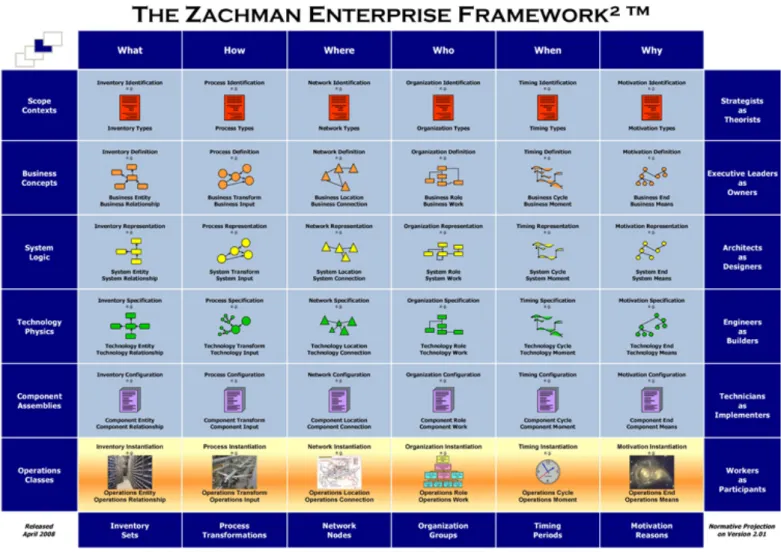
When Zachman presented his methodology, he explained it by analogy to the
construction industry. In the construction industry the architectural artefacts are organized in two
dimensions. The users dimension and the focus dimension as for example: what, how, when,
etc. These dimensions are represented in the form of a table as shown in Figure 2.
If the table is read horizontally, while holding the user perspective, the focus changes,
that is, different descriptions of the system can be observed. Reading the table vertically the
focus perspective does not change but the user’s does, being possible to observe different
perspectives with the same focus.
Figure 2 - Zachman Framework
This framework offers three recommendations to help an enterprise develop its own EA
(Sessions, 2007):
1. Each architectural artefact must exist in only one cell. There should be no ambiguity
about in which cell does a certain artefact belong. If this is not clear it is possible that the
artefact is not well conceived;
2. The architecture can be considered complete when all the table cells are complete. One
cell is complete when it contains enough artefacts to completely define the system to a
specific user that is looking through a specific descriptive focus;
Literature Review
Advantages of this framework are that it is simple to understand, addresses the
enterprise as a whole, is defined independently of tools or methodologies, and any issues can be
mapped against it to understand where they fit (Lankhorst, 2012).
There are some critics to Zachman’s Framework. It is a taxonomy, making it a simplistic
system that does not offer any sequential order and does not explain the development process.
Its concern is mostly to guarantee that all the cells are filled creating a complete system, and it
does not help in the decision and analyses process as to create the best possible EA (Sessions,
2007; Urbaczewski & Mrdalj, 2006). Besides these drawbacks, Lankhorst (2012) refers that
there are a large number of cells and that the relations between them are not very well specified.
2.1.1.2. TOGAF
TOGAF “offers methods and tools to help in the acceptance, production, utilization and
maintenance of an EA. It is based on an iterative process model, supported by the best practices
and an existing reusable set of objects of the architecture” (Group, 2009).
This framework is prepared to support the four architectural domains referred before.
These four domains or architectures are presented in Table 1.
Table 1 - TOGAF architectural domains Business
Architecture Defines the business strategy, governance, organization and key business processes. Application
Architecture Plan for the individual application systems implementation, as well as their interactions and relations with the central business processes. Data Architecture Describes the logical and physical databases structure of the enterprise and the data management resources. Technology
Architecture Describes the logical hardware and software capabilities necessary to support the business services, data and applications functioning.
These four domains are closely interrelated. The Architecture Content Framework,
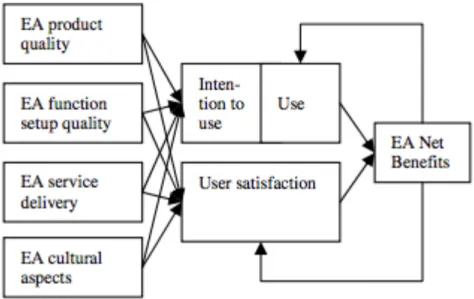
Figure 3, is the component of TOGAF, which considers an overall enterprise architecture consisting of
Figure 3 - TOGAF Architecture Content Framework
One of the most important components of TOGAF is its Architecture Development
Method (ADM). It is the ADM process that characterizes TOGAF (Sessions, 2007) and is
considered its core (Lankhorst, 2012). It is a stepwise cyclic process shown in Figure 4
composed by eight steps, which contribute to the development of the overall enterprise
architecture.
ADM is iterative, over the whole process, between phases and within phases. Lankhorst
(2012) states that each iteration forces decisions about:
• The breath of coverage of the enterprise to be defined;
• The level of detail to be defined;
• The extent of the time horizon aimed at, including the number and extent of any
intermediate time horizons;
• The architectural assets to be leveraged in the organization’s Enterprise Continuum,
including assets created in previous iterations and assets available elsewhere in the
industry.
Literature Review
Figure 4 - TOGAF Architecture Development Method
This method can be modified or adjusted to fit specific organizational needs as it may be
used in conjunction with a set of deliverables of another framework. ADM can also be used with
Zachman’s Framework, complementing its lack of a well-defined methodology.
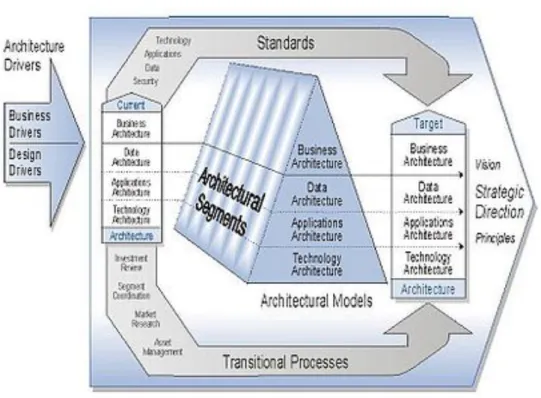
2.1.1.3. FEA
By the FEA perspective, Figure 5, the goal is to organize and promote sharing of Federal
information for the entire Federal government (Urbaczewski & Mrdalj, 2006). Architecture
consists of various segments. Each segment is a business area essential functionality. FEA
distinguishes between core mission-area segments, which are central to the organization
operation, and business-services segments, which are fundamental to most, if not all,
governmental organizations. FEA also considers organizational services.
A service can be distinguished from a segment. A service embraces all the political
organization while a segment concerns one political department.
According to Sessions (2007), a complete utilization of this framework includes:
• A perspective over how EA must be seen;
• A process to create an EA;
• A transactional process to move from a pre-architecture paradigm to as post-architecture
paradigm;
• A taxonomy to catalogue artefacts belonging to the EA;
• An approach to measure the use success of an EA as a way to create business value.
Figure 5 - Federal Enterprise Architecture
Five reference models intend to provide definitions and standards to the domain of EA
and enable the collaboration and share between government departments. The five reference
models are:
• Business Reference Model (BRM) – business vision of the various federal government
functions;
• Components Reference Model (CRM) – technological vision of the systems that support
business functions;
• Technical Reference Model (TRM) – defines technologies and standards that can be used
when developing technological systems;
• Data Reference Model (DRM) – defines standard ways to describe data;
• Performance Reference Model (PRM) – defines standard ways to describe the value
offered by EA;
Literature Review
The EA development process following the FEA focuses in the creation of architecture for
a subgroup of the enterprise. This process generally follows four main steps:
Step 1 – Architectural analyses – define a simple and concise vision for the segment
that relates to the organization plan;
Step 2 – Architectural definition – define the desired state of the architecture for
that segment; document the performance goals; consider implementations alternatives; develop
an EA for the segment including business, data, service and technological architectures;
Step 3 – Investment and financial strategy – Ponder how the project will be
financed;
Step 4 – Program management plan and projects execution – create a plan to
manage and execute a project, including milestones and performance measures to gauge the
project’s success.
2.1.2. Enterprise Architecture Benefits
At this point in the discussion, a question can be raised: What are the organizational
benefits of developing and maintaining an EA?
Literature claims a lack of empirical demonstration of EA organizational benefits
(Espinosa et al., 2011; Lange et al., 2012; Tallon & Pinsonneault, 2011; Tamm et al., 2011)
since there are no studies to evaluate the success or impact EA has on enterprises (Espinosa et
al., 2011). This is necessary to learn how EA helps organizations, and for EA practitioners, to
justify their investments on EA to organization managers (Obitz & Babu, 2009). This section will
focus on the benefits that are pointed out in the literature.
Some of the most cited benefits in the literature include increased responsiveness
leading to change, improved decision making, improved communication and cooperation, cost
reduction and business-IT alignment (Tamm et al., 2011). From all the afore mentioned,
business-IT alignment has been the primary goal for organizations when developing and using an
EA (Obitz & Babu, 2009; Tallon & Pinsonneault, 2011).
Besides all the benefits already considered, Ross et al. (2006) mentions higher
profitability, faster time to market and more business efficiency as other benefits that can be
accomplished by the existence of EA.
According to Tamm et al. (2011), it is necessary to distinguish between benefits that
directly derive from EA, from those that apparently have a direct connection to EA but instead are
enablers to achieve benefits. The authors propose the Enterprise Architecture Benefits Model
(EABM). This model presents organizational alignment as a result of EA (Lange et al., 2012) that
enables the achievement of other benefits. Organizational alignment is defined as an extension in
which the subunits of an organization share a common comprehension of the strategic goals and
contribute to achieve those objectives.
Organizational alignment must be thought horizontally between functional areas as well
as vertically, between organizational management and the different strategic business units. It
must be thought in a short term with organizational goals and in the long term with a shared
vision about technology usage (Gregor et al., 2007).
Some social factors can influence the possible organizational alignment. These factors
include top management support, organizational planning style and business plan
communication to stakeholders (Gregor et al., 2007).
When an organization plans or works around its EA, an involvement between the several
departments is created that enhances alignment creation. It is a task that implies dialogue
between various functions, identification of interdependencies between several parts of the
organization, identification of the stakeholders affected by those interdependencies and the
resolution of conflicts identified during the communication. All these factors lead to a better
comprehension and awareness of the various enterprise departments about the common goals
and other departments job (Tamm et al., 2011).
Sessions (2007) focuses on the two primary goals of EA. One of those objectives – the
alignment between business and IT, was already explored. The other one is reducing the
extensive costs and difficulty in maintaining technology by simplifying the complex IT systems
while increasing the business efficacy and value. If this is accomplished, it can be considered one
of the greatest benefits of EA. This and other benefits will also result in maintaining and
rebuilding the information technology function credibility within an organization.
Literature Review
Next to business-IT alignment, agility has grown as a key business imperative (Tallon &
Pinsonneault, 2011). It is amongst the most cited EA benefits and is the focus of this study.
2.2. Organizational Agility
The previous chapter section explored the benefits of EA. Organizational or business
agility is considered one of the most important benefits. This benefit of EA will be explored in this
chapter in all its dimensions and its characteristics described.
Agility is a necessity these days when the environment changes at ever-increasing pace.
What seemed a straight road, will eventually take a curve. Globalization, regulation and faster
cycle times (PriceWaterHouseCoopers, 2008) demand an ability to quickly change organizational
processes. Some companies are able to succeed and thrive for they have a solid foundation for
execution. This foundation for execution is the IT infrastructure and digitized business processes
automating a company’s core capabilities. Technologies are seen as an asset rather than a
liability and are embedded in the core business processes. What these companies have created
is a foundation for business agility (Ross et al., 2006).
Lankhorst (2012) defends that EA is the way to capture the essentials of the business,
while still allowing for maximal flexibility and adaptability (Dove, 1995a). As the author refers
“good architectural practice helps a company innovate and change by providing both stability and
flexibility. The insights provided by enterprise architecture are needed on the one hand in
determining the needs and priorities for change from a business perspective, and on the other
hand in assessing how the company may benefit from technological and business innovations.”
Before addressing the concept of organizational agility it is important to understand the
concept of agility. Agility is an “efficient and effective response to planned as well as
unanticipated change” (Alexopoulou, Kanellis, & Martakos, 2006), or, as Dove (1995a) presents
it: “the ability to thrive in a continuously changing and unpredictable environment.” The focus
word in these definitions is change. Organizations must have the ability to start change and to
respond to change. Change should be studied as a defensive as well as offensive characteristic in
every enterprise. This last definition is also supported by Tallon & Pinsonneault (2011), whom
add quickness and effectiveness as determinant characteristics of change. In other words,
organizational agility “is the ability to move quickly in new directions as needed without breaking
the core infrastructure and without putting the organization at undue risk”
(PriceWaterHouseCoopers, 2008).
Agility in the enterprise context appeared in 1991 when an industry group observed that
the increasing rate of change in the business environment was outpacing the adaptability of
traditional manufacturing organizations. This translated in customer losses as new and innovative
products and services emerged, and business failure (Dove, 1994a).
Dove (1994a) considered two necessary conditions in order for organizations to keep
operating: the organization must satisfy some purpose and must continue to adapt to the
changing environmental conditions. A successful organization adapts to take advantage of
unpredictable opportunities and survive unpredictable threats.
It is not easy to attain agility for it requires knowledge, experience, skills, anticipation,
planning, testing of solutions and an understanding of where the business value lies
(PriceWaterHouseCoopers, 2008). Factors such as personnel capabilities, IT infrastructure and
business strategy affect enterprise agility. So, for an enterprise to be agile, all its constituents
must be agile (Alexopoulou et al., 2006).
According to Dove (1994c), agility can be thought of in four different dimensions: cost,
time, quality and scope. Every dimension must be fulfilled for an enterprise to be considered
agile. It is not viable to have change at no cost, so the idea behind this dimension is to reduce
cost to its maximum. An effective way to respond to a change is to do it in a timely manner. But
changing quickly and economically is still not enough. A robust solution must be presented and
maintained. Finally, the last agile dimension concerns the ability to thrive on change and the
capacity to withstand the impact of change (PriceWaterHouseCoopers, 2008).
When a change is planned, the ideal transition period from previous to final state would
take no time and incur in no costs. But there is no change without a transition period of
integration and adjustment that takes time, quality, market assessment, and costs until it settles
(Dove, 1994c). To reduce this transition toll, process reutilization is necessary. Organizations that
pursue proficiency, need to structure their processes and systems as reusable and adaptable.
Processes, systems and other architectural issues must be built so they can be deconstructed
and reconstructed as necessary (Dove, 1994b).
Another concept used in the context of agility is standardization. Standards can be
positive and negative to agility (Dove, 1995b). As Ross et al. (2006) stated, standardization of
Literature Review