RESUMO.- [Influência da bipartição escrotal sobre o rendimento da espermatogênese e eficiência das cé
-lulas de Sertoli em ovinos.] Com o objetivo de avaliar o efeito da bipartição escrotal sobre a espermatogênese em ovinos, foram utilizados os testículos de 12 ovinos sem raça definida oriundos de criadouros do município de Patos-PB, Brasil, distribuídos em dois grupos, GI de seis animais com
bipartição escrotal e o GII de seis animais sem bipartição escrotal. Realizou-se a aferição da biometria testicular, em seguida, os testículos foram coletados, fixados em Bouin e fragmentos foram processados para obtenção de lâmi-nas histológicas. Foi estimado o rendimento da esperma-togênese e eficiência das células de Sertoli contando-se as células da linhagem espermatogênica no estádio I do Ciclo do Epitélio Seminífero, bem como as células de Sertoli. Os resultados foram submetidos à análise de variância pelo programa ASSISTAT v.7.6 e os valores médios foram com -parados pelo teste Student-Newman-Keuls (SNK) a 5% de significância. Os parâmetros de biometria testicular não apresentaram diferença estatística (p>0,05) entre os gru -pos. Os rendimentos meiótico, espermatogênico e a eficiên -cia das células de Sertoli mostraram-se superiores em ani -mais bipartidos (p<0,05), enquanto o rendimento mitótico não diferiu (p>0,05) entre GI e GII. Os resultados indicaram existir superioridade nos parâmetros espermatogênicos de ovinos bipartidos, sugerindo que estes animais apre
-Influence of scrotal bipartition on spermatogenesis yield and
sertoli cell efficiency in sheep
1Ramon T.G.A. Rodrigues2, José R.S. Santos2, Lilianne M.S. Azerêdo2, Ediane F. Rocha2,
Maria A.M. Carvalho3, Maria J.I.D. Portal4, Otávio B. Sousa2 and Danilo J.A. Menezes2*
ABSTRACT.- Rodrigues R.T.G.A., Santos J.R.S., Azerêdo L.M.S., Rocha E.F., Carvalho M.A.M., Portal M.J.I.D., Sousa O. B. & Menezes D.J.A. 2016. Influence of scrotal bipartition on sper
-matogenesis yield and Sertoli cell efficiency in sheep. Pesquisa Veterinária Brasileira 36(4):258-262. Unidade Acadêmica de Medicina Veterinária, Centro de Saúde e Tecnologia
Rural, Universidade Federal de Campina Grande, Avenida Universitária s/n, Santa Cecília, Patos, PB 58708-110, Brazil. E-mail: [email protected]
With the objective to assess the effect of scrotal bipartition on spermatogenesis in she-ep, the testes were used from 12 crossbred rams of sheep farms in the municipality of Pa -tos, Paraíba, Brazil, distributed into two groups: GI with six rams with scrotal bipartition, and GII with six rams without scrotal bipartition. The testicular biometry was measured and the testes were collected, fixed in Bouin and fragments were processed to obtain his -tological slides. The spermatogenesis yield and the Sertoli cell efficiency was estimated by counting the cells of the spermatogenetic line at stage one of the seminiferous epithelium cycle and the Sertoli cells. The results were submitted to analysis of variance with the AS -SISTAT v.7.6 program and the mean values were compared by the Student-Newman-Keuls test (SNK) at 5% significance. The testicular biometric parameters did not show statistical difference (p>0.05) between the groups. The meiotic, spermatogenetic and Sertoli cell effi -ciency were higher in bipartitioned rams (p<0.05), while the mitotic yield did not differ (p>0.05) between GI and GII. The results indicated that there is superiority in the sper -matogenetic parameters of bi-partitioned rams, suggesting that these sheep present, as reported in goats, indication of better reproductive indices.
INDEX TERMS: Scrotal bipartition, spermatogenesis yield, Sertoli cells, reproduction, testicle, sheep.
1 Received on December 1, 2015.
Accepted for publication on January 15, 2016.
2 Unidade Acadêmica de Medicina Veterinária, Centro de Saúde e Tec
-nologia Rural (CSTR), Universidade Federal de Campina Grande (UFCG), Avenida Universitária s/n, Santa Cecília, Patos, PB 58708-110, Brazil. *Co -responding author: [email protected]
3 Departamento de Morfofisiologia Veterinária, Centro de Ciências Agrá
-rias, Universidade Federal do Piauí (UFPI), Campus Ministro Petrônio Por
-tela, Socopo, Teresina, PI 64049-550, Brazil.
4 Departamento de Fisiologia Animal, Facultad de Veterinária, Universi
-dad Complutense de Madrid, Avda. Puerta de Hierro, s/n, Ciu-dad Univer
sentam, assim como constatado em caprinos, indicativo de melhores índices reprodutivos.
TERMOS DE INDEXAÇÃO: Bipartição escrotal, espermatogênese, células de Sertoli, ovinos, reprodução, morfologia, testículo, ovi -nos.
INTRODUCTION
Understanding the physiology of domestic animals is es-sential for stock rearing with high productivity indexes. The physiological parameters include the reproductive mechanisms, especially the gonadal dynamic, an important factor in reproductive plasticity that acts integrated with the environment and climate and the relationship between its genotype and the environment is very important for re-production of the species (Santos et al. 1998).
Successive reproduction of a herd depends, among other factors, on the choice of a good breeder that will transmit its genetic characteristics to its future descendants. Among the factors to be assessed in the male, the morphological aspects are important phenotypic indicators of what is ne -eded to obtain in future offspring. In addition to the body confirmation, the morphology of the reproductive appara -tus should be considered in this choice.
In regions with tropical climate, some manifestations have been reported of morphological alterations of the re-productive organs in goats, such as the appearance of a di-vision in the scrotum of these animals (Robertshaw 1982, Nunes et al. 1983). The characteristics of scrotal bipartition have also been reported in sheep of the Morada Nova breed (Melo 2013). In the semiarid region of the state of Paraíba, Brazil, sheep raisers have also reported the appearance of rams with these characteristics within their herds.
These and other morphological alterations are due to the evolution of the species, that is characterized by chan-ges in the frequency of the occurrence of determined ge -nes in response to factors including mutation, natural se-lection, geographic or reproductive isolation and climatic adversities. Thus the situations of certain genes that until then were quiescent in the organism, may be activated, tri -ggering the appearance of morphological adaptations in the animals (Linhares & Gewandsznajder 2000).
To analyze the effect of morphological alterations in the reproductive organs on reproductive efficiency, it is neces -sary to observe the testicular plasticity, especially regar-ding spermatogenesis, , that can indicate the reproductive efficiency of the animal submitted to intrinsic or extrinsic influences. In this way, testicle histological quantification becomes an efficient instrument to determine the sperma -togenetic capacity of an animal in the face of physiological or pathological conditions (Castro et al. 1997, Leal 2004).
Acquisition of knowledge regarding the influence of scrotal bipartition on reproductive efficiency in sheep has become relevant and necessary, considering that in the go-ats a positive correlation has already been found between these two factors. Thus the objective of the present study was to identify the presence and intensity of differences in the spermatogenesis process in animals with bipartitioned scrotum, by a histological study associating the morpholo-gical characteristics of animals from the semiarid region of
Paraíba state, Brazil. The results of this study may help she -ep rearers to select rams with high r-eproductive capacity to enhance the performance of their production activities.
MATERIALS AND METHODS
Location and research animals. The testis were collected from 12 hair crossbred rams, approximately 1-year-old, identi -fied by observing the change in the hoof wall (Silva 2001) and ho -mogeneous body score (mean weight 31.5kg). The animals came from extensive rearing systems on rural properties in the munici -pality of Patos, PB, Brasil, reared under the same food and climatic conditions. The animals were divided into two groups, conside -ring the scrotal conformation, as proposed by Almeida (2003) for goats, following the classification by Nunes et al. (1983). Group 1 (GI) consisted of six animals with a 10% of division in the distal portion of the scrotum and were considered animals with scrotal bipartition, and group two (GII) consisted of six animals without scrotal bipartition.
Testicular biometry. Before slaughtering the animals, the testes were measured, pulling them down and backwards to take the measurements of the scrotal perimeter using a tape measure at the widest part of the scrotum (mid portion).
After slaughtering the animals, the testes were carefully col -lected with a cutting instrument, dissected from the scrotum and separated from the epididymis, weighed on 0.01 g precision digi -tal scales and then the testes diameter and length were measured with 0.05 mm precision.
Histological processing. The testes were sectioned in cross cuts approximately 5mm thick, and five cuts were separated from the capitate region, five from the middle region and five from the caudal region of the organ. The cuts were submersed in Bouin so -lution for fixing for 24 hours, washed in 70% alcohol and kept in the solution. The cuts were then processed in a conventional histological routine with impregnation in paraffin to obtain5µm thick cuts by microtomy. The sections were stained using the hematoxylin-eosin (HE). The material was analyzed under a light microscope (Olympus BX40) by an image analysis system (Image Pro-Express v.6.0), images were taken of the seminiferous tubes and the nuclear diameters were measured in ten cells of each cell type analyzed in each testicle and the nuclear diameter of the Ser -toli cells to obtain the Mean Nuclear Diameter (ND).
Counting the cell types of the seminiferous tubes. A total of 72 histological slides were analyzed (three slides of each testi -cle, six slides per animal), in which stage one of the Seminiferous Epithelium Cycle (CES) was identified by the tubular morphology method (Cardoso 1981, Ortavante, Courot & Hochereau-de-Re -viers, 1984), observing the alterations in the shape of the sper -matid nucleus, the occurrence of meiotic division and sper-matid position in the seminiferous epithelium. The different cell types were counted in the 20 most circular cross cuts from seminiferous tubes per testicle. The CES cells counted were type A spermato -gonia, young spermatocyte I in the pre-leptotene or leptotene phase, old spermatocyte I at the pachytene phase and rounded spermatocytes,in addition to the Sertoli cells that were counted based on the presence of their nucleoles, due to the enormous va-riation and difficulty in delimiting the cell nucleus.
All the cell numbers found were corrected according to the Abercrombie correlation factor (Abercrombie, 1946) modified by Amann & Almquist (1962), for the nuclear diameter and cut thickness represented by the formula: number corrected = count obtained x cut thickness/cut thickness + √(ND/2)2 – (ND/4)2.
Mitosis yield or coefficient of efficiency: calculated by the ra -tios between primary spermatocytes in pre-leptotene/leptotene at stage I and spermatogonia at stage I;
General spermatogenesis yield: calculated from the ratio be-tween rounded spermatid and spermatogonia at stage I;
Sertoli cell efficiency: calculated from the ratio between the total number of rounded spermatids in stage I and the total num-ber of Sertoli cells.
Statistical analysis. The statistical analysis was made by a completely randomized design (two treatments and six replica -tions).The results obtained were submitted to analysis of varian -ce by the ASSISTAT v.7.6 statistical program and the mean values were compared by the Student-Newman-Keuls test (SNK) to com -pare the means at 5% significance.
RESULTS AND DISCUSSION
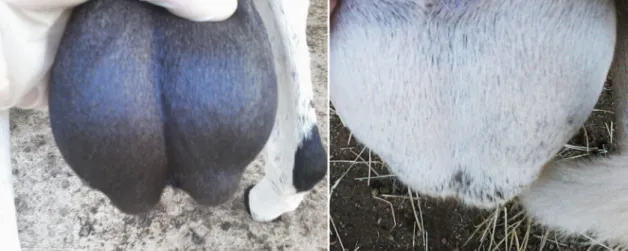
In the rams used in the present study, only one degree of scrotal bipartition was observed that was less than 50%, ie 10% of the scrotum length (Figure 1), similar to other stu -dies on sheep (Oliveira & Menezes 2012, Tolentino 2012), but differing from research on goats, in which animals were also identified with degrees of scrotal bipartition greater than 50% of the total scrotum length (Nunes et al. 1983, Nunes 2005, Almeida et al. 2008, Almeida et al. 2010).
The analysis of the scrotum testicle biometric data did not show significant statistical difference among the two groups of animals (Table 1).
The scrotum circumference and testicle length means observed in the present study (Table 1), compared with those observed in goats, were similar to those found by Al -meida et al. (2010) but lower than those found by Vilar Fi -lho et al. (1993) and greater than those reported by Oliveira et al. (2002). This variation among the testes of the sheep
studied from that of the goats observed in the literature was probably due to differences in the standard age during the study or even to the peculiar variation among the cros-sbred goats in the different studies. However, the impor -tance is highlighted of scrotum circumference analysis to assess sheep, because it was shown by animals of the Santa Inês breed that this parameter can help select animals with high weight gain and reproductive potential, and signifi -cant correlation has been observed between the scrotum circumference and the body weight of these animals (Bit -tencourt, Ribeiro Filho & Almeida 2003), unlike what has been reported in a study with buffaloes, that wasn’t shown correlation between these parameters (da Luz et al. 2013).
The mean testicle weight values of Santa Ines sheep, that ranged from 80 to 85.07g (Table 1), were compati -ble with the findings by Siddiqui et al. 2005 in Pakistani sheep of the Kajli breed, approximately 12 months old. In contrast, these numbers were lower than those found in a study with Santa Ines sheep (Martins 2006), because they were older animals than those used in the present study.
Biometric parameters are practical, cost free measure-ments and can be used as a means to classify puberty in sheep by any farmer who wishes to improve the genetics of his herd (Oliveira 2002), because the highest testicle gro -wth rates occur at this phase, when the primary sperma -tocytes appear and the seminiferous tubes elongate (Hafez & Hafez 2004). Studies have shown that goats with the scrotal bipartition characteristic have greater bodyweight, showing benefits for the production of these animals (Al -meida et al. 2010).
Measurements such as scrotum perimeter, testicle leng-th and weight are associated to leng-the capacity of leng-the organ
Fig.1. Scrotum of crossbred rams. On left, sheep with scrotal bipartition (GI), and the right one without scrotal bipartition (GII).
Table 1. Scrotum testicle biometric values (mean±standard deviation) of groups of crossbred sheep studied. Patos, PB, Brazil 2014
Group Length (cm) Diameter (cm) Weight (g) Scrotal circumference (cm)
Right Left Right Left Right Left
GI 6.79±0.14a 6.34±0.36a 4.92±0.19a 4.92±0.26a 85.07±14.06a 81.57±15.79a 25.33±1.21a
GII 6.72±0.28a 6.39±0.17a 4.83±0.17a 4.83±0.17a 84.44±19.15a 80.01±24.25a 25.16±1.94a
GI: Group I (bipartitioned); GII: Group II (not bipartitioned); Right; Left. Means followed by the same letter in the same colu
to produce spermatic cells (Mies Filho 1987, Almeida et al. 2010), but as there was no statistical difference among the two groups, the biometric data could not be considered as the ideal parameter to analyze the influence of the scrotal bipartition on spermatogenesis in the sheep in the present study. Therefore the quantitative histological analysis was the fundamental factor for comparison between the two groups.
Data regarding the histological parameters for asses-sing spermatogenesis were significantly different for the meiotic, spermatogenic and Sertoli cell yields, while only the mitotic yield was not statistically different among the bipartitioned and none bipartitioned animals (Table 2).
The mitotic yield presented very similar results between the two groups of animals studied, that means that during the phase when the spermatogonia go through continuous mitotic divisions, generating stock T cells, in addition to cells that will continue the differentiation process (Russell et al. 1990), the number of cells generated was similar in animals with and without scrotal bipartition. This result in numbers was similar to that found both in goats with more or less than 50% scrotal bipartition (Machado Júnior et al. 2012), but differed qualitatively because higher yield was observed in the goats with scrotal bipartition greater than 50% compared to those with less accentuated scro -tal bipartition. Qualitatively, the mitotic yields of both the groups of sheep differed from the mean found in a study with Santa Ines sheep (Martins 2006) and in Nelore breed cattle (Ferraz & Costa 2009), that presented values higher than those of the animals in the present study.
Significant statistical difference in the meiotic yield analysis was observed between GI and GII (Table 2), a di -fference also observed in goats with scrotal bipartition gre -ater than 50%, compared to animals that presented scrotal bipartition less than 50% (Machado Júnior et al. 2012). This suggests that the benefits of scrotal bipartition in the annals of the present study started with the meiotic pro -cess, in which the genetic material of the spermatocytesis duplicated and recombined (Hafez & Hafez 2004).
The group of bipartitioned sheep (GI) presented a mean general spermatogenesis yield greater than that of the GII animals (Table 2), suggesting that the spermato -genesis process is more efficient in the sheep with scrotal bipartition, because the result indicated that more roun-ded spermatids were generated from the spermatogonia at the start of the seminiferous epithelium cycle. This su -periority was observed in the literature only in goats with scrotal bipartition greater than 50% of the testicle length,
and did not differ statistically among goats with and wi -thout scrotal bipartition of up to 50% (Machado Júnior et al. 2012). The mean yield of GI was compatible with that observed in studies that used sheep (Martins 2006), and in bulls (Ferraz & Costa 2009), but differed from the findings by Machado Júnior et al. 2012 who used goats, so that it was greater than the yields of goats with various scrotal conformations.
The sheep in the GI presented greater Sertoli cell effi -ciency than the sheep in GII (Table 2), also as observed in bipartitioned goats (regardless of the degree of scrotal bi -partition) when compared to goats without scrotal biparti -tion (Machado Júnior et al. 2012). The Sertoli cell mean in GI was greater when compared to the findings in a study on sheep (Martins 2006), but lower than that observed in cattle (Ferraz & Costa 2009).
Studies have shown that the number of Sertoli cells per testicle is the main factor in determining sperm production and testicle size. This information is based on the fact that the Sertoli cells have a fixed support capacity for the ger -minative cells, so that the number of generators cells, espe-cially the spermatids, supported by a single Sertoli cell, is the best indication of the testicle functional efficiency and consequently of the sperm production (Rocha, Debeljuk & França 1999), that demonstrates that the Sertoli cells of the bipartitioned sheep support a greater quantity of cells of the spermatogenic line, that implies a greater quantity of spermatozoa generated in each cycle of the seminiferous epithelium.
The differences observed between the two groups in the spermatogenesis yield may have occurred due to the different spermatogenetic line process in the bipartitioned animals, because in these animals, there may be less cell apoptosis because their testes have a greater evaporation surface, favoring the testicle heat regulation process (Nu -nes et al. 1983, Machado Júnior et al. 2009).
CONCLUSION
It was concluded that the spermatogenetic line parameters of sheep with scrotal bipartition were different compared to those without scrotal bipartition, with greater efficien -cies in spermatogenesis yield and Sertoli cells in the she -ep with scrotal bipartition, suggesting that these animals present, as reported in goats, better reproductive indices. However, further research should be carried out to better assess the reproductive parameters of sheep with different scrotal characteristics.
Acknowledgements.- This study was carried out with support from CNPq (National Council for Scientific and Technological Development, Brazil)in the form of a grant from the scientific initiation program (PI
-BIC).
REFERENCES
Abercrombie M. 1946. Estimation of nuclear population from microtome
sections. Anat. Rec. 92:239-247.
Almeida M.M., Carvalho M.A.M., Machado Júnior A.A.N., Righi D.A., Xavier F.G., Conde J., Conde Júnior A.M. & Bombonato P.P. 2008. Efeito do grau de
bipartição escrotal sobre a vascularização arterial do escroto de
capri-nos nativos do Estado do Piauí. Braz. J. Vet. Res. Anim. Sci. 45:167-173.
Table 2. Mitotic, meiotic, spermatogenic and Sertoli cell efficiency of the seminiferous epitheliumin Santa Ines sheep
(mean±standard deviation)
Group Mitotic Meiotic Income Efficiency of
Income Income Spermatogenic Sertoli cells
GI 1.90±0.15a 27.20±6.08a 51.61±11.17a 22.74±7.29a
GII 1.78±0.30a 19.37±2.86b 34.33±6.31b 13.88±4.24b
Almeida M.M., Machado Júnior A.A.N., Ambrósio C.E., Menezes D.J.A., Righi D.A., Nascimento I.M.R. & Carvalho M.A.M. 2010. Influência do grau de bipartição escrotal sobre parâmetros reprodutivos de caprinos. Pesq. Vet. Bras. 30:345-350.
Almeida M.M. 2003. Vascularização arterial testicular e escrotal de capri -nos nativos do Estado do Piauí, segundo grau de divisão do escroto, e a
relação com parâmetros reprodutivos. MSc. Dissertation, Universidade Federal do Piauí, Teresina, PI.
Amann R.P.A. & Almquist J.O. 1962. Reproductive capacity of dairy bull. VIII. Direct and indirect measurement of testicular sperm production. J.
Dairy Sci. 45:774-781.
Bittencourt R.F., Ribeiro Filho A.L. & Almeida A.K. 2003. Avaliação de car
-neiros da raça Santa Inês baseando-se na circunferência escrotal. Revta Bras. Reprod. Anim. 27:195-197.
Cardoso F.M. 1981. Morfologia, cinética e quantificação da espermatogê
-nese em zebus (Bos indicus). PhD Thesis, Universidade Federal de Minas Gerais, Belo Horizonte, MG.
Castro A.C.S., Bernedson W.E. & Cardoso F.M. 1997. Cinética e quantifica -ção da espermatogênese: bases morfológicas e suas aplicações em estu-dos da reprodução de mamíferos. Revta Bras. Reprod. Anim. 21:25-34.
Da Luz PA., Santos P.R., Andrighetto C., Jorge A.M. & De Assis Neto A.C. 2013. The correlation between age, body weight and testicular parame -ters in Murrah buffalo bulls raised in Brazil. J. Reprod. Dev. 59(1):14-17.
Ferraz D.C. & Costa D.S. 2009. Rendimento intrínseco da espermatogênese de touros Nelore sexualmente maduros. II Mostra Científica da Faculda
-de -de Medicina Veterinária e Zootecnia, Campo Gran-de, MS. Available
from <http://www.propp.ufms.br/gestor/titan.php?target=openFile
-&fileId=541> Citedd on July 23, 2013.
Hafez B. & Hafez E.S.E. 2004. Reprodução Animal. 7ª ed. Manole, São Paulo. Leal M.C. 2004. Análise morfométrica e funcional do testículo e eficiência
espermatogênica em Sagüis Callithrix penicillata (Primates: Callitrichi
-dae). MSc. Dissertation, Universidade Federal de Minas Gerais, Belo Ho -pizonte, MG.
Linhares S. & Gewandsznajder F. 2000. Biologia Hoje. Ática, São Paulo. Machado Júnior A.A.N., Miglino M.A., Menezes D.J.A., Assis Neto A.C., Leiser
R., Silva R.A.B. & Carvalho M.A.M. 2009. Influence of the bipartite scro -tum on the testicular and scrotal temperatures in goats. Pesq. Vet. Bras.
29:797-802.
Machado Júnior A.A.N., Oliveira L.S., Assis Neto A.C., Alves F.R., Miglino M.A. & Carvalho M.A.M. 2012. Spermatogenesis in goats with and without
scrotum bipartition. Anim. Reprod. Sci. 130(1):42-50.
Martins J.A.M. 2006. Avaliação da biometria testicular, epididimal e das glândulas sexuais acessórias e correlações entre características biomé
-tricas e histológicas em carneiros deslanados sem padrão racial definido (SPRD). MSc. Dissertation, Universidade Federal do Ceará, Fortaleza, CE. Melo T.M.V., Lima Filho J.A.C., Silva J.G., Amaral C.R.A., Correia F.R., Sampaio
M.O., Souza W.M.A. & Coelho M.C.O.C. 2013. Bipartição escrotal associa
-da à má formação prepucial em ovino Mora-da Nova: relato de caso. Arq. Bras. Med. Vet. Zootec. 65:1103-1106.
Mies Filho A. 1987. Reprodução dos animais e inseminação artificial. 4ª ed. Livraria Sulina, Porto Alegre.
Nunes A.S. 2005. Morfologia do funículo espermático e dos escrotos em caprinos nativos do Estado do Piauí, com diferentes configurações es
-crotais. MSc. Dissertation, Universidade Federal do Piauí, Terezina, PI. Nunes J.F., Riera G.S., Silva A.E.F.D., Ponce De Leon F.A. & Lima F.A.M. 1983.
Características espermáticas de caprinos Moxotó de acordo com a mor
-fologia escrotal. Report no.6, Embrapa Caprinos, Sobral, CE.
Oliveira L.H. & Menezes A.J.A. 2012. Características morfológicas do funí
-culo espermático em ovinos sem raça definida, oriundos do estado da
Paraíba, com diferentes graus de bipartição escrotal. Anais VIII
Congres-so de Iniciação Científica da Universidade Federal de Campina Grande,
Patos. Available from <http://pesquisa.ufcg.edu.br/anais/2012/arqui
-vos/resumofinal2-laura-pivic_888.pdf> Cited on July 30, 2013. Oliveira R.R., Pinheiro Júnior J.W., Câmara D.R., Ribeiro K.L.C., Santos
R.M.B., Guerra M.M.P. & Bonelli M. 2002. Aspectos morfométricos e ir -rigação arterial do escroto e testículo em caprinos nativos do estado de
Pernambuco. Revta Bras. Reprod. Anim. 26:129-131.
Ortavante R., Courot M. & Hochereau-de-Reviers M.T. 1984. Espermato
-génesis em los mamíferos domésticos. In: Cole H.H. & Cupps P.T. (Eds), Reproduccion de los animales domésticos. 3ª ed. Acribia, Zaragoza. Robertshaw D. 1982. Concepts in animal adaptation: thermorregulation of
the goat. Dairy Goat J. 3:395-397.
Rocha D.C.M., Debeljuk L. & França L.R. 1999. Exposure to Constant ligth
during testis development increase daily sperm production in adult
Wistar rats. Tissue Cell 31:372-379.
Russell L.D., Ettlin R.A., Sinha-Hikin A.P. & Clegg E.D. 1990. Histological and
histopathological evaluation of the testis. Cache River Press, Clearwater.
Santos D.O., Simplício A.A. & Machado R. 1998. Características escroto -testiculares e do ejaculado em bodes mestiços submetidos à insulação
escrotal. Arq. Bras. Med. Vet. Zootec. 50:287-291.
Siddiqui H.U.R., Ahmad A.A. & Han Z.K. 2005. Biometrical studies of testes
of the ram. J. Agricult. Social Sci. 1:78-79.
Silva J.V., Ribeiro M.N., Silva L.P.G., Pimenta Filho E.C. & Vilar Filho A.C. 2001. Cronologia de caprinos mestiços e naturalizados criados no semi
-árido paraibano. Agropec. Téc. 22:45-51.
Tolentino M.L.D.L. & Sousa O.B. 2012. Descrição histológica do escroto de
ovinos nativos do estado da Paraíba, segundo o grau de bipartição es-crotal e sua relação com a biometria testicular. Anais VIII Congresso de
Iniciação Científica da Universidade Federal de Campina Grande, Patos,
PB. Available from: <http://pesquisa.ufcg.edu.br/anais/2012/arqui
-vos/619.pdf> Cited on July 30, 1913.
Vilar Filho A.C., Birgel E.H., Barnabe V.H., Visintin J.A. & Barnabe R.C. 1993.
Características testiculares e seminais de caprinos criados na região