Fisioter. Mov., Curitiba, v. 31, e003132, 2018 DOI: http://dx.doi.org/10.1590/1980-5918.031.AO32 Licensed under a Creative Commons attribution
[T]
Association between inflammatory mediators, grip
strength and mobility in community-dwelling elderly
Associação entre mediadores inflamatórios, força de
preensão manual e mobilidade em idosos da comunidade
Asociación entre mediadores inflamatorios, fuerza de
la empuñadura y la movilidad en ancianos de la comunidad
Barbara Gazolla de Macedo[a], Hanna Sette Câmara de Oliveira[a], Marielle Viotti de Paula[a], Gisele de Cássia Gomes[b], Carlos Maurício de Figueiredo Antunes[a, c]*
[a] Instituto de Ensino e Pesquisa da Santa Casa de Belo Horizonte (IEP SCBH), Belo Horizonte, MG, Brazil [b] Universidade Federal de Minas Gerais (UFMG), Belo Horizonte, MG, Brazil
[c] Johns Hopkins University School of Public Health (JHSPH), Baltimore, Maryland, United States
[R]
Abstract
Introduction:Aging is associated with loss of muscle mass, immunosenescence and increased production
of inflammatory mediators, high levels being predictors of a decline in functional capacity in the elderly. Objective: To assess the association between inflammatory mediators, interleukin 6 (IL-6) and C-reactive protein (CRP) and functional capacity in the elderly. Methods: Cross-sectional study with 308 community-dwelling elderly. The study was approved by the Research Ethics Committee, under protocol number 067/2010. Grip strength (GS) was measured using a JAMAR® dynamometer and functional capacity by
*BGM: Doctoral student, e-mail: [email protected]
HSCO: BS, e-mail: [email protected] MVP: BS, e-mail: [email protected] GCG: PhD, email: [email protected]
2
the Timed Up and Go (TUG) test. Blood tests were performed and serum levels of C-reactive protein and interleukin 6 assessed. Spearman’s coefficient was applied to analyze the correlation between variables and the Mann-Whitney for intergroup comparison. Significance was set at 0.05. Results: There was no significant correlation between GS, the TUG and inflammatory mediators (CRP and IL-6). However, by adjusting for variables such as age, sex and muscle mass, a significant and inverse correlation (p = 0.023) was observed between GS and CPR. Conclusion: Elderly subjects with low C-reactive protein levels performed better in the grip strength test. It is important to investigate the adverse effects on functional capacity that can be influenced by inflammatory cytokines in the elderly during aging.
Keywords: Inflammatory Mediators. Functional Capacity. Aging. Elderly.
Resumo
Introdução: O envelhecimento está relacionado a perda de massa muscular, imunossenescência e o aumento da produção de mediadores inflamatórios, cujos níveis elevados são preditores do declínio da capacidade funcional na população idosa. Objetivo: Avaliar a associação entre mediadores inflamatórios, interleucina-6 (IL-6) e proteína C-reativa (PCR) e capacidade funcional no idoso. Métodos: Estudo transversal com 308 idosos da comunidade. O estudo foi aprovado pelo Comitê de Ética e Pesquisa, 067/2010. A força de preensão manual (FPM) foi avaliada através do dinamômetro de JAMAR® e a capacidade funcional pelo teste Timed Up and Go. Foi realizado um exame de sangue e analisados os níveis séricos de proteína C-reativa e interleucina-6. Utilizou-se o coeficiente de Spearman para verificar a correlação entre as variáveis e o teste de Mann-Whitney para comparação entre os grupos. O nível de significância utilizado foi de 0,05. Resultados: Não houve correlação significativa entre a FPM e o Timed Up and Go e os mediadores inflamatórios (PCR e IL-6). Porém, ao controlar as variáveis como idade, gênero e índice de massa muscular encontrou-se uma associação significativa e inversa (p = 0,023) entre a FPM e os níveis de PCR. Conclusão: Idosos com baixos índices de proteína C-reativa apresentaram melhor desempenho no teste de força muscular manual. É destacável a importância da investigação dos desfechos adversos que podem ser influenciados pela citocinas inflamatórias na capacidade funcional dos idosos durante o envelhecimento.
Palavras-chave: Mediadores Inflamatórios. Capacidade Funcional. Envelhecimento. Idosos.
Resumen
Introducción: El envejecimiento se relaciona con una pérdida de masa muscular, inmunosenescencia, tanto el aumento de la producción de mediadores inflamatorios, cuyos niveles elevados son predictores de disminución de la capacidad funcional en la población de edad avanzada. Objetivo: Investigar la asociación entre mediadores inflamatorios, interleucina-6 (IL-6) y proteína C reactiva (CRP) y capacidad funcional en los ancianos. Métodos: Estudio transversal con 308 ancianos de la comunidad. El estudio fue aprobado por el Comité de Ética e Investigación, 067/2010. La fuerza de la empuñadura (GS) se evaluó utilizando el dinamómetro JAMAR® y la capacidad funcional mediante la prueba Timed Up and Go. Se realizó un análisis de sangre y se analizaron los niveles séricos de proteína C reactiva e interleucina-6. El coeficiente de Spearman se utilizó para verificar la correlación entre las variables y la prueba de Mann-Whitney para la comparación entre los grupos. El nivel de significancia fue 0,05. Resultados: No hubo correlación significativa entre GS y Timed Up and Go y mediadores inflamatorios (CRP e IL-6). Sin embargo, cuando se controlaron variables como la edad, el sexo y el índice de masa muscular, hubo una asociación significativa (p = 0,023) entre los niveles de GS y CRP, es decir, los individuos que obtuvieron buenos resultados en el GS obtuvieron niveles más bajos de PCR circulante. Conclusión: Los pacientes ancianos con bajos niveles de proteína C reactiva, presentaron mejor desempeño en la prueba de fuerza muscular manual. Es importante investigar los efectos adversos que pueden estar influenciados por las citosinas inflamatorias sobre la capacidad funcional de los ancianos durante el envejecimiento.
3
Introduction
The world is experiencing a demographic transition. Recent global population data published by the World Health Organization (WHO) indicate that 1 in every 10 people is aged 60 years or older, a figure that is expected to rise to 1 in 5 by 2050, with approximately 2.1 billion people in this age group [1]. Estimates suggest that Brazil’s population in 2050 will be the fifth largest in the world [2].
One of the consequences of this demographic shift is
the simultaneous increase in chronic health problems. By 2020, chronic conditions will be the primary cause of incapacity (80%) worldwide and a major problem for health care systems [3].
Senescence, or aging, is a dynamic process that involves physiological, psychological and biochemical losses and a heightened risk of chronic disease, which
can lead to declines in a range of different areas. Aging
is characterized as a progressive and linear decline in
bodily functions [3].
Worldwide, more than 46% of those aged 60 years or older exhibit disabilities. Poor performance in activities
of daily living that require mobility and locomotion are
common in older adults, affecting an estimated 20-30% of community-dwelling elderly over 70 years old [4].
Functional capacity (FC) was defined by Camara [5] as “the ability to efficiently respond to everyday physical
demands, including everything from the basic activities
required for independence to more complex tasks”. As
part of the aging process, FC decreases due to declining physical abilities and changes in the muscular, bone,
cardiorespiratory and nervous systems. The combined
dysregulation of these systems affects performance in
routine activities in this population [5].
Authors suggest that every year up to 10% of individuals aged 75 years or older lose their
independence in activities of daily living, requiring
greater care and assistance. Efficient clinical indices
are needed to allow early interventions aimed at
identifying functionally compromised elderly [6].
Functional impairment may be related to decreased strength and muscle mass, leading to a greater risk of
falls, dependence and mortality in the elderly [7 - 10].
Another relevant negative effect of aging is immunosenescence, which involves the gradual
deterioration of the immune system. These changes
are characterized by an increase in the production
of proinflammatory cytokines, causing chronic inflammation in the elderly. Although immunity may
appear preserved, the increase in these cytokines is associated with high levels of morbidity and mortality
in this population [11]. Some authors report that a rise in inflammatory cytokines is the result of
immunosenescence, low physical activity levels and sarcopenia, even without the presence of associated
diseases [8, 9, 12].
However, Penninx et al. [12] found that high inflammatory cytokine levels are present in acute and
chronic conditions such as coronary diseases, congestive heart failure, atherosclerosis and arthrosis, comorbidities
with a high prevalence among the aged population. Queiroz [13] reports that this increase can be triggered
by weight gain, decreased production of sex hormones,
smoking, extreme stress, depression and pain.
Cytokines, low molecular weight glycoproteins secreted by different cells of the body, play an important
role in this process as inflammatory mediators
(biomarkers) that control the duration and intensity
of inflammation, capable of acting at or near the sites
where they are produced, or being released into the
bloodstream [14]. Chronic inflammation, which persists
over longer periods, seems to have a harmful effect on
the body [8, 12].
The occurrence of persistent low-grade inflammation characterized by high inflammatory mediator levels is common at advanced ages. Interleukin 6 (IL-6) and C-reactive protein (CRP) are among the most widely studied cytokines and acute-phase proteins present in these inflammatory conditions. Inflammation is the result of an imbalance in pro- and anti-inflammatory substances in the body [15]. High levels of proinflammatory mediators, frequently observed in
healthy elderly individuals, contribute to loss of muscle mass and strength and are a precursor of functional decline, dependence, cardiovascular events and severe
diseases [7, 13, 15].
IL-6, known as the “geriatric cytokine”, is produced
during trauma and infection, but high serum levels
are observed in the elderly. Research has shown that prolonged inflammation may be negatively associated
with strength, mass, and functional performance in the
elderly [8 - 10, 12].
C-reactive protein is also related to the inflammatory
process and plays a vital role in the immune mechanism
of aged individuals [16]. High CRP levels are related to functional losses and disabilities [17], including cognitive deficits, vascular dementia and Alzheimer’s [18].
Some studies have demonstrated an association
4
reduced mobility, as well as a decline in the ability to
perform activities of daily living [8, 12].
The performance of elderly individuals in routine
tasks is affected by a number of different variables.
Physical tests and questionnaires aimed at measuring the functional capacity of these individuals are important because they predict possible longitudinal changes in FC
and can be used to assess the interventions applied [5]. The grip strength (GS) test is widely used [5, 8, 17, 19] and seems to reliably demonstrate loss of muscle strength in other muscle groups. Authors such as Camara et al. [5] have reported that the decline in
strength with age can cause repercussions such as increased disability, morbidity and mortality in this
population. Research has shown that GS can predict
reduced functional capacity and mobility, as well as falls
and even death in the elderly [5, 8, 19].
Another widely used mobility test to assess FC in
older adults is the Timed Up and Go (TUG). Its simplicity,
easy application and low cost make it highly useful in
clinical contexts. The TUG assesses aspects of functional ability, such as mobility and balance, and qualifies
performance according to the time taken to perform
the proposed task. With an ICC of r = 0.99, it is described
as a good predictor of disability, morbidity and mortality
among the elderly [5].
The aim of this study was to investigate associations
between inflammatory mediator levels (IL-6 and CRP) and functional capacity (GS and TUG) in community-dwelling elderly individuals.
Methods
Study Design and Participants
This is a cross-sectional study with 308 randomly
selected elderly individuals visiting a medical specialty
center in Belo Horizonte for a doctor’s consultation or rehabilitation. Inclusion criteria were: aged 60
years or older and able to walk independently, with
no gender or ethnicity restrictions. Older adults who had undergone surgery in the 6 months prior to data
collection, been diagnosed with cancer, exhibited
stroke sequelae, suffered from Parkinson’s disease or
neurological conditions affecting mobility and cognition, severe or decompensated heart failure, severe or decompensated chronic obstructive pulmonary disease,
or had been hospitalized in the last 6 months were excluded. The study was approved by the Research
Ethics Committee (COEP) under protocol number
067/2010. Data were collected from 2013 to 2014, at
a physiotherapy outpatient clinic run by the state health care network, after participants had provided written
informed consent.
Sociodemographic and clinical data were collected from the participants and blood samples were taken for
CRP and IL-6 analyses conducted in a clinical analysis laboratory.
Measuring instruments
Timed Up & Go Test (TUG)
The Timed Up and Go (TUG) test was used to assess
functional capacity. The test evaluates the time needed
to rise from a chair, walk three meters, turn around, walk back to the chair and sit down again, characterizing a set of everyday actions that are essential for independent
mobility. Performance is affected by reaction time, muscle strength of the lower limbs, balance and gait. The cutoff points proposed by Bohannon [20] were used, whereby the estimated execution time for 60 to 69-year-olds was 8.1 (7.1-9.0) seconds; 9.2 (8.2-10.2) seconds for 70 to 79-year-olds, and 11.3 (10.0-12.7) seconds for those aged 80 to 99 years.
Grip Strength (GS)
Grip strength was measured for the dominant arm,
using a Jamar® dynamometer. The test was conducted in
line with the recommendations of the American Society
of Hand Therapists [21]. Participants were positioned with their shoulder adducted, elbow flexed at 90°, forearm in a neutral position, and wrist between 0° and 30° extension and 0° and 15° of ulnar deviation. They
were verbally encouraged to squeeze the dynamometer handle at maximum strength with their dominant hand
for six seconds. Three measurements were taken, with a 60-second rest between them, and the highest of the three was used in the analysis. The grip strength reference values proposed by Fried et al. [22] and adjusted according to body mass index (BMI) were used in this study.
Inflammatory Markers
In order to determine serum levels of the
proinflammatory cytokines CRP and IL-6, blood samples
were collected by a specialized laboratory, which conducted a complete blood count for each participant
5
and Extension Studies Institute (IEP) in Belo Horizonte
(Minas Gerais state - MG), where it was centrifuged, and the plasma removed, stored and sent for analysis. Serum IL-6 levels were measured using an ultrasensitive ELISA kit for human IL-6 at the Research Laboratory
of the Federal University of Minas Gerais (UFMG), in
accordance with the manufacturer’s recommendations, and expressed as picograms per milliliter (pg/mL).
Statistical Analysis
The mean, standard deviation, first, second and third
quartiles were calculated to describe the quantitative variables and the minimum and maximum values
presented. Variables with non-normal distribution were submitted to Spearman’s correlation or the Mann-Whitney test (Hollander and Wolfe, 1999). Spearman’s correlation is a limited measure between -1 and 1, whereby the closer the coefficient is to -1, the greater the negative correlation, and the closer it is to 1, the greater the positive correlation. The analyses were conducted using R software (version 3.3.3) and the Hmisc and Ggplot packages. Qualitative variables were expressed as absolute and relative frequencies.
Results
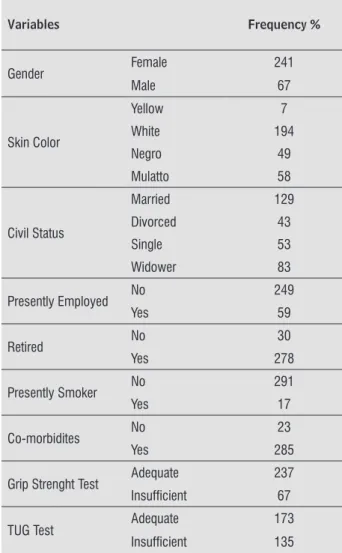
In a sample of 308 participants with an average age of 70.6 years (age range of 60 to 94 years), 78.2% were women and 63% were white. Of these, 41.9% were married and 26.9% widowed, with an average of 90% retired and 19.2% still employed. Only 5.5% of subjects reported they were smokers. The mean BMI for all participants was 27.4. Approximately 92.5% of the elderly subjects reported some form of comorbidity. Mean values for IL-6 and CRP were 4.0 mg/L and 3.8 pg/mL, respectively.
The quantitative variables GS and TUG were
classified in terms of good or poor performance, with 78% performing well in the GS assessment and 43.8% poorly in the TUG test. The characteristics of the
population according to sociodemographic and clinical
data are shown in Tables 1 and 2.
Table 1 - Frequency and qualitative variables
Variables Frequency %
Gender Female 241
Male 67
Skin Color
Yellow 7
White 194
Negro 49
Mulatto 58
Civil Status
Married 129
Divorced 43
Single 53
Widower 83
Presently Employed No 249
Yes 59
Retired No 30
Yes 278
Presently Smoker No 291
Yes 17
Co-morbidites No 23
Yes 285
Grip Strenght Test Adequate 237 Insufficient 67
TUG Test Adequate 173
6
Table 2 - Means and quantitative variables
Variables N Means Standard deviation Minimum 1ºQ 2ºQ 3ºQ Maximum
Age (years) 308 70.6 6.8 60 66 69 75 94
Education (years) 302 9.7 5.0 0 5 10 12 28
IMC (kg/m2) 304 27.4 4.8 16.8 24.1 27.1 30.2 45.6
Grip Strength (kgf) 306 23.3 7.6 10 18 22 28 50
TUG (seconds) 304 10.2 2.7 4 9 10 11 24
CRP (picogram/mL) 293 3.8 4.7 0.1 0.8 2.1 4.9 32.1
IL-6 (mg/L) 294 4.0 4.9 0.0 0.9 2.6 5.0 32.0
Note: Belo Horizonte, MG, 2014.
Assessment of the correlation between inflammatory variables and functional capacity using Spearman’s test showed no significant correlations between the TUG and IL-6 and CRP. There was also no evidence of a correlation between GS and IL-6 and CRP (Table 3).
Table 3 - Correlation between CRP, IL-6 and Grip Strength Test, TUG
Variables Correlation Coeficient Spearman P-value
CRP x Grip Strength -0.051 0.380
CRP x TUG 0.067 0.254
IL-6 x Grip Strength -0.034 0.558
IL-6 x TUG 0.052 0.378
Note: Belo Horizonte, MG, 2014.
Given the non-significant correlation in the quantitative assessment of the functional capacity tests (TUG and GS), the variables were categorized to determine the existence of a difference in the distribution of inflammatory mediators between good and poor performance.
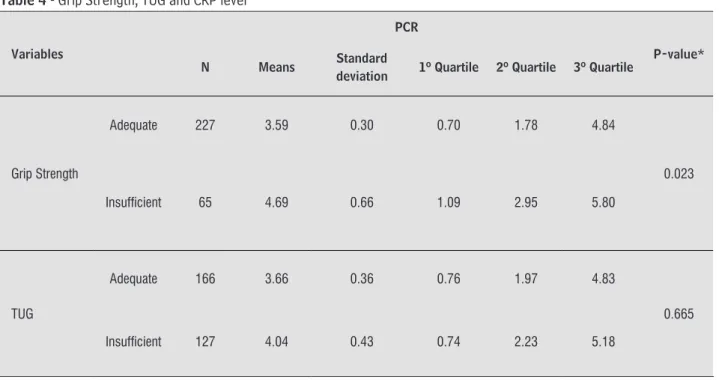
The TUG groups were formed using the classification criteria proposed by Bohannon [20], adjusted in accordance with the age range of participants. No significant difference was observed for CRP distribution in these groups (Table 4).
Performance in the GS test was classified as good or poor based on the criteria of Fried et al. [22]. A significant
intergroup difference in CRP distribution was observed, with lower values recorded in the group that performed
7
Table 4 - Grip Strength, TUG and CRP level
Variables
PCR
P-value*
N Means Standard
deviation 1º Quartile 2º Quartile 3º Quartile
Grip Strength
Adequate 227 3.59 0.30 0.70 1.78 4.84
0.023
Insufficient 65 4.69 0.66 1.09 2.95 5.80
TUG
Adequate 166 3.66 0.36 0.76 1.97 4.83
0.665
Insufficient 127 4.04 0.43 0.74 2.23 5.18
Note: Belo Horizonte, MG, 2014. * Significance 5%, Mann-Whitney Test.
No significant intergroup differences in IL-6 distribution were recorded for good and poor grip strength or between performance groups in the TUG (Table 5).
Table 5 - Grip Strength, TUG and IL-6 level
Variables
IL-6
P-value* N Means Standard
deviation 1º Quartile 2º Quartile 3º Quartile
Grip Strength
Adequate 228 3.76 0.31 0.85 2.49 4.52
0.084
Insufficient 65 5.01 0.72 0.95 3.38 6.76
TUG
Adequate 166 3.86 0.35 0.79 2.69 5.41
0.939
Insufficient 128 4.23 0.48 0.96 2.63 4.76
8
reaching the peripheral muscle tissue and generating
damage such as limited mobility.
By contrast, other studies have shown found
significant correlations between inflammatory mediators and functional capacity. In a study of 63 community-dwelling elderly, with an average age of 71.2 years, Pereira et al. [8] found an inverse correlation between IL-6 levels and GS. Bautmans et al. [17] studied a population of 274 older adults, with an average age of 76.4 years, and observed that GS was significantly related to IL-6 levels in men and that IL-6 was associated with perceived fatigue in women. However, the level of inflammatory mediators was not evident (CRP < 3 mg/l). Ferrucci et al. [24] also demonstrated an association between high levels of inflammatory cytokines and
reduced muscle strength, and the resulting functional
decline. In his thesis, Queiroz [13] described the
relationship between mediators, functionality and back
pain. In a recent study, Sousa et al. [19] analyzed 1,371
elderly individuals in an international study sample and found that high CRP levels were related to poor grip
strength, although this significance disappears when other covariates are adjusted.
In the present study, functional capacity was assessed using the TUG and GS because, according to Camara et
al. [5], GS alone is not effective at satisfactorily predicting
impairment since strength does not incorporate all the
factors that define functional capacity, such as mobility, balance and agility. Additionally, Lauretani et al. [25]
proposed that more than one test is needed to assess functional capacity in older adults with secondary
sarcopenia. The author defined secondary sarcopenia
as a condition in which loss of muscle mass cannot be explained solely by aging and physical inactivity,
but rather the coexistence of associated diseases. The
prevalence of comorbidities was high in our sample,
with 92.5% of participants suffering from some form of acute or chronic disease. As such, they could be
categorized as having secondary sarcopenia and two
functional tests were therefore applied.
On the other hand, some authors indicate that mediators increase with age, even without the presence
of associated comorbidities. This is a natural process caused by immunosenescence and sarcopenia. According to Ershler & Keller [26], this rise in IL-6 in healthy elderly people is caused by the decline in sex steroids, typically IL-6 inhibitors, making increased IL-6 a physiological outcome.
In a study by Ferrucci et al. [24], increased IL-6
levels occurred due to the decline in anabolic stimulant, reducing the synthesis of muscle proteins and leading
Discussion
This study aimed to assess the relationship between
serum levels of inflammatory mediators and functional capacity in the elderly. A quantitative assessment found no significant correlation between either of the functional tests (TUG and GS) and the inflammatory mediators (PCR and IL-6). However, a significant
relationship was observed in the distribution differences between the good and poor GS performance groups and CRP levels, that is, those who performed well in the GS
test had higher circulating CRP levels. This variable was qualitatively assessed after adjustment for BMI and age, as defined by Fried et al. [22]. Dong et al. [6] also related the grip strength test to BMI and sex. It is important to note that, unlike the test used to measure IL-6, those
that quantify CRP are more accessible and widely used
in clinical practice. In light of these findings, increased serum CRP levels should be investigated more carefully.
Our results are similar to those found in the literature. Pereira et al. [19] studied 130 community-dwelling elderly individuals and analyzed the cytokine IL-6, grip strength and the timed up and go test. The authors found
a relationship between the functional tests applied, with similar physical aptitude results, but there were
no significant correlations between the inflammatory mediator and GS performance. Felício et al. [9] studied the association between IL-6 and GS in 221 community-dwelling elderly and found no significant correlations. In a study with 919 older adults aged 65 to 101 years, Rantanen et al. [23] evaluated the relationship between IL-6 and CRP and the GS test and observed a significant correlation between participants with high inflammatory mediator levels and those with low grip strength.
As observed in the present study, these findings can
be explained by the fact that the population consisted
of independent community-dwelling elderly with no significant cognitive decline, which would result in lower circulating inflammatory mediator levels and better functionality indices. Another factor that may have influenced the outcome is the cutoff point for inflammatory mediators, which may not have reached levels high enough to affect functional capacity. The mean serum CRP and IL-6 levels recorded in the present study were 4 mg/L and 3.8 pg/mL, respectively. There is
no consensus in the literature regarding the cutoff points of mediators that predict adverse functional outcomes,
9
According to the author, although this requires more
resources and makes large-scale application difficult, it provides a comprehensive and effective assessment.
The fact that a majority of the sample were women,
who live longer and show higher levels of disability
[28], may have influenced the poor performance in the TUG. Pereira et al. [8] and Felício et al. [9, 10] found
that impaired functional capacity is more prevalent
in women. The author used all-female samples in his
research to prevent gender bias in relation to muscle strength and health status and because woman
represent the largest portion of the elderly population. By contrast, Dong et al. [6] found different losses in the
upper and lower limbs of women, who experience a slower decline in muscle strength in the arms when
compared to the legs. This may have influenced the large
number of low TUG results and high levels of good GS
performance, as occurred in the present study. The present study exhibits some limitations.
Information was not collected on disease severity, nutritional status, physical activity level, medication, stress levels, depression and pain, which may
have affected the findings. Patients with acute inflammatory conditions were not excluded, which may have influenced the inflammatory mediator results. Additionally, the cross-sectional design made it impossible to measure the long-term effects of the increase in inflammatory mediators.
It is important to conduct an accurate clinical assessment in order to study the functional changes that occur during senescence with a view to creating more
targeted and efficient preventive measures and initiatives
to ensure better quality of life and lower levels of disability,
falls, morbidity and mortality in the elderly population.
Conclusion
No significant associations were found between inflammatory mediators and functional capacity assessed by the TUG test and grip strength in community-dwelling elderly subjects; however, a significant
difference was observed between CRP distribution
and grip strength. This complex relationship should be investigated in future studies.
More significant determinations of broader
correlation studies are needed in order to recommend
the investigation of inflammatory cytokines in clinical
assessment aimed at determining the risk of frailty in
the elderly, which remains controversial in the literature. to sarcopenia. Recent data indicate that IL-6 inhibits the
production of insulin-like growth factor 1, an anabolic muscle stimulant. These findings reveal that high levels of cytokines can contribute to sarcopenia. Pereira et al. [8], Fougere et al. [7], Queiroz [13], and Bautmans et al. [17] reported that medication, physical activity
levels, common diseases, nutrition, obesity, diabetes and smoking can cause variations in mediator values
and directly affect sarcopenia. The mean BMI in our population was 27.4, indicating a prevalence of overweight individuals, although only 5.5% reported they were smokers. Data on nutritional status, current physical activity level and specific diseases were not collected. The high number of elderly individuals
with comorbidities demonstrates that this population
probably uses several drugs. All these factors are related to sarcopenia and circulating inflammatory mediators and may have influenced the results.
Penninx et al. [12] demonstrated that the relationship between low-grade inflammation in aging and inflammatory cytokines becomes more significant when different inflammatory mediators are assessed because it increases the specificity of inflammation and
better predicts physical decline than high levels of single
markers. Two widely studied inflammatory mediators related to the elderly and proinflammatory cytokines were assessed in the present study.
Interleukin 6 (IL-6), known as the “geriatric cytokine”, is the most frequently cited in the literature. There is consistent scientific evidence demonstrating that IL-6 is related to sarcopenia and persistent low-grade inflammation in the elderly and their relationship
with limited mobility, disabilities, falls, morbidity and
mortality [7, 8, 12, 15, 16, 17, 19]. C-reactive protein (CRP), an acute-phase protein, is also associated with
these processes and seems to have a strong relationship
with IL-6 [7, 17]. High levels of both are typical in immunosenescence, sarcopenia, and inflammatory conditions caused by chronic diseases [27].
The study population consisted of independent
elderly individuals, with 78% obtaining good results in the GS test. By contrast, almost half (43.8%) performed
poorly in the TUG, indicating that strength may have
had little influence on TUG performance, and that other
aspects of functional capacity, such as those described
by Camara et al, might have affected the results. Camara et al5 demonstrated that assessing functional capacity
based on the complexity of everyday actions should include a variety of areas, such as gait, mobility, balance,
10
11. Agondi RC, Rizzo LV, Kalil J, Barros MT. Imunossenescência. Rev. Bras. Alerg. Imunopatol. 2012;35(5):169-176. 12. Penninx BW, Kritchevsky SB, Newman AB, Nicklas BJ,
Simonsick EM, Rubin S, et al. Inflammatory markers and
incident mobility limitation in the elderly. J Am Geriatr Soc. 2004 Jul;52(7):1105-13.
13. Queiroz BZ. Mediadores inflamatórios, sarcopenia,
funcionalidade e dor lombar aguda em idosas: estudo
longitudinal Back Complaints in the Elders Brasil. Tese
(Doutorado em Fisioterapia) Belo Horizonte – Escola
de Educação Física, Fisioterapia e Terapia Ocupacional,
Universidade Federal de Minas Gerais, Belo
Horizonte; 2015.
14. Kraychete DC, Calasans MTA, Valente CML. Citocinas Pró-inflamatórias e dor. Rev. Bras. Reumatol. 2006; 46(3): 199-206.
15. Franceschi C, Campisi J. Chronic inflammation (inflammaging) and its potential contribution to age-associated diseases. J Gerontol A Biol Sci Med Sci. 2014;69(S1):S4-S9.
16. Caúla AL, Fischer RG. Relação entre a proteína C reativa sistêmica e a doença periodontal. Revista Periodontia. 2004;14(3):18-24.
17. Bautmans I, Gorus E, Njemini R, Mets T et al. Handgrip performance in relation to self perceives fatigue, physical
functioning and circulating IL-6 in elderly persons without inflammation. BMC Geriatrics. 2007;7:5. 18. Komulainen P, Lakka TA, Kivipelto M, Hassinen M,
Penttilä IM, Helkala EL et al. Serum high sensitivity
C-reactive protein and cognitive function in elderly women. Age Ageing. 2007;36:443-8.
19. Pereira DS, Cipriano VF, Amorim, JSC, Queiroz BZ, Felício
DC. Handgrip strength, functionality and plasma levels of IL-6 in elderly women. Fisioterapia em Movimento (PUC-PR. Impresso). 2015; 28: 477-483.
20. Bohannon RW. Reference Values for the Timed Up and Go test: a descriptive meta-analysis. J Geriatr Phys Ther. 2006;29(2):64-8.
21. American Society of Hand Therapists. Clinical Assessment Recommendations. Chicago. [cited 2017 Mar 26]. Available from: https://www.asht.org/ practice/clinicalassessmentrecommendatios
References
1. United Nations, Department of Economic and Social Affairs, Population Division. World Population Ageing. 2015. [cited 2017 Mar 22]. Available from: http://www. un.org/en/development/desa/population/
2. IBGE - Instituto Brasileiro de Geografia e Estatística. [cited 2017 Feb 22]. Available from: http://www. ibge.gov.br
3. Cuidados inovadores para condições crônicas:
componentes estruturais de ação: relatório mundial / Organização Mundial da Saúde – Brasília, 2003 Available from: https://www.opas.org.br/wpcontent/ uploads/2015/09/Manualfinal.pdf [cited 2017 Feb 26]. 4. Camargo ABM, Saad PMA. A transição demográfica no
Brasil e seu impacto na estrutura etária da população. SEADE. O idoso na Grande São Paulo. 1990; p. 9-25. 5. Camara FM, Gerez AG, Miranda MLJ, Velardi M.
Capacidade funcional do idoso: formas de avaliação e
tendência. ActaFisiátrica. 2008;15(4): 249-256. 6. Dong R, Wang X, Guo Q, Wang J, Zhang W, Shen S et al.
Clinical relevance of different handgrip strength indexes
and mobility limitation in the elderly adults. J Gerontol A Biol Sci Med Sci. 2016;71(1):96-102. doi: 10.1093/ gerona/glv168.
7. Fougère B, Vellas B, van Kan GA, Cesari M. Identification
of biological markers for better characterization of older
subjects with physical frailty and sarcopenia. Transl Neurosci. 2015;6(1):103-110.
8. Pereira LS, Narciso FM, Oliveira DM, Coelho FM, Souza DG, Dias RC. Correlation between manual muscle
strength and interleukin 6 (IL-6) plasma levels in elderly community-dwelling women. Arch Gerontol Geriatr. 2009;48(3):313-6. doi: 10.1016/j.archger.2008.02.012. 9. Felício DC, Pereira DS, Assumpção AM, Jesus-Moraleida
FR, Queiroz BZ, Silva JPet al. Inflammatory mediators,
muscle and functional performance of community-dwelling elderly women. Arch Gerontol Geriatr. 2014; 59(3):549-553. doi: 10.1016/j.archger.2014.08.004. 10. Felício DC et al. Systemic inflammation and physical
11
26. Ershler WB, Keller ET. Age-associated increased interleukin-6 gene expression, late-life diseases, and frailty. Annu Rev Med. 2000;51:245-70.
27. Sousa ACPA et al. Association between C-reative protein
and physical performance in older populations: results
from the International Mobility in Aging Study (IMIAS). Age and Aging. 2016; 45: 274-280.
28. Dohert TJ. Invited review: Aging and sarcopenia. J Appl Physiol 2003;95(4):1717-27.
Received in 09/12/2017
Recebido em 12/09/2017 Recibido en 12/09/2017
Approved in 05/24/2018
Aprovado em 24/05/2018 Aprobado en 24/05/2018
22. Fried LP, Tangen CM, Walston J, Newman AB, Hirsch C, Gottdiener J et al. Frailty in older adults: evidence
for a phenotype. J Gerontol A Biol Sci Med Sci. 2001;56(3):M146-56.
23. Rantanen T, Volpato S, Ferrucci L, Heikkinen E, Fried
LP, Guralnik JM. Handgrip strength and cause-specific and total mortality in older disabled women: exploring
the mechanism. J Am Geriatr. Soc. 2003;51(5):636-41. 24. Ferrucci L, Penninx BW, Volpato S, Harris TB,
Bandeen-Roche K, Balfour J et al. Change in muscle strength explains accelerated decline of physical function in
older women with high interleukin-6 serum levels. J Am Geriatr Soc. 2002;50(12):1947-54.
25. Lauretani F, Bautmans I, De Vita F, Nardelli A, Ceda GP, Maggio M. Identification and treatment of older persons