General and specific combining ability in sweet
sorghum
Mara Jane da Rocha
1, José Airton Rodrigues Nunes
1*, Rafael
Augusto da Costa Parrella
2, Pakizza Sherma da Silva Leite
1,
Gabrielle Maria Romeiro Lombardi
1, Mayra Luiza Costa Moura
3,
Robert Eugene Schaffert
2and Adriano Teodoro Bruzi
3Abstract: In breeding of sweet sorghum hybrids, non-additive genetic effects
are important in phenotypic expression of the traits of interest. The aim of this study was to evaluate the general combining ability (GCA) of sweet sorghum lines and the specific combining ability (SCA) of the hybrids for agronomic and technological traits. Five fertility restorer lines, four male-sterile lines, and their hybrids from partial diallel crosses were evaluated in experiments laid out in a 5 x 6 triple rectangular lattice design in the municipalities of Lavras, MG and Sete Lagoas, MG, Brazil. Diallel analysis was performed using the Griffing model adapted to partial diallel crosses. There was a significant effect of GCA and SCA for most of the traits evaluated, indicating the participation of additive or domi -nant genes in inheritance. The restorer lines CMSX508, BRS 511, CMSXS643, and CMSXS646 show potential for use as parents in sorghum breeding programs.
Keywords: Sorghum bicolor, parent selection, partial diallel, hybrid breeding.
Crop Breeding and Applied Biotechnology
18: 365-372, 2018
Brazilian Society of Plant Breeding. Printed in Brazil http://dx.doi.org/10.1590/1984-70332018v18n4a55
ARTICLE
*Corresponding author:
E-mail: [email protected]
Received: 28 May 2017 Accepted: 17 August 2018
1 Universidade Federal de Lavras, Departa
-mento de Biologia, 3037, 37.200-000, Lavras, MG, Brazil
2 Embrapa Milho e Sorgo, Rodovia MG-424,
Km 45, 35.701-970, Sete Lagoas, MG, Brazil
3 Universidade Federal de Lavras, Departa
-mento de Agricultura, 3037, 37.200-000,
Lavras, MG,
Brazil INTRODUCTION
Brazil is prominent worldwide for its use of renewable sources for energy production. Biofuel produced in Brazil is largely ethanol, with sugarcane
(Saccharum spp. L.) as the main feedstock. Nevertheless, the sugarcane crop has
some particular features that compromise the feedstock supply for sugarcane mills, such as the renewal rate of crop areas (~20% each year) and the off-season period (Souza et al. 2013). Currently, about 2 mi ha of sugarcane crop area is under renewal, and the period from March to April is the off-season. This is the context for strategic efforts to diversify bioenergy crops.
factor in establishing this crop in the Brazilian ethanol production chain.
Breeding strategies depend on the type of cultivar intended for commercial use. Although sweet sorghum is an autogamous plant, breeding programs have been conducted to obtain hybrids using the milo-kafir genetic-cytoplasmic male sterility system (Reddy et al. 2005, Bunphan et al. 2013). Adoption of this strategy is more justifiable if there is evidence of non-additive gene action in genetic control of the traits of interest, which can be investigated through the use of suitable genetic cross-breeding, such as diallel crosses.
The method of diallel analysis proposed by Griffing (1956) is widely used in the choice of parents since it allows estimation of general combining ability (GCA) and specific combining ability (SCA), previously defined by Sprague and Tatum (1942). Sweet sorghum has been studied in this manner in several countries, with emphasis on characterizing combining ability to produce ethanol (Makanda et al. 2009, Indhubala et al. 2010, Sandeep et al. 2010, Vinaykumar et al. 2011, Umakanth et al. 2012, Bunphan et al. 2015). These studies have encouraged breeding sorghum to obtain hybrids. However, in Brazil, information on the combining ability of sorghum lines is scarce. Information on GCA and SCA can greatly assist more assertive definition of cross-breeding between parents.
The purpose of the present study was to evaluate the general combining ability of elite lines of sorghum and the specific combining ability of the hybrid combinations for agronomic and technological traits.
MATERIAL AND METHODS
Lines and hybrids evaluated and experimental design
We evaluated four male-sterile lines (A-lines): CMSXS5503A, CMSXS5504A, CMSXS5505A, CMSX5508A and five fertility restorer lines (R-lines): BRS 511, BRS 508, CMSXS643, CMSXS646, CMSXS647from the sweet sorghum breeding program of the Empresa Brasileira de Pesquisa Agropecuária (Embrapa Milho e Sorgo) [Brazilian Agricultural Research Corporation – Maize and Sorghum] in Sete Lagoas, state of Minas Gerais, Brazil.
R-lines were developed from breeding populations obtained from crosses involving traditional varieties, such as Wray, Brandes, and Theis (Silva et al. 2017). A-lines were obtained from breeding populations of crosses between elite R-lines with high sugar content and B-maintainer lines rich in juice with low sugar content. In the segregating generations, individual plants were selected based on juice volume, sugar content, and plant height less than 1.5 m. After that, the sterilization process was initiated by backcrosses with a source of sterile cytoplasm. During this process, some B progenies that restored the fertility of A progenies were discarded. These discarded B progenies had dominant alleles of the fertility restorer gene inherited from R-lines in the initial cross.
A- and R-lines were crossed following a partial diallel design and 20 hybrids were obtained. A- and R-lines, hybrids, and the cultivar CV198, used as a check, were evaluated in experiments laid out in a 5 x 6 triple rectangular lattice design (i.e., partially balanced incomplete block design). The plots consisted of two 5.0-m length rows spaced at 0.70 m.
Sites and conduction of field experiments
Two experiments were conducted in the 2014/2015 growing season. The first was carried out in the experimental area of Embrapa Milho e Sorgo in the municipality of Sete Lagoas, Minas Gerais, in the central region of the state (lat 19º 27’ N, long 44º 14’ W, and alt 767 m asl). The soil classification is Latossolo Vermelho and the climate is Cwa, temperate rainy (mesothermal), according to the Köppen classification. The second experiment was conducted in the experimental area of the Muquém Farm of the Universidade Federal de Lavras, in the municipality of Lavras, Minas Gerais (lat 21° 14’ N, long 45º 00’ W, and alt 918 m asl). The soil classification is Latossolo Vermelho Distrófico and the climate is Cwa, temperate rainy (mesothermal), according to the Köppen classification.
Basal fertilization consisted of 450 kg ha-1 of the 08:28:16 NPK formulation in the planting furrow. At 30 days after
planting, 200 kg ha-1 urea was applied in top-dressing. The experiments were manually sown in November 2014. At
Traits measured
Agronomic and technological traits were measured. Time to flowering (FLOW), representing the number of days after sowing when 50% of the plants of the plot were in flower, was assessed only in Lavras. The plots were cut at 5.0 cm from the ground upon reaching physiological maturity of the grain. In each plot, we measured the production of green mass (PGM) of the whole plants using a digital suspension scale, in kg, which was converted to t ha-1. Six plants
per plot were taken at random to assess plant height (PH, m) from the ground surface to the apex of the panicle using a tape measure. These plants (without panicle) were ground and pressed in a hydraulic press (Sete Lagoas) or a mill (Lavras) to extract the juice and determine its quantity relative to stalk weight (EXT, %). Total soluble solids (TSS, ºBrix) in a juice sample were determined using an automatic digital refractometer. Total recoverable sugars (TRS, kg of sugar/t of stalk) was determined according to CONSECANA (2006). We then estimated ethanol production (ETH, L ha-1) by the
equation: ETH = hydrous ethanol production (L) × PGM.
Analysis of variance
First, individual analysis of variance was performed with recovery of inter-block information (per site). The Shapiro-Wilk and Q-Q plot tests were applied to check the normality of errors (Ferreira 2005). The relative efficiency of the lattice design was evaluated as described in Ramalho et al. (2012). Experimental precision was determined by the estimate of selective accuracy (rĝg) (Resende and Duarte 2007). For multi-site analysis, the homogeneity of the residual variances was previously verified by Hartley’s test. Statistical analyses were performed using the lm4 R package (Bates et al. 2015, R Development Core Team 2016).
Diallel analysis
The effect of genotypes (lines and hybrids) and the genotype x site interaction was decomposed according to a partial diallel cross design from the adjusted phenotypic means using the lsmeans R package (Russell 2016). In this, we adopted the model proposed by Geraldi and Miranda Filho (1988), which is an adaptation of the Griffing (1956) model for the study of GCA and SCA in a partial diallel design involving parents and F1 generations (Cruz et al. 2012).
ykk' = μ + 1
2 (d1 + d2) + gk + gk' + skk' + e̅kk'
where y̅kk' is the mean of the hybrid between the k-th A-line and k’-th R-line; μ is the overall mean; d1 and d2 are
the contrasts involving the means of the R- and A-lines and the overall mean; gk is the GCA effect of the k-th A-line; gk’
is the GCA effect of the k’-th R-line; skk’ is the SCA effect of the hybrid between the k-th A-line and k’-th R-line; and e̅kk'
is the experimental error.
The significance of the effects present in the diallel model was tested by Student’s t-test at 5% probability. Diallel analyses were performed using the Genes software (Cruz 2013).
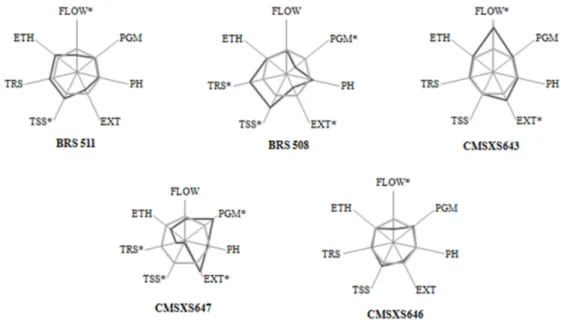
Radar charts were constructed from the studentized GCA effects of the lines for each trait m (tk(m)) using the following
expression:
(tk(m)) = ĝk(m)/ ŝĝk(m)),
where (ĝk(m)) is the GCA effect of line k for trait m and its respective standard error (ŝĝk(m)).
RESULTS AND DISCUSSION
According to the Shapiro-Wilk and Q-Q plot tests, the assumption of normal distribution of errors was not rejected for all traits. The rectangular lattice design did not show a relative efficiency superior to the randomized complete block design (<105%). The experimental precision measured by selective accuracy (rĝg) was classified as moderate to very high, according to Resende and Duarte (2007).
There were significant differences (P < 0.05) among genotypes for all traits (Table 1). Several studies have shown genetic variability in sweet sorghum (Umakanth et al. 2012, Elangovan et al. 2014). Genotype × site interaction (P < 0.05) was also observed for most of the traits, except for juice extraction (EXT). Some studies on sweet sorghum have indicated the presence of the genotype × environment interaction for traits related to ethanol yield (ETH) (Umakanth et al. 2012, Souza et al. 2013, Elangovan et al. 2014, Figueiredo et al. 2015).
In general, there were differences (P < 0.05) among the means of the A-lines and the R-lines. This is because the male-sterile lines in this study were initially selected for use in a breeding program for forage and grain sorghum, and thus the A-lines had lower sugar contents in the stalk. The lower height of the A-lines, which is advantageous for mechanical harvest, should also be noted.
From the diallel analysis, we observed a significant effect for GCA and SCA (P < 0.05) for time to flowering (FLOW), production of green mass (PGM), total soluble solids (TSS), total recoverable sugars (TRS), and ETH (Table 1). These results suggest that additive and non-additive genetic effects contribute to phenotypic expression of these traits. Similar results were found by Makanda et al. (2009) and Bunphan et al. (2015). These authors detected additive and dominance effects for the traits TSS and PGM. However, divergent results were reported by Bahadure et al. (2015), in which non-additive effects were not important in expression of TSS. Nevertheless, additive and non-additive effects were important for other traits, such as juice and stalk yield. In a study carried out by Kumar et al. (2016), traits related to sugar yield (e.g., TSS, sucrose content) exhibited moderate inbreeding depression, indicating the existence of genes with dominance action on expression of this trait.
For the PH trait, only SCA was significant, suggesting that non-additive effects were more important in phenotypic expression of this trait (Table 1). However, some studies have suggested additive and dominance effects for PH (Makanda et al. 2009, Bunphan et al. 2015). Significant SCA was not detected for the EXT trait (Table 1). However, other studies
Table 1. Summary of analysis of variance and diallel analysis for flowering time (FLOW, days), plant height (PH, m), production of
green mass (PGM, t ha-1), juice extraction (EXT, %), total soluble solids content (TSS, % juice), total recoverable sugars (TRS, kg sugar/t
of stalks), and ethanol production (ETH, L ha-1) evaluated in lines and hybrids of sweet sorghum at two sites
Sources of variation F-Statistics
df FLOW1 df PH PGM EXT TSS TRS ETH
Site (S) - - 1 9.62** 9.42* 18.94* 263.43** 247.25** 174.7**
Genotypes (G) (29) 14.36** 29 27.57* 15.94** 1.83* 7.15** 4.11** 9.78**
GCA A 3 2.56 3 2.51 7.05* 0.46 5.69* 3.63* 6.70*
GCA R 4 17.84* 4 0.40 7.97* 6.84* 19.52* 11.35* 1.57
SCA (20) 4.84* 20 17.78* 11.03* 1.56 6.04* 3.93* 9.75*
G x S 29 1.80* 2.23** 1.52 3.45** 2.34** 3.43**
GCA A x S 3 2.44 1.31 1.31 11.40* 8.13* 8.26*
GCA R x S 4 2.09 4.21* 2.20 3.72* 3.26* 3.72*
SCA x S 20 10.31* 2.57* 1.72* 2.47* 2.06* 2.90*
Mean/LA 85.61 2.92a 61.87a 67.92b 14.23a 81.31a 3758.13a
Mean/SL 2.78b 54.68b 70.02a 10.11b 54.82b 2133.03b
Mean/A 81.70b 1.70b 31.60b 68.92a 10.35b 59.64b 1383.53b
Mean/R 92.85a 3.05a 62.29a 69.23a 12.07a 65.7a 3013.87a
Mean/Hybrids 84.51 2.82 57.57 69.00 12.62 70.93 3242.19
Mean/Check 87.09 3.27 66.81 67.33 10.78 56.67 2936.23
rĝg LA (%) 96.46 98.73 96.52 60.41 93.18 86.3 94.19
rĝg SL (%) 94.06 92.27 63.33 84.62 75.84 86.55
1 measured only in Lavras, MG. *, **Significant at 5% and 1% probability by the F-test, respectively; Means followed by different letters in the same column are different
have found a non-additive effect for this trait (Umakanth et al. 2012, Bunphan et al. 2015, Kumar et al. 2016). It should
be emphasized that SCA depends on genetic divergence between the parental A- and R-lines in the loci related to the target trait with dominance action. Thus, complementarity between the A- and R-lines might not have been observed in the present study.
Significant effects were detected for GCA of the A-lines for PGM, TSS, TRS, and ETH and also for GCA of the R-lines for FLOW, PGM, EXT, TSS, and TRS (Table 1). These results suggest dissimilarity within the groups of the A- and R-lines for these traits. Thus, these lines are expected to promote variation in the average performance measures of the hybrids produced.
According to Cruz and Vencovsky (1989), the estimate of GCA is considered an efficient and informative criterion for parent selection. However, significant GCA × site interaction was observed for the traits PH, EXT, TSS, TRS, and ETH (Table 1). Moreover, there was also significant SCA × site interaction for all the traits studied. Although these results suggest that GCA and SCA were influenced by the
environment, the average effects across sites can be considered for purposes of the breeding program.
The significance of GCA indicates the existence of different allele frequencies among the A- and R-lines, and the most promising lines can be identified for use in breeding programs to extract lines that exhibit a higher frequency of favorable alleles. Thus, CMSXS5508A and CMSXS5504A can be highlighted as promising male-sterile lines (Figure 1). For the R-lines, BRS 511, CMSXS643, and CMSXS646 showed better GCA regarding ethanol production and traits related to feedstock quality (Figures 2).
Figure 1. Graphical representation of the studentized effects of
the general combining ability of the A-lines of sweet sorghum for the traits evaluated in Lavras and Sete Lagoas, MG, Brazil. * Significant at 5% probability by t-test.
Figure 2.Graphical representation of the studentized effects of the general combining ability of the lines R of sweet sorghum for the
The BRS 508 line exhibited positive and significant effects for TSS and TRS; however, it led to a decline in the mean PGM of the hybrids (Figure 2). The CMSXS647 line showed positive and significant effects for PGM and EXT, but resulted in lower TSS and TRS. One possibility for the breeding program is crossing these two lines to combine their advantages.
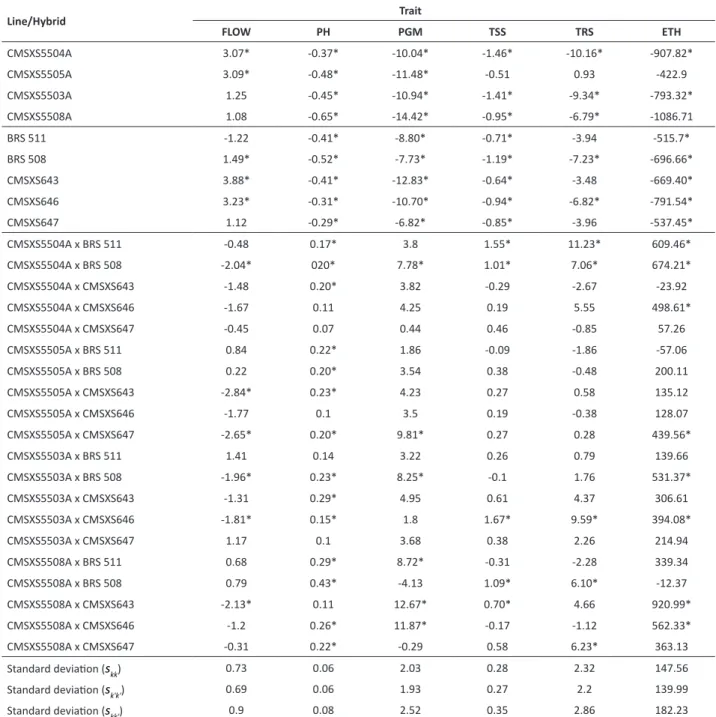
Table 2. Estimates of the mean effects of the specific combining ability of A-lines (skk), R-lines (sk'k') and hybrids (skk') of sweet sorghum
for the traits of flowering time (FLOW, days), plant height (PH, m), production of green mass (PGM, t ha-1), total soluble solids content
(TSS, % juice), total recoverable sugars (TRS, kg sugar/tof stalks), ethanol production (ETH, L ha-1)
Line/Hybrid Trait
FLOW PH PGM TSS TRS ETH
CMSXS5504A 3.07* -0.37* -10.04* -1.46* -10.16* -907.82*
CMSXS5505A 3.09* -0.48* -11.48* -0.51 0.93 -422.9
CMSXS5503A 1.25 -0.45* -10.94* -1.41* -9.34* -793.32*
CMSXS5508A 1.08 -0.65* -14.42* -0.95* -6.79* -1086.71
BRS 511 -1.22 -0.41* -8.80* -0.71* -3.94 -515.7*
BRS 508 1.49* -0.52* -7.73* -1.19* -7.23* -696.66*
CMSXS643 3.88* -0.41* -12.83* -0.64* -3.48 -669.40*
CMSXS646 3.23* -0.31* -10.70* -0.94* -6.82* -791.54*
CMSXS647 1.12 -0.29* -6.82* -0.85* -3.96 -537.45*
CMSXS5504A x BRS 511 -0.48 0.17* 3.8 1.55* 11.23* 609.46*
CMSXS5504A x BRS 508 -2.04* 020* 7.78* 1.01* 7.06* 674.21*
CMSXS5504A x CMSXS643 -1.48 0.20* 3.82 -0.29 -2.67 -23.92
CMSXS5504A x CMSXS646 -1.67 0.11 4.25 0.19 5.55 498.61*
CMSXS5504A x CMSXS647 -0.45 0.07 0.44 0.46 -0.85 57.26
CMSXS5505A x BRS 511 0.84 0.22* 1.86 -0.09 -1.86 -57.06
CMSXS5505A x BRS 508 0.22 0.20* 3.54 0.38 -0.48 200.11
CMSXS5505A x CMSXS643 -2.84* 0.23* 4.23 0.27 0.58 135.12
CMSXS5505A x CMSXS646 -1.77 0.1 3.5 0.19 -0.38 128.07
CMSXS5505A x CMSXS647 -2.65* 0.20* 9.81* 0.27 0.28 439.56*
CMSXS5503A x BRS 511 1.41 0.14 3.22 0.26 0.79 139.66
CMSXS5503A x BRS 508 -1.96* 0.23* 8.25* -0.1 1.76 531.37*
CMSXS5503A x CMSXS643 -1.31 0.29* 4.95 0.61 4.37 306.61
CMSXS5503A x CMSXS646 -1.81* 0.15* 1.8 1.67* 9.59* 394.08*
CMSXS5503A x CMSXS647 1.17 0.1 3.68 0.38 2.26 214.94
CMSXS5508A x BRS 511 0.68 0.29* 8.72* -0.31 -2.28 339.34
CMSXS5508A x BRS 508 0.79 0.43* -4.13 1.09* 6.10* -12.37
CMSXS5508A x CMSXS643 -2.13* 0.11 12.67* 0.70* 4.66 920.99*
CMSXS5508A x CMSXS646 -1.2 0.26* 11.87* -0.17 -1.12 562.33*
CMSXS5508A x CMSXS647 -0.31 0.22* -0.29 0.58 6.23* 363.13
Standard deviation (skk) 0.73 0.06 2.03 0.28 2.32 147.56
Standard deviation (sk'k') 0.69 0.06 1.93 0.27 2.2 139.99
Standard deviation (skk') 0.9 0.08 2.52 0.35 2.86 182.23
The SCA of parental lines is used as an indicator of the existence of unidirectional dominance (Cruz and Vencovsky 1989). For FLOW, most of the lines had positive SCA, indicating that the dominance effect contributed to reducing the number of days to flowering (Table 2). In contrast, negative SCA estimates were observed for other traits, indicating that the dominance effect acted to increase phenotypic expression. Kumar et al. (2016) observed a negative heterotic effect for FLOW, whereas this effect was positive for PH, stalk yield, juice volume, EXT, and sugar yield.
The SCA of parental lines is used as an indicator of the existence of unidirectional dominance (Cruz and Vencovsky 1989). For FLOW, most of the lines had positive SCA, indicating that the dominance effect contributed to reducing the number of days to flowering (Table 2). In contrast, negative SCA estimates were observed for other traits, indicating that the dominance effect acted to increase phenotypic expression. Kumar et al. (2016) observed a negative heterotic effect for FLOW, whereas this effect was positive for PH, stalk yield, juice volume, EXT, and sugar yield.
SCA is closely related to heterosis (h = dy2, where d is dominance and y is genetic divergence); thus, hybrids with high
SCA show greater heterosis. The main goal in breeding of sweet sorghum is ethanol production. Eight hybrids exhibited positive and significant effects of SCA on traits that result in greater ethanol production (Table 2). The importance of non-additive effects on phenotypic expression of several traits related to ethanol production was also found by Makanda et al. (2009), Audilakshmi et al. (2010), Pfeiffer et al. (2010), and Umakanth et al. (2012). This result encourages the use of heterosis in obtaining hybrids to increase ethanol yield from sweet sorghum.
ACKNOWLEDGMENTS
Our thanks to CAPES (Council for Improvement of Personnel in Higher Education) for granting a Master’s degree scholarship (Finance code 001), to Embrapa Milho e Sorgo for its infrastructure and technical support, and to FAPEMIG (Minas Gerais State Research Support Foundation) and CNPq (National Council for Scientific and Technological Development) for their support for this study.
REFERENCES
Audilakshmi S, Mall AK, Swarnalatha M and Seetharama N (2010)
Inheritance of sugar concentration in stalk (brix), sucrose content,
stalk and juice yield in sorghum. Biomass and Bioenergy 34: 813-820.
Bahadure DM, Marker S, Umakanth AV, Prabhakar, Ramteke PW, Patil JV and Rana BS (2015) Combining ability and heterosis on millable stalk and sugar concentration for bioethanol production across
environments in sweet sorghum (Sorghum bicolor (L.) Moench.).
Electronic Journal of Plant Breeding 6: 58-65.
Bates D, Martin M, Ben B and Steve W (2015) “Fitting linear mixed-effects
models using lme4”. Journal of Statistical Software 67: 1-48.
Borém A, Pimentel L and Parrela R (2014) Sorgo: do plantio a colheita.
UFV, Viçosa, 275p.
Bunphan D, Jaisil P and Sanitchon J (2013) Application of LW7 marker for identification of progenies with male sterility gene in sweet sorghum
population. Crop Breeding and Applied Biotechnology 13: 59-66.
Bunphan D, Jaisil P, Sanitchon J, Knoll JE and Anderson WF (2015) Heterosis
and combining ability of F1 hybrid sweet sorghum in Thailand. Crop
Science 55: 178-187.
CONSECANA - Conselho dos produtores de cana-de-açúcar (2006) Açúcar
e álcool do estado de São Paulo: Manual de instruções. 5th edn,
CONSECANA,Piracicaba, 54p.
Cruz CD (2013) GENES - A software package for analysis in experimental statistics and quantitative genetics. Acta Scientiarum Agronomy
35: 271-276.
Cruz CD and Vencovsky R (1989) Comparação de alguns métodos de análise dialética. Revista Brasileira de Genética 12: 425-438.
Cruz CD, Regazzi AJ and Carneiro PCS (2012)Modelos biométricos
aplicados ao melhoramento genético. UFV, Viçosa, 668p. Elangovan M, Kiranbabu P, Seetharama N and Patil JV (2014) Genetic
diversity and heritability characters associated in Sweet Sorghum [Sorghum bicolor (L.) Moench]. Sugar Tech 16: 200-210.
Ferreira DF (2005) Estatística básica. UFLA, Lavras, 653p.
Figueiredo UJ, Nunes JAR, Parrella RAC, Souza ED, Silva AR, Emygdio
BM, Machado JR and Tardin FD (2015) Adaptability and stability
of genotypes of sweet sorghum by GGE Biplot and Toler methods. Genetics and Molecular Research 14: 11211-11221.
Geraldi IO and Miranda Filho JB (1988) Adapted model for the analysis
of combining ability of varieties in partial diallel crosses. Revista
Brasileira de Genética 11: 419-430.
Griffing B (1956) Concept of general and specific combining ability in
relation to diallel crossing systems. Australian Journal of Biological
Sciences 9: 463-493.
Indhubala M, Ganesamurthy K and Punitha D (2010) Combining ability
studies for quality traits in Sweet Sorghum (Sorghum bicolor (L.)
Moench). The Madras Agricultural Journal 97: 17-20.
This is an Open Access article distributed under the terms of the Creative Commons Attribution License, which permits unrestricted use, distribution, and reproduction in any medium, provided the original work is properly cited.
enhancement research at ICRISAT. American Journal of Plant Sciences
2: 589-600.
Kumar S, Srinivasa Rao P, Reddy BVS, Ravindrababu V and Reddy KHP (2016) Heterosis and inbreeding depression in tropical sweet
sorghum (Sorghum bicolor (L.) Moench). Crop Research 51: 01-04.
Makanda I, Tongoona P and Derera J (2009) Combining ability and
heterosis of sorghum germplasm for stem sugar traits under
off-season conditions in tropical lowland environments. Field Crops
Research 114: 272-279.
Pfeiffer TW, Bitzer MJ, Toy JJ and Pedersen JF (2010) Heterosis in sweet sorghum and selection of a new sweet sorghum hybrid for use in
syrup production in Appalachia. Crop Science 50: 1788-1794.
R Development Core Team (2016) R: A language and environment for
statistical computing. R Foundation for Statistical Computing, Vienna, Austria. URL https://www.R-project.org/.
Ramalho MAP, Abreu AFB, Santos JB and Nunes JAR (2012) Aplicações
da genética quantitativa no melhoramento de plantas autógamas. UFLA, Lavras, 522p.
Reddy BVS, Ramesh S and Ortiz R (2005) Genetic and cytoplasmic-nuclear
male sterility in sorghum. Plant Breeding Reviews 25: 139-172.
Regassa TH and Wortmann CS (2014) Sweet sorghum as a bioenergy crop:
literature review. Biomass and Bioenergy 64: 348-355.
Resende MDV and Duarte JB (2007) Precisão e controle de qualidade em experimentos de avaliação de cultivares. Pesquisa Agropecuária
Tropical 37: 182-194.
Russell VL (2016) Least-squares means: The R package lsmeans. Journal
of Statistical Software 69: 1-33.
Sandeep RG, Gururaja Rao MR, Ramesh S, Chikkalingaiah and Shivanna H (2010) Parental combining ability as a good predictor of productive
crosses in sweet sorghum [Sorghum bicolor (L.) Moench]. Journal of
Applied and Natural Science 2: 245-250.
Silva MJ, Pastina MM, Souza VF, Schaffert RE, Carneiro PCS, Noda RW, Carneiro JES, Damasceno CM and Parrella RAC (2017) Phenotypic and molecular characterization of sweet sorghum accessions for
bioenergy production. PLoS ONE 12: e0183504.
Souza VF, Parrella RAC, Tardin FD, Costa MR, Carvalho Júnior GA and Schaffert RE (2013) Adaptability and stability of sweet sorghum
cultivars. Crop Breeding and Applied Biotechnology 13: 144-151.
Sprague GF and Tatum LA (1942) General vs. specific combining ability
in single crosses of corn. Journal of American Society of Agronomy
34: 923-932.
Umakanth AV, Patil JV, Rani CH, Gadakh SR, Kumar Siva S, Rao S and Kotasthane TV (2012) Combining ability and heterosis over environments for stalk and sugar related traits in sweet sorghum [Sorghum bicolor (L.) Moench.]. Sugar Tech 14: 237-246.
Vinaykumar R, Jagadeesh BN, Talekar S, Sandeep RG and Gururaja Rao MR (2011) Combining ability of parents and hybrids for juice yield and its
attributing traits in sweet sorghum [Sorghum bicolor (L.) Moench].