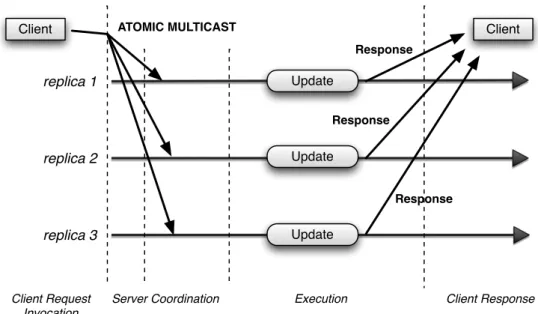
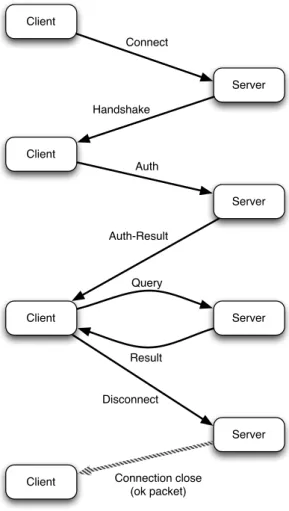
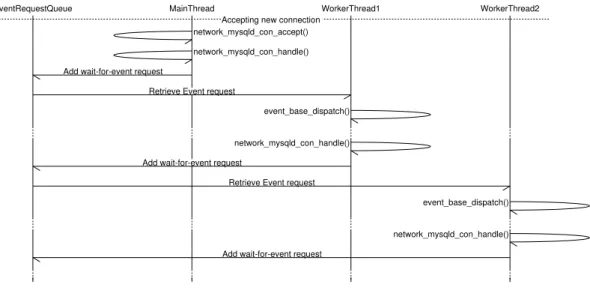
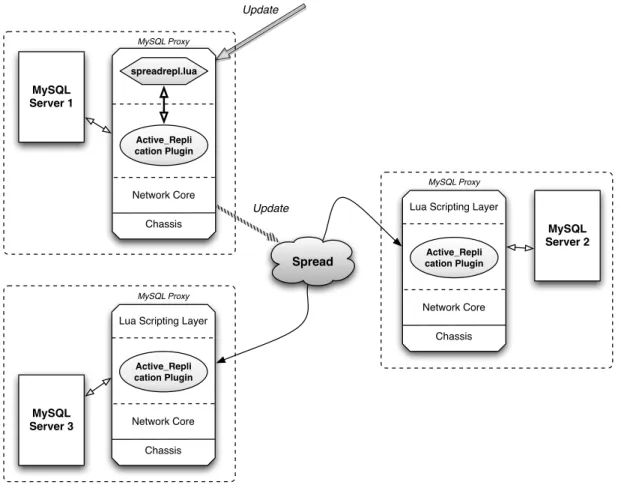
Universidade do Minho
Escola de Engenharia Departamento de Informática
Dissertação de Mestrado
Mestrado em Engenharia Informática
Database Replication
in Large Scale Systems
Miguel Gonçalves de Araújo
Trabalho efectuado sob a orientação do
Professor Doutor José Orlando Pereira
109044 / 2008).
Declaração
Nome:Miguel Gonçalves de Araújo
Endereço Electrónico:[email protected]
Telefone:963049012
Bilhete de Identidade:12749319
Título da Tese:Database Replication in Large Scale Systems
Orientador:Professor Doutor José Orlando Pereira
Ano de conclusão:2011
Designação do Mestrado:Mestrado em Engenharia Informática
É AUTORIZADA A REPRODUÇÃO INTEGRAL DESTA TESE APENAS PARA EFEITOS DE INVESTIGAÇÃO, MEDIANTE DECLARAÇÃO ESCRITA DO INTERESSADO, QUE A TAL SE COMPROMETE.
Universidade do Minho, 30 de Junho de 2011 Miguel Gonçalves de Araújo
Experience is what you get when you didn’t get what you wanted. Randy Pausch (The Last Lecture)
Acknowledgments
First of all, I want to thank Prof. Dr. José Orlando Pereira for accepting being my adviser and for encouraging me to work on the Distributed Systems Group at University of Minho. His availability, patient and support were crucial on this work. I would also like to thank Prof. Dr. Rui Oliveira for equal encouragement on joining the group.
A special thanks to my parents for all support throughout my journey and particularly all the incentives to keep on with my studies.
I thank to my friends at the group that joined me on this important stage of my stud-ies. A special thank to Ricardo Coelho, Pedro Gomes and Ricardo Gonçalves for all the discussions and exchange of ideas, always encouraging my work. I also thank for the good moments and fellowship to my friends and colleagues at university. Not forgetting all the good moments in the many trips to Braga, I would like also to thank my friend Rui Durães.
To all the past and current members of the Distributed Systems Group I want to thank for the good working environment, fruitful discussions and fundamental opinions. In special, I would like to thank Ricardo Vilaça and Nuno Carvalho for their help.
Although not personally acquainted, I also thank to Kay Roepke and to Jan Kneschke for all the questions clarified and opinions given through IRC.
Finally, thanks to all my friends for their friendship and comprehension during this course and to everyone that read this thesis and contributed with corrections and critics.
Resumo
Existe nos dias de hoje uma necessidade crescente da utilização de replicação em bases de dados, sendo que a construção de aplicações de alta performance, disponibilidade e em grande escala dependem desta para manter os dados sincronizados entre servidores e para obter tolerância a faltas.
Uma abordagem particularmente popular, é o sistema código aberto de gestão de bases de dados MySQL e seu mecanismo interno de replicação assíncrona. As limitações impostas pelo MySQL nas topologias de replicação significam que os dados tem que pas-sar por uma série de saltos ou que cada servidor tem de lidar com um grande número de réplicas. Isto é particularmente preocupante quando as actualizações são aceites por várias réplicas e em sistemas de grande escala. Observando as topologias mais comuns e tendo em conta a assincronia referida, surge um problema, o da frescura dos dados. Ou seja, o facto das réplicas não possuírem imediatamente os dados escritos mais recente-mente. Este problema vai de encontro ao estado da arte em comunicação em grupo.
Neste contexto, o trabalho apresentado nesta dissertação de Mestrado resulta de uma avaliação dos modelos e mecanismos de comunicação em grupo, assim como as van-tagens práticas da replicação baseada nestes. A solução proposta estende a ferramenta MySQL Proxy com plugins aliados ao sistema de comunicação em grupo Spread ofere-cendo a possibilidade de realizar, de forma transparente, replicação activa e passiva.
Finalmente, para avaliar a solução proposta e implementada utilizamos o modelo de carga de referência definido pelo TPC-C, largamente utilizado para medir o desempenho de bases de dados comerciais. Sob essa especificação, avaliamos assim a nossa proposta em diferentes cenários e configurações.
Abstract
There is nowadays an increasing need for database replication, as the construction of high performance, highly available, and large-scale applications depends on it to main-tain data synchronized across multiple servers and to achieve fault tolerance.
A particularly popular approach, is the MySQL open source database management system and its built-in asynchronous replication mechanism. The limitations imposed by MySQL on replication topologies mean that data has to go through a number of hops or each server has to handle a large number of slaves. This is particularly worrisome when updates are accepted by multiple replicas and in large systems. Noting the most common topologies and taking into account the asynchrony referred, a problem arises, the freshness of the data, i.e. the fact that the replicas do not have just the most recently written data. This problem contrasts with the state of the art in group communication.
In this context, the work presented in this Master’s thesis is the result of an evaluation of the models and mechanisms for group communication, as well as the practical advan-tages of group-based replication. The proposed solution extends the MySQL Proxy tool with plugins combined with the Spread group communication system offering, transpar-ently, active and passive replication.
Finally, to evaluate the proposed and implemented solution we used the reference workload defined by the TPC-C benchmark, widely used to measure the performance of commercial databases. Under this specification, we have evaluated our proposal on different scenarios and configurations.
Contents
1 Introduction 1 1.1 Problem Statement . . . 2 1.2 Objectives . . . 2 1.3 Contributions . . . 3 1.4 Dissertation Outline . . . 4 2 Database Replication 5 2.1 Classification Criteria . . . 52.1.1 Eager vs Lazy Replication . . . 5
2.1.2 Primary-copy vs Update-Everywhere . . . 6
2.2 Consistency Criteria . . . 9
2.3 Replication in Large Scale Databases . . . 10
2.4 MySQL . . . 11 2.4.1 Replication Formats . . . 11 2.4.2 Replication Mechanism . . . 12 2.4.3 Replication Topologies . . . 13 2.4.4 Replication Latency . . . 15 2.5 Summary . . . 16 3 Group-based Replication 17 3.1 Group Communication . . . 17 3.2 Primary-Backup Replication . . . 20
3.2.1 Group communication and passive replication . . . 21
3.3 State-Machine Replication . . . 22 xiii
3.3.1 Group communication and active replication . . . 23
3.4 Spread Group Communication Toolkit . . . 23
3.4.1 Message Types for Data and Membership Messages . . . 24
3.5 Summary . . . 25
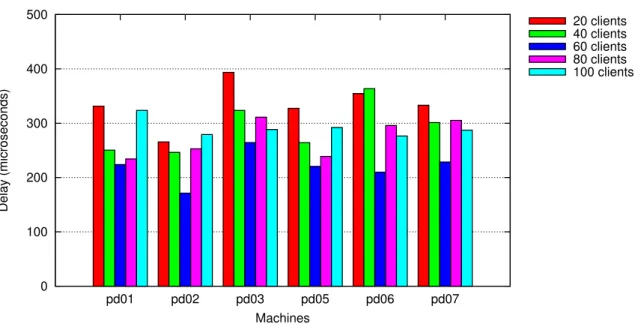
4 Measuring Propagation Delay 27 4.1 Background . . . 27 4.2 Approach . . . 28 4.2.1 Implementation . . . 30 4.2.2 Workload . . . 30 4.2.3 Setting . . . 32 4.3 Results . . . 34 4.4 Summary . . . 35
5 MySQL Proxy and Plugins 37 5.1 Architecture . . . 37
5.2 Chassis . . . 39
5.2.1 Config-file and Command-line Options . . . 40
5.2.2 Front end . . . 41
5.2.3 Plugin Interface . . . 41
5.3 Network Core . . . 41
5.3.1 MySQL Protocol . . . 41
5.3.2 Connection Life Cycle . . . 42
5.3.3 Concurrency . . . 44 5.4 Plugins . . . 46 5.4.1 Proxy plugin . . . 46 5.4.2 Admin plugin . . . 46 5.4.3 Debug plugin . . . 47 5.4.4 Client plugin . . . 47 5.4.5 Master plugin . . . 48 5.4.6 Replicant plugin . . . 48 5.5 Scripting . . . 49
CONTENTS xv
5.6 Summary . . . 51
6 Replication Plugins Using Group Communication 53 6.1 General Approach . . . 53 6.2 Active Replication . . . 54 6.2.1 Lua bindings . . . 55 6.2.2 Challenges . . . 56 6.2.3 Solution . . . 58 6.3 Passive Replication . . . 59 6.4 Recovery . . . 61 6.5 Summary . . . 62
7 Results and Performance Analysis 65 7.1 Motivation . . . 65
7.2 Workload and Setting . . . 66
7.3 Experimental Results . . . 66
7.3.1 MySQL Replication . . . 67
7.3.2 Proxy Spread Plugins - Active Replication . . . 72
7.3.3 Agreed Messages . . . 76 7.4 Summary . . . 80 8 Conclusions 81 8.1 Future Work . . . 82 Referencfaddfses 84 A Additional Results 89 A.1 MySQL Replication . . . 89
A.1.1 Master and Multiples Slaves . . . 89
A.1.2 Chain . . . 91
A.2 Proxy Spread Plugins - Active Replication . . . 92
A.2.1 FIFO Messages . . . 92
B Code and Scripts 97 B.1 Lua Script to use on Proxy Spread Master Plugin . . . 97
List of Figures
2.1 Master and Multiple Slaves Replication . . . 13
2.2 Ring Topology . . . 14
2.3 Chain Topology . . . 14
2.4 Tree Topology . . . 15
3.1 Primary-Backup Replication . . . 20
3.2 State-Machine Replication . . . 22
4.1 Impossibility to probe simultaneously master and slaves. . . 28
4.2 Log position over the time . . . 29
4.3 Sampling twice without updates erroneously biases the estimate. . . 29
4.4 Master and Multiple Slaves topology . . . 33
4.5 Chain topology . . . 33
4.6 Scalability of master and multiple slaves topology. . . 34
4.7 Scalability of the chain topology. . . 35
5.1 MySQL Proxy top-level architecture . . . 38
5.2 MySQL Proxy detailed architecture . . . 39
5.3 MySQL Protocol state-machine . . . 43
5.4 Thread I/O control flow . . . 45
5.5 Proxy Plugin hooks control flow . . . 50
6.1 Active replication plugin architecture . . . 58
6.2 Passive replication plugin architecture . . . 60 xvii
7.1 Replication delay values for Master and Multiple Slaves topology (default think-time) . . . 68 7.2 Replication delay values for Master and Multiple Slaves topology (half
think-time) . . . 68 7.3 Replication delay values for Chain topology (default think-time) . . . 70 7.4 Replication delay values for Chain topology (half think-time) . . . 70 7.5 Replication delay values for active replication with Proxy Spread plugins
with FIFO messages (default think-time) . . . 71 7.6 Replication delay values for active replication with Proxy Spread plugins
with FIFO messages (half think-time) . . . 72 7.7 Replication delay values for active replication with Proxy Spread plugins
with FIFO messages (default think-time, two replicas) . . . 73 7.8 Replication delay values for active replication with Proxy Spread plugins
with FIFO messages (half think-time, two replicas) . . . 74 7.9 Replication delay values for active replication with Proxy Spread plugins
with FIFO messages (default think-time, four replicas) . . . 75 7.10 Replication delay values for active replication with Proxy Spread plugins
with FIFO messages (half think-time, four replicas) . . . 75 7.11 Replication delay values for active replication with Proxy Spread plugins
with AGREED messages (default think-time) . . . 76 7.12 Replication delay values for active replication with Proxy Spread plugins
with AGREED messages (half think-time) . . . 77 7.13 Replication delay values for active replication with Proxy Spread plugins
with AGREED messages (default think-time, two replicas) . . . 78 7.14 Replication delay values for active replication with Proxy Spread plugins
with AGREED messages (half think-time, two replicas) . . . 78 7.15 Replication delay values for active replication with Proxy Spread plugins
with AGREED messages (default think-time, four replicas) . . . 79 7.16 Replication delay values for active replication with Proxy Spread plugins
with AGREED messages (half think-time, four replicas) . . . 79 A.1 Replication delay values for Master and Multiple Slaves topology (no
think-time) . . . 89 A.2 Replication delay values for Master and Multiple Slaves topology
LIST OF FIGURES xix A.3 Replication delay values for Chain topology (no think-time) . . . 91 A.4 Replication delay values for Chain topology (one-third of think-time) . . . 91 A.5 Replication delay values for active replication with Proxy Spread plugins
with FIFO messages (one-third of think-time) . . . 92 A.6 Replication delay values for active replication with Proxy Spread plugins
with FIFO messages (one-third of think-time, two replicas) . . . 93 A.7 Replication delay values for active replication with Proxy Spread plugins
with FIFO messages (one-third of think-time, four replicas) . . . 93 A.8 Replication delay values for active replication with Proxy Spread plugins
with AGREED messages (one-third of think-time) . . . 94 A.9 Replication delay values for active replication with Proxy Spread plugins
with AGREED messages (one-third of think-time, two replicas) . . . 95 A.10 Replication delay values for active replication with Proxy Spread plugins
List of Tables
4.1 Results for master and multiple slaves topology with 100 clients. . . 34
4.2 Results for chain topology with 100 clients. . . 35
5.1 Command-line and Defaults-file options examples . . . 41
5.2 Proxy Plugin options . . . 47
5.3 Admin Plugin options . . . 47
5.4 Debug Plugin options . . . 47
5.5 Client Plugin options . . . 48
5.6 Master Plugin options . . . 48
5.7 Replicant Plugin options . . . 49
7.1 TPC-C new-order transactions per minute for master and multiple slaves topology . . . 67
7.2 Results for master and multiple slaves topology with 100 clients. . . 67
7.3 TPC-C new-order transactions per minute for chain topology . . . 69
7.4 Results for chain topology with 100 clients. . . 69
7.5 TPC-C new-order transactions per minute for active replication with Proxy Spread Plugins with FIFO messages . . . 71
7.6 Replication delay values for active replication with Proxy Spread plugins with FIFO messages (default think-time) with 100 clients. . . 71
7.7 TPC-C new-order transactions per minute for active replication with Proxy Spread Plugins with AGREED messages . . . 76
7.8 Replication delay values for active replication with Proxy Spread plugins with AGREED messages (default think-time) with 100 clients. . . 76
Chapter 1
Introduction
Internet-based services have become a standard in our information society, supporting a wide range of economic, social, and public activities. And in this globalized era, since large organizations are present in different places all over the world, information must be always online and available. The loss of information or its unavailability can lead to serious economic damages.
Availability has recently became critical due to large amounts of data being captured and used each day with the emerging online services. Large companies such as Google, eBay, or Amazon handle exabytes of data per year. Facebook claims to be one of the largest MySQL installations running thousands of servers handling millions of queries, complemented by its own Cassandra data store for some very specific queries. So, high-availability, performance, and reliability are all critical requirements in such systems.
Both of these challenges are commonly addressed by means of the same technique, namely data replication. Application components must be spread over a wide area net-work, providing solutions that enable high availability through network shared contents. Data replication has become a rising study topic in many areas, specially in dis-tributed systems, mainly for fault tolerance proposes, and in databases, mainly for per-formance reasons. So, for this reasons, since databases are more and more deployed over clusters and workstations, replication is a key component. Replicating data improves fault-tolerance since the failure of a site does not make a data item inaccessible. Available sites can take over the work of failed ones. It also improves performance since data ac-cess can be localized over the database network, i.e. transaction load is distributed across the replicas, achieving load balancing. On the other hand, it can be used to provide more computational resources, or allow data to be read from closer sites reducing the response time and increasing the throughput of the system.
However, replication introduces a trade-off between consistency and performance.
Due to this, it is important to use adequate replication mechanisms.
Actually replicated databases, are usual solutions used in datacenter’s or local area networks. And so, most of solutions adopt a model where data consistency is relaxed in favor to better performance, i.e. most replicated databases do not ensure data consistency among replicas.
1.1
Problem Statement
Most database management systems implement asynchronous master-slave replication. These systems provide mechanisms for master-slave replication that allows configuring one or more servers as slaves of another server, or even to behave as master for local updates. MySQL in particular allows almost any configuration of master and slaves, as long as each server has at most one master. This usually leads to a variety of hierarchical replication topologies, but includes also a ring which allows updates to be performed at any replica, as long as conflicts are avoided. Being this engine widely used, open-source, and fast, it becomes a very interesting topic of investigation and contribution.
Being replicated asynchronously, data is first written on the master server and then is propagated to the respective slaves, and so, specially in the case of thousands or hun-dreds of servers, the nodes will not obtain the most recent data. This method of dissem-inating data combined with the impossibility of having more than one master makes it impossible to spread data rapidly to a large number of replicas.
This problem contrasts with the state of the art in group communication having in account the characteristics inherent to this. Guarantees such as reliability, order, and message stability, as also message delivery guarantees as for example reliable messaging or fully ordered messages.
1.2
Objectives
The central objective of this work is to improve the scalability and fault-tolerance of MySQL proposing, implementing and evaluating a mechanism of updates distribution that allows thousands or hundreds of replicas. For that, it is necessary to understand firstly the MySQL’s replication mechanism, and also the data freshness measurement. Moving next to the main objective to improve this with the use of a group communica-tion protocol.
1.3. CONTRIBUTIONS 3
1.3
Contributions
This thesis proposes a new approach to MySQL replication that enables state-machine replication and primary-backup replication by combining the software tool MySQL Proxy and the Spread Group Communication System. The key to our implementation is to take advantage of the guarantees of reliability, order, message stability and message delivery guarantees for reliable messaging or fully ordered messaging of group communication, to build an mechanism of active and passive replication for the MySQL database man-agement system.
In detail, we make the following contributions:
• Evaluation and measuring of data freshness in scenarios of large scale replicated databases
This contribution addresses the difficulty of measure accurately the impact of cation in data freshness by introducing a tool that can accurately measure repli-cation delays for any workload and then apply it to the industry standard TPC-C benchmark [1]. We also evaluate data freshness by applying the tool to two rep-resentative MySQL configurations with a varying number of replicas and increas-ing workloads usincreas-ing the industry standard TPC-C on-line transaction processincreas-ing benchmark [1].
• Documentation and analysis of the software tool MySQL Proxy
We fully document, analyze and discuss the components and working of the soft-ware tool MySQL Proxy.
• Development of plugins for group based replication using MySQL Proxy We propose a solution to implement group based replication using the software tool MySQL Proxy. The proposal exploits the plugin based architecture of MySQL Proxy to implement plugins to use the Spread Group Communication Toolkit for both active and passive replication.
• Evaluation and performance analysis of the proposed solution
We evaluate the developed solution using realistic workloads based on the indus-try standard TPC-C benchmark [1]. We analyze the behaviour of the solution under different conditions and configurations comparing it to the MySQL standard repli-cation mechanism.
1.4
Dissertation Outline
This thesis is organized as follows: Chapter 2 describes the state of the art in database replication; Chapter 3 introduces and discusses group-based replication; Chapter 4 presents the performance tests and the efforts done in order to measure the replication propaga-tion delay in the MySQL Database Management System; Chapter 5 presents and doc-uments the software tool MySQL Proxy; Chapter 6 presents the proposed approaches and solutions; Chapter 7 evaluates the solution implemented using realistic workloads; and finally Chapter 8 concludes the thesis, summarizing its contributions and describing possible future work.
Related Publications
Portion of the work presented in this thesis has been previously published in the form of conference and workshop papers:
• M. Araújo and J. Pereira. Evaluating Data Freshness in Large Scale Replicated Databases. In INForum. 2010.
Chapter 2
Database Replication
Database replication is a technique that allows taking a database and making an exact copy of it on another site. In a replicated database system each site stores a copy of the database. This copies can be total (full replication) or partial (partial replication). Data access is done via transactions. A transaction represents a unit of work (read or write operation) performed against a database.
Database replication is in charge of ensuring concurrent and consistent transaction execution. This is made by concurrency control and replica control mechanisms. Concur-rency control isolates concurrent transactions with conflicting operations, while replica control coordinates the access to different copies. Replication protocols are the ones in charge of performing this task.
2.1
Classification Criteria
Classification of replication protocols can be done according to where and when can up-dates be performed [17]. Regarding to when can upup-dates be propagated we have lazy replication protocols, also known as asynchronous protocols, and eager replication pro-tocols, also known as synchronous replication protocols. Regarding to where can updates be performed we have two approaches, primary-copy and update-everywhere [17].
2.1.1 Eager vs Lazy Replication
Eager replication keeps all replicas synchronized at all nodes by updating all the replicas as part of one atomic transaction [17]. This is comparable to the Two-Phase Commit pro-tocol. Eager protocols propagate updates to remote copies within the transaction bound-aries and coordinate the different sites before the transaction commits [35]. With this,
if the database management system is serializable, serializable execution is achieved -there are no concurrency anomalies. Strong consistency and fault-tolerance are achieved by ensuring that updates are stable at multiple replicas before replying to clients [21]. And so, crash detection is also allowed. These protocols are also flexible since they, in contrast with lazy replication, allow updates to any copy in the system.
But this type of replication has some disadvantages. Despite consistency achieved in these models it is expensive in terms of message overhead and response time. So the performance is reduced and transaction response times are increased because extra mes-sages are added to the transaction, also mobile nodes cannot use an eager scheme when disconnected and the probability of deadlocks and failed transactions rises very quickly with transaction size and number of nodes.
Lazy replication propagates replica updates asynchronously to other nodes after the transaction commits. The other nodes are updated later by capturing updates in the master, distributing and applying them. This mechanism as an impact on user visible performance, specially on transaction latency that is reduced.
Lazy schemes update replicas using separate transactions, in contrast to eager schemes that distribute updates to replicas in the context of the original updating transaction. The eager method makes it easy to guarantee transaction properties, such as serializability. However, since such transactions are distributed and relatively long-live, the approach does not scale well. [13].
Due to the complexity and performance of eager replication, there is a wide spectrum of lazy schemes. Lazy replication reduces response times since transactions can be exe-cuted and committed locally and only then updates are propagated to the other sites [22]. But asynchronous replication also has shortcomings, being the major one stale data versions. Even allowing a wide variety of optimizations, copies are allowed to diverge so inconsistencies among copies might occur [34]. This kind of replication is also not suit-able for fault-tolerance by fail-over while ensuring strong consistency because updates can be lost after a failure of the master.
Lazy schemes reduce response times, however durability cannot be guaranteed. If a node fails before it propagates the update of a committed transaction T to the other sites, then T is lost.
2.1.2 Primary-copy vs Update-Everywhere
The other classification parameter referred by [17] is about who can perform updates, primary-copyvs update-everywhere replication.
2.1. CLASSIFICATION CRITERIA 7 In the primary copy approach all the updates are initially performed at one copy, called master or primary copy. After this step the updates are propagated and executed in the other copies (replicas). All replicas must contact the same server to perform updates. To notice that after the execution of the transaction, the local server (master) sends the response back to the client, and only after the commit the updates are propagated to the other sites. This allows a reduction on the communication overhead. The Agreement Coordination phase [34], is relatively simple because all the ordering of the transactions takes place on the primary copy and the replicas need only to apply the propagated updates. This introduces a single point of failure and a potential bottleneck, but simplifies replica control.
In contrast, the update-everywhere method allows any copy to be updated, it speeds up data access but makes replica coordination more complex and expensive. In this case the Agreement Coordination phase, is much more complex than in the primary copy approach. Since any copy can perform updates, conflicting transactions may occur at the same time between replicas. So, the copies on the different sites may not only be inconsistent but also stale. Reconciliation is needed to decide what transactions should be performed and those that should be undone.
Update-Everywhere
This approach, also called Lazy Group Replication [17], works by sending a transaction to every node in order to apply the root transaction’s update to the replicas at the desti-nation node, when a transaction commits. It is possible for two nodes update the same object and race each other to install their updates to other nodes. So, the replication mechanism must detect this and reconcile the two transactions so that their updates are not lost.
The method commonly used to detect and reconcile transaction updates is the use of timestamps. Each object carries the timestamp of its most recent update. Each replica update carries the new value and is tagged with the old object timestamp. Each node detects incoming replica updates that would overwrite earlier committed updates. The node tests if the local replica’s timestamp and the update’s old timestamp are equal. If so, the update is safe. The local replica’s timestamp advances to the new transaction’s timestamp and the object value is updated. If the current timestamp of the local replica does not match the old timestamp seen by the root transaction, then the update may be dangerous. In such cases, the node rejects the incoming transaction and submits it for reconciliation.
Transactions that would wait in an eager replication system face reconciliation in a lazy-group replication system. Waits are much more frequent than deadlocks because it
takes two waits to make a deadlock. So, if waits are a rare event, deadlocks are even a more rare event. Eager replication waits cause delays while deadlocks create application faults. With lazy replication, waits are much more frequent; this is what determines the reconciliation frequency.
Primary-Copy
This approach, also called Master Replication [17] is the most common method used in lazy replication.
Master replication assigns an owner to each object and the owner stores the object’s correct current value. Updates are first done by the owner and then propagated to other replicas. Different objects may have different owners.
When a transaction wants to update an object, it sends an RPC (remote procedure call) to the node owning the object. To get serializability, a read action should send read-lock RPCs to the masters of any objects it reads.
Simplifying, the node that originates the transactions, broadcasts the replica updates to all the slaves after the master transaction commits. The originating node sends one slave transaction to each slave node. Slave updates have timestamps to assure that all the replicas converge to the final state. If the record timestamp is newer than a replica update timestamp, the update is "stale" and can be ignored. Alternatively, each master node send replica updates to slaves in sequential commit order.
Lazy-Master replication is not suitable for mobile applications. If a node wants to update an object it must be connected to the object owner and participate in an atomic transaction with it.
Lazy-master systems have no reconciliation failures, conflicts are resolved by wait-ing or deadlock. The deadlock rate for a lazy-master system is similar to a swait-ingle node system with much higher transaction rates. Transactions operate on master copies of ob-jects. The replica update transactions do not really matter, because they can abort and restart without affecting the user. The main issue relies on how frequently the master transactions deadlock.
This is a better behavior than lazy-group replication. Lazy-master replication sends fewer messages during the base transaction and so completes more quickly. Neverthe-less, all of these replication schemes have troubling deadlock or reconciliation rates as they grow to many nodes.
In summary, lazy-master replication requires contact with object masters and so is not useable by mobile applications. Lazy-master replication is slightly less deadlock prone than eager-group replication primarily because the transactions have shorter duration.
2.2. CONSISTENCY CRITERIA 9
2.2
Consistency Criteria
Replica consistency is a key issue to achieve fault tolerance. The consistency property ensures that the database remains in a consistent state before and after the transaction is over.
A correct behaviour in a replicated system must ensure the strictest correctness crite-rion: linearizability. The correctness criterion linearizability, also called one-copy equiv-alence, gives the illusion that a replicated database systems is single, i.e. non-replicated. The effect of transactions performed by clients on replicated objects should be the same as if they had been performed one at-a-time on a single set of objects. That is a desirable property because it preserve’s the program’s semantics [6].
Most of replications techniques were designed for serializable database management systems (DBMS) in order to obtain One-Copy Serializability Replication (1CS). However, there is an increasing popularity of Snapshot Isolation (SI) level where a transaction ob-tains the latest committed snapshot version of the database as of the time it starts [16,24]. The main goal of providing transactional guarantees weaker than 1CS, such as SI, is that the database system can achieve increased concurrency by relaxing the isolation requirements on transactions. This means that concurrently executing transactions may see each others indirectly through their effects on the database. However, SI does not guarantee serializability. It allows update transactions to read old data.
Another correctness criteria is Strong serializability. This criterion ensures that a transaction that starts after a previous transaction has finished is serialized after is pre-decessor. But recently, [12] demonstrated that this criteria is too strong for lazy replicated systems, and proposed Strong Session One-Copy Serializability Replication (Strong Ses-sion 1SR).
Strong Session 1SR is a generalization of One-Copy Serializability Replication (1SR) and Strong One-Copy Serializability (Strong 1SR) that allows important transaction or-dering constraints to be captured and unimportant ones to be ignored, improving data freshness. However, it has been proved that Strong 1SR is very difficult to achieve as the propagation latencies increase while the Strong Session 1SR can be maintained almost as efficiently as 1SR.
Concluding, higher degrees of transaction isolation guarantee fewer anomalies but with larger performance penalties. There is a range of solutions to achieve transaction isolation guarantees, each one introducing a trade-off between performance and data consistency.
2.3
Replication in Large Scale Databases
Current database replication techniques have attained some degree of scalability; how-ever, there are two main limitations to existing approaches. Firstly, most solutions adopt a full replication model where all sites store a full copy of the database. The coordination overhead imposed by keeping all replicas consistent allows such approaches to achieve only medium scalability. Secondly, most replication protocols rely on the traditional con-sistency criterion, 1-copy-serializability, which limits concurrency, and thus scalability of the system [31].
The main problem of the protocols that ensure serializability is that all concurrency conflicts must be considered, like read/write and write/write transactions. Read/write conflicts are very frequent and limit the amount of potential concurrency in the system, resulting in lack of scalability.
The protocols studied are fully replicated, then updates have to be executed at all replicas. So, in eager protocols, the replicated database does not scale under update workloads, because all sites do the same work.
On the other hand, lazy replication updates all the copies in separate transactions, so the latency is reduced in comparison with eager replication. A replica is updated only by one transaction and the remain replicas are updated later on by separate refresh transactions [28].
Although there are concurrency control techniques and consistency criterion which guarantee serializability in lazy replication systems, these techniques do not provide data freshness guarantees. Since transactions may see stale data, they may be serialized in an order different from the one in which they were submitted.
So, asynchronous replication leads to periods of time that copies of the same data diverge. Some of them have already the latest data introduced by the last transaction, and others have not. This divergence leads to the notion of data freshness: The lower the divergence of a copy in comparison with the other copies already updated, the fresher is the copy [29].
Actually have been proposed some consistency techniques to improve data freshness, but having a trade-off between consistency and performance.
Recently, some refresh strategies have also been proposed. The first one to be men-tioned is the ASAP model, in which the updated are propagated from the source to the replicas as soon as possible [5, 7, 11]. Another strategy used in data warehouses, is to re-fresh replicas periodically, as in [9,25]. In [32] a rere-fresh strategy was proposed, which con-sist in maintaining the freshness of replicas by propagating updates only when a replica is too stale.
2.4. MYSQL 11 Mixed strategies were also proposed. An approach to improve data freshness has been proposed in which the data sources push updates to caches nodes when their fresh-ness level is too low [26]. If needed, cache nodes can also force refreshment. Another strategy discussed in [23] states that an asynchronous Web cache maintains materialized views whit an ASAP strategy while regular views are regenerated on demand. In these approaches, refresh strategies are not chosen having in concern the performance related to the workload in question.
2.4
MySQL
In this work we take the MySQL case study to systematize and evaluate the replication mechanisms. MySQL database management system implements asynchronous master-slave replication. The system provides mechanism to configure master-master-slave replication that allows configuring one or more servers as slaves (replicas) of another server, or even to behave as master for local updates.
The configuration of replication allows an arrangement of masters and slaves in dif-ferent topologies. It is possible to replicate the entire server, replicate only certain databases or to choose what tables to replicate.
2.4.1 Replication Formats
MySQL uses the Primary-Copy Replication method, and supports two kinds of replica-tion, statement-based and row-based.
Statement-Based Replication
In the statement-based approach, every SQL statement that could modify the data is logged on the master server. After this those statements are re-executed on the slave against the same initial dataset and in the same context. It generally requires less data to be transferred between the master and the slave, as well as taking up less space in the update logs. It does not have to deal with the format of the row. The compactness of the data transfer will generally allow it to perform better. On the other hand, it is necessary to log a lot of execution context information in order for the update to produce the same results on the slave as it did originally on the master. In some cases it is not possible to provide such a context. Statement-based replication is also more difficult to maintain, as the addition of new SQL functionality frequently requires extensive code updates for it to replicate properly.
Row-Based Replication
In the row-based approach, every row modification gets logged on the master and then applied on the slave. No context information is required. It is only necessary to know which record is being updated, and what is being written to that record. Given a good code base, the maintenance of a row-based replication is also fairly simple. Since the logging happens at a lower level, the new code will naturally execute the necessary low-level routines that modify the database, which will do the logging with no additional code changes. However, on a system that frequently executes queries such as UPDATE customer SET status=’Current’ WHERE id BETWEEN 10000 and 20000, row-based repli-cation produces unnecessarily large update logs and generates a lot of unnecessary net-work traffic between the master and the slave. It requires a lot of awareness of the in-ternal physical format of the record, and still has to deal with the schema modifications. In some situations the performance overhead associated with the increased I/O could become unacceptable.
2.4.2 Replication Mechanism
The replication mechanism of MySQL, works at a high level in a simple three-part pro-cess:
• The master records changes to its data in its binary log (these records are called binary log events).
• The slave copies the master’s binary log events to its relay log.
• The slave replays the events in the relay log, applying the changes to its own data. Briefly, after writing the events to the binary log, the master tells the storage engine to commit the transactions. The next step is for the slave to start a I/O thread to start the dump. This process reads events from the master’s binary log. If there are events on the master, the thread writes them on the relay log. Finally, a thread in the slave called SQL thread reads and replay events from the relay log, thus updates slave’s data to match the master’s data. To notice that the relay log usually stays in the operating system’s cache, having very low overhead.
This replication architecture decouples the processes of fetching and replaying events on the slave, which allows them to be asynchronous. That is, the I/O thread can work independently of the SQL thread. It also places constraints on the replication process, the most important of which is that replication is serialized on the slave. This means updates
2.4. MYSQL 13
Figure 2.1: Master and Multiple Slaves Replication
that might have run in parallel (in different threads) on the master cannot be parallelized on the slave. However, this is a performance bottleneck for many workloads.
2.4.3 Replication Topologies
It is possible to setup MySQL replication for almost any configuration of masters and slaves, with the limitation that a given MySQL slave instance can have only one master.
The simplest topology besides Master-Slave is Master and Multiple Slaves (Figure 2.1). In this topology, slaves do not interact with each other at all, they all connect only to the master. This is a configuration useful for a system that has few writes and many reads. However, this configuration is scalable to the limit that the slaves put too much load on the master or network bandwidth from the master to the slaves becoming a problem.
Other possible configuration is Master-Master in Active-Active Mode. This topology involves two servers, each configured as both a master and slave of the other. The main bottleneck in this configuration resides on how to handle conflicting changes.
A variation on master-master replication that avoids the problems of the previous is the Master-Master in Active-Passive mode replication. The main difference is that one of the servers is a read-only "passive" server. This configuration permits swapping the active and passive server roles back and forth very easily, because the servers configura-tions are symmetrical. This makes failover and failback easy.
The related topology of the previous ones is Master-Master with Slaves. The advan-tage of this configuration is extra redundancy. In a geographically distributed replication topology, it removes the single point of failure at each site.
One of the most common configuration in database replication, is the Ring topology (Figure 2.2). A ring has three or more masters. Each server is a slave of the server before it in the ring, and a master of the server after it. This topology is also called circular replication. Rings do not have some of the key benefits of a master-master setup, such as symmetrical configuration and easy failover. They also depend completely on every
Figure 2.2: Ring Topology
Figure 2.3: Chain Topology
node in the ring being available, which greatly increases the probability of the entire system failing. And if you remove one of the nodes from the ring, any replication events that originated at that node can go into an infinite loop. They will cycle forever through the topology, because the only server that will filter out an event based on its server ID is the server that created it. In general, rings are brittle and best avoided. Some of the risks of ring replication can be decreased by adding slaves to provide redundancy at each site. This merely protects against the risk of a server failing, though.
Another possibility, regarding some certain situations where having many machines replicating from a single server requires too much work for the master, or the replication is to spread across a large geographic area that chaining the closest ones together gives better replication speed, is the Daisy Chain (Figure 2.3). In this configuration each server is set to be a slave server to one machine as as master to another in a chain. Again, like the ring topology the risk of losing a server can the decreased by adding slaves to provide
2.4. MYSQL 15
Figure 2.4: Tree Topology
redundancy at each site.
The other most common configuration is the Tree or Pyramid topology (Figure 2.4). This is very useful in the case of replicating a master to a very large number of slaves. The advantage of this design is that it eases the load on the master, just as the distribution master did in the previous section. The disadvantage is that any failure in an interme-diate level will affect multiple servers, which would not happen if the slaves were each attached to the master directly. Also, the more intermediate levels you have, the harder and more complicated it is to handle failures.
2.4.4 Replication Latency
In theory, replication speed should be extremely fast (i.e. , bounded only by the network speed). The MySQL binlog dump process does not poll the master for events, which would be inefficient and slow. Instead, the master notifies the slave of events. Reading a binary log event from the master is a blocking network call that begins sending data practically instantaneously after the master logs the event. Thus, it’s probably safe to say the event will reach the slave as quickly as the slave thread can wake up and the network can transfer the data.
However, since MySQL uses the Primary-Copy Replication method, it lacks of scala-bility since updating transactions are executed by a single replica and this compromises its performance.
Noting both the replication topologies and the behaviour of MySQL’s replication mechanism, one can deduce that in these, several hops are made by updates in order to reach all replicas. The update delay will increase proportional to the number of hops,
having a major impact on large scale systems’ data freshness.
2.5
Summary
In this chapter we have introduced database replication presenting for a start the dif-ferent main replication protocols and the consistency criteria. Afterwards asynchronous replication have been described with detail leading us to draw some conclusions about its application on large scale scenarios. The data freshness problem is stated motivating the work to achieve a solution to this problem. It is interesting to note that even though lazy replication models reduce latency taking advantage of the fact that the replicas are updated in separate transactions, it does guarantee data freshness since they lead to pe-riod of time where copies of the same data diverge.
The chapter ends with a description and discussion around the MySQL database man-agement system replication mechanisms. It allow us to draw some conclusions about replication speed on MySQL and on different topologies focusing on the data freshness problem. The limitation of having more than one master restricts the dissemination of the updates to a large number of replicas. This is the basis for the definition of group communication primitives and database replication based on group communication in the following chapter.
Chapter 3
Group-based Replication
High-availability, performance, and reliability requirements are mostly achieved by the data replication technique. Database replication it is commonly implemented using group communication primitives. These primitives provide a framework that reduces the com-plexity of the implementation. Replication commonly addresses the linearizability issue with two main models: primary-backup, also called passive replication, or state-machine, also called active replication.
3.1
Group Communication
A distributed system consists of multiple processes that communicate via communica-tion links using message passing. These processes can behave according to their specifi-cation if they are correct or crash or behave maliciously if they are incorrect [19]. This set of processes is known as group. A process group has the ability to control the distribu-tion of messages and signals, i.e., a message sent to a process group is delivered to all the other processes.
A group represents a set of processes, as it can address all the processes into a single entity. For example, consider a replicated object x. A group Gx can represent the set of replicas of x. As so, Gx can be used to address a message to all the replicas of x [18]. A group can be used to send messages to all the constituents of it without naming them explicitly, i.e. the process addresses the message to the logical group address.
Since group communication protocols are based on groups of processes, i.e. recipi-ents, communication takes into account the existence of multiple receivers for the mes-sages. As so, message passing within the group must ensure properties such as reliability, and order.
Group Communication provides group membership management to track the dy-17
namic constitution of groups. Groups can be of two different kinds: static or dynamic [18]. Groups are considered static if the membership is not changed during the system life-time. All initial members of the group remain with the membership even if they crash. If a recover is possible, the member remains member of the group. On the other hand, dynamic groups are the opposite, membership can change during the life-time of the system. If a replica crashes it leaves the group and if it recovers at any time it can rejoin the group. This states the notion of group membership and view. A group membership maintains group views, i.e., the set of processes believed to be correct at the moment. For the crashing process example, when it crashes it is removed from the Group and when it recovers it rejoins, the history of the group membership is constituted by the views [19]. The group membership service is responsible for tracking correct and incor-rect processes, creating and destroying groups, to add or withdraw processes to and from a group and to notify process members of membership changes. Group membership can be defined by the following properties [10]:
Self inclusion:
Every view installed by a process includes itself, i.e. if a process p installs view V, then p is a member of V
Local monotonocity:
If a process p installs view V after installing view V’ then the identifier of V is greater than that of V’
Agreement:
Any two views with the same identifier contains the same set of processes. Linear membership:
For any two consecutive views there is at least one process belonging to both views.
The definition of a group communication protocol involves properties such as reliabil-ity, order and atomicity. In order to obtain reliability in message passing, group commu-nication use reliable multicast. A reliable multicast primitive can be defined as follows: If process p is correct and reliably multicasts message m, then every correct recipient even-tually delivers m [20].
Sometimes there is a need to coordinate message transmission with the group mem-bership service. This is achieved by view synchrony. View synchrony synchronizes pro-cesses on membership changes. The definition is as follows [10]: any two propro-cesses that install two consecutive views will deliver the same set of messages multicast between these views.
3.1. GROUP COMMUNICATION 19 To multicast the messages View Synchrony defines two primitives: VSCAST and VSDELIVER. Virtual Synchronous Multicast (VSCAST) satisfies the following proper-ties [10]:
Integrity:
If a process p delivers (VSDELIVER) a message m, then message m was previously VSCAST(m, g);
No Duplication:
If a process q delivers (VSDELIVER) m and m’, then m6=m’; View Synchrony:
If processes p and q install two consecutive views, V and V’, then any message delivered (VSDELIVER) by p in V is also delivered (VSDELIVER) by q in V;
Termination:
If a process p is correct and VSCAST(m, g) in view V, then each member q of V either delivers (VSDELIVER) m or installs a new view V’ in V.
However virtual synchrony multicast is not enough in some particular cases, where there is a need to deliver messages sent to a set of processes at each site in the same order. TOCAST provides a group communication primitive that guarantees that a message m, sent to a group g (TOCAST(m,g)) is delivered (TODELIVER) in the same order at every member of group g. Total Order Multicast is defined as following [15]:
Integrity:
If a process p delivers TODELIVER a message m, it does it so at most once and only if m was previously TOCAST(m, g);
Validaty:
If a process p TOCAST a message m, then a correct process p’ eventually delivers (TODELIVER) m;
Agreement:
If a process p TOCAST a message m, and a correct process p’ delivers (TODELIVER) m then all correct processes eventually also delivers (TODELIVER) m;
Total Order:
If processes p and a q TOCAST(m, g) and TOCAST(m’, g), respectively, then two correct processes r and s deliver (TODELIVER) m and m’ in the same order.
primary: replica 1 replica 2 replica 3 Update Apply Apply Apply Ack Ack Client Client Response VS CAST Client Request Invocation
Execution Agreement Coordination Client Response
Figure 3.1: Primary-Backup Replication
3.2
Primary-Backup Replication
A classical approach for replication is to use a server as the primary and all the others as backups of this [8]. The client issue requests to the primary server only. This server has a main role to receive client invocations and to return to it the responses.
This technique states that the replicas do not execute the client invocation but apply the changes produced by the invocation executed on the primary, i.e., the updates [34]. The primary executes the client invocations and sends the updates to the replicas. How-ever, updates need to be propagated in the same order according to the order in which the primary replica received the invocations. This way, linearizability is achieved because the order on the primary replica defines the total order of all servers [19].
As seen in (Figure 3.1) The client starts by sending the request invocation to the pri-mary server. This server executes the request which will give rise to a response. It then updates its state and coordinates with the other replicas by sending them the update in-formation. Finally the primary server sends the response to the client once it receives the acknowledgment from all the correct replicas.
However, linearizability is obtained if the primary does not crash since it states the total order on all invocations. If the primary crashes, three cases can be distinguished [18]:
• The primary crashes before sending the update message to the replicas;
3.2. PRIMARY-BACKUP REPLICATION 21 client receives the response;
• The primary crashes after the client has received the response;
In all the three cases a new primary replica has to be selected. For the first case, when the crash happens before the primary sends the update to the replicas the client will not receive any response so it will issue the request again. The new primary will considers the invocation as a new one. In the second case, the client will also not receive any response, however since the crash happened after the update message was sent atomicity must be guaranteed, i.e. either the replicas receive the message or none. If none receives the update message then the process is similar to the fist case. Otherwise, if all the replicas receive the update then the state of each is updated as supposed but the client will not receive any response, issuing again the request invocation. The solution to this problem was to introduce information in order to know the invocation identification (invID) and respective response (red). Thus, avoiding to handle the same invocation twice. When the primary receives an invocation with the same identification (invID) it immediately send the response (res) back to the client.
The great advantage of the primary-backup technique is that it allows non-deterministic operations, i.e. it is possible for each replica to have multi-threading. Besides that fac-tor, it has a lower cost in terms of processing power compared to other replication tech-niques. However, when the primary fails it has some costs for re-electing a new primary and handle the crash. Concerning fault transparency, in contrast to the state-machine replication the crash of the primary is not transparent to the client since it increases the latency between invocation and reception of the response. However, the replicas crash is completely transparent to the client.
3.2.1 Group communication and passive replication
At a first glance, the primary-backup technique does not need group communication to obtain primitives as TOCAST because the primary replica is which defines the update sending order. However, when the primary replica crashes there is a need to select a new primary and handle the crash event so group communication is needed. There is a need to use the dynamic groups property of group communication protocols. Group members must agree on a unique sequence of views [19]. When the primary replica crashes, a new view is installed and a new primary replica is chosen. However, in this example, the primary backup crashes while sending an update and only some of the replicas receive that update. Due to this, a simple multicast primitive is not enough so the view-synchronous multicast(VSCAST) is used.
replica 1 replica 2 replica 3 Client Client Response Client Request Invocation
Server Coordination Execution Client Response
Update Update Update ATOMIC MULTICAST Response Response
Figure 3.2: State-Machine Replication
3.3
State-Machine Replication
Since fault tolerance is commonly obtained with multiple servers with the same data, the state of each server must be distributed among all replicas. In this technique, the state update is received by all replicas in the same order [18].
Contrasting with the primary-backup model, in active replication there is not a cen-tralized control by one of the servers. This way fault-tolerance can be achiever in a greater scale since the multiple servers can fail independently without compromising the whole replicated system. Each replica has the same role in processing and distributing the up-dates, and consistency is guaranteed by assuming that all replicas receive the invocations of client processes in the same order [19].
To obtain this level of consistency, the client requests must be propagated having the properties of order and atomicity, i.e., using the primitive Atomic Multicast or Total Or-der Multicast.
The great advantage of this technique is the transparency obtained. A crash of a single replica is transparent to the client process since it does not need to repeat the request. So, the client is never aware nor needs to take in concern a replica failure. All the replicas process the request even if one fails. However, active replication introduces more costs to the replication since each invocation is processed by all replicas.
As in (Figure 3.2), the client starts by sending a request to the servers. This is achieved using an Atomic Multicast that guarantees the total order property needed for
coordina-3.4. SPREAD GROUP COMMUNICATION TOOLKIT 23 tion. Then each replica processes the request in the same order since replicas are deter-ministic producing the same result, and reply with the request result to the client. In this phase the client usually waits for receiving the first response, or to receive a majority of identical responses [18].
3.3.1 Group communication and active replication
The state-machine approach, as described above requires that the invocations sent to all servers are atomic and on the same order. As so, this technique requires the total-order multicast primitive(TOCAST). A process sends a message with an invocation, which is received by a replica that coordinates with the other replicas to guarantee the properties of the total-order multicast primitive: order, atomicity and termination. After that the replica can deliver the message [19].
3.4
Spread Group Communication Toolkit
The Spread toolkit is a group communication system1. Spread provides reliability,
order-ing and stability guarantees for message delivery. Spread supports a rich fault model that includes process crashes and recoveries and network partitions and merges under the extended virtual synchrony semantics. The standard virtual synchrony semantics is also supported [3]. It provides besides group communication, an highly tuned application-level multicast and point to point support.
Spread provides high performance messaging across local and wide area networks. The big question that arises is how Spread handles wide area networks and how it pro-vides these characteristics in those scenarios since they bring three main difficulties. One of the difficulties is related to the variety of loss rates, latency and bandwidth over the different parts of the network. Other difficult is related to the significantly higher rate of packet loss in comparison to LAN networks. And finally, it is more complex to imple-ment efficient reliability and ordering on the wide area multicast mechanism besides its limitations.
The Spread group communication system addresses the above difficulties through three main structural design issues [4]. It allows the utilization of different low level protocols to disseminate messages depending on the configuration of the network. And in particular, Spread integrates two low-level protocols: Ring and Hop. Ring protocol is meant to be used on local area networks and the Hop protocol in wide area networks.
Spread is built following a daemon-client architecture. This brings several benefits,
mainly the fact that this way membership changes have less impact and cost on the global system. Simple joins and leaves of processes are translated into a single message.
Finally, spread decouples the message dissemination and reliability mechanisms from the global ordering and stability protocols. This allows messages to be forwarded to the network immediately as also supports the Extended Virtual Synchrony model [2] where data messages are only sent to the minimal necessary set of the network components, without compromising the strong semantic guarantees.
Spread is highly configurable, allowing the user to configure it to their needs. It allows the user to control the type of communication mechanisms used and the layout of the virtual network. Spread can use a single daemon over the whole network or to use one daemon in every node running group communication applications. Each Spread daemon keeps track of the computers’s membership, keeping track of processes residing on each machine and participating on group communication. Since this information is shared between the daemon, it created the lightweight process group membership.
3.4.1 Message Types for Data and Membership Messages
Spread allows different types of messages satisfying the ordering and reliability proper-ties described above. The following flags as described on2set the message type:
UNRELIABLE_MESS:
The message is sent unreliably, however it is possible to be dropped or duplicated even that duplications are very rare.
RELIABLE_MESS:
The message will arrive once at all members of its destination group, it may be arbitrarily, but finitely delayed before arriving, and may arrive out of order with regards to other reliable messages.
FIFO_MESS:
The message has the reliable message properties, but it will be ordered with all other FIFO messages from the same source. However, nothing is guaranteed about the ordering of FIFO messages from different sources.
CAUSAL_MESS:
This type of message has all the properties of FIFO messages and in addition are causally ordered with regards to all sources.
3.5. SUMMARY 25 AGREED_MESS:
These messages have all the properties of FIFO messages but will be delivered in a causal ordering which will be the same at all recipients, i.e. all the recipients will ’agree’ on the order of delivery.
SAFE_MESS:
These messages have all the properties of AGREED messages, but are not delivered until all daemons have received it and are ready to deliver it to the application. This guarantees that if any one application receives a SAFE message then all the appli-cations in that group will also receive it unless the machine or program crashes. Regarding data messages Spread allows to define a type of message that is used to identify a data/application message. This is defined by the flag: REGULAR_MESS.
Finally, a desired property in some use cases is the ability to not deliver a message to the application connection which sent it. However, one must be aware that if the application has multiple connections open which have joined the same group then other connections will receive it. This is defined by the flag: SELF_DISCARD.
3.5
Summary
This chapter describes group communication primitives, introducing the theoretical basis of message passing primitives, groups and group membership and motivating the work on defining a replication protocol based on group communication by demonstrating the properties and guarantees of reliability, order, and message stability, as also message delivery guarantees as for example reliable messaging or fully ordered messages.
Detailing these guarantees one can conclude the practical advantages of group-based replication. As so, we have described two main approaches for replication: primary-backup and state-machine, and how does group communication fits the needs of each.
Taking into account the limitations of MySQL’s replication discussed on the previous chapter, one can induce a possible solution for this problem using group communication. However the main concern when using MySQL asynchronous replication mechanism is the data freshness. But one questions how big is this delay. Several efforts were made in order to measure the delay and to assess the impact on replication topologies. These efforts and concluding results are presented on the following chapter.
Chapter 4
Measuring Propagation Delay
MySQL allows almost any configuration of master and slaves, as long as each server has at most one master. As described in Chapter 2, this usually leads to a variety of hierarchical replication topologies, but includes also a ring which allows updates to be performed at any replica, as long as conflicts are avoided.
It is thus interesting to assess the impact of replication topology in MySQL, towards maximizing scalability and data freshness. This is not however easy to accomplish. First, it requires comparing samples obtained at different replicas and thus on different time referentials, or, when using a centralized probe, network round-trip has to be accounted for. Second, the number of samples that can be obtained has to be small in order not to introduce a probing overhead. Finally, the evaluation should be performed while the system is running a realistic workload, which makes it harder to assess the point-in-time at each replica with a simple operation.
In this chapter we address these challenges by presenting the several efforts made in order to measure the asynchronous replication delay of the MySQL’s Database Manage-ment System.
4.1
Background
MySQL replication is commonly known as being very fast, as it depends strictly on the the speed that the engine copies and replays events, the network, the seize of the binary log, and time between logging and execution of a query [30]. However, there have not been many systematic efforts to precisely characterize the impact on data freshness.
One approach is based on the use of a User Defined Function returning the system time with microsecond precision [30]. Inserting this function’s return value on the tables we want to measure and comparing it to the value on the respective slave’s table we
Master
Slave
Monitor
Figure 4.1: Impossibility to probe simultaneously master and slaves.
can obtain the time delay between them. But this measurements can only be achieved on MySQL instances running on the same server due to clock inaccuracies between different machines.
A more practical approach uses a Perl script and the Time::HiRes module to get the system time with seconds and microseconds precision.1 The first step is to insert that
time in a table on the master, including the time for the insertion. After this, the slave is queried to get the same record and immediately after the attainment of it the subtraction between system’s date and time got from the slave’s table is made, obtaining the repli-cation time. As with the method described above this one lacks of accuracy due to the same clock inaccuracies.
4.2
Approach
Our approach is based on using a centralized probe to periodically query each of the replicas, thus discovering what has been the last update applied. By comparing such positions, it should be possible to discover the propagation delay. There are however several challenges that have to be tackled to obtain correct results, as follows.
Measuring updates. The first challenge is to determine by how much two replicas dif-fer and thus when two replicas have applied exactly the same amount of updates. Instead of trying to compare database content, which would introduce a large overhead, or using a simple database schema and workload that makes it easy, we use the size of the trans-actional log itself. Although this does not allow us to measure logical divergence, we can determine when two replicas are exactly with the same state.