A Work Project, presented as part of the requirements for the Award of a Masters Degree in Management from the Faculdade de Economia da Universidade Nova de Lisboa
Digital Interconnectivity as a driver for Port and Logistics
competitiveness: the case of husbandry services as a cloud service.
Patrícia Correia Duarte #2400A project carried out on the Management course with the supervision of José Crespo de Carvalho
2
Abstract
Creating an innovative tool that takes advantage of digital interconnectivity between shipping agencies and husbandry services suppliers was the starting point. But the main purpose of this paper is to figure out if that represents a business opportunity.
It describes the preliminary stages undertaken, as the connections with the main potential providers of the husbandry services. This was carried out as a qualitative research, based on interviews given by shipping agencies that contributed as a source of data about their activities but also to survey their acceptance of the concept that could change the way of doing business in this area.At the same time, inquiries have been made to build financial scenarios that show the costs and revenue streams allocated to this project.
Considering the data collected from the main players in husbandry services and the different outcomes, the feasibility of this project is assessed.
Even though the paradigm was well received by all the firms contacted, the development costs turn out to be the main threat to the project so further steps are advised.
3
1. Introduction
Portugal was one of the first countries to develop a technology with the goal of optimization of the administrative procedures for the port and logistics activity. The Project “JUP – Janela Única Portuária” – Unique Port Window, is a platform that allows the players to share every document needed in the relation with the Ports Authorities. Quoting Ports of Portugal (2015), "JUP is an electronic port information in a concept of 'one-stop shopping port' aiming normalization, simplification and harmonization of ports' processes and procedures facilitating traffic and maritime transport". A Port is more than this type of activity and services, it is an ecosystem where different players from the supply chain interact and connect (Felicio et al, 2014). When a ship arrives to the port there are several needs that have to be satisfied: bunker, spare parts to be supplied, provisions and fresh water, crew handling that is hotel bookings, transfers and others. This type of services are called Husbandry Services. The shipowner will contact a shipping agent near to the port area and will provide the needs of their ships. Meanwhile the agent will contact their suppliers in order to get all the services required. All this is made by phone calls and emails, without any data registration or either database. The first motivation for this Work Project were the professional experiences in a shipping agent by the author that drew the attention to the challenges of Husbandry services. It was noticed that there were mostly old contracts with the suppliers and the shipping agencies were using the same suppliers over that at least 20 years. That’s where a gap can be found, the agreements most of the time are so old and not renegotiated, there is no diversity on the suppliers and the price is not efficient, as it can be always have irregular fluctuations. Other problem was the lack of efficient planning. If there were more economies of scale, with better planning with the same suppliers for different ports and/or transfers that could be used with better going and returning usage, there will be savings in the costs that exist in the market. The problem
4 with the main agents it’s the lack of resources to develop such a tool, because it represents a huge investment, most of them financial resources that could be too much to allocate to some companies. Operating with a consultant technology partner shifts the perspective and the use of the platform could be in a cloud that would allow the usage for the different shipping agencies with a small fee or a fee charged for each transaction and this would make agents’ life easier. The H2U, that means Husbandry to You and from now is only referred by its acronym, will be a tool that makes the connection between ship agents and suppliers, providing the husbandry service required. In Portugal, there are 149 shipping agencies affiliated to AGEPOR - Associação dos Agentes de Navegação de Portugal (AGEPOR, 2015) and in Portugal there were 16.046,00 ships landing in Portugal.
In this Work Project the research question was to verify the feasibility of creating a platform for the Husbandry service and analyze the financial and business model. The report is organized in Literature Review and Hypothesis, then presents the data and methods, then shows the business case along with the different financial scenarios and afterwards finalizes with the main conclusions, limitations and further steps.
2. Literature and Hypothesis
Digital Interconnectivity is what we aim to do when we want to connect all the parties to a platform and considering the port in this particular case as an ecosystem where all are involved and need to interconnect through a community system. According to Hagel III (2015), "Platforms help to make resources and participants more accessible to each other on an as-needed basis. Properly designed, they can become powerful catalysts for rich ecosystems of resources and participants." This allows the suppliers to enable a business "pull-based" strategy.
5 There are three common platform types: aggregation platforms, social platforms and mobilization platforms. These are used mainly to respectively facilitate transactions, interactions, and mobilization.
As described briefly by Hagel III (2015), the types of platform are:
"Aggregation platforms bring together a broad array of relevant resources and help users of the platform to connect with the most appropriate resources.
Social platforms are similar to aggregation platforms in the sense of aggregating a lot of people.
Mobilization platforms take common interests to the level of action. "
The platform aimed in this work is an aggregation platform that could enlarge the business related to husbandry services - "For a graphic presenting the types of platforms see Annex I".
Husbandry Services are the services offered by an agent selected by the owner of a ship that makes the required repairs, and attends to the management, equipment and other specifics concerns of the ship and the agent that is legally authorized to act as the general agent of the owners in the port. These services are associated with supply/maintenance of the ship, as all services associated with its crew. The range of services are mainly: crew handling: hotel bookings, transfers and medical services; Suppliers of maintenance and spare parts and suppliers of customs clearance. There are other services within the Port Authority but it is already efficient with the JUP - Unique Port Window that is a platform where everything is shared between the stakeholders.
The gap identified as that in the case of the Husbandry matters and in that there is no platform and everything is managed by phone calls and emails. The problem statement is how to match the demand with the supply by e-market place concept and how to do it with a unique platform that matches the suppliers and the agents located in a cloud computing environment. With this in consideration we can also understand if the users (the crew and the ship owner) are either
6 satisfied or not with the services by analyzing after the service delivered. The platform can have all the suppliers from husbandry matters and make the market demand to be more competitive and, with this, decrease the costs while the major players compete in the platform to match the demand. In this thesis the main risk will be the non-transparency in the shipping market but this risk is also a challenge that if overcome makes the research and hypotheses turn to be a higher added value.
Cloud computing is referred by Gonçalves et al (2013) as "an emerging technology used to deliver on-demand services over the Internet. (...) Cloud Computing can be summarized into three keywords: elasticity, on-demand, and (autonomously) fully-managed." The same authors identify the three business models for Cloud Computing:
"Business models for cloud computing present the resulting system according to three major layers: Infrastructure as a Service (IaaS), Platform as a Service (PaaS) and Software as a Service (SaaS). (...) Availability, continuity, API support, location, charging scheme and price, as well as technical characteristics such as computational capabilities, storage and processing memory, are some of the parameters of the resulting business offers."
IaaS is the most used cloud computing service but PaaS is conquering its place, according to Neves,Cunha and Sousa (2013). They also state that
"PaaS, andoriented application development, hasthe potential to abstract organizations of all the maintenance and configuration processes of servers as well as the installation of facilities. A PaaS provider offers an integrated environment, simple and intuitive to develop, test, monitor and host web applications and respective Databases."
The virtues of working in a cloud computing environment are also summarized by Gorenick (2013):
Cloud computing now offers organizations more choices regarding how to run infrastructures, save costs, and delegate liabilities to third-party providers. It has become an integral part of technology and business models, and has forced businesses to adapt to new technology strategies.
Accordingly, the demand for cloud computing has forced the development of new market offerings, representing various cloud service and delivery models.
7 Gorenick adds that “the cloud can provide exactly the same technologies as “traditional” IT infrastructure – the main difference (…) is that each of these technologies is provided as a service.”
According to Torres (2012), e-commerce has three strategic dimensions and justify the integration of different value creation theories in the context of virtual markets, including:
• Differentiation via marketing; • Differentiation via innovation;
• Leadership for the costs.-"Table 3 presents the three dimensions of e-commerce, in Annex II".
The same author adds that “operational efficiency, compliance with deadlines, skills in information technology and customer service, are considered essential in any e-commerce business".
Port is a multilayered concept that has evolved. Nowadays it could be defined as “a physical and organic entity provided with adequate resources to supply services both to the vessel and the cargo” (Felício et al, 2014). The same author support that “in the market economy, due to the growing integration of processes and the importance of the competitive conditions, there’s a need understand what a port is as an entity and economical organization”.
"Ports are points of convergence between two geographical domains of freight circulation (sometimes passengers); the land and maritime domains" as stated by Rodrigue, Slack and Notteboom (2015).
Maritime traffic remained steady from 2008 till 2014 presenting a slight reduction of the number of vessels. But we have to notice a tenuous increase in 2014 -"For a table and a graphic presenting numbers of vessels per Port see Appendix VII".
8
3. Data and Methods Methodology
The methodology chosen was a qualitative research because it is necessary to understand the experience, beliefs and the ideas of the main shipping agencies operating in Portugal, with a higher internationalization activity. As the platform will set a full range of services that include the traditionally provided by shipping agencies, it is most valuable to figure out what should be included in such a web based application. The method used was the interview considered by Anderson & Kanuka (2003) "as a unique method of data collection, through which the researcher gathers data from communication between individuals". Bogdan & Biklen (2010) stated that "an interview is used to collect descriptive data in the language of the subject, allowing the researcher intuitively develop an idea about how subjects interpret aspects of the world."
In order to undertake the interviews it was necessary to contact by email and/or by phone the shipping agencies, explaining briefly its purpose and asking permission to record the interview – "For a survey's template, refer to appendix I".
A script was made to the interviews as some of the interviewed prefer to know the questions in advance. It was thought to be more effective to the posterior analysis of contents as it narrows the context of the registry units. The interviews analyzed were conducted to the Iberolinhas, Navex and Orey Shipping were answered by the administrators of the companies or husbandry services responsible. The transcripts were made and afterwards the interviewed are identified as subjects A, B and C in order to remain anonymous. Then it was performed an analysis content. This is "a set of communication analysis techniques to obtain by systematic procedures and description of the contents of indicators messages objectives (quantitative or not) that allow the inference of knowledge about the conditions of production/reception (inferred variables) of these messages"
9 (Bardin, 2009). This technique aims to analyze what is explicit in the text to obtain indicators to make inferences. The investigator in a qualitative data analysis wants to learn "something from which the research subjects trust him" (Amado, 2000) so the summary table presented lays the framework to the data analysis. These preliminary studies are intended to help the investigator to build up some sceneries. Scenery is defined by Schwartz (2003) as being all the ongoing process of thinking about the future and to identify elements to improve decision-making. One of the useful instruments to do so is the SWOT analysis, what explains some of the questions presented to the interviewed. As Kotler & Keller (2012) said "the overall evaluation of a company’s strengths, weaknesses, opportunities, and threats is called SWOT analysis. It’s a way of monitoring the external and internal marketing environment.” The information given was to be taken into consideration to the business model conceived.
Data Analysis and project layout
Registry units
Variables Subject A Subject B Subject C
Competition Main
Competitors
"Opdr, Wec Lines, McAndrews"
"Navex has a strong segment in tramping "
"Orey, 10-11%" ; Barwil Knudsen 10%; Pinto Basto has a little less; Marmedsa 5%, at a national level"; "there are niche market competitors at the ports"
“Our company has approximately 18% of market share”
“Our principal competitors are Navex, Barwill, Marmedsa, Pinto Basto and Portmar. There are also local competitors like Sitank at Sines, Seteshipping at Setúbal and Foztrafego at Figueira da Foz.”
Market share "market share too splitted"; "a market too fragmented"
“Navex would have an 18% approximately of market share, Barwill of more and less 6%, Marmedsa circa of 5%.”
“Orey shipping has approximately 11% of market share”.
10
Threats “price war
competition”
“the agency need/role for the future of the shipping business”
“the eventual digital revolution and the price and margins reduction”
Opportunities / Challenges
“the future role for the shipping agency” “to add value to the client”
“It’s expectable that in the next years the tendency of industry concentration will continue, along with the ship-owner concentration and the need to offer the clients a bigger geographic range. “
“To answer to the digital challenge.” External factors: constrains/weak nesses “profit margin reduced” “price war competition”
“The effort and investment dimension to challenge the digital and the need to
accomplished the
geographic range in Spain to be equivalent to the Portugal geographic range.” Strengths / Competitive advantage
“quality of the service” “other core areas” “innovation”
“Strong brand and high level of customer service along with a good relationship with the stakeholders – Port Administrations, Pilots, Tugboat companies, mooring, migration and borders service, customs, sanitary, port terminals among others.”
Husbandry Services Actual
procedure “traditional company that controls every
services or
outsources”
“With local teams in each port, that know the local reality and with a strong concern about the customer service and the relationship with the stakeholders.” Challenges and
services with more demand
“trust in the service” “time constraints (…) encourages the permanency of the same supplier, in this
“By offering a more easy way to obtain the scaling land data will improve the relationship with the customers and the
11 case of the shipping
agency”
“There associated to(…) ship arrival (…), tugboats, supplies by the Ship-chandler”
“The Ship-chandler has lower costs for the same product.”
productivity of the working teams. A platform like the one described below with be a competitive advantage if used as a differentiation factor for the position on the market.”
Web Application
Opinion “The pioneer always gains market position” “there will be competition”
“You must overcome the business inertia (…) and the personal relationships.”
As before described, there may be an interest if the platform works as a differentiated factor and as competitive advantage. Nevertheless that is a need to know that the ship needs are much diversified and need to be satisfied in a short period of time that does not allow to the sales process to be very long. Features “central supplier
services”
“There is no electronic analysis comparative price report “
“the services of the ship-chandlers”
“a platform that can aggregate an ensemble of suppliers”
“transparency”
The possibility of the suppliers to participate if interested on the services to the ships when they land on the port and post their offers. There is a need because of the activity nature to have a good availability of the suppliers to answer any need for the demand and have a quick response. It should be a preference to the suppliers that better serve the customers.
Added Value Yes Yes Yes
The interviews from the companies analyzed in this paper stand for about 32% of the market share. About the competition it is notorious that the main competitors know who are the
12 players and their standing in the market share. The competition is fierce and even as it's noticeable that some companies stand out, the market is very fragmented. The main shipping Portuguese agencies are Navex, Orey, Barwill, Marmedsa, Pinto Basto and Portmar.
Figure 1 - Portuguese husbandry service market share, in percentage.
As Kotler & Keller (2012) stated, "Clearly, the business doesn’t have to correct all its weaknesses, nor should it gloat about all its strengths.
The big question is whether it should limit itself to those opportunities for which it possesses the required strengths, or consider those that might require it to find or develop new strengths."
In this case, it´s interesting that some topics are either indicated as Weaknesses and Threats. Husbandry services are described as been done in a traditional way, as agencies rely on those suppliers with whom they have long-term business relationships. In a way, it's because it's handy and it would take a long selection process to change this as this would be time consuming and as in business "time means money", changes must be perceived as very effective to been thought as worthwhile.
13 About the H2U concept presented the perception was that the launching company would have an edge due to no actual competition, because this is a brand new service. Of course, this first-to-come effect will fade in if this application succeeds because this attracts further competition in this technological area.
One of the features that should be incorporated is the possibility of generate a report to compare the prices to a specific service. Transparency is one of the requirements and for all the partners there would be the possibility to include some add-ons or new features depending on their requests and suggestions made.
Prototype Presentation
The web platform has to be shown to potential partners and/or clients at two different stages: first, as a concept and later on, as the IT department finishes its work, as a full working prototype. In this project is included a short overview of the initial presentation and some of the basic features.
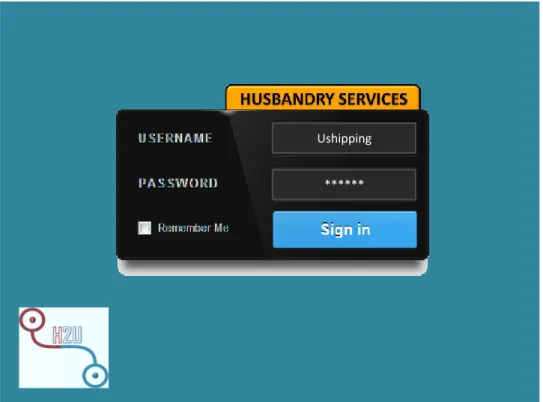
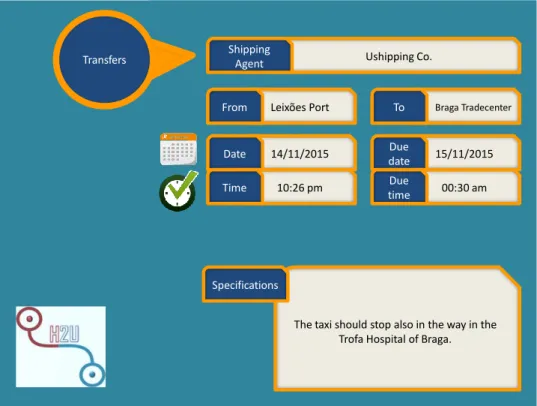
As in many software applications, a login is required. Then the range of services are presented and within each type a specific request/order can be put. The suppliers have a delay of 12 hours to consult/accept the request and present the conditions within they can provide that service, including prices and delivery dates.
This platform receives a fee for each request placed in it set as a combination of fixed amount per request and a percentage of the operation costs. Consultations are meant to be free for all users for a certain period of time.
The platform should be easy to access and be easily recognizable as a unique brand so the logo was also an important early phase of the development. The logo was created according to Kotler's criteria for choosing brand elements.
14 "There are six criteria for choosing brand elements. The first three- memorable, meaningful, and likeable - are "brand building". The latter three - transferable, adaptable, and protectable - are "defensive" and help leverage and preserve brand equity against challenges." (Kotler, 2012: 291)
Kotler (2012) also refers that
"A brand is a name, term, sign, symbol, design, or some combination of these elements, intend to identify the goods and services of one seller or group of sellers and to differentiate them from those of competitors. The different components of a brand - brand names, logos, symbols, package designs, and so on - are brand elements."
The application logo is easily reproduced and refers to the service provided and discloses the concept.
Figure 2 – Application logo
Some details about the conceptual web application are presented in the figures 3 to 6 – “The conceptual web app is presented in appendix III".
The Business Case
The Husbandry Services specifications are requested from the ship-owners or ship management to the ship agents. Then, after long mails, previous agreements and phone conversations the service is allocated to several suppliers. That’s how it is done until the present days. The H2U tool will perform the intermediary between ship agents and suppliers, providing a platform that should match the demand and supply in a way that improves the efficiency of the procedures, in a sector that is very competitive. Within a community system and with the cloud
15 service, this will increase the technology modernization in a critical supply chain and in particular for the economy of the sea.
Channel
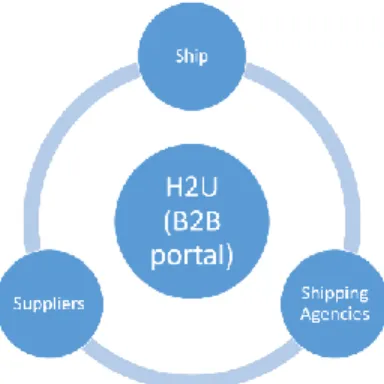
The distribution channel below represents the flowchart in the business case presented. The ship will have the information that is going to land in a port at least in 72h and will inform the shipping agencies of their needs about Husbandry Services. Then the shipping agencies will insert the information in the platform, that will generate an alert to all the suppliers, and these will have to reply with availability and price. The agencies finally will choose the services that fit the most. This process along the platform needs to be complete in less than 48h. After the service is completed, the ship will have a survey to answer, in order to verify its quality. This type of business it’s B2B, and as Kotler (2015:190) referred "successful business-to-business marketing requires that business marketers know which types of companies to focus on in their selling efforts, as well as who to concentrate on within the buying centers in those organizations." But Kotler (2015:203) also points out the particularities of e-commerce: "Building trust can be especially tricky in online settings, and firms often impose more stringent requirements on their online business partners than on others."
16 Key Partners
The key partners to the H2U application would be the main suppliers for the medical service, hotel services, transfers, bunker suppliers, Ship-chandlers, spare parts suppliers, fresh water suppliers and finally lubricants and chemical suppliers.
To implement such a platform as H2U it's possible to go as a stand-alone project or as a joint venture. Joint venture (JV) is defined by Wille (1998) as "a new entity / company, legally autonomous, formed by two or more companies." Kirby and Kaiser (2003) and Wille (1998) added that a JV can be seen as a market power accumulation mechanism by aggregating conjunction with other resource(s) entity(ies) or as a vehicle for acquiring new technologies, new business or simply get quickly and effectively in a new market.
The second way seems to fit better the purpose of this project because as Kotler & Keller (2012) added "companies need to give creative thought to finding partners that might complement their strengths and offset their weaknesses".
Key Activities
The main key activities would be the web platform development itself and the continuous efforts of the Sales and Marketing department.
Key Resources
The main Key resources are the Human Resources (therefore referred as HR) in this case. A good IT expertise will be the differentiation factor along with the good relationship with the stakeholders.
"Analysts define software requirements and specifications, and guide programme design and development. The analyst's role sits between the initial business analysis stage and the detailed system design, building and programming stages of the systems development process." (Job Guide, 2015)
17 Customer Relationship
Customers along with the employees are the most important assets in a project like these. The collaboration between technology consulting company and partners (costumers) is the most important step to get the best features on the development and the best integration. There is no strategy, profit or planning without a good customer relationship. They are our partners for the construction of what we sell to them.
Customer Segments
The segments in this initial phase would be the shipping agencies. In the future the web platform can be adapted to several markets and the same technology can be used.
Cost Structure
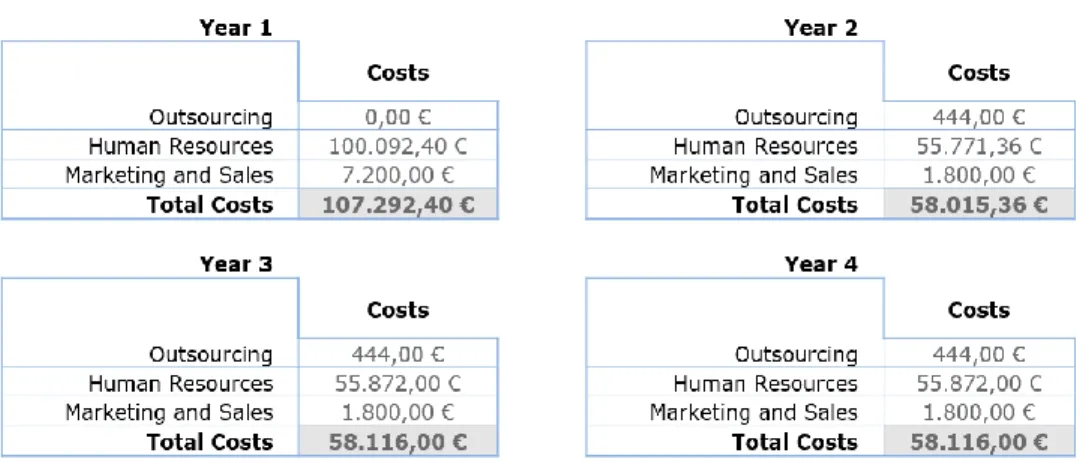
There are fixed costs associated with the Human Resources, technology, fee of cloud service usage (outsourcing).
Considering similar projects - web-based application in a cloud service - in other areas, it takes seven months of development. In order to fulfill the goals of this stage it should be required 1 project planner, 1 analyst, 1 senior programmer, 2 junior programmer. The expected associated costs are calculated based on the current wages given to these HR (including taxes and social security contributions) in a technology consulting company that asked to remain anonymous.
The Senior Analyst will just be needed in the first seven months of software development but the number of hours located to the project is variable; his work will be done in two different periods of time: in the first three months the amount of hours will until the project would be ready to be taken by the Junior Programmers. The Project Planner will manage more than one project so he would only work part-time in this. After the development, it will only be needed one Junior Programmer and the Project Planner.
18 Outsourcing relates to the fees applied to the cloud service and were calculated upon the current prices of Amazon Web Services for the features required. The first twelve months are free of charge and after that the fees are about 40$/month (approx. 37€/month).
Marketing and Sales costs are expected to be mainly due to travelling and computer equipment’s.
"For a detailed cost structure refer to Appendix IV - Human Resources; Appendix V - Outsourcing; Appendix VI - Marketing and Sales”.
Figure 4 - Summary of Cost Structures for a four year period. Revenue Streams and Results
There will be two ways of making direct revenue: a subscription fee and a fee per transaction (usage fee).
As at this stage it's not possible to have data to estimate the number of transactions and there’s also the chance of closing the deal offline, it was only considered to be an option a subscription fee.
There is also another possibility of revenue, by advertising and publicity on our application. Scenario analysis were made focusing on the main variables: the expected revenue due to the payment of a subscription fee and the market share (% of the number of clients).
19 Among the many tools a manager can use for strategic planning, scenario
planning stands out for its ability to capture a whole range of possibilities in rich detail. By identifying basic trends and uncertainties, a manager can construct a series of scenarios that will help to compensate for the usual errors in decision making — overconfidence and tunnel vision.
Kotler (2015) defines scenario analysis: "developing plausible representations of a firm's possible future that make different assumptions about forces driving the market and include different uncertainties."
The subject B informed about the average annual cost for each type of service of Husbandry services, presented in the table 1 below. Considering the total annual cost of 505.000,00 and that the subject B has 18% of the market share, that means the market it's valuated in approximately 2.805.556€. If the platform would save 10% of annual costs to the shipping agencies due to lesser transactions costs, then the savings would be 2.805€. Paying a subscription fee of 57,5€/month (IVA included), or690€/year, the agencies still would have a saving of 2.115€ per month. Extrapolating the data, even to a shipping agency that represent 1% of market it would affordable to be the subscription fee.
Table 1 - Annual costs of husbandry services (subject B and extrapolated data to a subject owning 1% of market share.
20 For this it was supposed to be 149 potential clients (shipping agencies)and an increasing market share starting with 25% of the market and increasing 10% in each year that could invest in the platform, meaning that after four years at least 55% of the agencies were users of this platform.
Table 2 - Scenario for a subscription fee of 57,5€/month per customer of the platform and 55% targeted market share
In Scenario 1, there is a monthly fee for the users of 57,5€ (IVA included), the mean of the values given. This value was reached based on the information given by the firms: the minimum value indicated choosing from a value between 35,1 to 58,4€/month(price without IVA) - see Appendix VIII - Subscription fees calculations. The fees chosen by the inquired agents varied between the lowest to 45€.
This scenario 1 it is not possible because the market is too short to make it profitable.
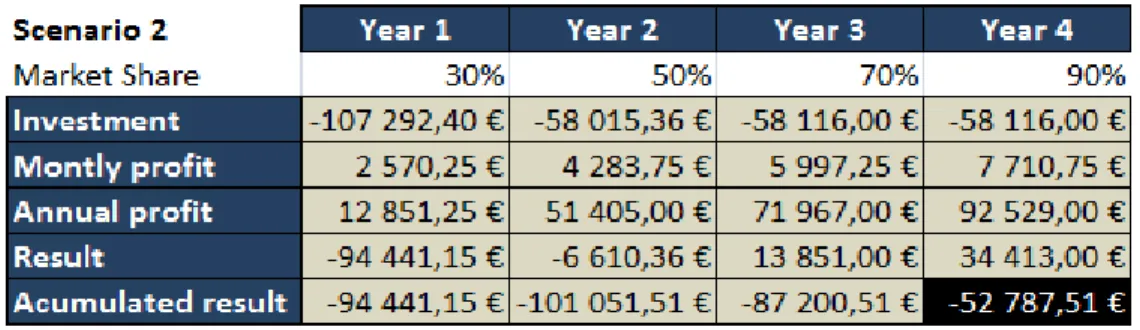
Scenario 2 - subscription fee (mean) and a targeted market share of 90%
InScenario2, the same monthly fee of 46,75€ (w/ IVA) is applied but the increasing market share goes from 30 to 90%, meaning that it would grow 20% per year.
Table 3 - Scenario for a subscription fee of 46,75€/month per customer of the platform and a targeted market share of 90%
21
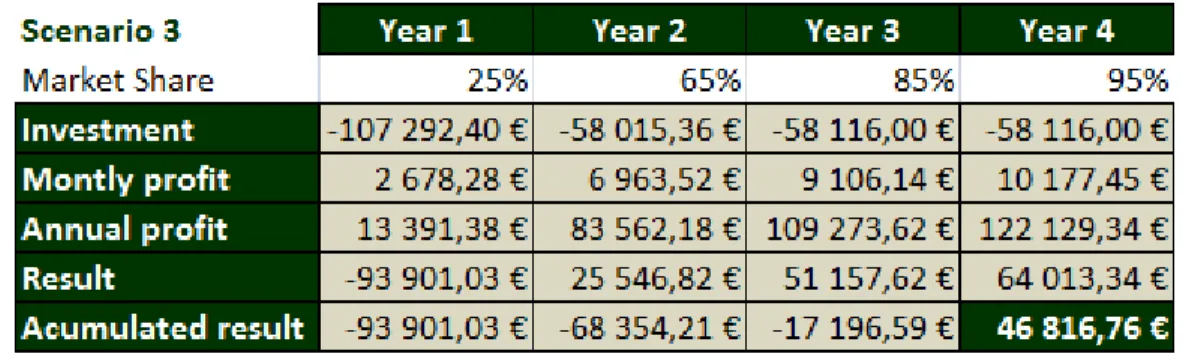
Scenario 3- subscription fee (maximum) and a targeted market share of 95%
In Scenario 3, the maximum subscription fee is of 71,9€ is considered and the market share grows unevenly, rapidly at first and then slower.
Table 4 - Scenario for a subscription fee of 71,9€/month per customer of the platform and a targeted market share of 95%
This is a really optimistic scenario and the only one that estimates to reach a positive outcome. In this case it was calculated the Return On Investment (ROI).
ROI is a common performance measure used to evaluate the efficiency of an investment or to compare the efficiency of an investment or to compare the efficiency of a number of different investment opportunities. To calculate ROI, the benefit or gain associated with an investment is divided by the cost of the investment and the result is expressed as a percentage or a ratio,
ROI = (𝑅𝑒𝑡𝑢𝑟𝑛−𝐼𝑛𝑣𝑒𝑠𝑡𝑚𝑒𝑛𝑡)𝐼𝑛𝑣𝑒𝑠𝑡𝑚𝑒𝑛𝑡
ROI [Scenario 3]=107292,446816,8 = 43,63% Conclusions
There appears to be a place for the implementation of H2U as it was considered to be a powerful and helpful tool that facilitates the trading and/or fulfillment of requests, in the opinion of the interviewed.
Several companies presented their interest in becoming partners and collaborate in the development of such a platform. This is considered to be a good starting point as those who could be the main users visualize the possibility of joining this project.
22 During this work project and as several scenarios were built there was a need to understand if the tool would be unprofitable or if it would feasible and allow the return of the investment with some variable changes.
Just in an optimistic scenario - scenario 3 - it appears that this to be profitable so it represents a huge risk for a solo investor. So, it was concluded that if a Joint Venture could be arranged with one or some of the major’s players in this area, at the end, it could be a win-win outcome, as desired. Even tough, to expect that in fragmented market as this is almost all competitors would take up such concept and embrace quickly the shifting of the way business is made, could prove to be unrealistic.
A wider approach to the main players is advisable to clear some points that are potential threats to a potential business opportunity. As it is, there is insufficient data to take a conscious decision.
Limitations of this project
There were several other requests of interview sent to other companies but it was not possible to get the answers in due time to this research. Other limitation would be that not all the questions were answered by the 3 companies.
There were also some constrains related to the financial requirements of this project and the adhesion of the maritime agents, the fact that agents thought it was a good idea does not mean it’s feasible, and as stated in the financial analyses and conclusions it's a "long shot".
Further steps
An option for the further steps would be to be a broker in the husbandry services. The way that this could be lead would be firstly to understand the price of similar platforms in the market and make the changes to this area. Then it would be needed to learn the demand for the whole year
23 of the 149 agencies in order to obtain economies of scale. As Kotler (2015) stated, a "company needs a larger customer base to achieve economies of scale."
Krugman, quoted by Leão (2009), assumes the following linear cost function for the typical firm:
C = F + c.Q where F is a fixed cost, Q is the level of output, and c the firm’s marginal cost (MC, constant by assumption). This implies economies of scale, because the larger the firm’s output, the less is the fixed cost per unit. The average cost declines as Q increases because the fixed cost is spread over a larger output.
In this way we could decrease the costs and our offer would be efficient due to the provisional needs of the agents. In this case, instead of creating a platform from scratch it seems more likely to outsource the platform creation as there are several portal providers that allow customers to adjust pre-existent platforms to their requirements. In this case the administrator would be a broker that would act like as a bigger agent, charging a fee to the customers, in this case the shipping agencies, for its services. Aggregation of demand empowers the broker in order to get more leverage in the negotiation with the suppliers.
24
Appendix I
EXPERT’S INTERVIEW - HUSBANDRY SERVICES
I am Patricia Duarte and I am taking a master degree in Management at Universidade Nova SBE.
The purpose of this interview is to collect data for my project that focuses on Digital Interconnectivity as a driver for competitiveness in Ports and Logistics, more specifically, the case of the creation of a Cloud service of this nature.
As a representative (CEO, manager) of the company I would like to have your vision on the main needs of this business area because I would like to listen to the real experts: those who know everything about the strategies of the company and its daily work. I will start my interview with some general questions about your company and I then would proceed to some specific issues related to my research.
Description:
1. Can you describe briefly your company?
2. Who do you believe to be your main competitors?
3. What do considerer it’s your position in terms of market share?
4. Regarding your competition, what you think is the market share of each one of the main competitors?
Analysis / Diagnosis:
5. What are the current threats facing the industry?
6. In view of the current situation what are the opportunities / challenges for the next 5-10 years?
25 7. Considering the external factors to the organization what are the main constraints / weaknesses facing the organization?
8. What are the strengths / differentiation factors of competition?
Husbandry Services are the services we have associated with supply / maintenance of the ship, as all services associated with his crew. Part of the dispatching services customs, transfers, hotels, supply spare parts and, fuel supply, water sanitation, medical services and we would like to add restoration and leisure services.
9. How do husbandry services work nowadays?
10. What are the biggest challenges? What are the services more in demand?
My focus is on developing a software that wants to add efficiency in the means of operation of companies and that could be a valuable asset to optimize logistics needs. Viewing this as an agent, this would be a platform where you could select any type of service wanted by the final customer and that would provide a set of suppliers that would be competing among themselves. It would be an e-market place that provides a match between demand and supply.
11. What is your opinion about an e-market that solves and matches matching supply and demand for shipping agencies?
12. What do you consider to be the main requirements / features that should be built on this platform?
One of the features would be the evaluation / feedback from the final customer about service in order to assess the satisfaction and to be carried out a ranking within the suppliers.
26
Appendix II – SWOT analysis
Figure 5 - Swot analysis of H2U
Appendix III – Prototype Presentation
Ushipping ******
27 Spare Parts
Medical Hotels Chandlers
Ship-Chemicals and Lubricants Transfers
Please choose the type of service
Figure 7 - Types of services provided
Transfers
The taxi should stop also in the way in the Trofa Hospital of Braga.
Specifications Leixões Port From Ushipping Co. Shipping Agent Braga Tradecenter To 14/11/2015 Date Due 15/11/2015 date 10:26 pm Time Due 00:30 am time
28 Husbandry
Services
Rate by … See all proposals
Price Delivery date
Figure 9 - Proposals set by price or delivery date for each service required (supplier’s answers)
Appendix IV - Human Resources
29
Appendix V - Outsourcing
Table 6 - Outsourcing Costs
Appendix VI - Marketing and Sales
Table 7 - Marketing and Sales Costs
Appendix VII - Number of vessels per Port, from 2009 to 2014.
Table 8 - Number of Vessels per Port, from 2009 to 2014
Number of vessels per Port
Year Leixões Lisboa Setúbal Sines Total
2009 5 098 6 428 2 642 2 951 17 119 2010 5 078 6 194 4 052 3 271 18 595 2011 5 276 6 097 4 170 3 151 18 694 2012 5 182 5 266 2 256 3 309 16 013 2013 5 102 5 637 1 376 4 017 16 132 2014 5 218 5 412 1 414 4 002 6 046 Total 30 954 35 034 15 910 20 701 102 599
30 Figure 10 - Nº of Vessels per Port graphic
Appendix VIII - Calculations of subscription fees
31
Annex I - Types of Platforms
Figure 12 - Three common platform types that facilitate transactions, interactions, and mobilization.
Annex II
32
References
AGEPOR - Associação dos Agentes de Navegação de Portugal. 2015. http://www.agepor.pt/pdf/associados.pdf (accessedSeptember 30, 2015).
Amado, J. 2000. "A Técnica da Análise de Conteúdo". In Revista de Enfermagem, Referência Iª Série, nº 5, pp. 53-63. https://woc.uc.pt/fpce/person/ppinvestigador.do?idpessoa=10057
Anderson, T., Kanuka, H. 2003. E-Research, Methods, Strategies and Issues. USA: Person Education.
Bardin, L. 2009. Análise de Conteúdo. Lisboa: Edições 70.
Besanko, D. et al. 2009. Economics of Strategy, p. 290-295. 5th. ed. New York: John Wiley & Sons.
Bogdan, R. and Biklen, S. 2010. Investigação Qualitativa em Educação: Uma Introdução à Teoria e aos Métodos. Porto: Porto Editora.
Cunha, David; Gonçalves, Carlos; Neves, Pedro; Sousa, Pedro; Gomes, Diogo and Barraca, João Paulo. 2013. Towards a Cloud Service Broker for the Meta-Cloud. Aveiro: University of Aveiro. http://ria.ua.pt/bitstream/10773/13634/1/2035-7328-1-PB%20%281%29.pdf (acessed September 30, 2015)
Felicio, J.Augusto; Soares, João; Caldeirinha, Vítor and Ferreira, Fernanda N. 2014. Portos, Shipping, Intermodalidade e Governação. Porto: Riscos Editora
Gorelik, Eugene. 2013. Cloud Computing Models. Working Paper CISL# 2013-01. Massachusetts: Massachusetts Institute of Technology Cambridge.
33 Gurnani C.P. 2014. "The role of Connectivity in Reshaping the World." Huffington Post, August 25. http://www.huffingtonpost.com/cp-Gurnani/the-role-of-connectivity-in-reshaping-the-world_b_4665180.html
Hagel III, John. 2015. "The power of platforms." In Deloitte University Press, April 15.
http://dupress.com/articles/platform-strategy-new-level-business-trends/?id=gx:2sm:3li:4dup1051:5eng:6cons:20150519132400:bt15&linkId=14322344
Job Guide. 2015. http://www.jobguide.thegoodguides.com.au/occupation/Analyst-Information-Technology (accessedSeptember 30, 2015).
JUP - Janela Única Portuária. 2015. http://www.portosdeportugal.pt/janela-unica-portuaria (acessed September 30, 2015).
Leão, Emanuel R. e Pedro, R. Leão. 2009. "Trade based on economies of scale under monopolistic competition: a clarification of Krugman's model". Instituto Superior de Economia e Gestão - DE. Workingpapers nº 10-2009/DE/UECE
Kim, W. Chan and Mauborgne Renée. 2005. Blue Ocean Strategy, How to create Uncontested Market Space and Make the Competition Irrelevant. Boston: Harvard Business School.
Kirby, D. A. & Kaiser, S. 2003. Joint Ventures as Internationalization Strategy for SMEs. In Small Business Economics, 21, pp. 229-242.
Kotler, Philip and Keller, Kevin Lane. 2012. Marketing Management, 14th Edition. New Jersey: Prentice Hall.
Neves, Pedro; Cunha, David and Sousa, Pedro. 2013. "Cloud Platform-as-a-Service". In Saber & Fazer Telecomunicações 2013.
http://repositorium.sdum.uminho.pt/bitstream/1822/28448/1/Saber-Fazer.pdf (acessed October 5, 2015).
34 Rodrigue, Jean-Paul, Slack, Brian, and Notteboom, Theo. 2013 “Port Terminals.” In The Geography of Transport Systems. New York: Routledge – Taylor & Francis Group.
Sandborn, P. , Jazouli, T. and Haddad, G .2012. "Supporting Business Cases for PHM: Return on Investment and Availability Impacts". In Diagnostics and Prognostics of Engineering Systems: Methods and Techniques. Ed. Kadry, Seifedine. Maryland, USA: Engineering Science Reference (an imprint of IGI Global)
Schwartz, P. 2003. A arte da visão de longo prazo: planejando o futuro em um mundo de incertezas. (2a ed.). São Paulo: Best Seller.
Shoemaker, Paul J. H. 1995.“Scenario Planning: A Tool for Strategic Thinking". In Sloan Management Review (Winter 1995), pp. 25 – 40. http://sloanreview.mit.edu/article/scenario-planning-a-tool-for-strategic-thinking/ (accessed November 08, 2015).
Tassabehji, R. 2003. Applying e-commerce to business. London: Sage Publications Ltd.
Torres, Pedro Marcelo Amado Garcia da Rocha. 2012.Estratégias de E-Commerce e o seu Impacto na Performance Empresarial: uma Abordagem pelo Processo de Criação de Valor. Coimbra : [s.n.], 2012
Torres, Pedro Marcelo and Lisboa, João Veríssimo. 2012. Competing in virtual markets. Coimbra: 1 University of Coimbra, School of Economics & School of Economics and Institute of Systems and Robotics.
Wille, J. R. 1998. Joint-venturing strategies. In: The Handbook of Joint Venturing.Homewood, Illinois: Dow Jones-Irwin, pp. 10-24.