Z´as – An Aspect-Oriented Access Control Framework
Paulo Zenida
Presented to the Instituto Superior de Ciˆencias do Trabalho e da Empresa
in Partial Fulfillment of the Requirements for the Degree of
Master of Science in Computer Engineering and Telecommunications
July 19, 2007
Abstract
Traditionally, access control system architectures are based on the abstract reference monitor model proposed by Anderson, which tries to separate the access control logic from the logic of applications.
The implementation of this model has been difficult since access control presents itself as a crosscutting concern, i.e., it crosscuts the functionalities of applications. However, the devel-opments of the techniques that support the separation of concerns, particularly aspect oriented programming, have been enabling the development of systems in which the access control code is not scattered through the code of the application. Nevertheless, these solutions are still too specific to a given application.
This work presents an access control framework for Java applications, named Z´as, which can be reused and that applies the abstract reference monitor proposed by Anderson. This framework supports access control policies using different kinds of context information and allows them to be changed at runtime. Z´as was developed in the aspect oriented programming language AspectJ and it uses Java5 annotations.
We used Z´as in several small applications since its inception, so as to gain experience and in-sight from its application. Nevertheless, to evaluate the performance and applicability of the final version of the Z´as framework prototype, we integrated it in a very large Web application called F´enix, which brought us very interesting results, such as showing the easiness of applicating Z´as to already existing applications, and also the main caveats and limitations of Z´as.
ii ABSTRACT
Resumo
As arquitecturas dos sistemas de controlo de acesso s˜ao tradicionalmente baseadas no modelo abstracto de monitor de referˆencia proposto por Anderson, o qual visa separar a l´ogica do controlo de acesso da l´ogica das aplicac¸˜oes.
A concretizac¸˜ao deste modelo tem sido dificultada pelo facto de o controlo de acesso se apre-sentar como uma faceta transversal `as funcionalidades das aplicac¸˜oes. No entanto, os progressos verificados nas t´ecnicas que suportam a separac¸˜ao de facetas, em particular a programac¸˜ao orien-tada para aspectos, tˆem permitido desenvolver sistemas em que o c´odigo de controlo de acesso n˜ao ´e disseminado pelo c´odigo das aplicac¸˜oes. Por´em, estas soluc¸˜oes s˜ao ainda concretizac¸˜oes espec´ıficas, para uma determinada aplicac¸˜ao.
Este trabalho apresenta uma plataforma de controlo de acesso para aplicac¸˜oes Java, designada por Z´as, que ´e reutiliz´avel e que aplica o modelo abstracto de monitor de referˆencia proposto por Anderson. Esta plataforma suporta pol´ıticas de controlo de acesso fazendo uso de diferentes tipos de informac¸˜ao de contexto e permitindo a sua alterac¸˜ao em tempo de execuc¸˜ao. O Z´as foi desenvolvido na linguagem de programac¸˜ao orientada para aspectos AspectJ e recorrendo `as anotac¸˜oes do Java5.
N´os aplic´amos o Z´as a v´arias aplicac¸˜oes pequenas desde o seu comec¸o, de forma a ganhar experiˆencia e conhecimento atrav´es da sua aplicac¸˜ao. No entanto, para avaliar o desempenho e aplicabilidade da vers˜ao final do prot´otipo da plataforma Z´as, n´os integr´amo-lo numa aplicac¸˜ao Web muito grande chamada F´enix, a qual nos trouxe resultados muito interessantes, tais como mostrar a facilidade da aplicac¸˜ao do Z´as a aplicac¸˜oes j´a existentes, e os principais problemas e
iv RESUMO
limitac¸˜oes do Z´as.
Contents
Abstract i
Resumo iii
List of Figures vii
List of Tables ix Acronyms xi Acknowledgements xv 1 Introduction 1 1.1 Contributions . . . 3 1.2 Structure. . . 4 2 Access control 5 2.1 Concepts . . . 5
2.2 Access control system architectures . . . 7
2.3 Access control in Java. . . 10
2.4 Access control in object-oriented databases . . . 11
2.5 Conclusions . . . 12
vi CONTENTS
3 A toy application and possible solutions 13
3.1 Toy application . . . 13
3.2 Ad hoc. . . 15
3.3 JAAS . . . 15
3.4 JAAS with AspectJ . . . 18
3.5 JAAS with AspectJ and annotations . . . 20
4 The Z´as framework 23 4.1 Access control model . . . 23
4.2 Architecture . . . 24 4.3 Design . . . 26 4.4 Implementation . . . 29 4.5 Usage . . . 37 4.6 Features . . . 40 4.6.1 Basic . . . 41 4.6.2 Advanced . . . 45 4.6.3 Future . . . 59
5 Evaluation and metrics 63 5.1 F´enix . . . 63
5.2 Analysis . . . 71
5.2.1 Number of files . . . 72
5.2.2 LOC . . . 73
5.2.3 Performance . . . 74
5.2.4 Percentage of affected access controlled methods . . . 77
5.2.5 ACRSR . . . 78
5.2.6 Conclusions. . . 79
List of Figures
2.1 Abstract reference monitor proposed by Anderson. . . 7
2.2 Abstract reference monitor extended with authorizations with predicates.. . . 8
4.1 The architecture of the Z´as access control framework. . . 25
4.2 “Debit account” use case diagram. . . 27
4.3 Class diagram for the banking system case study. . . 28
4.4 “Debit account” case study sequence diagram. . . 30
4.5 The concept of stack of subjects. . . 60
5.1 F´enix domain level performance before and after Z´as. . . 75
5.2 F´enix services level performance before and after Z´as. . . 76
5.3 F´enix compilation time before and after Z´as. . . 77
List of Tables
4.1 Wildcards currently supported by Z´as. . . 44
5.1 Number of files before and after Z´as. . . 73
5.2 Lines of code before and after Z´as. . . 73
5.3 Percentage of affected access controlled methods. . . 78
5.4 Access Control Requirements Specification Ratio. . . 79
Acronyms
ACRSR Access Control Requirements Specification Ratio
AJDT AspectJ Development Tools
AO Aspect-Oriented
AOP Aspect-Oriented Programming
AOSD Aspect-Oriented Software Development
CORBA Common Object Request Broker Architecture
CPU Central Processing Unit
DAC Discretionary Access Control
DBMS Database Management Systems
DD Domain Driven
DML Domain Modeling Language
DOM Document Object Model
EJB Enterprise JavaBeans
FTP File Transfer Protocol
xii ACRONYMS
HT Hyper-Threading
HTTP HyperText Transfer Protocol
IDE Integrated Development Environment
IT Information Technologies
ITD Inter-Type Declaration
JAAS Java Authentication and Authorization Service
JAR Java ARchive
JDK J2SE(Java 2 Platform Standard Edition) Development Kit
JSF JavaServer Faces
JSP JavaServer Pages
J2SE Java 2 Platform Standard Edition
LDAP Lightweight Directory Access Protocol
LOC Lines of Code
MAC Mandatory Access Control
NOV Net Option Value
OASIS Organization for the Advancement of Structured Information Standards
OJB ObJect Relational Bridge
OO Object-Oriented
xiii
ORM Object-Relational Mapping
PAM Pluggable Authentication Modules
RAM Random Access Memory
RAD Resource Access Decision
RBAC Role-Based Access Control
SOA Services Oriented Architecture
SPL Security Policy Language
UML Unified Modeling Language
XACML eXtensible Access Control Markup Language
Acknowledgements
I would like to especially thank my advisors, Manuel Menezes de Sequeira and Dulce Domingos, for their guidance, expertise, and support. They kept me on track and never let me go down. I would also like to thank Jos´e Pedro Pereira, from Linkare, who always showed interest in my research and with whom I had many interesting discussions about access control models, archi-tectures, and techniques. To Ramnivas Laddad, though we never met personally (only through e-mail), a special thanks for his interest and motivating words when this research began and I showed him my first results. To the AspectJ community in general and to the AspectJ compiler development team, especially Andy Clement, for helping me with some hard AspectJ compiler problems, a deepest thanks.
I would also like to thank the insightful comments from the anonymous reviewers and au-dience from the ICSOFT 2006 conference to which I have submitted an accepted paper about Z´as, since it allowed me to discuss with others the first results of my work, and especially to the anonymous reviewers from the AOSD2007 conference to which I have submitted a paper about Z´as which ended up being rejected, since those comments were really useful to improve the qual-ity of my research. Finally, I am also very grateful to my family, especially my parents and my brother, who have always helped and supported me in the tough moments, and a very, very special thanks to my girlfriend, with whom I have learned a lot about myself and with whom I now know I can always count on.
Chapter 1
Introduction
Separation of concerns, as proposed by Dijkstra [17], is a key principle in software engineering. This principle is used for controlling the complexity of the applications and defends that, given a complex problem with different concerns, these concerns should be properly identified, each addressed separately and, finally, the respective solutions integrated to produce the final result of the solution. This principle has been pursued by access control1 system architectures, since they are traditionally based on the abstract reference monitor proposed by Anderson [2], which in fact tries to separate the access control logic from the logic of the application.
Bearing in mind the guidelines which state that security Information Technologies (IT) sys-tems should be developed by a combination of security engineering and software engineering [18], and that software engineers should not have to be concerned with security issues, and vice-versa, the development of an application should be separated, i.e., “the security code should not be mixed with the application code” [1].
The implementation of the abstract reference monitor has been difficult, since access control is a crosscutting2 concern, i.e., “a security requirement that crosscuts the (business part of the)
1The “ability to permit or deny the use of an object (a passive entity, such as a system or file) by a subject (an
active entity, such as an individual or process).” [46]
2“Features of a program that are orthogonal to the main decomposition of the program [13]”.
2 CHAPTER 1. INTRODUCTION
application” [47].
Progresses in techniques supporting the separation of concerns, such as design patterns [49, 19, 20] and, more recently, Aspect-Oriented Programming (AOP) [26, 47, 44], enabled the de-velopment of systems in which the access control code is not scattered through the code of the application. Indeed, one of the advantages ofAOPis that it enables the separation of crosscut-ting concerns from the main decomposition of the application. However, current access control solutions using these techniques have typically not been reusable nor generic.
This thesis presents an access control framework for Java applications, named Z´as3, mainly inspired by a proposal of Laddad to modularize Java Authentication and Authorization Service (JAAS) client code usingAOP[26]. Z´as controls the invocations of methods and constructors, as well as sets and gets of values of fields. Hence, Z´as protects methods, and fields.
Z´as supports access control policies which use different kinds of context information and enables the change of these policies at runtime. Z´as’ advantages stem mainly from the fact that anAOPapproach is used, allowing it to address some of the problems found in the application of industry standards such as JAAS[29, 14, 34]. The framework was implemented in theAOP language AspectJ [4] and it uses Java5 annotations to specify the application’s protected objects and their access control requirements. A few importantAOPnotions used throughout this thesis are:
• join point – a well defined point in the execution of the program, • pointcut – a set of join points, and
• advice – a piece of code that is weaved in all join points of the pointcut with which it is associated.
We used Z´as in several small applications since its inception, so as to gain experience and insight from its application. Nevertheless, to evaluate the performance and applicability of the
3The Z´as source code may be found in
1.1. CONTRIBUTIONS 3
final version of the Z´as framework prototype, we integrated it in a very large Web application called F´enix R4, which was also the main source of motivation for the creation of this framework! Empirical results of the application of Z´as to F´enix are presented in Chapter5.
Throughout this thesis, we assume that the reader is familiarized with the basic concepts of AOPand AspectJ. Nevertheless, if that is not the case, we strongly recommend reading Laddad’s AspectJ in Action [26].
1.1
Contributions
The main contribution of this thesis is the development of a reusable framework of aspects and classes for application-level access control enforcement that fully separates the functional code from the access control code. Z´as uses Java5 annotations, which augments the expressiveness of the source code, to specify the protected objects and their access control requirements.
Other important contributions of this thesis, though not the most relevant, were related to general contributions to theAOPand AspectJ communities, such as the detection of several bugs in the AspectJ compiler and their registration in the corresponding bug tracking system.
Similarly, the application of Z´as to a project such as F´enix is also a contribution to the com-munity, since it focuses on the application ofAOPto a real, large application. Finally, after the hard technical and political task of introducing aspects to F´enix, with Andrew Clement’s pre-cious help, from the AspectJ project development team, and Jos´e Pedro Pereira from Linkare, we achieved our goal and new applications ofAOPto that project arose, such as contracts checking (pre conditions, post conditions and invariant conditions).
4See
4 CHAPTER 1. INTRODUCTION
1.2
Structure
The remainder of this thesis is structured as follows. Chapter2briefly introduces the main access control concepts and related work. Chapter 3 presents a very simple toy application to show the access control crosscutting problem and four different approaches to solve it, ranging from Object-Oriented (OO) ad hoc solutions to Aspect-Oriented (AO) solutions based on JAASand annotations. Chapter4 presents the architecture and features of Z´as and Chapter5evaluates its applicability. Finally, Chapter6 presents the conclusions of the research and lays out possible directions for further work.
Chapter 2
Access control
Access control is a security service whose purpose it to guarantee the protection of resources1 against unauthorized accesses. This chapter presents the main access control concepts and the main contributions and limitations related to the application of the abstract reference monitor.
2.1
Concepts
The development of an access control system implies the definition of an access control policy (rules and regulations) and its enforcement through appropriate security mechanisms. Access control models represent formally the access control policies, expressed through specific access control languages. Ponder [16], Security Policy Language (SPL) [15] and eXtensible Access Control Markup Language (XACML) [35] are representative examples of this kind of language.
Traditionally, there are two access control models:
1. Mandatory Access Control (MAC) models, in which access rules are system-wide and usu-ally fixed. While rules can change over time, users cannot influence them. These models are commonly used in systems were rigorous access control is very important.
1In this work we will use the term “protected object” when referring to the resource which is subject to access
control.
6 CHAPTER 2. ACCESS CONTROL
2. Discretionary Access Control (DAC) models give the owner of the protected object the right to determine the access control policy for that object. These systems are discretionary in the sense that a user that was given discretionary access to a protected object is capable of granting access to that protected object to other users. These models are used in operating systems like Unix, in which a user can specify the access rules to the files she owns.
Generically, a discretionary access control policy is defined by a set of authorizations, each typically defined as a tuple(s, m, o, pred) stating that subject s may legitimately use the access mode m to access to the protected object o if the predicate pred2 is true in the context of the access. The access mode may represent a specific operation performed with or over the object, or an abstract access mode, associated to a set of specific operations. Using abstract access modes has the advantage to decrease the number of permissions within the system, since each abstract access mode may be associated to a set of operations, instead of simply one.
The use of predicates augments the expressiveness of the authorizations, supporting a more fine-grained control of authorizations.
As an alternative to the MAC and DAC models, a model based on the notion of role, viz. Role-Based Access Control (RBAC), was proposed. This model was very well received, since the notion of roles fits well to the common notion of function in organizations. RBAC models associate authorizations to roles performed by subjects [21]. RBACauthorization(r, m, o, pred) states that a subject performing role r can legitimately use mode m to access to the protected object o whenever the predicate pred is true. Since subjects are not directly associated with access modes, but indirectly through the role or roles they perform, the management of individual privileges in the system is often only a matter of assigning the appropriate roles to each subject.
2.2. ACCESS CONTROL SYSTEM ARCHITECTURES 7
2.2
Access control system architectures
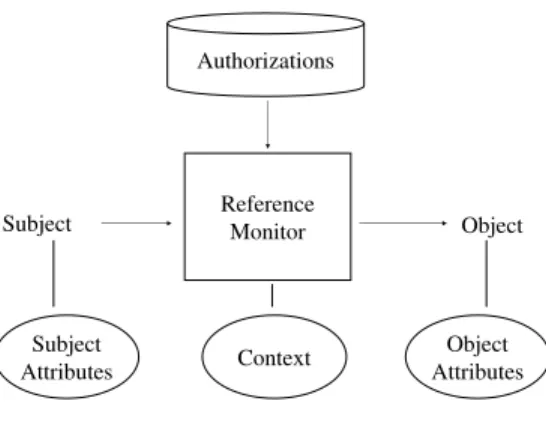
Access control system architectures are traditionally based on the abstract reference monitor pro-posed by Anderson [2], Figure2.1. A reference monitor intercepts all access attempts from sub-jects to the protected obsub-jects. Conceptually, a reference monitor has two main functions:
Figure 2.1: Abstract reference monitor proposed by Anderson.
1. a decider, responsible for evaluating the legitimacy of the accesses,
2. an enforcer, responsible for intercepting all access attempts and enforce the decision that was taken.
According to this model, all access attempts are intercepted by the enforcer, which asks the decider to determine the legitimacy of the access, searching the authorizations database.
Recently, the Organization for the Advancement of Structured Information Standards (OASIS) has applied this model in its proposal for theXACMLaccess control system [35]. However, im-plementing this model has been difficult, since access control crosscuts applications functionali-ties.
Middleware systems supply a simple solution to separate access control from the application logic, since the decider and the enforcer may be implemented in its middle layer. Some examples
8 CHAPTER 2. ACCESS CONTROL
of systems adopting this architecture are Common Object Request Broker Architecture (CORBA), Enterprise JavaBeans (EJB), andJAAS[29].
However, when considering application level access control requirements, these systems present some limitations related to the authorization expressiveness they can support and the type of ob-jects they can protect. In general, these systems do not support more expressive authorizations with domain specific information and they can not protect applications’ specific objects, such as specific functionalities.
Supporting the definition and enforcement of more expressive authorizations is performed through the use of predicates. Predicates may be defined with different types of specific informa-tion from the applicainforma-tion domain, as illustrated in Figure2.2. Using this specific information in the definition of the predicates, makes it mandatory the decider to have access to that information at the time of the evaluation of the legitimacy of the access.
Figure 2.2: Abstract reference monitor extended with authorizations with predicates.
Within more generic solutions, a specific module implements the decider and the invoker supplies the domain specific information to the module at invocation time [38, 36]. Typically, these solutions require that applications perform the invoker function, not avoiding the scattering of access control code over the application code.
Alternatively, the specific module can itself obtain the domain specific information through requests to the applications [8,15]. This approach allows the decider to be invoked by middleware
2.2. ACCESS CONTROL SYSTEM ARCHITECTURES 9
systems, promoting the separation between access control and application code.
However, within solutions that implement the decider within a specific module, the domain specific information that is available to the decider is constrained by the application interface predefined.
Additionally, protecting application specific objects constraints the separation between the enforcer and the application logic, resulting in the scattering and in the entanglement of that code over the application modules.
To avoid scattering enforcer code throughout the application, many techniques addressing the problem of scattered concerns have been used, such as design patterns, particularly the proxy pattern [22], meta-level or reflexive architectures [1], and, more recently, AOP[9], in which our work fits.
ThoughAOPpresents potential benefits in the modularization of concerns whose implemen-tation would be naturally scattered through the application code, there are not many examples of its application to real cases in the literature [23, 11]. Bostrom [11] uses this paradigm to add encryption to a healthcare database application. Viega et al. [45] and Shah and Hill [39] apply AOPto enforce secure coding practices.
Considering access control, this paradigm can make easy the enforcer implementation. During the development process, the access control code is implemented separately. However, after the composition (the weaving process), this code is an integral part of the application [47].
De Win [47] usesAOPfor access control enforcement, analyzing Aspect-Oriented Software Development (AOSD)-based development to the development of a secure File Transfer Protocol (FTP) server.
Bodkin [9] analyzes the requirements ofAOPapplication to security, focusing on the expres-siveness of the language constructs that enable the specification of join points.
More recently, Verhanneman et. al [44] proposed a prototype of a modular access control ser-vice that can enforce expressive policies, while accounting for application-specific state, without requiring invasive changes to the application, using CaesarJ (an aspect-oriented language) so that
10 CHAPTER 2. ACCESS CONTROL
it is possible to change the policy without modifying the application. One of this prototype goals is, like Z´as, reuse. Nevertheless, it does not supply none of the advanced features provided by Z´as, which will be explained in Chapter4.
2.3
Access control in Java
The Java virtual machine can run mobile code such as applets [6]. Its initial access control model aims to prevent unauthorized Java applications to access or modify computer resources (for in-stance: files). This way, within this model, the subject is defined according to the code origin - it is a code-centric model.
JAASwas first introduced as an extension to theJ2SE(Java 2 Platform Standard Edition) De-velopment Kit (JDK) and became part of its core with version1.4. [6]. JAASadded a new access control model to the Java language: a user-centric model. Besides users can be subjects, protected objects can also be specific application resources, i.e., specific application functionalities.
InJAAS, classSubjectis used to represent a subject (e.g., a user) authenticated in a given system. A subject is an aggregation of principals3, in which each principal represents one of the different “entities” from whom the subject derives its authority, e.g., a principal may be a username, the name of a group to which she is associated, or a role that she performs. This way, JAASalso supports theRBACmodel.
However, the defaultJAASdoes not support runtime changes to the access control policy: its security manager, responsible for the definition of the access control policy, cannot change the principals’ authorizations and reflect the changes into the application without restarting it. Addi-tionally,JAASdoes not support predicates, which limits the expressiveness of its authorizations. Finally, it has the drawback of not allowing the separation between the enforcement code and the application logic when we try to protect specific protected objects: the invocation of the enforcer
3“person [entity] from whom an agent’s [subject’s] authority derives”4.
4“principal”. Merriam-Webster Online Dictionary, 2007.
http://www.merriam-webster.com/(The 31st of March, 2007).
2.4. ACCESS CONTROL IN OBJECT-ORIENTED DATABASES 11
must be explicitly made in the application wherever it requires access control, leading to code scattering and to entanglement of concerns.
Laddad [26] modularized the application ofJAASusingAOP, eliminating the invasive nature of the enforcement code. Nevertheless, this proposal presents some limitations, as we will detail in Chapter3.
2.4
Access control in object-oriented databases
Access control models for OODatabase Management Systems (DBMS) present, as specific re-quirements, the incorporation ofOOconcepts, such as, the difference between classes and class instances, class hierarchies, composed objects and versions of objects. Inheritance and versioning makes access control harder. For example, as pointed out by Strahorn [40], “if a given user has access to a parent class, is there any implicit permission or restriction on access to a child class?”. Consequently, to address these requirements, the access control model defined and supported by ORIONOO DBMS5presents the following contributions [40]:
1. the identification of the access modes adapted to the systems: read, write, generate and read definition,
2. the identification of the objects that need to be protected, where it is pointed out the separa-tion between the class concept and the protected objects: class and the set of class instances,
3. the definition of the hierarchical relations between access modes and between protected objects. These relations are used on the definition of implication rules of authorizations, which allows us to obtain implicit authorizations from explicitly defined authorizations, according to the following criteria:
(a) the hierarchical relations pre defined in the model,
5“ORION was a prototypeOO DBMSdeveloped at MCC, an American consortium by Won Kim and his group.”,
12 CHAPTER 2. ACCESS CONTROL
(b) authorizations defined for a class are propagated to all subclasses,
(c) authorizations of a complex object are propagated to its sub objects,
(d) authorizations defined for a generic version of an object are propagated to all its ver-sions (the authorizations defined specifically for a version are applied to that version only).
Although a variety of models addressing access control in OO DBMShave been proposed, as pointed out by Strahorn [40], none of them have been of sufficient merit to be completely incorporated into commercial products. As a result, each different commercial next-generation database provides its own flavor of security. In order for these databases to become as accepted in industry as the relation databases, the proposed models and some new ideas need to be combined into a standard for security in next-generation databases.
Though the focus of this work is not answering to questions like “what is the relation between the access control specified on a method of a class whose subclasses override it”, in our opinion, this kind of relations should be explicitly defined in the code since it augments the expressiveness of that code and hence increases the code readability.
2.5
Conclusions
In this chapter, we present the main access control concepts and we overview the main contribu-tions and open problems related to the application of the abstract reference monitor, to avoid the scattering and entanglement of the access control concerns throughout the logic of the applica-tion, which constitutes the problem we are addressing in this work. Finally, the chapter discussed the additional problems that controlling accesses in object-orientation brings, such as the relation between a class and its sub classes. Though we present a framework to modularize access con-trol in anOOlanguage, we did not address those problems, since we needed to clearly limit the boundaries of our work.
Chapter 3
A toy application and possible solutions
What do the classical solutions to the access control problem look like? What are their main drawbacks? What exactly are we trying to solve? This brief chapter attempts to hint at the answers to these questions by proposing a very simple toy application and presenting solutions to the access control problem using some of the techniques discussed in the previous chapter, ranging from ad hoc solutions to the use ofJAASimproved by the use ofAOPand Java5 annotations.
3.1
Toy application
Suppose we have a simple banking system with an operation –debit()– that needs to be access controlled,
public class Account { private User owner;
public Account(User owner) { this.owner = owner;
}
public void debit(float amount) {
// ... } }
14 CHAPTER 3. A TOY APPLICATION AND POSSIBLE SOLUTIONS
and the following access control rules,
1. Business operations are for authenticated users only, which are instances of a class User representing the subject. Users have their privileges in the system assigned from a set of abstract access modes,
public class User {
private Collection<String> abstractAccessModes; private String name;
public User(String name) { this.name = name;
this.abstractAccessModes = new HashSet<String>();
}
public Collection<String> getAbstractAccessModes() { return abstractAccessModes;
} }
anddebit()requires abstract access modedebit.
The access control policy in this case would be defined by the tuple: (authenticatedUser, debit, debit(), true).
The testing code for this example would be like:
public class Test {
public static User login() {
// for simplicity, it simply returns a new instance of user // with the abstract access mode ‘‘debit’’.
}
public static void main(String args[]) {
User authenticatedUser = Test.login();
Account account = new Account(new User("John Doe")); account.debit(100.0f);
} }
3.2. AD HOC 15
3.2
Ad hoc
In anOOad hoc solution, methoddebit()needs an extra argument, the authenticated user, so that it is possible for the method to evaluate the legitimacy of the access. Method hasAbstract-AccessMode()simply checks if the abstract access mode passed as argument is contained in the authenticated user abstract access modes:
public class Account {
public void debit(float amount, User authenticatedUser) { if(!authenticatedUser.hasAbstractAccessMode("debit")) {
throw new AuthorizationException();
}
// ... as before }
}
it is now necessary to pass the authenticated user todebit(),
public class Test {
public static void main(String args[]) {
// ... as before
account.debit(100.0f, authenticatedUser); }
}
This approach forces us to create non-reusable access control mechanisms from scratch. It also leads to the scattering and entanglement of the access control code throughout the application code requiring access control.
3.3
JAAS
Our main focus while studying existing authorization tools wasJAAS, since it is a standard for authentication and authorization in Java [42] and an integral part of theJDK.
InJAAS, there is no need for an extra argument in methoddebit(), containing the authenti-cated user, sinceJAASfetches the currently logged in subject through stack inspection. Therefore,
16 CHAPTER 3. A TOY APPLICATION AND POSSIBLE SOLUTIONS
on the callee side – methoddebit()– it would be only necessary to callcheckPermission(), which associates the abstract access modedebitto the method:
public class Account {
public void debit(float amount) {
AccessController.checkPermission(new BankPermission("debit")); // ... as before
} }
However, on the caller side – method main() – it is necessary to wrap the call to method debit()inside adoAsPrivileged()invocation to which the authenticated subject1 must be passed as argument, followed by an inline anonymous class extendingPrivilegedActionand overriding itsrun()method, and finally by an instance of theAccessControlContextto be tied to the specified subject and action which, when set to null, forces the instantiation of a new AccessControlContextwith an empty collection ofProtectionDomains.2
public class Test {
public static void main(String args[]) {
// ... authenticate subject and get user advice code
Subject.doAsPrivileged(authenticatedUser, new PrivilegedAction<Test>() {
public Test run() {
account.debit(100.0f);
// it has to return something. In this case, since debit() // is not a procedure, it returns null.
return null;
} }, null); }
}
public class User implements Principal {
// ... }
1JAASneeds a special kind of subject, which means that the original authentication solution would need to be
slightly changed. However, since this is not our focus, we did not include it here.
2See
3.3. JAAS 17
public class BankingPermission extends BasicPermission { // ...
}
JAAS is a good, non-ad hoc solution to the problem of supplying our toy application with access control, especially in what concerns authentication. In fact,JAASauthentication model is based on the concept of Pluggable Authentication Modules (PAM), allowing developers to easily change from one authentication module to another, by simply changing a policy file, without the need to recompile the application.
However,JAASis implemented and typically applied usingOOapproaches, thus being prone to the common problems of code scattering and tangling: as we have seen, code must be added to the application classes in order to implement authorization both at the callee and at the caller code. As stated by Scott [34], JAASrequires considerable configuration effort and is by nature, totally invasive.
Security policy files are used to specify the principals and what are their abstract access modes. E.g., for the current example, we would need a policy file such as:
grant Principal banking.User "authenticatedUser" { permission test.BankingPermission "debit"; };
JAASaccess control has some weaknesses but it is still clearly a non-ad hoc solution, meaning that developers do not have to create it from scratch. Its main advantages are that
1. it is used by the access control of the Java language itself,
2. it separates the security policy from the application code, recurring to external files defining the principals and their abstract access modes granted,
3. it is a standard in Java.
However, JAAS access control forces changes both to the caller and to the callee code. JAAS, thus is very intrusive. All calls to access controlled methods must to be wrapped inside
18 CHAPTER 3. A TOY APPLICATION AND POSSIBLE SOLUTIONS
Subject.doAsPrivileged()blocks of code, leading to reduce code legibility and increased maintenance efforts. This drawback, combined with the (justifiability) complicated nature of JAAS(and implementation details) makes it hard to adopt the framework in real applications.
3.4
JAAS with AspectJ
Laddad [26] addresses the intrusive nature of JAAS and shows the potentials and strengths of usingAOPto modularize access control.
public class Account {
public void debit(float amount) {
// ... as before }
}
public class User implements Principal {
// ... }
public class BankingPermission extends BasicPermission { // ...
}
The original toy project code practically suffers from no changes with the introduction of the access control concerns, since the access control related code is all modularized in the aspect. In Laddad’s proposal, there is an abstract aspect that needs to be concretized later in the client application, as will be explained later in Chapter4. That base aspect has an abstract pointcut to be defined in specific implementations of the aspect and an abstract method returning theJAAS Permissionclass associated with a given method.
public abstract aspect AbstractAuthAspect {
private Subject authenticatedSubject; public abstract pointcut authOperations();
// authenticate subject advice code
3.4. JAAS WITH ASPECTJ 19
joinPointStaticPart);
Object around(final Account account) :
authOperations() && !cflowbelow(authOperations()) { Subject.doAsPrivileged(authenticatedSubject,
new PrivilegedAction<Object>() { public Object run() {
return proceed(account); } }, null); return null; } before() : authOperations() { AccessController.checkPermission( getPermission(thisJoinPointStaticPart); } }
In our toy project, the previous aspect would be implemented as follows, leaving the client code totally free from any access control related code.
public aspect BankingAuthAspect extends AbstractAuthAspect { public pointcut authOperations() :
execution(public void Account.debit(float));
public Permission getPermission(JoinPoint.StaticPart
joinPointStaticPart) {
return new BankingPermission(joinPointStaticPart.
getSignature().getName()); }
}
AOP enables to achieve a better modularization and separation of concerns, by putting the code related to authentication and authorization inside the aspect. However, Laddad’s proposal assumes that each method has associated to it an abstract access mode having the same name as the method. Therefore, it would be necessary as many abstract access modes as the protected objects in our application. Finally, Laddad’s proposal is based on quantification, which is a problem in AOPbecause of the difficulties in controlling the scope of the application of the aspects.
20 CHAPTER 3. A TOY APPLICATION AND POSSIBLE SOLUTIONS
3.5
JAAS with AspectJ and annotations
This solution uses annotations, allowing to both mark the protected objects and define the abstract access mode required to access that protected object. Therefore, we would create an annotation, as follows,
@Retention(RetentionPolicy.RUNTIME) public @interface AccessControlled {
public String name(); public String actions();
public Class<Permission> permissionClass;
}
having as its elements the name and actions needed to pass to the creation of classPermission in JAAS, and the JAAS permission class itself, needed to access the protected method. That annotation would then simply be added next to the signature of the method we want to have under access control,
public class Account {
@AccessControlled(name = "debit", actions = "", permissionClass = BankingPermission.class)
public void debit(float amount) {
// ... as before }
}
public class User {
private Collection<Permission> abstractAccessModes;
// ...
} public class BankingPermission extends BasicPermission { // constructor with a String parameter
}
The access controller aspect would be modularized as
public abstract aspect AbstractAuthAspect {
private Subject authenticatedSubject; public pointcut authOperations() :
3.5. JAAS WITH ASPECTJ AND ANNOTATIONS 21
// authenticate subject advice code
public Permission getPermission(AccessControlled ac) { final Class permissionClass = ac.permissionClass(); final String name = ac.name();
final String actions = ac.actions();
// ... instantiate the permission with the // ... appropriate arguments
return permission;
}
Object around(final Account account) :
authOperations() && !cflowbelow(authOperations()) { Subject.doAsPrivileged(authenticatedSubject,
new PrivilegedAction<Object>() { public Object run() {
return proceed(account); } }, null); return null; } before() : authOperations() { AccessController.checkPermission( getPermission(thisJoinPointStaticPart); } }
Since there is no abstract method in the previous solution, the implementation of the concrete aspect is straightforward, simply being necessary a non-abstract aspect to extend it.
public aspect BankingAuthAspect extends AbstractAuthAspect {
}
Annotations add more semantics to code thus improving its quality, since it augments its expressiveness while reducing scattering and entanglement. Annotations may be though of as allowing the programmer to express in the code its required semantics, still oblivious of the exact way in which these semantics will actually be implemented.
22 CHAPTER 3. A TOY APPLICATION AND POSSIBLE SOLUTIONS
The use of annotations to mark the access controlled methods is beneficial since, e.g., they force the invocation of checkXXX() to be executed at the beginning of the access controlled method and never in the middle or in the end, and addresses the problem of the separation of concerns, since methods are marked as access controlled but do not have any access control-related code in their bodies.
As presented in this example,AOPtogether with annotations is a powerful technique to mod-ularize access control. However, this solution depends on the use ofJAAS, it does not decrease its required configuration effort, and it does not take into account predicates, i.e., access control rules based on domain or context specific information. E.g., adding a new access control rule specify-ing that only the owner of the account is allowed to debit that account is not easy to accomplish withJAAS. Z´as, as will be seen in Chapter4, solves this.
Chapter 4
The Z´as framework
In this chapter we present Z´as, an access control framework for Java applications that applies the abstract reference monitor proposed by Anderson. It is reusable and supports authorizations with domain specific information.
4.1
Access control model
Generically, an authorization is defined as a tuple (s, m, o, pred) stating that subject s has the access mode m over the protected object o if the predicate pred is true.
In this section we refine the generic authorization definition in order to meet access control requirements of Java applications.
• Subjects: The Z´as framework is not restricted to any kind of subject, i.e., subjects can represent users, groups of users or roles, etc.
• Access modes: The Z´as access control model uses the concept of abstract access mode: abstract access modes are granted to subjects and are associated to operations that can be done over protected objects.
• Protected objects: The Z´as framework aims to protect fields and methods. The operations 23
24 CHAPTER 4. THE Z ´AS FRAMEWORK
we can perform over fields are sets and gets and the operation we can perform over methods is execute. To reduce the number of access control requirements we need to define, Z´as also supports their definition for classes and interfaces. These access control requirements are propagated to all non private members of the class/interface (attributes and methods).
• Predicates: Generically, predicates are used to augment the authorizations expressive-ness, supporting the definition of more fine-grained authorizations, restricting their appli-cation [18]
Predicates or conditions may use different types of information, such as:
– user characteristics, e.g., name, date of birth, gender, nationality, etc. – object characteristics (the access control depends on the content)
– external conditions, e.g., the access localization (the access control depends on the context), previously performed accesses (the access control depends on the context flow)
– relation between entities
This way, we split authorizations into two tuples:(s, m, pred) and (m, op, po). The first tuple defines that subject s has the abstract access mode m if pred is true. The second one defines that any subject that has the abstract access mode m can perform the operation op over the protected object po. From now on, we call the fist tuple as an authorization and the second one as an access control requirement.
4.2
Architecture
The architecture of Z´as is based on the abstract reference monitor, as illustrated in Figure4.1. The Z´as enforcer, the main contribution of this work, is responsible for intercepting every access to protected objects, gathering the context information necessary to the evaluation of
au-4.2. ARCHITECTURE 25
thorizations, passing it to the decider (which can be supplied by client code), and finally for enforcing the decision taken.
The Z´as decider is responsible for deciding whether a subject can legitimately access a pro-tected object, and for returning its decision to the enforcer, so that it may grant or deny access from the subject to the protected object.
These functions include the following steps:
Figure 4.1: The architecture of the Z´as access control framework.
1. The subject attempts an access to the protected object. The enforcer intercepts the access.
2. The enforcer collects the context information, particularly the one that the decider needs:
2a. The subject.
2b. The protected object and its usage context, e.g., the object, the method and the argu-ments associated to the invocation of a method.
26 CHAPTER 4. THE Z ´AS FRAMEWORK
2c. The abstract access modes required to access the protected object (specified through Java 5 annotations and Z´as eXtensible Markup Language (XML) files, and gathered through reflection) and other architectural meta-information that the enforcer may need.
2d. The static context in which the protected object usage has been requested, e.g., the method containing the code that tries the access.
3. The decider gets the context information required to evaluate the legitimacy of the access.
4. The decider searches in the access control policy defined externally from the code (e.g., in JAASpolicy files orXACML).
5. The decider returns to the enforcer the result of its evaluation.
6. The enforcer enforces the decision that was taken:
6a. Either an exception is thrown, in the case of an access denial, 6b. or the access proceeds, otherwise.
4.3
Design
The design of the framework is presented here using extensions to the Unified Modeling Language (UML) [37,10] proposed by Jacobson and Wei [25], to support aspect orientation, and by Halvorsen and Haugen [24], to represent exceptions being thrown in sequence diagrams. To simplify this presentation, the explanations and the diagrams were applied to the toy application presented in Chapter3.
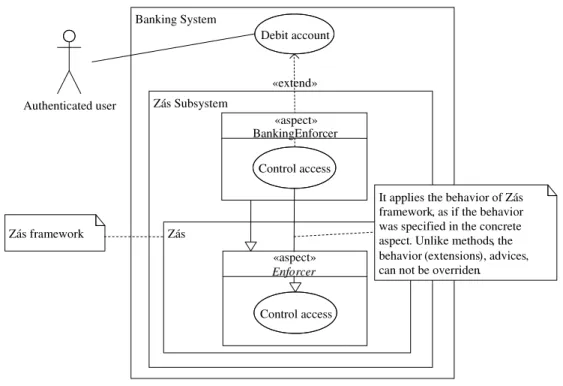
Figure4.2presents the use case associated to the debit of a bank account. An authenticated user tries to debit an account. To perform that operation, though, she requires authorization. The access control is supplied by the subsystem Z´as, which in this case is a realization of the Z´as
4.3. DESIGN 27
framework in the form of an access control subsystem adapted to the banking application. This realization consists of:
Figure 4.2: “Debit account” use case diagram.
• the definition of the default decider (and other optional deciders specific to the application) • the specification of the protected objects whose access should be controlled and the abstract
access modes associated to them,
• the optional external specification of the access control requirements, and
• the parametrization of the framework’s generic code with the application class representing the subjects of access control.
In the case of the account debit, the access control may be seen as an extension to the basic use case, providing it, in a non-invasive way, with the required access control functionalities.
28 CHAPTER 4. THE Z ´AS FRAMEWORK
Figure 4.3: Class diagram for the banking system case study.
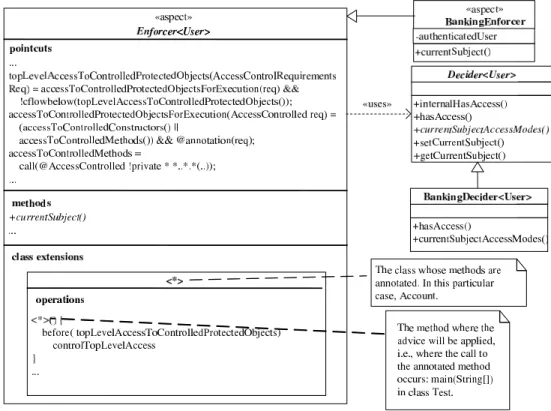
As can be seen in Figure 4.3, the main entities in Z´as, the enforcer and the decider, are modularized respectively by the abstract and generic aspectEnforcerand by the abstract class Decider. Z´as subsystems are realized in each application by the concretization and parametriza-tion ofEnforcer, by the non-abstract class extension to the deciderDecider, and by the anno-tation(s)AccessControlledcontained or injected in the application code.
The parameter of the generic aspectEnforceris used by client code to specify the class that represents the subjects of access control in the application. In the banking system case, subjects are simply instances of classUser.
The concretization of the abstract aspect Enforceris essential to make the access control available in the application: in AspectJ, abstract aspects have no effect on their own. This
con-4.4. IMPLEMENTATION 29
cretization requires the client code to implement the abstract methods ofDecider, particularly the method currentSubject(), which returns the subject involved in the current access at-tempt and defaultAccessVerifierClass(), which defines the default decider class (this class must be a non-abstract extension to classDecider, having one no-argument constructor), responsible for evaluating the legitimacy of the access attempt.
Additionally, the client code must extend class Deciderand implement its abstract method currentSubjectAccessModes(), which returns a textual representation of the abstract access modes that the subject has permission to use, which are necessary to evaluate the legitimacy of an access attempt.
The sequence diagram in Figure 4.2represents the behavior of Z´as subsystem in the case of the debit operation. The messages are exchanged between the objects involved in the use case, including its extension supplied by the Z´as subsystem. The behavior added by the subsystem to the debit operation occurs before its invocation. This way, the invocation happens only if the authenticated user has access, after the evaluation of the access by the decider in the Z´as subsystem (which in this case is the decider module provided by Z´as framework).
4.4
Implementation
The generic aspectEnforcerhas as a parameterSubject, of which the access control subjects are supposed to be instances:
public abstract aspect Enforcer<Subject> ...
The framework may thus be parameterized with the specific type of the subject used by a given application, in this case with classUser, as will be seen later.
The extension to the behavior of the debit account operation, extension that corresponds to the access control concern, is defined by abefore()advice from the aspect:
// Advice name: controlTopLevelAccess
30 CHAPTER 4. THE Z ´AS FRAMEWORK
Figure 4.4: “Debit account” case study sequence diagram.
topLevelAccessToControlledProtectedObjects(requirements) // ... refinements in the advice definition.
{ // ... checkAuthorization( AccessControlRequirements.buildFrom( requirements, ProtectedObjectKind.convertToEnum( thisJoinPoint.getKind())), thisJoinPoint, thisEnclosingJoinPointStaticPart, false, false); // ... }
4.4. IMPLEMENTATION 31
This advice is applied to the invocation (call to a method, or set or get to the value of a field) of the protected objects annotated with AccessControlledthat are not invoked within the con-trol flow of a similarly annotated method (topLevelAccessToControlledResources). The methodbuildFrom()returns a new instance of classAccessControlRequirementscreated from the protected object’s annotation. That class instance represents the annotation elements’ data and is associated to the kind of protected object (method or constructor, and set or get to the value of a field). That class represents both the elements data from the Z´as framework access control annotations and the access control requirements specified in the Z´as XML files, which will be presented later.
The most important part of the behavior of this advice is implemented in the method check-Authorization():1
private void checkAuthorization(
AccessControlRequirements requirements,
JoinPoint joinPoint, JoinPoint.StaticPart enclosingStaticPart,
boolean isShallow, boolean inCflowOfAccessControl) {
// ...
Subject currentSubject = currentSubject();
Decider<Subject> decider = deciderClass(requirements, joinPoint, !inCflowOfAccessControl); String protectedObjectAbstractAccessModes = getProtectedObjectAccessModes(requirements, joinPoint); decider.setCurrentSubject(currentSubject); // ... if (!decider.internalHasAccess(protectedObjectAbstractAccessModes, joinPoint, enclosingStaticPart)) handleSituationWhenAccessNotGranted(joinPoint.getStaticPart()); }
The parameter joinPoint in the invocation of method deciderClass()is required so that it is possible to register the decider and associate it to that join point (there is only one
1It is usually a good practice to define the arguments passed to a method as final. However, in this thesis, for
32 CHAPTER 4. THE Z ´AS FRAMEWORK
instance of decider per protected object, which is created the first time that the protected object is accessed and reused later on). The argumentisShallowcontrol the depth of the access control enforcement, as will be further explained in Section4.6.2.3. The argument inCflowOfAccess-Controlcontrols either the decider class should be registered for the current join point or not: the registration is performed only in top level accesses.
The methodcheckAuthorization()obtains the subject through the invocation of the ab-stract methodcurrentSubject(), implemented in the concrete aspect BankingEnforcer, and obtains the protected object’s abstract access modes from the information specified in its meta-information (e.g., in annotation AccessControlled, presented later in this section), by invokinggetProtectedObjectAccessModes().
In the methodcheckAuthorization()it is also necessary to obtain an instance of the de-cider class specified in the protected object’s meta-information and invoke its method internal-hasAccess(), which compares the abstract access modes expression defined in the protected object’s access control requirements with the abstract access modes the subject has permission to use, obtained through the invocation of the abstract methodcurrentSubjectAccessModes() (implemented in the concrete decider (BankingDecider)), returning true only if the subject has the required abstract access modes to access the protected object. Additionally, it invokes method hasAccess(), optionally implemented in client code, thus enabling to perform additional access control verifications.
@Privileged
public class Decider<Subject> {
public final boolean internalHasAccess(
String protectedObjectAccessModes, JoinPoint joinpoint,
JoinPoint.StaticPart enclosingStaticPart) {
boolean result = false;
// ...
return result &&
hasAccess(protectedObjectAccessModes, joinpoint, enclosingStaticPart);
4.4. IMPLEMENTATION 33
public boolean hasAccess(String protectedObjectAccessModes,
JoinPoint joinpoint, JoinPoint.StaticPart enclosingStaticPart) {
return true;
} }
WheninternalHasAccess()returns true, the access to the protected object proceeds im-mediately. When it returns false,checkAuthorization()throws a runtime exception. Notice that it is a runtime, unchecked exception, as inJAAS, therefore making it possible for Z´as to be totally non-invasive, since unchecked exceptions do not have to be declared as part of the methods signatures.
Apart from the arguments already mentioned, hasAccess() gets also the execution (dy-namic) and invocation (static) contexts of the access attempt.
The dynamic context is necessary so that the access control decision may be based on data. However, if the impact in the application performance is deemed too large, a future version of the framework will possibly define two kinds of authorizations, as suggested by Laddad [28]: AccessControlledandDataDrivenAccessControlled, together with two base deciders – one receiving dynamic information, the other static.
It is important to notice that the classDeciderand all its subclasses2are marked as privileged (further details are presented in Section4.6.2.4).
This is necessary because these classes often need to obtain access to protected objects, partic-ularly when it is necessary to compute the value of predicates using domain specific information, e.g., protected object’s properties. This may be a problem, since in the context of these classes, one may access every data of a given application, therefore, this is an open issue for further inves-tigation.
In AspectJ, pointcuts may be either named or anonymous. In general, named pointcut defi-nitions may be overridden by defidefi-nitions with the same name in derived aspects. When it is not
34 CHAPTER 4. THE Z ´AS FRAMEWORK
desirable, pointcuts may be qualified as final in the base aspect or even private, when they are seen as implementation details.
The two main pointcuts from aspect Enforcer are private, i.e., they are implementation details and hence they cannot be overridden:
private pointcut topLevelAccessToControlledProtectedObjects(
AccessControlled requirements) :
accessToControlledProtectedObjectsForExecution(requirements) && !cflowbelow(
accessToControlledProtectedObjectsForExecution(AccessControlled));
private pointcut accessToControlledProtectedObjectsForExecution(
AccessControlled requirements) : (accessToControlledConstructors() ||
accessToControlledMethods()) && @annotation(requirements);
public pointcut accessToControlledMethods() : call(@AccessControlled !private * *..*.*(..));
This is due to the fact that any change in these pointcuts may compromise the Z´as subsystem. On the contrary, derived concrete aspects of Enforcermay override pointcut accessTo-ControlledMethods. For instance, aspect BankingAccessController could refine the pointcut definition in such a way that the private methods would also be subject to access control. By default, and since this framework is still a prototype, the used join points correspond to invocations of methods annotated withAccessControlled: the application of advices to these join points has the advantage of allowing one to obtain not only the dynamic context of execution, but also the static context of invocation.3
Nevertheless, in an implementation of the framework for production, this choice is not the most appropriate, for security reasons. Advices, in the case of invocations, are weaved in the code that accesses the protected object. If this code is external to the application or, for some reason, can not be manipulated by the AspectJ compiler, the weaving of the access control advices may be
3We have already started an implementation using execution instead of call, though, in
the branch “B zas-new-annotations”, which may be found in the Web site of the project at
4.4. IMPLEMENTATION 35
impossible, compromising the security of the application. Therefore, the Z´as framework should, by default, control the executions, since the compiler has full access to the application of which the subsystem Z´as is a part.4 Additionally, the protected object as defined in Z´as is the method itself, i.e., the execution of the method and not its invocation.
The control of method executions, not invocations, will make it harder to implement some of the current features of the Z´as framework, described in Section4.6.2: it will no longer be possible to obtain the static context of invocation through the implicit variable thisEnclosingJoin-PointStaticPart, thus, the implementation of some current features from Z´as will be harder. Implementing execution side access control might require the observation and the parsing of the Java stack trace. However, the Java stack trace does not provide the full signature of the methods on the stack, which means it is not possible to access the method by simply parsing the stack. The solution for this problem would include the creation of a pseudo-stack, managed by Z´as, which works as an add-on to the Java stack trace, in order to augment its information. This implementation has already begun, as detailed in Section4.6.3.
The annotation AccessControlled is used by the Z´as framework to specify the meta-information used to control the access to methods:
public @interface AccessControlled { String value() default "#";
Class<? extends Decider> deciderClass()
default Decider.class;
Depth depth() default Depth.DEEP; Class[] trusts() default {};
boolean inherited() default false; boolean suspicious() default false;
}
Thevalue()element is used to declare the names of the abstract access modes required to access to the protected objects. By default, its value is‘‘#’’, which represents conventionally the full signature of the protected object (though without return type).5
4Bug submitted in:http://sourceforge.net/tracker/?group_id=195589&atid=954049. 5Using full signatures prevents the collision of the names of the abstract access modes.
36 CHAPTER 4. THE Z ´AS FRAMEWORK
ThedeciderClass()element is used to explicitly specify the class responsible for deciding whether the access should be granted. By default, it is the classDecider. Notice that different protected objects may define different deciders.
Thedepth()element specifies the enforcement depth, i.e., it specifies whether control access should be performed (or not) during the flow of control of a method that has already been access access controlled. When a methodfoo(), say, has depthSHALLOW, it is enough for the subject to have access to the invocation offoo(), since the subject will be granted access to any protected object, provided the access occurs within the flow of control of that invocation offoo(). By default, the value of this element isDEEP, since it is the most restrictive behavior and, as such, the most secure, forcing all accesses to be controlled, at any level of the stack trace.
The trusts() element is, by default, empty. It is used to indicate the classes that have automatic access to the protected object. It is used to explicitly declare that the protected object trusts in those classes to access the protected object. This is somehow related to “exporting features” in Eiffel [31], because in Eiffel we may restrict access of a method to a classes, similar to what we may do in Z´as with this element. When this element is used, the current subject is not only the entity that has initiated the access attempt but also the classes in which the protected object trusts.
Theinherited()element controls the inheritance of the access control requirements from the type (class or interface) where the protected object was defined. By default, its value is false, meaning that by default protected objects do not inherit the access control requirements from their type.
Finally,suspicious(), when true, forces the access to the protected object to be performed at any level of the stack trace, even when the access depth verification was specified asSHALLOW at some lower point in the stack.
From a strict security point of view, all “resources” should be seen as protected objects: it is safer for the application to throw an authorization exception for all access attempts than to implic-itly grant access from all subjects to that “resource”. However, that would forbid programmers to
4.5. USAGE 37
restrict the access control scope, for example, to the business layer of the application. Ideally, it should be possible to define an abstract pointcutscopeForProtectedObjects()
// In aspect Enforcer:
public abstract pointcut scopeForProtectedObjects();
declare @method : scopeForProtectedObjects() : @AccessControlled("*");
// ...
forcing this way the client code to define it appropriately to her application. The ‘‘*’’ is a wildcard that matches for any abstract access mode, i.e., the previous code means that all protected objects require, at least, one abstract access mode.
However, the AspectJ language forces the usage of type patterns in Inter-Type Declaration (ITD), not allowing the usage of pointcuts. Therefore, the generalized access control in the busi-ness layer is considered as a best practice of Z´as, but it cannot be forced by it.
4.5
Usage
In this section we will present the Z´as-based solution to the implementation of the toy project from Chapter 3 with an additional access control rule, stating that only the account owner is allowed to debit the account if she was granted permission to use the abstract access modedebit. The first step in a Z´as-based implementation of access control in some application is to identify the protected objects whose access should be controlled. There are two different ways to do this. One of them is invasive, consisting in annotating directly the protected objects whose access should be controlled:
public class Account {
@AccessControlled(value = "debit", deciderClass = BankingDecider.class)
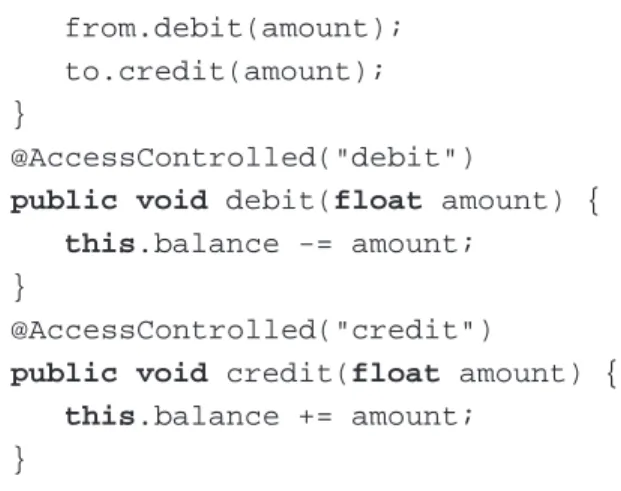
public void debit(float amount) {
// ... } }
38 CHAPTER 4. THE Z ´AS FRAMEWORK
public class Test {
// ... as before }
The other is non-invasive. It involves usingITDto inject the necessary annotations in the access controlled protected objects. The drawback of this approach, however, is that readability becomes harder: the access control requirements of a protected object are not specified close to its defini-tion. The Integrated Development Environment (IDE) we used was Eclipse6, which helps to solve this problem since the protected object is shown with a note indicating that it is being annotated by some aspect. Nevertheless, it is simply a note and it makes programmers depend on theIDE:
// In aspect Enforcer:
declare @method : Account.debit(float) :
@AccessControlled(value = "debit", deciderClass = BankingDecider.class);
As a second step, it is necessary on the one hand to configure the security aspects from Z´as though the parametrization, extension, and concretization of aspectEnforcer, which involves the implementation of the abstract methodscurrentSubject()anddefaultDeciderClass(), and, on the other hand, at least for this particular case, the definition of an advice that guarantees user authentication:
public aspect BankingEnforcer extends Enforcer<User> { public User currentSubject() {
return SecurityContext.getCurrentSubject();
}
public Class<BankingDecider> defaultDeciderClass() { return BankingDecider.class;
}
after() returning(User authenticatedUser) : call(public static User Test.login()) {
SecurityContext.setCurrentSubject(authenticatedUser); }
}
The advice shown previously executes after any successful login attempt in the application.