EVects of Conventional Pesticides on the Preimaginal
Developmental Stages and on Adults of Trichogramma
cordubensis (Hymenoptera: Trichogrammatidae)
ANTOÂNIO VIEIRA, LUIÂSA OLIVEIRA and PATRIÂCIA GARCIA
Departamento de Biologia, Universidade dos AcËores, P-9502 Ponta Delgada
Codex, AcËores, Portugal
(Received for publication 19 July 2000; revised manuscript accepted 8 February 2001)
The eVects of seven pesticides sprayed on hosts with parasitoid s at diVerent phases of egg to adult development (24, 24 ± 48, 48± 72, 72 ± 96, 120± 144, 192± 216 h) of Trichogramma cordubensis (Vargas & Cabello) were studied. The eVect of these pesticides on the mortality of adult parasitoids upon contact with the hosts immediately or 24 h after the treatments was also tested. One organophosphat e insecticide (trichlorfon), one organochlorin e insecticide (endosulfan) , two pyrethroid s (deltamethrin and lambda-cyhalothrin) , a commercial formulation of Bacillus
thuringiensis subsp. Kurstaki, and two fungicide s (acetamide
+
dithiocarbamet e and basic copper sulphate) were selected for testing. All the tests were carried out with fresh solutions of commercial insecticides applied on host eggs at the recommended concentration. The pesticides applied at diVerent development phases did not aVect the duration of parasitoid development, except endosulfan, which delayed the parasitoid preimaginal development for one day. With few exceptions, the number of parasitize d host eggs that turned black (i.e. with parasitoid prepupae) did not diVer signiWcantly between the pesticide treatments and the control. The chemical insecticides aVected the adult emergence rates signiWcantly, while the other products resulted in emergence rates similar to control values. The longevity of adult progeny was very short when endosulfan or trichlorfon (< 1 and < 2 days, respectively) were applied. Overall, endosulfan was the pesticide most harmful to the preimaginal development stages of T. cordubensis. Therefore, the use of this product should be avoided when this species is part of an integrated pest control programme.Keywords: Trichogramma cordubensis, insecticides, fungicides, toxicity
INTRODUCTION
Natural enemies of lepidopteran agricultural pests such as Autographa gamma (L.),
Chryso-deixis chalcites (Esper), Helocoverpa armigera (HuÈbner), Noctua pronuba (L.), Peridroma sausia (HuÈbner), Phlogophora meticulosa (L.), Pseudaletia unipunct a (Haworth), Spodoptera
Correspondence to L. Oliveira. Tel: +351 96 653044; Fax: +351 96 653455; E-mail: [email protected] ISSN 0958-3157 (print)/ISSN 1360-047 8 (online)/01/040527-08 2001 Taylor & Francis Ltd DOI: 10.1080 /0958315012006755 3
littoralis (Boisduval) and Pieris brassicae (L.) can be a key component for their management. Trichogramma cordubensis Vargas & Cabello is one of the most important parasitoids of
these lepidopteran pests on the island of SaÄo Miguel-Azores (Portugal) (Garcia et al., 1994; Garcia, 1995). Low rates of parasitism have been reported in several agricultural regions and this may be due partly to the extensive use of insecticides (Gullan & Cranston, 1992; Driesche & Bellows, 1996). To promote integrated pest control methods in Azorean crops, where the use of pesticides cannot be completely excluded, eVorts have been undertake n to evaluate the safety of the most frequently used pesticides for potential native natural enemies of these lepidopteran agricultural pests, such as T. cordubensis.
Although a wide range of literature is available on the eVects of pesticides on
Tricho-gramma (Jalali & Singh, 1993; Kumar et al., 1994; Branco & FrancËa, 1995; Kring & Smith,
1995; Sterk et al., 1999) little is known about the lethal eVects of pesticides on T. cordubensis. In this study, the eVects of seven diVerent pesticides on the following biological parameters of T. cordubensis are examined and compared: adult mortality, duration of preimaginal development, number of parasitized host eggs that turned black, adult emergence rates and the longevity of adult progeny.
MATERIALS AND METHODS
Insects
Adults of T. cordubensis were collected originally from SaÄo Miguel Island, Azores (Portugal) (Garcia, 1995), and maintained on Ephestia kuehniella Zeller (Lepidoptera: Pyralidae) eggs for the previous 8 years in laborator y conditions, according to the methods of Tavares and Vieira (1992).
Insecticides
All the tests were done with fresh solutions of commercial pesticides prepared in water. Five insecticides (one organophosphate , one organochlorine, two pyrethroids and a commercial formulation of Bacillus thuringiensis) and two fungicides (acetamide
+
dithiocarbamete and basic copper sulphate) were tested at the concentrations indicated in Table 1. Pesticides for testing were selected on the basis of their use for the control of diVerent pests in agricultural ® elds in the Azores archipelago, and concentrations were those recommended by the manufacturer for the control of lepidopteran and fungal pests.Bioassay 1
In order to test the eVects of various pesticides on the immature stages of T. cordubensis, 280 yellow cards (1.53 0.8 cm) were prepared, each with 500 E. kuehniella eggs glued to it. Each egg card was exposed to 15 females of T. cordubensis and placed inside a glass tube (73 1 cm) for 24 h. Forty cards with E. kuehniella eggs, < 24 h after parasitization, were TABLE 1. Details of pesticides tested against T. cordubensis
Concentration
Active ingredient Pesticide Formulation tested (%) Company
Trichlorfon Diptrex 80 80% PS 0.20 Bayer
Endosulfan Thiodan 35% EC 0.65 Sapec
Deltamethrin Decis 2.8% EC 0.05 Hoechst
Lambda-cyhalothrin Karate 5.5% EC 0.05 Zeneca Agro
Bacillus thuringiensis
Berliner subsp. Kurstaki Dipel 16 000 UI WP 0.10 Bayer
Acetamide+dithiocarbamete Milraz 4.8+58% SP 0.25 Bayer Basic copper sulphate Calda bordalesa 25% SP 2.50 Quimigal
each sprayed with 6 ml of an aqueous suspension of one of the insecticides using Potter tower equipment (Burkard, Rickmansworth, UK) at 2 bar. Controls were sprayed with distilled water. This resulted in homogeneous spray coverage of 9.526 2.17 l l (mean6 SD) of ¯ uid per cm2, corresponding to the concentrations recommended by the manufacturer
(1000 l/ha. Egg cards 24± 48, 48± 72, 72± 96, 120± 144, 192± 216 h after parasitizatio n were treated similarly. The eVects of the treatments on the development times of the parasitoid, on the number of parasitized host eggs that turned black (i.e. with parasitoid prepupae), on the adult emergence rates and on adult longevity were recorded. Each treatment was repeated four times, and there were ® ve replicate cards in each treatment (i.e. n5 20 egg cards per each treatment).
Bioassay 2
In order to test the eVect of the various pesticides on the mortality of adults of T. cordubensis, 80 egg cards, prepared as described in Bioassay 1, were each sprayed with one of the same seven pesticides or with water (control). After egg cards had dried, 24 h after spraying, 15
T. cordubensis females were introduced into the glass tube containing the treated hosts. Each
treatment was repeated four times, and there were ® ve replicate cards in each treatment (i.e.
n5 20 egg cards per each treatment). Mortality of the parasitoid adults was observed 6, 24 and 48 h after the ® rst contact with the hosts. During the ® rst 24 h, parasitoids were in contact with the treated eggs. After being in contact with the hosts, parasitoids were kept in the same tubes but without the hosts, supplied only with honey solution, for another period of 24 h.
All tests were done under controlled conditions, at 226 1ë C, 706 5% relative humidity (RH) and with a photoperiod of 16L:8D h.
Statistical Analysis
DiVerences in parasitoid development times, number of parasitized host eggs that turned black and adult longevity were determined by ANOVA using
Î
(x+
0.5)-transforme d data. Adult emergence rates and parasitoid mortality (Bioassay 2) were analysed by ANOVA using arcsineÎ
x-transformed data (Zar, 1996). When ANOVA showed signi® cant diVerences(P < 0.05) among the means, paired comparisons of each mean were made using Student± Newman± Keuls tests (Zar, 1996). Parasitoid mortality, after contact with the pesticides, was analysed by ANOVA using arcsine
Î
x-transformed data. All analyses were performed usingSPSS 6.1 (Norusis, 1994) for the Macintosh system. RESULTS
Bioassay 1
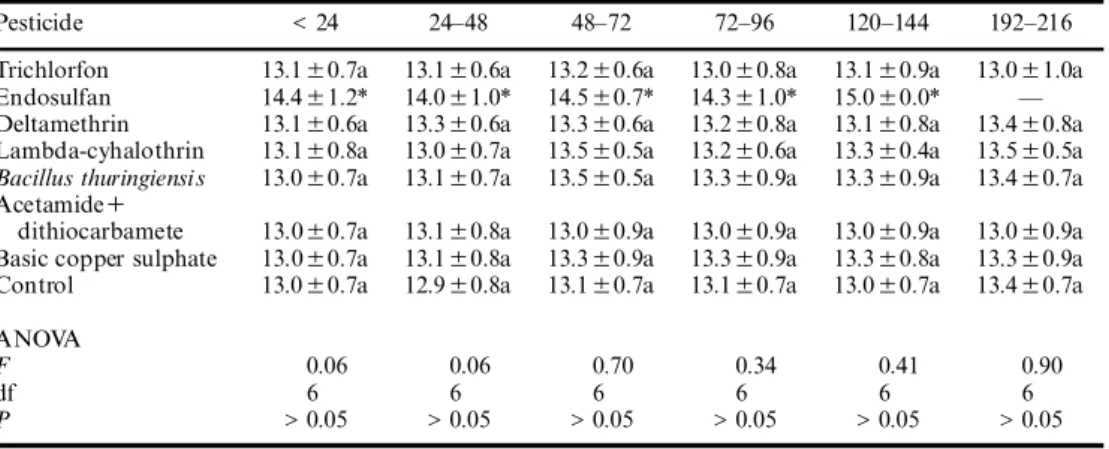
The treatments applied at diVerent development phases did not aVect the duration of parasitoid development signi® cantly (of approximately 13 days) (Table 2). However, with endosulfan, the preimaginal development was delayed for one day, but the sample size was too small to conclude if there was a signi® cant diVerence (Table 2).
With few exceptions, pesticides did not signi® cantly aVect the number of parasitized host eggs that turned black (Table 3). DiVerences were observed when treatments were performed at < 24 and 72± 96 h after parasitization . In the ® rst case, the number of parasitized host eggs treated with endosulfan was signi® cantly smaller than those treated with lambda-cyhalothrin. In the second case (72± 96 h after parasitism), the number of parasitized host eggs was signi® cantly higher when deltamethrin was applied in comparison with basic copper sulphate (Table 3).
Adult emergence rates of the parasitoids from the ® rst four treatments (chemical insect-icides) were signi® cantly inferior to the control values (Table 4). The adult emergence rates of T. cordubensis were reduced to near zero by endosulfan. Lambda-cyhalothri n reduced the emergence rate by approximatel y 40%, and deltamethrin reduced it by approximatel y 26%.
TABLE 2. Mean (6 SD) of the duration of development (days) when seven pesticides were applied on diVerent phases of the development of T. cordubensis
Pesticide < 24 24± 48 48± 72 72± 96 120± 144 192± 216
Trichlorfon 13.16 0.7a 13.16 0.6a 13.26 0.6a 13.06 0.8a 13.16 0.9a 13.06 1.0a Endosulfan 14.46 1.2* 14.06 1.0* 14.56 0.7* 14.36 1.0* 15.06 0.0* Ð Deltamethrin 13.16 0.6a 13.36 0.6a 13.36 0.6a 13.26 0.8a 13.16 0.8a 13.46 0.8a Lambda-cyhalothrin 13.16 0.8a 13.06 0.7a 13.56 0.5a 13.26 0.6a 13.36 0.4a 13.56 0.5a Bacillus thuringiensis 13.06 0.7a 13.16 0.7a 13.56 0.5a 13.36 0.9a 13.36 0.9a 13.46 0.7a Acetamide+
dithiocarbamete 13.06 0.7a 13.16 0.8a 13.06 0.9a 13.06 0.9a 13.06 0.9a 13.06 0.9a Basic copper sulphate 13.06 0.7a 13.16 0.8a 13.36 0.9a 13.36 0.9a 13.36 0.8a 13.36 0.9a Control 13.06 0.7a 12.96 0.8a 13.16 0.7a 13.16 0.7a 13.06 0.7a 13.46 0.7a ANOVA
F 0.06 0.06 0.70 0.34 0.41 0.90
df 6 6 6 6 6 6
P > 0.05 > 0.05 > 0.05 > 0.05 > 0.05 > 0.05 ANOVA F, df and P-values.
Means in each column followed by a diVerent letter are signi® cantly diVerent (P< 0.05, Student± Newman± Keuls test).
* Sample size was too small to include in analysis.
TABLE 3. Mean (6 SD) number of parasitized host eggs that turned black when seven pesticides were applied on diVerent phases of the development of T. cordubensis
Pesticide < 24 24± 48 48± 72 72± 96 120± 144 192± 216
Trichlorfon 218.56 40.6ab 215.86 38.1a 214.2 6 61.3a 239.8 6 36.4ab 231.36 46.7a 224.26 57.2a Endosulfan 200.46 44.3a 228.06 42.8a 233.0 6 48.1a 230.9 6 29.2ab 228.36 35.9a 225.96 52.0a Deltamethrin 212.26 46.5ab 243.26 42.9a 241.0 6 37.2a 262.7 6 29.4a 237.96 38.1a 225.86 50.3a
Lambda-cyhalothrin 244.66 27.0b 236.96 35.5a 229.0 6 57.0a 254.3 6 48.2ab 215.06 40.9a 230.86 33.2 Bacillus
thuringiensis 229.36 40.8ab 216.56 45.0a 241.0 6 31.3a 221.0 6 51.7ab 240.76 39.7a 234.76 52.7a Acetamide+
dithio-carbamete 232.76 40.8ab 240.26 38.3a 235.9 6 35.2a 244.3 6 36.4ab 241.96 39.2a 233.56 42.0a Basic copper
sulphate 211.86 35.1ab 212.56 42.3a 226.0 6 45.0a 219.6 6 63.0b 243.06 37.7a 239.86 45.1a Control 232.26 27.7ab 233.06 49.3a 210.9 6 32.1a 238.0 6 43.6ab 233.26 40.1a 224.26 52.0a ANOVA
F 2.87 1.66 1.02 2.34 0.66 0.31
df 7 7 7 7 7 7
P < 0.01 > 0.05 > 0.05 < 0.05 > 0.05 > 0.05 ANOVA F, df and P-values.
Means in each column followed by a diVerent letter are signi® cantly diVerent (P< 0.05, Student± Newman± Keuls test).
Basic copper sulphate, when applied 24± 48, 72± 96, 120± 144 and 192± 216 h after parasitism diVered signi® cantly from the control values, with a similar eVect to trichlorfon (Table 4).
The longevity of adult progeny was very short when endosulfar or trichlorfon (< 1 and < 2 days, respectively) were applied. With the other products, longevity varied from 10 to 16 days without signi® cant diVerences among pesticides. Aside from organophosphat e and organochlorin e insecticides, only lambda-cyhalothrin , applie d 72± 96 h after parasitization, signi® cantly reduced longevity when compared with the control (Table 5).
TABLE 4. Adult emergence rates (6 SD) when seven pesticides were applied on diVerent phases of the development of T. cordubensis
Pesticide < 24 24± 48 48± 72 72± 96 120± 144 192± 216
Trichlorfon 91.06 05.3a 92.66 03.0a 89.46 05.7a 87.76 08.8a 88.76 05.1a 91.46 04.3a Endosulfan 00.46 00.8b 00.16 00.3b 00.06 00.1b 00.26 00.3b 00.16 00.4b 00.06 00.0b Deltamethrin 74.56 04.8c 69.06 09.3c 70.26 08.7c 65.36 11.3c 65.86 13.7c 67.06 11.5c Lambda-cyhalothrin 62.46 13.6d 56.86 15.0d 57.36 15.5d 51.26 22.9c 45.76 20.3d 51.86 14.9d Bacillus thuringiensis 96.16 01.4e 95.56 01.6e 96.56 01.7e 95.66 02.6d 96.46 01.2e 95.56 02.8e Acetamide+
dithiocarbamete 95.46 01.8e 96.26 02.2e 96.76 01.5e 96.06 01.3d 95.76 01.7e 95.36 01.8e Basic copper sulphate 94.36 02.1e 93.26 02.4a 94.46 02.2e 91.16 07.9a 90.06 06.3a 90.46 04.7a Control 96.06 01.3e 95.96 02.1e 91.46 02.4e 95.46 02.0d 96.16 01.5e 95.26 02.0e ANOVA
F 808.7 752.3 677.9 307.9 385.3 610.2
df 7 7 7 7 7 7
P < 0.001 < 0.001 < 0.001 < 0.001 < 0.001 < 0.001 ANOVA F, df and P-values.
Means in each column followed by a diVerent letter are signi® cantly diVerent (P< 0.05, Student± Newman± Keuls test).
TABLE 5. Mean (6 SD) adult progeny longevity (days) when seven pesticides were applied on diVerent phases of the development of T. cordubensis
Pesticide < 24 24± 48 48± 72 72± 96 120± 144 192± 216
Trichlorfon 01.76 0.8a 01.86 0.7a 01.76 0.6a 01.56 1.1a 01.96 0.7a 02.06 0.4a
Endosulfan < 1* < 1* < 1* < 1* < 1* Ð Deltamethrin 12.56 5.3b 13.26 5.2b 13.36 6.1b 13.46 5.8bc 12.96 5.1b 12.36 4.4b Lambda-cyhalothrin 11.16 4.8b 11.36 4.9b 11.86 4.4b 11.06 4.9b 10.66 3.9b 11.76 4.6b Bacillus thuringiensis 15.76 6.7b 14.46 6.9b 15.76 6.8b 16.06 6.5bc 16.26 7.1b 15.56 6.2b Acetamide+ dithiocarbamete 14.86 0.7b 15.36 7.6b 15.66 6.6b 15.56 6.5bc 15.86 7.3b 16.36 7.1b Basic copper sulphate 15.56 6.7b 14.66 6.1b 14.36 5.7b 16.36 7.5bc 15.16 6.8b 16.36 6.6b Control 16.56 7.0b 15.46 7.2b 15.86 7.2b 16.96 7.5c 16.26 8.9b 15.36 6.6b ANOVA
F 23.57 19.77 22.41 25.36 20.81 23.96
df 6 6 6 6 6 6
P < 0.001 < 0.001 < 0.001 < 0.001 < 0.001 < 0.001 ANOVA F, df and P-values.
Means in each column followed by a diVerent letter are signi® cantly diVerent (P< 0.05, Student± Newman± Keuls test).
* Sample size was too small to include in analysis.
Bioassay 2
In all tests, including the control, the mortality of the females increased with time.
Endosulfan was the most quickly and highly toxic pesticide for adults of T. cordubensis, causing 100% mortality. Trichlorfon gave slower, but similar results (Table 6).
Both pyrethroids (deltamethrin and lambda-cyhalothrin ) reduced the parasitoid popula-tion by approximatel y 25%, 48 h after the ® rst contact with pesticide. Comparing these results with those obtained for the other products, we observed some signi® cant diVerences between pyrethroids and the other treatments (Table 6).
Bacillus thuringiensi s and the two fungicides, acetamide
+
dithiocarbamete and basic copper sulphate, did not cause signi® cant mortality in T. cordubensis as compared with the control. Only acetamide+
dithiocarbamete caused a greater mortality 48 h after the ® rst contact with the pesticide, when treated eggs were given to parasitoids immediately (Table 6).TABLE 6. Mortality rates (6 SD) when seven pesticides were applied on adults of T. cordubensis 0 h after treatment 24 h after treatment
Pesticide 6 h 24 h 48 h 6 h 24 h 48 h
Trichlorfon 29.16 39.3a 94.86 14.1a 100.06 00.0a 40.76 47.9a 89.26 20.6a 99.76 01.5a Endosulfan 100.06 00.0b 100.06 00.0a 100.06 00.0a 98.06 05.3b 100.0 6 00.0a 100.0 6 00.0a Deltamethrin 06.46 07.4c 15.56 11.9b 17.56 11.9b 05.16 04.9c 18.76 14.1b 20.66 14.9b Lambda-cyhalothrin 06.36 08.9c 17.96 18.8b 21.46 19.9b 06.76 06.9c 19.26 13.9b 26.36 20.0b Bacillus thuringiensis 00.36 01.5c 03.76 06.2c 04.26 07.3c 00.76 03.0c 04.46 07.0c 05.96 07.6c Acetamide+
dithiocarbamete 00.36 01.5c 03.16 01.5c 23.66 39.4b 00.36 01.5c 04.16 05.6c 06.36 08.7c Basic copper sulphate 00.06 00.0c 02.76 07.2c 04.76 09.8c 00.36 01.5c 05.36 05.8c 08.66 09.4c Control 00.06 00.0c 00.36 01.3c 03.56 04.7c 00.36 01.5c 02.86 05.3c 04.66 05.3c ANOVA
F 112.5 318.8 133.6 72.1 249.2 302.2
df 7 7 7 7 7 7
P < 0.001 < 0.001 < 0.001 < 0.001 < 0.001 < 0.001 ANOVA F, df and P-values.
Means in each column followed by a diVerent letter are signi® cantly diVerent (P< 0.05. Student± Newman± Keuls test).
Results show that the tested pesticides have a high residual eVect, since the mortality values were similar when the parasitoids contacted with the pesticide immediately or 24 h after the treatments.
DISCUSSION
Of the pesticides evaluated in this study, the organochlorin e and organophosphat e insect-icides were the most toxic to T. cordubensis. However, trichlorfon was less toxic than endosulfan. The pyrethroids were less harmful, with deltamethrin being less toxic than lambda-cyhalothrin. Bacillus thuringiensi s and the two fungicides were not harmful to
T. cordubensis. These pesticides did not aVect parameters such as the duration of development
and the number of parasitized host eggs that turned black before treatment.
A negative eVect was observed on both the adult emergence rates and the longevity of adult progeny (Bioassay 1) when endosulfan and trichlorfon were applied. The ® rst parameter was also in¯ uenced by the pyrethroids. These results indicate that the egg chorion of
E. kuehniella did not protect the parasitoid.
As observed for T. cordubensis, a very low adult emergence rate of T. australicum Girault and Trichogrammatoide a armigera Nagaraja has been reported by Dutt and Somchoudhur y (1986) and Jalali and Singh (1993), respectively, when endosulfan was applied to immature forms of the parasitoids. Contrary to our ® ndings, endosulfan sprays have been found to be of low toxicity to T. pretiosum (Riley) (Hohmann, 1991, 1993), to T. chilonis Ishi (Santharam & Kumaraswami, 1985; Kumar et al., 1994) and to T. perkinsi Girault (Dutt & Somchoud-hury, 1986).
The emergence rate of adults was reduced signi® cantly by the pyrethroids deltamethrin and lambda-cyhalothrin . Kring and Smith (1995), when studying the eVects of cyhalothrin in T. pretiosum, also observed a reduction in the emergence rate. Sterk et al. (1999) found similar results when applying lambda-cyhalothri n to pupae of diVerent species of
Trichogramma. On the other hand Hohmann (1991, 1993) obtained diVerent results with T. pretiosum, as did Jalali and Singh (1993) with Trichogrammatoide a armigera and Kuman et al. (1994) with T. cholonis when deltamethrin was applied.
Trichlorfon did not aVect the adult emergence rate of T. cordubensis, but reduced adult longevity greatly when treatment was performed on preimaginal stages. This reduction in
longevity will therefore in turn cause a reduction in the number of hosts parasitized by these wasps.
Bacillus thuringiensi s did not aVect the biological parameters of T. cordubensis measured
in this study. Sterk et al. (1999) found similar results for a long list of bene® cial organisms. Fungicides were found to be safe to all stages of T. cordubensis, as suggested by Jalali and Singh (1993) and Sterk et al. (1999) for other fungicides applied to bene® cial organisms. Results show that these fungicide s can be used simultaneously with T. cordubensis, allowing the development of integrated pest management programmes in the Azores.
The mortality of adults was not aVected by the pyrethroids after 6 h of contact. However, when this period is longer (i.e. 24 or 48 h) the mortality of the parasitoids is signi® cantly higher than the control values (Bioassay 2). Previous studies had also demonstrated that these pyrethroids can be very dangerous for Trichogrammatoide a armigera, T. chilonis and
T. pretiosum (Jalali & Singh, 1993; Kumar et al., 1994; Branco & FrancËa, 1995). Endosulfan
was very harmful to adult T. cordubensis, with very high mortality values after a short period of contact (Bioassay 2). This also has been reported for T. evanescens Westwood by Chan (1978), for T. cacaecia Marchal by Hassan et al. (1983) and for Trichogrammatoidea
armigera by Jalali and Singh (1993). However, this eVect was more moderate in studies of T. pretiosum (Jacobs et al., 1984) and T. australicum (Dutt & Somchoudhur y, 1986).
The mortality of the adults was similar when parasitoids contacted immediately or 24 h after the treatments, indicating that all pesticides had a high residual eVect.
Of the seven pesticides tested here, endosulfan was the most harmful to the preimaginal developmental stages of T. cordubensis. Therefore, its use should be avoided when this species is part of an integrated pest control programme. Nevertheless, additiona l studies are required to determine whether a low concentration of these pesticides can be used safely in agricultural pest control without aVecting natural enemies of the pests.
ACKNOWLEDGEMENTS
This research was eVectuated on CIRN (Centro para a InvestigacËaÄo dos Recursos Naturais) and ® nancially supported by the Universidade dos AcËores.
REFERENCES
Branco, M.C. & FrancËa, F.H. (1995) Impacto de inseticidas e bioinseticidas sobre adultos de Trichogramma pretiosum. Horticultura Brasileira 13, 199± 201.
Chan, K.C. (1978) The eVect of some insecticides on the common Trichogramma (T. evanescens Westwood). Grad I Lozaraska Nauka 15, 73± 79.
Driesche, R.G. van & Bellows, T.S., Jr. (1996) Biological Control. Chapman & Hall, New York, NY, USA. Dutt, N. & Somchoudhury, A.K. (1986) Mortality response of immature and adult forms of Trichogramma perkinsi Girault and Trichogramma australicum Girault to few insecticides. Indian Journa l of Entomology
48, 23± 31.
Garcia, P. (1995) Trichogramma cordubensis Vargas & Cabello (Hym., Trichogrammatidae) na ilha de S. Miguel (AcËores): Aspectos de SistemaÂtica e Ecologia. Dissertation, Universidade dos AcËores, AcËores. Garcia, P., Oliveira, L. & Tavares, J. (1994) Trichogramma cordubensis (Hym., Trichogrammatidae): a
dynamics study of an Azorean population, in Trichogramma and Other Egg Parasitoid s (Wajnberg, E., Eds) 4th Internationa l Symposium. Les Colloques de l’INRA 73, 189-192.
Gullan, P.J. & Cranston, P.S. (1992) The Insects: An Outline of Entomology. Chapman & Hall, New York, NY, USA.
Hassan, S.A., Bigler, F., BogenschuÈtz, H., Brown, J.U., Firth, S.J., Huang, P., Ledieu, M.S., Naton, E., Oomen, P.A., Overmeer, W.P.J., Rieckmann, W., Samsoe-Petersen, L., Viggianni, G. & Van Zon, A.Q. (1983) Results of the second joint pesticide testing programme by the IOBC/WPRS Working Group `Pesticides and Bene® cial Arthopods’. Zeitschrift fuÈr Angewandte Entomologie 95, 151± 158.
Hohmann, C.L. (1991) Efeito de diferentes insecticidas sobre a emergeÃncia de Trichogramma pretiosum (Hymenoptera: Trichogrammatidae). Anais da Sociedade EntomoloÂgica do Brasil 20, 59± 65.
Hohmann, C.L. (1993) Efeito de alguns insecticidas sobre adultos de Trichogramma pretiosum RILEY. Anais da Sociedade EntomoloÂgica do Brasil 22, 563± 568.
(Hymenoptera: Trichogrammatidae) to residues of permethrin and endosulfan. Environmental Entomology
13, 355± 358.
Jalali, S.K. & Singh, S.P. (1993) Susceptibility of various stages of Trichogrammatoide a armigera Nagaraja to some pesticides and eVect of residues on survival and parasitizing ability. Biocontrol Science and Technology 3, 21± 27.
Kring, T.J. & Smith, T.B. (1995) Trichogramma pretiosum eYcacy in cotton under Bt-insecticides combina-tions. Cotton Insect Research and Control Conference, pp. 856± 857.
Kumar, M.G., Sundarabadu, P.C. & Edward, Y.S.J.T. (1994) Contact toxicity of insecticides to ecotypes of egg parasitoid Trichogramma chilonis Ishii. Madras Agriculture Journal 81, 437± 439.
Norusis, M.J. (1994) SPSS Advanced Statistics 6.1. SPSS Inc., USA.
Santharam, G. & Kumaraswami, T. (1985) EVect of some insecticides on the emergence of the parasitoid, Trichogramma chilonis Ishii (Hymenoptera: Trichogrammatidae). Entomon 10, 47± 48.
Sterk, G., Hassan, S.A., Baillod, M., Bakker, F., Bigler, F., BluÈmel, S., BogenschuÈtz, H., Boller, E., Bromand, B., Brun, J., Calis, J.N.M., Coremans-Pelseneer, J., Duso, C., Garrido, A., Grove, A., Heimbach, U., Hokkanen, H., Jacas, J., Lewis, G., Moreth, L., Polgar, L., Roversti, L., Samsoe-Petersen, L., Sauphanor, B., Schaub, L., StaÈubli, A., Tuset, J.J., Vainio, A., Van de Veire, M., Viggiani, G., VinÄuela, E. & Vogt, H. (1999) Results of the seventh joint pesticide testing programme carried out by the IOBC/WPRS-Working Group `Pesticides and bene® cial organisms’. Biocontrol 44, 99± 117.
Tavares, J. & Veira, V. (1992) ProducËaÄo em massa de Ephestia kuehniella Zeller (Lep., Pyralidae) IVÐ TeÂcnicas de recolha dos adultos e ovos. AcËoreana 7, 461± 470.