Clinical Gyms: a step towards
preventive medicine
Maria Gil Branco
152118117
Dissertation written under the supervision of Professor Inês Mendonça
Dissertation submitted in partial fulfilment of requirements for the MSc in
Management with specialization in Strategy and Entrepreneurship, at the
Clinical Gyms: a step towards preventive
medicine
Maria Gil Branco
152118117
Abstract
Preventive medicine is becoming increasingly important in the health sector. In parallel, two trends are shaping the shift in the healthcare industry: chronic diseases are affecting a bigger proportion of the population, whereas the overall society is increasingly aware of the importance of physical exercise. Thus, in this dissertation, we studied the creation of a new service: a Clinical Gym. This service combines the medical and health expertise of a Doctor with the training knowledge of a sports-related professional, aiming to create a tailor-made training plan for patients, while taking into consideration any medical conditions. We gathered 735 answers to surveys directed at prospective clients, Doctors and sports-related professionals, through which we could evaluate the need, the interest and the target of this new venture. Through our analysis we concluded that exists both a need and interest in this new service, since the majority of the three parties involved recognize the advantages that Clinical Gyms can bring: 63% of the end-users, 72% of Doctors and 65% of sports related professionals, are at least very interested in attending or providing this service. Additionally, we designed a brief business plan to validate the financial viability of Clinical Gyms. Our results seem encouraging to the pursuit of this business opportunity, although the analysis shall be deepened.
Keywords: Clinical Gyms, Healthcare, Gyms, New Business Opportunities, Entrepreneurship. J.E.L. Codes: I10, L21, L26, M13
Ginásios Clínicos: um passo em direção à
medicina preventiva
Maria Gil Branco
152118117
Abstrato
A medicina preventiva está a tornar-se cada vez mais importante no setor da saúde. Paralelamente, existem duas tendências que estão a definir a mudança no setor de saúde: as doenças crónicas estão a afetar uma maior proporção da população, ao mesmo tempo que a sociedade está cada vez mais consciente da importância do exercício físico. Assim, nesta dissertação, estudamos a criação de um novo serviço: Ginásios Clínicos. Este serviço combina a experiência médica e de saúde de um médico com o conhecimento de treino de um profissional de desporto, com o objetivo de criar um plano de treino personalizado para cada paciente, combinando os objetivos físicos de cada cliente com as suas necessidades e limitações patológicas, atingindo assim um treino com especificidade superior aos ginásios tradicionais. Recolhemos 735 respostas em questionários direcionados a potenciais clientes, médicos e profissionais de desporto, através das quais pudemos avaliar a necessidade, o interesse e o público-alvo deste serviço. Através desta análise, concluímos que existe necessidade e interesse neste novo serviço, uma vez que a maioria das três partes envolvidas reconhece as vantagens que os Ginásios Clínicos podem trazer: 63% dos consumidores finais, 72% dos médicos e 65% dos profissionais de desporto, estão pelo menos muito interessados em frequentar ou prestar esse serviço. Além disso, elaborámos um breve plano de negócios para validar a viabilidade financeira dos Ginásios Clínicos. Os resultados obtidos parecem ser encorajadores para a implementação desta oportunidade de negócio, não obstante a análise dever ser aprofundada.
Palavras-chave: Ginásios Clínicos, Saúde, Ginásios, Novas Oportunidades de Negócio, Empreendedorismo.
i Acknowledgements
This dissertation represents the end of my academic journey that I will remember for the rest of my life. From here, I will take my luggage full of knowledge, people and both amazing and challenging moments. Thus, there are some people to which I would like to express my gratitude.
First of all, I would like to thank CLSBE’s community for all the knowledge I acquired here, especially to my supervisor Inês Mendonça for all the support and advice she gave me during this last semester and to keep me on the right track anytime I felt lost during this project.
I would also like to thank my Innovation team, namely Madalena Clara and Caetana Gomes Leal, and my fellow trainees for the motivation and understanding they demonstrated throughout this semester.
Then, I would like to thank my “home friends” for understanding my absences and motivating me in the most difficult times. Thank you for proving me that friends are not just for parties!
I am also very grateful to Sara Marinho and Pedro Caferra Amaro, who are the ones that have been by my side since day one. Thank you for showing me that Lisbon can also be a home and for making this journey easier. I am very proud of what we did and achieved together.
Maria Bernardino and Bruno Alves were also very important to the conclusion of this dissertation. Thank you, Maria, for all your dedication and attention, not only during this semester but also in my life. Thank you, Bruno, for your immense support and motivation throughout the most difficult times, as well as for always challenging me. A special thanks for all the hours spent revising my dissertation.
My deepest thanks to Miguel, who once again proved to be the most amazing person in the world. Thank you for believing in me and always pushing me to do my best, for all your dedication, for helping me to clarify my ideas and for all the patience you had with me. I owe you an apology for all the weekends you wasted helping me with this project. I promise that from now on the weekends will be for sightseeing and that my bad mood will disappear.
Moreover, I would like to thank my cousin Telmo for his constant interest in this project and for being the best housemate I could have asked for.
ii
Por último, mas seguramente mais importante, quero agradecer à minha família, em especial aos meus pais, irmã e avós por serem a minha inspiração e por acreditarem sempre em mim, mesmo quando eu não acredito. Obrigada por serem o melhor colo quando as coisas não correm bem e por terem o mais verdadeiro sorriso nas minhas conquistas.
“Friends and family make the good times better and the hard times easier”
iii Table of contents List of Figures ... v List of Abbreviations ... v List of Tables ... vi 1. Introduction ... 1 1.1. Background Trends... 1
1.2. Problem Statement and Research Questions ... 1
1.3. Academic and Managerial Relevance ... 2
1.4. Methodology: Research Methods ... 2
1.5. Dissertation Outline ... 2
2. Literature Review ... 3
2.1. Entrepreneurship ... 3
2.2. Business Opportunities: Formation and Exploitation ... 3
2.3. Healthcare sector ... 4
2.4. Prevention ... 5
2.5. Overview of the Healthcare sector in Portugal ... 6
2.5.1. Chronic Diseases ... 7
2.6. Overview of the Portuguese Gyms’ Sector ... 8
3. Methodology ... 9 3.1. Research Design ... 9 3.2. Research Approach ... 10 3.2.1. Concept Testing ... 10 3.2.2. Inductive Approach ... 10 3.3. Research methods ... 10 3.3.1. Data Collection ... 10 3.3.1.1. Primary Data ... 10 3.3.1.1.1. Quantitative Research ... 10 3.3.1.1.2. Qualitative Research ... 12 3.4. Measurement Scales ... 12
4. Results and Findings ... 14
iv
4.2. Descriptive Statistics ... 15
4.3. Necessity ... 20
4.3.1. End-Users ... 20
4.3.2. Sports Related Professionals ... 22
4.3.3. Current and Future Healthcare Professionals ... 23
4.3.4. Appointment Simulation ... 23
4.4. Interest ... 24
4.4.1. End-Users ... 24
4.4.2. Sports related professionals ... 25
4.4.3. Current and Future Healthcare Professionals ... 26
4.5. Target ... 28
4.6. Price ... 30
4.7. Place... 32
4.8. Business Plan ... 33
5. Conclusions, Limitations and Future Work ... 38
6. References ... 40
Appendix 1 – Tables ... 47
Appendix 2 - Surveys ... 58
Consumers ... 58
Healthcare Professionals ... 68
v List of Figures
Figure 1 – Respondents’ Gender Figure 2 – Respondents’ Age
Figure 3 – Respondents’ Education Level Figure 4 – Respondents’ annual income Figure 5 – Health Insurance
Figure 6 – Respondents having diseases/limitations Figure 7 – Respondents having had injuries
Figure 8 – Respondents’ habit of exercising Figure 9 – Respondents’ gender
Figure 10 – Respondents’ age
Figure 11 – Respondents’ employment status Figure 12 – Respondents’ profession
Figure 13 – Respondents’ used to monitor people with physical limitations Figure 14 – Respondents’ profession
Figure 15 – Respondents’ workplace Figure 16 – Respondents’ gender Figure 17 – Respondents’ age Figure 18 – Participants’ gender Figure 19 – Participants’ age Figure 20 – Participants’ profession
Figure 21 – Percentage of participants that undergone physiotherapy List of Abbreviations
GGs – Clinical Gyms PTs – Personal Trainers TGs – Traditional Gyms
vi List of Tables
Table 1 – Interest in CGs prior to its presentation
Table 2 – Respondents’ perception about the follow-up after physiotherapy Table 3 – Respondents’ perception about the follow-up during physiotherapy
Table 4 – People that do not go to the gym because do not feel part of the gym community
Table 5 – People that do not go to gym because do not know what type of exercises they should do Table 6 – Relationship between people not going to the gym due to a medical condition and their degree of interest in this service.
Table 7 – Perceived differences between clinical gyms and traditional gyms
Table 8 – Relationship between the frequency with which respondents’ go to the doctor and the interest demonstrated by them in CGs (1= Not interested at all and 5= extremely interested) Table 9 – Relationship between respondents’ lifestyle and the interest demonstrated in CGs. (1 = sedentary lifestyle and 5 = active lifestyle)
Table 10 – Sports related professionals that are used to monitor people with physical limitations Table 11 – Sports related professionals’ perception about the importance of people going to medical appointments before start exercising.
Table 12 – Sports related professionals’ perception about the advantages that CGs can bring to their clients
Table 13 – Sports related professionals’ increased confidence providing this service Table 14 – Sports related professionals’ perception about the clients trusting them
Table 15 – Current and future healthcare professionals’ perception about the importance of people going to medical appointments before start exercising
Table 16 – Regularity with which healthcare professionals (excluding medical students) are consulted by people before start exercising
vii
Table 17 – Current and future healthcare professional’s perception about the advantages that CGs can bring to their patients
Table 18 – Current and future healthcare professionals’ perception about the importance of people having regular follow up appointments.
Table 19 – Interest demonstrated by end-users
Table 20 – People that would be enrolled in CGs, if the service was already available in the market Table 21 – Place where people have demonstrated more interest
Table 22 – Most important features for consumers Table 23 – Consumers’ perceived characteristics of CGs
Table 24 – Sports related professional’s willingness to provide this service
Table 25 – Relationship between the age and the willingness demonstrated by the professionals to provide this new service
Table 26 – Relationship between the respondents’ profession and the willingness demonstrated by them to provide this new service
Table 27 – Relationship between respondents’ gender and the willingness demonstrated by them to provide this new service
Table 28 – Relationship between respondents’ profession and the willingness demonstrated by them to provide this new service (grouped)
Table 29 – Relationship between respondents’ profession and the willingness demonstrated by them to provide this new service (detailed)
Table 30 – Relationship between respondents’ perceived importance for them and the willingness to provide this new service
Table 31 – Relationship between doctors’ workplace and the willingness to provide this new service.
viii
Table 33 – Relationship between respondents’ gender and the willingness to provide this new service.
Table 34 – Relationship between respondents’ age and the satisfaction in having a doctor tracking their progress.
Table 35 – Relationship between respondents’ gender and the satisfaction demonstrated in having a doctor tracking their progress
Table 36 – Relationship between attending the doctor and perceived importance of regular medical appointments
Table 37 – Relationship between respondents’ exercising habits and the interested in CGs
Table 38 – Relationship between respondents’ subscription to gyms and the interest in CGs. (0= do not go to the gym and 1= go to the gym)
Table 39 – Relationship between respondents’ lack of time to exercise and the interest in CGs Table 40 – Relationship between respondents’ lack of joy to exercise and the interest in CGs Table 41 – Relationship between respondents’ lack of knowledge about the exercises and the interest in CGs
Table 42 – Relationship between respondents’ physical limitations and the interest demonstrated in CGs
Table 43 – Relationship between respondents’ sense of belonging to the gym community and the interest demonstrated in CGs
Table 44 – Relationship between respondents’ lifestyle and the interested demonstrated in being enrolled in CGs. (1 = sedentary lifestyle and 5 = active lifestyle)
Table 45 – Relationship between respondents’ age and the interest demonstrated in CGs Table 46 – Relationship between consumers’ gender and the interest demonstrated in CGs Table 47 – Relationship between consumers’ school degree and the interest demonstrated in CGs Table 48– Relationship between consumers’ age and school degree
ix
Table 49 – Relationship between consumers’ interest in CGs and their illness history Table 50 – Relationship between consumers’ interest in CGs and their injuries history Table 51 – Breakdown and estimate of price paid by gym users
Table 52 – Breakdown and estimate of the potential price paid by those that are not gym members Table 53 – Breakdown and estimate of the potential price paid to subscribe to CGs for those that are gym users
Table 54 – Breakdown and estimate of the potential price paid to subscribe to CGs for those that are not gym users
Table 55 – Preference if the price of CGs was higher than TGs
Table 56 – Current and future healthcare professionals’ preferred place to provide this service Table 57 – Relationship between respondents’ willingness to provide this service and the place where they prefer to provide it
Table 58 – Relationship between respondents’ profession and the place where they prefer to provide it
Table 59 – Relationship between respondents’ workplace and the place where they prefer to provide it
Table 60 – Customers, Revenue and Pricing forecasts Table 61 – Initial investment needs
Table 62 – Investment in marketing Table 63 – Personnel Expenses
Table 64 – Costs with external suppliers Table 65 – Financial forecasts
1 1. Introduction
1.1. Background Trends
According to the World Health Organization (2003), “chronic diseases are those that have one or more of the following characteristics: they are permanent, leave residual disability, are caused by nonreversible pathological alteration, require special training of the patient for rehabilitation, or may be expected to require a long period of supervision, observation or care”. There are several risk factors to the development of chronic diseases, some of which are modifiable (such as smoking habits, poor diet, alcohol use and insufficient physical activity) or metabolic (such as obesity and hyperglycemia) (Ministério da Saúde, 2018). As a consequence of these cultural and sociological factors, chronic diseases are responsible for 60% of worldwide deaths, a share that rises to 80% if we just consider Europe.
In parallel, nowadays, people are getting more and more aware of their health and the importance of exercising. In 2017 and 2018, the number of gym members in Portugal increased 23% and 17%, respectively (Pedragosa & Cardadeiro, 2019). Nevertheless, 58.2% of the Portuguese population does not exercise on a regular basis (Santos et al., 2016). Thus, it is important to understand why this happens and what can be done to decrease this number.
1.2. Problem Statement and Research Questions
The main objective of this Master dissertation is to test a solution for people who do not exercise due to medical instructions or because they do not feel comfortable enough to go to the gym, while aiming to prevent, or minimize, the effects of chronic diseases. We want to test the viability of creating “Clinical Gyms”, a service that combines the fitness objectives of the client with its health limitations, thus achieving a more tailored exercise plan, vis a vis a traditional gym.
The purpose is to combine the medical evaluation performed by a Doctor with the elaboration of a training plan made by a personal trainer, which is adapted to the needs of each client. The usage of the joint know-how of both professionals should have synergies since they would be in permanent contact, while reducing the amount of information lost. This should also allow an optimization of the exercises performed, thus enabling clients to achieve their fitness objectives with the minimum possible impact on their health.
2
The answers we would like to get relate to the following research questions:
R.Q.1: Are Clinical Gyms necessary?
R.Q.2: Are the relevant stakeholders interested in Clinical Gyms? R.Q.3: Who is the target of Clinical Gyms?
1.3. Academic and Managerial Relevance
From the practical point of view, this dissertation provides preliminary evidence of the existence of a business opportunity in creating a new service that allows exploiting the synergies between Personal Trainers and Doctors while contributing to deliver a more tailored service to the client. Furthermore, our conclusions contribute to the empirical evidence that the healthcare sector is evolving towards a more customer-centric value-based healthcare.
1.4. Methodology: Research Methods
As mentioned before, the purpose of this dissertation is to test a new service, thus, both quantitative and qualitative data were collected, through online surveys and focus groups. Moreover, we also ran a simulation of a real-life appointment between a Doctor and a Personal Trainer.
1.5. Dissertation Outline
This dissertation is divided in five chapters. After the Introduction, we present the Literature Review, where we did a brief description of the literature about entrepreneurship and business opportunities, as well as an overview of the two sectors under study (healthcare and gyms). Then, in the Methodology, we describe how the data was collected and analyzed. Here, we also describe our sample. Moreover, in the Results and Findings chapter, the data collected is thoroughly analyzed in order to answer our research questions. In the last chapter of this dissertation, Conclusions, Limitations and Future Work are presented.
3 2. Literature Review
2.1. Entrepreneurship
There is no consensus about the definition of entrepreneurship (Venkataraman, 2019), as some authors have a more clear and concrete view, such as Eckthardt and Shane (2003), that defines entrepreneurship as “the discovery, evaluation, and exploitation of future goods and services”, whereas others have a more vague and ambiguous definition, such as Alvarez et al. (2013) that refers to entrepreneurship as “any specific institutional arrangements for exploiting opportunities”, independently of the characteristics of those institutions. Inversely, the purpose of entrepreneurs does not vary across the literature, with the main goal being to generate economic wealth (Alvarez et. al, 2013 and Kirzner, 1997)
Another topic in which consensus is increasing refers that opportunities are central to entrepreneurship (Shane and Venkataraman, 2000), with this field of study aiming to evaluate how, when, why, and by whom are these opportunities exploited, as well as its social, economical and psychological consequences (both for the entrepreneur and the stakeholders) (Venkataraman, 2019).
Business opportunities imply the formation of different means and/or goals that affect economic exchanges and that are dynamic, being constructed during the process (Puhakka, 2012), unlike decisions relating to optimization or satisfaction, in which the mean or the end is already given (Casson, 1982; Shane and Venkataraman, 2000; Eckthardt and Shane, 2003). In addition, business opportunities are characterized by uncertainty and creativity (Gaglio and Katz, 2001), thus, they cannot be optimized due to the unknown set of existing alternatives (Eckthardt and Shane, 2003). 2.2. Business Opportunities: Formation and Exploitation
Creating a venture by developing a product or service that is not yet in the market is a “multifaceted endeavor” (Finney and Corbett, 2007). According to the literature, there are three main theories that address the formation and exploitation of business opportunities: discovery theory and creation theory (Alvarez & Barney, 2007) and recognition theory (Baron, 2006). However, for this dissertation, we will focus on the first two theories (discovery and creation).
4
Both theories consider that business opportunities arise from market’s competitive imperfections, differing in the origin of those imperfections (Kirzner, 1973). On one hand, discovery theory defends that market imperfections are formed through exogenous factors, such as technological, political, regulatory, social and demographic changes (Kirzner, 1973; Shane, 2003; Barreto, 2012). On the other hand, creation theory defends that those imperfections are originated by endogenous factors such as actions and reactions, and entrepreneurs’ ability to try new products or services (Sarasvathy, 2001; Baker and Nelson, 2005; Weick, 2015).
Once an entrepreneur recognizes an opportunity, he can either take time to ensure that the firm has the resources and capabilities needed to succeed in that new product or service, or contrarily, the entrepreneur can exploit that opportunity once it is recognized, and benefit from being the first player in the market (Choi & Shepherd, 2004).
Inversely to what one would expect at first sight, and as previously stated, the simple fact that an opportunity is identified does not directly imply that the entrepreneur should immediately start exploiting it. In fact, there are other relevant variables, besides timing, that should be taken into account in the formation and exploration process, such as investment in scale (needed to benefit from the first mover advantage by tapping the unexplored market), learning (as the process of perfecting a product or service might be costly - and sometimes it is better to learn from others’ mistakes), valuable (both for the firm and the user) and durable (Lambkin, 1988; Craig and Lindsay, 2002; Choi and Shepherd, 2004).
2.3. Healthcare sector
The health sector is one of the most demanding sectors and has undergone several changes. It started by focusing on basic and indispensable aspects of life to evolve towards being a service that offers a more complete and complex solution to clients, and whose goals are to treat, cure and prevent, while providing the care that add more value to the patient (Serviço Nacional de Saúde, 2019a). For the sake of example, as considering the Portuguese case, the first nationwide vaccination plan was only implemented in 1965 (even though some vaccines were already mandatory since at least 1894), whereas nowadays there is a vast vaccination plan (Cabral & Pita, 2015). As a result, the number of cases of hepatitis and tetanus have drastically reduced, as well as
5
cases of AIDS and measles outbreaks (APDSI, 2014; Serviço Nacional De Saúde, 2019a; PORDATA, 2019c).
In addition to the advances in healthcare, we have experienced a change towards people being increasingly aware and concerned about their health, and now actively seeking medical help not only for disease treatment but also, and mainly, for disease prevention (Deloitte, 2019). Thus, we are witnessing a paradigm shift from volume-based to value-based healthcare (VBHC), through which the main objective is to focus on providing higher quality patient services, while ensuring patient safety and cost effectiveness. This healthcare view is aligned with the patient-centered healthcare by focusing on the entire cycle of care, which contradicts the more traditional and standard view of concentrating the caregiver’s attention on each individual task performed and services provided (Elf et al., 2017).
Moreover, technology is attaining a greater importance in this sector both for Doctors and patients (Calvillo et al., 2015). At the hospital level, robotics is already used for surgeries, allowing them to be less invasive, while increasing the effectiveness and accuracy of the medical procedures (Ashrafian et al., 2017). From a patient's perspective, the advances in technology also play a very important role, especially regarding disease prevention, as it produces new forms of communication and delivery of information, while strengthening the opportunities for self-care (Ossebaard & van Gemert-Pijnen, 2016). Thus, eHealth – “the use of information and communication technology to reinforce health and healthcare” – is becoming increasingly important (Ossebaard & van Gemert-Pijnen, 2016).
2.4. Prevention
“Prevention is an investment in people’s health” (Deloitte, 2017). Due to the paradigm shift from volume-based care to value based healthcare, prevention is gaining more importance for healthcare providers and should be a core component of this trend (Paavola, 2017). However, to achieve the goal of making healthcare more patient-centered, if healthcare institutions continue making the same investments and with the same mindset, it will be impossible to reach their goal and offer a service as VBHC. Thus, more than cure, the focus must be on prevention (Department of Health & Social Care, 2018).
6 Moreover, there is a broad consensus that prevention is cost-effective, in line with the concept of VBHC, thus ensuring better outcomes for patients since prevention can improve life expectancy (van Kampen et. al, 2014; Paavola, 2017). However, prevention is not only a responsibility of healthcare providers, but also of each individual, so it is important to have preventive behaviors and habits such as not smoking, not drinking alcohol, exercising, among others (Paavola, 2017; Department of Health & Social Care, 2018).
2.5. Overview of the Healthcare sector in Portugal
Currently, there are 10.26 million inhabitants in Portugal (PORDATA, 2020), 21% of which over 65 years and only 14% younger than 15 years old (Ministério da Saúde, 2018). The Portuguese population is aging, which is also reflected by the average life expectancy at birth that has been increasing throughout the years, being currently estimated at 80.8 years old, up from 76,4 years in 2000 (PORDATA, 2019a). Consequently, due to the fact that people are living longer, the pressure over healthcare systems is also increasing, since the increased lifespan also represents more diseases, such as chronic diseases (Ministério da Saúde, 2018). The increase in the average life expectancy together with the increase of chronic diseases, partly justifies the increase in the amount spent of healthcare from €15.5 billion, in 2013 to €18.3 billion in 2018 (even considering the 3% inflation in the healthcare sector from that period) (PORDATA, 2019b).
Healthcare services in Portugal can be divided in two main types of providers: public and private. Currently, there are 225 hospitals in Portugal, being 107 of which public and 118 private (Ministério da Saúde, 2018). Although the main goal of both providers is to treat patients, striving for efficiency, there are some differences between them that are important to highlight. Starting from the public sector, it is divided in primary healthcare (mostly provided in health centers), hospital care (characterized by a greater degree of differentiation when compared to primary healthcare) and continuous care (convalescence, recovery and reintegration of chronically ill, and people in situations of addiction, including home care) (Deloitte, 2011). As per the private sector, it comprises services provided by private entities that complement the public sector, since they have reached agreements with Serviço Nacional de Saúde to provide diagnosis and therapy-related care services (Deloitte, 2011). Moreover, private hospitals allow the decongestion of some public hospitals with higher affluence, which is possible due to the increase of people with health insurance, and are able to provide both a faster and more patient-centered service vis-à-vis public
7
hospitals (Buttigieg et al., 2016). Moreover, an additional key difference between both types of providers is that, since public healthcare is virtually free (for the user), with universal coverage and available for all, as it uses money to provide healthcare, whereas there are restrictions imposed in the private sector, namely in access, as it provides healthcare to make money (Buttigieg et al., 2016).
2.5.1. Chronic Diseases
A disease is classified as chronic if it has “one or more of the following characteristics: they are permanent, leave residual disability, are caused by nonreversible pathological alteration, require special training of the patient for rehabilitation, or may be expected to require a long period of supervision, observation or care” (World Health Organization, 2003). Some examples of chronic diseases are hypertension, hypercholesterolemia, arthrosis, allergy, depression, chronic pain, anxiety, diabetes, chronic obstructive pulmonary disease, cancer, asthma, Alzheimer, among others (Santos et al., 2016; Serviço Nacional de Saúde, 2019b). These diseases are responsible for roughly 80% of all deaths registered in European countries, mainly due to the social and lifestyle characteristics of these countries, in which there are a greater portion of sedentary, smoking and overweight citizens (Ministério da Saúde, 2018).
Since this type of diseases needs permanent/recurring care, one should expect that, on average, patients with chronic diseases have medical appointments more often. In fact, patients with two or more chronic diseases have, on average, between 9.4 and 18.6 appointments per year, which represents a difference of 5.6 to 12.5 appointments when compared to those that have one or no chronic diseases. Thus, a significant amount of health providers’ resources are devoted to patients with chronic diseases, with 78% of primary care medical appointments being for people with two or more chronic diseases (Romana et al., 2019).
In Portugal, 3.9 million inhabitants between 25 and 74 years old have at least one chronic disease, representing 57.8% of the Portuguese population. In Portugal women are slightly more affected by these diseases than men, as 62% of Portuguese women have at least one chronic disease, compared to 53% of Portuguese men. The increasing expression of chronic diseases is a reflex of an increase in the average life expectancy, as both the amount of diseases and the extent to which citizens are affected increase with the age (Santos et al., 2016).
8 2.6. Overview of the Portuguese Gyms’ Sector
“Whether for a more aesthetic image-related issue or demand for a healthier lifestyle, fitness seems to assert itself as a future trend” (Consumer Trends, 2017). This evidence is supported by the growth in the number of gym members, with a registered increase of 23% in 2017 and a 17% increase in 2018 (Pedragosa & Cardadeiro, 2019).
The percentage of men and women exercising at gyms is almost the same, however there is a slightly higher prevalence in women, which represents around 53% of the gyms’ members. In what regards the members’ age range, the most active users of gyms are those who have between 31 and 64 years (representing around 46% of the gyms’ members), followed by individuals with ages ranging between 16 and 30 years (totaling 42% of gym members). Individuals younger than 16 and older than 64 are the age ranges less representative of the gym community, representing 5% and 7% of the users, respectively (Pedragosa & Cardadeiro, 2019).
The frequency of exercising also varies among the gym users, with only around 13% of the members exercising at least 4 times per week, with the others being equally distributed between those that are used to exercise once (or less) a week (43%) and those that go to the gym twice or three times per week (44%) (Pedragosa & Cardadeiro, 2019).
There are three types of gyms in Portugal: low-cost, mid-market and premium. Besides the price, the main difference between these types of gyms is the concept in which they are based. In one hand, low-cost gyms intend to be practical and accessible (Garcia et al., 2017), thus in the majority of the low-cost gyms, people can exercise in any of the chain’s gyms, with the only goal being to exercise, with a “self-service operating philosophy” (Garcia et al., 2017). On the other hand, premium gyms’ aim is to provide a more personalized and customer centric experience, while also being a space where people go not only to exercise, but also to eat, to spend quality time with family and friends, thus having restaurants, spa, paddle, football and ballet classes, among others. Apart from gyms, there are several industries that prove that people are getting more and more worried and conscious about their lifestyle habits. As an example, in Portugal, since 2004, the number of federated sports players have increased from 402 thousand, to over 624 thousand in 2017, an increase of over 55% (PORDATA, 2018).
9 3. Methodology
3.1. Research Design
The purpose of this dissertation is to study the potential of Clinical Gyms. Thus, in order to reach the aim of our work, both quantitative and qualitative data were collected.
To gather quantitative data, three online surveys were done to analyze the perspectives of the main stakeholders involved in this new service (consumers, healthcare professionals and sports related professionals). After the surveys, in order to collect the qualitative data, a focus group was performed, to clarify some results that we attained through the surveys. Additionally, a simulation was conducted to understand how appointments would work in a real context, as well as the differences between sports related professionals (“PTs”) and Doctors’ approach, and the dynamic between both professionals.
On one hand, surveys are usually used as quantitative approach. Thus, the reason why online surveys were carried out was due to the fact that this method helps researchers to gather large amounts of data in a short period of time (Lefever et al., 2007), while removing geographical barriers (Evans and Mathur, 2005). Additionally, surveys enable both the questions and the answers to be consistent across the whole sample, allowing the researcher to aggregate and analyze it in an easier way (Brace, 2018). Lastly, surveys yield better results compared to personal interviews, since it reduces any preexisting bias of the interviewer (Bronner and Kuijlen, 2007).
On the other hand, focus groups are usually used as a qualitative approach, in order to achieve a detailed understanding of the topic under studying, obtaining data and insights from a particular group of individuals rather than a wider sample (Nyumba et al, 2018), enabling the researcher to understand why and how do people behave and act in a certain way (Segar et al., 2017).
Lastly, simulations allow a more practical study of real-life situations, enabling the researcher to run a rather fast, cheap, small-scale pilot, while concluding on the viability of the implementation of this service.
10 3.2. Research Approach
3.2.1. Concept Testing
In this dissertation, a concept testing was carried out to evaluate stakeholders’ interest in CGs prior to its introduction in the market. Thus, both quantitative and qualitative data were gathered in order to understand the viability of this service taking into account their interest on it.
3.2.2. Inductive Approach
Due to the novelty of this service, there is very little Literature Review about this topic, hence we followed an inductive approach. As stated by Thomas (2006), “the primary purpose of the inductive approach is to allow research findings to emerge from the frequent, dominant, or significant themes inherent in raw data”, thus enabling the researcher to avoid biases and preconceptions in the data collection.
In our case, to draw conclusions, we tested the viability of CGs in Portugal with both its potential providers and end-users. To enable a more accurate comprehension of the concept, an indirect comparison was made with traditional gyms, then adding the main differences which this venture intends to provide to the market. In short, we aimed at hypothesizing the supply and demand for this new service, based on the willingness of professionals to provide this service and the willingness of consumers to subscribe to CGs.
3.3. Research methods 3.3.1. Data Collection 3.3.1.1. Primary Data
3.3.1.1.1. Quantitative Research
As mentioned above, during this dissertation, quantitative data were collected. Thus, three online surveys were conducted with different research purposes, explicitly aimed at different types of individuals, namely consumers (end-users), healthcare professionals and sports’ related professionals. In order to gather responses, we used the non-probability sampling technique, due to the complexity of randomly sampling the whole population which met the sample criteria. In the professional’s surveys, the referral/snowball sampling technique was used, since the surveys were
11
distributed to close PTs and Doctors, that were later on asked to share it with those who they considered to be suitable respondents that fitted the desired sample. Regarding the consumers’ survey, we used the convenience sampling technique through which respondents were chosen based on the availability. To construct the surveys, we used Qualtrics Software.
All surveys aimed to answer two of our three research questions: the necessity of CGs and the interest of the stakeholders involved. Then, through the consumers’ survey, we also answered to our third research question: the target of CGs.
In our first survey, that was directed to end-users, data was collected through different social networks (Facebook, Instagram and Linkedin), aiming to reach the maximum amount of people, allowing us to have a diversified sample and as close as possible to the whole Portuguese population. In this survey, prior to the concept of CGs being presented, we tried to understand respondents’ healthcare habits and lifestyle routines in order to understand the unconscious necessity that they have in a service like CGs. Then, after the presentation of the idea, we tried to analyze consumers’ interest in attending CGs.
The second survey was directed to sports’ related professionals and to collect this data, we shared the surveys with sports professionals of different gym chains (Solinca, Fitness Hut, Kalorias, among others). This survey also has questions before and after CGs being presented. Before the concept presentation, we tried to understand the importance given by these professionals to their athletes consulting a Doctor before exercising. After the presentation of the service, we wanted to understand sports’ related professionals interest and willingness to provide this service.
Finally, our last survey was directed to current and future healthcare professionals, and in order to gather data we shared it with different hospitals and schools (Hospital Luz Saúde, José de Mello Saúde, Hospitais Médio Tejo, Hospital São Francisco Xavier, Universidade de Medicina de Lisboa and Nova Medical School). We followed the same structure of the abovementioned surveys, having divided the questions pre and post conceptualization of the idea. In the first section, we wanted to understand professionals’ current exposure to exercise-related matters in their work, namely if patients sought and relied on them to get advice, as well as their view on the importance and relevance of patients getting this counseling. Then, as in sports related professionals’ surveys, we aimed to understand this professionals’ interest and willingness in providing this service.
12
Winding up, this work intends to evaluate the need, interest and viability of pursuing this venture, based on the perspectives of all interested parties, users and providers, as both views are equally relevant and important, since the lack of interest of one of the parties would obliterate the viability of this service. Hence, the joint predisposition and willingness to engage in this new service from consumers and professionals (both Doctors and sports related) comprise a sine qua non condition for the implementation of CGs.
3.3.1.1.2. Qualitative Research
The qualitative method used was the focus group, as it is a methodology that allows to collect ideas from different people more efficiently, generating a structured discussion where the ideas complete and complement each other.
Our focus group was held in November 2019 at Católica-Lisbon SBE’s facilities. It started broadly with questions about the lifestyle and health of the participants, namely related to their medical background and exercising habits (e.g. did you had any injury; how many times per week do you exercise; if applicable, why do you not exercise?). Following this first set of questions, the moderator started deep diving into the participants’ perception about clinical gyms, including their preferences about its main attributes (e.g. what do you value about CGs?; where would you feel more comfortable attending this service?).
Additionally, in order to have an idea of how the contact between the PT and the Doctor will happen, we did a simulation, where two hypothetical cases were studied (herniated disk and postpartum recovery). We started by asking the PT what type of exercises she would follow in each of the situations, and then we challenged the Doctor to comment on it, based on her clinical knowledge.
3.4. Measurement Scales
Likert scale is the most reliable and widely used scale in surveys to quantify hard-to-measure data, since it assumes that attitudes are linear and can be measured (Pavlov et al., 2019) . Thus, it has the same number of negative and positive responses.
13
● 2-point scale: for direct and unambiguous situations (Yes/No answers)
● 5-point scale: to measure respondents’ lifestyle, degree of interest, degree of necessity, degree of satisfaction, degree of importance, degree of willingness, performance and frequency
● 7- point scale: to prioritize
● 10-point scale: degree of recommendation
● Ranges: in sensitive information, namely age, income and price
As per the analysis of such scales, the attitude of respondents was evaluated according to the direction (ex. agree/disagree) as well as the intensity (ex. by strongly agreeing or not) of attitude (Albaum, 1997).
14 4. Results and Findings
4.1. Data Collection and Treatment
Survey 1: End- Users
In this survey, we had 594 answers, from which 455 were complete, thus, in order to be consistent throughout our analysis, the remaining 139 incomplete responses were disregarded. Additionally, due to the fact that we are only focusing our analysis in the Portuguese market, the 10 international responses were not considered. Having this said, for our analysis 445 answers were taken into account.
Survey 2: PTs
For this survey, we collected 91 answers, from which 18 were not complete. After the elimination of the incomplete answers, we disregarded one answer due the fact that the respondent was an engineer, thus does not fitted the purpose we wanted to analyze. Thus, our final sample is composed by 72 responses.
Survey 3: Current and Future Healthcare Professionals
In this survey, we gathered 241 answers, and, to be consistent in our analysis, we only had to disregard the 23 that were incomplete. Apart from that, all the completed answers were considered valid for our analysis, thus we have analyzed 218 responses.
However, due to the fact that we had Doctors from different specialties answering our survey, and none were representative enough, we grouped them among the main categories, with respondents being divided between Doctors (physiatrists, orthopedists, pediatricians, cardiologists and internal medicine specialists, representing 48 answers), Nurses (30 answers), Medical Students (89 answers), Physiotherapists (42 answers) and Others (9 answers).
15 4.2. Descriptive Statistics
Survey 1: End-Users
As mentioned above, in this survey we had 445 respondents, from which 67% were women and 33% men (Figure 1). Regarding age, the prevailing age range is between 21-30 years old with 38%, followed by 41-50 (18%), 51-60 (16%), under 20 (13%), 31-40 (10%), 61-70 (3%) and over 70 (1%), as we can see in Figure 2. Concerning the education background, as we can see in Figure 3, the most representative sub-sample has a bachelor’s degree (39%), followed by high school, master’s degree, lower than high school and PhD (29%, 24%, 7% and 0.4% respectively).
In addition, the dominant ranges of annual income are less than €10,000 and from €10,000 to €19,000, amounting, together to 69% of respondents, as per Figure 4. Moreover, 35% of the sample does not have health insurance (Figure 5).
Figure 1 – Respondents’ Gender Figure 2 – Respondents’ Age
16
Furthermore, 23% of the respondents have physical limitations or diseases, within which 50% have chronic diseases. Additionally, 64% has already had an injury, out of which 47% did physical therapy (Figures 6 and 7).
Lastly, our sample is composed by 49% of respondents who usually exercise, compared to 51% that do not exercise (Figure 8).
Figure 4 – Respondents’ annual income Figure 5 – Health Insurance
17 Survey 2: PTs
We had 72 sports’ professionals responding this survey, from which 57% were women and 43% men, with those aged between 20 and 30 years old representing 60% of the whole sample, followed by 31-40 (19%), under 20 (8%), 41-50 (7%), 51-60 (4%), and over 60 (1%), as we can see in Figures 9 and 10.
From our sample, the majority (76%) is currently working, from which 38% are employed as a personal trainer, 27% as physical education teacher, 15% as coach and lastly 20% work in other areas, such as swimming teacher (Figures 11 and 12).
Lastly, as per Figure 13, 56% of the respondents are used to monitor people with physical limitations/restrictions. 57% 43%
GENDER
Male Female 8% 60% 19% 7% 4% 1% 0% 20% 40% 60% 80% Less than 20 20-30 31-40 41-50 51-60 More than 60AGE
Figure 9 – Respondents’ gender Figure 10 – Respondents’ age Figure 8 – Respondents’ habit of exercising
18 Survey 3: Current and Future Healthcare Professionals
In our last survey, we collected 218 responses from different areas within the healthcare sector, namely medical students, Doctors, physiotherapists and nurses, representing 41%, 22%, 19%, and 14%, respectively, being the remaining 4% correspondent to other healthcare professionals such as surgeons, nutritionists and occupational therapists (Figure 14). With these, as we can see in Figure 15, 57% work in public hospitals, 18% in clinics, 16% in private hospitals and 8% in institutions or health centers (which are the others).
76% 24%
EMPLOYED
Yes No 15% 38% 27% 20% 0% 10% 20% 30% 40% 50% Coach Personal Trainer Physical Education teacher OtherPROFESSION
Figure 11 – Respondents’ employment status Figure 12 – Respondents’ profession
56% 44%
HANDLING PEOPLE
WITH LIMITATIONS
Yes NoFigure 13 – Respondents’ used to monitor people with physical limitations
19
Our sample is composed by 78% women and 22% men, from which 58% are between 20 and 30 years old, 20% have between 31-40, 12% are under 20, 6% are aged between 41 and 50, 4% have 51-60 and 0.5% are older than 70 (Figures 16 and 17).
Focus Group
The focus group counted with 9 participants, from which five were men and four women, with ages between 20 and 26 years old, as we can see in Figures 18 and 19.
Figure 14 – Respondents’ profession Figure 15 – Respondents’ workplace
Figure 17 – Respondents’ age Figure 16 – Respondents’ gender
20
We tried to diversify our focus group as much as possible, thus we had a pediatric nurse, an internal Doctor, a medicine student, a PT, a student from sports science, a physiotherapist and three managers, from which six had already done physiotherapy (Figures 20 and 21).
4.3. Necessity
R.Q.1 - Are CGs necessary?
H1: There is a need for this service
To fully address R.Q.1 and H1, one must consider all parties involved with the provision of this service, namely those who provide it (Doctors and PTs) and those who intend to use it (the prospective clients and end-users). Thus, an analysis of several dimensions of each specific survey shall be done in order to evaluate the need for CGs.
4.3.1. End-Users
Starting from the agents that create the demand for this potential new service, there were several questions included in the survey to try to measure the (conscious or unconscious) perceived necessity for this service (either for themselves or others).
Prior to the accurate description of the intention of this Business Opportunity, we asked about the simple idea of having a Doctor tracking their progress at the gym. Without yet knowing anything
Figure 20 – Participants’ profession Figure 21 – Percentage of participants that undergone physiotherapy
21
about this concept, over 75% of respondents answered that they considered this new venture as needed (even those that do not go to the gym) – Table 1.
Also prior to understanding the concept of CGs, and considering only those that have suffered an injury and had to undergo physiotherapy, the majority of the respondents had a positive experience regarding the guidance on which exercises they should (or not) do to improve their condition during the physiotherapy sessions. Inversely, when considering the follow-up after the physiotherapy, the majority of the sample had a rather negative experience, with 48% of respondents classifying the guidance as “non-existing”, as we can see in Table 2. After looking at these results, we decided to test if the past experience had an impact on the degree of interest that this sub-sample had in the service. As per Table 3, we can see that the respondents that are more interested in CGs are the ones that either had a really positive experience or the ones that had a not so pleasant experience. As we found these results rather intriguing, we decided to discuss this matter in the focus group. Luckily, some of the attendees had done physiotherapy, and the ones that were satisfied with the guidance recognized the importance of having medical support, thus considering interesting and important this business opportunity. Inversely, those with worse experiences felt the need of additional guidance and support, thus the appeal of a service like CGs.
Moreover, even before the introduction of CGs, questions were asked about the respondents’ lifestyle, namely if they exercise and, if not, why. The analysis of the responses shows that nearly half (48%) of the respondents that do not exercise, do so since they do not feel part of the gym community (Table 4). This topic was both approached in the survey as well as in the focus group. Through the survey we concluded that 37% (Table 5) of the respondents that do not exercise, do it as they do not know what training plan they should follow, thus guidance would be very helpful for them. When exploring this issue during the focus group, the consensus was that some people do not go to the gym because they feel old and/or insecure about their body, not only because of the weight but also because they do not feel fit enough to go to gyms where most users’ body is already in shape. It was also meaningful to notice that those that highlighted having any physical limitation as one of the three main reasons not to attend gyms were the ones that attributed a greater necessity to this service, with 80% considering this service necessary (Table 6).
Then, after the concept of CGs was presented, as we can see in Table 7 respondents were asked to evaluate how different they find it comparing to traditional gyms, and only 0.4% of them found it
22
the same. Thus, 99.6% recognize that there are differences between CGs and the service currently offered, with 77% of those considering this service at least a lot different from regular gyms. In addition, among those that go the doctor less often (and are thus more prone to unknowingly have physical limitations), 3 out of 5 respondents would be interested in this service (Table 8), thus contributing to an increase in the awareness about their body and condition.
Another angle by which this service might add value to users is by allowing them to escape a sedentary lifestyle, thus contributing to the overall health of the population. In fact, among the respondents that consider living a sedentary lifestyle, over 50% consider CGs necessary (Table 9). In short, we believe that these results point towards people’s conscious and unconscious recognition of the need of a service like this, as they value CGs attributes, its characteristics would have been useful to respondents in the past, and the provision of such service would benefit respondents’ health and lifestyle.
4.3.2. Sports Related Professionals
In order to answer R.Q.1, we made questions about PTs’ necessities while monitoring clients. Thus, we followed the same structure as in consumers’ surveys, asking questions before the respondents knew the concept of CGs.
Through these questions, we could assess that the majority (56% - Table 10) of the professionals are used to monitor people with physical limitations/restrictions and that 88% of respondents, independently of being used to monitor these people, consider utmost important that patients undergo medical evaluations before starting any sport/exercise, being also relevant to mention the
quasi-consensus between the professionals, since none consider that medical evaluations is only
slightly important nor not important at all (Table 11).
As we can see in Table 12, this consensus was maintained after the introduction of CGs, where every professional recognized this service as beneficial for patients, having rated the advantages of this service with an average of 4.75 out of 5. Another evidence of this, portrayed in Tables 13 and 14, was the 96% of the respondents saying that this service would improve their confidence in what regards client’s health and well-being, while contributing to an increase in the trust that clients have on professionals’ work, something that is agreed by 83% of PTs.
23 4.3.3. Current and Future Healthcare Professionals
Finally, to answer thoroughly whether CGs are, in fact, needed, Doctors were inquired to (i) explore some of the patients’ motives to consult them, while (ii) enabling us to understand the Doctors’ perception about this service, without being biased. In what regards medical students, they have not been asked practical questions about the reasons that lead patients consult them, but similarly to Doctors we evaluated their opinion before they know the service.
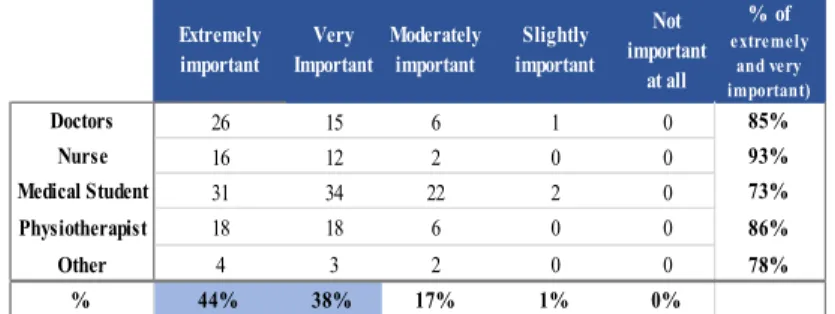
Therefore, prior to the presentation of the CGs concept, 82% (Table 15) of the respondents stated that they consider extremely or very important their patients undergoing a physical evaluation before start exercising. However, as per Table 16, 63% of the current health professionals are never or almost never consulted by patients to get advice from them before start exercising, with only 5% being consulted very often or always. These results are slightly skewed from what we found with consumers, where 82% said they never or rarely went to the Doctor before starting exercise. The reason for this deviation may be due to the fact that the target of this survey were health professionals who, at the outset, will be those whom patients will turn to if they want to have an opinion on whether or not they can do sport.
In order to validate if the CGs satisfy this need for prior consultation, after the concept was presented, 86% of current and future health professionals stated that this service was extremely or very advantageous for patients, assigning an average rate of 4.28 out of 5 in terms of the benefits that CGs can bring (Table 17). Moreover, Table 18 suggests that, besides the professionals’ sense of need for this service and for a pre-exercise appointment, 97% of them also consider regular follow-up appointments of utmost importance.
4.3.4. Appointment Simulation
Through the simulation with a PT and a Doctor, we wanted to test how an appointment would work in a real-life situation. Thus, two hypothetical situations were discussed: a patient with a herniated disk and a postpartum recovery.
In the first case, the PT highlighted the need to strengthen the abdominal muscles, especially the muscles of the torso, through exercises without weights that could damage the spine and swimming (backstroke). When faced with these recommendations, the Doctor agreed with the realization of exercises without associated weights, and that could affect the spine. However, she reinforced the lack of a “standard” exercise adequate for each pathology, and that each patient must be evaluated
24
in a case by case basis. Moreover, she also added that there were cases in which she would highly discourage any sort of exercise.
As per the postpartum recovery, the PT prescribed light and static abdominal exercises aimed at reconstructing the abdomen, a suggestion with which the Doctor agreed, as this is a more standard case.
In short, we felt that the PT seemed to adopt a more linear and straightforward perspective when dealing with these two hypothetical patients, promptly suggesting which exercises should be done. Inversely, the Doctor stressed the need to deeply understand the patient pathology and limitations, and that, at least in a first stage, her advice would be to cease doing exercise, until a more accurate diagnosis had been reached.
Although this experiment was nothing more than a simulation, in this brief exercise it was clear that there is the need to include both the Doctor and the PT when suggesting the exercises and designing the training plan. This is a consequence of the Doctor having a clearer view on the limitations of the patient, and the PT knowing which exercises should be performed to tackle the patient’s recuperation.
4.4. Interest
R.Q.2 – Are the stakeholders interested in CG? H2: Agents are interested in this service.
In the three surveys, the topic of interest was the most discussed, as, although we have concluded that this service is needed, the viability of this business opportunity is highly dependent on the interest it might generate. In fact, if there is no interest neither from consumers nor professionals, the service itself does not make sense.
4.4.1. End-Users
The most relevant source of interest shall be consumers, as they are the ones that drive demand for this service. Thus, in this section of the dissertation, we will have a broad view of respondents’ interest in CGs, and then, in R.Q.3, we will deeply analyze this topic.
25
To start, we concluded that the majority - 63% - of our sample seems at least very interested in CGs, having attributed 4 or 5 (out of 5) to this question, and only 12% of our sample demonstrated a lack of interest in this service, as per Table 19. Additionally, within those who showed higher interest, 73% stated that they would be enrolled in CGs if this service was already available in the market (Table 20), thus one would say that those respondents are the ones who are truly interested in CGs. As we can see in Table 21, within those that have more interest, 78% prefer to attend CGs in gym-like facilities, compared to 22% that would prefer to see this service being provided by a hospital. This is a topic that will be further developed in section 4.7 – Place.
In the previous section, before knowing the details of CGs, respondents were asked how interested they would be in having a Doctor tracking their training plan, where 75% of respondents answered positively (Table 1). However, interest in this feature grew after people got to know better the concept of CGs, since 81% of the respondents considered at least very important to have regular medical appointments, an increase of 6 p.p. (Table 22).
Regarding the features that CGs may have, Table 22 gives us an overview of which are the characteristics and complementary services that consumers value the most (by order of preference): price, regular medical appointments, nutritionist, location, an app where they can check PTs and Doctor’s reports, the equipment’s offered and classes and lastly extras, like pool, massages, among others.
Finally, looking at Table 23, we can see that people consider this service mainly as being innovative (52%), important (49%), safe (49%), trustworthy (38%) and supportive (38%).
The results attained by analyzing the first agent seem to show that the end-users are interested in this service. Moreover, the number of respondents that were interested in being tracked by a doctor also validate the same conclusion, being enhanced by the increase in interest in this feature after the concept of CGs was explained.
4.4.2. Sports related professionals
Moving forward to the professionals’ point of view, our main objective is to understand if PTs are willing to provide this service. Thus, an analysis regarding the age, gender, profession and their perception towards this service and their relationship with clients were done.
26
Taking a global perspective, according to Table 24, we can see that 65% of the professionals’ sample are willing to provide this service. Deep diving into our responses, we can see that both age and profession seem to influence the willingness to provide this service.
As we can see in Table 25, the older the respondents are, the higher their predisposition to accept working in CGs is, which can be explained by what was discussed in the focus group, where the PT said: “We gain experience over time, thus consequently as we get older we also get more
experienced. And the more experienced, the more comfortable we are to deal with pathologies and direct the train to health rather than fit”.
Although the interest seems independent of the profession, and the majority answered positively to their willingness to provide this service (Table 26) those that currently work as Personal Trainers are the ones that demonstrated most interest, which may be due to the fact that those should be the ones whose job will be less affected, as assisting traditional gym users only differs on the exercise restrictions imposed by clients’ health limitations, when compared to CGs users.
However, in what concerns gender, both genders show almost the same interest in providing their services in CGs (Table 27).
Summing up, through the analyses of this questions, we infer that our PTs shall probably be older (aged between 40 and 60) and, ideally, have past experience as PTs.
4.4.3. Current and Future Healthcare Professionals
Now, that we have seen that there are potential clients for CGs, and that PTs are willing to provide this service, we ought to verify if Doctors, or at least future Doctors, are interested on it.
As previously mentioned, we divided the employment occupations of our respondents in four groups: Doctors, nurses, physiotherapists and medical students. However, in order to answer this research question, our main focus will be Doctors, which are those that are the target to provide this service, because are those professionals that are more reliable to evaluate patients in what concerns their physical condition. Although medical students have not yet chosen their specialty and are not yet practicing, this group of people will represent future Doctors and as such their opinion is important, although they have an incomplete real-life knowledge regarding patient’s needs.
27
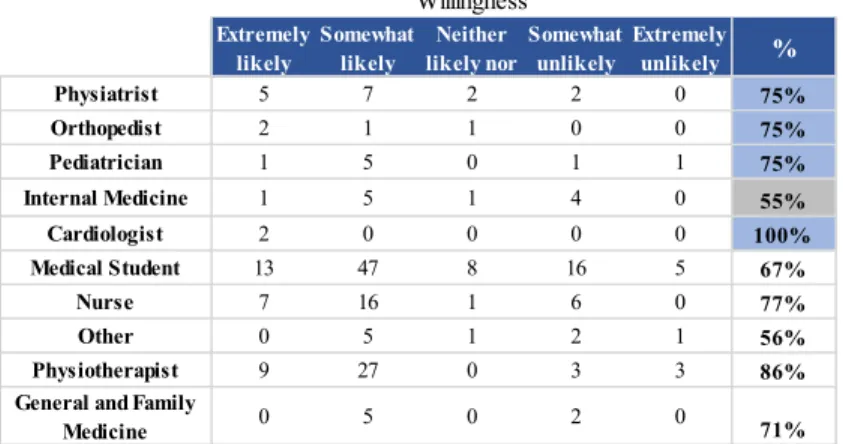
Having this said, through our survey we concluded that 71% of the Doctors and 67% of medical students are willing to provide this service (Table 28). Here, we considered important to make a separation between the specialties, mentioning that 100% of the cardiologists, and 75% of the physiatrists, orthopedists and pediatricians seemed at least very likely to work in CGs. The health professionals that show less interest in working on CGs are internal Doctors, since, as we can see in Table 29, 45% seems to be, indifferent or less in providing this service.
We also decided to emphasize the physiotherapists, since in the medium/long term it might make sense for them to also be part of this service, being responsible for monitoring more complex pathologies and requiring not only monitoring but also, and most importantly, treatment. Hence, we concluded that 86% of these professionals are available to work in partnership with CGs, as per Table 29.
Of the sample considered in this analysis, i.e., excluding Nurses and Others, 51% of Doctors and future Doctors who said they were unlikely or extremely unlikely to provide this service attributed at least 4 out of 5 to the importance of CGs for them as Doctors (Table 30). These results seem inconsistent, thus this was one of the topics discussed in the focus group. Unfortunately, we did not have any Doctor or future Doctor that identified with these results thus, we are not be able to explain this properly.
Then, we tried to understand if the place where Doctors work have impact on the willingness they show in providing this service and we concluded that people who work in private hospitals are the ones who seems most interested in being part of these multidisciplinary teams, as we can see in Table 31, since 90% of Doctors who work in the private sector are very interested in this service compared to 67% of those working in the public hospitals. This can be explained by the fact that private hospitals focus more on preventive medicine, as we saw in the first chapter of this dissertation, and thus these services and objectives are more familiar for the professionals who work there.
Lastly, we analyzed the impact that age and gender have on the willingness demonstrated by Doctors to work in CGs. In what regards the age, as we can see in Table 32, although the youngest are those that seem least likely to work in CGs, at least 70% of all ranges assumed to be interested in providing this service, which proves the validity and robustness of the interest of this stakeholder. A possible justification for the younger being more interested in engaging with CGs