EUROPEAN ORGANIZATION FOR NUCLEAR RESEARCH (CERN)
CERN-PH-EP/2012-336 2013/03/19
CMS-SMP-12-007
Measurement of the ZZ production cross section and search
for anomalous couplings in 2
`
2
`
0
final states in pp collisions
at
√
s
=
7 TeV
The CMS Collaboration
∗Abstract
A measurement is presented of the ZZ production cross section in the ZZ → 2`2`0
decay mode with` = e, µ and`0 = e, µ, τ in proton-proton collisions at√s = 7 TeV with the CMS experiment at the LHC. Results are based on data corresponding to an integrated luminosity of 5.0 fb−1. The measured cross section σ(pp → ZZ) =
6.24+−0.860.80(stat.)+−0.410.32(syst.)±0.14 (lumi.) pb is consistent with the standard model pre-dictions. The following limits on ZZZ and ZZγ anomalous trilinear gauge couplings are set at 95% confidence level: −0.011 < f4Z < 0.012, −0.012 < f5Z < 0.012,
−0.013< fγ
4 <0.015, and−0.014< f
γ
5 <0.014.
Submitted to the Journal of High Energy Physics
c
2013 CERN for the benefit of the CMS Collaboration. CC-BY-3.0 license
∗See Appendix A for the list of collaboration members
1
The study of diboson production in proton-proton collisions provides an important test of the standard model (SM). Many extensions of the SM predict new scalar, vector, or spin-2 particles that decay into a pair of W or Z bosons. In addition, these final states are sensitive to the self-interactions among the gauge bosons via trilinear gauge couplings (TGCs). These couplings are the direct consequence of the non-Abelian SU(2) ×U(1)gauge symmetry of the SM and are a necessary ingredient to construct renormalizable theories. The values of these couplings are fully determined in the SM by the gauge structure of the Lagrangian. Therefore, any devi-ation of the observed coupling strength from the SM prediction would indicate the presence of new physics. This deviation would be manifested as a change in the production cross section, especially for energetic heavy gauge bosons.
In the SM, ZZ production proceeds via the t- and u-channel qq scattering diagrams, and via gluon-gluon fusion. The presence of anomalous neutral trilinear couplings (ATGCs) would lead to a sizable enhancement of ZZ final states via s-channel qq scattering. A model featuring such couplings can be constructed by means of an effective Lagrangian [1]. In this parametriza-tion, two ZZZ couplings and two ZZγ couplings are allowed by electromagnetic gauge invari-ance and Lorentz invariinvari-ance for on-shell Z bosons. The couplings are parametrized by two CP-violating ( f4Z,γ) and two CP-conserving ( f5Z,γ) complex parameters, which are zero in the SM.
Measurements of the ZZ cross section were previously performed at the Tevatron [2, 3] and the Large Hadron Collider (LHC) [4, 5]. A first measurement of the ZZ cross section at center-of-mass energy√s = 7 TeV by the Compact Muon Solenoid (CMS) Collaboration in the decay mode ZZ →2`2`, where`is either e or µ, is presented in Ref. [4]. The measured cross section
σ(pp→ ZZ)B(ZZ → 2`2`) = 28.1+−4.64.0(stat.) ±1.2 (syst.)±1.3 (lumi.) fb agrees well with the
SM prediction of 27.9 ±1.9 fb. In this Letter, we present an extended measurement of the ZZ production cross section based on the decay mode 2`2`0, where`0is e, µ, or τ. If a τ is present in the final state, one Z is required to decay into e+e−or µ+µ−, and the second Z into τ+τ−in four
possible final states: τhτh, τeτh, τµτh, and τeτµ, where τhrepresents a τ decaying hadronically,
while τeand τµindicate taus decaying into an electron and a muon, respectively. The presence
of four leptons in the final state provides a clean signature with only a small contribution from background processes. The background sources include reducible contributions from Zbb and tt processes, where the final states contain two isolated leptons and two b jets with secondary leptons, and from Z+jets and ZW+jets processes where the jets are misidentified as leptons. In this Letter, we also present a search for the neutral ZZZ and ZZγ ATGCs. Previous studies on neutral ZZZ and ZZγ ATGCs were performed at LEP2 [6–10], the Tevatron [11], and the LHC [5]. The most restrictive limits were set in Ref. [5], −0.07 < f4,5Z < 0.07 and −0.08 <
fγ
4,5 < 0.08, with a data set corresponding to an integrated luminosity of 1 fb
−1of pp collisions
at√s =7 TeV.
The measurements presented here are based on data collected in 2010 and 2011 with the CMS experiment at the LHC at √s = 7 TeV, corresponding to an integrated luminosity of 5.0±
0.1 fb−1. A set of Monte Carlo (MC) event samples is used to simulate signal and background events. The ZZ production via qq is generated at next-to-leading order (NLO) with POWHEG
2.0 [12–14], while other diboson processes (WW, WZ, Zγ) are generated with PYTHIA 6.424
and MADGRAPH [15]. The gg → ZZ contribution is estimated using events generated with
the gg2ZZ code [16]. The Z+jets samples, namely Zbb , Zcc, and Z+light jets, are generated with MADGRAPH. The tt events are generated at NLO withPOWHEG. For leading-order gener-ators, the default set of parton distribution functions (PDFs) used to produce these samples is CTEQ6L [17], while CT10 [18] is used for NLO generators. Finally, for the modeling of
ATGCs, the SHERPA generator version 1.2.2 is used [19]. The τ-lepton decays are generated withTAUOLA[20]. All events are processed through a detailed simulation of the CMS detector based on GEANT4 [21] and reconstructed with the same algorithms as used for data.
A detailed description of the CMS detector can be found elsewhere [22]. The central feature of the CMS apparatus is a superconducting solenoid of 6 m internal diameter, providing a mag-netic field of 3.8 T. Within the field volume are the silicon pixel and strip tracker, the crystal electromagnetic calorimeter (ECAL), and the brass/scintillator hadron calorimeter (HCAL). Muons are measured in gas-ionization detectors embedded in the steel flux return yoke of the magnet. CMS uses a right-handed coordinate system, with the origin at the nominal interaction point, the x axis pointing to the center of the LHC ring, the y axis pointing up (perpendicular to the plane of the LHC ring), and the z axis along the counterclockwise-beam direction. The polar angle θ is measured from the positive z axis and the azimuthal angle φ is measured in the x-y plane. Variables used in this analysis include the pseudorapidity η = −ln[tan(θ/2)]
and the transverse momentum pT =
q p2
x+p2y. The ECAL is designed to have both
excel-lent energy resolution and high granularity, properties that are crucial for reconstructing elec-trons and photons produced in τ-lepton decays. The ECAL is constructed with projective lead tungstate crystals that provide coverage in pseudorapidity|η| < 1.48 in a barrel region and
1.48 < |η| < 3.00 in two endcap regions (EE). A preshower detector consisting of two planes
of silicon sensors interleaved with a total of 3X0 of lead is located in front of the EE. The
en-ergy resolution is 3% or better for the range of electron energies relevant for this analysis. The tracker measures charged particle tracks within the range|η| < 2.5. It consists of 1440 silicon
pixel and 15 148 silicon strip detector modules, and provides an impact parameter resolution of
∼15 µm and a transverse momentum resolution of about 1.5% for 100 GeV particles. The recon-structed tracks are used to measure the location of interaction vertices. The spatial resolution of the reconstruction in the transverse direction is∼25 µm for primary vertices with more than 30 associated tracks [23]. The barrel region of the muon system is instrumented with drift tubes, and the endcap regions with cathode strip chambers. In both regions, resistive-plate chambers provide additional coordinate and timing information. Muons are reconstructed in the range
|η| <2.4, with a typical pTresolution of∼1% for pT =40 GeV.
At the trigger level, the selected events are required to have either at least two electrons, one with pT >17 GeV and the other with pT >8 GeV, or at least two muons, one with pT>13 GeV
(pT > 17 GeV for high instantaneous luminosity data-taking periods) and the other with pT >
8 GeV.
Electrons are reconstructed within|ηe| < 2.5 and with peT > 7 GeV by combining information
from the ECAL and tracker [24, 25]. Electron identification requirements rely on the electro-magnetic shower shape and other observables based on tracker and calorimeter information. The selection criteria depend on peTand|ηe|, and on a categorization according to observables
that are sensitive to the amount of bremsstrahlung emitted along the trajectory in the tracker. Muons are reconstructed [26] within|ηµ| <2.4 and pµT>5 GeV with information from both the
tracker and the muon spectrometer. The track must have more than 10 out of up to 24 possible hits in the silicon tracker [23] to ensure a precise measurement of the momentum. The efficien-cies are measured in data, using a tag-and-probe technique [27] based on an inclusive sample of Z→ `+`−events. The measurements are performed in several ranges of p`
Tand|η`|. The
prod-uct of reconstrprod-uction and identification efficiencies for electrons in the ECAL barrel (endcaps) varies from about 68% (62%) for the peT range 7–10 GeV, to 82% (74%) at 10 < peT < 20 GeV, and reaches up to 90% (89%) at pe
T>20 GeV. The muons are reconstructed and identified with
3
Since the ZZ final state is expected to have only a small contribution from background pro-cesses, the algorithms are tuned to maximize the lepton-reconstruction efficiency, resulting in an increased lepton-misidentification rate. A particle-flow (PF) technique [28] is used for τh reconstruction. In the PF approach, information from all subdetectors is combined to recon-struct and identify particles produced in the collision. The particles are classified into mutually exclusive categories: charged hadrons, photons, neutral hadrons, muons, and electrons. These particles are used to reconstruct the τh candidates with the “hadron plus strip” (HPS)
algo-rithm [29], which is designed to optimize the performance of τh identification and
reconstruc-tion by considering specific τh decay modes. The neutrinos produced in all τ decays escape
detection and are ignored in the τhreconstruction. The algorithm provides high τh
identifica-tion efficiency, approximately 50% for the range of τhenergies relevant for this analysis, while
keeping the misidentification rate for jets at the level of 1%.
Events are required to have at least one Z → `+`− candidate, denoted by Z
1. The invariant
mass of the reconstructed Z1is required to be 60<m``<120 GeV. The two leptons must have
opposite charges, one with pT >20 GeV and the other with pT >10 GeV, and with|η| <2.5 for
the electrons and|η| <2.4 for the muons. If more than one candidate is found, the one with
the mass closest to the Z mass is considered as Z1.
Lepton isolation requirements depend on the ZZ decay mode. For the final states with only electrons and muons, the isolation criteria are based on a combination of the tracker, ECAL, and HCAL information. The standard combined relative isolation is defined as
Irelstd =
∑
i piT, track+max(∑
j ET, ECALj +∑
k ET, HCALk −π·∆R2max·ρ; 0) ! /p`T,with the sums running over the charged tracks and the energy deposits in the ECAL and HCAL within a cone around the lepton direction defined by ∆R < ∆Rmax = 0.3, where
∆R= p(∆η)2+ (∆φ)2, and E
Tstands for the transverse energy. The neutral isolation is made
largely independent of the pileup of pp collisions by correcting for the average energy density,
ρ, calculated in each event using a “jet area” technique [30] and defined as the median of the
en-ergy distribution for the neutral particles around all jets. The isolation variable Istd
rel is required
to be less than 0.275 for each lepton. The significance of the impact parameter of each lepton relative to the event vertex (S3D) is required to satisfy|S3D| <4. The primary vertex is chosen
as the vertex with the highest sum of p2Tof its constituent tracks.
In the 2`2τ final states, instead of standard isolation, the leptons from the Z1 are required to
have a combined PF relative isolation IrelPF < 0.25. The IrelPF is defined similarly to Irelstd, however in this case the sums run over charged hadrons, photons, and neutral hadrons, all measured in the isolation cone of∆R<0.4 around the lepton direction.
The selection requirements for the second Z, denoted by Z2, also depend on the final state. In
the final states with electrons and muons only, the isolation requirements are the same as for the leptons from Z1, but pT > 7 GeV and pT > 5 GeV are required for electrons and muons,
respectively. If the final state is τeτµ, the lepton pT values are required to exceed 10 GeV. The
remaining criteria are identical to those for Z1. Since hadronically decaying τ leptons have
much larger misidentification rates than the other leptons, the isolation requirement based on IPF
rel for the electrons and muons in the final states τeτh and τµτh is changed to 0.15 and 0.1,
respectively. A study of inclusive Z → τ+τ− production [31] demonstrated that modifying
the electron and muon isolation requirements is a more effective way to reduce background in such final states than requiring tighter isolation on τh. The τ leptons are required to have
pT > 20 GeV and|η| < 2.3, and to satisfy the requirements of a loose HPS working point. If
the Z2 decays to τh+τh−, both τhare required to satisfy the requirements of a medium working
point of the HPS algorithm. The loose (medium) working point requires the scalar sum of the pT of the charged hadrons and ET of the neutral hadrons within the isolation cone to be
less than 2 GeV (1 GeV). The loose (medium) working point corresponds to a probability of approximately 1% (0.5%) for jets to be misidentified as τh. Using the medium instead of loose
working point leads to a decrease in the τhreconstruction efficiency from≈50% to≈40%.
The invariant mass of the reconstructed Z2 is required to satisfy 60 < m`` < 120 GeV, when
Z2decays into e+e− or µ+µ−. In the 2`2τ final states, the visible invariant mass of the
recon-structed Z2 → τ+τ− is required to satisfy 30 < mvisττ < 80 GeV. The upper bound reduces
contributions from Z2 → `+`−, where an electron or a muon is not well reconstructed and is
misidentified as a τh. For the Z2 → τeτµ final state, the upper bound on mττ is increased to
90 GeV, as this state is not produced in Z2 → `+`− decays. In the final states involving τh,
leptons from the same Z are required to be separated by∆R>0.4 for the Z1, and by∆R>0.5
for the Z2.
The major contributions to the background are due to Z production in association with jets, WZ production in association with jets, and tt. In all of these cases, a jet or nonisolated lepton is misidentified as an isolated electron, muon, or τh. The relative contribution of each source of background depends on the final state.
The background estimate is performed in two steps. Firstly, the rate for loosely isolated objects to be misidentified as isolated ones is measured in a control region that does not contain any signal contribution. The misidentification rate is estimated with events in which the Z1passes
all selection requirements, and which contain an additional probe electron, muon, or τh. No
isolation requirement is applied to the probe. The misidentification rate is defined as the ratio of the number of probe candidates that pass the isolation requirements to the initial number of probe candidates, and is measured as a function of pTand η for each lepton flavor.
The second step is to estimate the number of background events in the signal region. The mea-sured misidentification rate is applied to events that pass all selection requirements, including the opposite-charge requirement for the Z2, but requiring the candidates to not be isolated.
Theoretical uncertainties on the ZZ → 2`2`0 acceptance are evaluated using MCFM 6.2 [32],
varying QCD scales up and down by a factor of two with respect to the default factorization (µF) and renormalization (µR) scales µF =µR = mZ, where mZis the mass of the Z boson. The
variations in the acceptance are 0.1% (qq → ZZ) and 0.4% (gg → ZZ) and can be neglected. The uncertainties related to the PDFs are evaluated following the PDF4LHC prescription [33]. Using the CT10 [18], MSTW08 [34], and NNPDF [35] sets, the uncertainties are estimated to be 4% for qq→ZZ and and 5% for gg→ZZ processes.
The uncertainties on Z+jets, WZ+jets, and tt backgrounds reflect the uncertainties on the mea-sured values of the misidentication rates and the limited quantity of data in the control regions in the data and amount to 30–50% depending on the decay channel. The uncertainty on the integrated luminosity is 2.2% [36]. Systematic uncertainties on trigger efficiency (1.5%), lepton identification efficiency, and lepton isolation are evaluated from data. The uncertainties asso-ciated with lepton identification and isolation are 1–2% for muons and electrons, and 6–7% for
τh. Uncertainties on energy scales, 3% for τhand 1–2.5% for electrons, contribute to variations
in the shape of the mass spectrum.
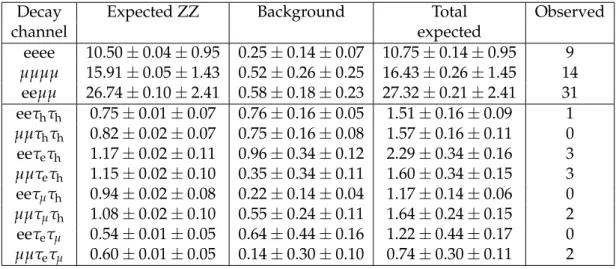
Table 1 presents the number of observed events in the signal region in each channel, as well as the expected number of signal events and the estimated number of background events. We
ob-5
Table 1: The expected yield of ZZ events obtained from simulation and the estimated yield of background events obtained from data, as described in the text, are shown for each decay channel and are summed in the total expected yield (“Total expected”). They are compared to the number of events observed in the signal region. The first uncertainty is statistical while the second one is systematic.
Decay Expected ZZ Background Total Observed
channel expected eeee 10.50±0.04±0.95 0.25±0.14±0.07 10.75±0.14±0.95 9 µµµµ 15.91±0.05±1.43 0.52±0.26±0.25 16.43±0.26±1.45 14 eeµµ 26.74±0.10±2.41 0.58±0.18±0.23 27.32±0.21±2.41 31 eeτhτh 0.75±0.01±0.07 0.76±0.16±0.05 1.51±0.16±0.09 1 µµτhτh 0.82±0.02±0.07 0.75±0.16±0.08 1.57±0.16±0.11 0 eeτeτh 1.17±0.02±0.11 0.96±0.34±0.12 2.29±0.34±0.16 3 µµτeτh 1.15±0.02±0.10 0.35±0.34±0.11 1.60±0.34±0.15 3 eeτµτh 0.94±0.02±0.08 0.22±0.14±0.04 1.17±0.14±0.06 0 µµτµτh 1.08±0.02±0.10 0.55±0.24±0.11 1.64±0.24±0.15 2 eeτeτµ 0.54±0.01±0.05 0.64±0.44±0.16 1.22±0.44±0.17 0 µµτeτµ 0.60±0.01±0.05 0.14±0.30±0.10 0.74±0.30±0.11 2
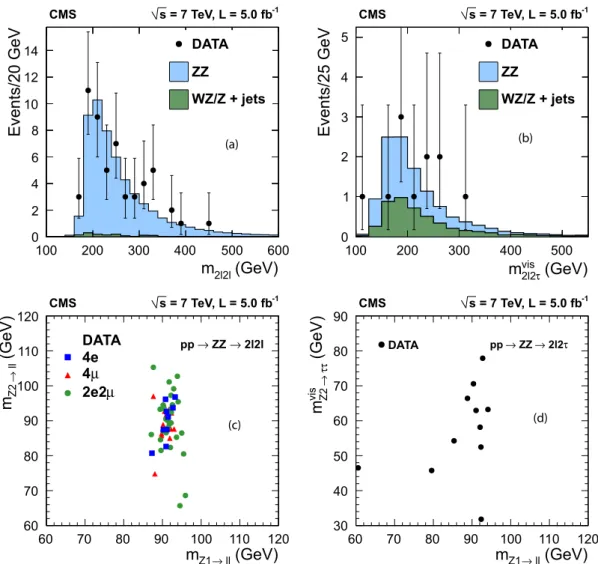
serve a total of 54 candidate events in the 4e, 4µ, and 2e2µ channels, compared to the SM expec-tation of 54.5±0.3 (stat.)±4.8 (syst.) events, which includes 1.4 from background processes. In the 2`2τ channels, 11 candidate events are observed, compared to 11.7±0.8 (stat.)±1.0 (syst.) events expected, including 4.4 from background processes. The reconstructed four-lepton in-variant mass distributions are compared to the SM expectations in Figs. 1 (a) and (b) for the sum of the 4e, 4µ, and 2e2µ channels, and the sum of all the 2`2τ channels. The shapes of the signal and background are taken from the MC simulation, with each component normalized to the corresponding estimated value from Table 1. The reconstructed masses in 2`2τ states (mvis2`2τ) are shifted downwards with respect to the generated Z masses by about 30% due to the undetected neutrinos in τ decays. Figures 1 (c) and (d) demonstrate the relationship between the reconstructed Z1and Z2masses.
To include all the final states in the calculation of the cross section, a simultaneous fit to the numbers of observed events in all the decay channels is performed. The fit is constrained by the requirement that all the measurements come from the same initial state via different de-cay modes. It allows for combining many dede-cay modes with either very few or no events observed. The joint likelihood is a combination of the likelihoods for the individual channels, which include the signal and background hypotheses. Each τ-lepton decay mode is treated as a separate channel because they are mutually exclusive owing to the methodology adopted for event reconstruction and subsequent event selection. The statistical and systematic uncertain-ties are introduced in the form of nuisance parameters via log-normal distributions around the estimated central values.
The resulting cross section is measured to be
σ(pp→ZZ) =6.24−+0.860.80(stat.)+−0.410.32(syst.)±0.14 (lumi.) pb.
This result is to be compared to the theoretical value of 6.3±0.4 pb calculated with MCFM at NLO for qq →ZZ and LO for gg →ZZ with the MSTW08 PDFs and for both Z bosons in the mass range 60 < MZ < 120 GeV. This is the most precise published pp → ZZ cross section
(GeV) 2l2l m 100 200 300 400 500 600 Events/20 GeV 0 2 4 6 8 10 12 14 DATA ZZ WZ/Z + jets -1 = 7 TeV, L = 5.0 fb s CMS (a) (GeV) vis τ 2l2 m 100 200 300 400 500 Events/25 GeV 0 1 2 3 4 5 DATA ZZ WZ/Z + jets -1 = 7 TeV, L = 5.0 fb s CMS (b) (GeV) ll → Z1 m 60 70 80 90 100 110 120 (GeV) ll → Z2 m 60 70 80 90 100 110 120 DATA 4e µ 4 µ 2e2 2l2l → ZZ → pp -1 = 7 TeV, L = 5.0 fb s CMS (c) (GeV) ll → Z1 m 60 70 80 90 100 110 120 (GeV) vis ττ → Z2 m 30 40 50 60 70 80 90 DATA pp→ ZZ → 2l2τ -1 = 7 TeV, L = 5.0 fb s CMS (d)
Figure 1: Distributions of the four-lepton reconstructed mass for (a) the sum of the 4e, 4µ, and 2e2µ channels and (b) the sum of the 2`2τ channels. Points represent the data, and the shaded histograms represent the expected ZZ signal and the reducible background. The shapes of the signal and background are taken from the MC simulation, with each component normalized to the corresponding estimated value from Table 1. The distributions (c) and (d) demonstrate the relationship between the reconstructed Z1and Z2masses.
7
include final states with hadronically decaying τ leptons.
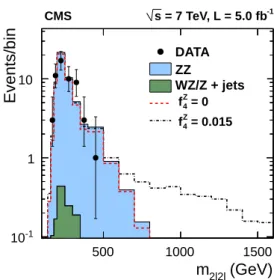
(GeV) 2l2l m 500 1000 1500 Events/bin -1 10 1 10 DATA ZZ WZ/Z + jets -1 = 7 TeV, L = 5.0 fb s CMS = 0 Z 4 f = 0.015 Z 4 f
Figure 2: Distribution of the four-lepton reconstructed mass for the sum of the 4e, 4µ, and the 2e2µ channels. Points represent the data, and the shaded histograms represent the expected ZZ signal and the reducible background. The dashed and dotted histograms represent the results of the SHERPA simulation for the SM ( f4Z = 0) and in the presence of an ATGC ( f4Z = 0.015), while all the other anomalous couplings are set to zero.
The limits on ATGCs are calculated with the modified frequentist construction CLs [37–39]
based on the shape of the four-lepton invariant mass distributions, including the 4e, 4µ, and 2e2µ channels in the likelihood combination. Figure 2 presents the distribution of the four-lepton reconstructed mass for the sum of the 4e, 4µ, and 2e2µ channels. The dashed and dotted histograms represent the results of the SHERPA simulation for the SM ( f4Z = 0) and in the presence of an ATGC ( f4Z=0.015), while all the other anomalous couplings are set to zero. The presence of ATGCs would be manifested in an increased yield of events at high four-lepton masses. The invariant mass distributions are interpolated fromSHERPAsimulation for different
values of the anomalous couplings. For each distribution only one or two couplings are varied, while all others are set to zero. The fit is performed to find the maximum likelihood value and limits are calculated. To avoid unitarity violation at energies above the scaleΛ of new physics, the ATGCs are often modified with a form-factor parametrization of the type 1/(1+ˆs/Λ2)2, where√ˆs≈m2`2`is the effective center-of-mass energy of the collision. However, no unitarity
violations occur in the sensitive region m2`2` . 1.5 TeV for bare anomalous couplings of order
0.05 or smaller [40], so we calculate the limits without form-factor scaling. This choice has the advantage of avoiding any bias from energy-dependence assumptions and is exact in the limit in which the scale of new physics is much larger than√ˆs.
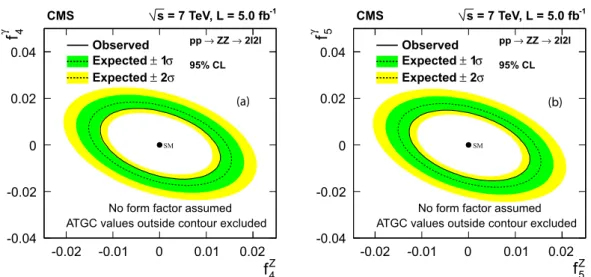
Figure 3 presents the expected and observed two-dimensional exclusion limits at 95% confi-dence level (CL) on the anomalous neutral trilinear ZZZ and ZZγ couplings. The green and yellow bands represent the one and two standard-deviation variations from the expected limit. The present limits are dominated by statistical uncertainties. Systematic uncertainties arising from the uncertainty on the theoretical cross section, PDFs, detector efficiencies, and luminosity are introduced in the form of nuisance parameters with log-normal probability density func-tions. One-dimensional 95% CL limits for the f4Z,γ and f5Z,γ anomalous coupling parameters are measured to be
Z 4 f -0.02 -0.01 0 0.01 0.02 γ f 4 -0.04 -0.02 0 0.02 0.04 SM
No form factor assumed ATGC values outside contour excluded
Observed σ 1 ± Expected σ 2 ± Expected 2l2l → ZZ → pp 95% CL -1 = 7 TeV, L = 5.0 fb s CMS (a) Z 5 f -0.02 -0.01 0 0.01 0.02 γ f5 -0.04 -0.02 0 0.02 0.04 SM
No form factor assumed ATGC values outside contour excluded
Observed σ 1 ± Expected σ 2 ± Expected 2l2l → ZZ → pp 95% CL -1 = 7 TeV, L = 5.0 fb s CMS (b)
Figure 3: Expected and observed two-dimensional exclusion limits at 95% CL on the anomalous neutral trilinear ZZZ ( fZ
4,5) and ZZγ ( f
γ
4,5) couplings. The green and yellow bands represent the
one and two standard-deviation variations from the expected limit. In calculating the limits, the anomalous couplings that are not shown in the figure are set to zero.
−0.011< f4Z <0.012,−0.012< f5Z<0.012, −0.013< fγ
4 <0.015, −0.014< f
γ
5 <0.014.
In the one-dimensional fits, all of the ATGC parameters except the one under study are kept fixed to zero. These values extend previous results on vector boson self-interactions and are currently the most stringent limits established for ZZZ and ZZγ couplings.
In summary, we have presented an updated measurement of the ZZ production cross section in proton-proton collisions at 7 TeV in the ZZ → 2`2`0 decay mode, with` = e, µ and `0 =
e, µ, τ. The data sample corresponds to an integrated luminosity of 5.0 fb−1. The measured cross section σ(pp→ZZ) =6.24−+0.860.80(stat.)+−0.410.32(syst.)±0.14 (lumi.) pb is consistent with the SM prediction and is the most precise published pp→ ZZ cross section measurement to date. For the first time the pp → ZZ → 2`2` measurements are extended to include final states with hadronically decaying τ leptons. Limits on vector-boson self-interactions are established, significantly restricting anomalous ZZZ and ZZγ trilinear gauge couplings.
We congratulate our colleagues in the CERN accelerator departments for the excellent perfor-mance of the LHC and thank the technical and administrative staffs at CERN and at other CMS institutes for their contributions to the success of the CMS effort. In addition, we gratefully ac-knowledge the computing centers and personnel of the Worldwide LHC Computing Grid for delivering so effectively the computing infrastructure essential to our analyses. Finally, we ac-knowledge the enduring support for the construction and operation of the LHC and the CMS detector provided by the following funding agencies: BMWF and FWF (Austria); FNRS and FWO (Belgium); CNPq, CAPES, FAPERJ, and FAPESP (Brazil); MEYS (Bulgaria); CERN; CAS, MoST, and NSFC (China); COLCIENCIAS (Colombia); MSES (Croatia); RPF (Cyprus); MoER, SF0690030s09 and ERDF (Estonia); Academy of Finland, MEC, and HIP (Finland); CEA and CNRS/IN2P3 (France); BMBF, DFG, and HGF (Germany); GSRT (Greece); OTKA and NKTH (Hungary); DAE and DST (India); IPM (Iran); SFI (Ireland); INFN (Italy); NRF and WCU (Re-public of Korea); LAS (Lithuania); CINVESTAV, CONACYT, SEP, and UASLP-FAI (Mexico);
References 9
MSI (New Zealand); PAEC (Pakistan); MSHE and NSC (Poland); FCT (Portugal); JINR (Arme-nia, Belarus, Georgia, Ukraine, Uzbekistan); MON, RosAtom, RAS and RFBR (Russia); MSTD (Serbia); SEIDI and CPAN (Spain); Swiss Funding Agencies (Switzerland); NSC (Taipei); ThEP-Center, IPST and NSTDA (Thailand); TUBITAK and TAEK (Turkey); NASU (Ukraine); STFC (United Kingdom); DOE and NSF (USA).
References
[1] K. Hagiwara et al., “Probing the weak boson sector in e+e−→W+W−”, Nucl. Phys. B
282(1987) 253, doi:10.1016/0550-3213(87)90685-7.
[2] CDF Collaboration, “Measurement of ZZ production in leptonic final states at√s of 1.96 TeV at CDF”, Phys. Rev. Lett. 108 (2012) 101801,
doi:10.1103/PhysRevLett.108.101801, arXiv:1112.2978.
[3] D0 Collaboration, “Measurement of the ZZ production cross section in p ¯p collisions at√ s =1.96 TeV”, Phys. Rev. D 84 (2011) 011103, doi:10.1103/PhysRevD.84.011103, arXiv:1104.3078.
[4] CMS Collaboration, “Search for the standard model Higgs boson in the decay channel H→ZZ→4l in pp collisions at√s=7 TeV”, Phys. Rev. Lett. 108 (2012) 111804,
doi:10.1103/PhysRevLett.108.111804, arXiv:1202.1997.
[5] ATLAS Collaboration, “Measurement of the ZZ production cross section and limits on anomalous neutral triple gauge couplings in proton-proton collisions at√s=7 TeV with the ATLAS detector”, Phys. Rev. Lett. 108 (2012) 041804,
doi:10.1103/PhysRevLett.108.041804, arXiv:1110.5016.
[6] ALEPH Collaboration, “Measurement of Z-pair production in e+e−collisions and constraints on anomalous neutral gauge couplings”, JHEP 04 (2009) 124,
doi:10.1088/1126-6708/2009/04/124.
[7] DELPHI Collaboration, “Study of triple-gauge-boson couplings ZZZ, ZZγ and Zγγ at LEP”, Eur. Phys. J. C 51 (2007) 525, doi:10.1140/epjc/s10052-007-0345-0, arXiv:0706.2741.
[8] LEP Electroweak Working Group, “A combination of preliminary electroweak measurements and constraints on the standard model”, (2006).
arXiv:hep-ex/0612034.
[9] OPAL Collaboration, “Study of Z pair production and anomalous couplings in e+e− collisions at√s between 190 GeV and 209 GeV”, Eur. Phys. J. C 32 (2003) 303,
doi:10.1140/epjc/s2003-01467-x, arXiv:hep-ex/0310013.
[10] L3 Collaboration, “Study of anomalous ZZγ and Zγγ couplings at LEP”, Phys. Lett. B
436(1998) 187, doi:10.1016/S0370-2693(98)00883-1.
[11] D0 Collaboration, “Search for ZZ and Zγ∗production in p ¯p collisions at√s=1.96 TeV and limits on anomalous ZZZ and ZZγ∗couplings”, Phys. Rev. Lett. 100 (2008) 131801, doi:10.1103/PhysRevLett.100.131801, arXiv:0712.0599.
[12] S. Alioli et al., “NLO vector-boson production matched with shower in POWHEG”, JHEP 07 (2008) 060, doi:10.1088/1126-6708/2008/07/060, arXiv:0805.4802.
[13] P. Nason, “A new method for combining NLO QCD with shower Monte Carlo algorithms”, JHEP 11 (2004) 040, doi:10.1088/1126-6708/2004/11/040, arXiv:hep-ph/0409146.
[14] S. Frixione, P. Nason, and C. Oleari, “Matching NLO QCD computations with Parton Shower simulations: the POWHEG method”, JHEP 11 (2007) 070,
doi:10.1088/1126-6708/2007/11/070, arXiv:0709.2092. [15] J. Alwall et al., “MadGraph 5: going beyond”, JHEP 06 (2011) 128,
doi:10.1007/JHEP06(2011)128, arXiv:1106.0522.
[16] T. Binoth, N. Kauer, and P. Mertsch, “Gluon-induced QCD corrections to pp→ZZ→ ```¯ 0`¯0”, (2008). arXiv:0807.0024.
[17] H.-L. Lai et al., “Uncertainty induced by QCD coupling in the CTEQ global analysis of parton distributions”, Phys. Rev. D 82 (2010) 054021,
doi:10.1103/PhysRevD.82.054021, arXiv:1004.4624.
[18] H.-L. Lai et al., “New parton distributions for collider physics”, Phys. Rev. D 82 (2010) 074024, doi:10.1103/PhysRevD.82.074024, arXiv:1007.2241.
[19] T. Gleisberg et al., “Event generation withSHERPA1.1”, JHEP 02 (2009) 007, doi:10.1088/1126-6708/2009/02/007, arXiv:0811.4622.
[20] S. Jadach et al., “The tau decay library TAUOLA: Version 2.4”, Comput. Phys. Commun.
76(1993) 361, doi:10.1016/0010-4655(93)90061-G.
[21] GEANT4 Collaboration, “GEANT4–a simulation toolkit”, Nucl. Instrum. Meth. A 506 (2003) 250, doi:10.1016/S0168-9002(03)01368-8.
[22] CMS Collaboration, “The CMS experiment at the CERN LHC”, JINST 03 (2008) S08004, doi:10.1088/1748-0221/3/08/S08004.
[23] CMS Collaboration, “CMS Tracking Performance Results from early LHC Operation”, Eur. Phys. J. C 70 (2010) 1165, doi:10.1140/epjc/s10052-010-1491-3,
arXiv:1007.1988.
[24] S. Baffioni et al., “Electron reconstruction in CMS”, Eur. Phys. J. C 49 (2007) 1099, doi:10.1140/epjc/s10052-006-0175-5.
[25] CMS Collaboration, “Electron Reconstruction and Identification at√s=7 TeV”, CMS Physics Analysis Summary CMS-PAS-EGM-10-004, (2010).
[26] CMS Collaboration, “Performance of CMS muon reconstruction in pp collision events at√ s =7 TeV”, JINST 7 (2012) P10002, doi:10.1088/1748-0221/7/10/P10002, arXiv:1206.4071.
[27] CMS Collaboration, “Measurement of the Inclusive W and Z Production Cross Sections in pp Collisions at√s=7 TeV”, JHEP 10 (2011) 132,
doi:10.1007/JHEP10(2011)132, arXiv:1107.4789.
[28] CMS Collaboration, “Particle–Flow Event Reconstruction in CMS and Performance for Jets, Taus, and EmissT ”, CMS Physics Analysis Summary CMS-PAS-PFT-09-001, (2009).
References 11
[29] CMS Collaboration, “Performance of tau-lepton reconstruction and identification in CMS”, JINST 7 (2012) P01001, doi:10.1088/1748-0221/7/01/P01001, arXiv:1109.6034.
[30] M. Cacciari and G. Salam, “Pileup substruction using jets”, Phys. Lett. B 659 (2008) 119, doi:10.1016/j.physletb.2007.09.077, arXiv:0707.1378.
[31] CMS Collaboration, “Measurement of the Inclusive Z Cross Section via Decays to Tau Pairs in pp Collisions at√s =7 TeV”, JHEP 08 (2011) 117,
doi:10.1007/JHEP08(2011)117, arXiv:1104.1617.
[32] J. M. Campbell and R. K. Ellis, “MCFM for the Tevatron and the LHC”, Nucl. Phys. Proc. Suppl. 205 (2010) 10, doi:10.1016/j.nuclphysbps.2010.08.011,
arXiv:1007.3492.
[33] M. Botje et al., “The PDF4LHC Working Group Interim Recommendations”, (2011). arXiv:1101.0538.
[34] A. D. Martin et al., “Parton distributions for the LHC”, Eur. Phys. J. C 63 (2009) 189, doi:10.1140/epjc/s10052-009-1072-5, arXiv:0901.0002.
[35] D. R. Ball et al., “Impact of Heavy Quark Masses on Parton Distributions and LHC Phenomenology”, Nucl. Phys. B 849 (2011) 296,
doi:10.1016/j.nuclphysb.2011.03.021, arXiv:1101.1300.
[36] CMS Collaboration, “Absolute Calibration of the Luminosity Measurement at CMS: Winter 2012 Update”, CMS Physics Analysis Summary CMS-PAS-SMP-12-008, (2012). [37] T. Junk, “Confidence level computation for combining searches with small statistics”,
Nucl. Instrum. Meth. A 434 (1999) 435, doi:10.1016/S0168-9002(99)00498-2, arXiv:hep-ex/9902006.
[38] A. L. Read, “Presentation of search results: the CLstechnique”, J. Phys. G 28 (2002) 2693,
doi:10.1088/0954-3899/28/10/313.
[39] ATLAS and CMS Collaborations, “Procedure for the LHC Higgs boson search
combination in summer 2011”, ATL-PHYS-PUB-2011-011, CMS NOTE-2011/005, (2011). [40] M. Zralek and P. Khristova, “Composite Z boson in the e+e−→ZZ process”, Acta Phys.
13
A
The CMS Collaboration
Yerevan Physics Institute, Yerevan, Armenia
S. Chatrchyan, V. Khachatryan, A.M. Sirunyan, A. Tumasyan
Institut f ¨ur Hochenergiephysik der OeAW, Wien, Austria
W. Adam, E. Aguilo, T. Bergauer, M. Dragicevic, J. Er ¨o, C. Fabjan1, M. Friedl, R. Fr ¨uhwirth1, V.M. Ghete, J. Hammer, N. H ¨ormann, J. Hrubec, M. Jeitler1, W. Kiesenhofer, V. Kn ¨unz, M. Krammer1, I. Kr¨atschmer, D. Liko, I. Mikulec, M. Pernicka†, B. Rahbaran, C. Rohringer,
H. Rohringer, R. Sch ¨ofbeck, J. Strauss, A. Taurok, W. Waltenberger, G. Walzel, E. Widl, C.-E. Wulz1
National Centre for Particle and High Energy Physics, Minsk, Belarus
V. Mossolov, N. Shumeiko, J. Suarez Gonzalez
Universiteit Antwerpen, Antwerpen, Belgium
M. Bansal, S. Bansal, T. Cornelis, E.A. De Wolf, X. Janssen, S. Luyckx, L. Mucibello, S. Ochesanu, B. Roland, R. Rougny, M. Selvaggi, Z. Staykova, H. Van Haevermaet, P. Van Mechelen, N. Van Remortel, A. Van Spilbeeck
Vrije Universiteit Brussel, Brussel, Belgium
F. Blekman, S. Blyweert, J. D’Hondt, R. Gonzalez Suarez, A. Kalogeropoulos, M. Maes, A. Olbrechts, W. Van Doninck, P. Van Mulders, G.P. Van Onsem, I. Villella
Universit´e Libre de Bruxelles, Bruxelles, Belgium
B. Clerbaux, G. De Lentdecker, V. Dero, A.P.R. Gay, T. Hreus, A. L´eonard, P.E. Marage, A. Mohammadi, T. Reis, L. Thomas, G. Vander Marcken, C. Vander Velde, P. Vanlaer, J. Wang
Ghent University, Ghent, Belgium
V. Adler, K. Beernaert, A. Cimmino, S. Costantini, G. Garcia, M. Grunewald, B. Klein, J. Lellouch, A. Marinov, J. Mccartin, A.A. Ocampo Rios, D. Ryckbosch, N. Strobbe, F. Thyssen, M. Tytgat, S. Walsh, E. Yazgan, N. Zaganidis
Universit´e Catholique de Louvain, Louvain-la-Neuve, Belgium
S. Basegmez, G. Bruno, R. Castello, L. Ceard, C. Delaere, T. du Pree, D. Favart, L. Forthomme, A. Giammanco2, J. Hollar, V. Lemaitre, J. Liao, O. Militaru, C. Nuttens, D. Pagano, A. Pin, K. Piotrzkowski, N. Schul, J.M. Vizan Garcia
Universit´e de Mons, Mons, Belgium
N. Beliy, T. Caebergs, E. Daubie, G.H. Hammad
Centro Brasileiro de Pesquisas Fisicas, Rio de Janeiro, Brazil
G.A. Alves, M. Correa Martins Junior, T. Martins, M.E. Pol, M.H.G. Souza
Universidade do Estado do Rio de Janeiro, Rio de Janeiro, Brazil
W.L. Ald´a J ´unior, W. Carvalho, A. Cust ´odio, E.M. Da Costa, D. De Jesus Damiao, C. De Oliveira Martins, S. Fonseca De Souza, D. Matos Figueiredo, L. Mundim, H. Nogima, W.L. Prado Da Silva, A. Santoro, L. Soares Jorge, A. Sznajder, A. Vilela Pereira
Instituto de Fisica Teoricaa, Universidade Estadual Paulistab, Sao Paulo, Brazil
T.S. Anjosb,3, C.A. Bernardesb,3, F.A. Diasa,4, T.R. Fernandez Perez Tomeia, E.M. Gregoresb,3, C. Laganaa, F. Marinhoa, P.G. Mercadanteb,3, S.F. Novaesa, Sandra S. Padulaa
Institute for Nuclear Research and Nuclear Energy, Sofia, Bulgaria
V. Genchev5, P. Iaydjiev5, S. Piperov, M. Rodozov, S. Stoykova, G. Sultanov, V. Tcholakov,
University of Sofia, Sofia, Bulgaria
A. Dimitrov, R. Hadjiiska, V. Kozhuharov, L. Litov, B. Pavlov, P. Petkov
Institute of High Energy Physics, Beijing, China
J.G. Bian, G.M. Chen, H.S. Chen, C.H. Jiang, D. Liang, S. Liang, X. Meng, J. Tao, J. Wang, X. Wang, Z. Wang, H. Xiao, M. Xu, J. Zang, Z. Zhang
State Key Lab. of Nucl. Phys. and Tech., Peking University, Beijing, China
C. Asawatangtrakuldee, Y. Ban, Y. Guo, W. Li, S. Liu, Y. Mao, S.J. Qian, H. Teng, D. Wang, L. Zhang, W. Zou
Universidad de Los Andes, Bogota, Colombia
C. Avila, J.P. Gomez, B. Gomez Moreno, A.F. Osorio Oliveros, J.C. Sanabria
Technical University of Split, Split, Croatia
N. Godinovic, D. Lelas, R. Plestina6, D. Polic, I. Puljak5
University of Split, Split, Croatia
Z. Antunovic, M. Kovac
Institute Rudjer Boskovic, Zagreb, Croatia
V. Brigljevic, S. Duric, K. Kadija, J. Luetic, S. Morovic
University of Cyprus, Nicosia, Cyprus
A. Attikis, M. Galanti, G. Mavromanolakis, J. Mousa, C. Nicolaou, F. Ptochos, P.A. Razis
Charles University, Prague, Czech Republic
M. Finger, M. Finger Jr.
Academy of Scientific Research and Technology of the Arab Republic of Egypt, Egyptian Network of High Energy Physics, Cairo, Egypt
Y. Assran7, S. Elgammal8, A. Ellithi Kamel9, M.A. Mahmoud10, A. Radi11,12
National Institute of Chemical Physics and Biophysics, Tallinn, Estonia
M. Kadastik, M. M ¨untel, M. Raidal, L. Rebane, A. Tiko
Department of Physics, University of Helsinki, Helsinki, Finland
P. Eerola, G. Fedi, M. Voutilainen
Helsinki Institute of Physics, Helsinki, Finland
J. H¨ark ¨onen, A. Heikkinen, V. Karim¨aki, R. Kinnunen, M.J. Kortelainen, T. Lamp´en, K. Lassila-Perini, S. Lehti, T. Lind´en, P. Luukka, T. M¨aenp¨a¨a, T. Peltola, E. Tuominen, J. Tuominiemi, E. Tuovinen, D. Ungaro, L. Wendland
Lappeenranta University of Technology, Lappeenranta, Finland
K. Banzuzi, A. Karjalainen, A. Korpela, T. Tuuva
DSM/IRFU, CEA/Saclay, Gif-sur-Yvette, France
M. Besancon, S. Choudhury, M. Dejardin, D. Denegri, B. Fabbro, J.L. Faure, F. Ferri, S. Ganjour, A. Givernaud, P. Gras, G. Hamel de Monchenault, P. Jarry, E. Locci, J. Malcles, L. Millischer, A. Nayak, J. Rander, A. Rosowsky, I. Shreyber, M. Titov
Laboratoire Leprince-Ringuet, Ecole Polytechnique, IN2P3-CNRS, Palaiseau, France
S. Baffioni, F. Beaudette, L. Benhabib, L. Bianchini, M. Bluj13, C. Broutin, P. Busson, C. Charlot, N. Daci, T. Dahms, M. Dalchenko, L. Dobrzynski, A. Florent, R. Granier de Cassagnac, M. Haguenauer, P. Min´e, C. Mironov, I.N. Naranjo, M. Nguyen, C. Ochando, P. Paganini, D. Sabes, R. Salerno, Y. Sirois, C. Veelken, A. Zabi
15
Institut Pluridisciplinaire Hubert Curien, Universit´e de Strasbourg, Universit´e de Haute Alsace Mulhouse, CNRS/IN2P3, Strasbourg, France
J.-L. Agram14, J. Andrea, D. Bloch, D. Bodin, J.-M. Brom, M. Cardaci, E.C. Chabert, C. Collard, E. Conte14, F. Drouhin14, C. Ferro, J.-C. Fontaine14, D. Gel´e, U. Goerlach, P. Juillot, A.-C. Le
Bihan, P. Van Hove
Centre de Calcul de l’Institut National de Physique Nucleaire et de Physique des Particules, CNRS/IN2P3, Villeurbanne, France, Villeurbanne, France
F. Fassi, D. Mercier
Universit´e de Lyon, Universit´e Claude Bernard Lyon 1, CNRS-IN2P3, Institut de Physique Nucl´eaire de Lyon, Villeurbanne, France
S. Beauceron, N. Beaupere, O. Bondu, G. Boudoul, J. Chasserat, R. Chierici5, D. Contardo, P. Depasse, H. El Mamouni, J. Fay, S. Gascon, M. Gouzevitch, B. Ille, T. Kurca, M. Lethuillier, L. Mirabito, S. Perries, L. Sgandurra, V. Sordini, Y. Tschudi, P. Verdier, S. Viret
Institute of High Energy Physics and Informatization, Tbilisi State University, Tbilisi, Georgia
Z. Tsamalaidze15
RWTH Aachen University, I. Physikalisches Institut, Aachen, Germany
G. Anagnostou, C. Autermann, S. Beranek, B. Calpas, M. Edelhoff, L. Feld, N. Heracleous, O. Hindrichs, R. Jussen, K. Klein, J. Merz, A. Ostapchuk, A. Perieanu, F. Raupach, J. Sammet, S. Schael, D. Sprenger, H. Weber, B. Wittmer, V. Zhukov16
RWTH Aachen University, III. Physikalisches Institut A, Aachen, Germany
M. Ata, J. Caudron, E. Dietz-Laursonn, D. Duchardt, M. Erdmann, R. Fischer, A. G ¨uth, T. Hebbeker, C. Heidemann, K. Hoepfner, D. Klingebiel, P. Kreuzer, M. Merschmeyer, A. Meyer, M. Olschewski, P. Papacz, H. Pieta, H. Reithler, S.A. Schmitz, L. Sonnenschein, J. Steggemann, D. Teyssier, S. Th ¨uer, M. Weber
RWTH Aachen University, III. Physikalisches Institut B, Aachen, Germany
M. Bontenackels, V. Cherepanov, Y. Erdogan, G. Fl ¨ugge, H. Geenen, M. Geisler, W. Haj Ahmad, F. Hoehle, B. Kargoll, T. Kress, Y. Kuessel, J. Lingemann5, A. Nowack, L. Perchalla, O. Pooth, P. Sauerland, A. Stahl
Deutsches Elektronen-Synchrotron, Hamburg, Germany
M. Aldaya Martin, J. Behr, W. Behrenhoff, U. Behrens, M. Bergholz17, A. Bethani, K. Borras, A. Burgmeier, A. Cakir, L. Calligaris, A. Campbell, E. Castro, F. Costanza, D. Dammann, C. Diez Pardos, G. Eckerlin, D. Eckstein, G. Flucke, A. Geiser, I. Glushkov, P. Gunnellini, S. Habib, J. Hauk, G. Hellwig, H. Jung, M. Kasemann, P. Katsas, C. Kleinwort, H. Kluge, A. Knutsson, M. Kr¨amer, D. Kr ¨ucker, E. Kuznetsova, W. Lange, W. Lohmann17, B. Lutz, R. Mankel, I. Marfin, M. Marienfeld, I.-A. Melzer-Pellmann, A.B. Meyer, J. Mnich, A. Mussgiller, S. Naumann-Emme, O. Novgorodova, J. Olzem, H. Perrey, A. Petrukhin, D. Pitzl, A. Raspereza, P.M. Ribeiro Cipriano, C. Riedl, E. Ron, M. Rosin, J. Salfeld-Nebgen, R. Schmidt17, T. Schoerner-Sadenius, N. Sen, A. Spiridonov, M. Stein, R. Walsh, C. Wissing
University of Hamburg, Hamburg, Germany
V. Blobel, J. Draeger, H. Enderle, J. Erfle, U. Gebbert, M. G ¨orner, T. Hermanns, R.S. H ¨oing, K. Kaschube, G. Kaussen, H. Kirschenmann, R. Klanner, J. Lange, B. Mura, F. Nowak, T. Peiffer, N. Pietsch, D. Rathjens, C. Sander, H. Schettler, P. Schleper, E. Schlieckau, A. Schmidt, M. Schr ¨oder, T. Schum, M. Seidel, J. Sibille18, V. Sola, H. Stadie, G. Steinbr ¨uck, J. Thomsen, L. Vanelderen
Institut f ¨ur Experimentelle Kernphysik, Karlsruhe, Germany
C. Barth, J. Berger, C. B ¨oser, T. Chwalek, W. De Boer, A. Descroix, A. Dierlamm, M. Feindt, M. Guthoff5, C. Hackstein, F. Hartmann, T. Hauth5, M. Heinrich, H. Held, K.H. Hoffmann, U. Husemann, I. Katkov16, J.R. Komaragiri, P. Lobelle Pardo, D. Martschei, S. Mueller,
Th. M ¨uller, M. Niegel, A. N ¨urnberg, O. Oberst, A. Oehler, J. Ott, G. Quast, K. Rabbertz, F. Ratnikov, N. Ratnikova, S. R ¨ocker, F.-P. Schilling, G. Schott, H.J. Simonis, F.M. Stober, D. Troendle, R. Ulrich, J. Wagner-Kuhr, S. Wayand, T. Weiler, M. Zeise
Institute of Nuclear Physics ”Demokritos”, Aghia Paraskevi, Greece
G. Daskalakis, T. Geralis, S. Kesisoglou, A. Kyriakis, D. Loukas, I. Manolakos, A. Markou, C. Markou, C. Mavrommatis, E. Ntomari
University of Athens, Athens, Greece
L. Gouskos, T.J. Mertzimekis, A. Panagiotou, N. Saoulidou
University of Io´annina, Io´annina, Greece
I. Evangelou, C. Foudas, P. Kokkas, N. Manthos, I. Papadopoulos, V. Patras
KFKI Research Institute for Particle and Nuclear Physics, Budapest, Hungary
G. Bencze, C. Hajdu, P. Hidas, D. Horvath19, F. Sikler, V. Veszpremi, G. Vesztergombi20
Institute of Nuclear Research ATOMKI, Debrecen, Hungary
N. Beni, S. Czellar, J. Molnar, J. Palinkas, Z. Szillasi
University of Debrecen, Debrecen, Hungary
J. Karancsi, P. Raics, Z.L. Trocsanyi, B. Ujvari
Panjab University, Chandigarh, India
S.B. Beri, V. Bhatnagar, N. Dhingra, R. Gupta, M. Kaur, M.Z. Mehta, N. Nishu, L.K. Saini, A. Sharma, J.B. Singh
University of Delhi, Delhi, India
Ashok Kumar, Arun Kumar, S. Ahuja, A. Bhardwaj, B.C. Choudhary, S. Malhotra, M. Naimuddin, K. Ranjan, V. Sharma, R.K. Shivpuri
Saha Institute of Nuclear Physics, Kolkata, India
S. Banerjee, S. Bhattacharya, S. Dutta, B. Gomber, Sa. Jain, Sh. Jain, R. Khurana, S. Sarkar, M. Sharan
Bhabha Atomic Research Centre, Mumbai, India
A. Abdulsalam, D. Dutta, S. Kailas, V. Kumar, A.K. Mohanty5, L.M. Pant, P. Shukla
Tata Institute of Fundamental Research - EHEP, Mumbai, India
T. Aziz, S. Ganguly, M. Guchait21, M. Maity22, G. Majumder, K. Mazumdar, G.B. Mohanty, B. Parida, K. Sudhakar, N. Wickramage
Tata Institute of Fundamental Research - HECR, Mumbai, India
S. Banerjee, S. Dugad
Institute for Research in Fundamental Sciences (IPM), Tehran, Iran
H. Arfaei23, H. Bakhshiansohi, S.M. Etesami24, A. Fahim23, M. Hashemi, H. Hesari, A. Jafari, M. Khakzad, M. Mohammadi Najafabadi, S. Paktinat Mehdiabadi, B. Safarzadeh25, M. Zeinali
INFN Sezione di Baria, Universit`a di Barib, Politecnico di Baric, Bari, Italy
M. Abbresciaa,b, L. Barbonea,b, C. Calabriaa,b,5, S.S. Chhibraa,b, A. Colaleoa, D. Creanzaa,c, N. De Filippisa,c,5, M. De Palmaa,b, L. Fiorea, G. Iasellia,c, G. Maggia,c, M. Maggia, B. Marangellia,b,
17
S. Mya,c, S. Nuzzoa,b, N. Pacificoa, A. Pompilia,b, G. Pugliesea,c, G. Selvaggia,b, L. Silvestrisa, G. Singha,b, R. Vendittia,b, P. Verwilligen, G. Zitoa
INFN Sezione di Bolognaa, Universit`a di Bolognab, Bologna, Italy
G. Abbiendia, A.C. Benvenutia, D. Bonacorsia,b, S. Braibant-Giacomellia,b, L. Brigliadoria,b, P. Capiluppia,b, A. Castroa,b, F.R. Cavalloa, M. Cuffiania,b, G.M. Dallavallea, F. Fabbria, A. Fanfania,b, D. Fasanellaa,b, P. Giacomellia, C. Grandia, L. Guiduccia,b, S. Marcellinia, G. Masettia, M. Meneghellia,b,5, A. Montanaria, F.L. Navarriaa,b, F. Odoricia, A. Perrottaa, F. Primaveraa,b, A.M. Rossia,b, T. Rovellia,b, G.P. Sirolia,b, N. Tosi, R. Travaglinia,b
INFN Sezione di Cataniaa, Universit`a di Cataniab, Catania, Italy
S. Albergoa,b, G. Cappelloa,b, M. Chiorbolia,b, S. Costaa,b, R. Potenzaa,b, A. Tricomia,b, C. Tuvea,b
INFN Sezione di Firenzea, Universit`a di Firenzeb, Firenze, Italy
G. Barbaglia, V. Ciullia,b, C. Civininia, R. D’Alessandroa,b, E. Focardia,b, S. Frosalia,b, E. Galloa, S. Gonzia,b, M. Meschinia, S. Paolettia, G. Sguazzonia, A. Tropianoa,b
INFN Laboratori Nazionali di Frascati, Frascati, Italy
L. Benussi, S. Bianco, S. Colafranceschi26, F. Fabbri, D. Piccolo
INFN Sezione di Genovaa, Universit`a di Genovab, Genova, Italy
P. Fabbricatorea, R. Musenicha, S. Tosia,b
INFN Sezione di Milano-Bicoccaa, Universit`a di Milano-Bicoccab, Milano, Italy
A. Benagliaa,b, F. De Guioa,b, L. Di Matteoa,b,5, S. Fiorendia,b, S. Gennaia,5, A. Ghezzia,b, S. Malvezzia, R.A. Manzonia,b, A. Martellia,b, A. Massironia,b, D. Menascea, L. Moronia, M. Paganonia,b, D. Pedrinia, S. Ragazzia,b, N. Redaellia, S. Salaa, T. Tabarelli de Fatisa,b
INFN Sezione di Napolia, Universit`a di Napoli ”Federico II”b, Napoli, Italy
S. Buontempoa, C.A. Carrillo Montoyaa, N. Cavalloa,27, A. De Cosaa,b,5, O. Doganguna,b, F. Fabozzia,27, A.O.M. Iorioa,b, L. Listaa, S. Meolaa,28, M. Merolaa, P. Paoluccia,5
INFN Sezione di Padovaa, Universit`a di Padovab, Universit`a di Trento (Trento)c, Padova,
Italy
P. Azzia, N. Bacchettaa,5, P. Bellana,b, D. Biselloa,b, A. Brancaa,b,5, R. Carlina,b, P. Checchiaa,
T. Dorigoa, U. Dossellia, F. Gasparinia,b, U. Gasparinia,b, A. Gozzelinoa, K. Kanishcheva,c, S. Lacapraraa, I. Lazzizzeraa,c, M. Margonia,b, A.T. Meneguzzoa,b, M. Nespoloa,5, J. Pazzinia,b, P. Ronchesea,b, F. Simonettoa,b, E. Torassaa, S. Vaninia,b, P. Zottoa,b, G. Zumerlea,b
INFN Sezione di Paviaa, Universit`a di Paviab, Pavia, Italy
M. Gabusia,b, S.P. Rattia,b, C. Riccardia,b, P. Torrea,b, P. Vituloa,b
INFN Sezione di Perugiaa, Universit`a di Perugiab, Perugia, Italy
M. Biasinia,b, G.M. Bileia, L. Fan `oa,b, P. Laricciaa,b, G. Mantovania,b, M. Menichellia, A. Nappia,b†, F. Romeoa,b, A. Sahaa, A. Santocchiaa,b, A. Spieziaa,b, S. Taronia,b
INFN Sezione di Pisaa, Universit`a di Pisab, Scuola Normale Superiore di Pisac, Pisa, Italy
P. Azzurria,c, G. Bagliesia, J. Bernardinia, T. Boccalia, G. Broccoloa,c, R. Castaldia, R.T. D’Agnoloa,c,5, R. Dell’Orsoa, F. Fioria,b,5, L. Fo`aa,c, A. Giassia, A. Kraana, F. Ligabuea,c, T. Lomtadzea, L. Martinia,29, A. Messineoa,b, F. Pallaa, A. Rizzia,b, A.T. Serbana,30, P. Spagnoloa,
P. Squillaciotia,5, R. Tenchinia, G. Tonellia,b, A. Venturia, P.G. Verdinia
INFN Sezione di Romaa, Universit`a di Romab, Roma, Italy
P. Meridiania,5, F. Michelia,b, S. Nourbakhsha,b, G. Organtinia,b, R. Paramattia, S. Rahatloua,b, M. Sigamania, L. Soffia,b
INFN Sezione di Torino a, Universit`a di Torino b, Universit`a del Piemonte Orientale
(No-vara)c, Torino, Italy
N. Amapanea,b, R. Arcidiaconoa,c, S. Argiroa,b, M. Arneodoa,c, C. Biinoa, N. Cartigliaa, M. Costaa,b, N. Demariaa, C. Mariottia,5, S. Masellia, E. Migliorea,b, V. Monacoa,b, M. Musicha,5, M.M. Obertinoa,c, N. Pastronea, M. Pelliccionia, A. Potenzaa,b, A. Romeroa,b, M. Ruspaa,c, R. Sacchia,b, A. Solanoa,b, A. Staianoa
INFN Sezione di Triestea, Universit`a di Triesteb, Trieste, Italy
S. Belfortea, V. Candelisea,b, M. Casarsaa, F. Cossuttia, G. Della Riccaa,b, B. Gobboa,
M. Maronea,b,5, D. Montaninoa,b,5, A. Penzoa, A. Schizzia,b
Kangwon National University, Chunchon, Korea
S.G. Heo, T.Y. Kim, S.K. Nam
Kyungpook National University, Daegu, Korea
S. Chang, D.H. Kim, G.N. Kim, D.J. Kong, H. Park, S.R. Ro, D.C. Son, T. Son
Chonnam National University, Institute for Universe and Elementary Particles, Kwangju, Korea
J.Y. Kim, Zero J. Kim, S. Song
Korea University, Seoul, Korea
S. Choi, D. Gyun, B. Hong, M. Jo, H. Kim, T.J. Kim, K.S. Lee, D.H. Moon, S.K. Park
University of Seoul, Seoul, Korea
M. Choi, J.H. Kim, C. Park, I.C. Park, S. Park, G. Ryu
Sungkyunkwan University, Suwon, Korea
Y. Cho, Y. Choi, Y.K. Choi, J. Goh, M.S. Kim, E. Kwon, B. Lee, J. Lee, S. Lee, H. Seo, I. Yu
Vilnius University, Vilnius, Lithuania
M.J. Bilinskas, I. Grigelionis, M. Janulis, A. Juodagalvis
Centro de Investigacion y de Estudios Avanzados del IPN, Mexico City, Mexico
H. Castilla-Valdez, E. De La Cruz-Burelo, I. Heredia-de La Cruz, R. Lopez-Fernandez, R. Maga ˜na Villalba, J. Mart´ınez-Ortega, A. Sanchez-Hernandez, L.M. Villasenor-Cendejas
Universidad Iberoamericana, Mexico City, Mexico
S. Carrillo Moreno, F. Vazquez Valencia
Benemerita Universidad Autonoma de Puebla, Puebla, Mexico
H.A. Salazar Ibarguen
Universidad Aut ´onoma de San Luis Potos´ı, San Luis Potos´ı, Mexico
E. Casimiro Linares, A. Morelos Pineda, M.A. Reyes-Santos
University of Auckland, Auckland, New Zealand
D. Krofcheck
University of Canterbury, Christchurch, New Zealand
19
National Centre for Physics, Quaid-I-Azam University, Islamabad, Pakistan
M. Ahmad, M.I. Asghar, J. Butt, H.R. Hoorani, S. Khalid, W.A. Khan, T. Khurshid, S. Qazi, M.A. Shah, M. Shoaib
National Centre for Nuclear Research, Swierk, Poland
H. Bialkowska, B. Boimska, T. Frueboes, R. Gokieli, M. G ´orski, M. Kazana, K. Nawrocki, K. Romanowska-Rybinska, M. Szleper, G. Wrochna, P. Zalewski
Institute of Experimental Physics, Faculty of Physics, University of Warsaw, Warsaw, Poland
G. Brona, K. Bunkowski, M. Cwiok, W. Dominik, K. Doroba, A. Kalinowski, M. Konecki, J. Krolikowski
Laborat ´orio de Instrumenta¸c˜ao e F´ısica Experimental de Part´ıculas, Lisboa, Portugal
N. Almeida, P. Bargassa, A. David, P. Faccioli, P.G. Ferreira Parracho, M. Gallinaro, J. Seixas, J. Varela, P. Vischia
Joint Institute for Nuclear Research, Dubna, Russia
I. Belotelov, P. Bunin, I. Golutvin, I. Gorbunov, A. Kamenev, V. Karjavin, G. Kozlov, A. Lanev, A. Malakhov, P. Moisenz, V. Palichik, V. Perelygin, M. Savina, S. Shmatov, V. Smirnov, A. Volodko, A. Zarubin
Petersburg Nuclear Physics Institute, Gatchina (St. Petersburg), Russia
S. Evstyukhin, V. Golovtsov, Y. Ivanov, V. Kim, P. Levchenko, V. Murzin, V. Oreshkin, I. Smirnov, V. Sulimov, L. Uvarov, S. Vavilov, A. Vorobyev, An. Vorobyev
Institute for Nuclear Research, Moscow, Russia
Yu. Andreev, A. Dermenev, S. Gninenko, N. Golubev, M. Kirsanov, N. Krasnikov, V. Matveev, A. Pashenkov, D. Tlisov, A. Toropin
Institute for Theoretical and Experimental Physics, Moscow, Russia
V. Epshteyn, M. Erofeeva, V. Gavrilov, M. Kossov, N. Lychkovskaya, V. Popov, G. Safronov, S. Semenov, V. Stolin, E. Vlasov, A. Zhokin
Moscow State University, Moscow, Russia
A. Belyaev, E. Boos, M. Dubinin4, L. Dudko, A. Ershov, A. Gribushin, V. Klyukhin, O. Kodolova,
I. Lokhtin, A. Markina, S. Obraztsov, M. Perfilov, S. Petrushanko, A. Popov, L. Sarycheva†, V. Savrin, A. Snigirev
P.N. Lebedev Physical Institute, Moscow, Russia
V. Andreev, M. Azarkin, I. Dremin, M. Kirakosyan, A. Leonidov, G. Mesyats, S.V. Rusakov, A. Vinogradov
State Research Center of Russian Federation, Institute for High Energy Physics, Protvino, Russia
I. Azhgirey, I. Bayshev, S. Bitioukov, V. Grishin5, V. Kachanov, D. Konstantinov, V. Krychkine, V. Petrov, R. Ryutin, A. Sobol, L. Tourtchanovitch, S. Troshin, N. Tyurin, A. Uzunian, A. Volkov
University of Belgrade, Faculty of Physics and Vinca Institute of Nuclear Sciences, Belgrade, Serbia
P. Adzic31, M. Djordjevic, M. Ekmedzic, D. Krpic31, J. Milosevic
Centro de Investigaciones Energ´eticas Medioambientales y Tecnol ´ogicas (CIEMAT), Madrid, Spain
M. Aguilar-Benitez, J. Alcaraz Maestre, P. Arce, C. Battilana, E. Calvo, M. Cerrada, M. Chamizo Llatas, N. Colino, B. De La Cruz, A. Delgado Peris, D. Dom´ınguez V´azquez, C. Fernandez
Bedoya, J.P. Fern´andez Ramos, A. Ferrando, J. Flix, M.C. Fouz, P. Garcia-Abia, O. Gonzalez Lopez, S. Goy Lopez, J.M. Hernandez, M.I. Josa, G. Merino, J. Puerta Pelayo, A. Quintario Olmeda, I. Redondo, L. Romero, J. Santaolalla, M.S. Soares, C. Willmott
Universidad Aut ´onoma de Madrid, Madrid, Spain
C. Albajar, G. Codispoti, J.F. de Troc ´oniz
Universidad de Oviedo, Oviedo, Spain
H. Brun, J. Cuevas, J. Fernandez Menendez, S. Folgueras, I. Gonzalez Caballero, L. Lloret Iglesias, J. Piedra Gomez
Instituto de F´ısica de Cantabria (IFCA), CSIC-Universidad de Cantabria, Santander, Spain
J.A. Brochero Cifuentes, I.J. Cabrillo, A. Calderon, S.H. Chuang, J. Duarte Campderros, M. Felcini32, M. Fernandez, G. Gomez, J. Gonzalez Sanchez, A. Graziano, C. Jorda, A. Lopez Virto, J. Marco, R. Marco, C. Martinez Rivero, F. Matorras, F.J. Munoz Sanchez, T. Rodrigo, A.Y. Rodr´ıguez-Marrero, A. Ruiz-Jimeno, L. Scodellaro, I. Vila, R. Vilar Cortabitarte
CERN, European Organization for Nuclear Research, Geneva, Switzerland
D. Abbaneo, E. Auffray, G. Auzinger, M. Bachtis, P. Baillon, A.H. Ball, D. Barney, J.F. Benitez, C. Bernet6, G. Bianchi, P. Bloch, A. Bocci, A. Bonato, C. Botta, H. Breuker, T. Camporesi,
G. Cerminara, T. Christiansen, J.A. Coarasa Perez, D. D’Enterria, A. Dabrowski, A. De Roeck, S. Di Guida, M. Dobson, N. Dupont-Sagorin, A. Elliott-Peisert, B. Frisch, W. Funk, G. Georgiou, M. Giffels, D. Gigi, K. Gill, D. Giordano, M. Girone, M. Giunta, F. Glege, R. Gomez-Reino Garrido, P. Govoni, S. Gowdy, R. Guida, M. Hansen, P. Harris, C. Hartl, J. Harvey, B. Hegner, A. Hinzmann, V. Innocente, P. Janot, K. Kaadze, E. Karavakis, K. Kousouris, P. Lecoq, Y.-J. Lee, P. Lenzi, C. Lourenc¸o, N. Magini, T. M¨aki, M. Malberti, L. Malgeri, M. Mannelli, L. Masetti, F. Meijers, S. Mersi, E. Meschi, R. Moser, M.U. Mozer, M. Mulders, P. Musella, E. Nesvold, T. Orimoto, L. Orsini, E. Palencia Cortezon, E. Perez, L. Perrozzi, A. Petrilli, A. Pfeiffer, M. Pierini, M. Pimi¨a, D. Piparo, G. Polese, L. Quertenmont, A. Racz, W. Reece, J. Rodrigues Antunes, G. Rolandi33, C. Rovelli34, M. Rovere, H. Sakulin, F. Santanastasio, C. Sch¨afer, C. Schwick, I. Segoni, S. Sekmen, A. Sharma, P. Siegrist, P. Silva, M. Simon, P. Sphicas35, D. Spiga, A. Tsirou, G.I. Veres20, J.R. Vlimant, H.K. W ¨ohri, S.D. Worm36, W.D. Zeuner
Paul Scherrer Institut, Villigen, Switzerland
W. Bertl, K. Deiters, W. Erdmann, K. Gabathuler, R. Horisberger, Q. Ingram, H.C. Kaestli, S. K ¨onig, D. Kotlinski, U. Langenegger, F. Meier, D. Renker, T. Rohe
Institute for Particle Physics, ETH Zurich, Zurich, Switzerland
L. B¨ani, P. Bortignon, M.A. Buchmann, B. Casal, N. Chanon, A. Deisher, G. Dissertori, M. Dittmar, M. Doneg`a, M. D ¨unser, J. Eugster, K. Freudenreich, C. Grab, D. Hits, P. Lecomte, W. Lustermann, A.C. Marini, P. Martinez Ruiz del Arbol, N. Mohr, F. Moortgat, C. N¨ageli37, P. Nef, F. Nessi-Tedaldi, F. Pandolfi, L. Pape, F. Pauss, M. Peruzzi, F.J. Ronga, M. Rossini, L. Sala, A.K. Sanchez, A. Starodumov38, B. Stieger, M. Takahashi, L. Tauscher†, A. Thea, K. Theofilatos,
D. Treille, C. Urscheler, R. Wallny, H.A. Weber, L. Wehrli
Universit¨at Z ¨urich, Zurich, Switzerland
C. Amsler39, V. Chiochia, S. De Visscher, C. Favaro, M. Ivova Rikova, B. Millan Mejias, P. Otiougova, P. Robmann, H. Snoek, S. Tupputi, M. Verzetti
National Central University, Chung-Li, Taiwan
Y.H. Chang, K.H. Chen, C.M. Kuo, S.W. Li, W. Lin, Y.J. Lu, D. Mekterovic, A.P. Singh, R. Volpe, S.S. Yu
21
National Taiwan University (NTU), Taipei, Taiwan
P. Bartalini, P. Chang, Y.H. Chang, Y.W. Chang, Y. Chao, K.F. Chen, C. Dietz, U. Grundler, W.-S. Hou, Y. Hsiung, K.Y. Kao, Y.J. Lei, R.-W.-S. Lu, D. Majumder, E. Petrakou, X. Shi, J.G. Shiu, Y.M. Tzeng, X. Wan, M. Wang
Chulalongkorn University, Bangkok, Thailand
B. Asavapibhop, N. Srimanobhas
Cukurova University, Adana, Turkey
A. Adiguzel, M.N. Bakirci40, S. Cerci41, C. Dozen, I. Dumanoglu, E. Eskut, S. Girgis, G. Gokbulut, E. Gurpinar, I. Hos, E.E. Kangal, T. Karaman, G. Karapinar42, A. Kayis Topaksu,
G. Onengut, K. Ozdemir, S. Ozturk43, A. Polatoz, K. Sogut44, D. Sunar Cerci41, B. Tali41,
H. Topakli40, L.N. Vergili, M. Vergili
Middle East Technical University, Physics Department, Ankara, Turkey
I.V. Akin, T. Aliev, B. Bilin, S. Bilmis, M. Deniz, H. Gamsizkan, A.M. Guler, K. Ocalan, A. Ozpineci, M. Serin, R. Sever, U.E. Surat, M. Yalvac, E. Yildirim, M. Zeyrek
Bogazici University, Istanbul, Turkey
E. G ¨ulmez, B. Isildak45, M. Kaya46, O. Kaya46, S. Ozkorucuklu47, N. Sonmez48
Istanbul Technical University, Istanbul, Turkey
K. Cankocak
National Scientific Center, Kharkov Institute of Physics and Technology, Kharkov, Ukraine
L. Levchuk
University of Bristol, Bristol, United Kingdom
J.J. Brooke, E. Clement, D. Cussans, H. Flacher, R. Frazier, J. Goldstein, M. Grimes, G.P. Heath, H.F. Heath, L. Kreczko, S. Metson, D.M. Newbold36, K. Nirunpong, A. Poll, S. Senkin, V.J. Smith, T. Williams
Rutherford Appleton Laboratory, Didcot, United Kingdom
L. Basso49, K.W. Bell, A. Belyaev49, C. Brew, R.M. Brown, D.J.A. Cockerill, J.A. Coughlan,
K. Harder, S. Harper, J. Jackson, B.W. Kennedy, E. Olaiya, D. Petyt, B.C. Radburn-Smith, C.H. Shepherd-Themistocleous, I.R. Tomalin, W.J. Womersley
Imperial College, London, United Kingdom
R. Bainbridge, G. Ball, R. Beuselinck, O. Buchmuller, D. Colling, N. Cripps, M. Cutajar, P. Dauncey, G. Davies, M. Della Negra, W. Ferguson, J. Fulcher, D. Futyan, A. Gilbert, A. Guneratne Bryer, G. Hall, Z. Hatherell, J. Hays, G. Iles, M. Jarvis, G. Karapostoli, L. Lyons, A.-M. Magnan, J. Marrouche, B. Mathias, R. Nandi, J. Nash, A. Nikitenko38, A. Papageorgiou,
J. Pela, M. Pesaresi, K. Petridis, M. Pioppi50, D.M. Raymond, S. Rogerson, A. Rose, M.J. Ryan,
C. Seez, P. Sharp†, A. Sparrow, M. Stoye, A. Tapper, M. Vazquez Acosta, T. Virdee, S. Wakefield, N. Wardle, T. Whyntie
Brunel University, Uxbridge, United Kingdom
M. Chadwick, J.E. Cole, P.R. Hobson, A. Khan, P. Kyberd, D. Leggat, D. Leslie, W. Martin, I.D. Reid, P. Symonds, L. Teodorescu, M. Turner
Baylor University, Waco, USA
K. Hatakeyama, H. Liu, T. Scarborough
The University of Alabama, Tuscaloosa, USA
Boston University, Boston, USA
A. Avetisyan, T. Bose, C. Fantasia, A. Heister, J. St. John, P. Lawson, D. Lazic, J. Rohlf, D. Sperka, L. Sulak
Brown University, Providence, USA
J. Alimena, S. Bhattacharya, D. Cutts, Z. Demiragli, A. Ferapontov, A. Garabedian, U. Heintz, S. Jabeen, G. Kukartsev, E. Laird, G. Landsberg, M. Luk, M. Narain, D. Nguyen, M. Segala, T. Sinthuprasith, T. Speer
University of California, Davis, Davis, USA
R. Breedon, G. Breto, M. Calderon De La Barca Sanchez, S. Chauhan, M. Chertok, J. Conway, R. Conway, P.T. Cox, J. Dolen, R. Erbacher, M. Gardner, R. Houtz, W. Ko, A. Kopecky, R. Lander, O. Mall, T. Miceli, D. Pellett, F. Ricci-Tam, B. Rutherford, M. Searle, J. Smith, M. Squires, M. Tripathi, R. Vasquez Sierra, R. Yohay
University of California, Los Angeles, Los Angeles, USA
V. Andreev, D. Cline, R. Cousins, J. Duris, S. Erhan, P. Everaerts, C. Farrell, J. Hauser, M. Ignatenko, C. Jarvis, C. Plager, G. Rakness, P. Schlein†, P. Traczyk, V. Valuev, M. Weber
University of California, Riverside, Riverside, USA
J. Babb, R. Clare, M.E. Dinardo, J. Ellison, J.W. Gary, F. Giordano, G. Hanson, G.Y. Jeng51, H. Liu, O.R. Long, A. Luthra, H. Nguyen, S. Paramesvaran, J. Sturdy, S. Sumowidagdo, R. Wilken, S. Wimpenny
University of California, San Diego, La Jolla, USA
W. Andrews, J.G. Branson, G.B. Cerati, S. Cittolin, D. Evans, F. Golf, A. Holzner, R. Kelley, M. Lebourgeois, J. Letts, I. Macneill, B. Mangano, S. Padhi, C. Palmer, G. Petrucciani, M. Pieri, M. Sani, V. Sharma, S. Simon, E. Sudano, M. Tadel, Y. Tu, A. Vartak, S. Wasserbaech52,
F. W ¨urthwein, A. Yagil, J. Yoo
University of California, Santa Barbara, Santa Barbara, USA
D. Barge, R. Bellan, C. Campagnari, M. D’Alfonso, T. Danielson, K. Flowers, P. Geffert, J. Incandela, C. Justus, P. Kalavase, D. Kovalskyi, V. Krutelyov, S. Lowette, N. Mccoll, V. Pavlunin, F. Rebassoo, J. Ribnik, J. Richman, R. Rossin, D. Stuart, W. To, C. West
California Institute of Technology, Pasadena, USA
A. Apresyan, A. Bornheim, Y. Chen, E. Di Marco, J. Duarte, M. Gataullin, Y. Ma, A. Mott, H.B. Newman, C. Rogan, M. Spiropulu, V. Timciuc, J. Veverka, R. Wilkinson, S. Xie, Y. Yang, R.Y. Zhu
Carnegie Mellon University, Pittsburgh, USA
B. Akgun, V. Azzolini, A. Calamba, R. Carroll, T. Ferguson, Y. Iiyama, D.W. Jang, Y.F. Liu, M. Paulini, H. Vogel, I. Vorobiev
University of Colorado at Boulder, Boulder, USA
J.P. Cumalat, B.R. Drell, W.T. Ford, A. Gaz, E. Luiggi Lopez, J.G. Smith, K. Stenson, K.A. Ulmer, S.R. Wagner
Cornell University, Ithaca, USA
J. Alexander, A. Chatterjee, N. Eggert, L.K. Gibbons, B. Heltsley, A. Khukhunaishvili, B. Kreis, N. Mirman, G. Nicolas Kaufman, J.R. Patterson, A. Ryd, E. Salvati, W. Sun, W.D. Teo, J. Thom, J. Thompson, J. Tucker, J. Vaughan, Y. Weng, L. Winstrom, P. Wittich
Fairfield University, Fairfield, USA
23
Fermi National Accelerator Laboratory, Batavia, USA
S. Abdullin, M. Albrow, J. Anderson, G. Apollinari, L.A.T. Bauerdick, A. Beretvas, J. Berryhill, P.C. Bhat, I. Bloch, K. Burkett, J.N. Butler, V. Chetluru, H.W.K. Cheung, F. Chlebana, V.D. Elvira, I. Fisk, J. Freeman, Y. Gao, D. Green, O. Gutsche, J. Hanlon, R.M. Harris, J. Hirschauer, B. Hooberman, S. Jindariani, M. Johnson, U. Joshi, B. Kilminster, B. Klima, S. Kunori, S. Kwan, C. Leonidopoulos53, J. Linacre, D. Lincoln, R. Lipton, J. Lykken, K. Maeshima, J.M. Marraffino, S. Maruyama, D. Mason, P. McBride, K. Mishra, S. Mrenna, Y. Musienko54, C. Newman-Holmes, V. O’Dell, E. Sexton-Kennedy, S. Sharma, W.J. Spalding, L. Spiegel, L. Taylor, S. Tkaczyk, N.V. Tran, L. Uplegger, E.W. Vaandering, R. Vidal, J. Whitmore, W. Wu, F. Yang, J.C. Yun
University of Florida, Gainesville, USA
D. Acosta, P. Avery, D. Bourilkov, M. Chen, T. Cheng, S. Das, M. De Gruttola, G.P. Di Giovanni, D. Dobur, A. Drozdetskiy, R.D. Field, M. Fisher, Y. Fu, I.K. Furic, J. Gartner, J. Hugon, B. Kim, J. Konigsberg, A. Korytov, A. Kropivnitskaya, T. Kypreos, J.F. Low, K. Matchev, P. Milenovic55, G. Mitselmakher, L. Muniz, M. Park, R. Remington, A. Rinkevicius, P. Sellers, N. Skhirtladze, M. Snowball, J. Yelton, M. Zakaria
Florida International University, Miami, USA
V. Gaultney, S. Hewamanage, L.M. Lebolo, S. Linn, P. Markowitz, G. Martinez, J.L. Rodriguez
Florida State University, Tallahassee, USA
T. Adams, A. Askew, J. Bochenek, J. Chen, B. Diamond, S.V. Gleyzer, J. Haas, S. Hagopian, V. Hagopian, M. Jenkins, K.F. Johnson, H. Prosper, V. Veeraraghavan, M. Weinberg
Florida Institute of Technology, Melbourne, USA
M.M. Baarmand, B. Dorney, M. Hohlmann, H. Kalakhety, I. Vodopiyanov, F. Yumiceva
University of Illinois at Chicago (UIC), Chicago, USA
M.R. Adams, I.M. Anghel, L. Apanasevich, Y. Bai, V.E. Bazterra, R.R. Betts, I. Bucinskaite, J. Callner, R. Cavanaugh, O. Evdokimov, L. Gauthier, C.E. Gerber, D.J. Hofman, S. Khalatyan, F. Lacroix, M. Malek, C. O’Brien, C. Silkworth, D. Strom, P. Turner, N. Varelas
The University of Iowa, Iowa City, USA
U. Akgun, E.A. Albayrak, B. Bilki56, W. Clarida, F. Duru, J.-P. Merlo, H. Mermerkaya57,
A. Mestvirishvili, A. Moeller, J. Nachtman, C.R. Newsom, E. Norbeck, Y. Onel, F. Ozok58, S. Sen, P. Tan, E. Tiras, J. Wetzel, T. Yetkin, K. Yi
Johns Hopkins University, Baltimore, USA
B.A. Barnett, B. Blumenfeld, S. Bolognesi, D. Fehling, G. Giurgiu, A.V. Gritsan, Z.J. Guo, G. Hu, P. Maksimovic, S. Rappoccio, M. Swartz, A. Whitbeck
The University of Kansas, Lawrence, USA
P. Baringer, A. Bean, G. Benelli, R.P. Kenny Iii, M. Murray, D. Noonan, S. Sanders, R. Stringer, G. Tinti, J.S. Wood, V. Zhukova
Kansas State University, Manhattan, USA
A.F. Barfuss, T. Bolton, I. Chakaberia, A. Ivanov, S. Khalil, M. Makouski, Y. Maravin, S. Shrestha, I. Svintradze
Lawrence Livermore National Laboratory, Livermore, USA
J. Gronberg, D. Lange, D. Wright
University of Maryland, College Park, USA