
Development of low-density particleboards bonded
with starch-based adhesive
Sandra Cristina Costa Monteiro
Dissertation presented for the degree of
Doctor of Philosophy in Chemical and Biological Engineering
by
Chemical Engineering Department - Faculty of Engineering of
University of Porto
Supervisors:
Fernão Domingos de Montenegro Baptista Malheiro de Magalhães
(Faculty of Engineering of the University of Porto)
Luísa Maria Hora de Carvalho
(Polytechnic Institute of Viseu and Faculty of Engineering of the
University of Porto)
ACKNOWLEDGEMENTS
I would like to thank the financial support of PDEQB - Doctoral Programme in Chemical and Biological Engineering for this work. This work was financially supported by: Base Funding - UIDB/00511/2020 of the Laboratory for Process Engineering, Environment, Biotechnology and Energy – LEPABE - funded by national funds through the FCT/MCTES (PIDDAC); project NORTE‐01‐0145‐ FEDER‐000005 – LEPABE-2-ECO-INNOVATION, supported by North Portugal Regional Operational Program (NORTE 2020), under the Portugal 2020 Partnership Agreement, through the European Regional Development Fund (ERDF).
My heartfelt thanks to my supervisors Professor Fernão de Magalhães and Professor Luísa Carvalho for all the given support, shared knowledge and guidance. Your contribution was absolutely essential to give this work a scientific robustness.
A special thanks to Professor Jorge Martins for his hands-on approach, helping me with the laboratorial work and also for his permanent support and supervision. Thanks to João Pereira and Margarida Almeida for the support and enormous help in the laboratory work.
A truly heartfelt thanks to my dears Ana Gomes e Inês Camoiana for all good moments and friendship.
My profound gratitude to Ângela, Ana Antunes, Ana Henriques, Eva and Carolina for all the friendship and the laughs and tears that we shared.
For their unconditional love and never-ending support, my deepest gratitude to lovely family, my parents Avelina and João, my siblings Andreia and Pedro and my brother-in-law Roberto, and not forgetting, because they are also part of the family, my friends Marta and Hugo Martins many thanks for your love and support.
showing me that there is always a solution for each problem. Thank you for all your love, for your support, for believing. Thank you for everything. “Just the two of us building castles in the sky”.
A
BSTRACT
Nowadays, low-density materials assume a great importance in several industries, such as aerospace, building and furniture. The low-density is desirable for economic (materials and transportations cost) and environmental (resources, eco-efficiency) reasons. In this way, the lightweight particleboard plays an important role in furniture industry.
This product is traditionally produced using amino resins as particle binder. These particles can be wood, wood residues, recycled wood or any other lignocellulosic materials. However, international regulations for the reduction of formaldehyde emissions have forced industry to look for sustainable alternatives with less environmental impact.
The first goal of this work was to produce low-density particleboards using a binder based on cassava starch, taking advantage of its adhesive and self-expansion properties. The physico-mechanical characterization (density, internal bond strength, thickness swelling and moisture content) of the produced panels was carried out according to the European standards. The particleboards produced showed densities between 207 kg·m-3 e 407 kg·m-3. The best
performance corresponds to panels with a density of 318 kg·m-3, internal bond
strength of 0.47 N·mm-2 and thickness swelling of 8.7%. It was observed that a
heat post-treatment (24 h, 80 °C) led to worse performance in terms of internal bond strength, but lower thickness swelling was observed.
The preliminary studies described above have shown that this composite could not be produced using the conventional pressing method of the particleboards. Therefore, the next step of this work was to determine the proper conditions for the production process of the panels. The pressing methodology which was developed involves two steps: in the first, the panels were pressed at a specific thickness during a certain period of time, called pressing time. In the second one, the top platen of the press is raised to allow for panel expansion during a certain
period of time, designated as hold time. The parameters studied were the pressing time (10 to 150 s), the hold time (290 to 890 s) and the top platen temperature (80 to 190 °C). The panels were characterized in terms of density, internal bond strength, thickness swelling and moisture content. The panels with best performance (density of 405 kg·m- 3 and internal bond strength of 0.44 N·mm-2)
were produced at 190 °C, with a pressing time of 60 s and a hold time of 540 s. After establishing the process conditions for particleboards production, the next step was to optimise the adhesive formulation. It was necessary to understand the role of each component present in the starting formulation, and also the optimum amounts to be used. Two important changes were introduced at this stage, as a consequence of existing circumstances. The first one was to replace the cassava starch with a national starch (potato starch). The second alteration was the substitution of the recycled wood particles by cardoon particles, which are a by-product of the national cheese industry with no commercial value.
In this way, different ratios starch/cardoon (0.6; 0.8; 1 and 1.2) were studied. In the two ratios most promising (0.6 and 0.8), we evaluated the effect of different bio-based additives (chitosan, wood fibre and glycerol) on the performance of the adhesive system. The results showed that the addition of chitosan improves significantly the internal bond strength of the produced particleboards. On the other hand, the introduction of wood fibre impairs the mechanical performance of the panels. Concerning glycerol, the addition of this plasticiser did not have a significant effect on the mechanical properties of particleboards. So, the panels with the best physico-mechanical performance (density of 323 kg·m-3, internal
bond of 0.35 N·mm-2 and thickness swelling of 15.2%) were produced with a
starch/cardoon ratio of 0.8, chitosan/starch of 0.05 and water/starch of 1.75. Finally, the developed composite was used in the production of pieces with non-flat geometries using a moulding process.
S
UMÁRIO
Hoje em dia, os materiais leves assumem grande importância nas mais diversas indústrias, nomeadamente na indústria aerospacial, construção e mobiliário. A baixa densidade é desejável pelas vantagens que traz em termos económicos (custos de materiais e transporte) e ambientais (recursos e ecoeficiência). Desta forma, o painel de aglomerado de partículas de baixa densidade desempenha um papel importante na indústria do mobiliário.
Este produto, é produzido tradicionalmente utilizando resinas amino-formaldeído como aglutinante de partículas. Estas partículas podem ser de madeira, resíduos de madeira, madeira reciclada ou qualquer outro material lenhocelulósico. Contudo, a legislação internacional para as reduções de emissão de formaldeído tem obrigado a indústria a procurar alternativas sustentáveis com menor impacte ambiental.
O primeiro objetivo deste trabalho foi produzir painéis de aglomerado de partícula de baixa densidade utilizando como ligante amido de mandioca, tirando partido do seu comportamento auto-expansível e das suas propriedades adesiva. A caraterização físico-mecânica (densidade, resistência interna, inchamento em espessura e teor de água) dos painéis produzidos foi efetuada de acordo com as normas europeias. Os painéis produzidos apresentaram massas volúmicas entre os 207 kg·m-3 e 407 kg·m-3. O melhor desempenho corresponde aos painéis com
massa volúmica de 318 kg·m-3, com uma resistência interna de 0,47 N·mm-2 e
inchamento em espessura de 8,7%. Nesta fase do trabalho os painéis foram sujeitos a um tratamento térmico (24 h, 80 °C) apresentando estes painéis um pior desempenho em termos de resistência interna. Contudo, apresentaram uma diminuição do inchamento em espessura.
Os estudos preliminares descritos acima mostraram que este compósito não poderia ser produzido utilizando o método convencional de prensagem de painéis aglomerados de partícula. Desta forma, a fase seguinte deste trabalho consistiu em determinar as condições mais adequadas para a produção dos
painéis. O método de prensagem desenvolvido envolve duas etapas: a primeira, uma prensagem a uma espessura específica durante um período de tempo, ao qual designamos por tempo de prensagem. A segunda, o prato superior da prensa é levantado durante um determinado tempo, designado por tempo de espera, de forma a permitir que o painel expanda. Os parâmetros estudados foram o tempo de prensagem (10 a 150 s), o tempo de espera (290 a 890 s) e a temperatura do prato superior da prensa (80 a 190 °C). Os painéis foram caracterizados em termos de densidade, resistência interna, inchamento em espessura e teor em água. Os painéis com melhor desempenho (massa volúmica de 405 kg·m-3 e
resistência interna de 0,44 N·mm-2) foram produzidos à temperatura de 190 °C
com tempo de prensagem de 60 s e um tempo de espera de 540 s.
Após estabelecido o processo de produção dos painéis e determinadas as condições de prensagem, o trabalho seguinte foi otimizar a formulação do adesivo. Era necessário compreender o papel de cada componente presente na formulação inicial, assim como as quantidades ótimas a serem usadas. Nesta etapa do trabalho duas alterações importantes fizeram sentido antes de se iniciar o estudo da formulação. A primeira foi a substituição do amido de mandioca, o principal componente do sistema adesivo, por um amido nacional (amido de batata). A segunda, passou por substituir as partículas de madeira por partículas de cardo, um subproduto da indústria nacional de queijo que não tem qualquer valor comercial. Deste modo estudaram-se diferentes razões amido/cardo (0,6; 0,8; 1 e 1,2). Nas duas razões mais promissoras (0,6 e 0,8), avaliou-se o efeito de diferentes aditivos de base natural (quitosano, fibra e glicerol) no desempenho do sistema adesivo. Os resultados mostraram que, a adição de quitosano contribui para um aumento significativo da resistência internas dos painéis produzidos. Por outro lado, a introdução de fibra prejudica o desempenho mecânico dos painéis. No que se refere ao glicerol, a adição deste plastificante não tem efeito significativo nas propriedades mecânicas dos painéis produzidos. Assim, os painéis que apresentaram melhor desempenho físico-mecânico (massa volúmica de 323 kg·m-3, resistência interna de 0,35 N·mm-2 e inchamento em espessura de
15,2%), foram produzidos com uma razão amido/cardo de 0,8, razão quitosano/amido de 0,05 e razão água/amido de 1,75.
Por fim, o compósito desenvolvido foi utilizado na produção de peças com geometria não-plana utilizando o processo de moldagem.
R
ÉSUMÉ
Actuellement, les matériaux à faible densité sont très important pour plusieurs industries, telles que l'aérospatiale, le bâtiment et l’ameublement. La faible densité est souhaitable pour des raisons économiques (coût des matériaux et des transports) et environnementales (ressources, éco-efficience). De cette façon, le panneau de particules léger joue un rôle important dans l'industrie de l’ameublement.
Ce produit est traditionnellement fabriqué en utilisant des résines aminoplastes comme liant des particules. Ces particules peuvent être du bois, des résidus de bois, du bois recyclé ou d’autres matériaux lignocellulosiques. Cependant, les réglementations internationales pour la réduction des émissions de formaldéhyde ont conduit l'industrie à rechercher des alternatives durables avec moins d'impact sur l'environnement.
Le premier but de ce travail a été de produire des panneaux de particules légers à l'aide d'un liant à base d'amidon de manioc, en profitant de ses propriétés adhésives et auto-expansibles. La caractérisation physico-mécanique (masse volumique, cohésion interne, gonflement en épaisseur et teneur en humidité) des panneaux produits a été réalisée selon les normes européennes. Les panneaux de particules produits ont eu des masses volumiques comprises entre 207 kg·m-3 et
407 kg·m-3. Les meilleures performances correspondent à des panneaux avec une
masse volumique de 318 kg·m-3, une cohésion interne de 0,47 N·mm-2 et un
gonflement en épaisseur de 8,7%. Il a été observé qu'un post-traitement thermique (24 h, 80 °C) conduisait à une plus basse performance au niveau de la cohésion interne. Cependant, ils ont présenté un gonflement en épaisseur plus faible.
Les études préliminaires décrites ci-dessus ont montré que ce composite ne pouvait pas être produit en utilisant la méthode de pressage conventionnelle des panneaux de particules. De cette façon, la prochaine étape de ce travail a été de déterminer les conditions appropriées pour le processus de production des panneaux. La méthodologie de pressage qui a été développée comprend deux
étapes: dans la première, les panneaux ont été pressés à une épaisseur spécifique pendant une certaine période de temps, appelée temps de pressage. Dans la deuxième, le plateau supérieur de la presse est relevé pour permettre l'expansion du panneau pendant une certaine période de temps, désignée comme temps d'attente. Les paramètres étudiés sont le temps de pressage (10 à 150 s), le temps d’attente (290 à 890 s) et la température du plateau supérieur (80 à 190 °C). Les panneaux ont été caractérisés au niveau de la masse volumique, de la cohésion interne, du gonflement en épaisseur et du teneur en humidité. Les panneaux les plus performants (masse volumique de 405 kg·m-3 et cohésion interne de
0,44 N·mm-2) ont été produits à 190 °C, avec un temps de pressage de 60 s et un
temps d’attente de 540 s.
Après avoir établi les conditions du processus de production des panneaux de particules, l'étape suivante consistait à optimiser la formulation de l'adhésif. Il était nécessaire de comprendre le rôle de chaque composant présent dans la formulation de départ, ainsi que les quantités optimales à utiliser. À ce stade, deux changements importants ont été introduits. Le premier consistait à remplacer l'amidon de manioc par un amidon national (fécule de pomme de terre). La deuxième modification a été la substitution des particules de bois recyclées par des particules de chardon, qui sont un sous-produit de l'industrie nationale du fromage sans valeur commerciale.
De cette manière, différents rapports amidon/chardon (0,6; 0,8; 1 et 1,2) ont été étudiés. Dans les deux rapports les plus prometteurs (0,6 et 0,8), nous avons évalué l'effet de différents additifs biosourcés (chitosane, fibre de bois et glycérol) sur les performances du système adhésif. Les résultats ont montré que l'ajout de chitosane améliore considérablement la cohésion interne des panneaux de particules. Par contre, l'introduction de la fibre de bois change les performances mécaniques des panneaux. Concernant le glycérol, l'ajout de ce plastifiant n'a pas eu d'effet significatif sur les propriétés mécaniques des panneaux de particules. Donc, les panneaux avec les meilleures performances physico-mécaniques (masse volumique de 323 kg·m-3, cohésion interne de
0,35 N·mm-2 et gonflement en épaisseur de 15,2%) ont été produits avec un
rapport amidon/chardon de 0,8, chitosane/amidon de 0,05 et eau/amidon de 1,75. Finalement, le composite développé a été utilisé dans la production de pièces à géométrie non plane à l'aide d'un procédé de moulage.
LIST OF ABBREVIATIONS
cs Chitosan
D Density
EPS Expanded Polystyrene Foam
FTIR Fourier Transform Infrared Spectroscopy
Gly Glycerol
HDF High Density Fibreboard
HPT Heat Post-Treatment
IARC International Agency for Research on Cancer
IB Internal Bond Strength
JIS Japanese Industrial Standards
L-MDF Light Medium Density Fibreboard
LVDT Linear Variable Differential Transformer
MC Moisture Content
MDF Medium Density Fibreboard
MDI Methylene Diphenyl Diisocyanate
MOE Modulus of Elasticity
MOR Modulus of Rupture
MUF Melamine-Urea-Formaldehyde
OSB Oriented Strand Board
PB Particleboard
PF Phenol-Formaldehyde
PMDI Polymeric Methylene Diphenyl Diisocyanate
PW Plywood
SEM Scanning Electron Microscopy
Tg Glass Transition Temperature
TMP Thermo-Mechanical Pulping
TS Thickness Swelling
UF Urea-Formaldehyde
UL1-MDF Ultra-Light Medium Density Fibreboard Type 1 UL2-MDF Ultra-Light Medium Density Fibreboard Type 2
UL-MDF Ultra-Light Medium Density Fibreboard
VOCs Volatile Organic Compounds
WBPs Wood-Based Panels
T
ABLE OF
C
ONTENTS
1. Introduction ... 33
Thesis motivation and outline ... 33
Bio-based adhesives ... 35
Lightweight wood composites: challenges, production and performance1 ... 43
1.3.1. Introduction to lightweight wood-based composites ... 44
1.3.2. Fibreboard ... 47
1.3.2.1. Wet process fibreboards: softboard ... 49
1.3.2.2. Dry process fibreboards: light MDF and ultra-light MDF 52 1.3.3. Particleboard... 58
1.3.3.1. Particleboard manufacture ... 59
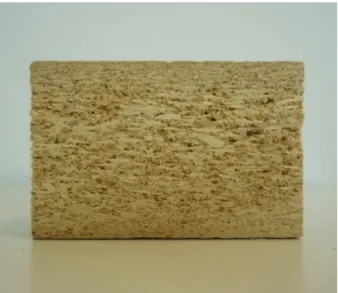
1.3.3.2. Particleboards made from light wood species ... 62
1.3.3.3. Particleboards with light fillers ... 65
1.3.4. Extruded particleboards ... 68
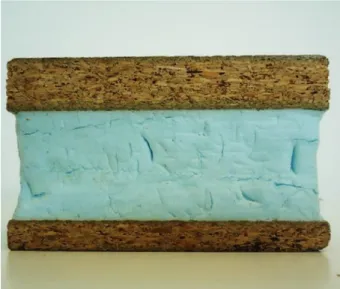
1.3.5. Sandwich panel ... 69
1.3.5.1. Sandwich assembly ... 71
1.3.5.2. Types of sandwich core materials ... 72
1.3.6. Conclusion and future perspectives ... 79
1.3.7. References ... 79
2. Low-density wood-based particleboards bonded with foamable sour cassava starch: preliminary studies2 ... 93
2.1. Introduction ... 94
2.2. Materials and methods ... 97
2.2.1. Materials ... 97
2.2.2. Determination of amylose content ... 97
2.2.4. Fourier transform infrared (FTIR) spectroscopy ... 98
2.2.5. Preparation of binder system ... 98
2.2.6. Foamability of sour and native cassava starch ... 99
2.2.7. Particleboard production ... 99
2.2.8. Particleboard characterization ... 100
2.3. Results and discussion ... 100
2.3.1. Foamability of sour cassava starch ... 100
2.3.2. FTIR spectroscopy analysis ... 101
2.3.3. Physico-mechanical properties of particleboards ... 102
2.4. Conclusions ... 109
2.5. References ... 110
3. Low-density wood particleboards bonded with starch foam: study of production process conditions3 ... 117
3.1. Introduction ... 118
3.2. Materials and methods ... 120
3.2.1. Materials ... 120
3.2.2. Preparation of binder ... 121
3.2.3. Scanning electron microscopy ... 121
3.2.4. Particleboard production ... 122
3.3. Results and discussion ... 124
3.4. Conclusions ... 139
3.5. References ... 140
4. Low-density cardoon (Cynara cardunculus) particleboards bound with potato starch-based adhesive4 ... 145
4.1. Introduction ... 146
4.2. Materials and methods ... 148
4.2.1. Materials ... 148
4.2.2. Preparation of binder ... 149
4.3. Results and discussion ... 150
4.3.1. Effect of starch/cardoon ratio ... 150
4.3.2. Effect of chitosan content ... 153
4.3.3. Effect of fibre content ... 155
4.3.4. Effect of glycerol content ... 157
4.3.5. Effect of water content ... 160
4.4. Conclusions ... 164
4.5. References ... 165
5. Conclusions and future work ... 173
5.1. General conclusions ... 173
5.2. Future work ... 175
L
IST OF
F
IGURES
Figure 1.1. Process of starch gelatinization. ... 41 Figure 1.2. Density of wood-based materials and for cell wall: foam core panel, honeycomb panel, tubular boards, ultra-light and light MDF(medium density fibreboard), veneer plywood, oriented strand board (OSB), particleboard, medium density fibreboard (MDF), high density fibreboard (HDF), wood plastic composites (WPC), pregwood and solid wood (adapted from [28]). ... 45 Figure 1.3. Strategies for panel weight reduction. ... 46 Figure 1.4. Wet process manufacture (adapted from [40]). ... 49 Figure 1.5. Dry process manufacture (adapted from [40]). ... 52 Figure 1.6. Scheme of the comparison between the standard technology of fibreboard production and the developed Dascanova technology (adapted from ( www.wbpionline.com)). ... 58 Figure 1.7. Particleboard manufacture. ... 61 Figure 1.8. Internal section of particleboard made from Populus spp. wood... 63 Figure 1.9. Internal section of particleboard produced with expanded polystyrene foam (EPS) mixed with wood particles in core layer. ... 66 Figure 1.10. Scheme of cross section of tubular boards with identical (top) and different (bottom) diameters of hollow tubes. ... 69 Figure 1.11. Schema of sandwich structure (adapted from [73]). ... 70 Figure 1.12. Scheme of varies types of sandwich cores (adapted from [83]). ... 73 Figure 1.13. Sandwich panel with a polystyrene foam core and wood-based particleboard in the facings. ... 74 Figure 1.14. Continuous line of foam production (adapted from [76]). ... 75 Figure 1.15. Different honeycomb cells configurations: a) hexagon, b) square cell, c) reinforced hexagon and d) flex-core (adapted from [85]). ... 76 Figure 1.16. Sandwich panel with paper honeycomb core. ... 77 Figure 1.17. Manufacture process by expansion of honeycomb (adapted from [85]). ... 77
Figure 1.18. Scheme of corrugated production process (adapted from [85]). ... 78 Figure 2.1. Molecular structure of (a) amylose and (b) amylopectin. ... 95 Figure 2.2. Expansion behavior of different types of cassava starches. (a,b) Native cassava starch before and after heating, respectively; (c,d) sour cassava starch before and after heating, respectively. ... 101 Figure 2.3. FTIR spectra of native and sour cassava starch in the (4000–500 cm−1) spectral region. ... 102 Figure 2.4. Particleboards produced with sour cassava starch–based binder. (a) Outside appearance; (b) close-up detail; (c) SEM image showing wood particles and surrounding foam, 100x magnification. ... 104 Figure 2.5. Density of dry particleboards bonded with sour cassava starch foam. White circles: without HPT; black circles: with HPT. Dashed line shows coincidence between measured and expected densities. ... 105 Figure 2.6. Detail of internal morphology of particleboards: (a) expected density of 313 kg·m-3, showing uniform internal structure; (b) expected density of 550
kg·m-3, showing internal delamination. ... 106
Figure 2.7. Internal bond of particleboards bonded with sour cassava starch foam. White circles: Without HPT; black circles: With HPT. ... 108 Figure 2.8. Thickness swelling of particleboards bonded with sour cassava starch foam. White circles: Without HPT; black circles: With HPT. ... 109 Figure 3.1. Steps of manufacture process of particleboards bonded with a sour cassava starch, starting with a mixture of wood particles and starch paste and ending with a finished particleboard. ... 123 Figure 3.2. Density of particleboards bonded with sour cassava starch foam for different hold times at 190 °C. The pressing time used was 10 s. ... 124 Figure 3.3. Internal bond strength of particleboards bonded with sour cassava starch foam for different hold times, produced at 190 C. The pressing time used was 10 s. ... 126
Figure 3.4. Thickness swelling of particleboards bonded with sour cassava starch produced at different hold times at 190 C. The pressing time used was 10 s. 127 Figure 3.5. Internal bond strength as function of density for particleboards produced at different hold times and 190 C. The pressing time used was 10 s. ... 128 Figure 3.6. Density of particleboards produced with different top platen temperatures, for a hold time of 490 s. The pressing time used was 10 s. ... 129 Figure 3.7. Internal bond of particleboards produced at different top platen temperatures, for hold time of 490 s. The pressing time used was 10 s. ... 130 Figure 3.8. Thickness swelling of particleboards bonded with sour cassava starch foam produced at different pressing temperatures with a hold time of 490 s. The pressing time used was 10 s. ... 131 Figure 3.9. Internal bond strength as function of density for particleboards produced at different temperatures with a hold time of 490 s. The pressing time used was 10 s. ... 132 Figure 3.10. Expansion behavior profile of particleboards bonded with sour cassava starch for different pressing times: 10 s (a), 30 s (b), 90 s (c), and 150 s (d). The pressing temperature of experiments was 190 C. ... 134 Figure 3.11. Density of particleboards bonded with sour cassava starch for different hold times at 190 C. The pressing time used was 60 s. ... 135 Figure 3.12. Internal bond of strength particleboards bonded with sour cassava starch for different hold times at 190 C. The pressing time used was 60 s. ... 136 Figure 3.13. Thickness swelling of particleboards bonded with sour cassava starch for different hold times at 190 C. The pressing time used was 60 s. ... 137 Figure 3.14. Internal bond strength as function of density for particleboards bonded with sour cassava starch for different hold times at 190 C. The pressing time used was 60 s. ... 138 Figure 3.15. SEM image of the interior of the particleboards showing wood particle surrounding by a starch foam, 100× magnification. ... 139
Figure 4.1.Stalks fraction of cardoon: a) pith, b) cortex and c) epidermis. ... 147 Figure 4.2. Internal bond strength of particleboards bonded with potato starch as function of density for starch/cardoon ratios of 0.6, 0.8, 1 and 1.2. All formulations had a water/starch ratio of 2. ... 151 Figure 4.3. Thickness swelling of particleboards bonded with potato starch for starch/cardoon ratios of 0.6, 0.8, 1 and 1.2. All formulations had a water/starch ratio of 2. ... 152 Figure 4.4. Internal bond strength of particleboards bonded with potato starch as function of density for starch/cardoon ratios of 0.6, 0.8, 1 and 1.2. All formulations had chitosan/starch ratio of 0.05 and water/starch ratio of 2. ... 153 Figure 4.5. Thickness swelling of particleboards bonded with potato starch for starch/cardoon ratios of 0.6, 0.8, 1 and 1.2. All formulations had chitosan/starch ratio of 0.05 and water/starch ratio of 2. ... 154 Figure 4.6. Density of the particleboards produced with fibre and fibre combined with chitosan. All adhesive formulations had a starch/cardoon ratio of 0.6 and 0.8. ... 155 Figure 4.7. Effect of fibre content and the combined effect of chitosan and fibre on internal bond strength of the particleboards bonded with a potato starch. All adhesive formulations had a starch/cardoon ratio of 0.6 and 0.8. ... 156 Figure 4.8. Effect of fibre content and the combined effect of chitosan and fibre on thickness swelling of the particleboards bonded with a potato starch. All adhesive formulations had a starch/cardoon ratio of 0.6 and 0.8. ... 157 Figure 4.9. Density of the particleboards produced with different gly/starch ratios. All adhesive formulations had a starch/cardoon ratio of 0.6 and 0.8 and cs/starch ratio of 0.05. ... 158 Figure 4.10. Effect of glycerol content on internal bond strength of the particleboards bonded with a potato starch. All adhesive formulations had a starch/cardoon ratio of 0.6 and 0.8 and cs/starch ratio of 0.05. ... 159
Figure 4.11. Effect of glycerol content on thickness swelling of the particleboards bonded with a potato starch. All adhesive formulations had a starch/cardoon ratio of 0.6 and 0.8 and cs/starch ratio of 0.05. ... 160 Figure 4.12. Density of the particleboards produced with different water/starch ratios. All adhesive formulations had a starch/cardoon ratio of 0.6 and 0.8 and cs/starch ratio of 0.05. ... 161 Figure 4.13. Effect of water content on internal bond strength of the particleboards bonded with a potato starch. All adhesive formulations had a starch/cardoon ratio of 0.6 and 0.8 and cs/starch ratio of 0.05. ... 162 Figure 4.14. Cardoon particleboard with potato starch binder. Panel thickness is 16 mm... 163 Figure 4.15. Effect of water content on thickness swelling of the particleboards bonded with a potato starch. All adhesive formulations had a starch/cardoon ratio of 0.6 and 0.8 and cs/starch ratio of 0.05. ... 163
L
IST OF
T
ABLES
Table 1.1. Advantages and disadvantages of different types of adhesives used in the production of wood-based panels. (adapted from .[2]) ... 37 Table 1.2. Different features from different types of starches (adapted from [16]). ... 40 Table 1.3. Typical properties of softboards [39]. ... 50 Table 1.4. Comparison of properties of different softboards available in market [41]. ... 51 Table 1.5. Requirements for light MDF boards for use in dry and humid conditions (type L-MDF and type L.MDF.H) (EN 622-5). ... 55 Table 1.6. Requirements for ultra-light MDF boards for use in dry conditions (type UL1-MDF and type UL2-MDF) (EN 622-5). ... 56 Table 1.7. Mechanical properties of some light and ultra-light MDF available in the market for dry conditions. Information taken from the products’ datasheets. ... 57 Table 1.8. General purpose lightweight boards LP1 and LP2 for use in dry conditions (CEN/TS 16368). ... 62 Table 1.9. Properties of different core materials [39]. ... 72 Table 2.1. Formulation of the adhesive system. ... 98 Table 3.1. Formulation of the adhesive system. ... 121 Table 3.2. Panels thickness measured immediately after removed from the press (results for four specimens). ... 125
CHAPTER 1
1.
Introduction
Thesis motivation and outline
Wood-based panels (WBPs) is a generic term for a diversity of board products, being one of them particleboards (PB). In the last decades, the demand for light wood-based panels has increased, especially for use in furniture and wall coverings. The reduction of weight is desirable for economical reasons (material and transportation costs) and environmental reasons (resources, eco-efficiency). The trends in the furniture market have a huge impact on the demand for lightweight furniture. Consumers prefer products that can be easily handled and that are available at the time of purchase. In addition, there is a trend in furniture design to use high-thickness components, whereby low-density is a fundamental requirement. Panels with a density below 600 kg·m-3 are defined as lightweight
particleboard according to European Technical Specification CEN/TS 16368. There are several ways to reduce the weight of panels, such as incorporation of low-density particles in the core layer, the use of foam as a core layer and the use of low-density wood species. However, the reduction of weight leads to decrease in mechanical performance (flexural strength, internal bond strength and resistance to axial withdrawal of screws), in the quality of finishing (coating, edge lamination) and in machinability.
Synthetic formaldehyde-based resins are normally used in the production of particleboards due to their low cost, high reactivity and good bonding properties. However, the main disadvantage is the formaldehyde emission during the production and lifetime of the panels. In this way, the interest in the development of bio-sourced adhesives increases, not only to give an answer to government regulations but also to the people concerns with environmental issues. Nature-sourced alternatives have been tested for production of wood-based panels, such as adhesives based on tannins, lignin, soy protein and starch. Starch is one of the
most abundant natural polymers, and is widely used as binder due to its excellent affinity towards polar materials such as cellulose, thanks to the abundance of hydroxyl groups in its structure, forming strong adhesive interactions. For this reason, starch is a good candidate for a natural adhesive system for wood-based panels, substituting the traditional synthetic resins and therefore producing panels with lower environmental impact. In this way, the development and optimization of the adhesive system and its impact on the physico-mechanical properties of the panels becomes a crucial task. The process of panels production is also a challenge because it is important to determine the impact of key parameters (temperatures and times) in the pressing process on the final properties of the panels, and in this way establish a methodology that assures the quality of the final product.
The main goal of this work is the production of low-density particleboards using as binder a starch-based adhesive, without compromising the physico-mechanical properties of the final panel. To achieve this goal, different approaches were followed. This thesis is divided into five chapters, described below.
Chapter 1, titled “Lightweight Wood Composites: Challenges, Production and Performance”, is an introduction to the thesis, outlining the main goal and an overview of the state of the art of the work. In this chapter is given a special attention to bio-based adhesives used in the production of lignocellulosic composites and literature review of lightweight composites, which includes the production process of particleboards.
Chapter 2, “Low-density wood-based particleboards bonded with foamable sour cassava starch – preliminary studies”, describes a starting formulation of an adhesive based on sour cassava starch. It was intended to understand whether it was possible to produce low-density particleboards, taking advantage of the adhesive and foam expansion properties of sour cassava starch, without compromising the good mechanical performance of the particleboards.
Chapter 3, “Low-density wood particleboards bonded with starch foam – study of production process conditions”, studies the particleboard production process using the adhesive system developed in the preliminary studies. The impact of press parameters (temperature, pressing time and hold time) on the final properties of particleboards was analysed.
Chapter 4, “Low-density cardoon (Cynara cardunculus) particleboards bound with potato starch-based adhesive”, looks into a different type of particles for particleboard production. The recycled wood particles used in the previous chapters were replaced by cardoon particles. This came as a consequence of the work team having identified cardoon as a by-product from the national cheese industry, with no added value. The main component on the adhesive system was also replaced: cassava starch was substituted by national potato starch. This chapter discusses the effect of the components of the adhesive system formulation for this new type of particleboard.
Chapter 5 summarizes the main conclusions and outlines some suggestions for future work.
The proof of concept is presented in Appendix A, here it is shown that starch/cardoon composite can be moulded into flat and non-flat geometries, which is one potential advantage of this product when compared to particleboards produced from thermosetting resins.
Bio-based adhesives
The industry of wood-based panels (WBPs) uses predominantly synthetic thermosetting adhesives, such as urea-formaldehyde (UF), phenol-formaldehyde (PF) and melamine-urea-formaldehyde (MUF) [1]. Other type of adhesive also used in the manufacture of WBPs is polymeric methylene diphenyl diisocyanate (pMDI).
UF resins are usually used as adhesive in the production of particleboards (PB) and medium density fibreboard (MDF), in fact the manufacturing of theses panels consumes 68% of UF resins produced in the world [2]. Their extensive use its due to their high reactivity, good binding strength and low price. The panels show lower performance when compared with a MUF resin, for this reason they are adequate for less demanding purposes in indoor use.
PF resins have excellent stability and good resistance to moisture combined with high mechanical strength. These characteristics make them a good binder for the production of exterior grade panels. Commonly, PF are used in the production of oriented strand board (OSB) and plywood (PW), however the high price constraints their broad application.
Panels produced with pMDI exhibit better stiffness and high-water resistance. pMDI requires a shorter curing time than MUF or PF, and a small amount of resin is needed to prepare the panels. These adhesives provide non-formaldehyde emitting solutions for panel manufacturers, nevertheless the higher price (3 or 4 times higher than UF adhesive) combined with problems that may result during the industrial process related with press-sticking, in particular in cases of face-layer applications limits its application [1,3]. Another issue is the toxicity associated with the diphenylmethane diisocyanate monomeric (MDI) residue, which is known as a powerful irritant for the respiratory system [4]. Table 1.1 show overall summary of the advantages and disadvantages of the synthetic adhesives used in the production of wood-based panels.
Table 1.1. Advantages and disadvantages of different types of adhesives used in the production of wood-based panels. (adapted from [2])
Adhesives
Properties UF MUF PF pMDI
Price L M/H M H Cure Temperature L M H M Press Time S M M/l Short Affinity for wood
species H M L H Efficiency L M/H M/H H Compatibility with
bio-based raw-materials M M M/H H Handling Easy Easy Easy Difficult Hydrolysis resistance No M/H H H Use in wet conditions No Partially yes Yes Yes Formaldehyde emission *E1 (≤0.1 ppm) *CARB I (0.18 ppm) E1 (≤0.1 ppm) CARB II (0.09 ppm) Very low No
L-low; M-medium; H-high, S-short and l-long *Class E1 according to EN 13986+A1 *CARB- California Air Resources Board
Currently, the use of formaldehyde-based adhesives raises different issues that panel’s industry needs to face. These problems are related to 1) the sustainability of raw material and the final products, 2) price fluctuations of fossil resources, 3) applicable legislation to synthetic adhesives is increasingly stringent and 4) formaldehyde emissions (especially in indoor applications).
Formaldehyde is a chemical compound toxic by ingestion, inhalation and skin absorption [5]. The International Agency for Research on Cancer (IARC) classified formaldehyde as carcinogenic and toxic for humans [1,6]. Different strategies were adopted from wood-based panels industry to produce boards with very low formaldehyde emission, such as reducing formaldehyde to urea (or amine groups) ratios, the use of appropriate formaldehyde scavengers in the
adhesive, and the development of (synthetic or bio-based) formaldehyde-free adhesives [7,8].
The development of bio-based adhesives has aroused the interest of wood adhesives producers in order to find economically and eco-friendly options taking account the availability, cost and the energy of natural resources. Several options have been studied such as lignin, tannins, proteins (soy) and carbohydrates (starch).
Lignin is a natural polymer produced by plants, being a natural binder of cellulose microfibrils. It is the main component of pulping liquors from the paper industry. Due to the complexity of its chemical structure, low level of reactive sites and chemical variability, the use of lignin as an adhesive itself is limited [9]. Therefore, lignin is usually combined with synthetic resins, mainly phenol formaldehyde due to its phenolic structure [10].
Tannins are natural polyphenolic compounds that can be divided in two classes: hydrolysable and condensed. Tannins-based adhesives can be obtained by polycondensation with formaldehyde, hexamine and precondensates of urea-formaldehyde with the use of sodium hydroxide as a catalyst [11]. In these conditions the tannins and formaldehyde react to form products with high molecular weight and highly branched, with low susceptibility to hydrolysis and low formaldehyde emission.
The use of adhesives based on soy protein has increased in the wood industry due to its low price, availability and ease of handling [12]. The chemical properties of proteins are influenced by their complex structure. The presence of amino acids (constituted by amino and carboxyl as functional groups) is responsible for its amphoteric behaviour, in other words they can behave as acid or base depending of the pH value of the medium. To use the protein as an adhesive it is necessary its denaturation to expose more polar groups and allow their solubilisation and formation of hydrogen bond with the substrate. Adhesives based on proteins are
susceptible to biological degradation, have high viscosities, fast cure and lower moisture resistance when compared to synthetic adhesives. For these reasons they are used for indoor applications [13,12].
Carbohydrates are an abundant and low-cost raw material and are, in general, non-toxic, biodegradable, and come from renewable resources. The polymeric carbohydrates existing in large scale are cellulose, starch, sugars and gums. Starch is one of most abundant natural polymers (Figure 1.1), available in abundance in nature and it is manly extracted from roots (cassava), tubers (potato) and cereal grains (corn and wheat). These are some of the commercial sources of starch for industrial exploitation [14]. Starch can form strong adhesive bond with cellulose, due to the presence of the hydroxyl groups in its structure [15]. During the centuries starch was used as binder for paper and wood and as gum for the textile industry [16].
Figure 1.1. Molecular structure of a) amylose and b) amylopectin.
The morphological features of starch vary with the botanical source and the content of amylose, amylopectin and with the presence of lipids, proteins and inorganic compounds. Table 1.2 presents different features from different types of starches such as their granules shape, size and amylose content.
Table 1.2. Different features from different types of starches (adapted from [16]).
Source Diameter (µm) Amylose content (%) Shape
Maize 5-25 28 Polyhedric Cassava 5-35 16 Semi-spherical
Potato 15-100 20 Ellipsoidal Wheat 20-22 30 Lenticular, polyhedric
Starch consists of two major molecular components, amylose and amylopectin which can be differentiated by their chemical structure. The linear α-(1→4) linked glucan is called amylose while an α-(1→4) linked glucan with (4.2–5.9)% α-(1→6) branch linkages is amylopectin [14].
Inside a starch granule, there are two different regions: one crystalline, constituted by amylopectin chains, and another amorphous, constituted by amylose, where part of it forms a helical complex with lipids. Amylose is located next to or intertwined with amylopectin, keeping the integrity of the granule [14].
Starch presents different polymorphic crystal forms, called A-, B- and C-type. A and B types are usually present in native starch, being that the first is associated to cereal starches and the second to root starches, however B-type also occurs in maize starches. The crystalline forms A and B are very similar; however, the molecular packing of crystalline form A is higher than for form B. The C-type is a mixture of both A and B forms, and it is present in pea and bean starches. The V-type form (Verkleisterung) is a result of amylose being complexed with other substances (for example lipids). Types A and B differ in the packed arrangement, being type A more compacted and less hydrated when compared with type B [17]. When heated in water or other solvent that allows the formation of hydrogen bonding, starch granules become hydrated and swell, thus occurring the disruption of the granules. This phenomenon is called gelatinization. This occurs above a characteristic temperature, designated by gelatinization temperature.
During this process amylose is leached from the granule and dissolves in water, resulting in an increase in solution viscosity [14].
The starch/water ratio influences the melting temperature. The gelatinization process is influenced by the molecular structure of amylopectin (chain length, extension of branching, molecular weight), starch composition (ratio amylose/amylopectin) and granule architecture (proportion of crystalline and amorphous regions). Usually, high transition temperatures are associated with high degree of crystallinity, which makes the granules more stable and resistant to gelatinization (Figure 1.2) [18].
Figure 1.2. Process of starch gelatinization.
The heating of starch in presence of water, followed by cooling, leads to gradual reorganization of the disrupted amylose and amylopectin chains into a different ordered structure, in a process known as retrogradation. The retrogradation process is affected by the type and amount of starch, the ratio between amylose and amylopectin, the storage temperature, pH and the presence of other components [19,20].
In the literature there are some studies that report the use of starch-based adhesives in the production of particleboards. Moubarik et al. [21] reported that
the incorporation of a small amount of cornflour (7 wt%) in UF resins contributes to improve the physico-mechanical properties of the produced particleboards (0.57 N·mm-2 of internal bond strength (IB)) and the reduction of formaldehyde
emissions. Amini et al. [22] used modified corn starch with 25% glutaraldehyde hardener solution as a binder for rubberwood particleboards. Particleboards were produced with three different densities: 600 kg·m-3, 700 kg·m-3 and
800 kg·m- 3.The modulus of rupture (MOR) and the IB obtained were acceptable.
However, to improve water resistance it was necessary to add water repellent agents. In another study, oil palm starch was firstly crosslinked by phosphoryl chloride (POCl3) and then reacted with sodium chloroacetate (C2H2ClNaO2) to
form a carboxymethylated starch to produce particleboards. The modulus of elasticity (MOE) and IB of the particleboards produced met the requirements of the Japanese Industrial Standards (JIS), except for the MOR [23]. In order to achieve the minimum values specified by the JIS for MOR, addition of 2% of UF to the carboxymethylated starch adhesive could be an option.
Starch adhesives had low water resistance due to their highly hydrophilic character. The high viscosity is a limitation for industrial uses. These types of adhesives have a poor storage stability and low bonding strength [24].
Lightweight wood composites: challenges, production
and performance
1Abstract
Wood composites are materials made by bonding together wood and adhesives into a large material that can be used for different purposes. Nowadays, lightweight materials play an important role in several industries: aerospace, building and furniture. The reduction of weight is desirable for economic reasons (materials and transportation costs) and environmental reasons (resources, eco-efficiency). Once wood composites are employed in these industries, low-density is a desired property. There are several options in the market to reduce the weight of composites, such as the use of low-density wood species, lower compaction of the wooden mat, incorporation of light fillers in the core layer of the panel, or use of sandwich panels with honeycomb core. All these strategies have challenges with respect to manufacture, machinability (connections and lamination of the edges) and performance (physico-mechanical properties).
_________________________________
1Monteiro, S.; Martins, J.; Magalhães, F.D.; Carvalho, L. Lightweight wood composites:
challenges, production and performance. In Lignocellulosic Composite Materials, 1st ed.; Springer International Publishing:Cham, Switzerland, 2018; volume 1, pp. 293–322.
1.3.1. Introduction to lightweight wood-based composites
Wood composites are materials made by bonding together wood with different shapes and sizes and adhesives, forming a large material which can be used for a variety of products with the required physico-mechanical properties: furniture, flooring, roofing, palettes, decking, structural beams, marine applications, aircraft materials, etc.
The advantages of using wood-based composites, in relation to solid wood, are 1) use of small diameter trees, 2) use of waste wood from industrial processing and agriculture residues, 3) products with uniform and defect-free appearance, 4) better strength than solid wood, 5) products with unique shapes and dimensions, and 6) products with special properties such as low thermal conductivity, fire resistance, and better biological durability [25].
Several factors have a huge impact on the mechanical properties of wood-based composites such as: wood species, forest management regimes (naturally regenerated, intensively managed), kind of adhesive used, shape (fibres, flakes, strands, particles, veneer, lumber) and the arrangement of wood elements in composite and the final composite density. The performance of wood composites can be characterized according to several engineering properties. Structural and non-structural applications are defined by the mechanical properties of the composite.
Static elasticity and strength are the key properties used to choose the materials or set up the design and the specifications [26].
Nowadays, the use of lightweight materials becomes a topical issue in many developed industrial countries. The trend concerning lightweight materials is notorious in many industries and the furniture and wood-based panels industries do not miss out. The increase of the mobility of people demands that materials should be lightweight and also have proper physico-mechanical properties.
Generally, a lightweight material brings many advantages for producers, designers and consumers: 1) lower costs in consequence of mass reduction and transportation, 2) possibility of obtaining thick elements, answering current design trends, 3) more rational use of wood, when its price is high or availability is scarce, 4) ease of transportation by producer and final costumer, with lower environmental impacts [27]. According to CEN/TS 16368, panels with density below 600 kg·m-3 are classified as lightweight materials. Materials such as
tubular board, honeycomb panel and panels with foam core are included in this group. Figure 1.3 shows the different ranges of density for wood based-materials, emphasizing those considered as lightweight.
Figure 1.3. Density of wood-based materials and for cell wall: foam core panel, honeycomb panel, tubular boards, ultra-light and light MDF(medium density fibreboard), veneer plywood, oriented strand board (OSB), particleboard, medium density fibreboard (MDF), high density fibreboard (HDF), wood plastic composites (WPC), pregwood and solid wood (adapted from [28]).
The different strategies available for obtaining the lightweight wood composites already available in the market are summarized in Figure 1.4 [29–31].
Figure 1.4. Strategies for panel weight reduction.
Panels such as MDF and particleboards with low-density are produced by using lower compaction of the wood mat. Another strategy is using very light wood species like Ochroma spp. (50 to 300 kg·m-3) or Ceiba spp. (300 kg.m-3) from
North America and South America respectively. Populus spp. (450 kg·m-3) from
Europe is another type of light wood also used in the production of lightweight particleboards [32]. Extruded tubular boards are frequently used and the density achieved with this method may vary between 250 to 400 kg·m-3. Sandwich
panels with foam core (made of polyurethane or polystyrene foam) or paper-based honeycomb structures are a major trend in the industry, achieving densities from 100 to 350 kg·m-3. However, lightweight panels have certain restrictions,
• Reduction of mechanical properties, which disallows the use of panels in applications requiring load bearing capacity,
• The use of agricultural residues requires higher amount of resin,
• Difficult storage of non-wood bio-based materials such as agriculture crops,
• Limitations in terms of surface finishing and post-forming,
• Increase of production cost associated to the need of new additives due to lower bonding strength of the new raw materials [27,33].
1.3.2. Fibreboard
Fibreboard is a wood-based panel with a nominal thickness of 1.5 mm or greater, manufactured from lignocellulosic fibres with application of heat and/ or pressure (EN 316). The bond is derived from either the felting of the fibres and their inherent adhesive properties or from a synthetic binder added to the fibres. Other additives can be included (EN 622-5).
The most commonly used lignocellulosic fibres are wood, but other plant fibres can be used such as bagasse and cereal straws. Thermo-mechanical pulping (TMP) is the process commonly used to make fibreboards. This process consists in breaking the bonds between the wood cells by combining action of heat and mechanical energy. The lignin present in the wood have the ability to absorb small amounts of water, therefore its softening temperature is dependent of moisture content. The TPM process uses high temperature (170-195 C) and humidity (60-120%) that increase the probability of breaking the wood cells, when subjected to a mechanical energy during the refining process [35,36]. The methods of wood-based fibreboard manufacture are generally divided into wet and dry process. The definitions of fibreboards are formulated in the
European standard (EN 316). Fibreboards are classified by their production process as follows:
• Wet process fibreboards (fibre distribution in water), • Dry process fibreboards (fibre distribution in air).
Wet process boards are fibreboards having fibre moisture content of more than 20% at the stage of forming. Additionally, wet process boards are classified according to density, as follows:
Hardboards (HB) Boards with density ≥ 900 kg·m-3
Medium boards (MD) Boards with density ≥ 400 kg·m-3 to ± 900 kg·m-3
Softboards (SB) Boards with density < 400 kg·m-3
Dry process fibreboards are fibreboards having a fibre moisture content of less than 20% at the stage of forming and having a density ≥ 450 kg·m-3. Medium
density fibreboard (MDF) is one of the most rapidly growing composite panel products in forest products market.
Raw materials namely wood, binders and other additives and the production parameters are the factors that have major effect on physico-mechanical properties of MDF [37]. When wood is considered as a raw material, wood fibre properties such as fibre structure and strength, anatomical and chemical properties of fibre, and fibre composition (percentages of whole and broken fibres and fines) are considered to be basic characteristics influencing fibreboard properties, since they occupy a large portion of the total panel volume. For marketing purposes, MDF of specific density range can be given different denominations. For example, the following density-related marketing terms for MDF have become established:
High Density Fibreboard (HDF) MDF with density ≥ 800 kg·m-3
Light MDF (L-MDF) MDF with density ≤ 650 kg·m-3
Ultra-light MDF (UL-MDF) MDF with density ≤ 550 kg·m-3
1.3.2.1.
Wet process fibreboards: softboard
Softboards are usually used in the interior of walls and floors, and as underlays in roofs, in order to provide heat insulation properties. The low-density leads to a more energy efficiency caused by the many air voids in the panel [38,39]. Softboards can be produced via a wet process (Figure 1.5), which is really an extension of paper manufacturing technology.
Figure 1.5. Wet process manufacture (adapted from [40]).
Wood enters a chipper to be reduced in size (with sizes of approximately 25 and 5 mm thick). The chips are screened to remove undersized (< 2 mm) and oversized (> 50 mm) particles. The chips are washed to remove contaminants and to facilitate defibration, and then fed into the pre-heater or digester, where they are heated with overheated steam at 6-10 bar and at a temperature of 175-195 C for 3-7 minutes. The steam treatment softens the lignin, which binds the fibres
together allowing their separation in a pressurized discs’ refiner under saturated steam at 8-10 bar. Here, the steamed chips are transformed into fibres. Some wet-process boards are made without additional binders. If the lignocellulosic materials contain sufficient lignin, this compound can serve as binder, as long as it is retained during the refining operation. Under heat and pressure, lignin will flow and act as a thermosetting adhesive, enhancing the naturally occurring hydrogen bonds. The fibres are discharged from the defibrator and then water is added to form a slurry (water is used as the dispersion medium for forming the fibres into a mat, this is the reason why the process is called wet-process). This slurry is introduced into a wire mesh conveyer belt to form the board, losing its water prior to drying. The boards are lightly compressed and dried in an oven. The voids created after the evaporation provide the board its good thermal properties.
Contrary to other wood-based boards, fibre-based insulation materials are not required to display high strength. Surface appearance, internal bond, and bending strength are also not of primary importance for softboards. The typical properties of these boards are presented in Table 1.3.
Table 1.3. Typical properties of softboards [39].
Property Values
Density 170-280 kg·m-3
Flexural strength 1.0-2.7 MPa Modulus of elasticity 80-400 MPa Maximum thickness swelling 12-20% Sound absorption of acoustical board (522 Hz) 50-85%
There are several insulation products available in the market. The board properties vary with production technologies, final application and specific
requirements. Table 1.4 gathers examples of few commercial softboards and their properties.
Table 1.4. Comparison of properties of different softboards available in market [41].
Product/ Producer Application area Thickness (mm) Density (kg·m-3) EN 1602 Heat conductivity [W/(m K)] Materials and Additives HolzFlex®/ Homatherm Intermediate rafter framework 40-200 40 0.038 -Wood fibres -Polyolefin fibres -Ammonium polyphosphate Steico-Flex/ Steico Intermediate rafter framework 40-200 50 0.038 -Wood fibres -Polyolefin fibres -Ammonium sulphate Agepan THD N+F 230/ Glunz
Over rafter 40/60/80 230 0.047 -Wood fibres -Polyurethane resin Thermosafe Homogen/ Gutex Universal insulating board 20-240 < 110 0.037 -Wood fibres -diphenylmethane di-isocyanate (pMDI)
The major benefit of this production process is the low volatile organic compounds (VOCs) emission level caused by the low amount of resin used and the drying time that is longer. The density (> 150 kg·m-³) and the board thickness
(< 40 mm) are the two mainly restrictions in the wet process. Panels with higher thickness need a longer drying time which causes an increase of production costs [41,42].
1.3.2.2.
Dry process fibreboards: light MDF and
ultra-light MDF
Light MDF and ultralight MDF are widely used in the manufacture of furniture, doors and walls due to many excellent properties such as low density, low thermal conductivity and good sound absorption [43]. These types of panels are manufactured by using what is called a dry process (Figure 1.6).
Figure 1.6. Dry process manufacture (adapted from [40]).
In this process, the fibres are produced in the same way as the wet process. After the defibration process, wood fibres are discharged into a pressurized blowline, a tube with 80 to 120 mm of diameter, which transports wet fibres to the dryer. In the blowline, when the fibre is blended under high pressure, the resin is more easily distributed due to the steam expansion that causes the separation of fibres [36].
Resins like polymeric diphenylmethane di-isocyanate, urea-formaldehyde and phenol-formaldehyde are used as adhesives [44]. The adhesive, as well as other additives, are injected into the blowline through a 3-5 mm nozzle at high pressure (12-14 bar). The adhesive load is usually between 8 and 15% (resin solids/oven dry wood). The wet resinated fibres are then blown through a flash tube dryer (with around 100 m long and 1-3 m in diameter) at around 30 m·s-1. At the end
of the tube, cyclones separate the dried fibre from steam. After drying, fibres have approximately 8-12% moisture content. The dry fibre is conducted to mat
formers. These are made with the purpose of distributing an even layer of fibres onto a continuously moving belt. Here, the panel thickness is controlled by monitoring the speed belt. The forming head spread fibre mattress homogenously. In the case of an 18 mm thick MDF board, the mat is around 680 mm high and has a bulk density of 23 kg·m-3. After passing a continuous prepress to reduce its
height, the mat is then pressed in a continuous hot-press with temperature in the range of 180-210 C and pressure between 0.5 and 5.0 MPa [36]. The pressing stage can be used to manipulate panel properties by changing the panel density profile. This operation has a major effect on the balance of properties of the resulting panel: a rigorous control of all processing variables is necessary to achieve appropriate product quality and to minimize pressing time [45]. Immediately after pressing the panels are fed into a star shape cooler where boards are stood on their edges to expose their faces to ambient air to facilitate rapid cooling. Finally, boards are subjected to finishing operations, which includes trimming, sanding and cut to size. Nowadays manufacturer also includes several surface treatments such as laminating, profiling and painting.
Light and ultra-light MDF are produced in the same way as MDF, but lower pressing pressure is used to attain lower density MDF. The main advantage of this process is the decrease of the density to 50 kg·m-3and an extensive range of
thicknesses (< 200 mm). A disadvantage of the dry technology is the high level amount of resins that is needed to strengthen the fibre bonds [41].
Light MDF is used in situations where weight reduction is required in the range of 15-20% and where the machinability performance is not a limiting factor. In the manufacturing of MDF, several important factors have direct effects on mechanical properties and stability of the panel, namely the resin system, moisture content, hot-pressing conditions, and wood fibre characteristics. The structure and morphology of fibres have more influence than their mechanical characteristics on the board properties. Fibres with different morphologies have different specific surface areas [46]. Short fibres need higher amount of resin
when compared with longer fibres, which generally results in better mechanical properties for the panels. When the resin content of the panels increases from 6 to 12%, an increase in mechanical properties (internal bonding, modulus of rupture and modulus of elasticity) is observed, while thickness swelling and water absorption decrease. In the thermo-mechanical pulping process, usually used to refine fibres, refining pressure and time are two important features that affect the final properties of the board. With the exception of water absorption, refining pressure has great influence in overall panel properties. On the other hand, refining time does not alter the properties of fibre and board [47]. The effect of moisture content change on panel flatness is difficult to predict because of the characteristic variation of the density level throughout the thickness, or vertical density profile.
The panel properties depend of the compaction ratio of each layer that forms the panel. Generally, the difference between the layers is defined by the compaction ratio, since that no differences exist in geometry fibre and resin amount in the whole panel [48].
The requirements for light MDF are different depending on its use in dry or humid conditions. Panels in humid conditions have to withstand the presence of water vapour in the surrounding air and casual contact with water on surface. Table 1.5 specifies the requirements for light MDF boards for use in dry and humid conditions, particularly interior fitments including furniture.
Table 1.5. Requirements for light MDF boards for use in dry and humid conditions (type L-MDF and type L.MDF.H) (EN 622-5).
Property Conditions Test
method unit
Ranges of nominal thickness (mm)
>6̶ 9 >9-12 >12- 19 >19- 30 >12- 19 >45 Swelling in thickness 24 h Dry EN 317 % 20 16 14 12 11 11 Humid 18 16 13 12 11 10 Internal Bond Dry EN 319 N·mm-2 0.45 0.45 0.45 0.45 0.40 0.40 Humid Bending strength Dry EN 310 N·mm-2 20 20 18 15 14 14 Humid 20 20 18 16 16 14 Modulus of elasticity in bending Dry EN 310 N·mm-2 1700 1700 1600 1500 1400 1200 Humid
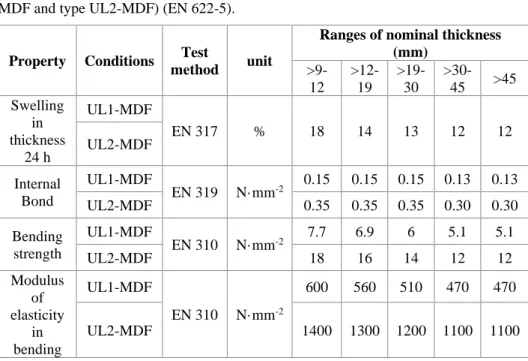
Concerning ultra-light MDF, the requirements are different from light MDF. In this case, panels are divided in two groups:
• Ultra-light MDF Type 1 (UL1-MDF), these boards are typically used as insulation panels providing limited mechanical stiffness;
• Ultra-light MDF Type 2 (UL2-MDF), these boards are typically used as panels with stiffening function; they also can be used with fasteners. These panels have insulating properties. The next table specifies the requirements for these two types of panels under dry conditions (Table 1.6).
Table 1.6. Requirements for ultra-light MDF boards for use in dry conditions (type UL1-MDF and type UL2-UL1-MDF) (EN 622-5).
Property Conditions Test
method unit
Ranges of nominal thickness (mm) >9-12 >12-19 >19- 30 >30-45 >45 Swelling in thickness 24 h UL1-MDF EN 317 % 18 14 13 12 12 UL2-MDF Internal Bond UL1-MDF EN 319 N·mm-2 0.15 0.15 0.15 0.13 0.13 UL2-MDF 0.35 0.35 0.35 0.30 0.30 Bending strength UL1-MDF EN 310 N·mm-2 7.7 6.9 6 5.1 5.1 UL2-MDF 18 16 14 12 12 Modulus of elasticity in bending UL1-MDF EN 310 N·mm-2 600 560 510 470 470 UL2-MDF 1400 1300 1200 1100 1100
The most important feature of low-density MDF is its homogeneous density profile along the thickness, which allows turning and edge profiling operations. The possibility of surface and edges finishing is one of main advantages of this material over other wood composites.
There are several options of traditional light and ultra-light MDF in the market, in Table 1.7 are presented some examples.




![Figure 1.16. Different honeycomb cells configurations: a) hexagon, b) square cell, c) reinforced hexagon and d) flex-core (adapted from [85])](https://thumb-eu.123doks.com/thumbv2/123dok_br/15720031.1070358/76.744.144.541.202.519/figure-different-honeycomb-configurations-hexagon-reinforced-hexagon-adapted.webp)


