DOI: 10.1590/1809-5844201824
José Pedro Cerdeira1
http://orcid.org/0000-0001-5487-6612
1(Instituto Politécnico de Coimbra, Escola Superior de Educação, Curso de Licenciatura em Comunicação Organizacional e Mestrado em Comunicação Organizacional – Cidadania, Confiança e Responsabilidade Social. Coimbra, Portugal)
Abstract
This paper intends to develop the first validity studies of a Portuguese version of Facebook Addiction Scale (AFS) by Koc and Gulyagci (2013). The study was carried out with a convenience sample (N=144), through a questionnaire made available online. Statistical analyzes of the results suggest that the scale has excellent psychometric properties, similar to those of the original scale. Analysis of the principal components, with varimax rotation, reveals the existence of a single factor, able of explaining 63,7% of the total variance, while the internal consistency analysis is .91 (Cronbach’s alpha).
Keywords: Facebook Addiction Scale. Behavioral Dependencies. Behavioral Addiction. Internet
attitudes. Social networks.
Introduction
Nowadays the Internet is a widely disseminated technology in present-day societies (OSBURG; LOHRMANN, 2017). People use the Web to reach goals (acquiring knowledge, engaging in professional activities, purchasing products and services etc.) or to meet psychological needs (acknowledgment, sense of belonging, socialising, entertainment etc.) (HEW, 2011; PEMPEK et al, 2009; PONTES et al, 2016; RYAN et al, 2014; WILSON et al, 2012; YANG; BROWN, 2013). According to the Internet World Stats (2017), between 2000 and 2017, the growth rate of Internet users was 936%, reaching 3,7 billion users in the present year. On 31 March 2017, one in every two inhabitants was using the Internet, which accounts for a penetration rate of 49,7% in terms of the world population. Of these users, about 637 million are European, of which 7 million are Portuguese (the penetration rate in Portugal stands at 67,6%, which adds up to 7.015.519 users) (MINIWATTS MARKETING GROUP, 2017). As for the use of Facebook at a global level, statistics from March 2017 show that 1,28 billion people use Facebook on a daily basis (FACEBOOK, 2017). In Portugal, there are 5,6 million subscribers, that is, 54% of the Portuguese population are Facebook customers, which means that 79,8% of Internet users are Facebook customers1 (MINIWATTS MARKETING GROUP, 2017).
In light of these figures, and in accordance with other sources, (GUEDES et al, 2016; PONTES; GRIFFITHS, 2014), a number of questions are raised. One of them refers to whether the extensive use of the Internet may or not be understood as a behavioural addiction (or dependence), with symptoms which are more or less similar to the symptoms of substance addiction (GRIFFITHS, 1996, 1999, 2000; GRIFFITHS; PONTES; KUSS, 2016, KUSS; LOPEZ-FERNANDEZ, 2016; KUSS; BILLIEUX, 2017; YOUNG, 1998). Another mentions some specific uses of the Internet, which may be regarded as behavioural addictions (or dependences), such as, videogames and online gambling (GRIFFITHS et al, 2017; GRIFFITHS; PONTES, 2015; NG; WIEMER-HASTINGS, 2005), smartphones (KUSS, 2017; VAN DEURSEN et al, 2015) or Facebook (RYAN et al, 2014; YOUNG et al, 2017).
In different cases, research has identified some prejudicial effects related with these behavioural addictions or dependences. For example, excessive use of Facebook is associated with the declining quality of students’ daily activities (distractions and procrastination of more frequent school tasks), the experiencing of anxiety and stress, insomnia and depression, disturbance of interpersonal relations, isolation, hostility towards others, deteriorating social competences, mood changes etc. (EKIZOGLU; OZCINAR, 2011; ELGENDI, 2015; ELPHINSTON; NOLLER, 2011; GENCER; KOC, 2012; GRIFFITHS; PONTES, 2015; GUEDES et al, 2016; RYAN et al, 2014, 2016a, 2016b; VANNUCCI et al, 2017).
In view of this, it is pertinent to call for further research to be conducted on the attitudes to the use of information and communication technologies on the Internet. This may involve, for instance, the designing of new instruments for assessing attitudes or, alternatively, the translation and adaptation of existing instruments, with the corresponding validity studies associated to them.
Objective
This study serves two purposes: translating into Portuguese the Facebook Addiction Scale, designed by Koc & Gulyagci (2013), and conducting some exploratory studies to assess the psychometric properties of the scale, with a view to providing an answer to the scarcity of papers in the field of studies into behavioural addictions to or dependences on Facebook (PONTES; GRIFFITHS, 2014).
Instrument
behavioural control, relapses, abstinence manifestations and the restoring of previously eliminated behaviours. Basically, the creation of this scale aimed to fill a gap in the research on new dependences, as the instruments for the recognition of addiction to or dependence on the new communication technologies were few and far between, and the studies on the validity of these instruments are scarce. In more recent years, with the growing widespread use of these technologies, the topic of addictions has gained visibility; hence the reason for exploratory studies about the phenomenon as well as for validity studies on the instruments
aimed at assessing it.
All the items on the scale are written in the affirmative, and so the values corresponding to the answers may be added up to reach a total. The higher the value of the score resulting from the adding up of the answers to the eight points of the scale, the more marked the Facebook addiction will be. Since the scale has not been widely used in research studies, it will be pertinent to conduct exploratory studies to establish the psychometric properties of the scale and its validity.
Sample
A sample of convenience was used2, made up of 144 voluntary participants, of which 46 are male (31,9%) and 98 are female (68,1%), with ages ranging from 15 to 35 years (M=21,94, DP=3,41). The data were compiled through GoogleDocs, using a questionnaire, during the months of April-June 2016.
Procedures
The first part of the questionnaire includes questions for the characterisation of the sample: gender, age, occupation, years of professional activity, whilst the second is made up of the eight items of the Facebook Addiction Scale (KOC; GULYAGCI, 2013). The answers were coded on a Likert scale of seven points, from 1 – I strongly disagree to 7 – I strongly agree. All the items are written in the affirmative. This means the scale is additive, so that a higher score will correspond to the expression of a greater addiction to Facebook. In order to keep the meaning of the sentences on the scale as close to the original as possible, the suggestion made by Hill and Hill (2008) was followed, that is to say, the scale was translated into Portuguese and, subsequently, translated into English again by another researcher. The differences detected between the two versions were then analysed and discussed. The final version was assessed by a group of five undergraduate students to identify possible problems of comprehension in the meaning of the items and thus avoid potential misunderstandings. At this stage, an alteration to the answers coding system
was introduced and a seven-point Likert scale was adopted (instead of the five-point
original scale)3, as well as an alteration to the associated labels, which were changed from
1-I strongly disagree to 7-I strongly agree, instead of the original labels (1-not true to 5-extremely true)4. These alterations were discussed, and there was unanimous consensus that they gained in clarity.
The data were analysed using the Statistical Package for Social Sciences (SPSS,
version 21)5. Nine subjects of the sample were disregarded (5,9%) for having answered only the characterisation questions of the first part of the questionnaire. No non-answers were detected.
Results
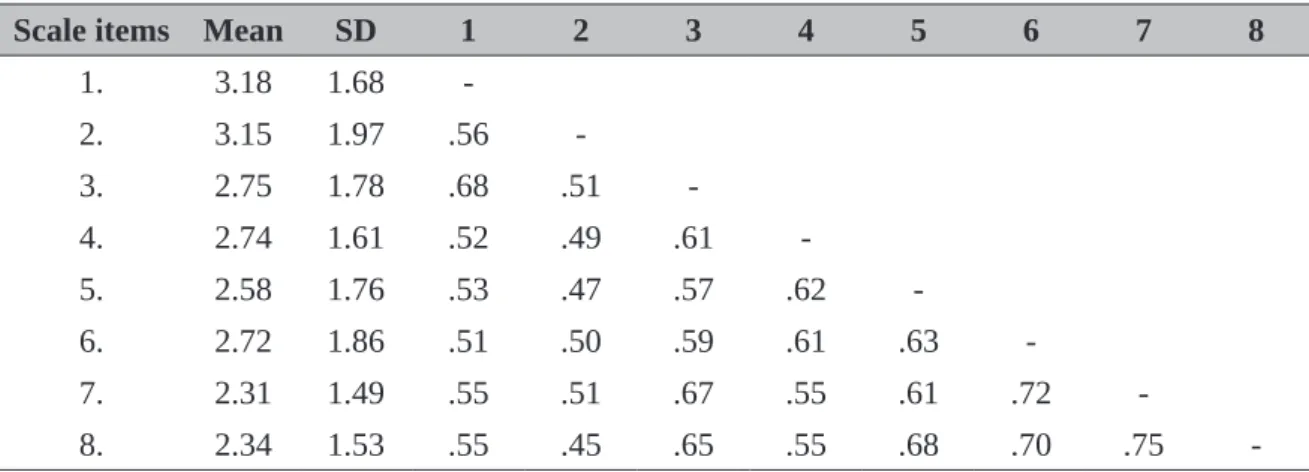
On Table 1, the mean and standard deviation values of the scale items are shown. The total mean of the scale was 21,77 (DP=10.88), and no statistically significant differences in regard to gender were detected through test t of student. However, if an item per item analysis is conducted, statistically significant differences may be identified in item 4 (O uso que faço do Facebook interfere com as minhas actividades sociais6), with a value of t (142)=2,148, p=.033. Male participants show a higher mean (M=3.15, DP=1.59) by comparison with female ones. (M=2.54, DP=1.59). As regards the remaining sociodemographic variables of the sample, no statistically significant differences were found in the mean values.
Table 1: Mean, standard-deviation and inter-items correlation of 8-item of Facebook
Addiction Scale (N=144)
Scale items Mean SD 1 2 3 4 5 6 7 8
1. 3.18 1.68
-2. 3.15 1.97 .56
-3. 2.75 1.78 .68 .51
-4. 2.74 1.61 .52 .49 .61
-5. 2.58 1.76 .53 .47 .57 .62
-6. 2.72 1.86 .51 .50 .59 .61 .63
-7. 2.31 1.49 .55 .51 .67 .55 .61 .72
-8. 2.34 1.53 .55 .45 .65 .55 .68 .70 .75
-Source: Prepared by the author.
3 The Likert scales are one of the most commonly used procedures to code the subjects’ answers in a survey. In the case of this explo
-ratory study, the answers format was extended to comprise seven levels in order to increase the range of possible answers.
4 The original labels (“It is not true” and “It is extremely true”) were replaced with labels implying greater or lesser agreement with the meaning of the statements.
The lowest inter-item correlation is .45 (between item 2 and item 8), the highest is .75 (between items 7 and 8), with a correlation mean of .58. All the inter-item correlation values are significant (p < .01). The correlation matrix determinant equals .006, which indicates the possibility of conducting a factorial analysis, a possibility which is also suggested by Bartlett’s Test of Sphericity (x2(28, N=144)=707.191 (p<.000)) and Kaiser-Meyer-Olkin’s index value (K.M.O.=.913)7.
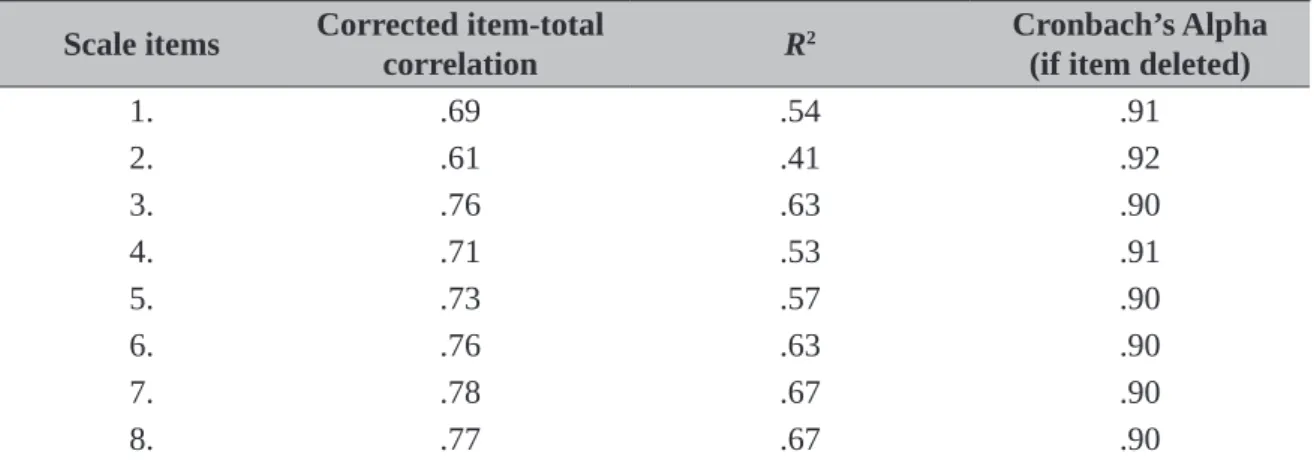
Table 2: Corrected item-total correlations, squared multiple correlation and Cronbachs’s
Alpha if Item deleted from Facebook Addiction Scale (N=144)
Scale items Corrected item-total
correlation R
2 Cronbach’s Alpha
(if item deleted)
1. .69 .54 .91
2. .61 .41 .92
3. .76 .63 .90
4. .71 .53 .91
5. .73 .57 .90
6. .76 .63 .90
7. .78 .67 .90
8. .77 .67 .90
Source: Prepared by the author.
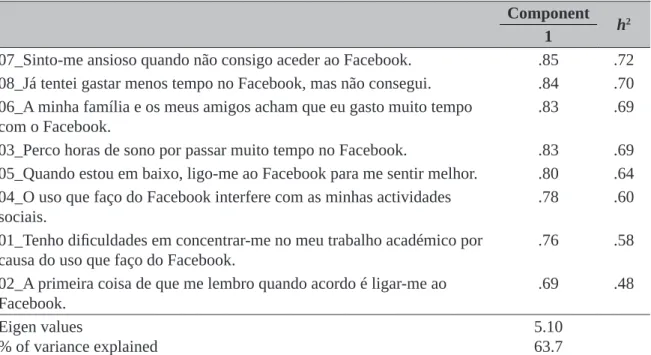
The conditions for the factorialisation of the correlations matrix having been checked, the method used will be that of the principal components analysis, with Varimax rotation, for an exploratory factorial analysis8. This analysis resulted in a solution with a single component with its eigen value higher than the unit (5.10), capable of accounting for a rather large part of the general variability of the answers given to the totality of the items on the scale (63.8%). The saturation indexes of all eight items are higher than .69 (Table 2).
The Cronbach9 alpha value is .91, which suggests a high internal consistency in the scale’s items, borne out by the analysis of the values of the multiple correlation square, which vary between .41 and .67. This indicates that the items share important percentages of their variance between them (Table 3). The alpha value decreases with the removal of any item from the scale, with the exception of item 2’s elimination (A primeira coisa de que me lembro quando acordo é ligar-me ao Facebook10), whose removal maintains the alpha value constant.
7 Bartlett’s test of sphericity and the Kaiser-Meyer-Olkin index are two measures which enable the conditions required for a factorial analysis of data to be assessed (MARÔCO, 2018).
8 The method of the principal components analysis corresponds to a statistical method for data analysis used to convert a set of obser
-vations of non-correlated variables into values with a statistical meaning (MARÔCO, 2018).
9 The Cronbach alpha is a indicator of the degree of internal consistency of a psychological measure.
Table 3: Factor loadings (principal components analyses method), commonalities, eigen
values and variance explained of 8-itens of Facebook Addiction Scale (N=144)11
Component h2 1
07_Sinto-me ansioso quando não consigo aceder ao Facebook. .85 .72
08_Já tentei gastar menos tempo no Facebook, mas não consegui. .84 .70 06_A minha família e os meus amigos acham que eu gasto muito tempo
com o Facebook. .83 .69
03_Perco horas de sono por passar muito tempo no Facebook. .83 .69
05_Quando estou em baixo, ligo-me ao Facebook para me sentir melhor. .80 .64 04_O uso que faço do Facebook interfere com as minhas actividades
sociais.
.78 .60
01_Tenho dificuldades em concentrar-me no meu trabalho académico por
causa do uso que faço do Facebook. .76 .58
02_A primeira coisa de que me lembro quando acordo é ligar-me ao
Facebook. .69 .48
Eigen values
% of variance explained 5.1063.7
Source: Prepared by the author.
On the whole, these results suggest that the eight items of the Portuguese adaptation of the Facebook Addiction Scale designed by Koc and Gulyagci (2013) measure one single dimension, with excellent internal consistency.
Conclusions
The main objective here was to develop exploratory studies for the construct validity of a Portuguese version of Koc and Gulyagci’s (2013) Facebook Addiction Scale, with a view to making some means available for the research into the use of one of the most widespread technological tools: Facebook. Despite being a first study, with a limited convenience sample (which does not rule out the need for complementary validity studies to be carried out), it is certainly relevant to highlight some of its results. Firstly, the scale has a single-factor structure. The use of the principal components method, with Varimax rotation, allowed for the production of a solution with a single main component, which may account for 63,7% of the total variance and in which the totality of the items saturates above
11 Items of Facebook Addiction Scale in English: 01) I have difficulties in focusing on my academic work due to my Facebook use; 02)
.69 – with important communality values (above .48). This appears to reinforce the original factorial model of the scale’s authors. Secondly, the fact that the alpha value found is very high (.91), associated with the circumstance that the removal of any item from the scale contributes to a reduction in that value, suggests a very good internal consistency.
Since a sample of convenience made up of relatively heterogeneous subjects was used, the conclusions are limited to the nature of the sample. Therefore, it will not be possible to suggest any type of association between the results obtained through the use of the scale and possible behaviours of addiction to or dependence on Facebook. Further studies will be needed to achieve this goal.
References
EKIZOGLU, N.; OZCINAR, Z. A study of developing an anxiety scale towards the internet. Procedia Social and Behavioral Sciences, v.15, p.3902-3911, 2011.
ELGENDI, H. The effect of Facebook on college student’s. International Journal of Networks and Communications, v.5, n.2, p.37-40, 2015.
ELPHINSTON, R. A.; NOLLER, P. Time to face it! Facebook intrusion and the implications for romantic jealousy and relationship satisfaction. Cyberpsychology, Behavior, and Social Networking, v.14, n.11,
p.631-635, 2011.
FACEBOOK. Facebook newsroom: company info. 2017. Available at: http://newsroom. fb.com/company-info/. Accessed on: 20 jun. 2017.
GENCER, S. L.; KOC, M. Internet abuse among teenagers and its relations to internet usage patterns and
demographics. Educational Technology & Society, v.15, n.2, p.25-36, 2012.
GRIFFITHS, M. D. Behavioural addiction: an issue for everybody? Employee Councelling Today: the journal
of workplace learning, v.8, n.3, p.19-25, 1996.
______. Internet addiction: fact or fiction? Psychologist, v.12, p.246–250, 1999.
______. Does Internet and computer ‘addiction’ exist? Some case-study evidence. CyberPsychology & Behavior, v.3, n.2, p.211–218, 2000.
______.; PONTES, H. M. Addiction and entertainment products. In: NAKATSU, R.; RAUTERBERG, M.; CIANCARINI, P. (Eds.). Handbook of digital games and entertainment technologies. Singapore: Springer, 2015, p.1-22.
______.; KUSS, D. J.; GORTARI, A. B. Videogames as therapy: an updated selective review of the medical and psychological literature. International Journal of Privacy and Health Information Management, v.5, n.2, p.71-96, 2017.
______.; PONTES, H. M.; KUSS, D. J. Online addictions: Conceptualizations, debates and controversies.
Addicta: the turkish journal on addictions, v.3, n.2, p.151-164, 2016.
GUEDES, E.; SANCASSIANI, F.; CARTA, M. G.; CAMPOS, C.; MACHADO, S.; KING, A. L., NARDI, A. E. Internet addiction and excessive social networks use: what about Facebook? Clinical Pratice & Epidemology in Mental Health, v.12, p.43-48, 2016.
HILL, M. M.; HILL, A. Investigação por questionário. Lisboa: Edições Sílabo, 2008.
KOC, M.; GULYAGCI, S. Facebook addiction among turkish college students: The role of psychological
health, demographic, and usage characteristics. Cyberpsychology, Behavior, and Social Networking, v.16,
n.4, p.279-284, 2013.
KUSS, D. J. OP-58: Problematic mobile phone use and mobile phone addiction. Journal of Behavioral Addictions, v.6, n.1, p.28-29, 2017.
KUSS, D. J.; BILLIEUX, J. Technological addictions: conceptualisation, measurement, etiology and treatment.
Addictive behaviors, v.64, p.231-233, 2017.
KUSS, D. J.; LOPEZ-FERNANDEZ, O. Internet addiction and problematic internet use: a systematic review of clinical research. World Journal of Psychiatry, v.6, n.1, p.143-176, 2016.
MARÔCO, J. Análise estatística com o SPSS Statistics. Lisboa: Edições Sílabo, 2018.
MINIWATTS MARKETING GROUP. World internet usage statistics news and population stats. 2017.
Available at: www.internetworldstats.com/stats.htm. Accessed on: 2 jun. 2017.
NG, B. D.; WIEMER-HASTINGS, P. Addiction to the internet and online gaming. CyberPsychology & Behavior, v.8, n.2, p.110-113, 2005.
OSBURG, T., & LOHRMANN, C. (Eds.). Sustainability in a digital world. New oportunities though new technologies. Cham: Springer International Publishing, 2017.
PEMPEK, T. A.; YERMOLAYEVA, Y. A.; CALVERT, S. L. College students social networking experiences on Facebook. Journal of Applied Developmental Psychology, v.30, n.3, p.227-238, 2009.
______.; GRIFFITHS, M. D. A dependência à internet no contexto português: mito, ficção ou realidade? In: IXº CONGRESSO IBEROAMERICANO DE PSICOLOGIA e IIº CONGRESSO DA ORDEM DOS PSICÓLOGOS PORTUGUESES. Setembro 2014. Actas. Available at DOI: 10.13140/2.1.1608.3522.
Accessed on: 20 jun. 2017.
PONTES, H. M.; ANDREASSEN, C. S.; GRIFFITHS, M. D. Portuguese validation of the Bergen Facebook Addiction Scale: an empirical study. International Journal of Mental Health Addiction, v.14, p.1062-1073, 2016.
RYAN, T.; CHESTER, A.; REECE, J.; XENOS, S. The uses and abuses of Facebook: a review of Facebook
addiction. Journal of Behavioral Addictions, v.3, n.3, p.133–148, 2014.
______.; CHESTER, A.; REECE, J.; XENOS, S. A qualitative exploration of Facebook addiction: working toward construct validity. Addicta: The Turkish Journal on Addictions, v.3, n.1, p.55–76, 2016a.
______.; REECE, J.; CHESTER, A.; XENOS, S. Who gets hooked on Facebook? An exploratory typology of problematic Facebook users. Cyberpsychology: journal of psychosocial research on cyberspace, v.10, n.3, p.1-25, 2016b.
VAN DEURSEN, A. J.; BOLLE, C. L.; HEGNER, S. M.; KOMMERS, P. A. Modeling habitual and addictive smartphone behavior: the role of smartphone usage types, emotional intelligence, social stress, self-regulation,
age, and gender. Computers in Human Behavior, v.45, p.411-420, 2015.
VANNUCCI, A.; FLANNERY, K. M.; OHANNESSIAN, C. M. Social media use and anxiety in emerging
adults. Journal of Affective Disorders, v.207, p.163-166, 2017.
WILSON, R. E.; GOSLING, S. D.; GRAHAN, L. T. A review of Facebook research in the social sciences.
Perspectives on Psychological Science, v.7, n.3, p.203-220, 2012.
YOUNG, K. S. Internet addiction: the emergence of a new clinical disorder. CyberPsychology & Behavior,
v.1, n.3, p.237-244, 1998.
YOUNG, N. L.; KUSS, D. J.; GRIFFITHS, M. D., HOWARD, C. J. Passive Facebook use, Facebook addiction, and associations with escapism: an experimental vignette study. Computers in Human Behavior, v.71,
p.24-31, 2017.
José Pedro Cerdeira
PhD in Social Psychology at the University of Coimbra. Professor Coordinator. Director of the licenciatura degree (1st cycle Bologna) in Organizational Communication and of the master’s degree in Organizational Communication - Citizenship, Trust and Social Responsibility (2nd cycle Bologna). Coordinator of the scientific area of Communication Sciences, Organizations and Media (CCOM) and member of the Center for Studies in Social Psychology (CEPS), School of Education, Polytechnic Institute of Coimbra. E-mail: [email protected].
Received on: 07.28.2017 Accepted on: 07.16.2018