1 Corresponding author:
Received: June 20, 2017. Accepted: February 05, 2018.
Copyright: All the contents of this journal, except where otherwise noted, is licensed under a Creative Commons Attribution License.
Development of ‘Maciel’ peach trees on different
propagation systems
Aline Ramm
1, André Luiz Külkamp de Souza
2, Roberta Manica-Berto
3,
Cari Rejane Fiss Timm
4, Márcia Wulff Schuch
5,
Márcia Vizzotto
6Abstract - The development of new technologies for seedling production is essential in fruit growing. In this context, the objective was to compare vegetative and productive aspects of ‘Maciel’ peach trees and the quality of fruits from plants under different propagation systems. The experiment was carried out in a randomized complete block design with four replications, in a 2 x 3 factorial scheme, two years (2014 and 2015) and three propagation systems (self-rooted ‘Maciel’ (minicutting), ‘Maciel’ with rootstock ‘Okinawa’ (minicutting) e ‘Maciel’ with rootstock ‘Okinawa’ (seed)). The variables evaluated were canopy volume, trunk diameter, yield, productive
efficiency, fruit diameter, soluble solids (SS), titratable acidity (TA), SS/TA ratio, pH, pulp firmness,
carotenoids, phenolic compounds and antioxidant capacity. The self-rooted ‘Maciel’ peach plants, in the second year of evaluation, present higher canopy volume, trunk diameter and thus, they
express higher yield and productive efficiency. Fruit quality how much soluble solids, titratable acidity, SS/TA ratio, pH and pulp firmness are not altered by different propagation systems. The use of different propagation systems over two years modifies the levels of carotenoids and phenolic
compounds total and, consequently, the antioxidant capacity of the fruits of ‘Maciel’ peach plants.
Index terms:Prunus persica, minicuttings clonal, propagation, self-rooting.
Desenvolvimento de pessegueiro ‘Maciel’ sobre
diferentes sistemas de propagação
Resumo – O desenvolvimento de novas tecnologias para produção de mudas é essencial na fruticultura. Nesse contexto, objetivou-se comparar aspectos vegetativos e produtivos de plantas de pessegueiro ‘Maciel’ e a qualidade de frutos oriundos de plantas sob diferentes sistemas de propagação. Para isso, o experimento foi conduzido em delineamento experimental de blocos completos casualizados, com quatro repetições, em esquema fatorial 2 x 3, sendo dois anos (2014 e 2015) e três sistemas de propagação (‘Maciel’ autoenraizado (miniestaquia), ‘Maciel’ com porta-enxerto ‘Okinawa’ (miniestaquia) e ‘Maciel’ com porta-porta-enxerto ‘Okinawa’ (semente)). As variáveis
avaliadas foram volume da copa, diâmetro do tronco, produtividade, eficiência produtiva, diâmetro das frutas, sólidos solúveis (SS), acidez titulável (AT), relação SS/AT, pH, firmeza de polpa,
carotenoides e compostos fenólicos totais e capacidade antioxidante. As plantas de pessegueiro ‘Maciel’ autoenraizadas, no segundo ano de avaliação, apresentam maior volume da copa, diâmetro
do tronco e, assim, expressam maior produtividade e eficiência produtiva. A qualidade dos frutos quanto a sólidos solúveis, acidez titulável, relação SS/AT, pH e firmeza de polpa não é alterada
pelos diferentes sistemas de propagação. O uso de diferentes sistemas de propagação ao longo de
dois anos modifica os teores de carotenoides e compostos fenólicos totais e, consequentemente,
a capacidade antioxidante dos frutos de plantas de pessegueiro ‘Maciel’.
Termos para indexação: Prunus persica, miniestacas clonais, propagação, autoenraizamento.
1Agronomy Ph.D. student of the Universidade Federal de Pelotas. E-mail: [email protected]
2Ph.D. in Agronomy, Empresa de Pesquisa Agropecuária e Extensão Rural de Santa Catarina - Epagri. E-mail: [email protected] 3Ph.D. in Agronomy, Tríade - Comunicação Científica. E-mail: [email protected]
4Ph.D. in Agronomy. E-mail: [email protected].
Introduction
In Brazil, one of the sectors that stands out in the economy is fruit growing and among the great variety of crops produced in the country, the peach tree (Prunus persica (L.) Batsch) stands out for its great expression, occupying an area of 17,451 hectares distributed in the southeastern and southern regions of Brazil. Rio Grande do Sul (RS), also considered an important producer of seedlings, contributes about 80% of the national production of 128,924 tons, followed by São Paulo and Santa Catarina with 35,954 and 21,700 tons, respectively. The average national income corresponds to 12,402 kg ha-1 while in RS the average is around 10,253 kg ha-1 (IBGE, 2015).
The lack of new technologies in the production of seedlings undoubtedly contributes to this lower yield. Among these needs are new alternatives for rootstocks and propagation methods that guarantee the maintenance of the genetic characteristics of the parent plant and the appropriate establishment in the orchard. The propagation of the peach tree is carried out by the grafted scion cultivar on rootstock, being obtained by sexual propagation. This method was stimulated due to the availability of peach seed derived from fruit processing by canning industries
in the region. However, it may present some drawbacks,
such as varietal mixing and misuse of cultivar identity, nonuniformity in the orchard, delay in the early stages of production and different plant reactions to problems such
as biotic and abiotic stresses (CARVALHO et al., 2014).
In the conventional method the production of seedlings by grafting of gem requires a period of 12 to
16 months from sowing to planting in the field. Another
method used is the rooting of minicuttings, which guarantees the health of the seedlings and maintain the characteristics of the matrix plant, besides, it requires less infrastructure due to the reduced space used in the nursery. This method eliminates the use of grafting and thus unites the increase of quality and the reduction of costs, since it requires a much shorter period to bring the seedling
to the field when compared to the conventional method. However, there is little information on the behavior of these plants in the field (TOMAZ et al., 2014).
In this context, the objective was to compare vegetative and productive aspects of ‘Maciel’ peach trees and the quality of fruits from plants under different propagation systems.
Material and Methods
The experiment was conducted in two years (2014 and 2015) in the orchard of the Centro Agropecuário da Palma, city of Capão do Leão-RS (31º48’S, 52º30’W and 60 m elevation). The climate of the region according to the
classification of Köppen and Geiger (1928) is of type Cfa,
temperate humid with hot summers. The local data of the average temperatures minimum, maximum, sum of rainfall precipitation and relative humidity referring the two years were obtained from the Estação Agroclimatológica de Capão do Leão-RS (CPAT, 2017) (Figure 1), which is 200 meters away from the experimental area where the experiment was conducted.
The soil of the experiment place belongs to the Camaquã mapping unit, being moderately deep with
medium texture in the A horizon and clayey in B, classified
as Red-Yellow Argiloso (EMBRAPA, 2006). Three-year-old ‘Maciel’ peach trees were used, spacing 5 m between planting lines and 1.4 m between plants conducted in ‘V’.
The experimental design was randomized complete blocks, with four replications, each plot consisting of three plants. This study was carried out in a 2 x 3 factorial scheme, two years (2014 and 2015) and three propagation systems (self-rooted ‘Maciel’ (minicutting), ‘Maciel’ with rootstock ‘Okinawa’ (minicutting) e ‘Maciel’ with rootstock ‘Okinawa’ (seed)).
The vegetative aspects evaluated were canopy
volume by the formula: V = [((L/2) x (T/2) x π) x (H)]/3,
where V = canopy volume in m³, L = length upper between
the legs (m), T = average thickness of the two legs (m), H = canopy height (m) and π = 3,1416 (ROCHA et al., 2007);
and trunk diameter (mm). At harvest were determined yield (t ha-1), productive efficiency (kg cm-2) and fruit diameter (mm).
The yield was achieved by total weighing of harvested fruits and expressed in tons per hectare. The
productive efficiency was obtained by the relation between
the production per plant and the canopy volume and the area of the trunk section expressed by Kg m-3 and Kg cm-2
respectively; and, the fruit diameter was measured in 10
fruits per repetition, in its equatorial direction, by means of a digital caliper.
A subsample of 20 fruits per replicate was submitted to the following physicochemical analyzes for the determination of soluble solids (SS - oBrix), titratable
acidity (TA - percentage of citric acid), SS/TA ratio, pH and pulp firmness (N). For soluble solids was used a
digital refractometer and neutralization titulometry with
NaOH (0.1N) for titratable acidity; the SS/TA ratio was
obtained through quotient between these two variables.
The firmness of the pulp was measured by means of a
manual penetrometer with 8 mm tip.
Another subsample of 10 fruits per replicate was used to determine the content of carotenoids, phenolic compounds and antioxidant capacity. For the total
carotenoids was method adapted Talcott and Howard
(1999), where 2.5 g of tissue were homogenized with 20 mL of ethanol. After centrifugation for 20 minutes at 2°C, the supernatant was transferred to a funnel and
transferred to a plastic recipient and 25 mL of hexane were added, the samples being stirred vigorously. Water (12.5 mL) was added and the solution was stirred vigorously and allowed to stand for 30 minutes to allow separation of the phases. It was used the separated phase and hexane. The spectrophotometer was to zero using hexane and the readings made at 470 nm. The concentration of total carotenoids was calculated from a standard curve
constructed for β-carotene and the results were expressed as mg of equivalent in β-carotene per 100g of sample.
For the total phenolic compounds, five grams of
fruits were weighed and homogenized in ultra-turrax with 20 mL solvent (methanol) and then centrifuged (Jouan®). The supernatant was pipetted into a microtube kept at
-20°C until read. A 50 μL aliquot of the supernatant was diluted in 4 mL distilled water, 200 μL methanol and 250 μL Folin-Ciocalteau reagent (0.25 N) and reacted for four minutes before adding 500 μL of Na2CO3 (1 N) (SWAIN;
HILLIS, 1959). Thereafter the blends were held for two
hours at in rest room temperature and in the dark. In a spectrophotometer (Genesys®) the samples were read at absorbance of 725 nm. A standard curve for chlorogenic acid was constructed and the results were expressed in as mg of equivalents in chlorogenic acid per 100g of sample.
For the total antioxidant capacity, five grams of
sample were weighed in the extraction and then crushed in ultra-turrax with 20 mL of methanol and centrifuged.
A 10 μL aliquot of the sample supernatant was combined with 150 μL of methanol and 3800 μL of the DPPH
(2,2-diphenyl-1-picrylhydrazyl) solution (BRAND-WILLIAMS et al., 1995). These samples and a blank (control) reacted for 24 hours and the reading was done in a spectrophotometer (Genesys®) previously zeroed with methanol. The absorbance used was 515 nm. A standard curve was constructed for 6-hydroxy-2,5,7,8-tetramethylchroman-2-carboxylic acid and the results were expressed as expressed as µg of equivalent of trolox per g of sample.
The data were analyzed for normality by the
Shapiro-Wilk’s test; to homoscedasticity by the Hartley’s test; and, the independence of residues was by graphic
analysis. Subsequently, the data were submitted to
analysis of variance (p≤0.05), adopting the mixed models procedure (PROC MIXED). In case of significance, the
effects of the years and propagation systems were analyzed
by the F and Tukey test (p≤0.05), respectively.
Thereafter, a joint analysis with all determinations was made, making it possible to compare the effect main of years and propagation systems by multivariate analysis, using the principal components method. Principal component analysis (PCA) was extracted from a correlation matrix of the dependent variables. Thus, the information contained in the original variables was projected into a smaller number of underlying variables called Principal Components (PCs). The criterion for
discarding variables (PCs) used was recommended by Jolliffe (2002). This criterion establishes that a number of principal components should be retained, covering at least 70 to 90% of the total variation. After selecting the number of PCs, were obtained their respective eigenvalues , with their corresponding eigenvectors. The adopted graphic procedure was the biplot, from the scores and loads of the selected principal components. The presence of correlations between the variables dependent on the study
was analyzed using the Pearson correlation coefficient (r).
Results and Discussion
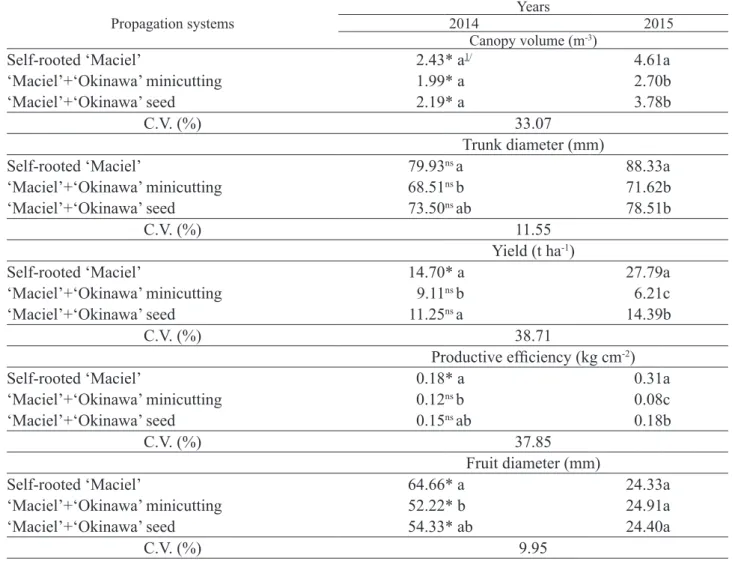
For canopy volume (F = 3.46, p = 0.0373), trunk diameter (F = 7.70, p < 0.0001), yield (F = 12.28, p <
0.0001), productive efficiency (F = 8.01, p = 0.0008) and
fruit diameter (F = 5.74, p = 0.0118), there was interaction between the years and propagation systems (Table 1).
The propagation systems in the first year did not
differ in terms of canopy volume, however in 2015, self-rooted ‘Maciel’ presented the highest volume, differing
from other systems. Also, it was verified that the two
years were different for all plant propagation systems, with higher canopy volume in 2015 (Table 1). The use of rootstock can affect the performance of the scion cultivar and later, modify characteristics related to fruit quality. In addition, the cold requirement of the rootstock may also
influence the physiology of the scion cultivar altering
vegetative and reproductive aspects (PICOLOTTO et al., 2009, 2012).
In the trunk diameter, the self-rooted ‘Maciel’ plant presented larger diameters along with ‘Maciel’+‘Okinawa’
seed in 2014. However, in the second year of evaluation, the largest trunk diameter was verified in peach trees
without rootstock. There was no difference between the years in all propagation systems (Table 1).
T h e l o w e s t y i e l d s w e r e v e r i f i e d f o r ‘Maciel’+‘Okinawa’ minicutting plants that differed from the other propagation systems in both years. Difference between 2014 and 2015 was only observed for self-rooted ‘Maciel’ (Table 1). These results demonstrate that the greater canopy vigor and trunk diameter provided a direct relationship with yield, since the plants without rootstocks also showed greater vegetative growth in 2015.
This behavior was confirmed by the positive correlation
between yield and canopy volume (r = 0.59, p = 0.0001), trunk diameter (r = 0.63, p < 0.001) and productive
efficiency (r = 0.96, p < 0.001). The plants with higher canopy volume tend to be more efficient in the capture of
light, and there is a trend of directing the circulation of the sap of the branches more exposed to light, which explains
the higher yield in 2015 (HADLICH; MARODIN, 2004;
PICOLOTTO et al. al., 2012).
seed plants presented higher productive efficiencies in 2014. However, in 2015 only self-rooted ‘Maciel’ plants characterized higher efficiencies, differing from other
propagation systems (Table 1). As for the comparison of the years, 2014 obtained a differentiated behavior in relation to 2015 in the system of propagation self-rooted ‘Maciel’.
The fruit diameter presented the same behavior
as the productive efficiency in 2014. However in 2015
there was no difference in fruit diameter between the propagation systems tested (Table 1). The evaluation years differed for all propagation systems. These results can be explained by the fact that in the second year there were more fruits harvested, but with smaller diameters.
The events what occurred since the beginning of
floral induction, related to floral morphogenesis (floral differentiation) and the growth of flowering buds, which
includes a sequence of morphological and biochemical changes, such as cell division, increase in carbohydrate content and the activity of some respiratory enzymes, synthesis of proteins and RNA can affect fruit quality attributes such as mineral concentration, number and size of cells, fruit size and shape, intercellular volume,
maturation time and conservation (BANGERTH, 2008). These facts can be justified by the differences observed
during flowering, in 2014 the beginning and end of flowering occurred on July 14 and 31, respectively.
However in 2015, the beginning of flowering was on July
7 and the end on July 23. Associated with this, higher mean maximum temperatures were recorded in June 2015,
which may have contributed to anticipate the onset of floral
induction (Figure 1B).
Table 1
.
Canopy volume (m
-3), trunk diameter (mm), yield (t ha
-1), productive efficiency (kg cm
-2) and
fruit diameter (mm) of ‘Maciel’ peach trees under different propagation systems on 2014 and 2015. Capão
do Leão/RS.
Propagation systems
Years
2014 2015
Canopy volume (m-3)
Self-rooted ‘Maciel’ 2.43 * a1/ 4.61a
‘Maciel’+‘Okinawa’ minicutting 1.99* a 2.70b
‘Maciel’+‘Okinawa’ seed 2.19* a 3.78b
C.V. (%) 33.07
Trunk diameter (mm)
Self-rooted ‘Maciel’ 79.93ns a 88.33a
‘Maciel’+‘Okinawa’ minicutting 68.51 ns b 71.62b
‘Maciel’+‘Okinawa’ seed 73.50 ns ab 78.51b
C.V. (%) 11.55
Yield (t ha-1)
Self-rooted ‘Maciel’ 14.70* a 27.79a
‘Maciel’+‘Okinawa’ minicutting 9.11ns b 6.21c
‘Maciel’+‘Okinawa’ seed 11.25ns a 14.39b
C.V. (%) 38.71
Productive efficiency (kg cm-2)
Self-rooted ‘Maciel’ 0.18* a 0.31a
‘Maciel’+‘Okinawa’ minicutting 0.12ns b 0.08c
‘Maciel’+‘Okinawa’ seed 0.15ns ab 0.18b
C.V. (%) 37.85
Fruit diameter (mm)
Self-rooted ‘Maciel’ 64.66 * a 24.33a
‘Maciel’+‘Okinawa’ minicutting 52.22 * b 24.91a
‘Maciel’+‘Okinawa’ seed 54.33 * ab 24.40a
C.V. (%) 9.95
*, ns Significant and not significant, respectively by the F test (p≤0.05) comparing the years in each propagation system. 1/ Means accompanied by
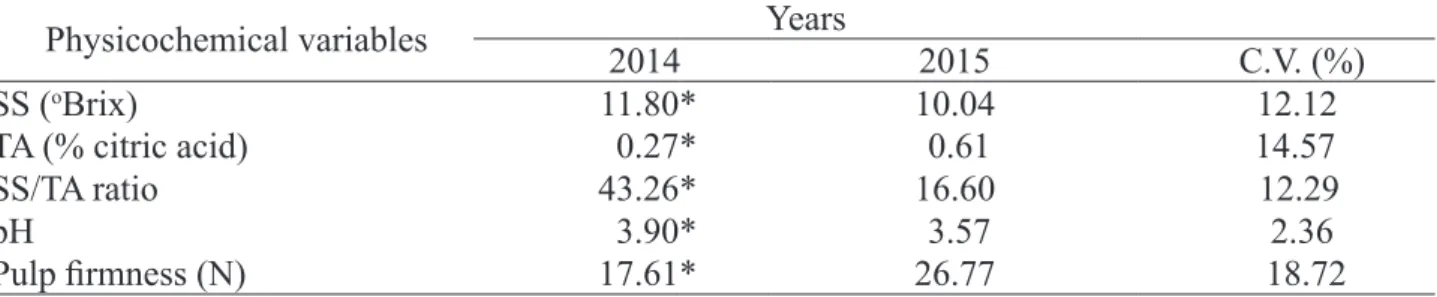
For soluble solids (F = 10.60, p = 0.0044),
titratable acidity (F = 156.16, p < 0.0001), SS/TA ratio (F = 314.46, p < 0.0001), pH (F = 83.56, p < 0.0001) and pulp firmness (F = 29.18, p < 0.0001) only occurred significance for the year main effect (Table 2). In 2014 the fruits obtained higher solids solids contents, SS/TA ratio, pH and, consequently, lower titratable acidity and pulp firmness. This variation may be related to several factors
associated to plant physiology, as well as temperature and precipitation variations (Figure 1). A factor that may be
related to the increase of soluble solids is pulp firmness,
because when higher soluble solids content occurred the
firmness index was lower, the same was also exposed by
Picolotto et al. (2012).
According to Comiotto et al. (2013), evaluating the quality of ‘Maciel’ fruits with the ‘Okinawa’ rootstock, values of 12.28 and 9.69°Brix were found. This content of SS increases as the fruit develops and varies with the cultivar, region and crop season (MAYER et al., 2008). For titratable acidity the highest value was observed in 2015, this variation from one productive cycle to the next may indicate a later maturation (PICOLOTTO et al., 2009). Therefore, the lower the TA concentration in fruits, the higher the consumers perceived sweetness (CRISOSTO,
1999), confirmed by the negative correlation between TA and the SS/TA ratio (r = - 0.94, p < 0.0001).
The SS/TA ratio was 43.26 in 2014 and 16.60
in 2015, probably due to higher average maximum temperatures in the fruit ripening period, between
November and December in the first growing season
(Figure 1). Other authors found a relation of 18.80 and 11.88 searching the same cultivar and rootstock. This higher ratio shows sweet fruits, and the minimum acceptable for commercialization is 11.4 (ARGENTA et
al., 2004; COMIOTTO et al., 2013).
For total carotenoid contents (F = 5.91, p = 0.0163), total phenolic compounds (F = 9.02, p = 0.0041) and antioxidant capacity (F = 12.77, p = 0.0002) interaction occurred among the factors evaluated (Table 3). In 2014, self-rooted ‘Maciel’ plants had a higher concentration of carotenoids, but did not differ from ‘Maciel’+‘Okinawa’ minicutting. In the second year of evaluation not differences were recorded between propagation systems. The evaluated years did not distinguish between themselves for ‘Maciel’+‘Okinawa’ seed. According to Segantini et al. (2012), the carotenoid contents can vary from 0.0435 to 0.0673 mg in 100g-1 of peach pulp, values smaller than those found in this work.
As for the content of phenolic compounds in 2014, ‘Maciel’+‘Okinawa’ minicutting plants had the highest levels and 2015 recorded the same behavior as for total carotenoids. The years were different for all propagation systems tested and in 2014 the values were higher. In 2014 there were lower precipitation and relative humidity records in the period prior to harvesting (Table 3 and
Figure 1), which was responsible for concentrating and increasing these compounds in the fruit.
How much for the antioxidant capacity, the effects
of the propagation systems in the two years were identical to those observed in the total phenolic compounds.
However, only for ‘Maciel’+‘Okinawa’ minicutting was
not recorded difference between years (Table 3). In other evaluations of antioxidant capacity, in the peel and pulp of the fruits of the cultivars Leonense, Maciel and Eldorado, all the samples had the capacity to sequester free radicals, but greater capacity was demonstrated in ‘Maciel’ and
‘Leonense’ (VIZZOTTO et al., 2014; VINHOLES et al.,
2016).
The content of bioactive compounds in fruits and vegetables depends on several factors such as genetic variety, stage of maturation (CAPECKA et al., 2005). It was observed that ‘Maciel’ with clonal origin ‘Okinawa’ rootstock presented the highest averages in the antioxidant capacity, as well as in the phenolic compounds content
in 2014 (Table 3), this relation was confirmed by the
positive correlation between the phenolic compounds and antioxidant capacity (r = 0.97, p < 0.0001).
The use of clonal seedlings by minicutting
influenced positively the concentration of these compounds
in fruits. In addition, it should be noted that the scion
self-rooted ‘Maciel’ becomes an alternative that may benefit
growers and nurseries in order to reduce implantation costs, labor costs and still allow competition with the
market, thus ensuring profitability.
According to Jolliffe (2002), only the first two PCs
were used in the analyzes because they contemplated 70% of the variation both in the comparison of propagation systems in each year (2014 and 2015) and in the
verification of differences between years (Figure 2).
When the analysis was carried out jointly, the formation of distinct groups was observed, showing the differentiation between the years as a function of the dependent variables
evaluated (Figure 2A). The first two principal components
accounted for 73.38% of the total variation, where PC1 was responsible for 54.45% with eigenvalue of 7.08 and PC2 characterized 18.93% of the differentiation with minor eigenvalue (2.46). The other PCs did not contribute
significantly to the differentiation. The variables that
were determinant for the separation of the years with
their respective eigenvectors were the ratio SS/TA (0.36),
titratable acidity (-0.35) and fruit diameter (0.34) for
PC1, and yield (0.51), productive efficiency (0.47) and
trunk diameter (0.44) in PC2. In 2014 higher values were
observed for fruit diameter, soluble solids, pH, SS/TA
ratio and carotenoids and total phenols (Tables 1, 2 and 3 and Figure 2A).
In 2014 the new set of orthogonal variables
(PCs) was generated by the PCA and the first principal
second PC had an eigenvalue of 2.23 and was responsible
for 17.13% of the variance in the data. The first two
principal components explained a large proportion of the total variation, that is, 73.11%, which allowed the plotting of scores and component loads related to the levels of propagation systems tested (Figure 2B). The self-rooted ‘Maciel’ peach plants behaved similar to ‘Maciel’+‘Okinawa’ seed, however both were distant from ‘Maciel’+‘Okinawa’ minicutting. Analyzing the eigenvectors, the variables that contributed to this differentiation were fruit diameter (0.45) in PC1 and
soluble solids (0.50) and productive efficiency (-0.49)
in PC2.
The first two principal components in 2015 explained 70.38% of the total variation, where PC1 accounted for 55.20% with the highest eigenvalue (7.17) and PC2 represented 15.18%, with an eigenvalue of 1.97 (Figure 2C). The propagation systems presented the same behavior observed in the previous year (2014), but the dependent variables that allowed this differentiation were different, analyzing the eigenvectors corresponding to
PC1 was the SS/TA (-0.42) and in PC2 was antioxidant
capacity (-0.38).
Table 2. Soluble solids (SS - oBrix), titratable acidity (TA - percentage of citric acid), SS/TA ratio, pH and pulp firmness (N) of ‘Maciel’ peach trees fruit on 2014 and 2015. Capão do Leão/RS.
Physicochemical variables
Years
2014
2015
C.V. (%)
SS (
oBrix)
11.80*
10.04
12.12
TA (% citric acid)
0.27 *
0.61
14.57
SS/TA ratio
43.26*
16.60
12.29
pH
3.90 *
3.57
2.36
Pulp firmness
(N)
17.61*
26.77
18.72
* Significant by the F test (p≤0.05). C.V.: coefficient of variation.
Table 3. Carotenoids (mg β-carotene 100g-1), phenolic compounds (mg chlorogenic acid 100g-1) and total antioxidant capacity (µg trolox g-1) of ‘Maciel’ peach trees fruit under different propagation systems on 2014 and 2015. Capão
do Leão/RS.
Propagation systems
Years
2014 2015
Total carotenoids
Self-rooted ‘Maciel’ 7.25 * a 4.89 a
‘Maciel’+‘Okinawa’ minicutting 5.69 * ab 3.91 a
‘Maciel’+‘Okinawa’ seed 4.81 ns b 4.89 a
C.V. (%) 17.29
Total phenolic compounds
Self-rooted ‘Maciel’ 232.35 * b 119.59 a
‘Maciel’+‘Okinawa’ minicutting 333.57 * a 122.50 a
‘Maciel’+‘Okinawa’ seed 253.58 * b 117.39 a
C.V. (%) 10.65
Total antioxidant capacity
Self-rooted ‘Maciel’ 3284.7 * b 6826.4 a
‘Maciel’+‘Okinawa’ minicutting 6398.4 ns a 8101.0 a
‘Maciel’+‘Okinawa’ seed 3915.4 * b 6975.0 a
C.V. (%) 15.49
*, ns Significant and not significant, respectively by the F test (p≤0.05) comparing the years in each propagation system. 1/ Means accompanied by
Figure 2.
Plot of PC1-PC2 scores and loads for the dependent variables analyzed together showing the
separation of the years (A) and individualizing 2014 (B) and 2015 (C) to the systems of propagation
Self-rooted ‘Maciel’ (Self), ‘Maciel’+‘Okinawa’ minicutting (Mini) and ‘Maciel’+‘Okinawa’ seed (Seed). Capão
do Leão - RS. Can Vol: canopy volume; Trunk DM: trunk diameter; Prod Effi: productive efficiency; Fruit
DM: fruit diameter; SS: soluble solids; TA: titratable acidity; SS/TA: SS/TA ratio; Antiox Cap: antioxidant
Conclusion
The self-rooted ‘Maciel’ peach plants, in the second year of evaluation, present higher canopy volume, trunk diameter and thus, they express higher yield and
productive efficiency. Fruit quality how much soluble solids, titratable acidity, SS/TA ratio, pH and pulp firmness
are not altered by different propagation systems.
The use of different propagation systems over two
years modifies the levels of carotenoids and phenolic
compounds total and, consequently, the antioxidant capacity of the fruits of ‘Maciel’ peach plants.
Acknowledgements
To the Coordination of Improvement of Higher
Education Personnel (CAPES) for the granting of a
master’s degree scholarship to the first author.
The authors would like to thank the Foundation for Research Support in Rio Grande do Sul (FAPERGS)
and National Council for Scientific and Technological Development (CNPq) for the financial contribution.
References
ARGENTA, L.C.; FLORES-CANTILLANO, F.;
BECKER, W.F. Tecnologias pós-colheita em fruteiras
e caroço. In: MONTEIRO, L. B.; MAY-DE MIO, L.L.; SERRAT, B.M.; CUQUEL, F.L. Fruteiras de caroço: uma visão ecológica. Curitiba: UFPR, 2004. p.333-362.
(2)
BANGERTH, K.F. Possible interferences of pre-harvest
factors with the storage behaviour and quality of fruit.
Acta Horticulturae, The Hague, v.796, n.1, p.19-30,
2008. (1)
BRAND-WILLIAMS, W.; CUVELIER, M.E.; BERSET,
C. Use of a free radical method to evaluate antioxidant activity. Lebensmittel-Wissenschaft & Technologie, Londres, v.28, n.1, p.25-30, 1995. (1)
CAPECKA, E.; MARECZEK, A., LEJA, M. Antioxidant
activity of fresh and dry herbs of some Lamiaceae species.
Food Chemistry, Oxford, v.93, n., p.223-226. 2005. (1)
CARVALHO, F.L.C.; PEREIRA, J.F.M.; RASEIRA,
M.C.B. Pessegueiro. Brasília: Embrapa, 2014. 776p. (2)
COMIOTTO, A.; FACHINELLO, J.C.; HOFFMANN, A.; GALARÇA, S. P.; PREZOTTO, M.E.; HASS, L.B.
Desenvolvimento, produção e qualidade dos frutos de pessegueiros enxertados sobre diferentes porta-enxertos.
Semina: Ciências Agrárias, Londrina, v.34, n.6, supl. 1, p.3553-3562, 2013. (1)
CPACT. Estação Agroclimatológica de Pelotas. Pelotas:
Embrapa Clima Temperado, 2017. Disponível em: <http:// www.cpact.embrapa.br/agromet/estacao/boletim.php>.
Acesso em: 01 nov. 2017. (5)
CRISOSTO, C. H. Optimum procedures for ripening stone fruit. In: MANAGEMENT of fruit ripening. Davis: University of California, 1999. p.28-30. (2)
EMBRAPA. Sistema brasileiro de classificação de Solos. 2.ed. Rio de Janeiro: Embrapa Solos, 2006. 306p. (2)
HADLICH, E.; MARODIN, G.A.B. Poda e condução do
pessegueiro e da ameixeira. In: MONTEIRO, L.B.
MAY-DE MIO, L.L.; SERRAT, B.M.; MOTTA, A.C.; CUQUEL,
F.L. Fruteiras de caroço: uma visão ecológica. Curitiba, UFPR, 2004. p.97-117. (2)
IBGE. Censo agropecuário: lavoura permanente e temporária.Rio de Janeiro, 2015. Disponível em: <http://
www.ibge.gov.br/estadosat/perfil.php?sigla=rs>. Acesso em: 9 set. 2016. (5)
JOLLIFFE, I.T. Principal component analysis. 2nd ed. New York: Springer-Verlag, 2002. 487p. (2)
KÖPPEN, W.; GEIGER, R. Klimate der Erde. Gotha:
Verlag Justus Perthes; 1928. (2)
MAYER, A.N.; MATTIUZ, B.; PEREIRA, F.M. Qualidade pós-colheita de pêssegos de cultivares e
seleções produzidos na microrregião de Jaboticabal-SP.
Revista Brasileira de Fruticultura, Jaboticabal, v.30, n.3, p.616-621, 2008. (1)
PICOLOTTO, L.; MANICA, R.B.; PAZIN, D.; PASA, M. DA S.; SCHMITZ, J.D.; PREZOTTO, M.E.; BETEMPS, D.; BIANCHI, V.J.; FACHINELLO, J.C.; Características
vegetativas, fenológicas e produtivas do pessegueiro cultivar Chimarrita enxertada em diferentes porta-enxertos. Pesquisa Agropecuária Brasileira, Brasília, DF, v.44, n.6, p.583-589, 2009. (1)
PICOLOTTO, L.; SCHMITZ, J.D.; PASA, M. da S.; BIANCHI, V.J.; FACHINELLO, J.C. Desenvolvimento
ROCHA, M.S; BIANCHI, V.J.; FACHINELLO, J.C.; SCHMITZ, J.D.; PASA, M. DA S.; SILVA, J.B. da.
Comportamento agronômico inicial da cv. Chimarrita enxertada em cinco porta-enxertos de pessegueiro.
Revista Brasileira de Fruticultura, Jaboticabal, v.29, n.3, p.583-588, 2007. (1)
SEGANTINI, D.M.; SARITA, L.; LIMA, G.P.P.; COSTA,
S.M.; RAMOS, A.R.P. Caracterização da polpa de pêssegos produzidos em São Manuel-SP. Ciência Rural, Santa Maria, v.42, n.1, p.52-57, 2012. (1)
SWAIN, T.; HILLIS, W.E. The phenolic constituents
of Prunus domestica L. - The quantitative analysis of phenolic constituents. Journal of Science and Food Agriculture, Washington, v.10, n.1, p.63-68, 1959. (1)
TALCOTT, T.S.; HOWARD, R.L. Phenolic autoxidation
is responsible for color degradation in processed carrot puree. Journal of Agriculture and Food Chemistry, Washington, v.47, n.5, p.2109-2115, 1999. (1)
TOMAZ, Z.F.P.; SCHUCH, M.W.; PEIL, R.M.N.; TIMM, C.R.F.; Desenvolvimento de porta-enxertos de pessegueiro
obtidos de miniestacas, em duas épocas, e sistema de cultivo sem solo. Revista Brasileira de Fruticultura, Jaboticabal, v.36 n.4, p.988-995, 2014. (1)
VINHOLES, J.; GELAIN, D.P.; VIZZOTTO, M. Stone
fruits as source of bioactive compounds. In: SILVA, L.R.
da; SILVA, B.M. (Ed.). Natural bioactive compounds from fruits and vegetables as health promoters- Part 1. Vinayagapuram: Bentham Science, 2016. p.110-127.
(2)
VIZZOTTO, M.; ZUANAZZI, A.J.; ROSSATO, S. O
pêssego como um alimento funcional. In: RASEIRA, M.
do C. B.; PEREIRA, J. F. M.; CARVALHO, F. L. C. (Ed.).