E-baby skin integrity: evidence-based technology innovation for
teaching in neonatal nursing
E-baby integridade da pele: inovação tecnológica no ensino de enfermagem neonatal baseado em
evidências
E-baby integridad de la piel: innovación tecnológica en la enseñanza de enfermería neonatal
basado en evidencias
Natália Del Angelo Aredes1
Danielle Monteiro Vilela Dias2 Luciana Mara Monti Fonseca3
Suzanne Hetzel Campbell4 José Carlos Amado Martins5
Manuel Alves Rodrigues5
1. Universidade Federal de Goiás. Goiânia, GO, Brasil.
2. Centro Universitário Claretiano. Batatais, SP, Brasil.
3. Universidade de São Paulo. Ribeirão Preto, SP, Brasil. 4. University of British Columbia. Vancouver, BC, Canadá.
5. Escola Superior de Enfermagem de Coimbra. Coimbra, Portugal.
Corresponding author:
Natália Del Angelo Aredes. E-mail: [email protected]
Submitted on 01/03/2018. Accepted on 05/24/2018.
DOI: 10.1590/2177-9465-EAN-2017-0424
A
bstrActObjective: To develop and validate the serious game e-Baby: skin integrity along with a panel of experts. Method: Methodological
research approaching the following development steps: scope definition, game format and functions, script and communication with software developers, creation of prototype with evaluation and production; and validation by four experts using the tool Heuristic Evaluation for Digital Educational Game. Results: The serious game was built in a 3D technology with multimedia
including animation and scientific-based content. The educational technology was validated by the experts in all heuristics, and among the all 36 analyzed items. 18 (50%) presented no errors, and regarding the remaining items with any error, none had more than 25% errors within levels 3 and 4, according to Nielsen's classification. Conclusion and implications for the practice:
The validated serious game is a virtual simulation educational technology with potential to contribute with learning in nursing
and with evidence-based clinical practice.
Keywords: Educational Technology; Child Health; Preterm; Preterm Infant; Evidence-Based Clinical Practice.
r
esumoObjetivo: Desenvolver e validar o serious game e-Baby: integridade da pele junto a um painel de experts. Método: Pesquisa
metodológica contemplando as etapas de desenvolvimento: definição de escopo, formato do jogo e suas funcionalidades, descrição do roteiro e comunicação com desenvolvedores, prototipagem com avaliação e produção; e validação junto a quatro
experts utilizando o instrumento Heuristic Evaluation for Digital Educational Games. Resultados: O Serious game foi construído em
3D, com multimídia, incluindo animações e conteúdo embasado cientificamente. Validado pelos experts em todas as heurísticas, dentre os 36 itens analisados, 18 (50%) foram considerados isentos de problemas, sendo que em nenhum dos itens houve mais que 25% de problemas classificados nos níveis 3 e 4, segundo a classificação de Nielsen. Conclusão e implicações para a prática: O serious game é uma tecnologia educacional do tipo simulação virtual, validado, e com potencial para contribuir com
a aprendizagem e a prática baseada em evidências.
Palavras-chave: Tecnologia Educacional; Saúde da Criança; Recém-Nascido Prematuro; Prática Clínica Baseada em Evidências.
r
esumenObjetivo: Desarrollar y validar el juego e-Baby: integridad de la piel junto a un panel de peritos. Método: La investigación
metodológica contemplando las etapas de desarrollo: definición de alcance, formato del juego y sus funcionalidades, descripción del guion y comunicación con desarrolladores, prototipaje con evaluación y producción; y validación junto a cuatro peritos
utilizando el instrumento Heuristic Evaluation for Digital Educational Games. Resultados: El serious game fue construido
en 3D con multimedia incluyendo animaciones y contenido basado científicamente. Validado en todas las heurísticas, dentro todos los 36 ítems analizados, 18 (50%) fueran considerados sin problemas, siendo que en ninguno de los ítems ocurrió más que 25% de problemas clasificados en los niveles 3 y 4, segundo la clasificación de Nielsen. Conclusión e implicaciones para la práctica: El juego validado es una tecnología educativa del tipo simulación virtual con potencial para contribuir con el aprendizaje em enfermería y la práctica basada en evidencias.
Palabras clave: Tecnología Educacional; Salud del Niño; Recién Nascido Prematuro; Práctica Clínica Basada en la Evidencia.
INTRODUCTION
With the technological advances and its increasing
incorporation in the daily life of people in Brazil and in the world, impact has also been observed in education, especially since
the advent of the personal computer. Following learning theorists who favor the active role of the student and the preparation of interesting and motivating situations in the process of learning
and teaching by the professor, technological innovations have
been highlighted as resource and support to teaching practice and access to information.1
Although this phenomenon occurs at all levels of education, this work focuses on the nursing course, and highlights its relevance and repercussion in the Brazilian Unified Health System (SUS - Sistema Único de Saúde), either by the number
of professionals working in the area, or by the volume of care and interactions with the community carried out by them daily. Thus,
it is strategic for the success of the health system to improve
the nurses' training processes, actions guided by the Diretrizes Curriculares Nacionais (National Curricular Guidelines).2
Starting from the setting of nursing education built for SUS, it is necessary to look closely at the demands of nurses' clinical practice, so that the gaps can be addressed and solved in
partnership with the academy.
In the area of child health, the theme of prematurity is highlighted, representing the leading cause of neonatal death worldwide (15.4% - 0.965 million). In addition, in view of the fraction represented in the picture of deaths up to five years of age (44% occur in the neonatal period), prematurity becomes the main cause of global infant mortality, surpassing pneumonia.3 Brazil still holds the 10th position in the ranking of countries,
regarding the number of preterm births, corroborating the
relevance of the topic.4
Therefore, it is recognized the need to invest in the qualifi -cation of health professionals for the care provided to preterm
infants, initiating training efforts from undergraduate course by articulating theory and practice, strengthening the evidence-based clinical practice, and offering potentially significant and
motivating learning experiences.
Nursing education based on constructivism, problemati
-zation, the articulation between research, teaching and care,
student autonomy and the relaxation of strategies and learning methods are currently recommended.2,5
In this way, pedagogical planning requires the professor
to increasingly articulate the demands of the context of the
health system and communities, from theory to practice in close collaboration and mutual feedback, and use of creativity
to encourage students belonging to Y generation that potentially prefers to learn through technology.6
In this context, educational technologies are highlighted by offering students fast access to the growing range of information, possibilities of human-computer interaction in multimedia,
making communication easier between peers and between
professors and students, by granting autonomy and flexibility in the search and synthesis of information, for allowing fun and
enhancing the understanding of certain contents.7
To date, resources for nursing teaching-learning subsidies, mediated by computer technology, have been created mainly in countries such as the United Kingdom, Canada and the United States, but more timidly in Brazil. Despite this, initiatives have been presented in the country, developing digital technologies
to strengthen the teaching of both students and nursing
professionals, including health education in the community through these technologies, in the topic of child and adolescent health.8,9
It should be noted that all the educational technologies de -veloped above can be accessed free of charge through the link:
http://gruposdepesquisa.eerp.usp.br/gpecca2/?page_id=23.
The topics listed to guide the development of technologies are based on the demands of society influenced by the epidemiology and scope of the care provided by the nurse in the health system.
The choice of theme was the integrity of the premature
infant's skin, considering the importance of qualifying the care
of the nurse and his/her team in the prevention of infections in
this population, another significant cause of neonatal mortality
considering the incomplete development of the skin that is the
first the body's mechanical and immune defense line.10
Believing in the positive impact of computer technologies
for nursing student learning, the objective of this work was to
develop and validate the e-Baby serious game: skin integrity.
LITERATURE REVIEW
Serious games are compulsory educational games whose entertainment aspect is optional, but prevalent in their creations
due to the graphic or fun aspects inherent to them. They have the
capacity to reproduce board games, cards or other, in addition to being able to mimic real situations, some of them assuming a virtual simulation character, allowing training advantages such as reflection on the practice, possibility of reuse and error in a safe environment, and contact with educational content through
lively and motivating interface.11
Currently, virtual simulation games represent a majority of
the main genres of the educational category.12 Scholars have discussed the importance of innovating strategies and resources
for learning with playability, assigning advantages such as flexibility of time and space for access, possibility of repetition, following user's learning pace and students' satisfaction in
learning from games and other technologies considered to be motivating.9
to implement, since many are not aware how to handle them or
even how to use them in learning settings. Measures of access
to technology, training and technical support become crucial to
overcome them.
As a result of access to devices such as microcomputers
and mobile phones, as well as the Internet, young people have
more encouraging numbers every year: mobile phones between 20 and 24 year olds reach 89.6% (almost as twice as the number
of microcomputers, indicating mobile technology trend), and Internet access reaches values above 80% in the age groups
between 15 and 24 years.13
Like technological devices, serious games have become popular among students due to motivation, and to facilitate the
understanding of some contents due to the animations and
immediate feedback, for eliciting reflections relevant to the practice, and for being a fun and unconventional way of learning.14
This way of learning is mediated by user interaction with
a setting that simulates reality, but because it is virtual, it opens space for experimentation, discovery and reflection on
good practices without risking patient safety.11 As part of the
discussions about the National Patient Safety Policy, virtual
simulation for health courses represents a strategy that aims to prepare students in a safe environment before dealing with the
real patient in the fields of practice, enhancing their relevance in
education.15
It should be noted that, in addition to the development of educational technologies, there is fundamental importance in the
method that guides it and in the validation for its use. Better results will be obtained from the creation of educational technologies
with scientific quality, whose learning objectives are supported
by pedagogical approaches that are appropriate and validated
with experts, and considering the preferences of use and needs
of the target public.
It is necessary to understand educational technology not as an end in itself, nor as a substitution of the professor, but as a tool that supports practice and facilitates the student's learning processes, being able to incorporate nonconventional character
through entertainment and fun.8
Another interesting reflection on the application of games
in education is about the pleasant experiences that can trigger
positive emotions during the study process, maximizing cognitive processes and learning, according to neuroscience studies.16
Thus, it is reiterated the importance of innovation in teaching in the face of the advances of technology, the learning needs and context of the SUS (Brazilian Unified Health System), the way
the university students of this generation study and the alignment
with the critical-reflexive training of nursing.2,8
METHOD
This is a methodological research involving the development and validation of the serious game e-Baby: skin integrity.
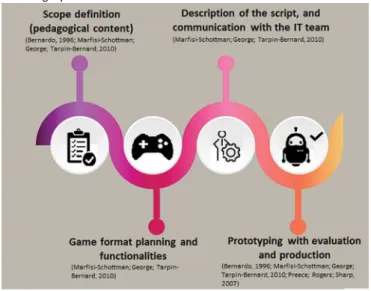
For the development of the serious game, some references of the area were combined, namely: Bernardo (1996) regarding the development of software with multimedia for the health area; Preece, Rogers and Sharp (2007), contributing to the construction of user-centered interactive design; and Marfisi-Schottman, George and Tarpin-Bernard (2010), with specifics for creating
serious games. The development stages are represented by Figure 1 and described in detail below.17-19
Figure 1. Stages of methodological research to develop serious game e-Baby:
skin integrity. Source: The authors.
The validation was carried out with four experts: three nurses from neonatal units with graduate studies related to
neonatology, two of them having experience in the development of digital technologies; and an expert with a baccalaureate diploma in computer sciences, and a master's degree in software engineering and digital educational games, one of the authors of
the tools applied in this research.
The Heuristic Evaluation for Digital Educational Games (HEDEG) was used, translated, adapted and validated for its use
in Brazil. The validation was conducted on May 2016.20 It should be noted that the number of experts involved in this process was
determined according to the recommendation of the Nielsen
benchmark that indicates between 3 and 5 experts to evaluate digital technologies.21
The tool consists of 36 items distributed in five heuristics: interface (10 items), educational elements (6 items), content (6 items), playability (9 items) and multimedia (5 items) 20, and is
summarized in Figure 2.
The experts classified the serious game according to the items of the tool, and evaluated them as shown in Chart 1, according to Nielsen:21
The criterion of validation adopted for the serious game was
an integrative review of the literature on clinical evaluation and skin care of the premature infant.24 For the meeting, which was
the first moment, researchers carefully listened to the nurses' experiences about premature infant's skin care, focusing on daily difficulties and frequent questions of students or professionals about the unit's routine. There was discussion on the theme regarding clinical conditions related to the premature infant's skin, and nursing practices.
The integrative literature review allowed us to gather and
synthesize important data in the premature infant's skin care overview, bringing together important material for
evidence-based clinical practice that has been incorporated into the serious game.24
The scope of the serious game was then defined into: clinical evaluation and care for diaper dermatitis, candidiasis infection, application of antiseptics before venipuncture, hygiene and adhesive handling, puncture and positioning of the temperature
sensor.
Definition of the game format and functionality
The game presents the clinical case of a premature infantthroughout a virtual nurse who narrates the anamnesis' relevant data and history of the clinical evaluation. Next, the challenge
of clinically evaluating the premature infant and promoting nursing care according to the presented problems appears on
the screen. You can see and hear the story again and again,
pausing if necessary.
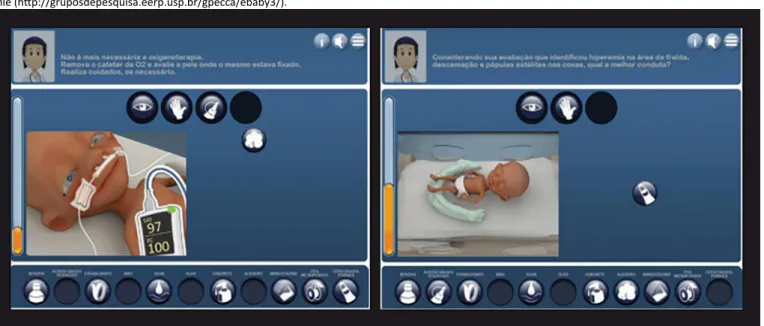
During the clinical evaluation and definition of nursing care, the user selects the tools that he/she deems pertinent, using the drag-and-drop technique, and others are available in the lower bar of the screen. If the chosen tool is not correct, trying to place
it in the empty space on the top bar automatically returns to the
available toolbar and, in some cases, generates informative feedback explaining why the tool is not suitable for the situation, justifying it based on the data obtained in the literature. If the user correctly selects the tools, the game proceeds with an animation simulating the action in a virtual setting, and then there is a question on the screen that requires clinical decision of the user.
Figure 3 below illustrates the tools available on two screens
of the serious game: benzene, essential fatty acids, antifungal medication in ointment (ketoconazole), hydrocolloid, hygiene products such as water, soap and cotton, adhesives such as plaster and microporous tape, and tools indicating inspection
(eye) and action through the use of hands.
There is a left sidebar on the screen that represents the
points obtained in the game. At each hit, there is a visual and
auditory feedback of positive feedback (hit symbol and child
laugh sound) and at each error, there is a negative feedback (error symbol and baby crying sound) shows up. Thus, nursing
students can measure their performance and try to improve on the next move if they wish.
Figure 2. Heuristics and its requirements, according to the Heuristic Evaluation
for Digital Educational Games (HEDEG). Source: Adapted from Valle, Vilela, Parreira Junior, Inocencio.20
Chart 1.
Heuristic usability evaluation, adapted from
Nielsen (1994)
Concept
Description
0
Problem encountered does not necessarily
affect the use
1
Aesthetic problem that does not necessarily
require correction
2
Low priority problem
3
High priority problem
4
Urgent priority problem
Source: Adapted from Nielsen.21
the items of each group to consider the corresponding heuristic
validated, following the definition of cut of punctuation adopted
in another study of technology validation.23
The data analysis used the descriptive statistics with
frequencies to verify compliance with the validation criteria,
mentioned above.
The research was conducted in accordance with Resolution 466 of 2012 and had approval of the Research Ethics Committee, identified by the process 638.277 and used the Informed Consent
Term at the time of data collection with the experts.
RESULTS
The serious game e-Baby: skin integrity was developed with
virtual simulation, which can be called using 3D technology, audio and written text, increasing the inclusion for access and its use.
The development process presented below contemplated the
steps provided and described in the Method section, based on:
Scope definition (pedagogical content)
The game content was defined from a dual approach:
Figure 3. Screens of the serious game e-Baby: skin integrity demonstrating the available and selected toolbars, and the drag-and-drop process. Source: Authors’
file (http://gruposdepesquisa.eerp.usp.br/gpecca/ebaby3/).
Description of the script, and communication with
the development team
The most common situations that could raise questions
among students during theoretical-practical activities in neonatal
units were incorporated into the script, based on the experience
of the researchers and nurses who participated in the stage of
scope's definition, added to the scientific literature researched.
The script design followed the logic of the storyboard and
described from the beginning the functionality, the text and the
expected action. To facilitate communication with the software
development team, it is recommended to present a well-structured, sequential script explaining each desired action and presenting sample images that faithfully represent objects, parts of the human body, and clinical manifestations desired mimic, briefly reporting the intended learning objectives.
Prototyping, evaluation and production
This stage is fundamental to the process of developing educational technologies and consists of analyzing the prototype
in detail, comparing it with the script, and identifying errors, communicating to the technology team, waiting for correction
and re-evaluation.
It is an important moment that requires clear and systematic communication, and suggestions by the software development
team can arise when recognizing opportunities for improvement
in the playability experience, ensuring the achievement of the
objectives with the technology.
In order to avoid costs with corrections in the final product of the serious game, it is recommended prototyping in a simple
drawing sketch, which in this study was developed in Photoshop®,
on the tablet computer for Cintiq model drawing for PC, animated summary simulation and sequence analysis and playability effects
through detailed description. A fundamental and recommended
process for future studies as part of the method, since changes
occurred in the prototype validation process. Figure 4 below
shows examples of e-Baby prototype screens compared to the fi -nal product and designs of the animations that simulated the care.
After final approval, the production was the responsibility of the software development team, using the necessary adjustments and approval of the prototype. Immediately after delivery, the serious game was tested by the researchers confirming the suitability of the final product, proceeding with the validation.
The validity of the serious game was achieved in all items of
all heuristics (interface, educational elements, playability, content and multimedia), and of the 36 items contained in the tool, 18 (50%) were unanimously approved by the experts, without an errors' survey of any kind. Of the others that presented some problem, only seven were raised by more than one evaluator and none of the items presented more than 25% of problems classified as 3 or 4, confirming validation according to adopted criteria.
Graph 1 below represents the overview of absence or existence of problems, with classification of the same when identified by the experts, considering the 36 items of the tool among the five heuristics.
The errors classified in levels 3 or 4 represented in the proportion, among the total, 21% (7 errors) and 3% (1 error), respectively, being expressive the absence of errors or low level
Graphic 1. Identification and classification of problems in HEDEG items by
evaluated heuristics. Ribeirao Preto city, 2016. Source: The authors.
DISCUSSION
The development of the serious game followed the
con-solidated framework in the literature and, during the stages that preceded its production; the importance of qualified research on the subject was emphasized, contributing to the practice based on evidence. Thus, the technology presented in this study makes
it possible for the student to contact national and international
scientific recommendations to guide the care of the premature infant's skin.24
The access to innovative teaching technologies and strate-gies that contemplate health content should be based on the best
scientific evidence, being this fundamental component to reach its educational purpose, and to collaborate with the quality of clinical training and practice. Thus, it is expected that students,
when participating in these experiences in the teaching-learning
process, study in the context of scientific literature and start
practicing on the same basis.25
It is worth discussing that health behaviors are dynamic and change with the advances of research, and it is the task of those
responsible for the development of educational technologies to keep up to date and modify the variables of the game whenever
necessary. If this effort does not occur, the game will become obsolete and will not contribute to education properly, causing
its forgetfulness or inappropriate use.
As for the achievement of the development stages, it was
highlighted the articulation between a team of researchers and
developers, which demands intense communication and requires well-established work processes and timetable, especially in
the production and analysis of script and prototype. A recently
published study reinforces the importance of this communication,
considering the approximation between the teams that determine the success of the tool developed for use and application in teaching.22
The validation process is primordial to ensure the quality of the developed product, especially with a special look at the
pedagogical and usability aspects considering its nature of educational technology.23
It is not possible to decouple the creation of this type of technology from the learning frameworks and objectives, since
these are the basis and the motivation for the development of the
teaching tools, assuming the technology role of transmitter and
not main focus of the creation.
Many studies and initiatives have taken place in the field of the development of digital technologies, motivated by the analysis of effort and investment versus benefits, so that the creation and evaluation processes improve, achieving better results in the final products and their application in teaching. As examples, there is usability analysis and user-centered design, the emotional design
that analyzes human computer linkage through the positive or
negative emotions generated in interaction, participatory design and playability, in the context of computational-based educational
games.9,20,23,26
During validation, the problems encountered focused mainly on levels that do not require corrections, reinforcing that the
serious game was designed in line with the interests of serving
the end user in a useful, enjoyable and educational way. In this way, we discuss in this section the items of heuristics in which problems of level 3 and 4 were identified.
The only item evaluated with level 4 problem corresponds to
the playability heuristic and was pointed out by only one evaluator, referring to item 4 of the JG heuristic (JG4): "Users who have successfully completed a stage of the game are rewarded".20:252
This fact is justified because, for this evaluator, the sidebar of punctuation that fills each hit and the sound of the baby referring to happiness or laughter (different from the sound of crying when there is user error) were not considered rewards, as was the
congratulatory message from the nurse at the end of the game.
Since rewards are a key attribute in digital games, the serious game is in star-gain inclusion analysis, for example, or bonuses
for extra activities.
The other errors discussed were classified as level 3, starting with item IN5 (The elements of the game are able to avoid the user
error).20:251 It is possible to argue that, in the case of a game that
simulates a real situation, it is expected that it is possible for the user to commit errors, maintaining realism. Specifically in the case of e-Baby, the student has the opportunity to learn from his/her error, analyzing the arguments based on scientific literature that is provided in the explanatory feedback, being able to play again immediately after the error with a new chance to hit. However, the system partially avoids errors, so when choosing the tools that are not suitable for the clinical situation presented, the game returns them to the lower bar, indicating that it is necessary to choose
another one to proceed with the animation.
In the aspects of the educational elements, items ED3 ("The elements of the game are created in order to contemplate different levels of learning, for example, beginner, intermediate and advanced") and ED5 ("The game offers the user the possibility of choosing its difficulty level").20:251 In fact, the serious game does
undergraduate students before their first contact with the real baby in the practice fields, therefore, beginners. In spite of this,
it incorporates an increase of complexity in the resolution of the
clinical case, using the temporary change indication feature, that is, if in the clinical evaluation there were no atypical skin characteristics, a few days are spent in the virtual simulator and
the presence of papules and hyperemia.
As for the playability, one of the errors is being analyzed by the team of developers for correction: item JG3 ("Users are able to save games in different states throughout the game").20:252 In
agreement with the experts and with HEDEG, this is an important
feature because it prevents that whenever the user closes the
web page, it can resume the progress made so far.
In contrast, considering the scope of the game, its dynamics and learning objectives, it is not intended to be modified within the scope of item JG8 ("There are elements in the game that
allow the user to communicate with other users as well as
objects of the NPC type Non-player Character, in order to achieve their goals").20:252 There is an NPC-type object in the
game, characterized by the nurse who passes the call on with information necessary to perform the clinical case, but does
not intend to incorporate it as a consistent element to assist the
student in the decisions during the game, maintaining the level of difficulty as planned.
Finally, item JG9 ("The game is able to offer the user the ability to perform more than one task at a time")20:252 was identified
with an error level 3 by an expert, and the justification for not
modifying this one aspect of the educational technology was
that it is not intended to offer the user the possibility of multiple tasks at the same time, but rather to use concentration to achieve each one of them, progressing in learning without distractions.
Analyzing the validation process, it is worth discussing that there are different digital games and that the usability and
playability heuristics may vary depending on the objectives they
carry, requiring further studies in the area to assign weights to the
evaluated items depending on the nature of the game technology.
CONCLUSIONS AND IMPLICATIONS FOR
PRACTICE
The serious game e-Baby: Skin Integrity is a virtual
simulation educational technology validated by experts to
be used with nursing students. The game offers educational
experience that virtually simulates the real challenges of clinical
practice with the premature infant, aiming at better preparation
of students in a safe environment and study opportunity that precedes the actions in the neonatal unit.
It is valid as to its interface, if it is pleasant and easy to understand for the user; in relation to the educational elements, being compatible with the learning objectives that it proposes; in terms of content, considering scientific bases that guide the practice learned in the game; in front of the playability
heuristic, contemplating aspects of entertainment and, finally, of multimedia, considering the suitability of the graphical features
that it presents in 3D technology and simultaneous use of sound and text.
As the study limitation, we present the non-inclusion of nursing students, the final public, in the process of developing the serious game, corresponding to the so-called participatory design. Thus, it is suggested that future studies whose objective is the creation of digital educational technologies, incorporate
such practice from the conception of the prototype.
We believe that the serious game e-Baby: skin integrity can contribute as a resource to support teaching practice and the teaching-learning process also from the perspective of the
student, offering a differentiated tool to study and simulate real situations. It is an educational technology that can be repeated and used in any device with internet access, allows errors
and enables further attempts with immediate and informative
feedback support, and includes evidence from the health area for epidemiologically relevant problems, maximizing its use in training for the SUS.
REFERENCES
1. Pelizzari A, Kriegl ML, Baron MP, Finck NTL, Dorocinski SI. Teoria da Aprendizagem Significativa Segundo Ausubel. Rev PEC (Curitiba) [Internet]. 2002 Jul;2(1):37-42. Available from: http://portaldoprofessor.
mec.gov.br/storage/materiais/0000012381.pdf
2. Ministério da Educação (BR). CNE/CSE. Resolução Nº 3 de 7 de novembro de 2001. Institui Diretrizes Curriculares Nacionais do Curso de Graduação em Enfermagem. Brasília (DF): Ministério da Educação;
2001.
3. Liu L, Oza S, Hogan D, Perin J, Rudan I, Lawn JE, et al. Global, regional, and national causes of child mortality in 2000-13, with projections to
inform post-2015 priorities: an updated systematic analysis. Lancet
[Internet]. 2015 Jan;384:430-40. Available from: https://www.ncbi.nlm. nih.gov/pubmed/?term=3.%09Liu+L%2C+Oza+S%2C+Hogan+D%2 C+Perin+J%2C+Rudan+I%2C+Lawn+JE%2C+Cousens+S%2C+Ma thers+C%2C+Black+RE.+Lancet.+2015
4. World Health Organization (WHO). Born too soon: the global action report on preterm birth. Geneva: World Health Organization; 2012. 5. Freire P. Pedagogia do oprimido. 62ª ed. Rio de Janeiro: Paz e Terra;
2016.
6. Reinaldo F, Magalhães DR, Reis LP, Gaffuri S, Freddo A, Hallal R. Impasse aos Desafios do uso de Smartphones em Sala de Aula: Investigação por Grupos Focais. RISTI Rev Iber Sist Tecnol Inf [Internet]. 2016;19(9):77-92. Available from: http://www.scielo.mec.pt/pdf/rist/n19/
n19a07
7. Watts L. Synchronous and Asynchronous Communication in Distance Learning: A Review of the Literature. Quart Rev Dist Educ [Internet]. 2016;17(1):23-32. Available from: https://eric.ed.gov/?id=EJ1142962 8. Aredes NDA, Góes FSN, Silva MAI, Gonçalves MFC, Fonseca LMM.
Digital object in neonatal nursing: impact on student's learning. Rev Eletr Enferm [Internet]. 2015 Oct/Dec;17(4):1-10. Available from: https://
www.fen.ufg.br/revista/v17/n4/pdf/v17n4a10-en.pdf
9. Fonseca LM, Dias DM, Góes Fdos S, Seixas CA, Scochi CG, Martins JC, et al. Development of the e-Baby serious game with regard to
the evaluation of oxygenation in preterm babies: contributions of the
10. Carlidge P. The epidermal barrier. Semin Neonatol [Internet]. 2000 Nov;5(4):273-80. Available from: https://www.ncbi.nlm.nih.gov/pubm ed/?term=10.%09Carlidge+P.+The+epidermal+barrier.+Semin+Neon atol+2000%3B+5(4)%3A273%E2%80%9380
11. Fonseca LMM, Aredes NDA, Scochi CGS. Simulação em ambiente virtual de aprendizagem: inovação na área de enfermagem neonatal. In: Mendes IA, Mazzo A, Martins JCA, orgs. Simulação no ensino de enfermagem: bases teóricas. Ribeirão Preto: Sociedade Brasileira de Comunicação em Enfermagem (SOBRACEn); 2014. p. 241-57. 12. Boyle EA, Hainey T, Conolly TM, Gray G, Earp J, Ott M, et al. An
update to the systematic literature review of empirical evidence of the impacts and outcomes of computer games and serious games.
Comput Educ [Internet]. 2016 Mar;94:178-92. Available from: https:// www.sciencedirect.com/science/article/pii/S0360131515300750 13. Instituto Brasileiro de Geografia e Estatística (IBGE) (BR). Pesquisa
Nacional por Amostra de Domicílios. Síntese de Indicadores. Informação e Documentação. Rio de Janeiro: Instituto Brasileiro de Geografia e Estatística; 2016.
14. Ferguson C, Davidson PM, Scott PJ, Jackson D, Hickman LD. Augmented reality, virtual reality and gaming: an integral part of nursing. Contemp Nurse [Internet]. 2015;51(1):1-4. Available from: https://www. ncbi.nlm.nih.gov/pubmed/?term=Augmented+reality%2C+virtual+reali ty+and+gaming%3A+an+integral+part+of+nursing.+Contemporary+N urse.+2015%3B51(1)%3A1%E2%80%934
15. Ministério da Saúde (BR). Portaria Nº 529, de 1 de abril de 2013. Institui o Programa Nacional de Segurança do Paciente (PNSP). Brasília (DF): Ministério da Saúde; 2013.
16. Vogel S, Schwabe L. Learning and memory under stress: implications for the classroom. Sci Learn [Internet]. 2016;1(16011):1-10. Available from: https://www.nature.com/articles/npjscilearn201611.pdf. DOI: 10.1038/
npjscilearn.2016.11
17. Bernardo V. Metodologia para desenvolvimento de projeto multimídia aplicado ao ensino da medicina [dissertação]. São Paulo: Universidade Federal de São Paulo; 1996.
18. Preece J, Rogers Y, Sharp H. Interaction Design: Beyond Human Computer Interaction. New York: John Wiley & Sons; 2007.
19. Marfisi-Schottman I, George S, Tarpin-Bernard F. Tools and Methods for Efficiently Designing Serious Games. In: Proceedings of the 4th European Conference on Games Based Learning ECGBL; 2010 Oct 21-22; Copenhagen, Denmark.
20. Valle PH, Vilela RF, Parreira Junior PA, Inocencio CG. HEDEG - Heurísticas para Avaliação de Jogos Educacionais Digitais. In: Nuevas Ideias en Informática Educativa TISE. Anais da XVIII Conferência Internacional sobre Informática na Educação. 2013 Dec 9-11; Porto Alegre, RS, Brasil. p. 247-56.
21. Nielsen J. Usability Inspection Methods Conference companion on Human factors in computing systems. In: Proceedings of CHI '94 Conference Companion on Human Factors in Computing Systems; 1994 Apr 24-28; Boston, MA, USA.
22. Diehl LA, de Souza RM, Gordan PA, Esteves RZ, Coelho IC. Gaming Habits and Opinions of Brazilian Medical School Faculty and Students: What's Next? Games Health J [Internet]. 2014 Apr;3(2):79-85. Available from: https://www.ncbi.nlm.nih.gov/pubmed/?term=Gaming+Habits+an d+Opinions+of+Brazilian+Medical+School+Faculty+and+Students%3 A+What%E2%80%99s+Next%3F
23. Góes FSN, Fonseca LMM, Furtado MCC, Leite AM, Scochi CGS. Avaliação do objeto virtual de aprendizagem "Raciocínio diagnóstico em enfermagem aplicado ao prematuro". Rev Latino Am Enferm [Internet]. 2011;19(4):8 telas. Available from: http://www.scielo.br/pdf/rlae/v19n4/pt_07.pdf 24. Aredes NDA, Santos RCA, Fonseca LMM. Skin care of premature
newborns: integrative review. Rev Eletr Enferm [Internet]. 2017;19:1-25.
Available from: https://www.revistas.ufg.br/fen/article/view/43331/25159
25. Ryan M, Holland M. Preparing Prelicensure Nursing Students for Clinical Practice in Pediatric Acute Care Settings and Interprofessional in Situ Simulation. In: Campbell SH, Daley KM. Simulation Scenarios for Nursing Educators: Making it Real. 3rd ed. New York: Springer; 2017. 26. DeSmet A, Thompson D, Baranowski T, Palmeira A, Verlogine M,