Essential oil of
Pterodon polygalae
fl
orus
Benth
attenuates nociception in mice
A.N. Coelho-de-Souza
1, C.F. dos-Santos
1, L.N. Lopes-Filho
2, F.R. Holanda
1, A.C. Oliveira
1,
Y.A. Gomes-Vasconcelos
1, K.A. Oliveira
1, F.W. Ferreira-da-Silva
3, K.S. Silva-Alves
1and
J.H. Leal-Cardoso
11Laboratório de Fisiologia Experimental, Instituto Superior de Ciências Biomédicas, Universidade Estadual do Ceará,
Campus do Itaperi, Fortaleza, CE, Brasil 2Centro Universitário Christus, Fortaleza, CE, Brasil 3Curso de Engenharia Civil, Centro de Ciências Exatas e Tecnologia, Universidade Estadual Vale do Acaraú,
Campus CIDAO, Sobral, CE, Brasil
Abstract
Essential oils (EO) are volatile liquids responsible for the aroma of plants. Pterodon polygalaeflorus seeds have received
widespread use in folk medicine for the treatment of inflammatory diseases. For this reason and because Pterodon polygalaeflorusseeds have great EO content, which is frequently pharmacologically active, the present study aimed to evaluate the antinociceptive effect of EO fromPterodon polygalaeflorus(EOPPgfl) and its acute toxic effects. The EEOPPgflsample,
which was extracted by steam distillation of the seeds, had a yield of 2.4% of the seeds weight and had, as major constituents, beta-elemene (48.19%), trans-caryophyllene (19.51%), and epi-bicyclosesquiphellandrene (12.24%). The EOPPgfl sample showed mild acute toxicity and its calculated median lethal dose (LD50) was 3.38 g/kg. EOPPgfl (20–60 mg/kg) showed antinociceptive activity as evidenced by several tests and inhibited writhing induced by acetic acid. The maximum effect was obtained with the 30 mg/kg dose and at 60 min after its administration. EOPPgflalso decreased formalin-induced nociception, as verified by the inhibition of thefirst and second phase of the formalin test. At 30 mg/kg, EOPPgflalso decreased thermally stimulated nociception. Nociception may be related to inflammatory and antiedematogenic activity and at doses ranging 10–100 mg/kg, EOPPgflblocked dextran- and carrageenan-induced edema. The results demonstrated that EOPPgflpresented, at doses approximately 100 times smaller than LD50, an antinociceptive effect that probably was due to anti-inflammatory activities.
Key words: Essential oil;Pterodon polygalaeflorus; Antinociception; Anti-inflammatory activities; Beta-elemene; Caryophyllene
Introduction
Aromatic formulations have been used throughout human history for spiritual, social, and medicinal purposes. For medicinal purposes, they are not usually used as essential oils but mainly as infusions, teas, and incense (1). Essential oils (EO) are volatile and oleaginous liquids with usually pleasant aromas that provide odor to plants (2). EO of aromatic plants from Northeast Brazil have been studied from the chemical (3,4) and pharmacologic point of view (1,3,5,6) showing great potential for ther-apeutic use. Northeastern flora is abundant in aromatic species, whose EO consist of a mix of compounds, mostly phenylpropanoic and terpene derivatives. This chemical complexity allows EO to have several biological effects, such as antiparasitic (7), antimicrobial (8), analgesic and inflammatory (9), diuretic and hypotensive (10), anti-malarial (11), gastro-protector (1,6), cell excitability inhibi-tor (12–14), among others.
Pterodon polygalaeflorusBenth orCommilobium poly-galaeflorus, popularly known as‘‘sucupira branca’’(white sucupira), is a tree common in the Brazilian Northeast region and abundant in Maranhão and Piauí states (15,16). It has great regional importance because of the widespread use of its shell and seeds in popular medicine as hydro-alcoholic infusions for the treatment of chronic diarrhea (16), pharyngitis (15), and chronic pain and inflammation, such as in arthritis (17) and rheumatic diseases.
The chemical composition and pharmacological effects of the essential oil of Pterodon polygalaeflorus Benth (EOPPgfl) seeds have been previously investigated (15,16). It has demonstrated antispasmodic action on tracheal smooth muscle by blockade of voltage-operated calcium channels (15) and on intestinal smooth muscle by myogenic mechanisms, mainly mediated through an intracellular mechanism (16).
Correspondence: J.H.L. Cardoso:<[email protected]>
Due to its popularity in the treatment of inflammatory diseases, its previously observed pharmacological activ-ity, and the great EO yield of the seeds, the present study aimed to evaluate the antinociceptive effect of a new sample of EOPPgflin experimental models of pain and the acute toxic effects in order to seek new substances with therapeutic potential.
Material and Methods
Extraction and chemical analysis of EOPPgfl
EOPPgflwas extracted from the seed ofP.
polygalae-florusBenth collected in the municipality of São Raimundo das Mangabeiras, Maranhão state in February 1999 by steam distillation method. Chemical composition was deter-mined by gas chromatography coupled to mass spectrom-etry in the Technological Development Park of Federal University of Ceará (PADETEC-UFC) by Craveiro (18), as previously described. Briefly the conditions were as follows: Hewlett-Packard 6971 (USA); dimethylpolysiloxane DB-1 fused silica capillary column (30 m 0.25 mm; 0.1mm); helium (1 mL/min) as carrier gas; injector temperature: 250°C; detector temperature: 200°C; column tempera-ture: 35–180°C at 4°C/min and then 180–250°C at 10°C/min;
and mass spectra: electronic impact 70 eV. The compounds were identified using a NIST mass spectral library search (more information on https://chemdata.nist.gov/).
Drugs
All drugs were of analytical purity. Dextran, carragee-nan, histamine, and serotonin were from Sigma Chemical Company (USA). Cyproheptadine, formaldehyde, acetic acid, indomethacin, morphine, and naloxone were from Cinética Química Ltda. (Brazil).
Solutions were prepared by adding the pure substance to sterile saline (0.9% NaCl w/v). EOPPgflwas prepared in sterile saline, containing Tween 80, 0.1% v/v, followed by automatic stirring. After homogenization, the solution was administered by the orogastric route.
Animals
This study complied with the ethical principles for animal research. Swiss mice (25–30 g) from the Central
Vivarium of Federal University of Ceará were kept under constant temperature (22±2°C) with a 12 h light/12 h dark cycle and free access to food and water in the Laboratory of Electrophysiology of Excitable Tissue 1–3 days prior to
the experiment. The study was done from 2000 to 2002.
Assessment of acute toxic effects
The evaluation of acute toxic effects was done by determination of the median lethal dose (LD50) and
obser-vation of changes in behavioral parameters.
To determine LD50, the animals were randomly
sepa-rated into 6 groups: 1 control and 5 experimental groups. Each experimental group received, through orogastric
cannula, different concentrations of EOPPgfl (1–8 g/kg).
The control group received only vehicle (0.1% Tween 80 in 0.9% saline). The animals were then placed in cages with water and feedad libitumand observed for a period of 72 h. After this period, the number of deaths in each group was observed and reported as percentage of the total number of animals. Calculation of LD50was done by
semi-logarithmic interpolation, where the EOPPgfldoses were plotted on the abscissa axis and the values corresponding to the probit percentage of deaths on the ordinate axis.
To evaluate changes in behavioral parameters, ani-mals were randomly separated in 5 experimental groups (10 animals/group). The animals were initially observed for 72 h for the following behavioral parameters: alertness, analgesia, spontaneous motor activity, locomotion, seda-tion, response to touch, nasal secreseda-tion, piloerecseda-tion, ptosis, dyspnea, urination, diarrhea, and seizure. They were then treated with the same doses of EOPPgfl or vehicle and observed for the same parameters during thefirst 3 h and, at 24-h intervals, for 72 h.
Antinociceptive activity
To evaluate the EOPPgflanti-nociceptive activity, the acetic acid-induced writhing test (19), the paw-licking response to the formalin test (20), and the hot plate test (21) were used.
For the writhing test, different groups of animals (n = 8–10 animals/group) received EOPPgfl (10–100 mg/kg,
orally) or vehicle (0.1% Tween 80 in sterile saline, orally), 60 min before, or indomethacin (10 mg/kg, ip), 30 min
before noxious stimulation withip injection of acetic acid (0.6% v/v; 0.1 mL/10 g body weight). Then, abdominal writhes were recorded for 20 min, starting 10 min after acetic acid injection. In another experimental series, a time course for the effect of the oil (30 mg/kg, orally) administered 15, 30, 60, and 120 min before noxious stimulation was carried out. Antinociceptive activity is reported as the number of abdominal constrictions.
For the formalin test, different groups of animals received EOPPgfl(10–100 mg/kg) orally or vehicle, 60 min
before the treatment with 20 mL of formalin (2.5% v/v) administered into the sub-plantar region of the right hind paw. The time the animal spent licking the paw during the first 5 min (early phase) and from 15 to 30 min (late phase) post-formalin injection served as measures of sensitivity. The test was done at ambient temperature of 22–26°C
and care was taken to exclude environmental disturbance (high temperature, noise, and excessive movement) that might interfere with the animal’s response. In another experimental series, a group of animals received naloxone (2 mg/kg, sc), an opioid antagonist, 15 min before
treat-ment with oil (60 mg/kg orally) or morphine (5 mg/kg,sc). After 30 min of morphine administration, the formalin test was performed.
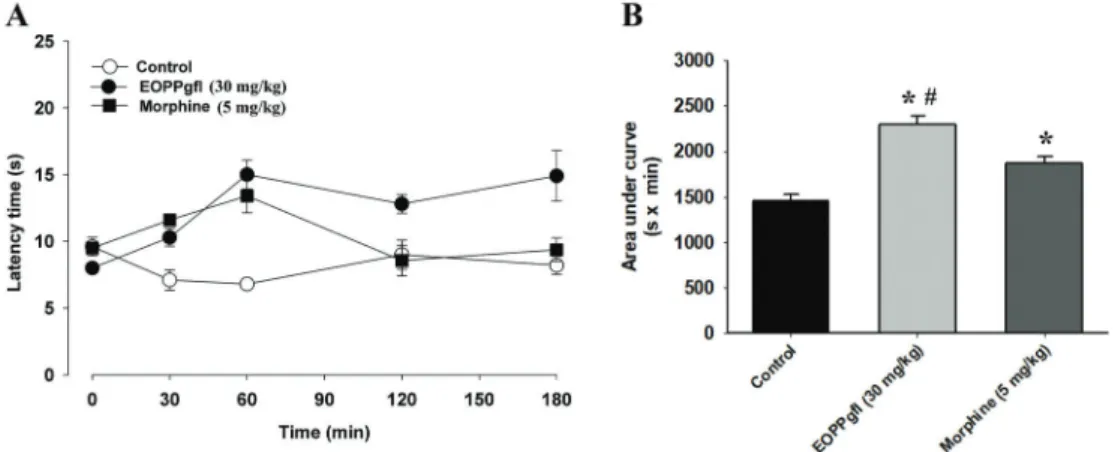
this nociceptive stimulus (number of seconds before it licked its hind paw or jumped) was quantified, with an interruption timep45 s. The test used only mice that in a pretest showed a hot plate reaction timep20 s. The latency of the reaction to nociception was measured at time 0 (60 min after EOPPgfl, 30 mg/kg, or vehicle administration) and then at 30 min intervals up to the 180th min.
Antiedematogenic activity
Antiedematogenic activity of EOPPgfl was evaluated by the carrageenan-, dextran-, or formalin-induced paw edema test.
In order to obtain carrageenan- and dextran-induced paw edema, the phlogistic agents (both 300mg/paw) were injected into the sub-plantar region of the right hind paw. The contralateral paw received an equal volume of sterile saline. The animals received EOPPgfl (10–60 mg/kg)
orally or vehicle. Indomethacin (10 mg/kg, ip) or
cypro-heptadine (10 mg/kg,ip) were used as positive controls. The time course of the carrageenan-induced paw edema was considered to have three phases: a first (from 1 to 90 min), a second (from 91 to 150 min), and a third phase (from 151 to 240 min) (22). For formalin-induced paw edema, the same animals submitted to the nociception test were used. In these animals, formalin (20mL of 2.5% formalin) was injected sc into the right hind paw. The animals received EOPPgfl (60 mg/kg) orally or vehicle. Paw licking was then measured during the first 5 min (considered as thefirst phase of formalin test) and at 15 min after the formalin injection (considered as the second phase of the test).
Paw edema volumes for antiedematogenic activity tests were measured with a plethysmometer (Panlab, S.L. U., Digital Water Plethysmometer Le 7500, Spain). Edema was considered to be the difference in volume between two paws, among the different time-periods and time zero.
Statistical analysis
All data are reported as means±SE, where n is the number of experiments. The difference between two groups was assessed by the unpaired Student’st-test. The
sig-nificance (Po0.05) of the results that demanded multiple
comparisons was initiated with the Kolmogorov-Smirnov test for normality of data distribution. In the cases in which normality was rejected, Kruskal-Wallis one-way ANOVA on ranks followed by Dunn’s post hoc test was done; otherwise parametric one-way ANOVA followed by Bonfer-roni or Holm-Sidakpost hoctest was employed. For each experimental series analyzed and parametric data, the ANOVA parameters d.f.1(degree of freedom related to the
number of independent variables, between groups), d.f.2
(degree of freedom related to the number of observations in each group, within group), and F (ratio of the mean square variation estimates of data between groups and within group) were used. For non-parametric data, ANOVA on rank parameters d.f. (degree of freedom) and H (value computed by ranking all observations from smallest to largest without regard to treatment group) was used. Po0.05 was considered significant for allpost hoctests. Statistical analysis was done using Sigma Stat and Sigma Plot software (Systat Inc., USA).
Results
Extraction and chemical analysis of EOPPgfl
The oil extracted by steam distillation of seeds gave a yield of 2.4% weight. In the oil sample, seven sesqui-terpenes (with % of oil weight) were identified: beta-elemene (48.19%), trans-caryophyllene (19.51%), epi-bicycloses-quiphellandrene (12.24%), gamma-elemene (4.44%), alpha-copaene (4.13%), alpha-humulene (3.32%), alloaro-madendrene (2.45%); and two alcohols: (3.17%) spatulenol and (2.55%) farnesol.
Toxic effect of EOPPgfl
As can be seen in Table 1, no death occurred in animals treated with doses of EOPPgflbelow or equal to 3 g/kg. However, at doses above 3 g/kg, toxic signs such as lethargy, motor incoordination, tachypnea, ptosis, and asphyxia were observed and the calculated LD50was 3.38 g/kg.
Antinociceptive activity
EOPPgfl (20, 30, and 60 mg/kg) and indomethacin (10 mg/kg) significantly reduced (Po0.05, ANOVA, Dunn test) writhing number from 51.9±1.62 counts (n=10) (control value)
Table 1.Symptoms and deaths of animals treated with essential oil ofPterodon polygalaeflorus(EOPPgfl).
Group Dose (mg/kg) Deaths Symptoms
Control - 0 none
EOPPgfl 1000 0 none
2000 0 none
3000 0 Lethargy, motor incoordination and anesthesia
4000 n=5 (62.5%) Lethargy, motor incoordination and anesthesia 8000 n=5 (62.5%) Motor incoordination, tachypnea and asphyxia
to 35.2±2.64 (n=10), 25.9±2.32 (n=10), 31.2±5.8, and 7.5±2.8 counts (n=8), respectively (Figure 1A). This reduc-tion corresponded to 32.2, 50.1, 39.8, and 85.5%. The effect of EOPPgfl was time-dependent since EOPPgfl (30 mg/kg), administered 15, 30, 60, or 120 min prior to the time of writhing measurement, induced writhing reduction that amounted to 27.0, 37.7, 46.8, and 31.2%, respectively. The EOPPglf-induced writhing reduction is shown in Figure 1B; the reduction was significant at 30 and 60 min.
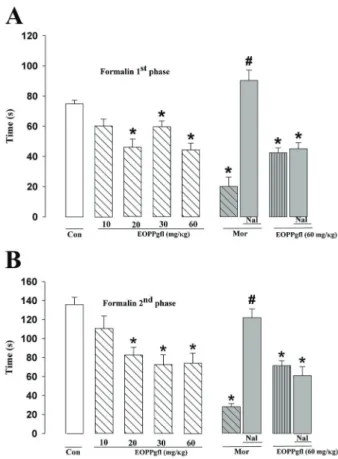
In the formalin test, EOPPgfl(20, 30, and 60 mg/kg) significantly reduced the time the animal spent licking its paw in both phases of the test (Figure 2A and B) com-pared to the control (1st phase 74.85±2.26 s (n=8) and
the 2nd phase 135±7.61 s (n=8)). At the dose of 20 mg/kg, for thefirst (Figure 2A) and second phase (Figure 2B), the time of licking was reduced to 46.1 and 82.6 s, respectively, at the dose of 30 mg/kg, to 59.7 and 72.6 s (n=7), and at the dose of 60 mg/kg, to 44.3 and 74.1 s (n=7). This effect was not altered (P40.05, ANOVA) by subcuta-neous injection of naloxone, an antagonist of opioid receptor (Figure 2A and B).
As assessed by the hot plate test, EOPPgfl signifi -cantly increased the latency time for nociceptive response to the thermal stimulus starting at 30 min and spanning throughout the observation period of 180 min. The peak of EOPPgfleffect occurred at 60 min when the latency time Figure 1. Effect of essential oil of Pterodon polygalaeflorus
(EOPPgfl) on acetic acid-induced writhing.A, Effect of several doses (10–300 mg/kg, orally) of EOPPgfland of indomethacin (Ind, 10 mg/kg,ip) on the number of writhings; EOPPgfland Ind were administered 60 and 30 min, respectively, before acetic acid administration. Ten min after acetic acid administration, the writh-ings were counted during 20 min. Con: control.B, Time course of the EOPPgfl effect (30 mg/kg, orally). Each animal received a single dose of EOPPgfl. Data are reported as means±SE (n=8
–10). A, *Po0.001 compared to control;#Po0.001 compared to 30 mg/kg EOPPgfl(one-way ANOVA, d.f.1=7, d.f.2=60, F=17.931, followed by Holm-Sidakpost hoctest).B, *P=0.002 compared to control (Kruskal-Wallis ANOVA on ranks, d.f.=4, H=16.923, followed by Dunn’spost hoctest).
Figure 2. Effect of essential oil of Pterodon polygalaeflorus (EOPPgfl) on formalin test. Effect of several doses (10–60 mg/kg, orally) of EOPPgfl, morphine (Mor; 5 mg/kg,sc), and naloxone (Nal; 2 mg/kg,sc) on paw licking from 0 to 5 min (1st phase of formalin test; panel A) and from 15 to 30 min (2nd phase of formalin test; panelB) after formalin administration (intraplantar injection of 20mL of 2.5% formalin (v/v) solution in distilled water). Con, control (intra-paw injection of 20 mL of saline). Data are reported as means±SE (n=8).A, *Po0.001 compared to control; #P
o0.001 compared to Mor (Kruskal-Wallis ANOVA on ranks, d.f.=8, H=43.151 followed Dunn’s post hoctest).B, *Po0.001 compared to control; #P
increased from 6.5 (control value) to 15.0 s. The effect of EOPPgfl was similar to that of morphine, although the effect of the oil lasted longer (Figure 3).
Antiedematogenic activity
EOPPgfl significantly inhibited the carrageenan-induced edema from the 30th to the 240th min of the experiment (Figure 4A1 and A2). At the three phases of carrageenan-induced edema, the paw volume increase underwent inhibition with all EOPPgfldoses, as demon-strated by the decrease of the area under the curve of Figure 4A2. At doses of 100 mg/kg, the effect of EOPPgfl was similar to the effect of indomethacin (inhibition of 80%). EOPPgfl at 30 and 60 mg/kg also inhibited the edema induced by dextran (Figure 4B) and at 60 mg/kg inhibited formalin-induced edema (2.5%) (Figure 4C). In the edema induced by dextran, the effect of EOPPgfl (30 and 60 mg/kg) occurred throughout the observation period and was similar to the effect of cyproheptadine. EOPPgflat 60 mg/kg produced a 55.7% inhibition of the edema caused by formalin.
Discussion
This study was designed to evaluate the antinocicep-tive, antiedematogenic, and acute toxic effects of EOPPgfl in experimental models of pain and inflammation. The results demonstrated that EOPPgfl, with the chemical composition here described, presented very low acute toxicity and antinociceptive effects, probably due to anti-inflammatory activities.
The sample ofP. polygalaefllorusseeds of the present investigation produced the same yield (2.4% of EO) found by Evangelista et al. (15) and Leonhardt et al (16), thus confirming the great EO yield of the seeds. It is also worth mentioning that this yield was obtained using a cheap and
easy method of EO extraction: steam distillation (23). The chromatographic analysis identified 100% of the com-pounds, predominantly sesquiterpenes, which largely differed from that of the previous investigation (15,16). In the present case, there was a major constituent (beta-elemene, 48.2%, followed by trans-caryophyllene, 19.5%), whilst in the previous study a major constituent was not identified (b-cariophyllene, 20.6%, followed by spatulenol, 16.6%). This is not surprising, since it is known that EO compositions differ with the place and season of collection (2); the time of collection of the present and previous samples differed (February vs October, respectively).
Since there is a large difference in chemical composition and it may affect the pharmacological results, care should be taken to obtain the appropriate EOPPgflsample.
The results demonstrated that the calculated LD50for
EOPPgfl, given orally, was 3.4 g/kg allowing the oil to be classified within the category of low-toxicity essential oils (2) and to be considered a safe oil regarding acute toxic aspects. It is important to note that the doses that inhibit nociception and edema formation in the various models tested are in the range of 10–100 mg/kg, which represent
doses below 3% of LD50. Thus, EOPPgfl can be
con-sidered to have high therapeutic potentiality. Moreover, this study also showed that EOPPgfl possesses anti-nociceptive activity on chemical and thermal nociception models.
In the hot plate test, 30 mg/kg EOPPgflincreased the latency time to the thermal stimulus. This test of thermal nociception is a good method for measuring the effects of opioid analgesics but it is not sensitive to the analgesic effects of nonsteroidal anti-inflammatory agents (24,25). EOPPgfl increased the response time to the thermal stimulus in the hot plate test, suggesting that EOPPgfl acted primarily at the spinal medulla and/or higher central nervous system levels (20), but not excluding an indirect
mechanism. In order to investigate the participation of an indirect mechanism of the effect of EOPPgfl, its action in acetic acid-induced writhing and in the formalin tests was investigated and the oil showed antinociceptive effects in both tests.
Acetic acid-induced writing is a model sensitive to analgesic substances of central or peripheral action, allow-ing the assessment of varied mechanisms of action (19). Acetic acid causes the release of endogenous mediators such as PGE2 and PGF2a, histamine, bradykinin, and serotonin and stimulates the nerve endings directly by pH reduction (1). Therefore, the effectiveness of EOPPgfl in decreasing acetic acid-induced contortions, although sug-gesting an involvement of primarily neural mechanisms, does not exclude a antinociceptive effect of EOPPgfldue to anti-inflammatory activity, secondary to inhibitory action on the phlogistic activity of autacoids such as histamine, serotonin, and/or prostaglandin. Despite a dose-dependent relationship, EOPPgfldoses above 60 mg/kg no longer had a significant antinociceptive effect in acetic acid-induced
writhing, which was surprising. Although we do not have a clear explanation for thisfinding, it can be suggested that in these doses, some components of EOPPgflsomehow prevent the action of the constituent promoting antinoci-ceptive activity. Although pronounced, the effect of EOPPgfl was lower than that caused by indomethacin (10 mg/kg,ip), a peripherally acting drug that inhibits prostaglandin synthesis
and/or alteration of central processing (25,28,29). In the formalin test, EOPPgfl was effective in both first and second phases of the test. The effectiveness of EOPPgflduring thefirst phase of formalin test suggests a peripheral neural mechanism. On the other hand, the effectiveness EOPPgflduring the second phase of formalin test is consistent with an anti-inflammatory action and/or alteration of central processing. In these effects, there was probably no involvement of opioid receptors since they were not blocked by naloxone (30), which blocked the effect of morphine.
Velozo et al. (31) showed thatP. polygalaeflorushas
anti-inflammatory activity by modulation of B cells and lymphocyte activation. Due to the effect of EOPPgfl in the second phase of the formalin test and because of the medicinal use ofP. polygalaeflorus seed extracts for the treatment of inflammatory diseases, we hypothesized that EOPPgfl acted by a mechanism that includes an indirect anti-inflammatory effect. Thus, in order to inves-tigate the participation of an anti-inflammatory mechanism of EOPPgfl, the effectiveness of EOPPgflin paw edema induced by noxious stimulation was investigated. Formalin, carrageenan, and dextran were used as inflammatory agents. EOPPgfl inhibited edema from the three sub-stances suggesting that its anti-nociceptive effect is primarily due to a large spectrum anti-inflammatory activity. It is important to highlight that this antiedematogenic activity was coherent with reports on the pharmacological effects of EOPPgflmajor constituents. The sesquiterpene beta-elemene, in investigations with macrophages of rats, was observed to inhibit the synthesis of PGE2 and NO (32), two potent mediators of pain and inflammation (33). An essential oil with trans-caryophyllene as a major con-stituent has demonstrated nociceptive and anti-inflammatory activity (34). Therefore, the activity of the oil can be partly explained by the fact that its main constituents present potent pharmacological effects related to the activities under study.
The investigation of the anti-inflammatory mechanism of EOPPgfl action was not the objective of this study. However, it is known that in the second phase of the formalin test, the release of inflammatory mediators occurs, and that there are differences in the edema induced by
carrageenan and dextran. Dextran, within 30 min after its injection, leads to edema mediated by histamine and 5-hydroxytryptamine (serotonin) (35), which contribute with the increase of vascular permeability and fluid extravasation (36) due to degranulation of mast cells (37). Carrageenan induces an acute vascular response with protein-rich exudate and containing large numbers of neutrophils (37). The inflammatory response has three distinct phases (22). The first relates to the release of histamine and serotonin, the second (90–150 min) is
mediated by the release of bradykinin (38), andfinally in the third phase, the mediator is suspected to be pros-taglandin (22). In the late phase of the formalin test, the release of inflammatory mediators (20) occurs such as histamine, bradykinin, and prostaglandin (39), thus the edema must be due to such mediators.
EOPPgfl inhibited formalin-induced paw edema, and with a similar potency, inhibited the dextran-induced edema (77.5%), and thefirst phase of carrageenan-induced edema (76.98%). This suggests that EOPPgflmay be inhibiting the synthesis, release, and/or effects of histamine and serotonin.
In conclusion, EOPPgfl was active in nociception and acute inflammation in rodents at very low doses in relation to its LD50, which is compatible with its use in folk
medicine. Given the large yield of the seeds, it can be hypothesized that EOPPgflis at least part of the active principle of the effects of the seeds preconized in folk medicine. Therefore, the current investigation provides information for the search of a novel candidate for the prevention and treatment of inflammation, either EOPPgfl (with a chemical composition here described) or a combi-nation of its major constituents.
Acknowledgments
This research was supported by the Conselho Nacional de Pesquisa e Desenvolvimento Tecnológico (CNPq), Coordenac¸ão de Aperfeic¸oamento de Pessoal de Nível Superior (CAPES), Fundac¸ão de Amparo ao Desenvol-vimento Científico e Tecnológico do Estado do Ceará (FUNCAP), Financiadora de Estudos e Projetos (FINEP), and Centro Universitário Christus (UniChristus).
References
1. Pinheiro MdeA, Magalhães RM, Torres DM, Cavalcante RC, Mota FS, Oliveira Coelho EM, et al. Gastroprotective effect of alpha-pinene and its correlation with antiulcerogenic activity of essential oils obtained from Hyptis species. Pharmacogn Mag2015; 11: 123–130, doi: 10.4103/0973-1296.149725
2. Tisserand R, Balacs T. Essential oil safety: a guide for health care professionals. 1 ed. New York: Churchill Livingstone; 1995.
3. Leal-Cardoso JH, Fonteles MC. Pharmacological effects of essential of plants os the northeast of Brazil.An Acad Bras Cienc1999; 71: 207–213.
4. Craveiro AA, Alencar JW, Matos FJA, Andrade CHS, Machado MH. Composic¸ão química de óleos essenciais de espécie nordestina de Cróton.Ciência e Cultura1978; 30: 326–327.
composition and antiedematogenic activity of the essential oil ofHyptis martiusiiBenth.Saudi J Biol Sci2017; 24: 355– 361, doi: 10.1016/j.sjbs.2015.10.004
6. Coelho-de-Souza AN, Lahlou S, Barreto JE, Yum ME, Oliveira AC, Oliveira HD, et al. Essential oil of Croton zehntneri and its major constituent anethole display gastro-protective effect by increasing the surface mucous layer. Fundam Clin Pharmacol 2013; 3: 288–98, doi: 10.1111/ j.1472-8206.2011.01021.x
7. Azeredo CMO, Santos TG, Maia BH, Soares MJ. In vitro biological evaluation of eight different essential oils against Trypanosoma cruzi, with emphasis on Cinnamomum verum essential oil.BMC Complement Altern Med2014; 14: 309, doi: 10.1186/1472-6882-14-309
8. Orchard A, van Vuuren S. Commercial essential oils as potential antimicrobials to treat skin diseases.Evid Based Complement Alternat Med 2017; 2017: 4517971, doi: 10.1155/2017/4517971
9. Basholli-Salihu M, Schuster R, Hajdari A, Mulla D, Viernstein H, Mustafa B. Phytochemical composition, antiinflammatory activity and cytotoxic effects of essential oils from three Pinus spp.Pharma Biol2017; 55: 1553–1560, doi: 10.1080/ 13880209.2017.1309555
10. Anwar MA, Al Disi SS, Eid AH. Anti-hypertensive herbs and their mechanisms of action: part II.Front Pharmacol2016; 7: 50, doi: 10.3389/fphar.2016.00050
11. Durant AA, Rodríguez C, Herrera L, Almanza A, Santana AI, Spadadora C, et al. Anti-malarial activity and HS-SPME-GC-MS chemical profiling of Plinia cerrocampanensis leaf essential oil. Malar J 2014; 13: 18, doi: 10.1186/1475-2875-13-18
12. Lima-Accioly PM, Lavor-Porto PR, Cavalcante FS, Magal-hães PJ, Lahlou S, Morais SM, et al. Essential oil of Croton nepetaefolius and its main constituent, 1,8-cineole, block excitability of rat sciatic nerve in vitro.Clin Exp Pharmacol Physiol 2006; 33: 1158–1163, doi: 10.1111/j.1440-1681. 2006.04494.x
13. Leal-Cardoso JH, Moreira MR, da Cruz GM, de Morais SM, Lahlou MS, Coelho-de-Souza AN. Effects of essential oil of Alpinia zerumbet on the compound action potential of the rat sciatic nerve. Phytomedicine 2004; 11: 549–553, doi: 10.1016/j.phymed.2003.07.008
14. Silva-Alves KS, Ferreira-da-Silva FW, Peixoto-Neves D, Viana-Cardoso KV, Moreira-Júnior L, Oquendo MB, et al. Estragole blocks neuronal excitability by direct inhibition of Na+channels.Braz J Med Biol2013; 46: 1056–1063, doi: 10.1590/1414-431X20133191
15. Evangelista GL, Coelho-de-Souza AN, Santos CF, Leal-Cardoso JH, Lopes EA, dos Santos MV, et al. Essential oil of Pterodon polygalaeflorus inhibits electromechanical coupling on rat isolated trachea.J Ethnopharmacol2007; 12: 515–522, doi: 10.1016/j.jep.2006.08.028
16. Leonhardt V, Leal-Cardoso JH, Lahlou S, Albuquerque AA, Porto RS, Celedônio NR et al. Antispasmodic effects of essential oil of Pterodon polygalaeflorus and its main constituentb-caryophyllene on rat isolated ileum.Fundam Clin Pharmacol 2010; 24: 749–758, doi: 10.1111/j.1472-8206.2009.00800.x
17. Hoscheid J, Cardoso MLC. Sucupira as a potential plant for arthritis treatment and other diseases.Arthritis2015; 2015: 379459, doi: 10.1155/2015/379459
18. Craveiro AA, Fernandes AG, Andrade CHS, Matos FJA, Alencar JW, Machado MIL. Óleos essenciais de plantas do Nordeste. Fortaleza: UFC, 1981. 210p.
19. Koster R, Anderson M, De Beer EJ. Acetic acid for analgesic screening.Fed Proc1959; 18: 412–417.
20. Hunskaar S, Fasmer OB, Hole K. Formalin test in mice, a useful technique for evaluating mild analgesics.Journal of Neuroscience Methods, 1985; 14: 69–76, doi: 10.1016/ 0165-0270(85)90116-5
21. Carlini ELA. Farmacologia prática sem aparelhagem. São Paulo: Savier; 1993. p 192.
22. Di Rosa M, Giroud PP, Willoughby DA. Studies on the mediators of the acute inflammatory response induced in rats in different sites by carrageenan and turpentine. J Pathol1971; 104:15–29, doi: 10.1002/path.1711040103 23. Kubatova A, Jansen B, Vaudoisot JF, Hawthorne SB.
Thermodynamic and kinetic models for the extraction of essential oil from savory and polycyclic aromatic hydro-carbons from soil with hot (subcritical) water and super-critical CO2.J Chromatog A2002; 975: 175–188, doi: 10.1016/ S0021-9673(02)01329-8
24. Lavich TR, Cordeiro RSB, Silva PMR, Martins MA. A novel hot-plate test sensitive to hyperalgesic stimuli and non-opioid analgesics.Braz J Med Biol Res2005; 38: 445–451, doi: 10.1590/S0100-879X2005000300016
25. Hunskaar S, Hole K. The formalin test in mice: dissociation between inflammatory and non-inflammatory pain. Pain 1987; 30: 103–114, doi: 10.1016/0304-3959(87)90088-1 26. Randolph BC, Peters MA. Analgesic effectiveness of ketorolac
compared to meperidine in the rat formalin test.Anesth Prog 1997; 44: 11–16.
27. Dubuisson D, Dennis SG. The formalin test: a quantitative study of the analgesic effects of morphine, meperidine and brain stem stimulation in rats and cats.Pain1977; 4: 161– 74, doi: 10.1016/0304-3959(77)90130-0
28. Shibata M, Ohkubo T, Takahashi H, Inoki R. Modified formalin test: characteristic biphasic pain response. Pain 1989; 38: 347–352, doi: 10.1016/0304-3959(89)90222-4 29. Rosland JH, Tjölsen A, Maehle B, Hole K. The formalin test
in mice: effect of formalin concentration.Pain1990; 42: 235– 242, doi: 10.1016/0304-3959(90)91167-H
30. Jacob JJ, Tremblay EC, Colombel M. Enhancement of nociceptive reactions by naloxone in mice and rats. Psycho-pharmacologia 1974; 37: 217–223, doi: 10.1007/BF004 21535
31. Velozo LS, Martino T, Vigliano MV, Pinto FA, Silva GP, Justo MdaG, et al. Pterodon polygalaeflorus essential oil mod-ulates acute inflammation and B and T lymphocyte activa-tion.Am J Chin Med2013; 41: 545–563, doi: 10.1142/S019 2415X13500390
32. Lim SS, Shin KH, Ban HS, Kim YP, Jung SH, Kim YJ, et al. Effect of the essential oil from the flowers of Magnolia sieboldii on the lipopolysaccharidre-induced of nitric oxide and prostaglandin E2 by rat peritoneal macrophages.Planta Med2002; 68: 459–462, doi: 10.1055/s-2002-32085 33. Contran RS, Kumar V, Robbins SL. Robbins Patologia
estrutural e funcional. 5 ed. Rio de Janeiro: Guanabara Koogan; 1996.
erythropappus leaves.J Pharm Pharmacol2008; 60: 771– 777, doi: 10.1211/jpp.60.6.0013
35. Katz LB, Theobald HD, Bookstaff RC, Peterson RE. Charecterization of the enhancced paw edema response to carrageenan and dextran in 2,3,7,8-tetrachorodibenzo-p-dioxin-treated rats.J Pharmacol Exp1984; 230: 670–677. 36. Parrat JR, West GB. Inhibition by various substances of
edema formation in the hind paw of the rat induced by 5-hydroxytryptamine, histamine, dextran, egg white and compound 48/80.Brit J Pharm Chemot1957; 13: 65–70, doi: 10.1111/j.1476-5381.1958.tb00192.x
37. Lo TN, Almeida AP, Beavan MA. Dextran and carrageenan evoke different inflammatory response in rat with respect to composition of infiltrates and effect of indometacin. J Pharmacol Exp Ther1982; 221: 261–267.