PRACTICE NURSING IN EMERGENCY SERVICES: SYSTEMATIC REVIEW
ATUAÇÃO DE ENFERMAGEM EM SERVIÇOS DE EMERGÊNCIA: REVISÃO SISTEMÁTICA
PRÁCTICA DE ENFERMERÍA EN LOS SERVICIOS DE URGENCIAS: REVISIÓN SISTEMÁTICA
Priscylla Helena Alencar Falcão Sobral1, Adriana Maria Pereira da Silva2, Viviane Euzébia Pereira Santos3, Rafaella
Ayanne Alves dos Santos4, Amanda Larissa Souza dos Santos5
ABSTRACT
Objective: to conduct a systematic review on nursing care in emergency care units from 2005 to 2009. Method: A
systematic review, based on the analysis of articles available on the Virtual Health Library Results: it was observed that the conditions and labor relations trigger stress; emergencialist the nurse is the primary care manager and immediate qualitative and as such the victim require upgrades in the area. The nurses are skilled professionals in emergency care; ambulatorialization of the urgent and emergency units is a problem that affects the quality of care, nursing has been performing in terms of emergency services and emergency positions. Conclusion: Increasingly the nurse has assumed a prominent position in providing care to patients in emergency situations, for the sake of producing a comprehensive and interdisciplinary care. Descriptors: Emergency nursing, Nursing care, Intensive care, Role of professional nursing.
RESUMO
Objetivo: realizar uma revisão sistemática acerca da assistência de enfermagem nas unidades de urgência e
emergência no período de 2005 a 2009. Método: revisão sistemática, a partir da análise de artigos disponíveis na Biblioteca Virtual de Saúde. Resultados: evidenciou-se que as condições e relações de trabalho desencadeiam estresse; o enfermeiro emergencialista é o principal gestor de cuidados imediatos e qualitativos à vítima e como tal necessita de atualizações na área. Os enfermeiros são hábeis profissionais no atendimento de emergência; a ambulatorialização das unidades de urgência e emergência é um problema que compromete a qualidade do atendimento; a enfermagem vem atuando em modalidades de serviços de urgência e emergência em posições de destaque. Conclusão: cada vez mais o enfermeiro vem assumindo posições de destaque na prestação de cuidados a pacientes em situações emergenciais, em prol da produção de um cuidado integral e interdisciplinar. Descritores: Enfermagem em emergência, Cuidados de enfermagem, Cuidados intensivos, Papel do profissional de enfermagem.
RESUMEN
Objetivo: Realizar una revisión sistemática sobre los cuidados de enfermería en las unidades de atención de
emergencia desde 2005 a 2009. Método: Se realizó una revisión sistemática, basada en el análisis de los artículos disponibles en los Resultados Biblioteca Virtual en Salud. Resultados: se observó que las condiciones de trabajo y el estrés desencadenar relaciones; emergencialista la enfermera es el administrador de atención primaria y cualitativa inmediato y, como tal, la víctima requieren actualizaciones en el área. Las enfermeras son profesionales especializados en la atención de emergencia; ambulatorialização de las unidades de urgencia y de emergencia es un problema que afecta a la calidad de la atención, la enfermería ha estado llevando a cabo en términos de los servicios de emergencia y puestos de emergencia. Conclusión: Cada vez que la enfermera ha asumido una posición prominente en la atención a los pacientes en situaciones de emergencia, en aras de producir una atención integral e interdisciplinaria.
Descriptores: Enfermería de emergencia, Cuidados de enfermería, Cuidados intensivos, Función de los profesionales de
enfermería.
1Nurse, Mastering in Nursing by UFBA, Professor of the Department of Nursing and research member of the research group Theories and Practices in Health,
Illness and Healing, University of Pernambuco, campus Petrolina, Pernambuco, Brazil. E-mail: [email protected]. 2Nurse, Resident Multiprofessional in
Emergency Nursing, Hospital of Emergency and Trauma by the Federal University of Vale do São Francisco, Petrolina, Pernambuco, Brazil. E-mail: [email protected]. 3Nurse, PhD in Nursing, Professor of the Department of Nursing and Post-graduation in Nursing, Deputy leader of the research
group laboratory of research of care, safety and health technologies and Nursing, Federal University of Rio Grande do Norte, Natal, Rio Grande do Norte, Brazil. E-mail: [email protected]. 4Nurse, Resident of Nursing in Health Women's Hospital Dom Malan at Institute of Integral Medicine Professor
Fernando Figueira, Petrolina, Pernambuco, Brazil. E-mail: [email protected]. 5Nurse in the Family Health Strategy, Professor of the technical course
in the Territorial Nursing Center for Professional of Piemonte Norte do Itapicuru, Jaguarari, Bahia, Brazil. Email: [email protected]. INTEGRATIVE REVIEW OF LITERATURE
The nursing team, formed by nurses, technical and nursing assistant, is directly responsible for the care provided to patients with any pathology.
As a leader of this team, the nurse has the primary function of coordinating it, providing individualized care actions, effective and quality, in order to restore the health of the user and abstaining him from any damage or complications.
This worker needs to be always updated on their knowledge and acquire technical skills and scientific in order to optimize care delivery and manage it so that it can provide the individual results. Thus, the nurse and her team must actually enter sectors Urgency and Emergency differentiated attention to the patient of these units and adopting efficient and attentive so that you are offered an environment conducive to their recovery.
Emergency care is a service provided at a first level of care to patients with acute, clinical, psychiatric or traumatic. One can say, though, that in an emergency, must prioritize nursing care according to the preliminary assessment, in order to ensure the identification and treatment of situations that threaten the patient's life.1
The nursing unit offers services of high complexity and diversity in patient care in situations of imminent risk of life, and advanced technologies used in this service do not always ensure the quality of care, as there are decisive influences of factors related to the object and the force Work in this process. For these authors, offering a humanized nursing environment involving critically ill patients is a challenge.2
Before that, he was inspired by the theme of this work, coupled with the author's professional practice units in emergency rooms as a nurse in the countryside of Pernambuco.
The construction of this study has the main objective to conduct a systematic review on nursing care in emergency care units from 2005 to 2009, through the analysis of scientific publications extracted from virtual databases.
With this, we hope to broaden the discussion on the role of a nurse in the areas of emergency rooms, bringing the importance and necessity of their work in caring for patients in critical care since their initial nursing care with regard to the process nursing within these units.
Thus, the study may contribute to the professional nursing seeks subsidies in assisting users exposed to risky situations and be aware of the great importance of their performance in these sectors, besides raising investment in new research that could expand the discussion about the topic.
Literature review
Nurses and nursing care in emergency care units. For over 145 years, the pioneer Florence Nightingale, expressing interest in attending hospitals and exercise activities unconventional for a "right girl" was contrary to the tradition of his family and started the empirical exercise of nursing, which at that time could not predict the complex environment of hospitals and health services.3
In 1970, the nursing class already represented a group of professionals in the health care system working for you in 1986, arose Law 7.498/86, which regulates the profession of nursing.3,4
Nursing is a human science, people and experiences, with a field of knowledge, reasoning and practice of caring for humans, which covers the state of health to disease state, transactions mediated by personal, professional, scientific, aesthetic, ethical and policies.3
From this perspective, the authors report that in any field of work, the nurse has three main
INTRODUCTION
functions: the role of the carer, which includes the ability to promote procedural actions meeting the needs of direct care to the patient, the role of leader, which involves the powers of decision, relationship, persuasion and facilitation and the role of researcher, which is responsible for contributing to the scientific practice of nursing.5
Thus, although each paper has its own responsibility, they correlate and are found in all fields of nursing. Moreover, they are structured to meet the immediate and future care, as well as the needs of consumers of health care-patients who are recipients of nursing care.
In this context, nursing is adapting to meet the changing needs and expectations of health, taking steps to improve the delivery of health services and reduce the costs of care. One such measure is the expansion of the nurse's role, perceived by the opening of several academic specialization courses, continuing education and the creation of the nursing process, which favors the growth and enhancement of the profession, making this professional strategist and collaborator in scientific success of the health-disease.5
Emergency services contemporaries have a specificity that distinguishes them from all other health services, requiring immediate assistance, efficient, integrated and comprehensive technical knowledge, professional skill and employment of technological resources.6
Thus, as a specialized part of nursing, emergency service is widespread. Unlike what happened before today, the level of knowledge, skill and ability of emergency nurses are recognized. Nurses have responded to what is expected of them, earning its place as skilled professionals specialized in emergency care.
The nurse emergencialista, as the nomenclature implies, is the one entitled to work in the field of treatment of urgency and emergency. The organization and the rules that
determine its efficiency department, but a well-trained nurse should be able to provide emergency treatment, make an assessment and implement the plan of action.
Therefore, nurses working in emergency rooms are leaders, teachers, counselors and coordinators,7 as engineers can efficiently
complete the efforts of administrators, physicians, and ancillary departments of the public in emergency care.
Currently, Ordinance No. 2048/GM, the Ministry of Health, established as a guideline of state systems for emergency rooms creating centers of education in emergencies, providing training, and continuing qualification of human resources in this area.8
In 1983, the American Nurses Association (ANA) established the standards of Nursing Practice in Emergency nurses and classified it into three levels, where the first minimum competency required providing care to trauma patients; the second requires expertise in the area of emergency; and the third area in need of expertise and operate in well-defined and pre-hospital.7
In addition to its functions and powers, you can check in nursing the fact of not being able to practice the profession without knowing the scientific and specific guiding the practice of care3. It is also important to consider that the
joints between the nursing team and other teams should be obvious, since the subject of care is unique.
This same author defines the relationship between all professionals is important and necessary, considering the differences, scientific knowledge, powers and hierarchies. With that, first, the nurse must be able to distinguish their functions within their own team, differentiating its role in relation to the technical and nursing assistant, and subsequently differentiate their
assignments of other professionals, such as physicians.
The nurse, in turn, directs the care in which a part of their work is independent and the other depends on the collaboration of his group and other teams. This dependence makes it important partial articulation, which provides quality care due to interdisciplinarity, ie, the junction of all professionals with expertise and responsibilities distinct favors a satisfactory outcome for the great scientific heritage acquired by the team.
Interdisciplinarity, the nursing staff did not act alone. Together, forming a multidisciplinary team, share the professionals in medicine, pharmacy, social work, physiotherapy, psychology, nutrition, speech therapy, occupational therapy and support service. In essence, the nursing staff providing direct and indirect care to patients in a variety of organizational methods under the supervision of nurses involved in the whole process.3
The emergency nursing functions are independent, interdependent and collaborative, and every nurse should know the legal limitations of their powers and remain within them.3
Therefore, their work along with doctors and other professionals in the emergency care unit should be friendly, respecting the powers of the class and others believing that the individual's success depends on the quality and efforts of the entire group.
Due to the continuing shortage of doctors and faulty geographical location of existing services, the duties of emergencialist nurse depend on the location that he carries his work. The laws that determine the scope of their activities vary from state to state, and decrees that regulate the profession of registered nurses are being expanded to define its broader role, which leads to increased responsibilities of these professionals in the emergency department.4
Another fact to this collaborative situation should be national trend to make available medical service best quality and efficiency of nursing in the emergency services. As foundations in emergency treatment, nurses have knowledge and practices that enable them to coordinate Urgency and Emergency Unit. Furthermore, the expansion of their role allows them to obtain the patient's history, do physical exams and perform treatments, counseling and teaching health maintenance and guiding the sick for continuity of care and vital signs.9
Few professions such as medicine and nursing has inherent, the relationship of cause and effect. Thus, the nurse must always be prepared, because their functions in the emergency department ranging from listening to the patient's history, physical examination, execution of treatment, counseling to patients the coordination of the nursing team, combining scientific knowledge and leadership skills , agility and quick thinking and the need to keep the peace.10
From professional experience in nursing care, it is observed that some professionals in performing their activities in emergency rooms, show concern, as its main focus, the biological aspects of human beings, without considering the other aspects of being, in most cases. Thus, fracture care, because they do not consider the human being in its entirety and complexity.
An emergency unit is riddled with complex conditions inherent to the environment and to humans who care and are cared for, that experience and also experience the complex human relationships in the process of care / care in a hospital organizational system.
The nursing professional to act on critical health unit must demonstrate dexterity, agility, skill, as well as the ability to prioritize and act consciously and safe in the care of humans, without forgetting that even provided emergency care is the link of interaction / integration /
relationship between professional and client. In relation to care, that worker establishes the link between the caregiver and the care receiver, and from pipelines imbued with zeal, attention and respect, strengthens the bond between them.11
The capacity for empathy of professional nursing and manifestation of attitudes permeated with warmth, love, kindness and attention, pegged to be this nice feature, enable the customer feel welcome and care in the hospital, even when packed. So manifest dedication and commitment to the care that underlie the professional practice.11
Besides these various forms of care, systematic approach to nursing staff and assessment of the emergency nurse becomes essential in the identification and prioritization of actual needs of the individual.
The patient who seeks a unit of urgent and emergency needs immediate care in critical situations that are described by themselves as an experience of pain and suffering. For their families, direct observers of this reality, it becomes evident the difficulty existing, often of understanding in regard to service priorities.12
Such priorities in patient care and / or family should be established from the communication, observation, scientific knowledge, and sensitivity and leadership skills of nurse to discern the different situations that require immediate action and attention in unity emergency and urgent care.
As methodological reference method was adopted descriptive and systematic review, so considering that it is a secondary study in a form of synthesis of research results related to a specific problem.
Systematic reviews bring together, in an organized, lots of research results and assist the explanation of differences between primary
studies investigating the same issue. A systematic review answers a specific question and uses explicit methods and systematically to identify, select, and critically evaluate studies and to collect and analyze data from the studies included in the review.
This review was undertaken based on the analysis of articles published in the databases Latin American and Caribbean Health Sciences (LILACS), MEDIars onLINE international literature (MEDLINE), Database of Nursing (BDENF), available at the Library virtual Health
It was decided by those sources by presenting databases known and widely published. The criteria for inclusion of publications in the sample were: submit expressions emergency rooms, nursing and / or nursing work, and were published between the years 2005 and 2009.
Thus, we read and analyzed the articles of all works included in the period from 2005 to 2009 and excluded those that contained information that did not cover the topic mentioned.
Data collection was developed by cataloging data bases, highlighting the number of productions that showed between your content keywords mentioned and the correlation between them. There was applied to statistical data analysis, having been built paintings, which demonstrate the findings, in addition to discussion of the material found in articles and discussion on literature.
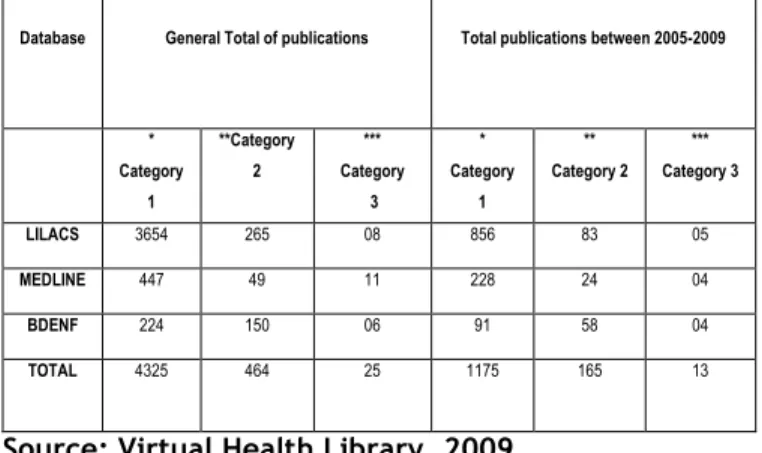
In analyzing our data, we found that the descriptors for emergency care there are a total of 4325 articles, while associating the descriptors emergency rooms and nursing these decreases to 464. Already, correlating descriptors urgency and emergency nurses' performance, this number was reduced to 25 items, of which only 13 were published in the last 5 years.
Table 1 shows the stratification of publications found, distributed virtual database and categorized according to the correlation of key words mentioned, with emphasis on those with years of publication in the range from 2005 to 2009.
Table 1: Distribution of publications with the words
urgent and emergency care, nursing and / or nursing work by the database.
Source: Virtual Health Library, 2009.
* Publications containing the words urgent and emergency related to each other;
** Publications containing the words urgent, emergency and nursing linked;
*** Publications with the words urgency and emergency nurses' performance linked.
Looking at Table 1, one can see that a total of publications in the period relevant to the study, a limited number of 13 articles dealt with issues pertaining to the role of a nurse in emergency rooms.
It is noteworthy that these 13 articles, 3 are common among databases LILACS and BDENF, the 4 base articles MedLine were excluded from analysis because they were not relevant to the subject. As well, the inaccessibility to 2 articles precluding its analysis, where one of them is common between the two bases mentioned. Consequently, only 4 articles remained to be analyzed.
Table 2 depicts the distribution of studies by frequency, and the percentage of publications included in the study period.
Table 2: Frequency and percentage of category 3 publications by Databases, from 2005 to 2009.
Database Found Publications Category 3 2005-2009 F Analized Publications Category 3 2005-2009 F % of analized publications LILACS 08 04 100 MEDLINE 11 00 00 BDENF 06 00 00 TOTAL 25 04 100
Source: Virtual Health Library, 2009.
The table above shows that the LILACS database represents all of the articles analyzed between the years 2005 to 2009, compared to the other two databases in question. Reveals that despite the present LILACS more publications related to the theme, as evidenced in Table 1, we specify the research that number regresses. One must consider that the LILACS is not specific to nursing as BDENF, which may have caused this reversal. Category 3 was being emphasized by the group in which the articles are inserted analyzed. It’s important to clarify that only publications were analyzed by LILACS contemplate those contained in BDENF.
Thus, it is clear that low investment has been designed for studies on the importance of the role of nurses in emergency and urgent care services, leading to questioning of this issue, despite its importance, has not been treated with due relevance and is not widespread in the scientific literature.
It is necessary to clarify that the articles of the databases analyzed, although covering the descriptors in question, not specifically focus on the role of nurses in emergency rooms, but highlight important points such as the ability of Database General Total of publications Total publications between 2005-2009
* Category 1 **Category 2 *** Category 3 * Category 1 ** Category 2 *** Category 3 LILACS 3654 265 08 856 83 05 MEDLINE 447 49 11 228 24 04 BDENF 224 150 06 91 58 04 TOTAL 4325 464 25 1175 165 13
this professional intervention in these sectors, as well as their skills and essential role in the coordination, management and leadership of the nursing staff in emergency situations.
Deal, yet, how the work environment and boundary conditions affect the physical and emotional aspects, highlighting the stress as a consequence of this process.
Also, indicate prospects for nursing work in different sectors of urgent and emergency care, while they raise the investment to improve the knowledge and practice of nursing in order to improve the quality of their care. Thus, the following discussion relates to these aspects.
Given these settings, to be admitted to the emergency unit and emergency, not always in favorable conditions, the user is faced with a team of health professionals in order to provide care to restore their vital functions in order to avoid risks that call into question his life. But on the other hand, the victim is unaware of the scientific potential that this team has, for the mere presence of these professionals does not guarantee success in assistance if they do not have, among other things, knowledge previously acquired in their training.
Nursing is an integral and fundamental part of this team and emergencialist nurse is the primary care manager and qualitative immediate victim, since the primary function of organizing and coordinating all nursing care to patients who need emergency care service, and to provide all necessary human and material resources to a favorable call.
Moreover, their responsibility is not limited to knowledge previously acquired, and their constant update on crucial matters of interest in your area of expertise, as well as sharing their knowledge of and involvement with professional staff of the emergency unit.
The emergency unit is characterized by high demand for appointments, derived from clinical
and / or traumatic different complexities. This fact, coupled with issues of organization and management, makes this unit does not always count on adequate working conditions, in terms of number of people and material resources for the achievement of quality care.
Agreeing with this idea sets up emergency units as appropriate locations for the care of patients with acute conditions that require specific and a team specialized and can be divided into emergency care, first aid and emergency.13
These authors argue that nurses emergency units, because they have more control and flexibility in the actions and differential mode of care, directed at persons in situations of urgency and emergency, must act as a managed process of care, following patients throughout their clinical process, and setting up the conclusion of your treatment.
Therefore, nurses need to be able to obtain a patient's history, physical examination, performing immediate treatment, concerned with the maintenance of life and guide patients to continue treatment.
It is therefore essential for the professional nurse also have sensitivity and knowledge to work with the feelings, values and beliefs of the patient, family and staff, in addition to dealing with their own emotions.
The emergence therefore represents a threatening situation that requires sharp and immediate corrective measures and defense, differing in the care clinics, primary health care, or treatment was scheduled because the subjects have a wide variety of current or potential issues may change its state unexpectedly.
Thus, the decision of the team needs to be immediate, based on a systematic and precise care, usually through prioritizing emergency protocols.
Given this reality, it becomes important that people who work in the services they provide
health care need to be prepared both technically and ethically, to give competent care while respecting the rights of the patient.
However, when they provide care in emergency situations, cannot visualize the trajectory of users and the difficulties they go to satisfy their health needs. Therefore it is important to understand these situations to make the service more friendly, using an approach that leads to competent and satisfactory solution to the user.14
The coordination of nursing care begins on user input, either in emergency departments, doctor's offices or clinics, with the opening of a route that stretches as the needs of the beneficiary, through the services of diagnostic and therapeutic support, and specialized care hospital.13
Given the unique role of nurses in emergency care units, is recognized in its financial assistance, leadership and research, all equally fundamental, although the function of care is the primary focus of this work. The situational leadership can contribute to support the practice of nursing leadership of the Emergency Unit and that there is a need to combine the technical competence humanistic and scientific.15
Corroborating this idea, nurses need to integrate their theoretical capacity for leadership, initiative and skills of teaching assistants and featuring both quick-witted as they are responsible for coordinating the nursing staff.13
Regarding the management of emergency situations by nurses, more skilled professional to perform this function, both for the breadth of their clinical knowledge as the ability to provide holistic care and strong tendency to defend the integrity of the patient.13
Thus, the strategy of case management provides a professional managing the situation at the unit, the nurse can drive and follow the user, avoiding unnecessary return the same to the
emergency room and in other cases, the worsening of her condition and with sequels hospitalization, as well as increasing the cost to the system.13
One factor quite statistically observed and that should be emphasized, is related to ambulatorialização units urgency and emergency, in which many individuals seek them in conditions that do not warrant the attention and eventually mischaracterize the service.
Studies show that over 85% of visits to an emergency department may result from seeking care in the Emergency situation for no immediate risk or suffering. This leads to the loss of identity of these units and contributes to inefficient care, since overcrowding mostly with patients who can be treated at outpatient clinics, the professionals who occasionally occupy should be promoting quality care to patients in situations críticas.16
Thus, this functional change of urgent and emergency units associated with unhealthy working conditions and unsafe with the fulfillment of tasks primarily bureaucratic, lack of qualified nursing staff, physical environment and improper features of complex services emergency nurses emergencialista lead to situations of emotional stress which contributes to decreased quality of care that professional and his team as a whole.17
Given, the environment be urgent and emergency services conducive to physical and mental burden of the caregiver, it is interesting to note that the stress experienced by nurses in emergency care units, where the employee works in sectors considered stressful, both for workload, as the specifics of their tasks.17
The research points to the fact that stress exists when the workplace becomes a threat to the individual and resonates on a personal and professional, emerging demands greater than their ability to cope and concludes that the nurse must obtain emergency units minimal human and material resources in order to provide quality care
to the patient and resolute in the face of complications occurring in this sector.17
The fence has been presented, one cannot fail to highlight nursing care in different emergency departments. Increasingly, this work is improving and performing important activities from the basic levels of health care to those of higher complexity. His performance in these units is not restricted to the hospital as part of their field assistance, pre-hospital component, including mobile units, rescue teams and integrating the body's military government institutions.
It is relevant in this discussion, knowing the pioneering study conducted by the Navy of Brazil, in which nursing practice brings a new perspective of action called Operation Nursing.
This term was created by the School of Health of the Navy for military nursing loom and it is an initial attempt at acting, proposed for deployment in the military, to care for and assist in borderline situations that military space, gets featured on fields of war. This study shows that the role of a nurse in emergency rooms is not restricted to services in the pre-hospital or hospital, emphasizing the importance of this professional service in assisting military bases in situations of higher or lower extremity, seeking its legitimacy as a service differentiated, innovative and contemporary together to competent national organs.18
Demonstrating another field of practice appropriate, a study that emphasizes the importance of training of nurses in Pre-hospital Care (PHC), stands out among its powers, this type of care in emergency rooms, the clinical rationale for the decision making and the ability to perform the operations promptly.19
Although nurses have recognized in your space relatively APH, specialization courses in emergency or APH are still recent in Brazil. Studies indicate that nurses Brazilian has been
calling this area, through specialized courses (sensu lato) in emergency or APH, meeting the guidelines of the Ministry of Education and the Federal Council of Enfermagem.19
In the context of Brazil, the performance of nurses and their training are in arrears compared to other countries like the United States and France, which have a more developed system of APH, where nurses have a consolidated basis and recognized in their systems of care. But despite this progress in developed countries, the role of the nurse is constantly rethought.20
From this perspective, the participation of nurses in the structuring of services, development of educational and management of this type of attention yet require an organized effort to its expansion.15, 20
It is necessary to expand the role of nurse, not restricted purely to the provision of assistance, but extend to the organization and management of care as Basic Life Support, adding a new look to the services of APH.
These scholars also shows the need for specific training and improving technical and scientific for professionals who work in the emergency department, be justified by the fact that this site nursing staff in conjunction with the medical staff, performs a call to the synchronized patient trauma victim.
This fact guides the need to implement programs aimed at developing skills in this area and strengthening the skills of nurses to help in consolidating its practice in these services, since both require great dexterity in the technical field as in science.
At the same time, it is essential that managers, professionals and users have clarity of purpose of the work performed in the emergency department to be agreed with other agencies and institutions. Any mismatch between them will cause clashes and conflicts that have like product
dissatisfaction of everyone involved in the process.
Thus, it is understood that despite the achievements accomplished by nurses in their trajectory of care, especially in character urgencies assistance and emergency room, there are still many challenges to be overcome towards implementing and enhancement of their work, and of its fundamental relevance contribution in the quest for consolidation of the Emergency Warning System as a resolute and effective strategy in the health of individuals, guided by the National Policy for Emergency ace.
The urgent and emergency units are important and wide field of nursing intervention. They represent the environment in which users are assisted in critical situations that compromise their life, and require nursing skill, vast technical and scientific knowledge, agility, leadership and management of care.
As part of the interdisciplinary health care team, assisting these establishments increasingly the nurse has assumed a prominent position in providing care to patients in emergency situations and has been appointed as the appropriate professional to assume the management of cases and situations emergency and urgent care.
In addition to these tasks, the performance of nurses urgencist understands its primary function of health care and the coordination of the nursing staff in providing care, but is not limited to these aspects.
His duties extend beyond the field of assistance, to the extent that, in most institutions, this professional exercises administrative and bureaucratic activities that often result in neglect of the central goal of his care. This is according to the literature, due to factors like unhealthy working conditions and unsafe with the fulfillment of tasks primarily
bureaucratic, lack of qualified nursing staff, physical environment and improper complex features of the emergency services, leading to decreased quality of care that professional and his team as a whole.
From this perspective, it is evident unpreparedness of most professionals working in emergency rooms, even though the recent initiatives in this regard, hence the need for greater investment in capacity building, training and qualification in this area by the institutions and bodies, especially in Brazil.
This study provided different types of emergency services and emergency nurses assume prominent positions such as Emergency, Pre-hospital Care, Nursing Work and Hospitals, among others.
All in all, one cannot fail to reaffirm the nursing process as the main tool of the nurse in providing an effective and quality care to the user in critical situation. It helps the nursing staff to plan your care, streamlining, streamlining and linking their actions directed to patient care, allowing also value the work of the nursing staff as an essential part of being in rehabilitation care.
Finally, this research led to confirmation that the role of a nurse in urgent and emergency situations has not received due attention in the scientific community. Despite an intensive search and detailed, is still sparse collection of specific studies on this problem.
It is necessary, therefore, to expand the discussion about the purpose of work in emergency services and emergency, so that workers can take critical view of their work process, becoming, in conjunction with users and managers, protagonist comprehensive reorganization of the system of care for emergencies.
Just so the nursing staff can deepen their professional and consolidate its leading role, understanding that nurses play a central role and
CONCLUSION
articulator which allows them great opportunities for interaction and influence on the professional actions that are developed in the emergency department, in favor production of a comprehensive and interdisciplinary care.
1. Ministério da Saúde(BR). Política nacional de atenção às urgências. 3ª ed. Brasília: Editora do Ministério da Saúde; 2006.
2. Dal Pai D, Lautert L. Suporte humanizado no pronto socorro: um desafio para a enfermagem. Rev. bras. enferm. [Internet]. 2005[cited 2010 may 06];58(2):231-4. Available from: <
http://www.scielo.br/scielo.php?pid=S0034-71672005000200021&script=sci_abstract&tlng=pt 3. Figueredo NMA. Práticas de enfermagem. Fundamentos, conceitos, situações e exercícios. São Paulo: Yendis; 2005.
4. Conselho Federal de Enfermagem. Lei nº 7498/86. Dispõe sobre a regulamentação do exercício da Enfermagem e dá outras providências. Brasília (Brasil): COFEN; 1986.
5. Smeltzer SC, Bare BG. Enfermagem medico-cirúrgica. Tratado de Brunner & Suddarth. 10. ed. Rio de Janeiro: Guanabara Koogan; 2005.
6. Almeida PJS, Pires DEP. O trabalho em emergência: entre o prazer e o sofrimento. Rev. Eletr. Enf. [Internet]. 2007.[cited 2010 jul 27];9(3):617-29. Available from: http://www.fen.ufg.br/revista/v9/n3/v9n3a05.ht m
7. Wehbe G, Galvão CM. O enfermeiro de unidade de emergência de hospital privado: algumas considerações. Rev. latinoam. enferm. 2001;9(2):86-90.
8. Gentil RC, Ramos LH, Whitaker IY. Capacitação de enfermeiros em atendimento pré-hospitalar. Rev. latinoam. enferm. [Internet]. 2008[cited 2010 apr 30];16(2): 192-7. Available from: http://www.scielo.br/scielo.php?script=sci_arttex t&pid=S010411692008000200004&lng=pt&nrm=iso
&tlng=pt
9. Alfaro-Lefevre R. Aplicação do processo de enfermagem: promoção do cuidado colaborativo. 5. ed. Porto Alegre: Artmed; 2005.
10. Furtado BMASM, Júnior JLCA. Percepção de enfermeiros sobre condições de trabalho em setor de emergência de um hospital. Acta paul. enferm. 2010;23(2):169-74.
11. Nascimento KC. As dimensões do cuidado em unidade crítica: emergindo o cuidado transpessoal e complexo[dissertation]. Florianópolis: Programa de Pós-Graduação em Enfermagem/UFSC; 2005. 180 p.
12. Figueiredo NMA; Vieira ÁAB. Emergência: atendimento e cuidados de enfermagem. São Caetano do Sul: Yendis; 2006.
13.Valentim MRS, Santos MLSC. Políticas de saúde em emergência e a enfermagem. Rev. enferm. UERJ. [Internet]. 2009[cited 2010 apr
29];17(2):285-9. Available from:
http://www.facenf.uerj.br/v17n2/v17n2a26.pdf 14. Marques GQ, Lima MADS. Demandas de usuários a um serviço de pronto atendimento e seu acolhimento ao sistema de saúde. Rev. latinoam. enferm.[Internet]. 2007[cited 2010 aug
03];15(1):13-9. Available from:
http://www.scielo.br/pdf/rlae/v15n1/pt_v15n1a0 3.pdf
15. Aguiar ARV. Leite, DO, Baldoino LKR, Araújo OF, Oliveira ADS. A produçâo científica sobre urgência/emergência na enfermagem publicada na Revista Brasileira de Enfermagem no período de 2001 a 2006. In: I Jornada de Iniciação Científica e I Amostra de Pesquisa da Pós-Gradação da Faculdade NOVAFAPI[Internet];2006 Nov;Teresina, Brasil. 2006[cited 2010 may 04]. Available from: http://www.novafapi.com.br/eventos/jic2006/tra balhos_poster.htm
16. Domiciano V, Fonseca AS. Perfil dos clientes atendidos no departamento de emergência de um hospital privado do município de São Paulo. Revista Emergência. 2005;1(3):96-102.
17. Batista KM, Bianchi ERF. Estresse do enfermeiro em unidade de emergência. Rev. latinoam. enferm. [Internet]. 2006[cited 2010 aug
03];14(4):534-9. Available from:
http://www.scielo.br/pdf/rlae/v14n4/v14n4a10.p df
18. Alcantara LM, Leite JL, Erdmann AL, Trevizan MA, Dantas CC. Enfermagem operativa: uma nova perspectiva para o cuidado em situações de "crash". Rev. latinoam. enferm. [Internet]. 2005[cited 2010 may 03];13(3):322-31. Available from:
http://www.scielo.br/scielo.php?script=sci_arttex t&pid=S010411692005000300006
19. Gentil RC, Ramos LH, Whitaker IY.Capacitação de enfermeiros em atendimento pré-hospitalar.Rev. latinoam. enferm.[Internet]. 2008[cited 2010 aug 03];16(2). Available from: http://www.scielo.br/pdf/rlae/v16n2/pt_04.pdf 20. Sanna MC, Ramos VO. A inserção da enfermeria no atendimento pré-hospitalar: histórico e perspectivas atuais. Rev. bras. enferm. 2005;58(3):355-60.