AR
TICLE
1 Departamento de Estudos sobre Violência e Saúde Jorge Careli/Claves, Escola Nacional de Saúde Pública, Fiocruz. Av. Brasil 4036/7º, Manguinhos. 21040-210 Rio de Janeiro RJ Brasil. [email protected]
Injuries caused by firearms
treated at Brazilian urgent and emergency healthcare services
Abstract This paper analyzes the medical care given at Brazilian urgent and emergency health-care services to people injured by firearms in 2014. A cross-sectional study was carried out on care given to patients with firearms injuries in 24 capital cities of Brazilian states and in the Brazilian Federal District, included in the VIVA Survey. Simple and relative frequencies of the variables related to the patients and to the event were calculated, and a logistic model for complex samples was applied adopting care for firearms injuries patients as outcome. The results show the following percentages of care events as caused by firearms: 0.7% for the category ‘other accidents (other than transport-related accidents)’, 1.5% for self-inflicted injuries, 15.9% for injuries due to assault, and 65.1% of cases arising from legal intervention. The care given was predominantly to young male adults (age 20-39), of mixed race and with a low level of schooling. The most com-mon injuries were: to arms and legs; and to mul-tiple organs. The paper concludes by discussing the efforts to control firearms held by the public in Brazil, and how they can lead to severe and lethal outcomes in quarrels and interpersonal disputes.
Key words Firearms, Health survey, Urgent and emergency care
Adalgisa Peixoto Ribeiro 1
Edinilsa Ramos de Souza 1
R
ib
eir
Introduction
Injuries caused by firearms cause irreversible damage, incapacity to work, and demands on the health sector to provide care at various lev-els of complexity, from pre-hospital to physical and mental rehabilitation of victims. They thus increase the costs of Brazil’s Unified Health Sys-tem (SUS), and also costs of other sectors such as the economy itself, the national social security
system, and the families involved1.
Possession and use of firearms have been considered to be important factors contributing to the high levels of violence, principally lethal
violence, in Latin American countries2-4.
A firearm was the means used in 75% of all homicides taking place in 2012 in low and me-dium-income countries in the Americas as a re-gion, and the instrument most used for all acts of
violence4. In Brazil, firearms were used to inflict
fatal injuries in 45,068 people in 2014. Of these, 94.9% were cases of assault, 2.2% resulted from self-inflicted violence, 2.1% were without known intention, and 0.8% were due to accidents. Of the total of deaths by homicide in 2014 (59,681),
71.6% were caused with a firearm5.
The presence of a firearm in acts of violence increases the probability of death or serious in-juries. As well as the high degree of lethality, firearms were responsible for 29% of the 61,268 hospitalizations resulting from assault or suicide
attempts in Brazil in 20145.
A study in 2006 of urgent and emergency care units in 34 Brazilian municipalities and in the Federal District showed that, of 4,854 care events for victims of violence, 13.4% involved
in-juries produced by firearms6. However, there are
few Brazilian studies on the injuries caused by firearms that have been treated in the emergen-cy hospital services, since the data traditionally analyzed are those of the Hospitalization Infor-mation System (SIH) and Mortality InforInfor-mation System (SIM). Some studies have approached such injuries in the context of violence in
gener-al6-8, or suicide attempts9, or accidents10, but they
do not analyze them based on the two groups of events: accidents and violence.
This paper provides an analysis of care given to firearms injury patients in urgent and emer-gency service units in Brazil in 2014. It completes a series of five research projects carried out by the Brazilian Health Ministry to ascertain demands in the health sector, specifically in the urgent and emergency service units, in relation to the ad-verse effects caused by accidents and violence.
Methodology
This is a cross-sectional study of medical care given to patients with injuries caused by firearms in urgent and emergency services of 24 Brazilian State capitals and the Federal District, included
in the 2014 VIVA (Sistema de Vigilância de
Vi-olências e Acidentes – Violence and Accident Su-pervision System) Survey.
The sampling of the survey included all care events taking place on 30 consecutive days in the period September to November, in 12-hour shifts previously chosen by lot, in 86 urgent and emer-gency service units of the public health network. Data were collected from the individual ac-cident and violence notification record form, created and standardized by the Health Minis-try, which contains the data on the socio-demo-graphic profile of the person served, the event, the injuries and the evolution of the case.
Simple and relative frequencies were calculat-ed for the variables selectcalculat-ed for description of the patients, their injuries and the care given: gender, age group, race/skin color, level of schooling, re-munerated activity, use of alcohol by the victim in the preceding six hours, day on which the care was given, care given in another service, location of the occurrence, whether on the way to or from work, part of the body affected, degree of inten-tion, and how the case evolved. All these variables were analyzed by the following subgroups of
ex-ternal causes in the ICD-10 (INCREASED, 10th
revision): W00–X59 – Other external causes of accidental injury (except transport); X60–X84 – Intentional self-harm; X85–Y09 – Assault; and Y35–Y36 – Legal intervention and war opera-tions, recorded on the notification file as Legal intervention. For the purpose of comparison with previous studies that analyzed VIVA data, a choice was made not to expand the sample in the descriptive analysis of these subgroups. However, to verify the precision of the estimates, expansion was carried out only in relation to the most fre-quent subgroups, and for adjustment of a statis-tical model.
e C
ole
tiv
a,
22(9):2851-2860,
2017
legal intervention caused by means other than firearms).
The risk exposure variables used in the model were: age (0–29 (young) and 30 or over (adult)); level of schooling (0–8 years, 9 years, or more); gender (male, female); race/skin col-or (white, black+black-mixed; and Asiatic+in-digenous); perpetrator (father/mother+partner/ former-partner+other family member, friend/ acquaintance, and legal-agent+unknown+oth-er), and place of occurrence (home, school+rec-reation-area+others, and public streets).
The process of adjustment of the model was carried out with initial inclusion of the variables relating to the patient (gender + age + schooling + race/skin color) and all were found to be sta-tistically significant. After this stage the variables relating to the event were included (location of the event, and perpetrator of the aggression), in which the variable ‘race/skin color’ ceased to be significant (p-value 0.29), thus resulting in it be-ing withdrawn from the final model (backward
elimination)11.
Injury by firearms was related to the explan-atory variables gender, age, level of schooling, perpetrator, and location of the event. For this regression analysis, the software SPSS version 20 was used, in the complex samples module. The associations and odds ratios between firearms in-juries and the co-variables selected in the survey were evaluated.
The 2014 VIVA Survey was approved by the National Research Ethics Committee (CONEP), of the Health Ministry.
Results
The 2014 VIVA Survey recorded 22,399 health-care treatments for the sum of the groups ‘other accidents (excluding transport)’, assault, self-harm and legal intervention. In only 3.9% of these cases were the injuries caused by firearms (Table 1).
As Table 1 shows, considering only victims of assault and events involving a public legal agent, the percentage of people injured by firearms is considerably greater. We also note that among patients with injuries caused by firearms, there is a predominance (79.7%) of victims of assault, characterized as attempted homicide.
In the analysis with the expanded sample for more frequent events, it is seen that the estimated prevalence for the subgroup of ‘other accidents’ was 11.8% – with CI of 9.4% to 14.7%; and for
the subgroup ‘assaults’ it was 81.2%, with CI of 77.4%–84.4%.
The profile of patients served for this type of injury shows a predominance of males, young adults aged 20 to 39, with racial type black-white mixed-race, and low level of schooling (0-8 years’ study – corresponding to primary education). These characteristics were similar for all the types of occurrence, as is seen in Table 2.
For males, the estimates for the subgroup of other accidents in the expanded sample were 10.8% (CI 8.5%–13.7%), and for assaults 82% (CI 78.5%–85.1%); and for females these esti-mates were 19.4%. (CI 9.8%–34.6%) and 73.9% (CI 57.9%–85.3%), respectively. As can be seen, the estimates for males were more precise than those observed in females. The estimates of the subgroups ‘other accidents’ and ‘assaults’ were more precise among young people than adults. For ‘other accidents’ the estimate was 10.9% (CI 8%–14.5%); for ‘assaults’ it was 81.9% (CI 77.6%–85.6%). In relation to skin color there was greater precision in the prevalences in the ‘group black and mixed-race’, compared to the others, both for ‘other accidents’ (12%, CI 9.2%–15.4%) and for ‘assaults’ (81.8%, CI 77.9%–85.2%).
A major proportion of the patients receiving care for firearms injuries in all the types of events said they had remunerated activity, except those that were involved in legal intervention. Among the latter, only one quarter had work at the time of the injury. On the other hand, it is important to point out that for a total of 44.1% of the care events this information was not recorded.
R
ib
eir
In the expanded sample, public streets were the location with the highest precision of esti-mates of other accidents and assault, compared to the other locations analyzed: 8.2% (CI 5.6%– 11.6%) and 81.8% (CI 77.1%–85.7%), respec-tively.
Considerable percentages of the patients receiving care had not made use of alcohol, al-though the consumption of alcohol in the six
hours prior to the event was present in 30% of the legal interventions, 25% of the assaults, 16.7% of the self-harm injuries and 8.5% for accidents.
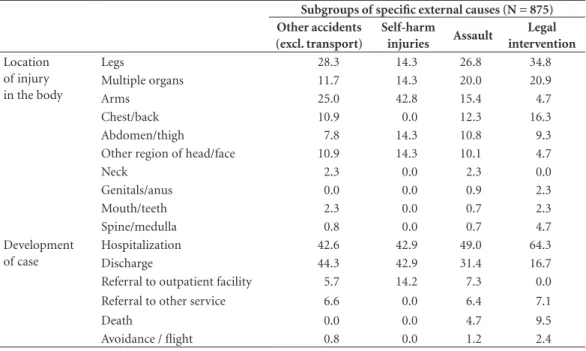
Legs and arms were the parts of the body most frequently affected by accidents; arms in the case of suicide attempts; and legs, and multi-ple organs, in cases of assault and intervention by public agent, showing that these last two groups of events had the most serious injuries (Table 4).
Table 1. Distribution of provision of care for accidents and cases of violence (total, and by firearms) given in urgent and emergency service units in 24 Brazilian state capital cities and the Federal District, by subgroup of specific external causes. VIVA, 2014.
Subgroups of specific external causes
Number of care events
Total Due to firearms
N N %
Other accidents (excluding transport) 17,450 128 0,7
Self-harm injuries 477 7 1.5
Assault 4,406 697 15.9
Legal intervention 66 43 65.1
TOTAL 22,399 875 3.9
Table 2. Percentage distribution of care given to patients with firearms injuries in urgent and emergency service units in 24 Brazilian state capital cities and the Federal District, by profile of patients and subgroup of specific external causes. VIVA, 2014.
Subgroups of specific external causes (N = 875) Other accidents
(excl. transport) Self-harm injuries Assault Legal intervention
Gender Male 89.1 100.0 90.2 93.0
Female 10.9 0 9.8 7.0
Age group 0-9 0.0 0.0 1.2 0.0
10-19 23.8 28.6 26.1 31.7
20-39 59.5 57.1 61.4 68.3
40-59 14.3 0.0 9.5 0.0
60 and over 2.4 14.3 1.8 0.0
Skin color/race White 14.2 14.3 17.3 19.0
Black 25.2 28.6 16.7 16.7
‘Yellow’ 0.8 0.0 1.0 7.1
Mixed-race 59.0 57.1 64.1 57.2
Indigenous 0.8 0.0 0.9 0.0
Level of schooling 0-4 years 32.4 60.0 31.7 18.2
5-8 years 33.4 20.0 35.5 54.6
9-11 years 29.6 20.0 28.9 22.7
12 + 4.6 0.0 3.9 4.5
Has remunerated activity
Yes 52.3 42.9 45.6 23.3
No 41.4 42.9 42.3 32.6
e C
ole
tiv
a,
22(9):2851-2860,
2017
In occurrences of aggression and legal inter-vention the most frequent development of the case was hospitalization, once again indicating their severity; in the other groups of injuries, the development was toward hospitalization and also discharge. In spite of the lower frequency in rela-tion to the other groups, it appears to be strange that three patients who received care for self-harm injury were discharged and only one was referred to outpatient monitoring.
In the expanded sample it was seen that lo-cation in the public streets had higher precision of estimates for injuries to arms in the subgroup of ‘other accidents’ (16.7%, CI 10.7%–25.1%), and in multiple organs in the ‘assaults’ subgroup (87.5%, CI 78.9%–92.9%), compared to the oth-er parts of the body injured.
Table 5 shows the results of the logistic re-gression statistical model for complex samples and the Wald test. The analysis covered health-care events for firearms injuries and the other healthcare treatment given and recorded in the 2014 VIVA Survey.
One item that stands out is the protective ef-fect in relation to females: women receiving care in the urgent and emergency service units
sur-veyed had 66% less chance of suffering a firearms injury than men. Young men (under age 30) had a higher risk of being victim of injuries of this type than the ‘adults’ group (over 30), who had 52% less chance of suffering this type of injury. Similarly, the people with lower levels of school-ing seem to be more susceptible to firearms in-juries than those with a higher level, who had a 44% lower chance of suffering an event due to this type of instrument.
The chance of suffering assault by firearm from a family member or intimate partner is 97% less than that of suffering assault by an agent of the law or an unknown person. Friends and acquaintances have 81% less chance of being the perpetrators of these violent acts, than the group of ‘agents of law’ and ‘persons unknown’. It is im-portant to highlight that these results should be considered in context: they cannot be amplified to the cases of self-harm and accidents because, obviously, in accidents and suicide attempts this analysis does not apply.
The analysis of the location of the event showed that in the school environment and ar-eas of recreation the chance of an event involving a firearm taking place is 54% lower than in the
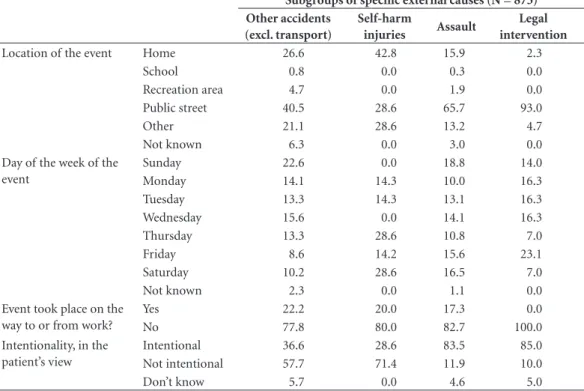
Table 3. Percentage distribution of healthcare actions for people with injuries caused by firearms in 24 Brazilian state capital cities and the Federal District, by characteristics of the events and subgroup of specific external causes. VIVA, 2014.
Subgroups of specific external causes (N = 875) Other accidents
(excl. transport)
Self-harm
injuries Assault
Legal intervention
Location of the event Home 26.6 42.8 15.9 2.3
School 0.8 0.0 0.3 0.0
Recreation area 4.7 0.0 1.9 0.0
Public street 40.5 28.6 65.7 93.0
Other 21.1 28.6 13.2 4.7
Not known 6.3 0.0 3.0 0.0
Day of the week of the event
Sunday 22.6 0.0 18.8 14.0
Monday 14.1 14.3 10.0 16.3
Tuesday 13.3 14.3 13.1 16.3
Wednesday 15.6 0.0 14.1 16.3
Thursday 13.3 28.6 10.8 7.0
Friday 8.6 14.2 15.6 23.1
Saturday 10.2 28.6 16.5 7.0
Not known 2.3 0.0 1.1 0.0
Event took place on the way to or from work?
Yes 22.2 20.0 17.3 0.0
No 77.8 80.0 82.7 100.0
Intentionality, in the patient’s view
Intentional 36.6 28.6 83.5 85.0
Not intentional 57.7 71.4 11.9 10.0
R
ib
eir
public streets. Here it needs to be pointed out that, although the variable ‘location of the event’ was statistically significant in the model, one of
its categories, ‘home’, was not.
In this model, the selected variables account
for 26% of the variability of firearms injuries (R2
= 0.264).
Discussion
At first sight the small percentage of care events for victims of firearms in the urgent and emergen-cy services participating in the 2014 VIVA Survey could give the false impression that the preva-lence/importance of these events was low, but it
Table 4. Percentage distribution of healthcare actions for people with firearms injuries, by location of injury in 24 Brazilian state capital cities and the Federal District, by progress of the case and subgroup of specific external causes. VIVA, 2014.
Subgroups of specific external causes (N = 875) Other accidents
(excl. transport)
Self-harm
injuries Assault
Legal intervention
Location of injury in the body
Legs 28.3 14.3 26.8 34.8
Multiple organs 11.7 14.3 20.0 20.9
Arms 25.0 42.8 15.4 4.7
Chest/back 10.9 0.0 12.3 16.3
Abdomen/thigh 7.8 14.3 10.8 9.3
Other region of head/face 10.9 14.3 10.1 4.7
Neck 2.3 0.0 2.3 0.0
Genitals/anus 0.0 0.0 0.9 2.3
Mouth/teeth 2.3 0.0 0.7 2.3
Spine/medulla 0.8 0.0 0.7 4.7
Development of case
Hospitalization 42.6 42.9 49.0 64.3
Discharge 44.3 42.9 31.4 16.7
Referral to outpatient facility 5.7 14.2 7.3 0.0
Referral to other service 6.6 0.0 6.4 7.1
Death 0.0 0.0 4.7 9.5
Avoidance / flight 0.8 0.0 1.2 2.4
Table 5. Result of the model adjusted for logistical regression for complex samples.
Variable Category OR Lower limit
(OR)
Upper limit
(OR) Wald F p-value
(Intercept) 434.419 < 0.001
Gender Male 1.00 30.455 < 0.001
Female 0.34 0.23 0.50
Age Young (age 0-29) 1.00 31.241 < 0.001
Adult (30+) 0.48 0.37 0.62
Schooling 1-8 years’ schooling 1.00 8.969 < 0.003 9+ years’ schooling 0.66 0.51 0.87
Aggressor Legal agent/unknown/other 1.00 55.389 < 0.001 Father/mother/partner/former
partner/other family member
0.03 0.01 0.07
Friend/acquaintance 0.19 0.13 0.29 Location of
event
Public street 1.00 10.599 < 0.001
Home 1.14 0.76 1.72
e C
ole
tiv
a,
22(9):2851-2860,
2017
needs to be pointed out that they are injuries of considerable severity, and in which possibly a large proportion of the people injured in this way do not even receive care from an urgent or emer-gency service unit, due to their high degree of lethality. This can be seen through the mortality figures for these causes in 2014 – in which 36.2%
of the deaths were caused by a firearm5.
A point that calls attention is the high per-centage of firearms injuries in the ‘legal inter-vention’ subgroup that are caused by bellicose action and confrontation between the police and the population. This issue is also expressed in the data for mortality, and has been a subject of criticisms and debates by academic authors who conclude that the Brazilian police is one of the
most lethal in the world12,13. On this point,
Lo-tin12 counted 17,663 deaths arising from these
in-terventions in Brazil over the period 2009–2015. The majority of them were cases of young people with the same characteristics observed in this present study.
The high level of young men with low level of schooling and of black or black-mixed race among the victims, seen in the analysis of the care reported in the 2014 VIVA Survey reproduc-es what has been seen in analysreproduc-es of mortality, in hospitalization, and has been widely
demon-strated in the literature on the subject1,13-18. In the
subgroup of assaults, firearms injuries have his-torically had percentages similar to those in the
VIVA Survey: In 2006 the percentage was 15.1%6,
in 2011 it was 14.9%19, and in 2014 it was 15.9%.
The data indicate the ‘peregrination’ of some patients between various health services before arriving at the urgent and emergency service unit that gave the care and reported the case. People who attempted suicide appear to have found a greater difficulty for receiving care than the others, which may indicate a deficiency of the healthcare network in caring for these cases.
On the care for patients with self-harm
inju-ries, Machin20 discusses that there appears to be
a resistance on the part of health professionals since the intentionality of the act committed by the person against him/herself negates the notion of care for a human body that is ill – these pa-tients often being denied care or treated with in-difference or aggression and with procedures that impose suffering and pain. They are, he says, seen as people who chose to have those injuries and are getting in the way of healthcare for patients who truly deserve it.
At the same time, it is interesting to note a lower degree of ‘peregrination’ among the
vic-tims of ‘legal intervention’ – this may be the re-sult of the police having caused the injury and at the same time taken the victim to the health unit, ensuring that person getting faster service.
The high percentage of care events in which patients with self-harm injuries stated that they were not intentional could be covering a sub-jective phenomenon in which they regret and negate their act; this has been found in various
studies on the subject21. Another point which
at-tracts attention is that just under 37% of the ac-cidents have been perceived as intentional. Such findings lead to certain suppositions: possibly, that there may have been an error in the classi-fication of this variable; or that some stories of violence may have been covered up by being de-nominated as accidental. Some authors highlight the difficulties of establishing the intentionality
of events22,23.
This study shows a differentiation between the parts of the body in which the injuries oc-curred, by type of event. Those with more sever-ity, which affected multiple organs, were more common in the subgroups ‘assault’ and ‘legal
intervention’. Another sign of the severity of
these injuries is that a large proportion of them required hospitalization. The study by Maciel
et al.24 which analyzed victims of firearms
inju-ries receiving care in an emergency hospital in Goiânia (State of Goiás) showed that the injuries recorded appear to have been more serious, since the regions of the body most affected were the chest and back (42.0%), followed by the abdo-men (37.3%) and the arms (28.0%). It is import-ant to point out that in that study the authors analyzed only intentionally caused injuries.
The participation of firearms in some acci-dental events, but above all in violent events and mortality, is very large. Curiously, there are only few studies that specifically deal with the question of firearms in Brazilian society and its impact on the health of the people injured, principally in re-lation to the temporary or permanent complica-tions or disablement caused by the firearms.
In fights and conflicts in which the outcome could have been less serious, when a firearm is present the potential for a result involving inju-ry and indeed even death is veinju-ry high. Marques
and Pollachi7 highlight that there is a consensus
R
ib
eir
for firearms has been growing in Brazilian society in recent years, which appears to reflect people’s sensation of insecurity much more than the real growth of the homicide rate in the country.
When analyzing care given to people with firearms injuries, it is also necessary to mention the present Brazilian context in relation to the control of use of this instrument that is so lethal. Brazilian Law 10826 of 2003, known as the Dis-armament Law, aimed to reduce the high levels of death by homicide and accidents involving firearms, through measures restricting carriage or acquisition of firearms. In 2005 the Brazilian population was consulted in a referendum, and rejected the article of that Law which prohibited sales of firearms and ammunition throughout the country. Several authors discuss the factors that led to this result, which was considered surprising by the protagonists of the disarmament campaign in the country – who found themselves instigated
to rethink the basis of the debate25. A recent law
now before the Lower House of Congress aims to repeal the Disarmament Law, consequently en-abling more firearms and more ammunition to reach the hands of more and younger people.
In view of the above, it is important to invite Brazilian society to reflect on the relationship between firearms and the injuries and deaths that they cause. The data analyzed in this study, on care given to victims of injuries caused by these arms, represent a small part of those who need to access the services of the Single Health System. Of the 45,068 people killed by events in-volving a firearm in 2014, 25.1% did receive care in a health establishment, but died as a result of
their wounds5. Does an increase in the number of
arms held by the civil population translate into more security and less victims? There is contro-versy on the control of firearms: On the one hand surveys indicate that this control reduces certain rates of violence such as homicide and suicide; and on the other, in developed countries, there
is little evidence on the efficacy of that control26.
Felix27, analyzing the effect of apprehension
of firearms on homicide rates in the State of São Paulo, found a negative correlation, indication that an increase in the number of firearms appre-hended by the police did have as its counterpart
reduction of intentional homicides taking place in the period 2009–12. According to this study, for every 10 firearms taken out of circulation it was estimated that more than two lives (2.3 lives) were saved. At the same time, Scorzafave et
al.28 concluded their survey on the incidence of
deaths from firearms in the State of Paraná, af-firming that the campaign of disarmament in the State of Paraná had no effect on the rate of deaths from firearms in the first six months, indicating that in the short term this policy was not effective for reduction of crimes involving firearms.
Finally, it is important to point out that the data of the VIVA Survey, held in 2014, reflect only part of the reality of injuries caused by firearms in Brazil. Its records do not cover the totality of the urgent and emergency services of the coun-try, but only those in state capital cities that were indicated as referrals for these cases and which agreed to take part in the survey. The result is restriction of the data, which cannot be gener-alized. Other limitations could be mentioned, such as the size of the sample, which might have adversely affected the stratified analyses of some variables relating to certain subgroups of external causes. As already mentioned, the option of not expanding the sample makes possible compari-sons between the previous studies relating to the VIVA Survey, but working with the non-expand-ed data resultnon-expand-ed in lower numbers in relation to the subgroups of the self-inflicted injuries and the legal interventions. Thus, to ensure greater confidence in the precision of the estimate, the work was done only with expanded samples for the subgroups of more frequent events.
We further highlight, as a limitation of the data, some precariousness in the filling in of cer-tain variables such as the location of the event, in 6.3% of the accidental events, and whether the patients had some remunerated activity, which, for example, was recorded for 44.1% of those receiving care as a result of ‘legal intervention’.
In relation to the variable ‘perpetrator’it is
e C
ole
tiv
a,
22(9):2851-2860,
2017
Collaborations
R
ib
eir
References
1. Sanches S, Duarte SJH, Pontes ERJC. Caracterização das vítimas de ferimentos por arma de fogo, atendidas pelo Serviço de Atendimento Móvel de Urgência em Campo Grande-MS. Saude soc 2009; 18(1):95-102. 2. Gonzalez-Perez GJ, Vega Lopez MG,
Flores-Villavicen-cio ME. El incremento de la mortalidad por armas de fuego y su relación con el estancamiento de la esperan-za de vida en México. Cien Saude Colet 2017; 22(9): 2861-2872.
3. Spinelli H, Alazraqui M, Zunino G, Olaeta H, Poggese H, Concaro C, Porterie S. Mortes e crimes cometidos com armas de fogo na Cidade Autônoma de Buenos Ai-res, 2002. Cien Saude Colet 2006; 11(Supl.):1235-1246. 4. Núcleo de Estudos da Violência da Universidade de São Paulo. Relatório Mundial Sobre a Prevenção da Violência 2014. São Paulo: USP; 2014.
5. Brasil. Ministério da Saúde (MS). DATASUS. Departa-mento de Informática do SUS [base de dados na in-ternet]. Informações de Saúde. Sistema de Informações sobre Mortalidade. Brasília; 2017. [acessado 2017 mar 10]. Disponível em: http://tabnet.datasus.gov.br 6. Mascarenhas MDM, Silva MMA, Malta DC, Moura L,
Macário EM, Gawryszewski VP, Morais Neto OL. Perfil epidemiológico dos atendimentos de emergência por violência no Sistema de Serviços Sentinelas de Vigilân-cia de ViolênVigilân-cias e Acidentes (Viva) - Brasil, 2006. Epi-demiol. Serv. Saúde 2009; 18(1):17-28.
7. Marques IC, Pollachi N. A entrada de armas de fogo no mercado legal - O crescimento da demanda por ar-mas de fogo. Anuário Brasileiro de Segurança Pública.
Fórum Brasileiro de Segurança Pública. 2016. p. 28-30.
[acessado 2017 mar 10]. Disponível em: http://www. forumseguranca.org.br/storage/10_anuario_site_18-11-2016-retificado.pdf
8. Oliveira LR, Jorge MHPM. Análise epidemiológica das causas externas em unidades de urgência e emergên-cia em Cuiabá/Mato Grosso. Rev. bras. epidemiol 2008; 11(3):420-430.
9. Brasil. Ministério da Saúde (MS). Saúde Brasil 2014:
uma análise da situação de saúde e das causas externas.
Brasília: MS; 2015.
10. Malta DC, Mascarenhas MDM, Silva MMA, Macário EM. Perfil dos atendimentos de emergência por aciden-tes envolvendo crianças menores de dez anos – Brasil, 2006 a 2007. Cien Saude Colet 2009; 14(5):1669-1679. 11. Hosmer DW, Lemeshow S. Applied Logistic Regression.
New York: John Wiley & Sons; 1989.
12. Lotin E. Uma “guerra de todos contra todos”. Anuário Brasileiro de Segurança Pública. Fórum Brasileiro de Segurança Pública. 2016. p. 28-30. [acessado 2017 mar 10]. Disponível em: http://www.forumseguranca.org. br/storage/10_anuario_site_18-11-2016-retificado.pdf 13. Anistia Internacional. Você matou meu filho!:
homicí-dios cometidos pela polícia militar na cidade do Rio de Janeiro. Rio de Janeiro: Anistia Internacional; 2015. 14. Trindade RFC, Costa FAMM, Silva PPAC, Caminiti GB,
Santos CB. Mapa dos homicídios por arma de fogo: perfil das vítimas e das agressões. Rev. esc. enferm. USP
2015; 49(5):748-755.
15. Costa FAMM, Trindade RFC, Santos CB. Deaths from homicides: a historical series. Rev. Latino-Am.
Enfer-magem 2014; 22(6):1017-1025.
16. Duarte EC, Garcia LP, Freitas LRS, Mansano NH, Mon-teiro RA, Ramalho WM. Associação ecológica entre características dos municípios e o risco de homicídios em homens adultos de 20-39 anos de idade no Brasil, 1999-2010. Cien Saude Colet 2012; 17(9):2259-2268. 17. Soares Filho AM. Vitimização por homicídios
segun-do características de raça no Brasil. Rev Saude Publica
2011; 45(4):745-755.
18. Barata RB, Ribeiro MCSA, Sordi M. Desigualdades so-ciais e homicídios na cidade de São Paulo, 1998. Rev. bras. epidemiol 2008; 11(1):3-13.
19. Brasil. Ministério da Saúde (MS). Sistema de Vigilância de Violências e Acidentes (Viva): 2009, 2010 e 2011. Bra-sília: MS; 2013.
20. Machin R. Nem doente, nem vítima: o atendimento às “lesões autoprovocadas” nas emergências. Cien Saude
Colet 2009; 14(5):1741-1750.
21. Santos, MIV. Histórias de suicídios não consumados: Um estudo sobre os significados construídos em torno da ten-tativa de suicídio [dissertação]. Évora: Escola de Ciên-cias Sociais; 2014.
22. Krug EG, Mercy JA, Dahlberg LL, Zwi AB. World report on violence and health. Geneva: World Health Organi-zation; 2002.
23. Minayo MCS. Conceitos, teorias e tipologias da violên-cia: a violência faz mal à saúde individual e coletiva. In: Njaine K, Assis SG, Constantino P, organizadoras.
Impactos da Violência na saúde. Rio de Janeiro: EAD/
ENSP; 2013. p. 420.
24. Maciel PR, Souza MR, Rosso CFW. Estudo descritivo do perfil das vítimas com ferimentos por projéteis de arma de fogo e dos custos assistenciais em um hospital da Rede Viva Sentinela. Epidemiol. Serv. Saúde 2016; 25(3):607-616.
25. Inácio M, Novais R, Anastasia F, organizadores.
De-mocracia e referendo no Brasil. Belo Horizonte: editora
UFMG; 2006.
26. Souza MFM , Macinko J , Alencar AP , Malta DC, Mo-rais Neto OL. Reductions In Firearm-Related Mortality And Hospitalizations In Brazil After Gun Control.
He-alth Aff March 2007; 26(2):575-584.
27. Felix SA. Armas versus vidas: análise de regressão sobre o impacto da apreensão de armas nos homicídios. Re-vista do Laboratório de Estudos da Violência da UNESP
2013; 11:119-129.
28. Scorzafave LG, Soares MK, Dorigan TA. Vale a pena pa-gar para desarmar? Uma avaliação do impacto da cam-panha de entrega voluntária de armas sobre as mortes com armas de fogo. Estud. Econ. 2015; 45(3):475-497.
Article submitted 15/03/2017 Approved 18/04/2017