João Miguel Jones Ventura
MSc in Computer ScienceAutomatic Extraction of Concepts from Texts
and Applications
Dissertação para obtenção do Grau de Doutor em Informática
Orientador :
Joaquim Francisco Ferreira da Silva, Prof. Auxiliar,
Universidade Nova de Lisboa
Júri:
Presidente: Doutor Pedro Manuel Calvente de Barahona
Arguentes: Doutor Paulo Miguel Torres Duarte Quaresma Doutor Pavel Bernard Brazdil
Vogais: Doutor José Gabriel Pereira Lopes Doutor Nuno João Neves Mamede
iii
Automatic Extraction of Concepts from Texts and Applications
Copyright cJoão Miguel Jones Ventura, Faculdade de Ciências e Tecnologia, Universi-dade Nova de Lisboa
Acknowledgements
To my advisor, Prof. Doutor Joaquim Ferreira da Silva, Assistant Professor at FCT/UNL, I thank for all the support on this PhD thesis. We have been working together since my Master’s course for about 8 years now, and starting from the first ideas for the extraction of relevant words from texts, to all the discussions that arose from there, I have learned so much with him.
I would also like to thank the members of the Thesis Advisory Committee, namely Prof. Doutor Gabriel Pereira Lopes and Prof. Doutor Gaël Harry Dias, for the advise given at the Thesis Plan and Thesis Proposal discussions. I thank also Prof. Doutora Maria Francisca Xavier of the Linguistics Department of FCSH/UNL for the feedback and manual evaluation of some of test cases of the Concept Extractor and applications.
I would also like to acknowledge the FCT/MCT, as the research for this thesis was supported by grant SFRH/BD/61543/2009.
Abstract
The extraction of relevant terms from texts is an extensively researched task in Text-Mining. Relevant terms have been applied in areas such as Information Retrieval or doc-ument clustering and classification. However,relevancehas a rather fuzzy nature since the classification of some terms asrelevantornot relevantis not consensual. For instance, while words such as "president" and "republic" are generally considered relevant by hu-man evaluators, and words like "the" and "or" are not, terms such as "read" and "finish" gather no consensus about their semantic and informativeness.
Concepts, on the other hand, have a less fuzzy nature. Therefore, instead of deciding on the relevance of a term during the extraction phase, as most extractors do, I propose to first extract, from texts, what I have calledgeneric concepts(all concepts) and postpone the decision about relevance for downstream applications, accordingly to their needs. For instance, a keyword extractor may assume that the most relevant keywords are the most frequent concepts on the documents. Moreover, most statistical extractors are in-capable of extracting single-word and multi-word expressions using the same method-ology. These factors led to the development of the ConceptExtractor, a statistical and language-independent methodology which is explained in Part I of this thesis.
In Part II, I will show that the automatic extraction of concepts has great applicabil-ity. For instance, for the extraction of keywords from documents, using theTf-Idf metric only on concepts yields better results than usingTf-Idf without concepts, specially for multi-words. In addition, since concepts can be semantically related to other concepts, this allows us to build implicit document descriptors. These applications led to pub-lished work. Finally, I will present some work that, although not pubpub-lished yet, is briefly discussed in this document.
Resumo
A extracção de termos relevantes é uma área muito investigada em Text-Mining. Estes termos têm sido aplicados em áreas comoInformation Retrieval, entre outras. No entanto, arelevânciatem uma natureza relativamente difusa, uma vez que a classificação de alguns termos comorelevanteounão relevantenão é consensual. Por exemplo, enquanto palavras como " presidente" e " república" são geralmente consideradas relevantes, e outras como " o" e " ou" não o são, palavras como " ler" e " terminar" não reúnem consenso.
Os conceitos, por outro lado, têm uma natureza menos difusa. Portanto, invés de decidir sobre a relevância de um termo durante a fase de extracção, como o fazem os extractores actuais, proponho extrair primeiro dos textos aquilo a que chameiconceitos genéricos (todos os conceitos) e adiar a decisão sobre a relevância para as aplicações a jusante, de acordo com as suas necessidades. Por exemplo, um extractor de palavras-chave poderá assumir que as palavras-palavras-chave relevantes são os conceitos mais frequentes nos documentos. Além disso, os extractores estatísticos actuais são incapazes de extrair palavras únicas e multipalavras usando a mesma metodologia. Estes factores levaram ao desenvolvimento doConceptExtractor, uma abordagem estatística e independente da língua que é explicada na Parte I desta tese.
Na Parte II, irei mostrar que a extracção automática de conceitos tem grande aplica-bilidade. Por exemplo, na extracção de palavras-chave de documentos, a utilização da métrica Tf-Idf apenas em conceitos produz melhores resultados do que o uso doTf-Idf sem conceitos, especialmente para multipalavras. Além disso, visto que os conceitos po-dem estar relacionados semanticamente com outros conceitos, isto permite-nos construir descritores implícitos de documentos. Estas aplicações deram origem a trabalhos publi-cados. Por fim, apresentarei algum trabalho que, apesar de não estar publicado, será brevemente discutido neste documento.
Contents
Acknowledgements vii
Abstract ix
Resumo xi
Contents xiii
List of Figures xvii
List of Tables xix
1 Introduction 1
1.1 Motivations . . . 3
1.1.1 A statistical approach for single-words and multi-words . . . 3
1.1.2 Extraction ofgenericconcepts from texts . . . 3
1.1.3 Applicability of extracted concepts . . . 4
1.2 Main contributions of this thesis . . . 4
1.2.1 Part I – ConceptExtractor . . . 4
1.2.2 Part II – Applicability of the extracted concepts . . . 5
1.3 Structure of this document . . . 7
I Automatic extraction of concepts from texts 9 2 Current Work 11 2.1 Concept extractors . . . 11
2.1.1 CICM – a linguistic approach . . . 11
2.1.2 GARAGe – an approach using external lexicons . . . 12
2.1.3 DIPRE – a domain-specific pattern-based approach . . . 13
xiv CONTENTS
2.2 Relevant single-word extractors . . . 15
2.2.1 Heid – a linguistic-based approach . . . 15
2.2.2 NN – an approach based on Neural Networks . . . 16
2.2.3 Luhn – frequency criterion . . . 16
2.2.4 TF-IDF– a statistical approach . . . 18
2.2.5 Zhou2003 – another statistical approach . . . 19
2.2.6 Islands – yet another statistical extractor . . . 20
2.3 Multi-word relevant expression extractors . . . 21
2.3.1 Hindi – a linguistic approach . . . 21
2.3.2 Fips – another linguistic approach . . . 22
2.3.3 HELAS – a multi-word hybrid extractor . . . 23
2.3.4 TEG – another hybrid approach . . . 24
2.3.5 Mutual Information, Chi-squared, Phi-squared – statistical metrics 25 2.3.6 LocalMaxs – a statistical approach . . . 27
2.4 Summary of the related work . . . 28
3 TheConceptExtractorapproach 31 3.1 An empirical approach to concepts . . . 31
3.1.1 Compound concepts . . . 31
3.1.2 Edges of compound concepts . . . 32
3.1.3 Tendency for fixed distances . . . 33
3.1.4 Specificity of concepts . . . 34
3.2 Exploring the tendency for fixed distances. . . 34
3.3 Specificity of single-word concepts . . . 38
3.4 Specificity of multi-word concepts . . . 40
4 TheConceptExtractor– corpora, methodology and results 45 4.1 The corpora . . . 45
4.2 Methodology and results . . . 48
4.3 Summary. . . 52
II Applicability of automatically extracted concepts 55 5 Extraction of explicit and implicit keywords from documents 57 5.1 About explicit and implicit keywords . . . 57
5.2 Related work. . . 58
5.2.1 Noun-phrases as document descriptors – an unsupervised linguis-tic approach . . . 58
5.2.2 UvT – an unsupervised hybrid approach . . . 59
5.2.3 Lexical chains – a supervised learning approach . . . 59
CONTENTS xv
5.2.5 Wikipedia as data source – recent trends . . . 60
5.2.6 Keywords as relevant expressions – a statistical approach . . . 61
5.2.7 TLR11 – a comparison of statistical methodologies . . . 63
5.2.8 Latent Semantic Indexing – another statistical approach . . . 64
5.3 The explicit descriptor . . . 64
5.3.1 Methodology and results . . . 64
5.3.2 Comparative results . . . 67
5.4 The implicit descriptor . . . 68
5.4.1 Inter-document proximity – correlation . . . 69
5.4.2 Intra-document proximity – word distance . . . 71
5.4.3 Semantic Proximity . . . 73
5.4.4 Ranking implicit concepts . . . 74
5.4.5 Experimental conditions and results . . . 76
5.5 Summary . . . 78
6 Extracting semantic relations from standalone documents using clusters of con-cepts 79 6.1 Introduction . . . 80
6.2 Related work. . . 81
6.2.1 Gre93 – a comparison of a linguistic and a window-based approach 81 6.2.2 Wanderlust – a linguistic approach using Dependency Grammar Patterns . . . 82
6.2.3 NHN08 – a linguist approach to extract semantic relations from Wikipediahyperlinks . . . 82
6.2.4 MN03 – an approach using external lexicons . . . 83
6.2.5 RAC05 – identification of lexical patterns using Wordnet . . . 83
6.2.6 Bra06 – a statistical approach using Latent Semantic Analysis . . . 83
6.2.7 PARR12 – a statistical approach using a KNN classifier . . . 84
6.2.8 TC03 – a comparison of statistical measures and methods . . . 84
6.3 Clusters of concepts – extracting semantic relations . . . 85
6.3.1 Identifying clusters of concepts . . . 86
6.3.2 Intersection and semantic closeness of clusters . . . 88
6.4 Experimental conditions and results . . . 90
6.5 On collections of documents . . . 92
6.6 Summary . . . 93
7 Other applications of concepts – opportunities for future research 95 7.1 Document topic segmentation – an opportunity for concepts . . . 95
7.1.1 Current work . . . 96
7.1.2 TextTilling approach . . . 96
xvi CONTENTS
7.2 Finding the most descriptive areas of documents – applicability for clusters
of concepts . . . 99
7.2.1 Clusters of concepts as indicators of topic importance . . . 100
7.2.2 Defining the boundaries and ranking by complexity. . . 101
7.2.3 Possible applications . . . 102
7.3 Extraction of concept definitions – a quest for clusters . . . 103
7.3.1 Current work . . . 103
7.3.2 Using clusters of concepts to find concept descriptions . . . 104
7.4 Summary. . . 107
8 Conclusions 109 9 Bibliography 113 A Classification tables forConceptExtractor 121 A.1 Classification for single-word concepts – English corpus . . . 121
A.2 Classification for multi-word concepts – English corpus . . . 124
A.3 Classification for single-word concepts – Portuguese corpus . . . 129
A.4 Classification for multi-word concepts – Portuguese corpus. . . 132
A.5 Classification for single-word concepts – German corpus . . . 137
List of Figures
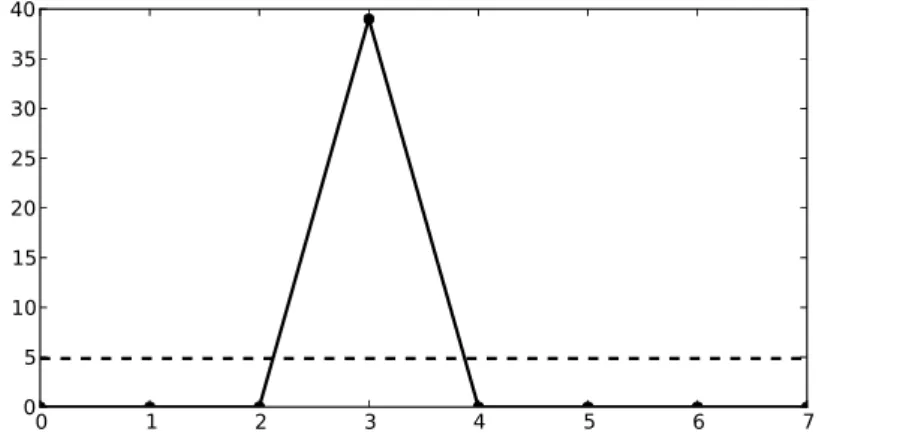
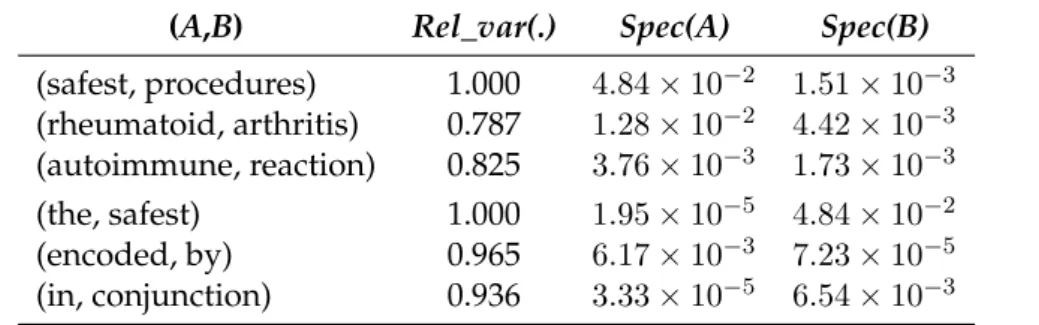
3.1 Representation of the frequencies of co-occurrence for the pair (allergic, re-action). X(reaction,allergic) = [0,0,0,39, reaction,0,0,0,0], x¯ = 4.875 and
Rel_var(.) = 1.000. . . 35
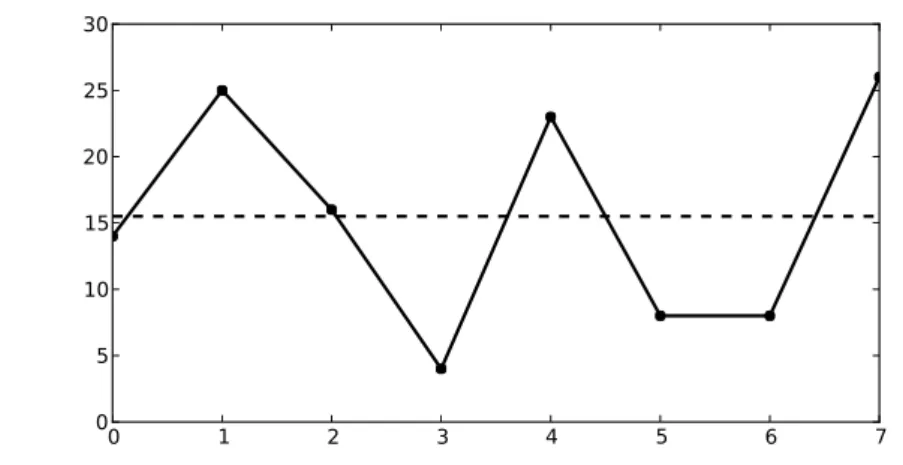
3.2 Representation of the frequencies of co-occurrence for the pair (of,reaction). X(reaction,of)= [14,25,16,4, reaction,23,8,8,26],x¯= 15.5andRel_var(.) = 0.0377. . . 36
3.3 Ordered distribution of theRel_var(.)values for pairs (medicine,bi).. . . . 38
3.4 Ordered distribution of theRel_var(.)values for pairs (of,bi). . . 39
4.1 CatScan V2.0βweb interface.. . . 46
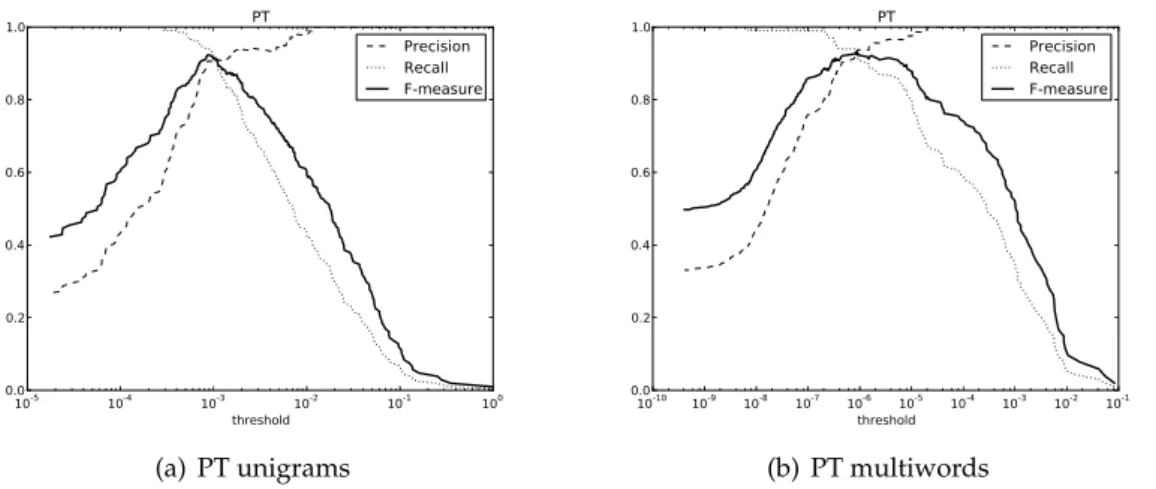
4.2 Precision, Recall and F-measure for different thresholds in the English test sets. . . 49
4.3 Precision, Recall and F-measure for different thresholds in the Portuguese test sets. . . 49
4.4 Precision, Recall and F-measure for different thresholds in the German test sets. . . 49
6.1 Two successive paragraphs from theArthritisarticle – English Wikipedia. 80 6.2 A paragraph from theArthritisarticle – English Wikipedia. . . 85
6.3 Paragraph analysis on a corpus of English documents. . . 86
6.4 Paragraph analysis on a corpus of Portuguese documents. . . 87
6.5 Paragraph analysis on a corpus of German documents. . . 87
6.6 Pseudo-code for finding clusters inLC. . . 88
7.1 TextTilling similarity plot and suggested topic boundaries for the English Arthritisdocument. . . 97
xviii LIST OF FIGURES
7.3 Comparison of TextTilling similarities with concepts (solid line) and the original (dashed line) for the English WikipediaAmygdalindocument. . . 99
7.4 Histogram of concept clusters in sentences for the English Wikipedia En-cephalitisdocument. . . 100
List of Tables
1.1 Classification of some terms from theArthritisdocument excerpt. . . 2
2.1 Relevant words among the 100 more frequent ones in an English medicine corpus. . . 17
3.1 Some multi-words from an English corpus. . . 32
3.2 Some multi-words from a Portuguese corpus. . . 32
3.3 Some multi-words from a German corpus. . . 33
3.4 Co-occurrence frequency of word pairs for different relative positions in an English corpus.. . . 33
3.5 Co-occurrence frequency of word pairs for different relative positions in a Portuguese corpus. . . 33
3.6 Co-occurrence frequency of word pairs for different relative positions in a German corpus. . . 34
3.7 SomeRel_var(.)values for pairs (bi, reaction) from an English corpus. . . 36
3.8 SomeRel_var(.)values for pairs (ácido,bi) from a Portuguese corpus. . . 37
3.9 SomeRel_var(.)values for pairs (bi, chirurgie) from a German corpus. . . 37
3.10 Specificity of some words from the English corpus.. . . 39
3.11 Specificity of some words from the Portuguese corpus. . . 40
3.12 Specificity of some words from the German corpus. . . 40
3.13 False compound concepts from the English corpus. . . 40
3.14 False compound concepts from the Portuguese corpus. . . 41
3.15 False compound concepts from the German corpus. . . 41
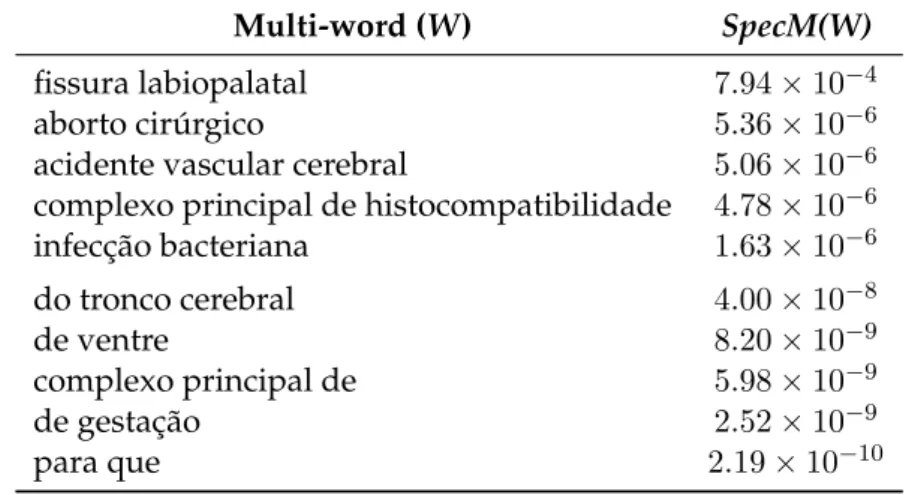
3.16 Comparison of theSpec(.)values for the single-words in some multi-words. 41 3.17 Specificity of some multi-words from the English corpus. . . 43
3.18 Specificity of some multi-words from the Portuguese corpus. . . 43
3.19 Specificity of some multi-words from the German corpus.. . . 43
xx LIST OF TABLES
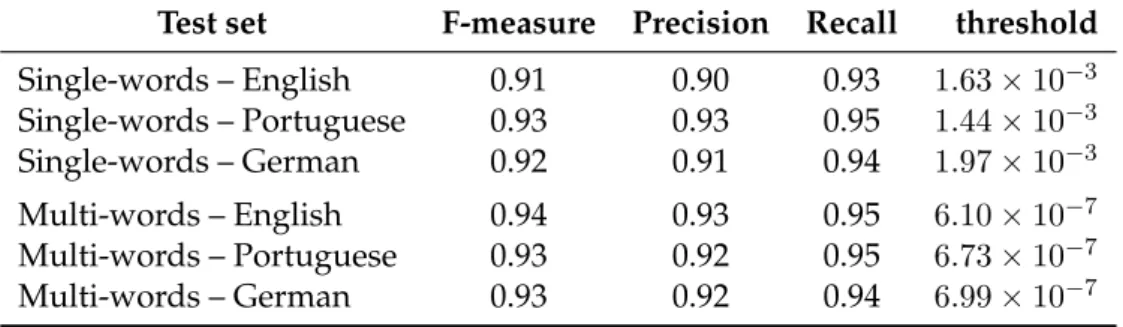
4.2 Precision, Recall and threshold values for the maximumF-measurevalue
of each test set.. . . 50
4.3 Precision, Recall and F-measure values for the test sets considering the average threshold values. . . 50
4.4 Precision and Recall values for different approaches – single-words.. . . . 51
4.5 Precision and Recall values for different approaches – multi-words. . . 51
5.1 Basic statistics about the corpora based on Wikipediagenericarticles. . . . 65
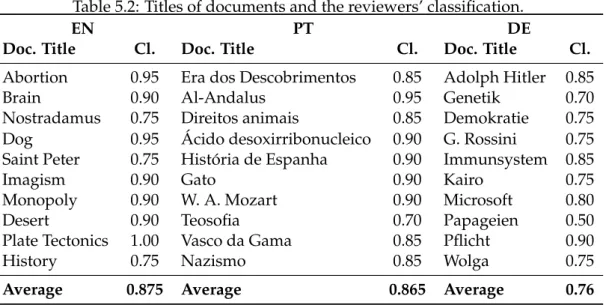
5.2 Titles of documents and the reviewers’ classification. . . 65
5.3 Explicit descriptor –BrainEnglish document. . . 66
5.4 Explicit descriptor –Ácido desoxirribonucleicoPortuguese document. . . 66
5.5 Explicit descriptor –ImmunsystemGerman document. . . 66
5.6 Results for the explicit keyword extraction usingTf-Idf with concepts. . . 67
5.7 Comparison of methods for explicit document descriptors – single-words 67 5.8 Comparison of methods for explicit document descriptors – multi-words. 67 5.9 Correlation values for some pairs in the English corpus. . . 69
5.10 Correlation values for some pairs in the Portuguese corpus. . . 70
5.11 Correlation values for some pairs in the German corpus. . . 70
5.12 IP(A, B)values for some pairs in the English corpus. . . 72
5.13 IP(A, B)values for some pairs in the Portuguese corpus. . . 72
5.14 IP(A, B)values for some pairs in the German corpus.. . . 73
5.15 SemP rox(A, B)values for some pairs in the English corpus. . . 74
5.16 First implicit keywords of the English WikipediaEconomicsarticle. . . 75
5.17 Explicit descriptor of the English WikipediaEconomicsarticle. . . 75
5.18 First ten implicit keywords of the English WikipediaBraindocument. . . . 76
5.19 First ten implicit keywords of the Portuguese WikipediaTeosofiadocument. 77 5.20 First ten implicit keywords of the German WikipediaImmunsystem docu-ment. . . 77
5.21 Precision values for the implicit descriptors.. . . 77
6.1 Semantic Closeness for terms in theArthritisarticle - English Wikipedia. . 89
6.2 Semantic Closeness for terms in theMetabolismoarticle - Portuguese Wikipedia. 90 6.3 Semantic Closeness for terms in theAutismusarticle - German Wikipedia. 90 6.4 Basic statistics about the corpora based on WikipediaMedicinearticles. . . 90
6.5 Random documents extracted from the English, Portuguese and German Wikipedia. . . 91
6.6 Classification results for the English articlePediatric ependymoma. . . 91
6.7 Precision and Recall results for the concept cluster’s approach. . . 92
6.8 Pearson correlation values for concepts co-occurring withgout – English corpus. . . 92
LIST OF TABLES xxi
7.1 Ranking results for theAbortionarticle - English Wikipedia.. . . 102
7.2 Definition results foruric acid– English Wikipedia corpus. . . 105
7.3 Definition results forarthritis– English Wikipedia corpus.. . . 105
7.4 Definition results foramnésia– Portuguese Wikipedia corpus. . . 106
7.5 Definition results forgout– English Wikipedia corpus.. . . 107
A.1 Classification for single-word concepts – English corpus. . . 121
A.2 Classification for multi-word concepts – English corpus. . . 124
A.3 Classification for single-word concepts – Portuguese corpus. . . 129
A.4 Classification for multi-word concepts – Portuguese corpus. . . 132
A.5 Classification for single-word concepts – German corpus. . . 137
1
Introduction
The automatic extraction of relevant terms from texts has been an extensively researched topic in the Text Mining area. Relevant terms are informative words or sequences of words with a high semantic value, and they have been successfully used in diverse ap-plications such as Information Retrieval, document clustering, and classification and in-dexing of documents.
However, a large majority of the work has been done on the extraction of relevant multi-word expressions. This means that the automatic extraction of relevant single-word units has been largely ignored. Nevertheless, it is easy to show that leaving out rel-evant single-words impoverishes, to a certain extent, a process of knowledge extraction. Take, for instance, the following excerpt from the EnglishArthritisWikipedia document:
Gout is caused by deposition of uric acid crystals in the joint, causing in-flammation. (. . . ) The joints in gout can often become swollen and lose func-tion. Gouty arthritis can become particularly painful and potentially debili-tating when gout cannot successfully be treated.
Although multi-word terms such as "uric acid", "uric acid crystals" and "gouty arthri-tis" would probably be captured by most modern multi-word extractors, informative single-word terms such as "gout", "joint" and "joints" would not. Similarly, the relevant single-words which compose some of the multi-word terms, such as "acid", "crystals" and "arthritis", would also be discarded by those extractors. Thus, much of the knowledge in this small excerpt would simply be ignored.
1. INTRODUCTION
"patent" (licenseorcertificate). This kind of relevant and complex single-word terms would also be left out by current multi-word extractors. Therefore, a unified approach for ex-tracting relevant single-words and multi-word expressions using a similar methodology is a major motivation for this thesis.
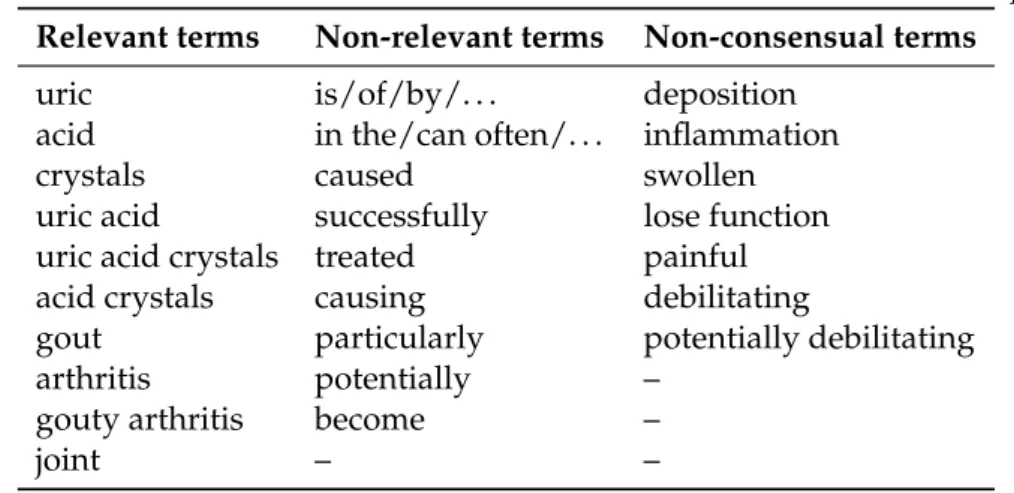
However, the notion of relevance (as in relevant single-words and relevant multi-word expressions) has a rather fuzzy nature. Consider, for instance, Table1.1which presents an example of the manual classification about the relevance of some terms from the previous excerpt.
Table 1.1: Classification of some terms from theArthritisdocument excerpt.
Relevant terms Non-relevant terms Non-consensual terms
uric is/of/by/. . . deposition acid in the/can often/. . . inflammation
crystals caused swollen
uric acid successfully lose function uric acid crystals treated painful acid crystals causing debilitating
gout particularly potentially debilitating arthritis potentially –
gouty arthritis become –
joint – –
For instance, while terms such as "uric acid", "gouty arthritis" or "joint" are usually considered relevant by human evaluators, less informative concepts such as "deposi-tion", "inflamma"deposi-tion", "swollen", "lose func"deposi-tion", "painful" and "debilitating" gather no consensus. This happens mainly because Text-Mining is frequently used for Information Retrieval tasks, and concepts like these are usually considered as not informative enough for most tasks. For instance, concepts such as "painful" and "debilitating" are not con-sidered relevant for tasks such as the extraction of keywords from documents since they usually do not describe the content of documents. But undeniably, these terms have a semantic value, and they may be useful for other kind of applications. Thus, a method-ology for the extraction ofgenericconcepts is also one of the main purposes of this thesis.
1. INTRODUCTION 1.1. Motivations
1.1
Motivations
1.1.1 A statistical approach for single-words and multi-words
Most methodologies for the extraction of relevant terms from texts are currently divided into linguistic, statistical or hybrid approaches. In a general way, linguistic and hybrid approaches tend to use syntactic filters and other language-dependent tools, and not all languages have high quality taggers and parsers available. This makes statistical meth-ods more desirable when language independence is a requirement. Besides, relevancy is not completely determined by morphosyntactic patterns. For instance, "triangle angle" and "greenhouse effect" share the same Noun-Nounpattern, however, only the second one is usually considered relevant.
Regarding the statistical methods, the majority of work has been done on the extrac-tion of multi-word expressions. This means that the automatic extracextrac-tion of relevant single-word units has been largely ignored, and as I mentioned previously, leaving out the relevant single-words impoverishes, to a certain extent, the process of knowledge extraction.
Currently, as far as I know, there are no statistical extractors capable of extracting both relevant single-word and relevant multi-word expressions using the same base method-ology. That poses an interesting challenge, and the development of such methodology is of great interest.
1.1.2 Extraction ofgenericconcepts from texts
1. INTRODUCTION 1.2. Main contributions of this thesis
1.1.3 Applicability of extracted concepts
By extracting all concepts from a text (instead of the small subset ofrelevantterms), and feedingthem downstream, we guarantee that most knowledge in the texts is made avail-able to the downstream applications. Then, accordingly to the specific needs of the task, each application decides which concepts are relevant. For instance, while a task of key-word extraction may assume that the most relevant keykey-words are the most frequent and exclusive concepts in each document, a task ofgenericknowledge extraction or thesaurus construction may assume that all concepts are equally relevant for its analysis.
To support the view that the definition ofrelevance of a term is strongly up to the purpose of the tasks which will use the concepts, the creation of several applications which make extended use of concepts were also a major motivation for this thesis.
1.2
Main contributions of this thesis
The following subsections summarize some of the main contributions of this thesis.
1.2.1 Part I – ConceptExtractor
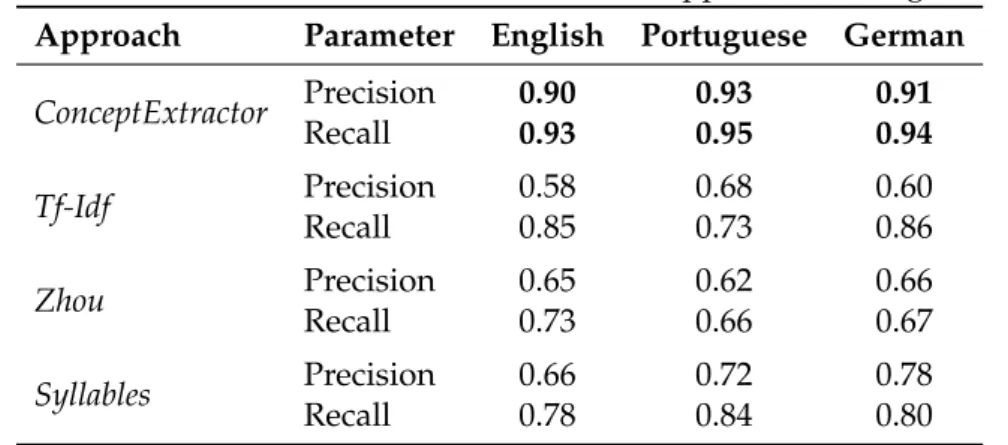
Part I of this thesis presents, as main contribution, the research which led to the imple-mentation of the ConceptExtractor, an approach capable of extracting both single-word and multi-word concepts. ConceptExtractorwas published in ICCS 2012, anA-type con-ference [VS12], and is capable of extracting concepts in text corpora with Precision and Recall values of about 90% for the tested corpora. Some of the innovations associated to this approach are:
• TheRelVarmetric
The core of the extractor is the identification of semantic relations between pairs of words which are not necessarily contiguous. Concepts tend to co-occur at fixed positions relatively to each other andRelVaris a simple statistical metric to detect and quantify those situations.
• Specificity of concepts
It is possible to quantify with the ConceptExtractorhow specific a concept is in a certain text, in relation with other concepts. More specific concepts tend to carry, say,moresemantic information.
• Independence on cohesion metrics
1. INTRODUCTION 1.2. Main contributions of this thesis
• Identification of concepts
My research led to the consideration that there is an uniform, cross-language, speci-ficitythreshold value for concepts. Words and multi-words below a certain speci-ficity value tend to be too generic/vague, carrying little semantic information. There-fore, they must not be considered concepts.
• Language independence
The statistic character and the non-usage of morphosyntactic filters on this ap-proach makes it independent of the language or application. This allows it to extract concepts in several languages and for several applications.
• Applicability
There are several domains for which the automatic extraction of concepts may be useful, besides the ones presented in Part II of the thesis:
– Enrichment of lexicons for Natural Language Processing.
– Enrichment of terminological dictionaries.
– Improvement of the automatic translation between languages, using concepts
extracted from parallel texts, and identifying translation pairs by means of specificity values. The same concepts should have similar specificity values even in different languages.
– Access to existing information in document collections, using extracted
con-cepts as document descriptors. Users may search for specific documents using tools like search engines specifically tailored for this type of application.
– Unsupervised document clustering for multi-language corpora.
– Etc . . .
1.2.2 Part II – Applicability of the extracted concepts
Part II of this thesis presents, as contributions, the research which led to the implemen-tation of some applications using the concepts automatically extracted by the extractor described in Part I. Some of the work described in the second part was published in two Book Chapters [VS13a;VS13b]. Some of those innovations are:
• Explicit document descriptors
1. INTRODUCTION 1.2. Main contributions of this thesis
• Implicit document descriptors
There are meaningful concepts that, although not occurring in the text of a doc-ument, are semantically related to its content. I call these the implicit keywords of a document. Concepts such as "car emissions", "Toxicology" and "acid rains" may be useful if automatically added as implicit keywords of a document about "air pollution", if those terms do not occur explicitly in that document. They may, for instance, provide a user of a search engine the access to documents that may not contain these keywords, but are semantically related to them.
• Identification of semantic relations in collections of documents
By being semantically rich, concepts tend to relate with other concepts. For in-stance, "car" is related to "automobile" and to "means of transportation". When con-cepts tend to co-occur in the same documents of a document collection, it can be as-sumed that their meanings are somewhat related. Thus, by extracting concepts with extractor presented in Part I, and then using a statistical, language-independent metric, it can be measured how semantically related a pair of concepts is in a col-lection.
• Identification of clusters of concepts
A cluster of a concept is a specific area on a text where a concept is relevant and tends to occur rather densely. When a concept occurs densely in an area, it usually implies that its meaning is being used in that area. The identification of clusters of concepts is essential for the next three contributions.
• Measuring semantic relations in standalone documents
When two concepts tend to form clusters in the same areas of a document, it means that they may be semantically related at a low-level. For instance, in a paragraph describing Gout (an inflammation of the joints) it is said that gout is caused by deposition of uric acid crystals. If "gout" and "uric acid" are used densely in that paragraph, both terms will form clusters in that area.
• Finding changes of topic in documents
Although structured documents such as papers, thesis and books, have clearly de-fined frontiers between passages (such as sections or chapters), some documents, especially web documents, are usually unstructured. However, most of these texts can be broken into fine-grained subtopics. TextTilling [Hea97] is a widely known algorithm in this area, and it will be shown that the usage of concepts can improve the performance of this algorithm.
• Finding descriptive areas of documents
1. INTRODUCTION 1.3. Structure of this document
to readers. Clusters of concepts can be used to measure the density of concepts throughout a document.
• Concept definition
As mentioned, a cluster of a concept occurs when a concept is being highly used in a specific area of a document. When a concept is being used in the same area as other concepts, in some cases it corresponds to its definition, especially when encyclopedic texts are being used as source.
1.3
Structure of this document
This thesis is divided in two parts: Part I deals with the automatic extraction of concepts from texts. It starts on chapter2by presenting some of the current state-of-the-art meth-ods for the extraction of concepts. On chapter3an empirical definition of concepts will be presented. The purpose is to demonstrate that there are some relations between concepts which can be explored through a statistical approach. The rest of the chapter shows how theConceptExtractoruses those relations to infer about thespecificityof concepts. Finally, chapter4shows how thespecificityof concepts allows us to separate concepts from non-concepts. The results for theConceptExtractorwill be presented in this chapter, including comparative results with some of the methods reviewed.
Part II presents some applications implemented during the research phase to make use of the extracted concepts. The purpose of this section is to support the view that the relevance of a term is mostly dependent on the goals of each task. Chapter5deals with the extraction of explicit and implicit keywords while chapter 6 presents a new methodology for the extraction of semantic relations using clusters of concepts. Since these applications are somewhat specific, I will present the state-of-the-art methods for each application in each respective chapter. Chapter7presents three other possible ap-plications for concepts which, by lack of opportunity, were not extensively researched and did not led to effective publications. However, some preliminary results were ob-tained, and they represent, essentially, opportunities for future research. Finally, chapter
Part I
2
Current Work
In this chapter I present some current methodologies for the extraction of concepts that I am aware of, and which are representative of the possible types of approaches. Since rel-evant single-words and multi-word expressions can be considered as a subset of all con-cepts occurring on texts, as mentioned in Chapter1, some extractors are also presented in this chapter. Because of the fact that there are no extractors capable of extracting both relevant single-words and multi-word expressions using the same methodology, I will present them separately.
2.1
Concept extractors
Unlike the following sections, which handle the extraction of relevant words and multi-words, the work discussed in this section is about methodologies which claim to extract complete concepts from the texts.
2.1.1 CICM – a linguistic approach
In their paper [ZW10], Zhou and Wang present a method for the extraction of concepts on texts and to discover inner semantic relations within concepts, namely the type of relation. To extract the concepts from the texts, they use lexical patterns. Since they are working with Chinese texts, they first designed a set of rules based on Chinese lexical patterns, for which the concepts tend to be on predefined lexical positions. To extract those concepts, they summarized the following criteria:
• High accuracy: Each lexical pattern on texts must be reflected by at least one
2. CURRENTWORK 2.1. Concept extractors
• High coverage: Each concept belongs to only one of three groups (physical object,
time object and generic concept).
Their idea is that achunkof text extracted using a lexical pattern is a concept if it has been matched by several rules (high accuracy criteria) and has been matched sufficient times by each single rule (high coverage criteria). In their experiments, they identify concepts if the number of matching patterns is greater than 5 and each pattern is matched at least 14 times. Although they report a very high precision using this approach (about 98.5%), they also report very low recall results.
To fix the low recall problem, they propose theCICM (Concept Inner-Constructive Model) to recognize more concepts from text chunks. Their hypothesis is that concepts obey other rules inside the first rules. In practice theCICMis a list of C-vectors, where, for a conceptW =w1w2· · ·wn, theC-vectorof a single wordwiis an ordered list with the words that occur before and afterwi in the analyzed texts. Since the wordwi can occur with other neighbor words on the texts,wimay have more than oneC-vector.
For constructing automatically the CICM, the authors use an external lexicon (the HowNet dictionary in their experiments), and keep only the C-vectors which form fre-quent patterns in the text. Because this generates a lot ofC-vectors, the authors propose a method to cluster similar words – they compute thedistancebetween two vectors using a similaritymetric, and group theC-vectorswhich score higher than a given threshold based on a Gaussian function. Finally, to identify if a chunk of text is a concept, they compute the similarity to all theirC-vectors, and use the same rules as before (number of matching patterns greater than 5 and each pattern matched at least 14 times). Later, they proceed to the identification of semantic relations between concepts, although that is outside the scope of this part of the Thesis.
Clearly, this method is not language independent, since the authors use lexical pat-terns which are specifically for the Chinese language, and an external lexicon is used to generate further rules to fix the low recall problem. A complete rewrite of the mor-phosyntactic filters would be necessary if this method was to be applied to other lan-guages.
2.1.2 GARAGe – an approach using external lexicons
In their paperAutomated Concept Extraction from Plain Text[GWP98], the authors describe a system for extracting concepts from unstructured text by identifying relationships be-tween words based on a lexical database.
2. CURRENTWORK 2.1. Concept extractors
For building the SRG, the authors start by breaking the text into its single-word com-ponents, originating a unordered list of unigrams. Then, for each single-word (calledbase words), they proceed to consult its occurrence and semantical relations on an external lex-icon –Wordnetin this paper. If a semantic relation between two base words is found in the lexicon, even if by means of a third concept not occurring in the text, the relation is drawn between those two base words. There can be more than one "bridge" word not occurring on the texts between a pair of base words, up to a certain predefined number.
Finally, having the structure which relates the words to each other, the idea is that words which do not have any semantic relations, or have incomplete semantic relations, are considered outliers and non-concepts.
The use of external lexicons, such as Wordnet, may affect the quality of results, since these lexicons are usually not entirely complete. Therefore, some semantic relations may not be identified and, as such, some valid concepts may be discarded.
2.1.3 DIPRE – a domain-specific pattern-based approach
The work in [Bri99] presents a pattern-based approach for the extraction of concepts from texts. The idea behind this paper is that some domain specific concepts can be extracted from web documents by exploring recognizable patterns in the texts.
Specifically, in this paper, the author considers the problem of extracting books, namely author names and book titles (tuples(name, title)). He starts with a small seed of(name, ti-tle)pairs. Then, from these occurrences, he recognizes patterns from the citations of these books which will then be reused to find new books. Finally, with these new books, he is able to generate new patterns which will be used to find even more books. The process ends after some iterations.
The method proposed is called DIPRE (Dual Iterative Pattern Relation Expansion) which relies on the duality between patterns and relations. For the experiment about books, the author defines a pattern as a 5-tuple(order, urlprefix, prefix, middle, suffix)where orderis a boolean value which is set to true if there is a pair(author, title)matching the pattern. Iforderis set to false, the pair(author, title)is switched as(title, author).
An important component of this method is the generation of patterns, which takes a set of occurrences of books and converts them into a list of patterns. Since this is not a trivial task, the author uses a very simple set of heuristics. Also, since patterns can be too general or too specific, the author measures the specificity of a pattern as the length of the pattern string and rejects all patterns which length is greater than a given threshold. This allows him to get rid of generic patterns and empty ones, since highly specific patterns are still usable. Finally, for matching the patterns with the text on the documents, the author uses regular expressions.
2. CURRENTWORK 2.1. Concept extractors
2.1.4 KOSMIX – an hybrid extractor
In [PRGM10] the authors propose a technique to extract concepts from large datasets, mainly web pages. The authors start by defining that their target arek-grams, represent-ing entities, events or ideas, that are somewhat popular (for which most users may be interested in) and concise.
An important observation of this technique is that for ak-grama1a2..akwithk > 2, it is not true that both (k−1)-grams (a1..ak−1 anda2..ak) are necessarily concepts. For instance, for the3-gram "Manhattan Experimental Theater", "Manhattan Experimental" is not considered a concept but "Experimental Theater" is. For k = 2, they assume that both words must be concepts.
As for the procedure, the first step is the extraction of allk-grams in a dataset, up to a predefined sizen, tagged with the frequency of occurrence of eachk-gram. Thisnis set to 4 on their experiments, for which they claim to be the largest length of most concepts, given by the titles of the Wikipedia articles they had access to. Then, since they want concise concepts, their idea is that either ak-gram is a concept, or one of its(k−1)-grams are concepts. For that, they use the following indications:
• The frequency of occurrence of a concept should be higher than a given threshold (i.e., concepts must be "popular").
• Either thek-gram isbetterthan all its(k−m)-grams, or it is not a concise concept.
• A concept must contain only portions of sentences that convey a single meaning or idea.
For the first indication, because concepts must occur more than a given threshold, this means that rare concepts may be ignored. For instance, the English wikipedia article Otolaryngologyhas only about 25 occurrences of this concept. Given its specificity, it is possible that a random corpus from Wikipedia documents may contain only one or two documents which refer to this medical specialty once or twice. However, the authors set a threshold of 100 to1-grams, which means thatotolaryngologymay never be considered a concept as well as other highly specific and infrequent concepts. This is a factor which probably gives low recall value to this technique, but the authors chose to publish only Precision results.
For the second indication, the idea is that ak-gram must be "better" than all possible
sub-(k−m)-grams. For that, they rely on the concept ofconfidence, which is basically the probability of occurrence of thek-gram given both its(k−1)-grams. Ak-gram is a concept
if its confidenceis greater than a given threshold. For single-words, they use 100 for the frequency of occurrence threshold in their experiments.
2. CURRENTWORK 2.2. Relevant single-word extractors
and also used on the extractor that I proposed in the context of this thesis, that is the ConceptExtractor, the criterion that states that concepts must not start or end with verbs means that concepts such asCry me a River, a popular song by Justin Timberlake which starts with a verb should not be eligible as concept. As for the idea that concepts should have nouns, it may imply that concepts such as White Houseshould not be eligible as well.
2.2
Relevant single-word extractors
Relevant single-word extractors are methods which are specifically tailored to extract single words from texts. These methods can be divided into four different categories: the linguistic approaches; the structure or knowledge-based approaches; the neural net approaches; and the statistical approaches. In this section I will present one or two promi-nent examples of each category.
2.2.1 Heid – a linguistic-based approach
In [Hei99], the author presents a method for the extraction of candidate single-word terms from German texts. His approach combines linguistic procedures based on pat-tern matching via regular expressions with a relative frequency comparison.
Before the extraction of candidate terms, the author specifies that the corpora used (German texts) must be preprocessed, specifically by tokenizing (word and sentence boundaries correctly identified), word class annotation (Part-Of-Speech tagging) and then lemmatization (grouping of different inflections of the same base word). The retrieval tool then operates on the previous parsed information, making use of lexical data such as lists ofgrammatical wordsand of sequence information, implemented as regular expres-sions over the sequences of characters. Those regular expresexpres-sions are based on prefixes and suffixes which the author justifies as being more frequent in technical vocabulary than in general language.
2. CURRENTWORK 2.2. Relevant single-word extractors
This approach is quite dependent on linguistic tools such as POS tagging, lemmati-zation, and regular expressions matching. This means that it may be not easily portable to other languages. The author itself presents a section where he assumes the difficulties in adapting some of the tools from English to German. Also, this approach is mainly directed to domain-specific relevant words, as the author clearly states by using mor-phemes which are specific to the "car manufacturing" domain.
2.2.2 NN – an approach based on Neural Networks
Neural Networks have also been applied on the extraction of relevant single-words from texts. In [DMPPG02] it is presented a method to search for "featured words", which can describe topics of documents, and then find documents which matches user queries.
Their Neural Network model consists of several nodes. Each node is assigned with a word from a user defined search query with pre-assigned equalenergy. The model then reads an article. The output of the article is a list of single-words obtained from the text. That list includes only the first 200 words of each document of a document-based corpus because, as the authors assume, a word in the title or in the summary of an article is more relevant than a word used in the body text. Next, a stop-word filter is applied, which has the particularity of removing unwanted words such as prepositions or articles ("and", "or", "the", etc.). Then, since words in the title or in the summary part of the document are considered more relevant, different weights are assigned to words accordingly to their place of occurrence.
For each article, if a match between a node (which is a word in the user query) and a word from the article is found, that node is fired and gets a higher energy. The strength of the energy change depends on the weight of the matching word, accordingly to its posi-tion of occurrence in the article. This process continues until the Neural Network reaches a state of equilibrium. This happens when no more nodes will change significantly their levels of energy. Finally, having a set of active nodes, the article with the higher energy will contain a larger number of searched words in its word list. This will associate user queries with documents.
Although this work is focused mainly in the search for candidate documents to satisfy user queries, it uses preprocessed lists of single-words. Those single-words may be what we consider as relevant single-words, since the authors use them as terms for identifying documents. However, Neural Networks, with their back-propagation computations, are known for being quite time consuming.
2.2.3 Luhn – frequency criterion
2. CURRENTWORK 2.2. Relevant single-word extractors
"... the justification for measuring the relevance of a word by the frequency of occurrence is based on the fact that a writer usually repeats some words when arguing and when elaborates certain aspects of a subject ..."
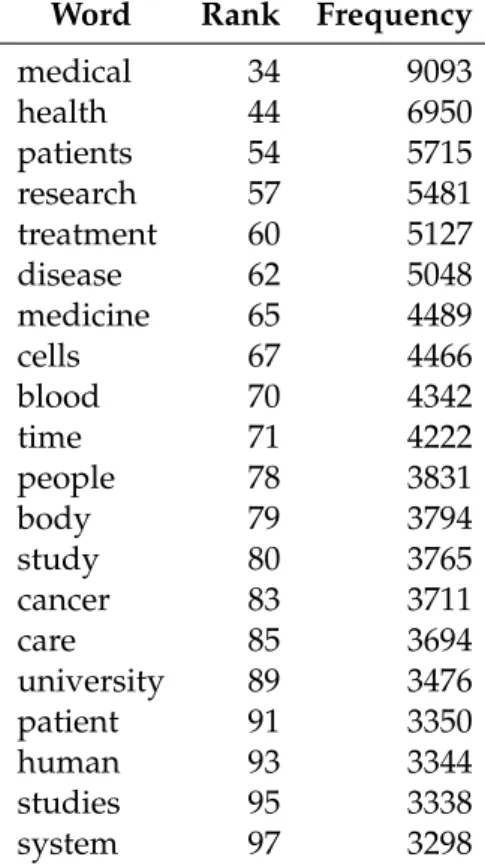
Luhn also suggests that words with a very high frequency of occurrence are usually considered common words, and words with low frequency of occurrence can be consid-ered rare, both being irrelevant. Although this approach seems intuitive, it is not nec-essarily true. During my research I noticed that for some specific corpora, considering different languages, among the 100 more frequent words, in average, about 20%–30% could be considered relevant. Table2.1lists the relevant words among the 100 more fre-quent words in an English corpus made of Wikipedia medicine articles:
Table 2.1: Relevant words among the 100 more frequent ones in an English medicine corpus.
Word Rank Frequency
medical 34 9093
health 44 6950
patients 54 5715 research 57 5481 treatment 60 5127 disease 62 5048 medicine 65 4489
cells 67 4466
blood 70 4342
time 71 4222
people 78 3831
body 79 3794
study 80 3765
cancer 83 3711
care 85 3694
university 89 3476 patient 91 3350
human 93 3344
studies 95 3338
system 97 3298
Considering the fact that the mentioned corpus has about 10 million words in av-erage, from which about 120.000 are distinct, it can be easily understood that with this criterion some or all of the words listed in Table2.1would be thrown away. Luhn’s crite-rion becomes, in this case, quite restrictive. And if we consider the fact that the words in Table2.1came from Medicine texts, one can see the kind of the information that would be rejected: words like "medicine" and "health" are quite descriptive of the texts.
2. CURRENTWORK 2.2. Relevant single-word extractors
important. The author solves this problem partially using a list of common words that should be rejected on the final list. However, Luhn idealized his method for texts with an average of 700 distinct words (scientific papers), but nowadays it would be impracticable to maintain a list of irrelevant words on texts with 100.000 distinct words, for all possible languages and domains.
2.2.4 TF-IDF– a statistical approach
Tf-Idf (Term Frequency – Inverse Document Frequency) [SB88] is a statistical metric for calculating the relevance of words in documents. Essentially, this technique measures how important a certain word is on a document regarding other documents in the same collection. Basically, a word is more important in a certain document the more it occurs in that document, but if that word occurs in other documents, its importance decreases. Words that are very frequent on a single document tend to be more valued than common words that occur on more documents, like articles or prepositions.
Formally, beingW a word, the importance ofW for a documentdj in a corpusD, it is defined by:
Tf−Idf(W, dj) =Tf(W, dj). Idf(W, dj) =
f(W, dj)
size(dj)
.log kDk
k{d:W ∈d}k . (2.1)
In equation2.1,kDkmeans the number of documents on corpusD;k{d:W ∈d}kis the number of documents containing termW andsize(dj)the number of words on the documentdj. To prevent bias towards longer documents, probability (f(W, dj)/size(dj)) of termW in documentdjis commonly used instead of the absolute frequency (f(W, dj)). However, it must be considered that the main goal ofTf-Idf is to analyze the relevance of a word in a document regarding other documents, and not to analyze the relevance of a word in a corpus. A slight modification was made in an experiment in the context of this thesis, so that the relevance of a word could be obtained from a corpus: the score of each word was given by the maximumTf-Idf value.
2. CURRENTWORK 2.2. Relevant single-word extractors
2.2.5 Zhou2003 – another statistical approach
Zhou2003is a metric proposed by Zhou and Slater [ZS03] for calculating the relevance of single-words in a text. It assumes that relevant words can be found in certain areas of the texts, either by being part of local topics or by being related to local contexts, therefore forming clusters in those areas. On the other hand, common and less relevant words should occur randomly in all the text, not forming significant clusters. This technique measures the relevance of a word according to the position of occurrence of each word in the texts.
For a wordw, the authors start with a listLw ={−1, t1, t2, . . . , tm, n}, whereti repre-sents the position of thei-th occurrence of wordwin the text and nrepresents the total number of words in the same text. Then, they obtainuˆ, which is basically the average sep-aration between consecutive occurrences of wordwfor the case of uniform distribution
of the occurrences.
ˆ
u= n+ 1
m+ 1 . (2.2)
The next step consists of the calculation of the average separation between real con-secutive occurrences of the word w in the text; 3 consecutive occurrences are used for
each calculation:
d(ti) =
ti+1−ti−1
2 i= 1,2, . . . , m . (2.3)
Then the approach identifies the points onLw that form part of clusters. Basically a point forms part of a cluster if its average distanced(ti)is less than the average distance between occurrences for the case of the uniform distribution (uˆ). This way,δ(ti)(equation
2.4) is obtained to identify which points ti belong to clusters. In a parallel way, v(ti) (equation2.5), which represents the local excess of words on positionti, is also obtained.
v(ti)basically measures the normalized separation to the average distanceuˆ.
δ(ti) =
1 ifδ(ti)<uˆ
0 otherwise . (2.4)
v(ti) = uˆ−d(ti) ˆ
u . (2.5)
Finally, the score of the wordw is measured by equation2.6. Being the information
about whethertibelongs or not to a cluster inδ(ti)and inv(ti)the normalized separation to the average distance,Γ(w)has the value ofv(ti)whentibelongs to a cluster and zero otherwise.
Γ(w) = 1
m
m X i=1
δ(ti).v(ti). (2.6)
2. CURRENTWORK 2.2. Relevant single-word extractors
problems regarding the very frequent relevant words. In fact, it harms the relevant words that are relatively frequent because they tend to occur throughout the texts and not only on local contexts. Also, by dealing exclusively with significant clusters, relevant words with low frequency of occurrence are also very harmed by this method.
2.2.6 Islands – yet another statistical extractor
The Islands extractor was developed in the context of my Master’s Thesis [VS07]. It presents several statistical metrics and methods for calculating the relevance of single-words in corpora, as well as a method for the automatic extraction of the most relevant words.
The underlying idea of this work is that relevant words have a special preference to relate with a small group of other words. Having this in mind, I proposed two metrics to calculate the score of a wordwbased on the relations with its successor words (all words
occurring right afterw– equation2.7) and with its predecessors (all words occurring just
beforew– equation2.8).
Scsuc(w) = v u u t
1 kYk −1
X yi∈Y
p(w, yi)−p(w, .)
p(w, .)
2
. (2.7)
Scpre(w) = v u u t
1 kYk −1
X yi∈Y
p(yi, w)−p(., w)
p(., w)
2
. (2.8)
p(w, .) = 1 kYk
X yi∈Y
p(w, yi) p(., w) = 1 kYk
X yi∈Y
p(yi, w) p(a, b) =
f(a, b)
N . (2.9)
Y is the set of words in the corpus,kYkstands for its size and N is the number of
words occurred in the corpus. f(a, b)is the frequency of occurrence of the 2-gram(a, b) in the same corpus. The final score is given bySc(w):
Sc(w) = Scpre(w) +Scsuc(w)
2 . (2.10)
After analyzing the words which were considered relevant, I proposed a metric based on the number of syllables of a word. The underlying idea is that it exists more words with 2, 3 and 4 syllables (depending on the language) than words with other number of syllables. As such, this class of words contains more semantical diversity. By applying the syllable analysis to thescoreof a word, Precision and Recall results of this metric were improved by an average of 20%.
2. CURRENTWORK 2.3. Multi-word relevant expression extractors
than its immediate neighbors. If r(w) is the score of a word given by Sc(w) (or Sc(w) with the syllable analysis), the relevance ofwis given by equation2.13.
Avgpre(w) =
X yi∈{predecs ofw}
p(yi, w). r(yi). (2.11)
Avgsuc(w) =
X yi∈{succecs ofw}
p(w, yi). r(yi), (2.12)
Relevance(w) =
1 r(w)≥0.9×max(Avgpre(w), Avgsuc(w))
0 otherwise
. (2.13)
The problem of this approach is that is only analyzes the immediate successors and predecessors of a word. Therefore, not all relevant words which are part of multi-words are correctly extracted. Furthermore, the syllable analysis tends to ignore small relevant words (like acronyms, such as "RAM", "ROM", "FBI", etc.) and larger relevant words (such as "electroencephalograph" or "otorhinolaryngology"). Large relevant words tend to be highly specific concepts, and may be of possible use for some applications.
2.3
Multi-word relevant expression extractors
Multi-word relevant expression extractors are methods which are specifically tailored to extract meaningful multi-words – sequences of 2 or more words – from texts. These se-quences are also known as Multi-word Expressions (MWE) or Multi-word Units (MWU) and they include sequences having a idiosyncratic meaning, i.e., not assembled from the composition of the words in it (such as "raining cats and dogs"), and also sequences where their meaning may be taken from the semantics of each word in the MWE (such as "pres-ident of Pakistan"). Whatever the type, MWEs are expected to have a strong meaning.
The methods to extract MWEs can be divided into four different categories: the lin-guistic approaches; the structure or knowledge-based approaches; the neural net ap-proaches; and the statistical approaches. In this section I will present one or two promi-nent examples of each category.
2.3.1 Hindi – a linguistic approach
The work of Sinha in [Sin11] is an approach which uses linguistic knowledge to extract MWE from the texts. In this specific work, the author is interested in extracting multi-words from Hindi texts, by applying a set of linguistic rules mostly specific for the Hindi language. The approach of Sinha starts by identifying sentence boundaries. Then, he makes a Part-Of-Speech tagging followed by a morphological analysis. Then Sinha ap-plies a sequence of steps.
2. CURRENTWORK 2.3. Multi-word relevant expression extractors
Acronyms and abbreviations in Hindi differ from Western languages (for instance, "Mo-handas Karamchand Gandhi" may be abbreviated as "ma. ka. gaandhii", "mo. ka. gaand-hii" or "ema. ke. gaandgaand-hii"). The identification of acronyms and abbreviations, with dots, is carried out using a rule base approach.
The next step is the Hindi chunker and verb-phrase form separation. Chunking is a process of performing shallow parsing of the sentence, where the words having affinity with each other at a syntactic level are grouped together. Since Hindi is a verb ending language, a finite state machine (FSM) is designed in a way such that it starts scanning the words from the rear end (right to left) for possible inclusion in the verb group, based on the POS tags and the morphemes.
The following step is the identification of replicating words and doublet class. Hindi, as other South-Asian languages, has replicating words which are used to emphasize an idea. For instance, "baRii baRii", which can be literally translated as "big big" in English, means in fact "quite big". As for doublets, they are pairs of words which are antonyms or synonyms/hyponyms of each other. An example for pairs of antonyms can be "din-raat" ("day night") which means "all the time" in English, while for synonyms can be "betaa-betii" ("son daughter"), meaning "family issues". Replicating words are identified using syntactic patterns and each word on a doublet is also identified as antonym or synonym using WordNet.
Next, it follows the identification ofvaalaamorphemes.Vaalaaare multi-words which contain one word of the form "vaalaa", "vaalii", "vaale" or "vaalo.M", such as "jaane vaalaa" ("govaalaa", that is, "about to go" in English) or "doodh vaalii balti" ("milkvaaliibucket", that is, "bucket filled with milk").
The next step is the identification of complex predicates and compound verbs. A com-plex predicate is a MWE where a noun, a verb or an adjective is followed by a light verb, and it behaves as a single verb unit. Some examples are "daan denaa" ("donation give" meaning "to donate" in English) and "mukka maaranaa" ("fist kill/beat" which means "to punch"), for which "denaa" and "maaranaa" are thelight verbs. Sinha uses a list with 30 light verbs.
Then, it follows the identification of acronyms with no dots, such as "beejepii", which is the acronym of "Bharatiya Janata Party" without dots, from the first English characters. Finally, the last step is the identification of named-entities, for which it is used an in-house named-entity recognizer.
This work is a good example of an approach that uses linguistic knowledge in such an intensive way, that the rules are only applicable for the Hindi language itself.
2.3.2 Fips – another linguistic approach
2. CURRENTWORK 2.3. Multi-word relevant expression extractors
considered a subset of the MWEs.
As the authors justify, previous linguistic extractors work by identifying collocations in a specific syntactic configuration, like (Verb,Name), and not defined in terms of linear proximity, as most statistical approaches usually do. This process is mostly made by a parser, and the identification of the collocations are made after the parsing process. The authors of this work propose that since collocations are made of frequently used and highly ambiguous terms, the identification of collocations should occur during the pars-ing process and not after, because this can help with the reduction of lexical ambiguities. Fipsis a grammar-based parser which uses left attachment and right attachment rules to build respectively left sub-constituents and right sub-constituents. The idea is that when a grammar rule is triggered in the text, the collocation procedure is invoked. This collocation procedure first verifies that both words of the collocation are associated in a lexical database to one or several collocations. Then, it searches the database for a collocation with both terms following a certain lexical pattern.
Similarly to other linguistic approaches already reviewed, this work is also quite de-pendent on the usage of POS taggers, parsers, grammars and lexical databases.
2.3.3 HELAS – a multi-word hybrid extractor
In his workMultiword unit hybrid extractor[Dia03], Dias presents a hybrid approach for the extraction of MWEs.
The author starts with a Part-Of-Speech tagged corpora. This POS tagged corpora is then divided into two sub-corpora: one containing words and the other containing POS tags. Each sub-corpus is then segmented into a set of positionaln-grams. A positionaln
-gram is a vector of words in the form[p11, u1, p12, u2, . . . , p1n, un]whereuiis any word in the positionaln-gram andp1i is the distance between wordu1 and wordui. These posi-tionaln-grams allows the representation of non-contiguous multi-word expressions. The
segmentation into positionaln-grams of the sub-corpora allows to associate a positional
n-gram of a word with the positionaln-gram of its Part-Of-Speech counterpart. Having both sub-corpora referencing each other, the author then merges both into a custom-made positionaln-gram notation (of the form
p11, u1,POS-tag1, . . . , p1n, un,POS-tagn
). The following step is the evaluation of the cohesion between all the textual units con-tained in a positionaln-gram, based on the concept of Normalized Expectation (NE) and relative frequency. The basic idea of the Normalized Expectation is to measure the cost of the loss of one element in the positional n-gram. Forf(.) being the frequency of a positionaln-gram, NE is given by:
N E([p11, u1, . . . , p1i, ui, . . . , p1n, un]) =
f([p11, u1, . . . , p1i, ui, . . . , p1n, un]) 1
n(f([p22, u2, . . . , p2i, ui, . . . , p2n, un]) + Pn
i=2f([p11, u1, . . . , p1i, ui, . . . , p1n, un]))
2. CURRENTWORK 2.3. Multi-word relevant expression extractors
Since the author assumes that the average cost of the loss of an element, given by equation2.14, is not sufficient, he uses a Mutual Expectation variant (equation2.15) to refine the results. In practice, the author uses the Mutual Expectation to weightN E(.)by the relative frequency of occurrence of the positionaln-gram, mainly because there may be two positionaln-grams with the same Normalized Expectation. It is given by:
M E([p11, u1, . . . , p1i, ui, . . . , p1n, un]) =
p([p11, u1, . . . , p1i, ui, . . . , p1n, un]). N E([p11, u1, . . . , p1i, ui, . . . , p1n, un])
. (2.15)
where p(v) measures the probability of occurrence of vectorv. This allows Dias to get the most frequent and cohesive positionaln-grams. Thus, by including POS data, Dias
claims that the cohesiveness of words and the degree of cohesiveness with its associated POS tags may allow us to identify MWEs. The combination of both factors is expressed in equation2.16.
CAM([p11, u1, t1, . . . , p1i, ui, ti. . . , p1n, un, tn]) =
M E([p11, u1, . . . , p1i, ui, . . . , p1n, un])α. M E([p11, t1, . . . , p1i, ti, . . . , p1n, tn])1−α
. (2.16)
In equation 2.16, t1, ti and tn are the corresponding POS tags. Variable α allows Dias to choose whether the process should be more oriented towards the cohesiveness of words or of POS tags. Finally, having CAMscores for all positionaln-grams, the most relevant n-grams are selected using the GenLocalMaxs algorithm. The GenLocalMaxs algorithm is quite similar to LocalMaxs algorithm (section 2.3.6), where the underlying idea is that an-gram is relevant if it scores higher than its neighborn-grams.
This approach is quite similar to the work presented in section2.3.6, although it is adapted for non-contiguous multi-word expressions. Results of this approach are vari-able, whether we are dealing with 2-grams up to 6-grams, but average Precision results seems to be around 60%.
2.3.4 TEG – another hybrid approach
TEG(Trainable Extraction Grammar) [FRF06] is a hybrid approach for the extraction of entities and relations at the sentence level, which combines a knowledge-based approach with a statistical machine-learning approach. The system is based on stochastic context-free grammars for which the rules of extraction are manually written.
2. CURRENTWORK 2.3. Multi-word relevant expression extractors
extract, but two classes of symbols require further declaration: termlists, which are col-lections of terms from the same semantic categories, such as country names, cities, states, genes, proteins; andn-grams. The following shows an example of such rules:
termlist TLHonorific = Mr Mrs Miss Ms Dr; (1) Person :- TLHonorific NGLastName; (2) Person :- NGFirstName NGLastName; (3) Person -> IsFriend Person;
(4) Text :- NGNone Text; (5) Text :- Person Text; (6) Text :- ;
In this example, the written rules are specific for a grammar to extract names of per-sons. To further improve the efficiency of this method, the authors train the grammar on a tagged corpus. The idea is that some rules are moreimportantthan others. That impor-tance is given by the frequency for which each rule is "fired" in the training data. Each rule is then rewritten with the probability of occurrence on the training data and finally the grammar is set to extract the entities and relations for which it was trained.
The main problem of this approach is that it tends to be very domain-specific. For instance, to extract names of persons, a set of rules is written, but to extract names of companies, another set of rules has to be written. This makes the usage of this approach rater laborious each time the domain changes, because patterns must be changed whether names of persons or of companies are to be extracted.
2.3.5 Mutual Information, Chi-squared, Phi-squared – statistical metrics
M I,χ2andΦ2are metrics used in some statistical approaches for the extraction of MWEs, mostly collocations. These statistical metrics measure the tendency for a pair of words on a 2-gram to co-occur in sequence. When the 2-grams on a text are ranked by the score of one of these measures, the application of a threshold filter may eventually be used in order to find a possible separation between the MWEs and the non-MWEs.
Mutual Information
The originalMutual Informationmetric [Sha48] is mostly used to measure the uncertainty between two random variables. To measure the degree of "cohesion" between a pair of words, Church & Hanks proposed theassociation ratiometric in [CH90]. Theassociation ratiois commonly known asMutual InformationorSpecific Mutual Informationin Compu-tational Linguistics. Its expression is as follows:
M I(x y) = log2 p(x y)
p(x).p(y) . (2.17)
p(x y) = f(x y)
N−1 p(x) =
f(x)
N p(y) = f(y)
2. CURRENTWORK 2.3. Multi-word relevant expression extractors
Functionsf(x) andf(y)give the frequency of occurrence of the single-words in the texts andf(x y)returns the frequency of occurrence of the 2-gramx y, i.e., ofxoccurring
in a position iwhileyoccurs in positioni+ 1. N stands for the total number of words
in the corpus. Although this metric returns good results for highly co-occurring pairs of words, it also benefits rare pairs. In fact, lets us suppose that a 2-gram occurs with the same frequency nas their unigramsxandy, namely, f(x) = f(y) = f(x y) = n. Then, assuming a big corpus, such thatN ≫1,
M I(x y) = log2 p(x y)
p(x).p(y) = log2
f(x y) N−1 f(x)
N . f(y)
N
≈log2 n N n N. n N
= log2 N 2.n
N.n2 = log2
N n .
This shows that whenn is low andN is high, MI(.)values are also high. So, rare 2-grams are favored by this metric, especially when they occur once (M I(x y) = log2N),
for instance, orthographic errors.
Chi-squared
χ2(.)is a statistical metric based on Pearson’s coefficient [Pea00]. For the extraction of multi-words, this metric is used as follows:
χ2(x y) = N.(f(x y).f(¬x¬y)−f(x¬y).f(¬x y)) 2
f(x).f(y).f(¬x).f(¬y) . (2.18)
As in the previous metric,f(x y) measures the frequency of occurrence of the pair
x y. f(¬x y)measures the frequency of occurrence for the cases whenxdoes not occur beforeyandf(x¬y)measures the frequency of the cases whenydoes not occur afterx. f(¬x ¬y)measures the frequency of 2-grams having neitherxnory. To find a threshold
capable of separating relevant 2-grams from non-relevant ones, the χ2 test is usually used. However, theχ2 test is only applicable when the frequency of occurrence of the
2-gram is greater than 5, or else it cannot be considered valid. This makes the χ2(.) measure and theχ2 test unusable for a great number of 2-grams in the texts.
Phi-squared
Φ2(.)is a statistical metric based on theχ2(.). It was proposed in [CG91] to rank pairs of parallel texts.
Φ2(x y) = (f(x y).f(¬x¬y)−f(x¬y).f(¬x y)) 2
f(x).f(y).f(¬x).f(¬y) . (2.19)