Catarina Figueiredo Moura Geraldes
Licenciada em Conservação - Restauro
Geopolymers as infill material for
conservation of azulejos
Dissertação para obtenção do Grau de Mestre em Conservação e Restauro, especialização em Cerâmica, Vidro e Azulejo
Orientador: Doutora Sílvia Pereira (LNEC) Co-orientador: Dra. Augusta Lima (FCT/NOVA)
Júri:
Presidente: Professora Doutora Maria João Melo Arguente: Professor Doutor João Coroado
Vogal: Doutora Sílvia Pereira
Catarina Figueiredo Moura Geraldes
Department of Conservation and Restoration Master degree in Conservation and Restoration
Geopolymers as infill material for conservation of azulejos
Dissertation presented at Faculdade de Ciências e Tecnologia, Universidade NOVA de Lisboa, in performance of the requirements for the Master degree in Conservation and
Restoration
Specialisation in Ceramics, Glass and Azulejo
Supervisor: Sílvia Pereira Co-supervisor: Augusta Lima
II
Geopolymers as infill material for conservation of azulejos
©Catarina Figueiredo Moura Geraldes, FCT/UNL e UNL
III
Acknowledgements
First of all, I want to thank my supervisor, Sílvia Pereira (Laboratório Nacional de Engenharia Civil, LNEC), for giving me the opportunity to develop this work and accepting to work with me. Thank you for all the guidance, support, and teaching, which allowed me to become a better professional and showed me other work perspectives and approaches. To my co-supervisor, Augusta Lima (Faculdade de Ciências e Tecnologia da Universidade NOVA de Lisboa, FCT-UNL), thanks for all the support, in particular the advices and discussions, as well as the availability and interest shown during this work. I deeply thank to the people from the group where I worked in Laboratório Nacional de Engenharia Civil (LNEC) who welcomed me kindly, specially to Professor J. Delgado Rodrigues for the advices and availability to always clarify doubts; João M. Mimoso for the support and interest in my work; Dória R. Costa for the huge help in performing of some trials; Lurdes Esteves for all the collaboration and teaching about the production of azulejos and for the support in the preparation of samples for SEM-EDS; Maria João Revez, Ines Cardoso and Marluci Mendes for the help and advices throughout the working time in LNEC. I also thank the people from LNEC that somehow contributed to this work: to Dr. António Santos Silva and Paula Menezes for the support with the XRD analysis; to Eng. Isabel Martins for the discussions, advices and support in XRF analysis, as well as to António Carvalho for the help while carrying out the XRF analysis; to António Ferreira for the availability and assistance provided; and to José Costa for all the technical help and constant availability, especially to cut the ceramics used in this work.
Thanks to Fundação para a Ciência e Tecnologia (FCT) for financing the CerAzul project (PTDC/CTM-CER /119085/2010 and UID/EAT/00729/2013), of which this dissertation is part, and also for giving me the opportunity to present the work in the conference E-MRS 2015 Spring Meeting, WB: Sustainable solutions for restoration & conservation of cultural heritage on 11 and 15 May 2015, Lille (France). Special thanks to Norman H. Tennent, advisor of the project, for the work discussions and advices. I also acknowledge LNEC for all the support given towards the development of this work; Laboratório Hércules, Universidade de Évora (Portugal) for the SEM-EDS analysis of the geopolymer pastes; VICARTE, Research Unit “Vidro e Cerâmica para as Artes”, Faculdade de Ciências e Tecnologia, Universidade NOVA de Lisboa (Portugal) for the support; Cromogenia Units from Spain for providing Metastar® 501; and New Terracotta SA from Portugal for the ceramic biscuits used.
IV investigation area. Also, I sincerely thank to Ana Maria, the sweetest person, who is always available for solving any problem.
I specially thank to Tatiana Vitorino, who always trusts and believes in me, gave me good advices in the hardest moments, and without whom it would not have been the same; to Joana for the friendship of all these years and for all the support; Isabel for the unconditional presence; and Rui for being always present and helping me in all possible ways, thanks for your care and love. I thank a lot to my family that always believed in my abilities, in particular, to my grandparents Tina e José, who have always been proud of me; my brothers Mariana and Miguel who have always been present. Finally, I thank to my mother for the daily care and unconditional support and to whom I literally owe everything.
V
Abstract
The restoration materials currently used to fill gaps in architectural historical azulejos (e.g. lime or organic resin pastes) usually show serious drawbacks in terms of compatibility, effectiveness and durability. The existing solutions do not fully protect azulejos in outdoor conditions and frequently result in further deterioration. Geopolymers can be a potential solution for azulejo lacunae infill given the chemical-mineralogical similitude to the ceramic body, and also the durability and versatile range of physical properties that can be obtained through the manipulation of their formulation and curing conditions. This work presents and discusses the viability of the use of geopolymeric pastes to fill lacunae in azulejos or to act as “cold” cast ceramic tile surrogates reproducing missing azulejo fragments. The formulation of geopolymers, namely the type of activators, the aluminosilicate source, the amount of water (to meet adequate workability requirements) and curing conditions were studied. The need for post-curing desalination was also considered envisaging their application in the restoration of outdoor architectural historical azulejos frequently exposed to adverse environmental conditions. The possible advantages and disadvantages of the use of geopolymers in the conservation of azulejos are also discussed. Several techniques were used to study the chemical and physical behavior of geopolymers, namely FT-IR, XRD, MIP, SEM-EDS, WDXRF, electrical conductivity, open porosity, bending strength, adhesion strength, water vapour permeability, thermal expansion and hydric expansion. The results indicate that geopolymers are a promising material for restoration of azulejos, exhibiting some properties, such as adhesion to the ceramic substrate, higher than inorganic materials used nowadays, such as aerial lime based pastes.
Key-words
VII
Resumo
Os materiais utilizados atualmente para preenchimento de lacunas em azulejos históricos de fachada (por exemplo, cal ou pastas à base de resinas orgânicas) apresentam geralmente sérias desvantagens em termos de compatibilidade, eficácia e durabilidade. As soluções existentes não protegem totalmente os azulejos em condições ambientais adversas o que frequentemente resulta numa maior deterioração do azulejo. Os geopolímeros podem ser uma possível solução para o preenchimento de lacunas em azulejos devido à semelhança química-mineralógica com o corpo cerâmico e também a durabilidade e a versátil gama de propriedades físicas que podem ser obtidas através da manipulação da sua formulação e condições de cura. Este trabalho apresenta e discute a viabilidade do uso de pastas geopoliméricas para preenchimento de lacunas ao nível do vidrado e da cerâmica em azulejos ou, reproduzindo fragmentos de azulejos em falta. Foi, assim, estudada a formulação dos geopolímeros, nomeadamente o tipo de ativadores, a fonte de alumino-silicato, a quantidade de água necessária para a obtenção da trabalhabilidade adequada das pastas e as condições de cura. A necessidade de um processo de dessalinização pós-cura foi também considerada prevendo a sua aplicação no restauro de azulejos históricos de fachada, frequentemente expostos a condições ambientais adversas. As possíveis vantagens e desvantagens da utilização das pastas geopoliméricas na conservação e restauro de azulejos são também discutidas. Foram utilizadas várias técnicas para estudar o comportamento químico e físico dos geopolímeros, nomeadamente FT-IR, DRX, MIP, SEM-EDS, WDXRF condutividade elétrica, porosidade aberta, ensaios de flexão, força de adesão, permeabilidade ao vapor de água e expansibilidade térmica e hídrica. Os resultados obtidos indicam que os geopolímeros são um material promissor para o restauro de azulejos, uma vez que sendo materiais inorgânicos apresentam algumas propriedades, tais como adesão ao corpo cerâmico, superiores as pastas inorgânicas atualmente utilizadas, como por exemplo as pastas à base de cal aérea.
Palavras-chave
IX
Index of contents
Acknowledgements ... III Abstract ... V Resumo ... VII Index of contents ... IX Index of Figures ... XI Index of Tables ... XIII Symbols and Abbreviations ... XV
1. Introduction ... 1
2. Geopolymers in heritage restoration ... 3
3. Experimental procedure... 5
3.1 Materials ... 5
3.1.1 Metakaolins and Activators ... 5
3.1.2 Reference ceramic substrates and infill paste ... 5
3.2 Geopolymers formulation and preparation ... 6
3.2.1 Geopolymer pastes formulation ... 6
3.2.2 Experimental design ... 7
3.2.3 Samples preparation for visual observations ... 7
3.3 Analytical techniques ... 8
3.3.1 X-ray Diffraction (XRD) ... 8
3.3.2 Fourier Transform Infrared Spectroscopy (FT-IR) ... 8
3.3.3 Wavelength Dispersive X-ray fluorescence (WDXRF) ... 8
3.3.4 Scanning Electron Microscopy with Energy Dispersive X-ray Spectroscopy (SEM-EDS) ... 8
3.3.5 Mercury Intrusion Porosimetry (MIP)... 9
3.3.6 Open porosity ... 9
3.3.7 Water vapour permeability ... 9
3.3.8 Hydric expansion ... 9
3.3.9 Thermal expansion ... 10
3.3.10 Bending strength ... 10
3.3.11 Adhesion strength ... 10
3.4 Methods ... 10
3.4.1 Desalination ... 10
X
4. Results and Discussion ... 13
4.1 Importance of limiting the water evaporation ... 13
4.2 Visual observation of the geopolymer pastes formulations ... 13
4.3 Chemical and mineralogical characterisation ... 16
4.3.1 XRD ... 16
4.3.2. WDXRF ... 17
4.3.3 FT-IR ... 17
4.3.4 Formation of soluble salts ... 19
4.3.5 SEM-EDS ... 21
4.4 Physical and Mechanical characterisation ... 22
4.4.1 Pore size distribution ... 22
4.4.2 Open porosity ... 23
4.4.3 Water vapour permeability ... 24
4.4.4 Hydric expansion ... 24
4.4.5 Thermal expansion ... 25
4.4.6 Flexural strength ... 26
4.4.7 Adhesion strength ... 27
5. Conclusions ... 29
5.1 Summary of results ... 29
5.2 Future work ... 30
Divulgation of work ... 31
References ... 31
Appendices ... 37
Appendix I. Chemical and physical properties of the studied metakaolins ... 38
Appendix II. Chemical and physical properties of historical azulejo (“Az21” – 18th century) and reference ceramic substrates (“25% CaO” and “Mortágua”). ... 39
Appendix III. WDX-ray Fluorescence analysis ... 34
Appendix IV. Preparation and performance of geopolymer pastes. ... 35
Appendix V. Images of some of the analythical techniques and samples used to study the properties of geopolymers pastes ... 36
Appendix VI. X-ray diffraction analysis ... 38
XI
Index of Figures
XII Figure 16. Hydric expansion coefficient vs time of geopolymer pastes NaOH_1000 and KOH_1000 (cured at 21 and 40 ºC). ... 25 Figure 17. Thermal expansion of geopolymer paste NaOH_1000 cured at 21 and 40 ºC, after desalination. ... 26 Figure 18. Flexural strength of geopolymer pastes NaOH_1000 and KOH_1000 cured at 21 and 40 ºC, after desalination, aerial lime paste (1:3 vol lime:silica powder), historical azulejos and reference ceramic substrate “Mortágua” ... 27 Figure 19. Adhesion strength results of geopolymer pastes cured at 21 and 40 ºC. Pastes applied on the reference ceramic substrate “25% CaO” and on historical azulejos. The results were compared with aerial lime paste. ... 28 Figure 20. Adhesion strength test of geopolymer pastes. Left: paste applied on the reference ceramic substrate “25% CaO” and right: pastes applied on historical azulejos cured at 21 ºC. ... 28 Figure I. Preparation of geopolymer paste. Left: metakaolin in powder; centre: addition of alkaline solution; right: final paste of geopolymer………..35 Figure II. Limit water evaporation step. Geopolymer pastes with metakaolin ARGICAL-M 1000® and silicates solutions. Left: paste K
XIII
Index of Tables
Table 1. Designation of the geopolymer pastes studied and ratio M:Al (mol:mol) used in formulation of the pastes ... 6 Table 2. Amount of water in the formulations. Ratio H2O:Al (mol:mol). ... 7 Table 3. Results of the visual observation of the geopolymer pastes prepared with MK 1000, MK 1200 or MK 501 mixed with the NaOH and KOH solutions. ... 13 Table 4. Results of the visual observation of the geopolymer pastes prepared with MK 1000 mixed with the six activators cured at 21 ºC. ... 14 Table 5. Chemical composition of studied materials through WDXRF, normalise to 100% wt. ... 17 Table 6. WDXRF analysis of geopolymer pastes NaOH_1000 and KOH_1000 (21 ºC and 40 ºC) normalised to 100% wt. ... 20 Table 7. Hydric expansion coefficient obtained at 48h of geopolymer pastes NaOH_1000 and KOH_1000 (cured at 21 and 40 ºC), aerial lime paste [44] and historical azulejos [25]. ... 25 Table I. Metakaolin elemental chemistry………...38 Table II. Physical properties of studied metakaolins………. 38 Table III. Physical properties of an 18th c. historical azulejo – “Az21” and reference ceramic substrates –“25% CaO” and “Mortágua”………. 39 Table IV. Characterisation of 18th c. historical azulejo1–“Az21” through SEM-EDS…. 39
Table V. Characterisation of 18th c. historical azulejo1–“Az21” through XRD………... 39
XV
Symbols and Abbreviations
AD Apparent Density
c. Century
DCR Department of Conservation and Restoration
ɛ Linear coefficient of hydric expansion F Force
FCT Faculty of Science and Technology
FT-IR Fourier Transform Infrared Spectroscopy
L Initial sample length
L0 Initial transducer reading
LfTransducer reading at 48 h
LNEC Laboratório Nacional de Engenharia Civil
MIP Mercury Intrusion Porosimetry
MK Metakaolin
MWU Maximal Water Uptake
NP Not Performed
P Porosity
RCS Reference Ceramic Substrate
RD Real Density
RH Relative Humidity
SEM-EDS Scanning Electron Microscopy – Energy Dispersive X-ray Spectroscopy UNL Universidade NOVA de Lisboa
WDXRF Wavelength Dispersive X-ray Fluorescence
XRD X-ray Diffraction
ΔL Length variation
1
1. Introduction
The enormous technological development in recent decades has resulted in the study and production of a range of promising novel materials, such as the commonly designated geopolymers or alkali-activated aluminosilicates [1-4]. These materials have attracted the attention of the scientific community, particularly in the field of civil engineering due to their low carbon footprint, excellent mechanical properties and high resistance to heat and acids [1, 4-8]. While there is a high potential of applicability of these materials in the conservation and restoration field, especially as infill material for stone and ceramics, the scientific and technological aspects deriving from their practical use has however been little explored so far.
The geopolymers have been studied since 1940 by many researchers, although it was only with Joseph Davidovits that the study of alkaline activation had a great increase. The term geopolymer was created by Davidovits, who developed and patented these binders obtained from the alkaline activation of metakaolin [9-11]. These materials are synthesised through the reaction between an aluminosilicate source, generally metakaolin, and an alkaline solution, denominated as activator, the more common of which are sodium and potassium hydroxides and sodium and potassium silicates [6, 11-13].
So far, the reaction of geopolymers is still not well understood [5, 14]. It is generally accepted that in a first step there is a hydrolysis reaction, with the dissolution of the solid aluminosilicate source by the alkaline components [15, 16]. The covalent bonds of the aluminosilicate source are broken, generating SiO4- and AlO4- that bind to each other alternately by sharing all the oxygen atoms, producing new silicate and aluminate species. A certain number of tetrahedral positions are occupied by Al3+ ions (in IV-fold coordination) [10], which create a charge deficit that is compensated by the presence of positive ions such as Na+ and K+ in the cavities of the structure. These ions are believed to be strongly linked to the molecule and balance the negative charge, making the structure electrically neutral. Subsequently, many condensation phases occur where the Si-O-Al-O units rearrange themselves and become increasingly organised until the last step, polymerisation and hardening, when a final three dimensional structure is formed [9-11, 15-18].
2 Scheme 1. Geopolymerisation reaction [19].
This work introduces the technological background of this novel material and presents the basic characteristics of a certain number of geopolymer pastes providing a first insight on the potentialities of geopolymers in the field of conservation and restoration of ceramic heritage especially as an infill material for outdoor historical azulejo exposed to adverse environmental conditions.
n(OH)3–Si-O-Al-O-Si-(OH)3 NaOH or KOH (Na,K)-(-Si-O-Al-O-Si-O-) + 4nH2O (-)
O (-)
(OH)2
(+)
O O
n(Si2O5,Al2O2) + 2nSiO2 + 4nH2O n(OH)3–Si-O-Al-O-Si-(OH)3 NaOH or KOH
(OH)2 (-)
Aluminosilicate source Alkali activators Geopolymer precursor
3
2. Geopolymers in heritage restoration
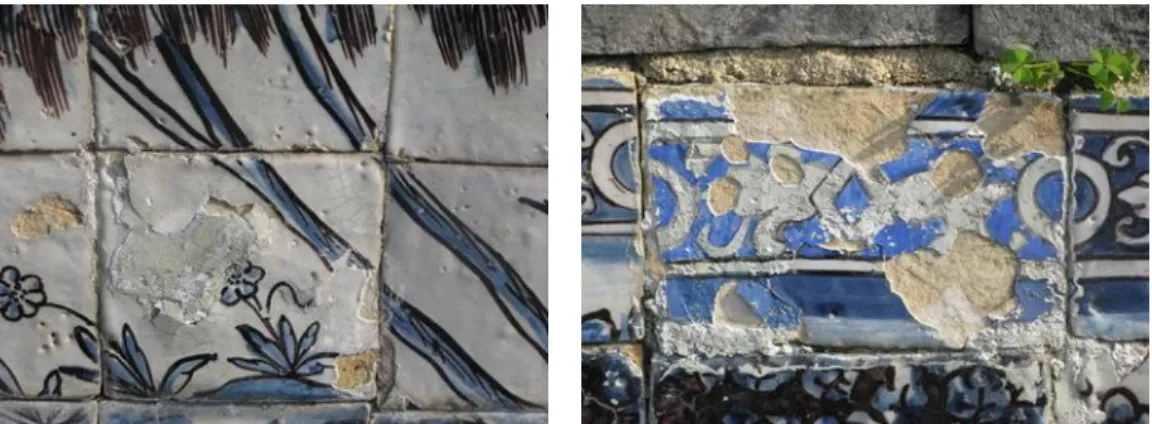
As aluminosilicates the geopolymers present a marked chemical-mineralogical similarity with ceramic bodies. Their potential high durability and the high versatile range of physical properties that can be mastered rend them an interesting alternative to the most commonly used materials in the filling of lacunae in azulejos (e.g. lime or organic resin pastes), which frequently exhibit limited effectiveness or lack of compatibility and insufficient durability (Fig. 1) [20].
These characteristics make the geopolymers highly promising for the conservation of cultural heritage, specifically for azulejos. They can be potentially resistant to extreme environmental conditions, have higher adhesion to the substrate (due to partial reaction with it since it is also an aluminosilicate), present adequate cohesion of the pastes fast curing and chemical and physical similarities with the ceramic substrate. However, these materials may have some disadvantages, such as the release of soluble salts, undesirable interaction (chemical reaction with glaze) with the historical materials, handling issues (since they require the manipulation of extremely strong alkaline solutions), and a non-negligible dependence on the environmental conditions, especially temperature.
The application of geopolymers to cultural heritage is still under-researched, even though some studies have been conducted specifically for the consolidation of terracotta structures [21, 22], earthen architecture [23] and conservation of stone [24]. When in architectural setting the azulejos restored with geopolymers are usually attached to the wall with a lime based mortar. The temperature and relative humidity are not controlled (there may be large daily and yearly variations) and the water present in the wall can affect the ceramic-infill interface. The potential of geopolymer pastes for the restoration of cultural heritage, namely as gap-fill material for ceramics in architectural setting, is explored in this work.
Figure 1. Lacunae infill treatments with issues of lack of compatibility, efficiency or durability.
5
3. Experimental procedure
3.1 Materials
3.1.1 Metakaolins and Activators
Three types of commercial metakaolins (MK), as the aluminosilicate source, were tested (Table I - Appendix I), ARGICAL-M 1000® and ARGICAL-M 1200S® (Imerys, UK) and MetaStar® 501 (Imerys, Spain). The metakaolins have different pozzolanic indexes, water need and particle size (Table II - Appendix I). The crystalline phases present in the MK ARGICAL-M 1000® were determined by X-ray diffraction.
The alkaline solutions used as activators were prepared using sodium hydroxide pellets (CARLO ERBA Reagents SAS, France) and potassium hydroxide pellets (E. Merck, Germany) dissolved in deionised water to obtain 12M NaOH and 10.4M KOH solutions. Commercial sodium silicate solution (Na2SiO3, 1.39 g/mL at 25 ºC. Sigma-Aldrich) and calcium hydroxide (Codex, Carlo Erba) were also used. Potassium silicate solution was prepared by mixing KOH pellets (E. Merck) with fumed silica (Cab-o-sil® M-5, Germany) in demineralised water according to [25] in order to obtain the same molarity as the commercial sodium silicate solution. The activators used were NaOH and KOH solutions, and mixtures of them with CaOH and with silicate of Na or K.
3.1.2 Reference ceramic substrates and infill paste
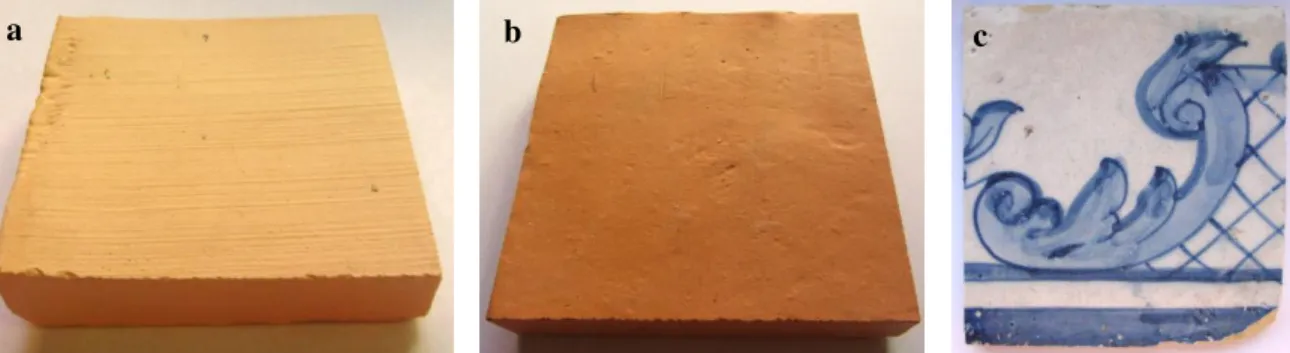
6 Figure 2. Reference ceramic substrates used. a) “Mortágua”; b) “25% CaO” and c) “Az21”.
3.2 Geopolymers formulation and preparation 3.2.1 Geopolymer pastes formulation
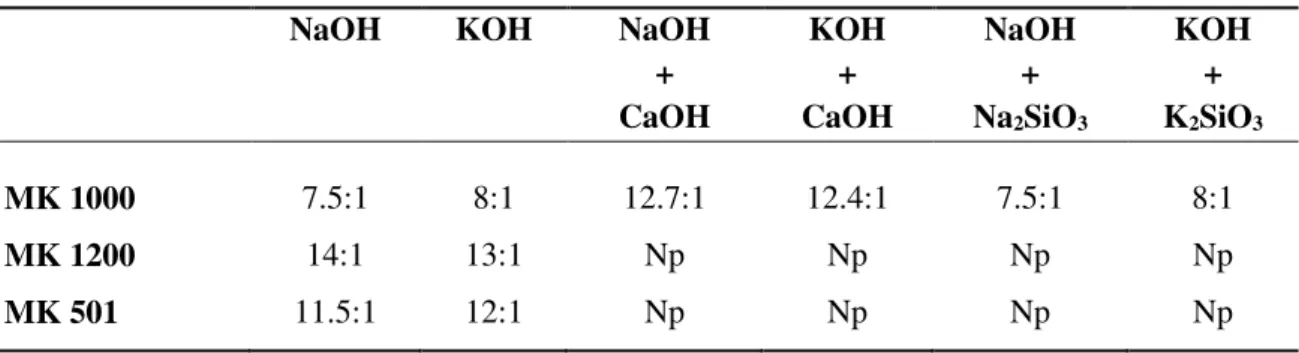
Geopolymer pastes were formulated (Table 1) by mixing the metakaolins with the alkaline solutions 12M NaOH and 10.4M KOH in the proportion of 1:1 and 0.85:1 mol:mol (1 or 0.85M:1Al) where M is Na or K. Pastes using mixtures of these alkaline solutions with CaOH in the proportions 0.4:0.5:1 (0.4M:0.5Ca:1Al), where the CaOH was dry mixed with the metakaolin,. Mixtures of alkaline solutions and Na2SiO3 or K2SiO3 in the proportion 1:1 or 0.85:1 (M:Al) were also formulated. The activators were mixed with the metakaolin by hand for about 1 min (Fig. I - Appendix IV). When necessary, distillate water was added in order to obtain a paste with good workability. The total amount of water is indicated in Table 2.
Table 1. Designation of the geopolymer pastes studied and ratio M:Al (mol:mol) used in formulation of the pastes
MK 1000 MK 1200 MK 501
Activators M:Al Paste name Paste name Paste name
NaOH 1:1 NaOH_1000 NaOH_1200 NaOH_501 KOH 0.85:1 KOH_1000 KOH_1200 KOH_501 NaOH +CaOH 0.5:0.5:1 Na+Ca_1000 Np Np KOH +CaOH 0.4:0.5:1 K+Ca_1000 Np Np NaOH +Na2SiO3 1:1 Na2SiO3_1000 Np Np
KOH +K2SiO3 0.85:1 K2SiO3_1000 Np Np
Note: M – Na or K; Np – Not performed
7 Table 2. Amount of water in the formulations. Ratio H2O:Al (mol:mol).
NaOH KOH NaOH + CaOH
KOH + CaOH
NaOH + Na2SiO3
KOH + K2SiO3
MK 1000 7.5:1 8:1 12.7:1 12.4:1 7.5:1 8:1
MK 1200 14:1 13:1 Np Np Np Np
MK 501 11.5:1 12:1 Np Np Np Np
Note: Np – Not performed
3.2.2 Experimental design
Initially, three commercial metakaolin sources (MK 1000, MK 1200 and MK 501) were selected and activated with the hydroxide solutions (NaOH and KOH) and cured at 21 ºC (RH 50±2%). Through visual observations, it was selected the MK which showed the best results and further tested using six different activators (Table 1) maintaining the curing temperature of 21 ºC. All formulations described before were wrapped in cling film. For the best activator and metakaolin a detailed characterisation has been performed, where all formulations were wrapped in cling film and left to cure at 21 °C (RH 50±2%) or at 40 ºC (in a ventilated oven) and after curing time were submitted to a desalination procedure. The obtained results were also compared with the ones using the aerial lime based paste. 3.2.3 Samples preparation for visual observations
Two types of samples (Fig. 3) were prepared: 1) pastes applied with a spatula on top of humid reference ceramic substrate - “Mortágua” 5 x 5 x 1 cm in size, and 2) pure paste monoliths 2.5 x 2 x 0.5 cm in size. All samples were wrapped in cling film and left to cure at 21 °C (RH 50±2%) for at least 7 days, where the setting time is approximately 24 h.
Figure 3. Types of samples prepared. Left: paste applied on a reference ceramic substrate
8 3.3 Analytical techniques
3.3.1 X-ray Diffraction (XRD)
Samples of pure pastes (without desalination) were dried after 7 days of curing up to constant weight and milled until all particles passed a 106µm sieve. The samples were analysed on a Philips X-Pert X-ray diffractometer with cobalt Kα radiation. The analysis conditions were: scan of 2θ ranging between 3 and 74 and a scanning speed of 0.05 ° 2θ / s. The voltage and filament current were 35 kV and 45 mA, respectively.
3.3.2 Fourier Transform Infrared Spectroscopy (FT-IR)
The equipment used was a TENSOR Series FT-IR Spectrometer from Bruker. It is equipped with RT-DLaTGS [Internal] detector, mid-IR source (4000 to 400 cm-1) and a KBr beam splitter. The parameters selected during the acquisition, in absorbance mode, were: 32 interferometer scans, RT-DLaTGS [Internal] detector and spectral resolution of 4 cm-1. Samples were prepared from powder obtained by sampling the interior of the geopolymer paste and mixing it with KBr. The results were analysed with the software Opus 6.0.
3.3.3 Wavelength Dispersive X-ray fluorescence (WDXRF)
Laboratory samples were ground in an agate mortar and passed through a sieve with 45µ aperture. The determination of the chemical composition of the samples was performed on pressed pellets, obtained by deposition of 0.5 g of sample on a support of analytical grade boric acid. The pressing was performed in a press HERZOG TP 20 P using a mold die Ø40mm, applying a 200KN force during 60s. A semi-quantitative analysis using a sequential wavelength dispersive X-ray fluorescence spectrometer, AXIOS PW 4400/24, from PANalytical evaluated the chemical composition of the pastes. The equipment allows the analysis of elements in the Periodic Table from Z = 4 (beryllium) to Z = 92 (uranium). The measurements were carried out using a 2.4 kW rhodium tube as a source of X-ray radiation. The IQ software, version 4.0G, using matrix corrections based on Fundamental Parameters model, was used to analyse the results.
3.3.4 Scanning Electron Microscopy with Energy Dispersive X-ray Spectroscopy (SEM-EDS)
9 3.3.5 Mercury Intrusion Porosimetry (MIP)
Samples (2 for each formulation) were dried up to constant weight at 40 ºC in a ventilated oven and let to cool in a desiccator. Measurements were performed in a Quantachrome Autoscan porosimeter, based on the ASTM D4404-84 American Standard.
3.3.6 Open porosity
The open porosity was determined by the hydrostatic weighting method, with samples saturated (3 for each formulation) under vacuum conditions (Fig. III - Appendix V). The dry weight was taken with the specimens dried at 40 °C. The open porosity (P), the maximal water uptake (MWU), the real (RD) and apparent densities (AD) were determined.
3.3.7 Water vapour permeability
The water vapour permeability of the geopolymer pastes was determined in monoliths of 5 x 5 x 1 cm using the dry cup method. Specimens were placed in the open face of a cubic box with calcium chloride (Fig. III - appendix V). The boxes were sealed with resin and placed inside a sealed chamber with controlled temperature and humidity, 70% RH and 21 ºC. The weighing of the samples was done every 24 h during 2 weeks.
3.3.8 Hydric expansion
The hydric expansion was measured using Linear Strain Conversion (LSC) transducers Full Bridge 350 according to LNEC procedure LERO PE-10 [28] based on the RILEM 25 PEM Provisional Recommendations. The samples with (about) 70 mm length were dried at 60 ºC in a ventilated oven and allowed to cool down in a desiccator before the measurement procedure. On the top was made a small incision to allow the transducer point to rest and avoid any slippage. Each sample and transducer were mounted on a stainless steel structure, put inside a cylindrical acrylic container and covered with deionised water (Fig. IV - Appendix V). The tests were performed at laboratory conditions (20 ± 2 ºC). The lengths were registered every 5 min up to 48 h. The linear coefficient of hydric expansion (ε) is calculated after 48 h of immersion through the formula:
𝜀 = (𝐿𝑓− 𝐿𝐿 0)
10 3.3.9 Thermal expansion
The thermal expansibility is measured with an automatic dilatometer Dilatomic 1200C manufactured by Theta Industries, with 1 µm resolution on the length measurement and 0.1 ºC on the surface temperature of the sample (Fig. IV – Appendix V). The samples with 4 x 7 x 1 cm were dried at 60 ºC in a ventilated oven and allowed to cool down in a desiccator before the measurement procedure. The experimental procedure was performed according to the EN-14581 Standard [29]. The temperature program initiated at 25 ºC with temperature increments of 5 ºC, a stabilization period of 180 min at each temperature step up to a temperature of 80 ºC. The thermal expansion coefficients (ξ) were calculated by regression from the ΔL / L values obtained at the end of each temperature step, where L is the initial sample length and ΔL is the length variation determined at the end of each step. 3.3.10 Bending strength
The flexural strength is quantified through the highest stress at breakage which is assessed from the force (F) applied at the time of rupture. Samples with 4 x 7 x 1 cm (3 for each formulation) were dried up to constant weight at 40 ºC in a ventilated oven and let to cool in a desiccator. Tests were performed using as equipment a 3 point bending machine (Gabbrielli CRAB424) from LNEC (Fig. V - Appendix V) according to the standard EN-ISO 10545.4 of 1997.
3.3.11 Adhesion strength
The adhesion strength of the geopolymers to the reference ceramics substrates was determined using a pull-off tester (Dyna Proceq Z16E) (Fig V - Appendix V). The test was performed in two reference ceramic substrates ("Mortágua" and “CaO 25%”) of 5 x 5 x 1 cm with 4 semi-spherical holes with 2 cm diameter and ca. 2.5 mm depth, and validated in the historical azulejos “Az21” with 2 semi-spherical holes with 2 cm diameter (Fig. VI and VII – Appendix V). The geopolymer pastes were applied in the holes with a spatula and were left to cure wrapped in cling film at 21 °C (50±2% RH) or at 40 ºC (in a ventilated oven).
3.4 Methods 3.4.1 Desalination
11 3.4.2 Release of soluble salts through Electrical Conductivity
13
4. Results and Discussion
4.1 Importance of limiting the water evaporation
As already mentioned in literature [16, 30-32] and also through visual observation of the geopolymer pastes during the curing process (Fig. II – Appendix IV), the isolation of the samples, with cling film, is a very important step in order to limit water evaporation and thus avoid the formation of cracking. It is also important to achieve a stronger adhesion of the pastes to the ceramic substrate. For the geopolymer formation, water is needed for the aluminosilicate hydrolysis and reorganization [15, 16]. Therefore, in the absence of water, the geopolymerisation is halted and friable and less adherent pastes are obtained. All geopolymers were therefore obtained by imposing a delayed drying.
4.2 Visual observation of the geopolymer pastes formulations
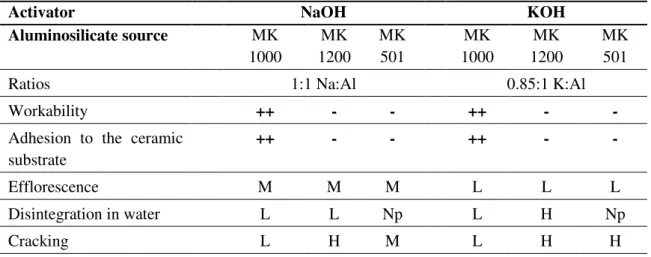
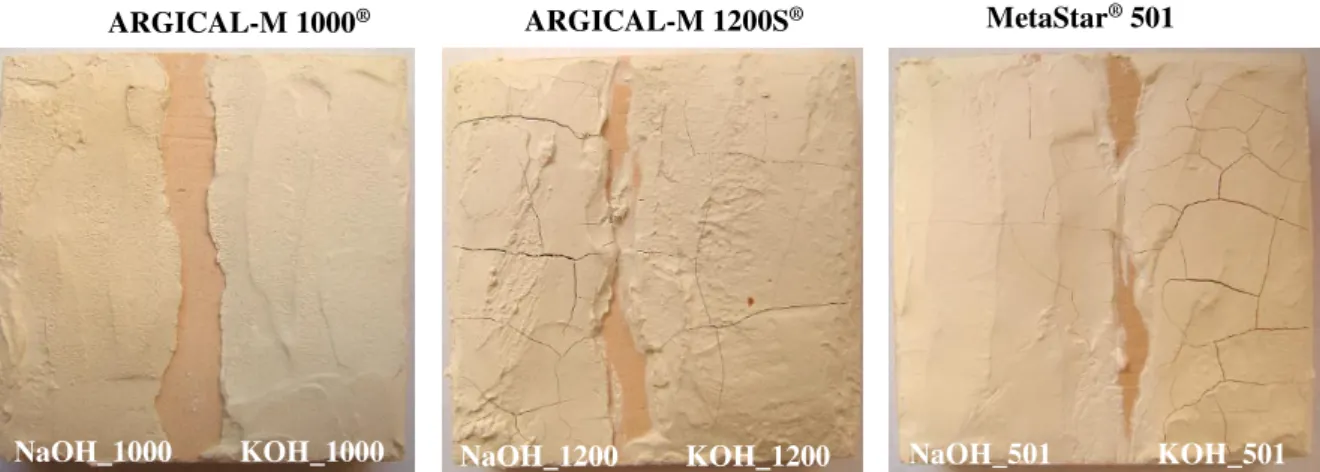
The first screening of the pastes efficacy as gap-fill material for azulejos lacunae was done through visual observation (Fig. 4). The three tested metakaolins were activated with solutions of both sodium and potassium hydroxides solutions (Table 3) and the best performance was obtained with the pastes prepared with MK ARGICAL-M 1000®. The pastes prepared with the metakaolins ARGICAL-M 1200S® and MetaStar® 501 showed cracking on the surface and low adhesion to the ceramic substrate (Table 3, Fig. 4). This may possibly be explained by the higher amount of water (Table 2) needed to ensure an adequate workability and, as stated before, since water plays an important role in geopolymer reaction, the excess may compromise the structural stability of geopolymers [16, 30, 33]. According to these results, MK 1000 was the metakaolin selected for the subsequent experiments.
Table 3. Results of the visual observation of the geopolymer pastes prepared with MK 1000, MK 1200 or MK 501 mixed with the NaOH and KOH solutions.
Activator NaOH KOH
Aluminosilicate source MK
1000 MK 1200 MK 501 MK 1000 MK 1200 MK 501
Ratios 1:1 Na:Al 0.85:1 K:Al
Workability ++ - - ++ - -
Adhesion to the ceramic substrate
++ - - ++ - -
Efflorescence M M M L L L
Disintegration in water L L Np L H Np
Cracking L H M L H H
14 Figure 4. Geopolymer pastes with commercial metakaolins and NaOH and KOH activators. In a preliminary screening of the six activators the best results were shown by the geopolymer pastes activated with the NaOH and KOH solutions (Table 4, Fig. 5). These pastes demonstrated to have good cohesion, proper adhesion to the ceramic body and no cracking. The pastes prepared using the silicate solutions as activators(Na2SiO3_1000 and K2SiO3_1000) demonstrated also satisfactory results in terms of cohesion and satisfactory adhesion to the ceramic substrate. The Na2SiO3_1000 presents a smooth and slight glossy surface (Fig. 5), very different from the grainy texture of the other pastes. However both silicate formulations presented a very fine network of cracks clearly visible to the naked eye. This fact prompt us to privilege the other formulations based solely on NaOH and KOH solutions, in spite of the promising results that the silicates pastes have shown, in line with the wide acceptance they have in the literature [11, 12, 15]. This facts recommend them to be further researched.
Table 4. Results of the visual observation of the geopolymer pastes prepared with MK 1000 mixed with the six activators cured at 21 ºC.
Activators NaOH KOH NaOH
+ CaOH KOH + CaOH NaOH + Na2SiO3
KOH + K2SiO3
Aluminosilicate source MK 1000 MK 1000 MK 1000 MK 1000 MK 1000 MK 1000
Ratios 1:1 0.85:1 0.4:0.5:1 0.4:0.5:1 1:1 0.85:1
Workability ++ ++ + + + +
Adhesion to ceramic substrate
++ ++ - - ++ ++
Efflorescence M L H L M L
Disintegration in water
L L Np Np Np Np
Cracking L L H H M M
Note: ++ Good, + Medium, - Bad, L - Low, M - Medium, H – High, Np - Not performed
ARGICAL-M 1000® ARGICAL-M 1200S® MetaStar® 501
15 Figure 5. Geopolymer pastes with metakaolin ARGICAL-M 1000® and different activators.
The geopolymer pastes prepared with MK 1000 and NaOH and KOH as activating solutions, were cured at two different temperatures, 21 ºC and 40 ºC, in order to assess if and how the curing temperature would affect significantly the paste properties. Both formulations showed good results (Fig. 6) with the setting time at 40 ºC being largely reduced (~ 2h instead of 24 h). The curing temperature is known to be an influencing factor in the synthesis of geopolymer pastes [34-36]. At 21 ºC the reaction speed is slow but it increases with the increase of the curing temperature leading to different properties of the geopolymer such as the compressive strength, which usually increases with the curing temperature [3, 36].
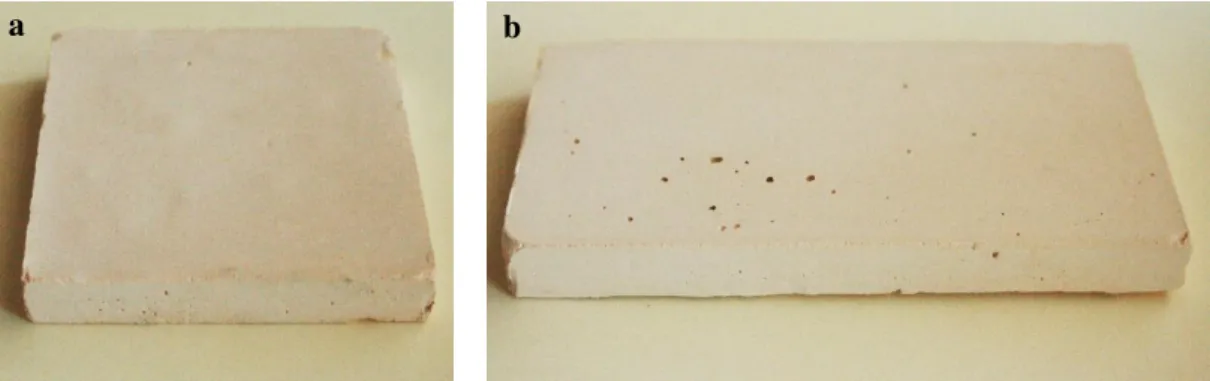
The color of the pastes vary between cream and beige and the surface texture is slightly grainy, possible to polishing to smooth the surface of the paste. These characteristics are compatible since they are similar to the ones shown by the ceramic bodies of historical azulejos. Pure samples (Fig. 7) of the geopolymers formulated with MK 1000, activated with NaOH and KOH solutions and cured at 21 and 40 ºC, were first submitted to a desalination procedure and further characterised (mineralogical, chemical, physical and mechanical) for a better understanding of the geopolymers properties.
Figure 6. Geopolymer pastes with metakaolin ARGICAL-M 1000® and NaOH / KOH activators
with two different curing temperatures. Left: cured at 21 ºC and righ: cured at 40 ºC.
NaOH_1000 KOH_1000 Na+Ca_1000
Na2SiO3_1000
K+Ca_1000
NaOH_1000 KOH_1000 NaOH_1000 KOH_1000
16 Figure 7. Example of pure samples of the geopolymers used in several tests to characterise the
pastes. a) NaOH_1000 (40 ºC) and b) NaOH_1000 (21 ºC).
4.3 Chemical and mineralogical characterisation 4.3.1 XRD
Through XRD (Fig. X - Appendix VI) it was possible to observe that the selected metakaolin (ARGICAL-M 1000®) is essentially an amorphous material containing some minerals, especially quartz (SiO2) and mica (muscovite/illite KAl2SiO10(OH)2). The minerals present in very low amounts or as traces are anatase (TiO2) and alkali feldspar (microcline - KAlSi3O8). The diffractograms of the geopolymer pastes (NaOH_1000 and KOH_1000) (Fig. 8) showed the same characteristics, revealing that they are essentially an amorphous material, however, soluble salts, such as kalicinite (KHCO3) and trona (Na3(CO3)(HCO3).2(H2O)) were identified in the KOH and NaOH pastes, respectively. A peak at 8:44 Å was also detected being attributed to a possible pseudo-zeolitic compound that still needs to be identified. The diffractogram of the reference ceramic substrate “25% CaO” is shown in Fig. X of the Appendix VI.
Figure 8. XRD diffractograms of the studied geopolymer pastes. Left: NaOH_1000_ 21º C and
right: KOH_1000_ 21 °C. Q - Quartz; M - Mica; A – Anatase; K – Kalicinite; T – Trona; Af – Amphibole.
17 4.3.2. WDXRF
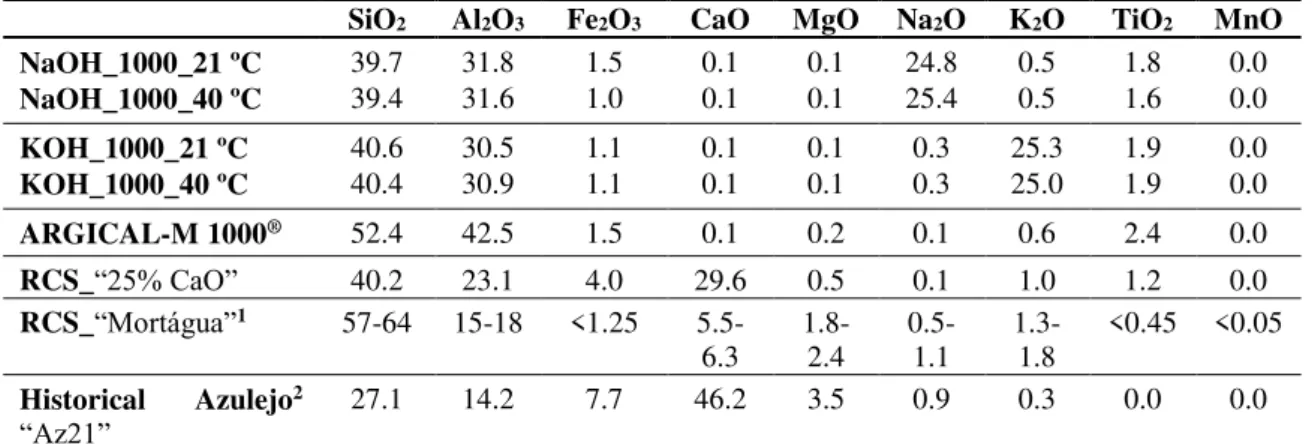
To further determine the chemical composition of the geopolymer pastes (NaOH_1000 and KOH_1000), an analysis through WDX-ray fluorescence spectrometry was carried out. The detailed composition is reported in Table 5.
Table 5. Chemical composition of studied materials through WDXRF, normalise to 100% wt.
SiO2 Al2O3 Fe2O3 CaO MgO Na2O K2O TiO2 MnO NaOH_1000_21 ºC 39.7 31.8 1.5 0.1 0.1 24.8 0.5 1.8 0.0 NaOH_1000_40 ºC 39.4 31.6 1.0 0.1 0.1 25.4 0.5 1.6 0.0
KOH_1000_21 ºC 40.6 30.5 1.1 0.1 0.1 0.3 25.3 1.9 0.0 KOH_1000_40 ºC 40.4 30.9 1.1 0.1 0.1 0.3 25.0 1.9 0.0
ARGICAL-M 1000® 52.4 42.5 1.5 0.1 0.2 0.1 0.6 2.4 0.0
RCS_“25% CaO” 40.2 23.1 4.0 29.6 0.5 0.1 1.0 1.2 0.0 RCS_“Mortágua”1 57-64 15-18 <1.25
5.5-6.3 1.8-2.4 0.5-1.1 1.3-1.8 <0.45 <0.05
Historical Azulejo2
“Az21” 27.1 14.2 7.7 46.2 3.5 0.9 0.3 0.0 0.0
Note: RCS – Reference ceramic substrate; 1– obtained from [25]; 2 – unpublished results obtained by SEM-EDS [20]
4.3.3 FT-IR
18 Figure 9. FT-IR spectra of metakaolin ARGICAL-M 1000® and geopolymer NaOH_1000, cured
at 21°C and 40ºC, after 8 days of cure.
When the geopolymerisation reaction is monitored for 8 days (Fig. 10) a displacement towards the right is observed in the bonds Si–O–Si and Si–O–Al from 1078 to 989 cm-1. The displacement to low wavenumbers is attributed to the formation of Al-rich geopolymeric gels [11, 40-42] and substitution of Si atoms by Al atoms in a IV-fold coordination. However, the addition of the alkali components (Na+ or K+) is another factor which causes a significant shift in the main asymmetric stretch vibration of the Si–O–T bond (T=Si, Al or Na+) [11, 42]. After preparation of the geopolymer pastes, three measurements were made, namely at 20 min, 3h and 6h, with the main band appearing at approximately 1080 cm1.
19 Figure 10. FT-IR spectra of the geopolymer paste NaOH_1000 during the curing process at a)
21°C and b) 40°C. From bottom to top: 20 min, 3 h, 6 h, 24 h, 3 days, 4 days, 7 days and 8days after paste preparation.
4.3.4 Formation of soluble salts
Unreacted NaOH and KOH compounds carbonate at normal environmental conditions producing the soluble carbonate salts trona and kalicinite observed by XRD (section 4.3.1). A higher amount of efflorescence was observed in the pastes formulated with NaOH_1000 compared to those formulated with KOH_1000. This can possibly be explained by the smaller size of Na+ cations when compared with K+ cations [11], which could favour the Na compounds transport to the surface resulting in efflorescence while the K compounds could be trapped giving rise mainly to subflorescence. The presence of soluble salts is potentially harmful for glazed ceramic azulejos and for other historical porous materials such as stone and mortars [23, 43, 44]. Therefore the amount of soluble salts produced during geopolymerisation should be reduced or eliminated as far as feasible. When this is not possible, a desalination process should be considered after the geopolymer curing. In conservation practice, azulejos are often subjected to desalination treatments before restoration [43-47] and in such circumstances the desalination process could be performed after the restoration work (lacunae infill) with the geopolymer pastes, and thus azulejo and geopolymer infills would be desalinated at the same time.
20 Figure 11. Electrical conductivity measured during desalination of geopolymer pastes
NaOH_1000 (21 and 40 °C) and KOH_1000 (21 and 40 °C).
In another attempt to estimate the amount of released soluble salts during desalination, samples of the studied formulations (NaOH_1000 and KOH_1000, 21º and 40 ºC) were chemically characterised through WDXRF: 1) after curing (monolith samples) 2) after a first desalination process where monolith samples were subject to three water baths (1 g sample per 14 ml water) and 3) after a second desalination process where the previously desalinated monolith samples (1 g) were crushed and then desalinated applying the same procedure, using vacuum filtered with a Büchner funnel in between water changes. The results (Table 6) show that in general with the increase of curing temperature both pastes demonstrate a lower release of alkali ions and that there is a larger amount of potassium ions trapped.
Table 6. WDXRF analysis of geopolymer pastes NaOH_1000 and KOH_1000 (21 ºC and 40 ºC) normalised to 100% wt.
Oxides (wt. %)
SiO2 Al2O3 Na2O K2O CaO Others
NaOH_1000 (21 °C)
After curing 39.7 31.8 24.8 0.5 0.1 3.1
After 1st desal. 41.7 33.3 21.2 0.5 0.1 3.2
After 2st desal.(crushed) 42.7 33.2 20.4 0.5 0.1 3.2 NaOH_1000 (40 °C)
After curing 39.4 31.6 25.4 0.5 0.1 2.9
After 1st desal. 40.9 32.5 23.1 0.5 0.1 2.9
After 2st desal. (crushed) 40.8 32.7 23.0 0.6 0.1 2.9 KOH_1000 (21 °C)
After curing 40.6 30.5 0.3 25.3 0.1 3.3
After 1st desal. 44.5 33.3 0.2 18.5 0.1 3.3
After 2st desal. (crushed) 46.4 33.3 0.3 16.4 0.1 3.5 KOH_1000 (40 °C)
After curing 40.4 30.9 0.3 25.0 0.1 3.3
After 1st desal. 43.3 32.4 0.3 20.6 0.1 3.3
21 The results may confirm a higher extent of the geopolymerisation reaction in higher temperature pastes, taking into account the higher amount of alkali metal ions that have been retained in the structure, i.e. the alkali necessary for the geopolymer formation. Also, the unreacted potassium is trapped to a larger extend inside the geopolymer structure due to its larger ion size.
According to these results, it may be conclude that the main content in alkali metal ions is stabilised in the geopolymer structure and that the remaining unreacted soluble salts are easily removed by a desalination procedure. However, further analyses are still necessary to test the long-term release of salts from the geopolymer pastes. The pH of the desalination water was also taken into account. In the first desalination (composed of three baths) it was observed that pH decreases with the number of baths. In the first bath the pH is about 11.5-10.5 (NaOH_1000 and KOH_1000, respectively) and in the last bath the pH is 10-9.5. The alkalinity is still high after three water baths, although, a second desalination has been performed after crushing the geopolymer samples and the pH of these baths has decreased considerably, with the last bath having a pH about 8-7 in both pastes (Na and K respectively). This demonstrates that it is possible to come as close to neutral pH after this procedure. However, to achieve this pH through the desalination process, it is probably necessary to keep the desalination baths for a longer period of time or to change the water baths more frequently. The effect of the pH of the desalination bath in the historical azulejos materials deserves however further investigation, in order to understand if any undesirable interaction occurs.
4.3.5 SEM-EDS
22 Figure 12. SEM-EDS images with EDS elemental mapping of cross-section samples of
geopolymer pastes applied on ceramic substrates a) NaOH_1000_21 ºC on top of ceramic
substrate (25% CaO); b) KOH_1000_21 ºC on top of ceramic substrate (25% CaO); c) Ceramic
substrate “25% CaO”and d) NaOH_1000_21 ºC on top of 18th c. azulejo (Az21).
4.4 Physical and Mechanical characterisation 4.4.1 Pore size distribution
The Mercury Intrusion Porosimetry (MIP) is one of the most important techniques for determining the porosity [48]. This technique allows the determination of the pore size distribution of the analysed material. Fig. 13 shows the pore size distribution curves for the NaOH_1000 and KOH_1000 geopolymer pastes (cured at 21 and 40 ºC, after desalination), a traditional lime mortar and ceramic bodies of historical azulejos (18th century from Lisbon [26]). All geopolymers pastes have the characteristic pore size around 0.2 - 0.3 µm while the lime mortar has a bimodal distribution with modes around 0.2 and 0.4 µm. The characteristic pore size of the historical reference azulejos stays between 0.3 and 0.8 µm. The pore size distribution of the geopolymer pastes is, as desirable, similar to one of the historical azulejos, being located in their lower range of values.
a Geopolymer b Geopolymer
d
Glaze Geopolymer
Ceramic body
23 Figure 13. Pore size distribution curves, obtained by MIP, of geopolymer pastes NaOH_1000 (21
and 40 ºC) and KOH_1000 (21 and 40 ºC), ceramic bodies of historical reference azulejos and aerial lime paste (1:3 vol lime:silica powder).
4.4.2 Open porosity
Regarding open porosity, the geopolymer pastes (NaOH_1000 and KOH_1000) have similar porosity to the ceramic bodies of historical azulejos (Fig. 14). Generally most of the alkalis are fixed into the three-dimensional structure of the geopolymers. Although some of them can remain in soluble form, as said before, when reaction is finalised. This free alkali is easily dissolved, which can produce an increase in the porosity of the specimen and consequently a decrease of its strength [12, 49].
Figure 14. Open porosity of geopolymer pastes NaOH_1000 and KOH_1000 (cured at 21 and 40
24 4.4.3 Water vapour permeability
The water vapour permeability of geopolymer pastes, aerial lime, reference ceramics (“25% CaO”) and historical azulejos [unpublished results] are presented in Fig. 15. Geopolymer pastes NaOH_1000 and KOH_1000 cured at 21 ºC shows higher permeability than aerial lime, while the pastes cured at 40 ºC show a similar lower permeability. All geopolymer pastes formulations have higher water vapour permeability than the historical azulejos (which usually have the glaze that is largely impermeable), having similar or higher values to its ceramic biscuits. This characteristic can provide the azulejos with extra “breathing” areas.
Figure 15. Water vapour permeability of geopolymer pastes NaOH_1000 and KOH_1000 (cured
at 21 and 40 ºC), aerial lime paste (1:3 vol lime:silica powder), historical azulejos and reference ceramic substrate “25%CaO”.
4.4.4 Hydric expansion
In Figure 16 and Table 7 are presented the results of the hydric expansion tests performed in the geopolymer pastes (NaOH_1000 and KOH_1000) and also the results of aerial lime based paste and historical azulejos. In literature it is referred that geopolymers expand linearly in the early stage of the absorption process [50, 51]. It is generally accepted that during the geopolymer formation may occur dehydration to some degree, involving the chemically bonded water present in the aluminosilicate source, and subsequently rehydration [50].
25 and did not stabilise. This way, it was considered as reference value the one obtained at 48 h, assuming that the material continues to expand.
The geopolymer pastes show higher hydric expansion values than historical azulejos (Table 7). Thus, these materials, such as aerial lime based pastes, may not follow the historical azulejos expansion when both are wetted, which may lead to possible incompatibility issues that need to be verified through ageing tests in order to understand if in a practical level this difference may be a problem or not.
Figure 16. Hydric expansion coefficient vs time of geopolymer pastes NaOH_1000 and
KOH_1000 (cured at 21 and 40 ºC).
Table 7. Hydric expansion coefficient obtained at 48h of geopolymer pastes NaOH_1000 and KOH_1000 (cured at 21 and 40 ºC), aerial lime paste [45] and historical azulejos [26].
Samples ɛ
(mm/m)
NaOH_1000_21 ºC 2.7 NaOH_1000_40 ºC Np KOH_1000 _21 ºC 2.8 KOH_1000_40 ºC 2.8 Aerial lime 0.04 Historical azulejos 0.1-0.4
Note: Np – Not Performed
4.4.5 Thermal expansion
26 azulejo to direct sunlight in summer (considered to be around 60 ºC). It is desirable an expansibility similar to the ones of historical azulejos. The results were obtained for geopolymer paste NaOH_1000 cured at 21 and 40 ºC (Fig. 17). These are not easy to interpret, they demonstrate that the pastes have a trend to contract with the increasing of temperature in opposition to the azulejos that expand. The expansibility coefficient of the pastes was - 4.7x10⁻⁵ and - 4.0x10⁻⁵ for 21 °C and 40 °C respectively, while the value for historic azulejos is reported to be in the range of + 6-8x10⁻⁶ [26]. The aerial lime based paste with an expansibility coefficient of + 1.1x10⁻⁵ is more in line with the values obtained for historic azulejos. For the NaOH_1000 (40 ºC) paste the suffered contraction proved to be only 60% reversible. The cause of the contraction with temperature and irreversibility still must be determined in the future, but it can be caused by a continuation of geopolymerisation reaction at higher temperatures or due to the loss of water adsorbed of the geopolymers. The practical significance of this difference of properties between the geopolymers and the historical azulejos needs to be verified through ageing tests.
Figure 17. Thermal expansion of geopolymer paste NaOH_1000 cured at 21 and 40 ºC, after
desalination.
4.4.6 Flexural strength
27 On the other hand, it being the fact that K+ ions are larger, and therefore with more difficult mobility and prone to subflorescence it may be responsible for the decrease in mechanical strength observed in this paste. The geopolymer paste, such as aerial lime can act therefore as a sacrificial material. Thorough ageing studies are still necessary in order to better understand the stability of the paste when present to undesired tensions, e.g. with “movements" of the building.
Figure 18. Flexural strength of geopolymer pastes NaOH_1000 and KOH_1000 cured at 21 and
40 ºC, after desalination, aerial lime paste (1:3 vol lime:silica powder), historical azulejos and reference ceramic substrate “Mortágua”
4.4.7 Adhesion strength
28 These results are very satisfactory since the main issue related to the inorganic pastes commonly used in azulejos lacunae infill (such as aerial lime) is their low adhesion to the azulejo substrate. The higher adhesion of the geopolymer pastes to both reference and historical substrates may be due to partial reaction in the interface of the geopolymer and ceramic substract (which also is an aluminosilicate), showing that this type of pastes are a potential solution to the lack of durability and efficacy revealed by most of the inorganic materials used nowadays in the restoration of azulejos.
Figure 19. Adhesion strength results of geopolymer pastes cured at 21 and 40 ºC. Pastes applied
on the reference ceramic substrate “25% CaO” and on historical azulejos. The results were compared with aerial lime paste.
Figure 20. Adhesion strength test of geopolymer pastes. Left: paste applied on the reference
ceramic substrate “25% CaO” and right: pastes applied on historical azulejos cured at 21 ºC.
29
5. Conclusions
5.1 Summary of results
Several analytical techniques were used to characterise geopolymer pastes, formulated to cover a reasonably wide range of end products. With these techniques, it was possible to monitor the geopolymerisation reaction, and the results show that we can reasonably expect that a certain capacity of mastering the properties of the final products is at reach, which turns this category of repair materials into highly promising candidates to be used in reparing actions, and namely for filling lacunae in the restoration of historical azulejos. Through visual observation, metakaolin ARGICAL-M 1000® was considered the best aluminosilicate source in terms of workability and efficacy. The formulations with best results were those obtained with the solutions 12M NaOH and 10.4M KOH as activators for curing temperatures of 21 ºC and 40 ºC. However, the formulations with Na and K silicates (Na2SiO3_1000 and K2SiO3_1000) as activators also seem to be highly promising deserving to be further investigated in a future work.
The results obtained confirm that limiting the evaporation of water is a very important step in the geopolymerisation reaction, since it helps to prevent cracking and thus reduces the chances of poor adhesion to the substrate and disaggregation of the pastes when applied on the azulejo. The pastes have a slightly grainy texture and their color is similar to the color of the ceramic bodies of historical azulejos, typically, between cream and beige. Analysis of geopolymerisation reaction by FT-IR demonstrated that during the curing time the characteristic band moves to lower wavenumbers, stabilizing near 980 cm-1, somewhat lower than the 991 cm-1 band reported in literature [33, 37]. The carbonation process leads to the formation of highly soluble salts (15 and 9 % in the case of NaOH_1000 pastes and 14 and 9 % in the case of KOH_1000 pastes) that subsequently effloresce or subflloresce. The results show that the soluble salts are efficiently eliminated through desalination, which supports the idea that geopolymers are susceptible to be used, since a stage of desalination after the restoration action is something that can be envisaged as a normal and current procedure in the conservation of azulejos.
30 revealed a clear advantage when compared to one of the most common infill materials, such as aerial lime based pastes. Ageing tests need to be carried out to further assess the durability and compatibility of geopolymers pastes. These are promising findings, however more research is needed to clarify the practical suitability of geopolymer pastes as conservation materials of historical azulejos.
5.2 Future work
This work allowed to obtain a good insight on the usage of geopolymers pastes to fill gaps in azulejos. It was possible to understand the properties of these materials and their initial behavior as a restoration material. However further investigations are need to be carried out. In particular, pastes based on silicate solutions as activators should be tested and characterised in order to answer some questions raised during the process; the study of the long term ionic compounds of leaching should be considered; study the differences in some physical properties (hydric and thermal expansion) in order to understand if the differences observed can create incompatibility issues with time; the possible harmful effects of the application of geopolymers pastes in the historical azulejos (ageing tests) further investigated and also, the inpainting tests.
31
Divulgation of work
This work was presented as an oral communication in two conferences: E-MRS 2015 Spring Meeting, WB: Sustainable solutions for restoration & conservation of cultural heritage, 11-15 May 2015, Lille (France) and GlazeArch2015, Glazed Ceramics in Architectural Heritage, International conference, 2-3 July 2015, LNEC, Lisbon (Portugal). It was also submitted and accepted an article entitled "Geopolymers as potential repair material in azulejos conservation" in Journal of Applied Physics A.
References
[1] Duxson P., Fernández-Jiménez A., Provis J. L.,. Lukey G. C, Palomo A. & Van Deventer J. S. J. 2006. Geopolymer technology: the current state of the art. Journal of Materials Science, 42: 2917-2933.
[2] Autef A., Joussein E., Gasgnier G. & Rossignol S. 2012. Role of the silica source on the geopolymerisation rate. Journal of Non-Crystalline Solids. 21: 2886-2893.
[3] Khale D. & Chaudhary R. 2007. Mechanism of geopolymerisation and factors influencing its development: a review. Journal of Materials Science, 42: 729-746.
[4] Farid S.B.H. 2014. Practicable activated aluminosilicates mortar. Ceramics International, 40: 15027-15032.
[5] Panagiotopoulou Ch., Kontori E., Perraki Th. & Kakali G. 2006. Dissolution of aluminosilicate minerals and by-products in alkaline media. Journal of Materials Science, 42: 2967-2973.
[6] Xu H. & Van Deventer J.S.J. 2000. The geopolymerisation of alumino-silicate minerals. International Journal of Mineral Processing, 59: 247-266.
[7] Rashad A. (2013). Alkali-activated metakaolin: A short guide for civil Engineer – An overview. Construction and Building Materials, 41: 751-765
[8] Duxson P., Provis J. L., Lukey G. C. & Van Deventer J.S.J. 2007. The role of inorganic polymer technology in the development of ‘green concrete. Cement and Concrete Research, 37: 1590-1597.
[9] Pacheco-Torgal F., Castro-Gomes J. & Jalali S. 2008. Alkali-activated binders: A review. Part 1. Historical background, terminology, reaction mechanisms and hydration products. Construction and Building Materials, 22: 1305-1314.
[10] Davidovits J. & Quentin S. 1991. GEOPOLYMERS Inorganic polymerie new materials. Journal of Thermal Analysis, 37: 1633-1656.
32 change the early age structural characteristic of kaolin-based geopolymers. Ceramics International, 40: 8953-8962.
[12] Guo W., Wu G., Wang J., Wen Z. & Yin S. 2008. Preparation and performance of geopolymers. Journal of Wuhan University of Technology-Mater. Sci. Ed, 23: 326-330. [13] PINTO A. 2004. Sistemas Ligantes Obtidos por Activação Alcalina do Metacaulino. PhD thesis, Minho University.
[14] Rahier H., Wastiels J., Biesemans M., Willlem R., Van Assche G. & Van Mele B.. 2006. Reaction mechanism, kinetics and high temperature transformations of geopolymers. Journal of Materials Science, 42: 2982-2996
[15] Lizcano M., Kim H.S., Basu S. & Radovic M. 2011. Mechanical properties of sodium and potassium activated metakaolin-based geopolymers. Journal of Materials Science, 47: 2607-2616.
[16] Zuhua Z., Xiao Y., Huajun Z. & Yue C. 2009. Role of water in the synthesis of calcined kaolin-based geopolymer. Applied Clay Science, 43: 218-223.
[17] Ryu G. S., Lee Y. B., Koh K. T. & Chung Y. S. 2013. The mechanical properties of fly ash-based geopolymer concrete with alkaline activators. Construction Building Materials, 47: 409-418.
[18] MacKenzie K.J.D, Brew D.R.M, Fletcher R.A. & Vagana R. 2007. Formation of aluminosilicate geopolymers from 1:1 layer-lattice minerals pre-treated by various methods: a comparative study. Journal of Materials Science, 42: 4667-4674.
[19] Davidovits, J. 1994. Properties of Geopolymer Cements. [Lecture] Kiev: First International Conference on Alkaline Cements and Concretes, 131-149.
[20] Mendes M., Ferreira T.A., Rodrigues J.D., Mimoso J.M. & Pereira S.R.M. 2015. Volumetric and chromatic reintegration in conservation of in-situ glazed tiles, 2-3 July [lecture] Lisbon: International Conference, Glaze Ceramics in Architectural Heritage, LNEC
[21] Hanzlíček T., Steinerová M., Straka P., Perná I., Siegl P. & Švarcová T. 2009. Reinforcement of the terracotta sculpture by geopolymer composite. Materials & Design, 30: 3229–3234.
[22] João Coroado. 2013. Geopolymers: potential use in sculpture restoration. ICOM-CC Working Group: Sculpture, and Architectural Decoration Polychrome Sculpture: Decorative Practice and Artistic Tradition. Tomar, May 28--29 (Portugal).
33 [24] Rescic S., Plescia P., Cossari P., Tempesta E., Capitani D., Proietti N. & Mecchi A.M. 2011. Mechano-chemical activation: an ecological safety process in the production of materials to stone conservation. Procedia Engineering, 21: 1061-1071.
[25] Skorina T. 2014. Ion exchange in amorphous alkali-activated aluminosilicates: Potassium based geopolymers. Applied Clay Science. 87: 205-211.
[26] Pereira S., Mimoso J.M. & Santos Silva A. 2011, Physical-Chemical characterization of historic portuguese tiles, Report 23/2011-NPC/NMM, LNEC.
[27] Mussachi J. 2012. Conservation of historical Portuguese tiles: Adhesives for outdoor exposure. Master’s Thesis, University of Bologna.
[28] LERO PE-10, Ensaio de determinação do coeficiente de dilatação por absorção de água, Manual de Procedimentos de Ensaio, LNEC, 1996;
[29] EN 14581, 2005, Natural stone test methods - Determination of linear thermal expansion coefficient;
[30] Kuenzel C., Vandeperre L., Donatello S., Boccaccini A.R. & Cheeseman C.R. 2012. Ambient Temperature Drying Shrinkage and Cracking in Metakaolin-Based Geopolymers. Journal of the American Ceramic Society, 95: 3270-3277
[31] Perná I., Hanzlíček T. & Šupová M. 2014. The identification of geopolymer affinity in specific cases of clay materials. Applied Clay Science, 102: 213-219
[32] Xie J. & Kayali O. 2014. Effect of initial water content and curing moisture conditions on the development of fly ash-based geopolymers in heat and ambient temperature. Construction Building Materials, 67: 20-28.
[33] Irfan Khan M., Khairun A., Suriati S. & Man Z. 2015. Sodium silicate-free geopolymers as coating materials: Effects of Na/Al and water/solid ratios on adhesion strength. Ceramics International, 45: 2794-2805.
[34] Mo B., Zhu H., Cui X., He Y. & Gong S. 2014. Effect of curing temperature on geopolymerisation of metakaolin-based geopolymers. Applied Clay Science, 99: 144-148. [35] Muñiz-Villarreal M.S., Manzano-Ramírez A., Sampieri-Bulbarela S., Gasca-Tirado J.R., Reyes-Araiza J.L., Rubio-Ávalos J.C, Pérez-Bueno J.J., Apatiga L.M., Zaldivar-Cadena A. & Amigó-Borrás V. 2011. The effect of temperature on the geopolymerisation process of a metakaolin-based geopolymer. Materials Letters, 65: 995-998.
[36] Rovnaník P. 2010. Effect of curing temperature on the development of hard structure of metakaolin-based geopolymer. Construction Building Materials, 24: 1176-1183.