Resear
ch
Approval CEP-Unit CAAE 27344214.7.0000.5546
1. Graduate [email protected] – Universidade Tiradentes (Unit) 2. Undergraduate [email protected] – Universidade Federal de Sergipe (UFS) 3. Undergraduate [email protected] – UFS 4. PhD student [email protected] – Unit, Aracaju/SE 5. PhD [email protected] – UFS, Aracaju/SE, Brasil.
Correspondence
Brunna Victória dos Santos Sá – Rua José Pires Winne, casa 217, Suíssa CEP 49052-290. Aracaju/SE, Brasil. The authors declare no conflict of interest.
Perception of patients on their relations with
physicians
Yanne Viana Souza 1, Rebeca Soares Gomes 2, Brunna Victória dos Santos Sá 3, Roberta Machado Pimentel Rebello de Mattos 4, Déborah
Mônica Machado Pimentel 5
Abstract
Communicating properly is fundamental to improve physician-patient relations and the quality of health care. Considering this, the current study analyzed the perception of 200 patients in Aracaju/SE, Brazil, on their relations with physicians. This is an exploratory, cross-sectional, descriptive and quantitative study with the application of a questionnaire. The sample was composed of young adults, females (71.5%), single (50.0%), without higher education (47.5%) and mainly attended in public hospitals (26.5%). A favorable environment for a good physician-patient relationship concerns not only the hospital infrastructure, but also the communication skills of health professionals. Regarding the relationship with physicians, most patients are satisfied (86%) and declared trust in the professionals (84%). Patient privacy was respected in most cases.
Keywords: Perception. Patients. Physicians. Medical assistance.
Resumo
Percepção de pacientes sobre sua relação com médicos
A comunicação adequada é fundamental para a relação médico-paciente e para melhorar a qualidade dos atendimentos. Diante disso, o objetivo deste estudo foi conhecer a percepção de 200 pacientes na cidade de Aracaju/SE sobre sua relação com os médicos. Trata-se de estudo exploratório, transversal, descritivo e quantitativo, com aplicação de questionário. A amostra foi composta majoritariamente por adultos jovens, do sexo feminino (71,5%), solteiros (50%), sem nível superior (47,5%), atendidos principalmente em hospitais da rede pública (26,5%). Um ambiente favorável para a boa relação médico-paciente depende não apenas da infraestrutura clínico-hospitalar, mas também da habilidade comunicativa dos profissionais. Quanto à relação com os médicos, a maioria relatou estar satisfeita (86%) e confiar nos profissionais (84%). A privacidade do paciente também foi respeitada na maioria dos casos.
Palavras-chave: Percepção. Pacientes. Médicos. Assistência médica.
Resumen
Percepción de los pacientes sobre su relación con los médicos
La comunicación adecuada es fundamental para la relación médico-paciente y para mejorar la calidad de la atención. Este estudio tuvo como objetivo conocer la percepción de 200 pacientes en la ciudad de Aracaju, capital del estado de Sergipe, Brasil, sobre su relación con los médicos. Se trata de un estudio exploratorio, transversal, descriptivo y cuantitativo, con aplicación de un cuestionario. La muestra estuvo formada mayoritariamente por adultos jóvenes, del sexo femenino (71,5%), solteros (50%), sin nivel superior (47,5%), atendidos principalmente en hospitales de la red pública (26,5%). Un ambiente favorable para la buena relación médico-paciente depende no solo de la infraestructura clínico-hospitalaria, sino también de la habilidad comunicativa de los profesionales. En cuanto a la relación con los médicos, la mayoría relató estar satisfecha (86%) y confiar en los profesionales (84%). También se respetó la privacidad del paciente en la mayoría de los casos.
Physician-patient relations has peculiarities rarely found in other relationships, especially when involving illness. The disease puts the patient in situations of fragility, and he expects the clinician to cure or relieve symptoms, and also to understand and to support him in this difficult moment 1.
Therefore, adequate communication is fundamental for the health professional-patient relationship, promoting greater adherence to the treatment and care for health needs 1,2.
In this contact, physicians’ performance stimulates several feelings in patients, whose behavior will be modulated by this set of emotions 3. If well established, this relationship
may determine the effectiveness of the encounter between these subjects and, for this, it must be based on certain foundations: patients must trust doctors to express themselves and tell the professionals what is afflicting them 4. This trust
depends partially on the professional’s empathy, who must understand the patients and let them feel comfortable and welcomed during the medical consultation 5,6.
With the Internet, the patient has access to more information, enabling them to interact
more with the health professional during care 7 –
however, this knowledge can ease or hinder their relationship 8. Several professionals report that
dealing with the sick is impaired by the difficulty of health services users in finding safe sources and understanding the information acquired.
However, according to Coelho, Coelho and Cardoso, studies show that the doctor is still the main source of information for ill people, and the Internet is only additional resource to support
the physician-patient relationship 9, used by the
patient with the intention of collaborating with the professional. Thus, the patient must have their autonomy respected, being able to express their opinion and choose among the therapeutic possibilities proposed 8.
In the legal field, since the 1960s, several factors have influenced the increase in lawsuits against health professionals. However, studies show that, although most lawsuits were related to patients with serious injuries or problems resulting from medical procedures, many demands were based on the insatisfaction of the sick or family members with the communication of health professionals 10,11.
Therefore, these professionals must know how to establish a good relationship with users of
health services, favoring interpersonal relationships and the humanization of medical services 1,2,12. In
this sense, for more than two decades, national and international guidelines have advised the teaching of communicative skills in medical schools, as they benefit the health services 10,13,14.
This study aims to know the profile and perception of patients about the relationship established with physicians working in health centers in Aracaju, Sergipe, Brazil. Furthermore, we analyzed the conditions of the health care services provided to citizens, as they can help or hinder the relationship in question.
Method
This is an exploratory, cross-sectional, descriptive and quantitative study conducted in the city of Aracaju, Sergipe, Brazil, with data collected in 2016. For the sample estimation, we considered the city has a predominantly urban population of
about 570,000 inhabitants 15. Only patients with
more than 18 years and treated in public and private health centers were selected for the study. The participants also agreed to sign the informed consent form after proper study detailing, without any other exclusion criteria.
A simple random sample was established according to the formula used by Gil 16 for infinite
populations (above 100,000 inhabitants), with a confidence level of 95% and maximum allowed error of 6%. Considering the hypothesis that at least 10% of patients have a positive perception about their relations with physicians, a minimum number of 100 participants was established. However, the researchers conducted a broader collection, with 200 patients.
The questionnaire applied included seven socioeconomic questions and 40 questions related to the communication process between patients and physicians. The questionnaires were self-administered, easy and quick to complete. The data obtained were described by simple and percentage frequencies when involving categorical variables, means, and standard deviation when continuous or ordinal. The Fisher’s exact test was used to evaluate the association between categorical variables; Pearson’s correlation was used for the mean differences and to analyze the correlations between continuous or ordinal variables. The significance level adopted was 5%, and the software used was the R Core Team 2016.
Resear
Results
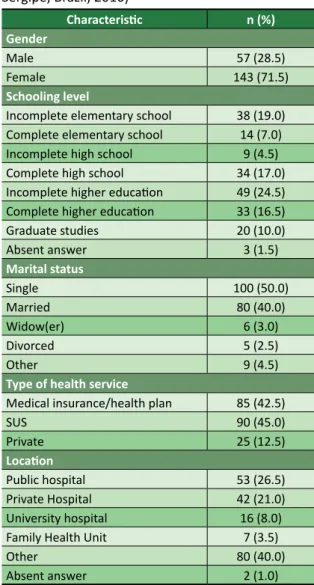
Most participants were female (71.5%), without higher education (47.5%), single (50%) and mean age of 34.9 years. Almost half of them (45%) was attended in the Brazilian Unified Health System (SUS) and approached mainly in a public hospital (26.5%). Data regarding the profile of users and places of approach are shown in Table 1.
Table 1. Profile of patients interviewed (Aracaju,
Sergipe, Brazil, 2016) Characteristic n (%) Gender Male 57 (28.5) Female 143 (71.5) Schooling level
Incomplete elementary school 38 (19.0) Complete elementary school 14 (7.0) Incomplete high school 9 (4.5) Complete high school 34 (17.0) Incomplete higher education 49 (24.5) Complete higher education 33 (16.5)
Graduate studies 20 (10.0) Absent answer 3 (1.5) Marital status Single 100 (50.0) Married 80 (40.0) Widow(er) 6 (3.0) Divorced 5 (2.5) Other 9 (4.5)
Type of health service
Medical insurance/health plan 85 (42.5)
SUS 90 (45.0) Private 25 (12.5) Location Public hospital 53 (26.5) Private Hospital 42 (21.0) University hospital 16 (8.0)
Family Health Unit 7 (3.5)
Other 80 (40.0)
Absent answer 2 (1.0)
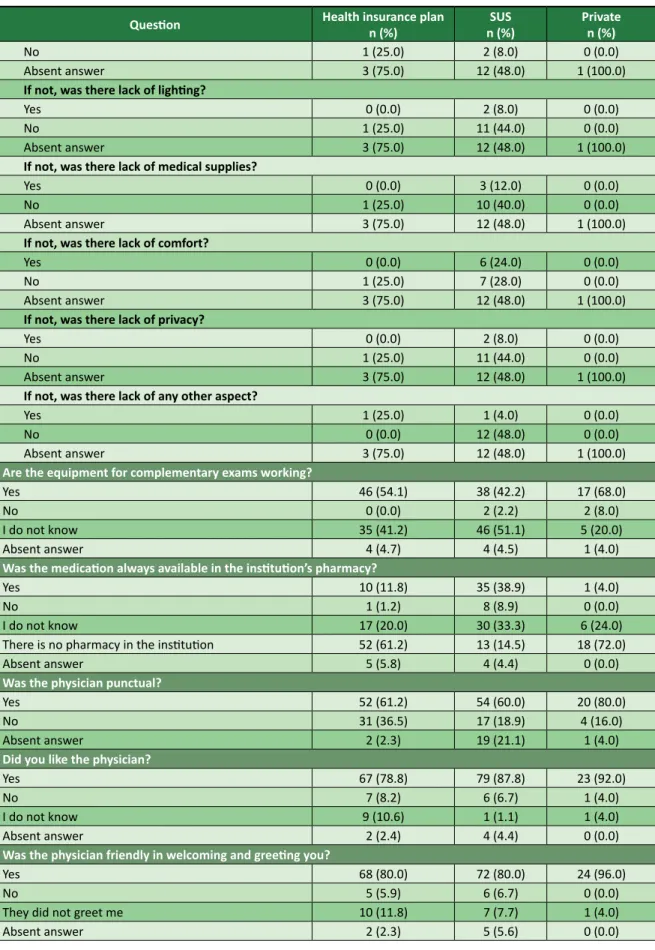
According to Table 2, most patients were able to schedule the appointment within one week (39%), and this facility was greater among patients treated by public or private health services (p<0.001). Patients were attended mainly in order of arrival (69.5%), and the waiting time was less than one hour in most cases (66%). Users of all types of health services considered the
structure of the building (79%) and the structure of the office (79%) as adequate, being the public health service the least well-rated environment in both aspects (p<0.001).
Most of the participants who considered the structure of the office as inappropriate complained of poor ventilation (36.7%), and this complaint was exclusive for public health service patients. Other problems reported were inappropriate hygiene (13.3%) and lighting (6.7%), lack of medical materials (10%), lack of privacy (6.7%) and lack of comfort (20%).
Most patients reported professionals’ punctuality (63%) – the least punctual physicians were those who attended health insurance plans, followed by SUS physicians, however without a significant difference between health services (p>0.05). Regarding the interaction between physicians and patients, participants said that in general the professionals were friendly (82%), getting up from the chair when they entered the room (45%) and greeting them with a handshake (51.5%). Respondents (84.5%) also reported liking the professional.
During the consultation, 75.5% of the patients were called by their name, and 85% stated that they had been treated well by the physician. In 84% of the cases, physicians showed confidence to users, especially in private care, but no statistical differences were verified between health services (p>0.05).
Regarding the physicianʼs appearance, 94.5% of the patients considered it adequate and, in cases of inadequacy, the clothing should be improved. In 76.5% of the cases, participants stated that the physician maintained visual contact, with SUS users showing greater dissatisfaction; 80% of the patients considered that the professional could understand what was said. Patients with health insurance plan had more complains (17.7%), followed by SUS patients (14.4%), however without statistically significant difference.
In 26.5% of the consultations, physical examinations were not performed, which were more frequent in private health services (88%). When they were performed, 24.3% of the professionals did not wash their hands when examining the patient, and in 49.7% of the exams no one else was present in the room, besides doctor and patient. Physicians requested additional exams in 60% of cases and 35% explained its importance. According to the respondents, 13.5%
Resear
of the consultations were interrupted, either because the doctor answered the cell phone or the phone (11.1%), or because he received someone in the room (11.1%). In most appointments, patients had their privacy respected (92%), and the public health service patients were the most unsatisfied with this aspect (p=0.046). Most consultations lasted between 10 and 15 minutes and private patients, followed by those with health insurance, had longer consultations (p<0.001).
Most said the doctor explained their illness (84.5%), with the highest percentages in health
insurance plans and private care (p=0.008). In 61% of the appointments, medication was prescribed, whose use was understood by the patient in 36.9% of the cases and whose prescription was understood by 77.6% of the participants, with no significant difference between the health services (p>0.05).
In 85.5% of the cases, the physicians said goodbye to the patient at the end of the appointment. Most patients were satisfied with the care (86%), with no statistical differences between the health services (p>0.05). The mean score given by patients to physicians was 8.9.
Table 2. User satisfaction with infrastructure, agility of care in the facilities and medical care (Aracaju,
Sergipe, Brazil, 2016)
Question Health insurance plann (%) n (%)SUS Privaten (%) How long have you scheduled this exam/return/appointment?
Up to one week 21 (24.7) 40 (44.4) 17 (68.0)
Two weeks ago 23 (27.0) 11 (12.2) 5 (20.0)
A month ago 20 (23.5) 8 (8.9) 2 (8.0)
More than a month ago 19 (22.4) 8 (8.9) 1 (4.0)
Absent answer 2 (2.4) 23 (25.6) 0 (0.0)
Was your appointment scheduled or in order of arrival?
Scheduled appointment 35 (17.5)
Order of arrival 139 (69.5)
Priority service 6 (3.0)
Absent answer 20 (10.0)
How long did you wait to be attended on the day of the appointment/exam/return?
Less than 15 minutes 8 (9.4) 16 (17.8) 3 (12.0)
Between 15 and 30 minutes 34 (40.0) 16 (17.8) 4 (16.0)
Between 30 minutes and 1 hour 22 (25.9) 20 (22.2) 9 (36.0)
More than 1 hour 19 (22.4) 14 (15.5) 9 (36.0)
Absent answer 2 (2.3) 24 (26.7) 0 (0.0)
Have you been attended to after this waiting time?
Yes 159 (79.5)
No 20 (10.0)
Absent answer 21 (10.5)
Did you consider the facilities suitable?
Yes 79 (92.9) 55 (61.1) 24 (96.0)
No 4 (4.7) 31 (34.5) 1 (4.0)
Absent answer 2 (2.4) 4 (4.4) 0 (0.0)
Did you consider the structure of the office as proper?
Yes 79 (92.9) 56 (62.2) 23 (92.0)
No 4 (4.7) 25 (27.8) 1 (4.0)
Absent answer 2 (2.4) 9 (10.0) 1 (4.0)
If not, was there lack of hygiene?
Yes 0 (0.0) 4 (16.0) 0 (0.0)
No 1 (25.0) 9 (36.0) 0 (0.0)
Absent answer 3 (75.0) 12 (48.0) 1 (100.0)
If not, was there lack of ventilation?
Yes 0 (0.0) 11 (44.0) 0 (0.0)
continues...
Resear
Question Health insurance plann (%) n (%)SUS Privaten (%)
No 1 (25.0) 2 (8.0) 0 (0.0)
Absent answer 3 (75.0) 12 (48.0) 1 (100.0)
If not, was there lack of lighting?
Yes 0 (0.0) 2 (8.0) 0 (0.0)
No 1 (25.0) 11 (44.0) 0 (0.0)
Absent answer 3 (75.0) 12 (48.0) 1 (100.0)
If not, was there lack of medical supplies?
Yes 0 (0.0) 3 (12.0) 0 (0.0)
No 1 (25.0) 10 (40.0) 0 (0.0)
Absent answer 3 (75.0) 12 (48.0) 1 (100.0)
If not, was there lack of comfort?
Yes 0 (0.0) 6 (24.0) 0 (0.0)
No 1 (25.0) 7 (28.0) 0 (0.0)
Absent answer 3 (75.0) 12 (48.0) 1 (100.0)
If not, was there lack of privacy?
Yes 0 (0.0) 2 (8.0) 0 (0.0)
No 1 (25.0) 11 (44.0) 0 (0.0)
Absent answer 3 (75.0) 12 (48.0) 1 (100.0)
If not, was there lack of any other aspect?
Yes 1 (25.0) 1 (4.0) 0 (0.0)
No 0 (0.0) 12 (48.0) 0 (0.0)
Absent answer 3 (75.0) 12 (48.0) 1 (100.0)
Are the equipment for complementary exams working?
Yes 46 (54.1) 38 (42.2) 17 (68.0)
No 0 (0.0) 2 (2.2) 2 (8.0)
I do not know 35 (41.2) 46 (51.1) 5 (20.0)
Absent answer 4 (4.7) 4 (4.5) 1 (4.0)
Was the medication always available in the institution’s pharmacy?
Yes 10 (11.8) 35 (38.9) 1 (4.0)
No 1 (1.2) 8 (8.9) 0 (0.0)
I do not know 17 (20.0) 30 (33.3) 6 (24.0)
There is no pharmacy in the institution 52 (61.2) 13 (14.5) 18 (72.0)
Absent answer 5 (5.8) 4 (4.4) 0 (0.0)
Was the physician punctual?
Yes 52 (61.2) 54 (60.0) 20 (80.0)
No 31 (36.5) 17 (18.9) 4 (16.0)
Absent answer 2 (2.3) 19 (21.1) 1 (4.0)
Did you like the physician?
Yes 67 (78.8) 79 (87.8) 23 (92.0)
No 7 (8.2) 6 (6.7) 1 (4.0)
I do not know 9 (10.6) 1 (1.1) 1 (4.0)
Absent answer 2 (2.4) 4 (4.4) 0 (0.0)
Was the physician friendly in welcoming and greeting you?
Yes 68 (80.0) 72 (80.0) 24 (96.0)
No 5 (5.9) 6 (6.7) 0 (0.0)
They did not greet me 10 (11.8) 7 (7.7) 1 (4.0)
Absent answer 2 (2.3) 5 (5.6) 0 (0.0)
continues... Table 2. Continuation
Resear
Question Health insurance plann (%) n (%)SUS Privaten (%) Did the physician get up when you came into the room?
Yes 46 (54.1) 31 (34.4) 13 (52.0)
No 37 (43.5) 45 (50.0) 12 (48.0)
Absent answer 2 (2.4) 14 (15.6) 0 (0.0)
Did the physician shake your hand?
Yes 52 (61.2) 34 (37.8) 17 (68.0)
No 31 (36.5) 50 (55.6) 8 (32.0)
Absent answer 2 (2.3) 6 (6.6) 0 (0.0)
Did the physician call you by your name?
Yes 67 (78.8) 60 (66.7) 24 (96.0)
No 16 (18.8) 25 (27.8) 1 (4.0)
Absent answer 2 (2.4) 5 (5.5) 0 (0.0)
Concerning appearance, was the physician suitable for care?
Yes 81 (95.2) 84 (93.4) 24 (96.0)
No 2 (2.4) 1 (1.1) 1 (4.0)
Absent answer 2 (2.4) 5 (5.5) 0 (0.0)
If not, in which aspects did the physician need to improve?
Clothing 4 (100.0)
Have you been treated well by the physician?
Yes 75 (88.2) 71 (78.9) 24 (96.0)
No 2 (2.4) 4 (4.4) 0 (0.0)
Indifferent 6 (7.0) 10 (11.1) 1 (4.0)
Absent answer 2 (2.4) 5 (5.6) 0 (0.0)
Was the physician nice to you throughout the appointment?
Yes 71 (83.5) 70 (77.8) 23 (92.0)
No 5 (5.9) 7 (7.7) 1 (4.0)
Indifferent 7 (8.2) 8 (8.9) 1 (4.0)
Absent answer 2 (2.4) 5 (5.6) 0 (0.0)
Did the physician give you confidence?
Yes 71 (83.5) 74 (82.2) 23 (92.0)
No 8 (9.4) 6 (6.7) 1 (4.0)
I do not know 4 (4.7) 4 (4.4) 1 (4.0)
Absent answer 2 (2.4) 6 (6.7) 0 (0.0)
Did the physician make eye contact with you?
Yes 70 (82.3) 61 (67.8) 22 (88.0)
No 13 (15.3) 24 (26.7) 3 (12.0)
Absent answer 2 (2.4) 5 (5.5) 0 (0.0)
Do you think the physician can understand everything you say in the consultation?
Always 67 (78.8) 71 (78.9) 22 (88.0)
Sometimes 15 (17.7) 11 (12.2) 3 (12.0)
Rarely 0 (0.0) 2 (2.2) 0 (0.0)
Absent answer 3 (3.5) 6 (6.7) 0 (0.0)
Did the doctor carry out a physical exam?
Yes 58 (68.2) 60 (66.7) 22 (88.0) No 25 (29.4) 25 (27.8) 3 (12.0) Absent answer 2 (2.4) 5 (5.5) 0 (0.0) continues... Table 2. Continuation
Resear
ch
Question Health insurance plann (%) n (%)SUS Privaten (%) If yes, did the physician wash his hands?
Yes 10 (17.2) 11 (18.3) 2 (9.1)
No 12 (20.7) 18 (30.0) 4 (18.2)
Absent answer 36 (62.1) 31 (51.7) 16 (72.7)
If yes, besides the physician, was anyone else present during the physical examination?
Yes, a companion 48 (34.4)
Yes, an assistant of services 22 (15.9)
No 70 (49.7)
Did the physician order additional tests?
Yes 56 (65.9) 46 (51.1) 18 (72.0)
No 27 (31.8) 38 (42.2) 7 (28.0)
Absent answer 2 (2.3) 6 (6.7) 0 (0.0)
If yes, did the physician explain the importance of this test?
Yes 18 (32.1) 22 (47.8) 2 (11.1)
No 3 (5.4) 4 (8.7) 1 (5.6)
Absent answer 35 (62.5) 20 (43.5) 15 (83.3)
Was there any interruption during the consultation?
Yes 15 (17.6) 9 (10.0) 3 (12.0)
No 68 (80.0) 75 (83.3) 22 (88.0)
Absent answer 2 (2.4) 6 (6.7) 0 (0.0)
If yes, what kind of interruption?
Doctor answered cell phone/phone 3 (11.1)
The doctor received someone in the room 3 (11.1)
Others 2 (7.4)
Absent answer 19 (70.4)
Was your privacy respected during medical care/hospitalization?
Yes 83 (97.6) 77 (85.6) 24 (96.0)
No 2 (2.4) 10 (11.1) 1 (4.0)
Absent answer 0 (0.0) 3 (3.3) 0 (0.0)
How long did your appointment last?
Up to 5 minutes 2 (2.4) 10 (11.1) 0 (0.0)
Between 5 and 10 minutes 8 (9.4) 13 (14.5) 2 (8.0)
Between 10 and 15 minutes 20 (23.5) 27 (30.0) 7 (28.0)
Between 15 and 20 minutes 16 (18.8) 19 (21.1) 1 (4.0)
Between 20 and 25 minutes 8 (9.4) 2 (2.2) 6 (24.0)
Between 25 and 30 minutes 11 (12.9) 8 (8.9) 1 (4.0)
Longer than 30 minutes 18 (21.2) 3 (3.3) 3 (12.0)
Others 0 (0.0) 1 (1.1) 5 (20.0)
Absent answer 2 (2.4) 7 (7.8) 0 (0.0)
Did the doctor explain what you had?
Yes 78 (91.8) 67 (74.4) 24 (96.0)
No 5 (5.9) 17 (18.9) 1 (4.0)
Absent answer 2 (2.3) 6 (6.7) 0 (0.0)
Did the physician prescribe any medication?
Yes 122 (61.0) No 69 (34.5) Absent answer 9 (4.5) continues... Table 2. Continuation
Resear
ch
Question Health insurance plann (%) n (%)SUS Privaten (%) If yes, did you understand how to use the medication?
Yes 45 (36.9)
No 2 (1.6)
The physician did not explain 1 (0.8)
Absent answer 74 (60.7)
Did you understand what was written on the prescription?
Yes 95 (77.6)
No 27 (22.4)
Did the physician say goodbye at the end of the appointment?
Yes 76 (89.4) 71 (78.9) 24 (96.0)
No 6 (7.1) 12 (13.3) 1 (4.0)
Absent answer 3 (3.5) 7 (7.8) 0 (0.0)
Were you satisfied with the appointment?
Yes 76 (89.4) 73 (81.1) 23 (92.0)
No 7 (8.2) 10 (11.1) 1 (4.0)
Absent answer 2 (2.4) 7 (7.8) 1 (4.0)
Table 2. Continuation
In relation to hospitalized patients, most of them were treated in public health services (80.9%) and were hospitalized mainly in the infirmary (92.6%). In 14.7% of the cases, the patient had to wait more than one day to get a bed, prevailing this occurrence in the health insurance plan service. In
55.9% of hospitalizations, the patient was treated by different physicians, and 21.1% of the respondents believe that this fact impaired their recovery. Users were evaluated daily by physicians in 91.2% of the cases and 82.4% of them considered that the physician’s visit time was sufficient (Table 3).
Table 3. Satisfaction of hospitalized patients (Aracaju, Sergipe, Brazil, 2016)
Variable Privaten (%) Health insurance plann (%) n (%)SUS
Type of hospitalization 1 (1.5) 12 (17.6) 55 (80.9)
Place of hospitalization
Infirmary 63 (92.6)
Apartment 4 (5.9)
Intensive care unit 1 (1.5)
How long did you wait for the hospital bed?
There was no wait time 1 (100.0) 7 (58.3) 42 (76.4)
Only one day 0 (0.0) 2 (16.7) 6 (10.9)
More than one day 0 (0.0) 3 (25.0) 7 (12.7)
Did the same doctor treat the patient?
Yes 1 (100.0) 9 (75.0) 19 (34.5)
No 0 (0.0) 3 (25.0) 35 (63.6)
Absent answer 0 (0.0) 0 (0.0) 1 (1.9)
If not, did that hinder the recovery?
Yes 8 (21.1)
No 11 (28.9)
I do not know yet 1 (2.6)
Absent answer 18 (47.4)
Was the patient daily evaluated by a doctor?
Yes 0 (0.0) 11 (91.7) 51 (92.7)
continues...
Resear
Variable Privaten (%) Health insurance plann (%) n (%)SUS
No 1 (100.0) 1 (8.3) 2 (3.6)
Not yet 0 (0.0) 0 (0.0) 2 (3.6)
Do you think the physician’s visit time was sufficient?
Yes 1 (100.0) 11 (91.7) 44 (80.0) No 0 (0.0) 1 (8.3) 7 (12.8) I do not know 0 (0.0) 0 (0.0) 2 (3.6) Absent answer 0 (0.0) 0 (0.0) 2 (3.6) Table 3. Continuation Discussion
Women were predominant in this study; according to the literature, they use more medical services 1,17-19. This suggests that they are more
concerned with their state of health 1 and thus
more critical with these services, although some studies show no difference in gender satisfaction 17.
The mean age of the participants in this study was 34.9 years, and according to the national literature, patients under 50 years tend to feel less satisfied with health services 17, 18.
Several authors point out that the physician-patient relationship can be influenced by the place of care, so that complaints motivated by failures, such as delay to schedule appointments or lack of resources, are attributed by the patient to the health professional 1,18,20-22. The patient’s perception of the
health center is related not only to health services and their providers, but also to factors such as social and economic context, personal experiences, cultural aspects and health situation 19,23. In this study, we
found more complaints regarding buildings facilities (34.5%) and the structure of the office (27.8%) in the public health service category (p<0.001).
A study conducted in health centers in the cities of Pará reported that 53.2% of the interviewed patients declared impairment at some point in
the care due to lack of equipment or supplies 22.
Corroborating other studies, the authors of the study in Pará reported that the center infrastructure is directly related to the quality of care provided, as it influences the professionalsʼ activities 21,22,24. In
private health service, unlike in the public sector, the care often starts with the patient admittance, the environment is more comfortable and appointments schedules and deadlines are better organized 1,17.
Institutions with well-structured physical space and practical and agile scheduling of appointments create positive expectations in the patient regarding
medical care. Thus, users of private or health insurance plans tend to show greater satisfaction, in contrast to those who attend the public health service 17. However, in this study, patients treated
by health insurance plans waited longer between scheduling and consultation, when compared with patients in public and private health services (p<0.05), considering that 45.9% of them waited a month or more.
Of the patients approached, most waited less than an hour on the day of appointment to be attended, and users of private health service waited longer (p<0.05). A study conducted in Porto Alegre, Rio Grande do Sul, Brazil, with public and private health service patients reported waits of five minutes up to more than an hour, without,
however, considering them unsatisfactory 17.
This may indicate that if the agility of scheduling appointments and the quality of medical care are satisfactory, the waiting time does not affect the patient’s impression 17.
In this context, the time of medical care ends up being the most important factor for the user’s satisfaction. Studies show that longer consultations are associated with more detailed medical history and the provision of more information to patients about their illness, habits and behavior, allowing them to better participate in the care 17,20. In this
study, most consultations lasted between 10 and 15 minutes in all types of health services, and those lasting more than 30 minutes were more frequent in the private health service (p<0.001).
The success of the medical consultation depends on variables such as accessibility, length, care provided and meeting the patient’s needs 17,20. In Brazilian studies, most patients were
satisfied with the quality of care provided by the professional 1,18,22,24, which was also observed in this
study, without statistical differences between health services (p=0.066).
Resear
In the current research, most patients said they were well treated by professionals (85%) and established a relationship of trust (84%), with no statistical difference between health services (p>0.05). In a study conducted in the public health system in the countryside of Minas Gerais, Brazil, 86.67% of the patients classified the professionals as “good,” which would be explained by the care and information provided, in order to guide the user in relation to their illness 1.
However, some patients reported differences between the care in private and public health services, such as the rush during the appointment and the attention given to the individual 1.
The depreciation of the public system can be evaluated both in relation to the physician, who may not provide comprehensive care and not worry about being pleasant, either for the lack of supplies, economic issues or lack of professional satisfaction 1,21,25, and by patients who use public
services only when unable to choose a professional from the private network.
The main complaint of patients about physicians is the lack of attention and conversation. For users, good care should include listening, dialogue, attention to what is said and physical examination – few patients speak of solutions as a crucial factor for effective care 1. In this study, without evaluating significant
differences between health services (p>0.05), 20% of the professionals did not have visual contact with the patient, 26.5% did not undergo physical examination and, according to user’s perception, in 15.5% of the cases the physician did not understand what was said. However, patient’s privacy was often respected during the consultation, being less respected in public services (p=0.046).
In a study conducted in a health center in Recife, Pernambuco, Brazil, the issues “clinical care,” “confidentiality,” and “right to information” were considered satisfactory in more than 90% of the cases 18. This question relates to the patients’ wishes:
if medical care is lower than their expectations, they will feel dissatisfied 22. Moreover, a good
physician-patient relationship is crucial to lessen anxiety and fears, and to facilitate recovery 2. In this study, 11.5%
of the professionals, predominantly from the public health service (p=0.008), did not explain the patient’s illness. Patients can devalue the professional’s conduct when they are not attentive and fail to provide information on disease and treatment, that is, when there is not an effective relationship 1,2.
The patient also has the right to know and to choose the resources available for treatment. The
physician is not the only responsible for making decision; he should consider patients’ opinions and respect their autonomy. The lack of clarification on the part of doctors also leads them to lose the patient’s confidence, which can impair the patient’s adherence to treatment 2.
Furthermore, patients are often attended by more than one physician, which makes it difficult to create ties with them 1, as it happens during
hospitalization. In this study, 55.9% of hospitalized patients were not treated by the same physician during the entire hospitalization, but only 21.1% of them said this affected their recovery.
Final considerations
Most of the participants were young adults, female, single, without higher education, attended mainly in public health services. Regarding the infrastructure of medical facilities, users of public health services had more complaints, evidencing possible management problems and the need to improve the structural quality, including equipment, of health centers. Patients with health insurance plans had greater difficulty in scheduling appointments, compared to those in public and private health services, which may be related to the prioritization of private consultations over those by the health insurance plan.
Regarding the relationship with physicians, most of them said they were satisfied and have trust in professionals, with no differences between services. Their privacy was also respected in most cases, being a reason for complaint mainly for users of the public health service. Patients from the health insurance and private health services felt better informed about their pathology, which may be linked to their greater demand and expectation.
A favorable environment for a good doctor-patient relationship concerns not only the clinical-hospital infrastructure, but also the communication skills of professionals. The physician must respect the patientʼs autonomy, that is, recognize them as people with their own knowledge, values, wills and social context, and ensure information on pathologies and treatments to establish more confidence and adherence to the treatment. Moreover, a research on this relationship is crucial to better understand the needs and expectations of users and to improve communicative skills during the academic training of health professionals.
Resear
References
1 Pinto JA, Silva KM, Sechinato MS, Figueiredo MGMCA. A relação médico-paciente segundo a perspectiva do paciente. Rev Ciênc Saúde [Internet]. 2012 [acesso 8 jul 2019];2(3):17-27. DOI: 10.21876/rcsfmit.v2i3.105
2. Bittencourt ALP, Quintana AM, Velho MTAC, Goldim JR, Wottrich LAF, Cherer EQ. A voz do paciente: por que ele se sente coagido? Psicol Estud [Internet]. 2013 [acesso 8 jul 2019];18(1):93-101. DOI: 10.1590/S1413-73722013000100010
3. Linhares AZ. A dinâmica emocional como suporte para a relação médico-paciente dentro de suas diversas contingências. Iátrico [Internet]. 2012 [acesso 8 jul 2019];(30):63-6. Disponível: https://bit.ly/2UG5rqd
4. Santos MFO, Santos TEO, Santos ALO. A confidencialidade médica na relação com o paciente adolescente: uma visão teórica. Rev. bioét. (Impr.) [Internet]. 2012 [acesso 8 jul 2019];20(2):318-25. Disponível: https://bit.ly/2UKQQd3
5. Medeiros NS, Santos TR, Trindade EMV, Almeida KJQ. Avaliação do desenvolvimento de competências afetivas e empáticas do futuro médico. Rev Bras Educ Méd [Internet]. 2013 [acesso 8 jul 2019];37(4):515-25. DOI: 10.1590/S0100-55022013000400007
6. Rennó CSN, Campos CJG. Comunicação interpessoal: valorização pelo paciente oncológico em uma unidade de alta complexidade em oncologia. Rev Min Enferm [Internet]. 2014 [acesso 8 jul 2019];18(1):106-15. DOI: 10.5935/1415-2762.20140009
7. Coelho EQ, Coelho AQ, Cardoso JED. Informações médicas na internet afetam a relação médico-paciente? Rev. bioét. (Impr.) [Internet]. 2013 [acesso 8 jul 2019];21(1):142-9. DOI: 10.1590/ S1983-80422013000100017
8. Marques Filho J, Hossne WS. A relação médico-paciente sob a influência do referencial bioético da autonomia. Rev. bioét. (Impr.) [Internet]. 2015 [acesso 8 jul 2019];23(2):304-10. DOI: 10.1590/1983-80422015232069
9. Coelho EQ, Coelho AQ, Cardoso JED. Op. cit. p. 143.
10. Grosseman S, Loures LFM, Mariussi AP, Grossman E, Muraguchi EMO. Projeto ensino de habilidades de comunicação na área da saúde: uma trajetória inicial. Cad Abem [Internet]. 2014 [acesso 8 jul 2019];10:7-12. Disponível: https://bit.ly/3bFcJSa
11. Almeida TA, Pimentel D. Julgamento ético do médico em Sergipe, Brasil. Rev. bioét. (Impr.) [Internet]. 2016 [acesso 8 jul 2019];24(1):128-35. DOI: 10.1590/1983-80422016241114 12. Santos MFO, Costa SFG, Fernandes MGM. Acolhimento como estratégia para humanizar
a relação médico-paciente. Espaç Saúde [Internet]. 2011 [acesso 8 jul 2019];13(1):66-73. DOI: 10.22421/1517-7130.2011v13n1p66
13. Chinato IB, D’Agostini CL, Marques RR. A relação médico-paciente e a formação de novos médicos: análises de vivências de hospitalização. Rev Bras Med Fam Comunidade [Internet]. 2012 [acesso 8 jul 2019];7(22):27-34. DOI: 10.5712/rbmfc7(22)289
14. Dohms M, Tesser CD, Grosseman S. Potencialidades no ensino-aprendizagem da comunicação médico-paciente em três escolas brasileira, espanhola e holandesa. Rev Bras Educ Méd [Internet]. 2013 [acesso 8 jul 2019];37(3):311-9. DOI: 10.1590/S0100-55022013000300002
15. Instituto Brasileiro de Geografia e Estatística. Censo demográfico 2010. Cidades@ [Internet]. 2010 [acesso 8 jul 2019]. Disponível: https://bit.ly/3dDhywV
16. Gil AC. Métodos e técnicas de pesquisa social. 6ª ed. São Paulo: Atlas; 2008.
17. Bastos GAN, Fasolo LR. Fatores que influenciam a satisfação do paciente ambulatorial em uma população de baixa renda: um estudo de base populacional. Rev Bras Epidemiol [Internet]. 2013 [acesso 8 jul 2019];16(1):114-24. DOI: 10.1590/S1415-790X2013000100011
18. Santiago RF, Mendes ACG, Miranda GMD, Duarte PO, Furtado BMASM, Souza WV. Qualidade do atendimento nas Unidades de Saúde da Família no município de Recife: a percepção dos usuários. Ciênc Saúde Coletiva [Internet]. 2013 [acesso 8 jul 2019];18(1):35-44. DOI: 10.1590/ S1413-81232013000100005
19. Silva BS, Menezes DCG, Dias OV. Receptividade e empatia: percepção dos usuários da Estratégia de Saúde da Família do município de Montes Claros/MG. Gerais [Internet]. 2014 [acesso 8 jul 2019]; 2(1):69-81. Disponível: https://bit.ly/3asePVe
20. Gomes AMA, Caprara A, Landim LOP, Vasconcelos MGF. Relação médico-paciente: entre o desejável e o possível na atenção primária à saúde. Physis [Internet]. 2012 [acesso 8 jul 2019];22(3):1101-19. DOI: 10.1590/S0103-73312012000300014
21. Barros PS, Falcone EMO, Pinho VD. Avaliação da empatia médica na percepção de médicos e pacientes em contextos público e privado de saúde. Arq Ciênc Saúde [Internet]. 2011 [acesso 8 jul 2019];18(1):36-43. Disponível: https://bit.ly/2Joo0Kl
22. Vieira AST, Miranda MSL, Emmi DT, Pinheiro HHC, Barroso RFF, Araújo MVA. Percepção dos usuários de serviços de saúde da atenção básica no estado do Pará. Rev Bras Pesqui Saúde [Internet]. 2016 [acesso 8 jul 2019];18(3):58-64. DOI: 10.21722/rbps.v18i3.15743
23. Arakawa AM, Lopes-Herrera SA, Caldana ML, Tomita NE. Percepção dos usuários do SUS: expectativa e satisfação do atendimento na Estratégia de Saúde da Família. Rev Cefac [Internet]. 2012 [acesso 8 jul 2019];14(6):1108-14. DOI: 10.1590/S1516-18462012005000010
Resear
24. Lima EFA, Sousa AI, Silva MM, Souza IEO, Leite FMC. Avaliação da atenção primária na percepção dos usuários e profissionais de saúde: uma revisão integrativa. Rev Enferm UFPE [Internet]. 2014 [acesso 8 jul 2019];8(supl 2):3758-66. DOI: 10.5205/reuol.4597-37683-1-ED.0810supl201423 25. Souza VCT, Pessini L, Hossne WS. Bioética, religião, espiritualidade e a arte do cuidar na relação
médico-paciente. Bioethikos [Internet]. 2012 [acesso 8 jul 2019];6(2):181-90. Disponível: https://bit.ly/3auDQPj
Participation of the authors
Yanne Viana Souza participated in all stages of the research. Brunna Victoria dos Santos Sá, Rebeca Soares Gomes and Roberta Machado Pimentel Rebello de Mattos contributed to the writing of the article. Roberta de Mattos and Déborah Mônica Machado Pimentel carried out the final revision of the text. Déborah Pimentel conceived the study and guided the entire research project.
Yanne Viana Souza 0000-0001-9921-4268 Rebeca Soares Gomes
0000-0001-7294-7349 Brunna Victória dos Santos Sá
0000-0001-8046-9797
Roberta Machado Pimentel Rebello de Mattos 0000-0002-7275-2522
Déborah Mônica Machado Pimentel 0000-0003-2102-7125 Received: 4.17.2019 Revised: 1.27.2020 Approved: 2.14.2020