2016 | Lavras | Editora UFLA | www.editora.ufla.br | www.scielo.br/cagro http://dx.doi.org/10.1590/1413-70542016405010516
Biodegradable films of starch/
PVOH
/alginate in packaging
systems for
minimally processed lettuce (
Lactuca sativa
L
.
)
Filmes biodegradáveis de amido/PVOH/alginato em sistema de embalagem para alface (Lactuca sativa L.) minimamente processada
Renata Paula Herrera Brandelero1*, Evandro Martin Brandelero1, Fábio Mendonça de Almeida1
1Universidade Tecnológica Federal do Paraná/UTFPR, Dois Vizinhos, PR, Brasil *Corresponding author: [email protected]
Received in February 29, 2016 and approved in July 29, 2016
ABSTRACT
Biodegradable packaging may replace non-biodegradable materials when the shelf life of the packaged product is relatively short, as in minimally processed foods. The objective of this work was to evaluate the efficiency of biodegradable films comprising starch/polyvinyl alcohol (PVOH)/alginate with the addition of 0 or 0.5% of essential oil of copaiba (EOCP) or lemongrass (EOLM) compared to poly-vinyl chloride (PVC) films in the storage of minimally processed lettuce. Lettuce samples cut into 1-cm strips were placed in polypropylene trays wrapped with biodegradable films and stored at 6 ± 2 °C for 8 days. PVC films were used as controls. The biofilms presented 11.43–8.11 MPa resistance and 11.3–13.22% elongation, with water vapor permeability (WVP) of 0.5–4.04 x 10⁻¹² g. s-1.Pa-1.m-1; thus, the films’ properties were considered suitable for the application. The lettuce stored in PVC presented minor total soluble solids (TSS), less luminosity (L), higher intensity of yellow color (b), and eight times less mass loss than that stored in biodegradable films. Multivariate analysis showed that the lettuce lost quality after 2 days of storage in PVC films, representing a different result from the other treatments. Lettuce stored in biodegradable films for 2 and 4 days showed a greater similarity with newly harvested lettuce (time zero). The films with or without the addition of essential oil showed similar characteristics. Biodegradable films were considered viable for the storage of minimally processed lettuce.
Index terms: Active packaging; biopolymer; copaiba oil; lemongrass oil.
RESUMO
As embalagens biodegradáveis podem substituir as não biodegradáveis quando a vida de prateleira do produto embalado é relativamente curta, como no caso dos alimentos minimamente processados. Neste trabalho o objetivo foi avaliar a eficiência de filmes biodegradáveis de amido/PVOH/alginato adicionados de 0 ou 0,5% de óleo essencial de copaíba (EOCP) ou de capim limão (EOLM) em comparação aos filmes de PVC ao longo do armazenamento de alfaces minimamente processadas. As alfaces cortadas em tiras de 1 cm foram dispostas em bandejas de polipropileno armazenadas a 6 ± 2 °C por 8 dias. Filmes de PVC foram utilizados como controle. Os biofilmes apresentaram 11,43 – 8,11MPa de resistência, 11,3 – 13,22% de elongação e permeabilidade ao vapor de água (PVA) entre 0,5 - 4,04 x 10⁻¹² g.s-1.Pa-1.m-1, sendo os filmes biodegradáveis considerados adequados á aplicação devido as propriedades apresentadas. As alfaces armazenadas em PVC apresentaram queda brusca dos sólidos solúveis totais (SST), menor luminosidade (L), maior intensidade da cor amarela (b) e perda de massa (2%) oito vezes menor que as armazenadas em filmes biodegradáveis (12-16%) aos 8 dias de armazenamento. A análise multivariada evidenciou que as alfaces em filmes de PVC perderam qualidade aos 2 dias de armazenamento diferindo dos demais tratamentos. Já alfaces armazenadas em biofilmes por 2 e 4 dias apresentaram maior similaridade com as alfaces recém colhidas (tempo zero). Os filmes biodegradáveis foram considerados viáveis ao armazenamento de alface minimamente processada.
Termos para indexação: Embalagem ativa; biopolímeros; óleo de copaíba; óleo de capim limão.
INTRODUCTION
Biopolymers present the characteristics of high availability, biodegradability, low cost, and renewability; for these reasons, they are suitable for confection eco-friendly packaging. They may be employed in the manufacture of plastic packaging for short-term use, such as for packaging minimally
processed food (Gilbert; Gontard; Gorris, 1996; Lin; Zhao, 2007).
Biodegradable films have been applied in the conservation of green peppers and minimally processed lettuce, respectively, by Koide and Shi (2007) and Marin
et al. (2010). These authors observed that the films with
an antimicrobial can help to improve the performance of biodegradable films in the conservation of food
(Fakhouri et al., 2007). Debiagi et al. (2014) verified
that the addition of antimicrobials, such as essential oil of clove or oregano, diminished the yeast, mold,
and bacterial counts in starch films. In accordance with these authors, it can be stated that starch films with the
addition of antimicrobial agents have advantages over
non-biodegradable plastic films, as they reduce the rate of growth of specific microorganisms.
When added to packaging films, antimicrobials
are released in a controlled manner on the surface of the food to inhibit the proliferation of microorganisms; in this way, the amounts of antimicrobials needed for microbiological control are much smaller than when the antimicrobial agents are incorporated into the products themselves, thereby supporting the trend of reduced additives in foods (Ghasemlou et al., 2013).
The incorporation of essential oils in films and not in
the formulation can diminish alterations in food in terms of taste and odor (Burt, 2004).
A major component of the lemongrass oil is citral, a substance with recognized fungitoxic properties (Guimarães et al., 2011). The essential copaiba oil is extracted from a native tree from the Amazon forest, and it is frequently used by the natives of this region as a medicinal product; it consists of a mixture of diterpenes and sesquiterpenes with antifungal activity (Pieri; Mussi; Moreira, 2009).
Starch films exhibit low permeability to oxygen
and carbon dioxide gas, which is an important property in the conservation of fruits and vegetables that are engaged in the processes of oxidative respiration after harvesting (Falguera et al., 2011; Lin; Zhao, 2007; Mali et al., 2010; Soliva-Fortuny; Martin-Belloso, 2003). Meanwhile the
high hydrophilicity of films from starch allows exchanges
of moisture between food and the environment, and the
water absorbed in starch films acts as plasticizer that makes the films weak and sticky; this limits the applications of starch films in packaging systems for foods (Mali et al.,
2010).
The mixing of starch with polyvinyl alcohol (PVOH) and alginate (ALG) was studied by Brandelero et al. (2014), and the quantities of each polymer were optimized to improve the mechanical properties and decrease the hydrophilicity of the material. The authors observed that the ternary mixture of polymers resulted in
films that were more resistant to tension, less permeable to water vapor, and less hydrophilic than films containing
only starch. This effect was due to the reduction in
availability of sites in connection with the water vapor caused by the increased interactions between polymeric chains (Brandelero et al., 2014; Córdaba et al., 2008).
The objective of this work was to evaluate the efficiency of starch/PVOH/alginate films with and without the addition of essential oil in the development of microorganisms and in the physicochemical characteristics of minimally processed lettuce during the refrigerated storage.
MATERIAL AND METHODS
The films were prepared with cassava starch
purchased from the Pinduca Food Industry located in the
city of Araruna, (Brazil), polyvinyl alcohol (PVOH) was obtained of Sekisui Chemical Co. (E523) with a degree of hydrolysis of 89%, and sodium alginate (ALG) Algin
I-3G, medium viscosity, was acquired from the Chemical
Corporation (Chile). Commercial-grade glycerol with 98% purity was purchased (Emfal, Brazil). Essential oils from
copaiba (Copaifera reticulata DucKe) and lemongrass
(Cymbopogon citratus) were acquired from Florananda
Industry and Commerce of Natural Products Ltda (Brazil),
containing 100% essential oil extracted from lemongrass
leaves and the resin obtained from Copaifera trees.
Production of films
The films were produced by the casting method
with a ternary mixture of thermoplastic starch (ATP), PVOH, and ALG. Table 1 presents the formulations of the
films. The films were prepared by adding 4 g of polymers to 100 ml of the solution, and the total values of the film
composition were 3.2 g of starch (80% of the mass of the polymer), 0.344 g PVOH (8.6% of the mass of the polymer), and 0.456 g alginate (11.4% of the mass of polymers). Following this, 0.5 g essential oil of lemongrass (EOLM) or essential oil of copaiba (EOCP) was added to
100 ml of the filmogenic solution. Twenty percent glycerol
calculated from the mass of polymers was added to all
films. Films without essential oil obtained using the same
proportions of polymers (WEO) served as a control. The starch was gelatinized in the presence of glycerol with agitation to 70 ºC for 45 minutes. A solution containing PVOH/ALG was heated to 80 °C until a viscous and homogeneous solution was formed. The starch solution with glycerol was added to the PVOH/ALG solution to produce the blends. After the two solutions were combined, the resulting mixture was heated to 80 °C under moderate agitation for 15 minutes,
Table 1: Formulation of the films applied in the conservation of minimally processed lettuce.
Treatment Starch (g/100 ml solution)
PVOH (g/100 ml solution)
Alginate (g/100 ml of solution)
Essential oil (g/100 ml solution)
Glycerol (g/100 ml solution)
WEO 3.2 0.344 0.456 0.0 0.8
EOLM 3.2 0.344 0.456 0.5 0.8
EOCP 3.2 0.344 0.456 0.5 0.8
WEO – films of starch/PVOH/alginate without essential oil, EOLM – films of satrch/PVOH/alginate with essential oil of lemongrass, EOCP – films of starch/PVOH/alginate with essential oil of copaiba.
The essential oil was added to the filmogenic solutions at ambient temperature in quantities of 0.5% (calculated in relation to the volume of the solution). The solutions were scattered on acrylic boards (300 mm x 215
mm x 10 mm) in the fixed quantity of 15 mg of solution/
cm2 to obtain films with a thickness of 0.05 mm. The plates
were dried in an oven at 40 °C for 14 hours.
Minimal processing
Leaves of crispy lettuce (Lactuca sativa)
were acquired in sufficient quantity to perform the experiment in a vegetable-producing property located in the city of Dois Vizinhos, Brazil.. After harvesting the leaves were transported to the laboratory, where they were manually cut into strips of 1 cm in width after being sanitized in sodium hypochlorite solution
at a concentration of 150 mg L-1 for 30 minutes. After
the sanitization, the leaves were washed, centrifuged, and dried on paper towel to remove excess water.
The leaves of minimally processed lettuce were placed in trays of polypropylene (PP) that had been previously sanitized with sodium hypochlorite. The
containers had a free volume of 200 cm3, and the area
of the opening was 100.5 cm2. The trays were covered
with biodegradable plastic films with or without the addition of essential oil or PVC films. The quantity of
lettuce in each container was approximately 45 g, and each tray held one sample. The experiment was prepared
in triplicate. After sealing with the films described in
Table 1, the trays were weighed and chilled to 6 ± 2 °C in a refrigerator with an internal moisture of 60 ± 10 % of relative humidity (RU).
Lettuce samples were analyzed after processing in relation to the parameters of color, total titratable acidity (TTA), total soluble solids (TSS), pH, ascorbic acid content (Ascorbic), and loss of mass (LM). The values were obtained at 0, 2, 4, and 8 days of storage. Microbiological examination was carried out. The yeast and mold counts, count of aerobic mesophilic bacteria, and counts of total
and fecal coliform were determined in leaves of lettuce stored for 0 and 8 days.
Determination of pH, total titratable acidity (TTA), ascorbic acid (ascorbic), and soluble solids (TSS)
The analyses of pH, TTA in citric acid, and TSS
content were performed according to the Norms of Instituto Adolfo Lutz (1985). The soluble solid content
was determined using a digital refractometer, model RTD
45, while pH was measured with an Instrutherm digital
potentiometer, model 1900. The ASC was determined according to the methodology of Benassi and Antunes (1988). The values were presented in triplicate at time zero and after 2, 4, and 8 days of storage.
Determination of color
The color was determined using a Minolta
colorimeter, Model CR-4110, using the CIE-Lab system. The values of –a⃰, b⃰, C⃰, and L⃰ were obtained in triplicate by
the equipment on equal portions of lettuce leaves. Lettuce
stored with different film coatings were analyzed at time
0 and after 2, 4, and 8 days of storage.
Microbiological quality
The counts of molds and yeasts, as well as mesophilic aerobic, total, and fecal coliforms, were
performed using Petrifilm 3M plates that were adequate for each specific microbial culture. The preparation and
dilution of the samples were carried out following Brazil (2003). The microbiological colony count was performed at time zero and after 8 days of storage.
Loss of mass (LM)
Characterization of the films
Thickness
The thickness was determined using a manual
micrometer (Mitutoyo, Japan). The final thickness was the arithmetic mean of 10 measurements of five random
measurements of two samples conditioned for 48 hour at 64% of RH.
Water vapor permeability (WVP)
The WVP of films was determined as the gravimetric
method adapted from the norm 96-95 of ASTM (ASTM, 1995). (The gradient of RH remained at 73%). The relative
humidity (RH) was 2% at RH2 and 75% at RH1. The WVP
was calculated using Equation 1:
maximum resistance to traction and the elongation were analyzed using a Pro Stable Micro System texturometer, model TA.TX2i (England). The dimensions of the
specimens were about 50 x 20 mm2, and the RH was
equilibrated to 52.9%. The specimens were placed between pneumatic clamps, with the distance between the grips set to 50 mm and a speed of traction of 0.83 mm/min. The tests were carried out in a conditioned room at 25 °C. Four measurements were taken for each sample. The resistance
to perforation was measured using 30 x 30 mm2 specimens.
The resistance values were expressed in Newton/mm, with the values for perforation divided by the thickness of films
to standardize the effect of the same in the perforation.
Multivariate analysis
The results of TSS; ASC; pH; TTA; color
parameters -a⃰, b⃰, and L⃰; and LM for the different treatments
(WEO, EOLM, EOCP, and PVC) at each time point (0, 2, 4 and 8 days) were used in the hierarchical analysis and in the analysis of the main components. The overall matrix with dimensions of 16 x 24 was obtained with four treatments (WEO, EOLM, EOCP, and PVC) and four different times (0, 2, 4, and 8 days of storage), with values obtained in
triplicate from eight variables (SST, ASC, pH, TTA, –a⃰, b⃰, L⃰, and LM). The original values in each column were
subtracted from the respective averages and divided by the standard deviation from the normalized data. The Statistic 6.0 program was used for statistical analysis. The graphs of groups, loadings, and scores were obtained to assist in the interpretation of results.
RESULTS AND DISCUSSION
The biodegradable films were evaluated in
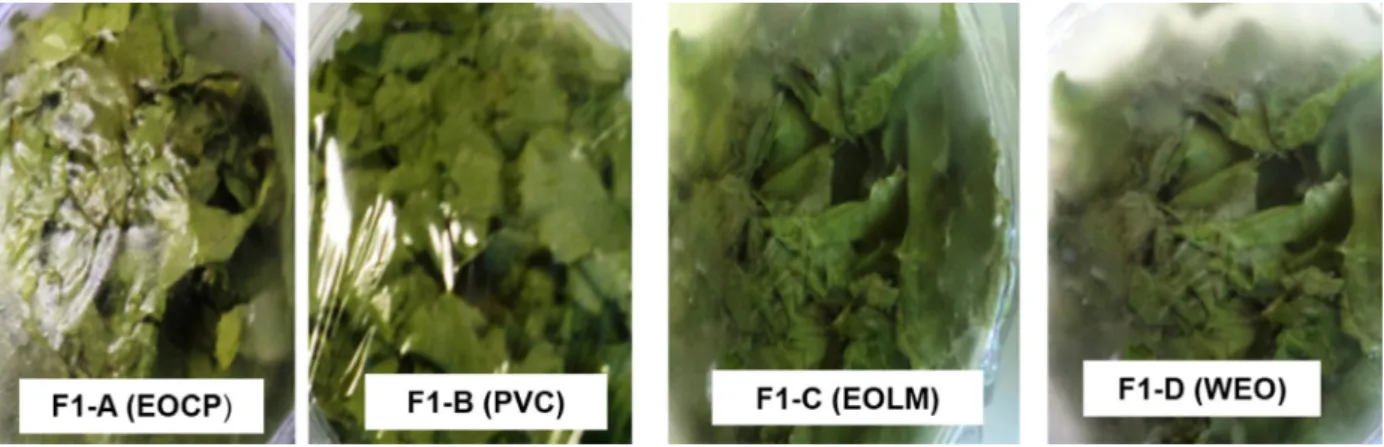
comparison with a PVC film. Figure 1 presents the general
appearance of the lettuce leaves after 8 days of storage
(Figure 1, F1-A at F1-D). Biodegradable films showed no
visible changes in appearance; however, it was observed that the leaves that were in contact with the biodegradable
films were apparently less turgid than the leaves that were not in contact with the biofilms.
Characteristics of biodegradable films
The thickness of the biodegradable films was
fixed at 50 μm, and it was determined that the variation in the thickness of the biodegradable films not statistically
significant (p>0.05). The PVC films showed minor
thickness than the biodegradable films (Table 2). The WVP of PVC film was not evaluated.The values of WVP
determined for starch/PVOH/alginate films are shown
1 2 S TPVA δ WVP RH RH A P 100 (1)
where TPVA is the rate of WVP (g water/day), δ is the average thickness of films (m), A is the area of permeation
of the capsule (28.26 x 10⁻⁴m2), P
s is the pressure of the
saturation of the vapor of water at 25 ºC (163.678.8), and RH is the relative humidity inside the desiccator (subindex 1) and the dish (subindex 2).
Opacity
The opacity corresponds to the value of the intensity
of light radiation that the films are blocking. The opacity of the films was determined using a Luxmeter (Instrutherm, LM- 8000A). The films were cut to a size of 4 x 4 cm and
placed over the Luxmeter sensor to measure the intensity
of the light crossing through the films. The analysis was
carried out in environmental light. The measurements were read in Lux with four repetitions per sample. The opacity
was calculated as the percentage of light blocked by films
(%Lux) using the Equation 2:
100 Lux i Lux f
%Lux x
Lux i
(2)
where Luxi is the measure of the intensity of the Lux of the
environment, and Luxf is the measurement of the intensity
of light crossing the film.
Mechanical properties
Figure 1: The appearance of the minimally processed lettuce leaves after 8 days of storage in films with essential oil of copaiba (EOCP): F1-A; in PVC films: F1-B; in films with essential oil of lemongrass (EOLM): F1-C; and in films without essential oil (WEO) F1-D.
Table 2: Characterization of the films developed in relation to Water Vapor Permeability (WVP), mechanical properties, opacity, and thickness.
Formulation (10-12 g sWVP -1.Pa-1.m-1) Maximum resistance to rupture (Mpa)
Elongation at rupture (%)
Opacity
(%Lux) Thickness(mm)
PVC - - - 9.80 10.0b
WEO 0.50c 8.11 11.3 9.25 49.4a
EOCP 4.04a 6.20 13.02 11.82 51.0a
EOLM 2.02b 11.43 13.23 9.15 64.0a
Values followed by the same letters in the columns did not significantly differ according to the Tukey test at 95% probability. in Table 2. These values were smaller than the values
determined by Lin and Zhao (2007) for PVC films, who
presented a WVP value equal to 2.6 x 10⁻¹¹g.s-.Pa-1.m-1,
indicating that the prepared starch/PVOH/alginate films
were 10 times less permeable to water vapor than PVC
films on a gradient of 73% humidity.
It was observed that the starch/PVOH/alginatefilms
formulated with essential oil were more permeable than those without oil. These results indicate that the WVP of
the films was more dependent on the process of diffusion
than that of solubility of water vapor in the matrix of the
film. Brandelero et al. (2014) characterized starch/PVOH/ alginate films with lemongrass or copaiba oils, and they
stated that the action of oil on the WVP was related to the
formation of relatively large cracks in the matrix of films,
which contributed to the process of diffusion of water vapor.
The resistance and the elongation of the films
were evaluated (Table 2). The values of resistance were considered characteristic of films of cassava starch supplemented with 20% glycerol. (Bergo et al., 2008; Mali
et al., 2006; Talja et al., 2008). It was observed that values
of maximum resistance at rupture (MRR) and elongation
at rupture were not significantly different between starch/
PVOH/alginate films with and without oil (p>0.05). The
results for mechanical properties obtained for starch/
PVOH/alginate films indicated that the addition of oil did
not hinder the structure of films. These results differ from
those of previous authors (Chasemlou etal.,2013; Pelissari
et al., 2009; Souza et al., 2013), who observed a reduction in the resistance and an increase in the elongation of starch
films containing added essential oils.
The starch/PVOH/alginate films had similar
opacity to that of PVC films, indicating that the addition of oil does not diminish the transparency of films. The
values of opacity indicated that the starch/PVOH/alginate
films presented transparency similar to PVC film. Similar
results were obtained by Gallardo-Pérez et al. (2012), who observed no differences in appearance or opacity in
Loss of mass (LM)
The biofilms produced were applied as a coating of
trays for the storage of minimally processed lettuce. The LM
of lettuce in relation at films was calculated, and the values
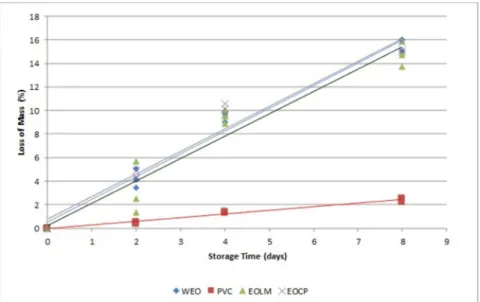
obtained were adjusted by linear regression. Figure 2 represents the LM of lettuce leaves according to storage time in starch/
PVOH/alginate films with or without essential oils, as well as that stored in PVC films. It was observed that the starch/ PVOH/alginate films allowed greater LM than the PVC film. The value for the loss of water was similar in films with and
without essential oil, indicating that in the concentration applied, copaiba and lemongrass oil had no effect on the
films’ barrier properties concerning water vapor. The samples packed with PVC films presented values of mass loss equal to 2% after 8 days of storage, while samples with biofilm
(WEO) presented loss of 14–16% in the same period. The RH inside the refrigerator varied from 50 to 70%, and the lettuce leaves were constituted of at least 90% water; thus, the migration of water vapor from the inside to the outside of the package was favored. The values obtained for the LMs found in this work for lettuce stored
in starch/PVOH/alginate films were much lower than those
determined by Marin et al. (2010), who reported about
40% of mass loss of lettuce after 8 days of storage in films
composed solely of starch; this indicated that the mixture of starch with alginate and PVOH improved the performance
of starch films in relation to the LM.
The WVP values of starch/PVOH/alginate films
(Table 2) were similar to values determined for PVC
films by other authors; however, the biodegradable films
showed more LM (Figure 2). These results indicated that
the values of WVP of starch/PVOH/alginate films probably
changed during the time in storage. The contact of starch/
PVOH/alginate film with the lettuce leaves may have caused retention of water in the matrix of the films, thereby
increasing the value of WVP due to the plasticizer effect of water. This is in accordance with Brandelero, Grossmann
and Yamashita’ (2010) finding that starch films present
an increase in the WVP value with increasing RH. This
behavior was related to the plasticizing effect of water. In this process, the water retention in the matrix of the film
increases the free volume between the polymers chains of the starch and the molecular mobility, while decreasing the
crystalline regions of the films; this favors the passage of
water vapor, leading to an increase in WVP. These results reinforce the observations in this work, indicating that the WVP is an important factor in controlling the loss of water.
Microbiological stability
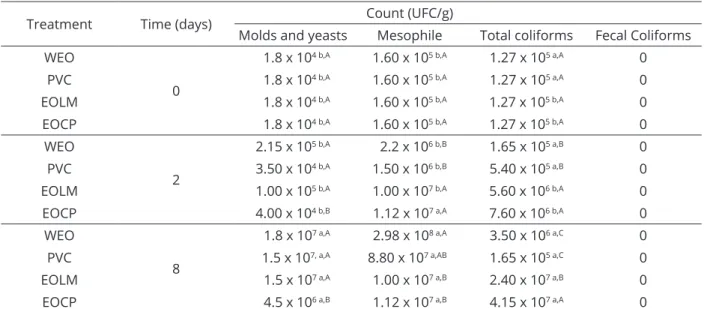
The microbiological stability of minimally processed lettuce was evaluated according to the storage time, as well as the results for mold and yeast, aerobic mesophile, and total and fecal coliform bacterial counts,
as presented in Table 3. It was observed that after 8 days of storage, the mold and yeast counts increased significantly
in relation to the count at time zero (p<0.05). The starch/
PVOH/alginate films with copaiba oil presented smaller
mold and yeast counts than other treatments did at this time, indicating the addition of oils had an effect on the
fungi present in microbial flora.
The mesophile count had increased significantly
at the eighth day of storage for all treatments (p<0.05).
PVC films and starch/PVOH/alginate films without the
addition of essential oil showed the lowest counts of total
coliforms during storage. The films with EOCP or EOLM
did not exercise control over the development of these microorganisms. The samples showed no count for fecal coliforms; these results indicate that the microbiological standards established for this microorganism were met during the storage period (Brasil, 2001). The starch/
PVOH/alginate films did not decrease the development
of total coliforms, but at the same time, they did not contribute to the development of these microorganisms.
The films with EOCP exercised protection in relation
to molds and yeasts (Table 3), indicating that there was greater microbiological control in starch/PVOH/alginate
films with essential oil.
Physicochemical analysis
The values of TSS, pH, TTA, and ASC were determined for each treatment in the different storage times. These are presented in Figure 3.
The values of TSS varied according to the storage period in all treatments (Figure 3, F3-B). Soluble solids are simple sugars that can be used in the storage of lettuce in the processes of cellular respiration. The lettuce
stored in PVC films exhibited a greater decrease in the
TSS value after 2 days of storage; the value increased soon after this point, probably due to the degradation of sugars of cellular wall, resulting in an increase of TSS after 4 days of storage. The rapid decrease in the values of TSS at 2 days may have occurred due to the cutting process used for minimally processed foods, which increases the contact enzyme substrate and the speed of the biochemical reactions. The starch/PVOH/
alginate films with or without essential oil only showed a significant reduction in the value of TSS on the eighth
day of storage (p<0.05). The results suggested that the
speed of oxidative reactions involved in respiration was greater in the lettuce packed with PVC.
The TTA of the lettuce leaves decreased significantly
from the second day of storage for all treatments (p<0.05),
followed by a nonsignificant increase (p>0.05) in the
biodegradable films and continuous decline in the film
with PVC (Figure 3, F3-A). The increase in pH values
confirmed the decrease in acidity (Figure 3, F3-C). Such a
decrease in acidity is related to the enzymatic reactions that occur in minimally processed food. Mattos et al. (2007) found the same behavior in minimally processed lettuce.
Table 3: Microbiological stability of minimally processed lettuce stored in different containers under chilled conditions.
Treatment Time (days) Count (UFC/g)
Molds and yeasts Mesophile Total coliforms Fecal Coliforms WEO
0
1.8 x 10⁴ b,A 1.60 x 10⁵ b,A 1.27 x 10⁵ a,A 0
PVC 1.8 x 10⁴ b,A 1.60 x 10⁵ b,A 1.27 x 10⁵ a,A 0
EOLM 1.8 x 10⁴ b,A 1.60 x 10⁵ b,A 1.27 x 10⁵ b,A 0
EOCP 1.8 x 10⁴ b,A 1.60 x 10⁵ b,A 1.27 x 10⁵ b,A 0
WEO
2
2.15 x 10⁵ b,A 2.2 x 10⁶ b,B 1.65 x 10⁵ a,B 0
PVC 3.50 x 10⁴ b,A 1.50 x 10⁶ b,B 5.40 x 10⁵ a,B 0
EOLM 1.00 x 10⁵ b,A 1.00 x 10⁷ b,A 5.60 x 10⁶ b,A 0
EOCP 4.00 x 10⁴ b,B 1.12 x 10⁷ a,A 7.60 x 10⁶ b,A 0
WEO
8
1.8 x 10⁷ a,A 2.98 x 10⁸ a,A 3.50 x 10⁶ a,C 0
PVC 1.5 x 10⁷, a,A 8.80 x 10⁷ a,AB 1.65 x 10⁵ a,C 0
EOLM 1.5 x 10⁷ a,A 1.00 x 10⁷ a,B 2.40 x 10⁷ a,B 0
EOCP 4.5 x 10⁶ a,B 1.12 x 10⁷ a,B 4.15 x 10⁷ a,A 0
The values of the ASC were determined for the lettuce packed in different treatments (Figure 3,
F3-D). It was observed that there were no significant
differences in the values during storage with exception
of the WEO films, which presented an increase in value
to 2 days of storage. The values of ASC determined at 8 days equaled the levels analyzed at time zero in
all treatments (p>0.05). Marin et al. (2010) observed
50% of increase in the values of ASC in lettuce stored
in pure starch films; according to these authors, the
effect should be device an excessive loss mass (40%), which caused a concentration of vitamins. LMs were also determined in this work, but the values were minor (close to 16%), and no effect was exerted on the evaluated physicochemical parameters.
Analysis of color
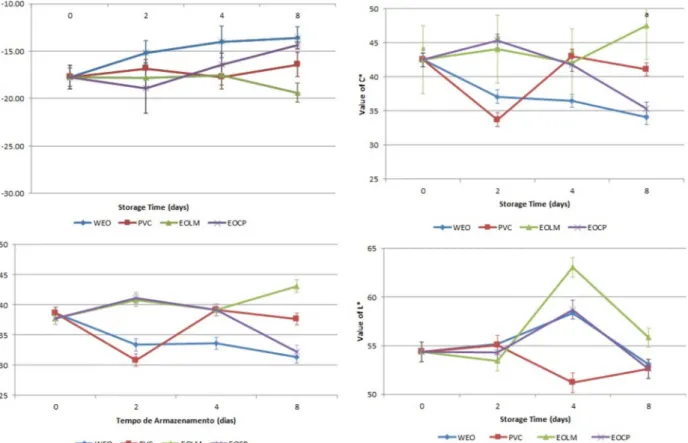
The color parameters –a*, b*, C*, and L* for lettuce
stored in each starch/PVOH/alginate film with or without essential oil and PVC films were determined. These are
presented in Figure 4.
Figure 3: Behavior of the values of total titratable acidity (TTA; F3-A), total soluble solids (TSS; F3-B), pH (F3-C), and ascorbic acid content (Ascorbic; F3-D) for minimally processed lettuce and packed in films without essential oil (WEO), films of PVC (PVC), films with oil of lemongrass (EOLM), and films with copaiba oil (EOCP). The averages were analyzed using Tukey’s test (p=0.05).
The lettuce leaves were characterized by yellow– green coloration. The leaves of lettuce stored in EOLM
films best preserved the green–yellow coloration observed
at time zero throughout the storage period. Positive values of “b*” indicates the yellow coloration, and negative values of parameter “a*” indicate greater green coloration. As shown in Figure 4, the –a* and b parameters various to treatments differed after 2 days of storage (p<0.05). The lettuce showed a tendency to diminish the green color with
the storage time in the WEO and EOCP films. The lettuce
in EOLM films and PVC films did not change parameter
–a* during storage. Parameter b* changed during of storage. The leaves of lettuce storage in WEO and EOCP
films exhibited a decrease in yellow color.
The decrease in green color was related to the degradation of chlorophyll, which is sensitive to oxygen among other factors; when chlorophyll is degraded by the action of oxygen, colorless compounds are formed, and the green color is attenuated. These results indicate that
the starch films with EO of lemongrass and PVC films
of oxygen to the interior of the packaging than starch/
PVOH/alginate films without oil and films incorporating
with EOCP. The yellow color represents the amount of carotenes, which are also sensitive to the action of oxygen
gas. The EOLM and PVC films resulted in a minor loss of
color during at storage time (Figure 4).
The phenol contents in minimally processed lettuce leaves may be oxidized, resulting in dark pigments; this process is known as enzymatic browning (Soliva-Fortuny; Martín-Belloso, 2003). The occurrence of enzymatic browning can diminish lightness (L*), and it can be increase the gray tones, consequently increase the values
of C⃰ (Mattos et al., 2007). It was observed that there
was an increase in the values of L* for the treatments
with biodegradable films and a decrease for the PVC
treatment at 4 days of storage; at this stage, the values of C* had already increased in the lettuce packaged in
films with PVC, remained the same in EOLM films, and declined in EOCP and WEO films. Mattos et al. (2007)
found that minimally processed lettuce presented a lower
lightness value than lettuce in whole leaves. These authors concluded that the higher activity of peroxidase and polyphenol oxidase in cut leaves was responsible for the
results. In comparison with the results of these authors, the findings of this study suggest a greater barrier to oxygen in starch/PVOH/alginate films added of lemongrass oil,
resulting in protection of the phenolic compounds.
Multivariate analysis
Multivariate statistical analysis was applied to the variables analyzed to distinguish the effects of the
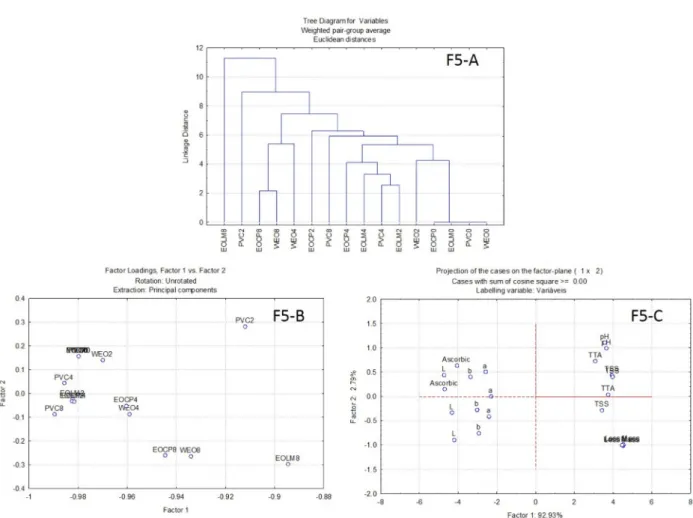
treatment. In the dendrogram in Figure 5 (F5-A), four
groups (or clusters) of different treatments can be observed
at p<0.05. The samples from time zero (WEO0, PVC0,
EOLM0 and EOCP) and WEO lettuce stored for 2 days
(WEO2) formed the first group of samples. The second
group was formed by the treatments with essential oil at 2
and 4 days of storage and by treatment with PVC film at 4
and 8 days of storage (PVC4 and PVC8). The third group
was formed by the treatments of films without essential
oil at 4 and 8 days (WEO4, WEO8) and by treatment with EOCP at 8 days (EOCP8). The treatments that were most different from the samples at time zero were those with essential oil of lemongrass at 8 days of storage (EOLM8), followed by PVC2 (samples in PVC with 2
days of storage), which formed the fourth group. In this
way, the treatments in the third and fourth groups were the most different in relation to the lettuce leaves at time zero. The analysis of the main components is represented by graphs of scores (Figure 5, F5-B) and the loadings (Figure 5, F5-C); the joint analysis of both graphics allow which of the analyzed variables were important to explain the difference between the treatments to be observed. The
lettuce samples packed with starch/PVOH/alginate films
with or without EO for 8 days of storage differed from treatments PVC due to LM, being that the mass loss was not an important factor to distinguish the biodegradable
films at 8 and at 4 and 2 days of storage (Figure 5, F5-B and F5-C). The treatment of PVC2 films differed from
Figure 5: Multivariate analysis applied to the study of biofilms in minimally processed lettuce storage.
the others due to the physicochemical parameters (TSS,
TTA, pH). The biodegradable films and PVC films at 4
and 8 days were similar due to the color parameters and amounts of ascorbic acid.
The graph of scores (Figure 5, F5-C) indicates
that the scores for treatment in biodegradable films with
essential oil at 0, 2, and 4 days of storage were alike; thus, it is considered that these groups were similar to each other. The high LM of lettuce leaves packaged in biodegradable
films limited the maximum time of storage to 4 days. PVC films allowed greater loss in TSS at 2 days of storage,
compromising the quality of leaves, as discussed above.
CONCLUSIONS
biodegradable films compared to that packed in PVC, as the PVC film was more efficient in the control of LM. The addition of EO did not improve the biofilms’ ability
to serve as a barrier against water vapor. The analysis of
TSS indicated that the PVC films were not efficient in
maintaining the quality of lettuce from about 2 days of
storage. The color analysis indicated that EOLM films were more efficient in protecting the color than the PVC films. The multivariate analysis also showed that lettuce stored in biofilms with EO for 4 days and without EO for 2
days were considered more similar to the other treatments
at time zero. The starch/PVOH/alginate biofilms were
considered to be viable in the storage of minimally processed lettuce for up to 4 days and may replace PVC packaging in the studied conditions.
ACKNOWLEDGMENTS
The authors are grateful for the financial support
and the F. M. De Almeida scholarship provided by the Federal University of Technology – Paraná.
REFERENCES
AMERICAN SOCIETY FOR TESTING AND MATERIALS (ASTM).
Standard test methods for water vapor transmission of material – E 96-95. In: Annual book of ASTM standards.
Philadelphia: ASTM. 1995. p.1-8
AMERICAN SOCIETY FOR TESTING AND MATERIALS (ASTM). Standard test methods for tensile properties of thin plastic sheeting – D 882-02. In: Annual book of ASTM standards.
Philadelphia: ASTM. 1996. p.1-10.
BENASSI, M. T.; ANTUNES, A. J. A comparison of metaphosphoric and oxalic acids as extracts solutions for the determination
of vitamin C in selected vegetables. Brazilian Archives of
Biology and Technology, 31(4):507-513, 1988.
BERGO, P. V. A. et al. Physical properties of edible films
based on cassava starch as affected by the plasticizer
concentration. Packaging Technology Science.
21:85-89, 2008.
BRANDELERO, R. P. H.; GROSSMANN, M. V. E.; YAMASHITA, F.
The effect of surfactant Tween 80 on the hydrophilicity,
water vapor permeation, and the mechanical properties of cassava starch and poly(butylene adipate-co-terephthalate)
(PBAT) blend films. Carbohydrate Polymers. 82:1102-1109, 2010.
BRANDELERO, R. P. H. et al. Mixture design applied to evaluating the effects of polyvinyl alcohol (PVOH) and
alginate on the properties of starch-based films. Starch/ Stärke. 66:1-9, 2014.
BRASIL. Agência Nacional de Vigilância Sanitária. Resolução (ANVISA) – RDC n. 12, de 02 de janeiro de 2001 – Aprova o Regulamento Técnico sobre padrões microbiológicos para alimentos.Diário Oficial da União. Brasília, 10 de janeiro
de 2001. Seção 1.
BRASIL. Ministério Da Agricultura, Pecuária E Abastecimento. Secretaria de Defesa Agropecuária (DISPOA). Instrução Normativa n. 62, de 26 de agosto de 2003. Oficializa os Métodos Analíticos Oficiais para Análises Microbiológicas para Controle de Produtos de Origem Animal e Água. Diário
Oficial da União. Brasília, 26 de agosto de 2003. xxxp.
BURT, S. Essential oils: Their antibacterial properties and
potential applications in foods. A review. International
Journal of Food Microbiological. 94(3):223-253, 2004. CÓRDOBA, A. et al. The plasticizing effect of alginate on the
thermoplastic starch/glycerin blends. Carbohydrate
Polymer. 73:409, 2008.
DEBIAGI, F. et al. Biodegradable active packaging based on cassava bagasse, polyvinyl alcohol and essential oil.
Industrial Crops and Products. 52:664-670, 2014.
FAKHOURI, F. M. et al. Filmes e coberturas comestíveis
compostas à base de amidos nativos e gelatina na conservação e aceitação sensorial de uvas Crimson.
Ciência e Tecnologia de Alimentos. 27(2):369-375, 2007. FALGUERA, V. et al. Edible films and coatings: structures, active
function and trends in their use. Trends in Food Science
& Technology. 22: 292-303, 2011.
GALLARDO-PÉREZ, A. et al. Effect of structural characteristics of modified waxy corn starches on rheological properties, film-forming solutions, and on water vapor permeability, solubility, and opacity of films. Starch/Stärke. 64:27-36, 2012.
GHASEMLOU, M. et al. Physical, mechanical and barrier properties of corn starch films incorporated with plant
essential oils. Carbohydrate Polymer. 98:1117-1126,
2013.
GUILBERT, S.; GONTARD, N.; GORRIS, L. G. M. Prolongation
of the shelf-life of perishable food products using biodegradable films and coatings. Lebensmittel-Wissenschaft & Technologie. 29:10-17, 1996.
GUIMARÃES, L. G. L. et al. Atividades antioxidante e fungitóxica
do óleo essencial de capim-limão. Revista Ciência
INSTITUTO ADOLFO LUTZ. Métodos Químicos e Físicos para
análise de alimentos. Normas Analíticas do Instituto
Adolfo Lutz. São Paulo: IMESP, v.1, 1985. 288p.
KOIDE, S.; JOHN, S. Microbial and quality evaluation of green peppers stored in biodegradable film packaging. Food
Control. 18:1121–1125, 2007.
LIN, D.; ZHAO, Y. Innovation in the development and application
of edible coating for fresh and minimally processed fruits and vegetables. Comprehensive Reviews in Food Science
and Food Safety. 6:60-75, 2007.
MALI, S. et al. Effects of controlled storage on thermal, mechanical and barrier properties of plasticized films from different starch sources. Journal of Food Engineering.
75:453-460, 2006.
MALI, S.; GROSSMANN, M. V. E.; YAMASHITA, F. Filmes de amido: Produção, propriedades e potencial de utilização. Semina: Ciências Agrárias. 31(1):137-156,
2010.
MARIN, T. et al. Embalagem ativa para alface americana (Lactuca sativa L.) minimamente processada. Semina: Ciências
Agrárias. 31(3):653-660, 2010.
MATTOS, L. M. et al. Qualidade de alface crespa minimamente
processada armazenada sob refrigeração em dois sistemas de embalagem. Horticultura Brasileira. 25:504-508, 2007.
PELISSARI, F. M. et al. Antimicrobial, mechanical and barrier properties of cassava starch-chitosan films incorporated
with oregano essential oil. Journal of Agriculture and
Food Chemistry. 57:7499- 7504, 2009.
PIERI, F. A.; MUSSI, M. C.; MOREIRA, M. A. S. Óleo de copaíba
(Copaifera sp.): Histórico, extração, aplicações industriais e propriedades medicinais. Revista Brasileira de Plantas
Medicinais. 11(4):465-472, 2009.
SOLIVA-FORTUNY, R. C.; MARTÍN-BELLOSO, O. New advances in extending the shelf-life of fresh-cut fruit. A review. Trends in Food Science & Technology. 14:341-353, 2003. SOUZA, A. C. et al. Cassava starch composite films incorporated
with cinnamon essential oil: Antimicrobial activity, microstructure, mechanical and barrier properties. LWT –
Food Science and Technology. 54:346-352, 2013.
TALJA, R. A. et al. Effect of type and content of binary polyol mixtures
on physical and mechanical properties of starch-based edible