(Annals of the Brazilian Academy of Sciences) ISSN 0001-3765
www.scielo.br/aabc
Associative diazotrophic bacteria in grass roots and soils
from heavy metal contaminated sites
FÁTIMA M.S. MOREIRA1, ANDERSON LANGE2, OSMAR KLAUBERG-FILHO3, JOSÉ O. SIQUEIRA1, RAFAELA S.A. NÓBREGA4 and ADRIANA S. LIMA4
1Departamento de Ciência do Solo (DCS), Universidade Federal de Lavras (UFLA), Caixa Postal 3037, 37200-000 Lavras, MG, Brasil 2Departamento de Agronomia, UNEMAT, Rodovia MT 208, km 147, Jardim Tropical, 78580-000 Alta Floresta, MT, Brasil
3Universidade do Estado de Santa Catarina (UDESC), Caixa Postal 281, 88520-000 Lages, SC, Brasil 4Departamento de Ciência do Solo (DCS), Universidade Federal de Lavras (UFLA)
Programa de Pós-graduação em solos e nutrição de plantas, Caixa Postal 3037, 37200-000 Lavras, MG, Brasil
Manuscript received on August 29, 2006; accepted for publication on July 22, 2008; contributed byJOSÉO. SIQUEIRA*
ABSTRACT
This work aimed to evaluate density of associative diazotrophic bacteria populations in soil and grass root samples from heavy metal contaminated sites, and to characterize isolates from these populations, both, phenotypically (Zinc, Cadmium and NaCl tolerancein vitro, and protein profiles) and genotypically (16S rDNA sequencing), as compared to type strains of known diazotrophic species. Densities were evaluated by using NFb, Fam and JNFb media, commonly used for enrichment cultures of diazotrophic bacteria. Bacterial densities found in soil and grass root samples from contaminated sites were similar to those reported for agricultural soils. Azospirillumspp. isolates from contaminated sites and type strains from non-contaminated sites varied substantially in their in vitrotolerance to Zn+2and Cd+2, being Cd+2more toxic than Zn+2. Among the most tolerant isolates (UFLA 1S, 1R, S181, S34 and S22), some (1R,
S34 and S22) were more tolerant to heavy metals than rhizobia from tropical and temperate soils. The majority of the isolates tolerant to heavy metals were also tolerant to salt stress as indicated by their ability to grow in solid medium supplemented with 30 g L-1NaCl. Five isolates exhibited high dissimilarity in protein profiles, and the 16S rDNA
sequence analysis of two of them revealed new sequences forAzospirillum.
Key words:Azospirillum, Zinc, Cadmium, soil contaminants, Nitrogen-fixing bacteria.
INTRODUCTION
Mining and metallurgical industry play an important role in worldwide economy, particularly in Brazil. How-ever, these industries can be responsible for environmen-tal impacts caused mainly by heavy meenvironmen-tal (HM) con-tamination of soil, vegetation and water bodies. Soil contamination with HM is a major constraint for plant growth (Marques et al. 2000) and for microbial density, diversity and processes, including biological Nitrogen fixation (Tyler 1981, Hirsch et al. 1993, Dias-Júnior et al. 1998, Giller et al. 1998, Klauberg-Filho et al. 2002).
*Member Academia Brasileira de Ciências Correspondence to: Fátima Maria de Souza Moreira E-mail: [email protected]
nitrogenase activity by heterotrophic soil bacterial pop-ulations in HM contaminated soil treated with sewage sludge. These authors also found high negative corre-lation between nitrogenase activity and Zn, Cd and Cu concentrations in the soil. Hayat et al. (2002) found that asymbiotic Nitrogen fixer populations, in soil receiving oil refinery wastewater, tolerate Ni, Cd, Pb, Cu and Zn tested individually, at concentrations up to 400µg mL-1.
In the only study with associative diazotrophic isolates (Strzelczyk et al. 1997), it was found a similar behav-ior of isolates to different HM (Zn, Cd and Cu). How-ever, results of these work are highly contradictory to what has been reported for other metal-bacteria inter-actions showing markedly differentiated response to distinct metals. The understanding of associative diazo-troph behavior in HM contaminated soil may provide good insights for the ecology and application of these organisms in rehabilitation practices.
In this work we assessed associative diazotrophic bacterial population densities in heavy metals contamin-ated soils and grass roots. We also characterized, pheno-typically (Zinc, Cadmium, and NaCl tolerance in vitro
and protein profiles) and genotypically (16S rDNA se-quencing) isolates from these sites in comparison to type strains.
MATERIALS AND METHODS
STUDIEDSITES ANDSAMPLING
Soil and grass root samples were collected in October (dry season) from five dumping sites near a Zinc proces-sing industry (Companhia Mineira de Metais – CMM), located at Três Marias (MG). Zn and Cd were the main soil contaminants in all sites, as their contents were very high considering the allowed limits according to the European Communities (Table I). All these sites have the predominance of grass species such as: Brachiaria decumbens,B. brizantha,B. muticaandAndropogonsp.
From each site, three samples of rhizosphere soil and three samples of roots were randomly collected at 0– 20 cm depth. The samples were placed in heat-isolated protective cases, and transferred to the laboratory where they were stored at−4◦C until used for analysis.
BACTERIALDENSITIES ANDISOLATION
Densities of diazothophic species were assessed by the most probable number method obtained by the
inocu-lation of successive decimal dilutions of samples (first dilution: 10 g root or soil/95 mL sterile NaCl solution 5.5 g L-1) in semi-solid media, known to favor growth
of Azospirillum spp. (A. lipoferum, A. brasilense, A. amazonense) (Magalhães and Döbereiner 1984, Döbe-reiner et al. 1995) andHerbaspirillumspp. (H. serope-dicae,H. rubrisubalbicans) (Döbereiner et al. 1995) as
well as other diazotrophs (Nóbrega et al. 2004) such asBurkholderiaspp. The following media were used:
Fam (Magalhães and Döbereiner 1984), NFb and JNFb (Döbereiner et al. 1995). Media were distributed into 10 mL vials (4 mL medium/vial). From each sample dilution, 0.1 mL was inoculated in each medium with three replicates (vials). Positive cultures for growth of diazotrophs were indicated by pellicle formation near medium surface. Isolates were obtained from single colonies and identified according to procedures described by Magalhães and Döbereiner (1984) and Döbereiner et al. (1995).
TYPESTRAINS
Type and reference strains of Azospirillum brasilense
(BR 11001T),A. lipoferum(BR 11080T),A. amazonense
(BR 11140T),
A. irakense (KCB1T), Herbaspirillum seropedicae(BR 11175T) and reference strain Burkhol-deriasp. (previously namedB. brasilensis) (BR 11340), as well as reference strain BR 9004 identified as Burk-holderiasp. (F.M.S. Moreira, unpublished results) were
also included in the phenotypic assays for comparison with isolates from contaminated sites.
INOCULUM
Isolates and type strains were grown in liquid potato dex-trose medium under 105 rpm at 28◦C. After 10 days, one
mL of each cell culture was submitted to centrifugation (Eppendorf centrifuge 5402, 14 rpm, 5 min, 10◦C),
dis-carding the supernatant and re-suspending cells in 1 mL saline solution (NaCl 5.5 g L-1), respectively. This
TABLE I
Heavy metal concentrations (Mehlich1) in soil samples from the various sites.
Site/grass species Heavy metal (mg.kg-1)(1)in soil
Zn Cd Mn Cu Pb
1 – Brachiaria decumbens 5739 67 267 4 30
2 – Andropogonsp. 5902 105 114 530 90
3 – B. decumbens 12873 46 34 548 144
4 – B. mutica 3960 223 76 215 134
5 – B. mutica 15279 76 78 722 198
(1) Permissible limits in European Communities: Zn = 300; Cd = 3; Cu = 140; Pb = 300 mg.kg-1(“aqua regia” extracted).
TOLERANCE TOZN, CD
Tolerance to Zn and Cd was assessed in potato dex-trose agar and in semi-solid Nitrogen-free media (Fam, NFb) in which diazotrophs grow acquiring atmospheric Nitrogen through nitrogenase activity. In both experi-ments, solid media and N-free semi-solid media were modified by the addition of biological buffers HEPES (1.3 mg L-1) and MES (1.1 mg L-1) and were
supple-mented with metals at concentrations ranging from 0 to 1,000 mg Zn+2 L-1and from 0 to 54.1 mg Cd+2L-1.
Assayed concentrations were defined from results of the effects of these metals on tropical rhizobia isolates (Trannin et al. 2001a, Matsuda et al. 2002). Modified potato dextrose agar media was supplemented after autoclaving, with sterile solutions of ZnSO4.7H2O and/
or CdSO4.8H2O to give final desirable concentrations
of 0; 125; 250; 500 and 1,000 mg Zn2+L-1or 0; 1.7; 3.4;
6.8; 13.5; 27.1 and 54.1 mg Cd2+L-1. Zn+2and Cd+2were
tested separately or in combinations of different concen-trations in potato dextrose medium. Metals combined in potato dextrose agar were only tested for A. ama-zonense. Fam and NFb semi-solid N-free media were
supplemented with sterile solutions of ZnSO4.7H2O or
CdSO4.8H2O at the following concentrations of Zn2+
and Cd2+: 0; 62.5; 125; 250; 500, 1,000 mg L-1 and
0; 2.5; 5.0; 10.0; 20.0; 40.0, 60.0 mg L-1, respectively.
Media receiving Zn sulfate (ZnSO4.7H2O) had the pH
adjusted to 6.8 by addition of KOH 1N.
After the incubation period (10 days at 28◦C),
strains and isolates growth was assessed in modified solid medium by attributing scores as following:
0 = no visual growth, 1 = very reduced growth, 2 = low growth, 3 = intermediate growth, 4 = abundant growth, 5 = very abundant growth as compared to the growth of the tested isolate/strain in the same medium without heavy metal supplementation. Maximum tolerated con-centration (MTC) was determined as being the highest one with a growth score equal or higher than 1. Forma-tion of typical pellicles near the surface was consid-ered as positive growth in semi-solid modified N-free media (Magalhães and Döbereiner 1984, Döbereiner et al. 1995). Nitrogenase activity was measured by the acetylene reduction technique (Dilworth 1966) in all semi-solid media in four day old cultures by using a gas chromatograph Varian 3400-CX.
TOLERANCE TONACL
In order to verify relationships between tolerance to dif-ferent stresses, strains were also tested for NaCl toler-ance. Potato dextrose agar medium was modified to ob-tain the following final NaCl concentrations: 0, 10, 20, 30, 50 and 80 g L-1, based on ranges commonly found
in the literature (Tortora et al. 2000).
TOTAL PROTEIN PROFILES
were compared for similarity degree estimated by Jacard coefficient (Sj), clustered by UPGMA method (average linkage clustering) (Everitt 1993) and graphically
rep-resent through a dendrogram, obtained by the program NTSYS-pc, version 2.0 t. (Rohlf 2002).
ANALYSES OF16SRDNA SEQUENCING
Genomic DNA was obtained from potato medium log phase cultures of two isolates (UFLA1S and UFLAS181 – which were among the most tolerant to NaCl) and extracted with Ultra-clean Soil DNA isolation kit from MOBIO laboratories. For 16S rRNA sequencing, near full-length 16S rDNA genes were amplified with prime pair 8F (AGAGTTTGATCCTGGCTCAG) and 1492R (GGTTACCTTGTTACGACTT). PCR conditions were: 30 cycles of 94◦C 40s; 55◦C 40s; 72◦C 90s. Directional
partial sequencing of PCR-products was performed with 8F primer. Purification of PCR products was performed with centrifugal filter devices Microcon Millipore. The isolates were sequenced at an ABI 3700 sequencer (Michigan State University). Sequences obtained were compared through BLAST software and submitted to the “National Center for Biotechnology Information” data base (http://www.ncbi.nlm.nih.gov/).
RESULTS
BACTERIALDENSITIES ANDISOLATES
Bacterial growth varied markedly amongst samples. Densities found were higher in roots than in soil samples (Table II). Densities found in soil samples (log most prob-able number g-1dry soil) by using Fam, NFb and JNFB
were respectively in the ranges: 0.57 to 2.34, 1.91 to 4.34 and 0 to 2.72, whereas in root samples, the range of den-sities (log most probable numbers g-1fresh root) were:
2.32 to 3.68, 3.5 to 5.63 and 2.27 to 5.5. Seven isolates were obtained from soil (S) or root (R) samples inocu-lated in these media. Four of them had typical cultural characteristics ofA. brasilense(UFLA 1R, S181, R214)
orA. lipoferum(UFLA 1S) (Döbereiner et al. 1995) and three were similar toA. amazonense(UFLA R204, S34, S22) (Magalhães and Döbereiner 1984).
TOLERANCE TOZN, CD
Maximum tolerated concentrations (MTC) of Zn+2 and
Cd+2in potato dextrose media varied among species and
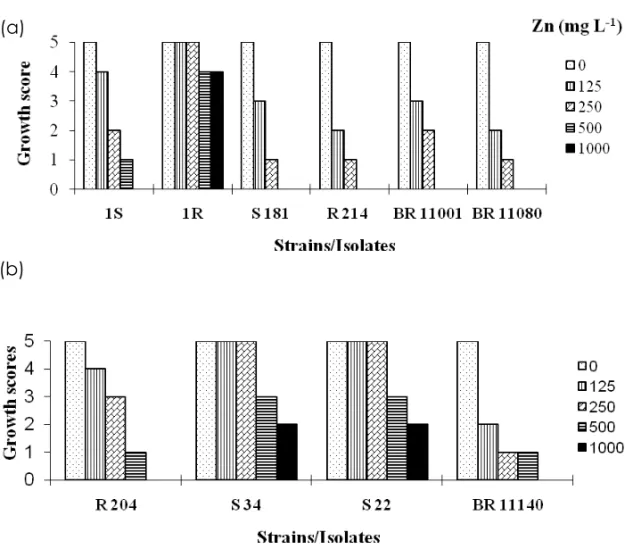
isolates (Figs. 1 and 2). OnlyA. amazonenseisolates
UFLA S34 and UFLA S22 and A. brasilense isolate
UFLA 1R had MTC of 1,000 mg Zn+2L-1. They had
growth score equal to 2 (UFLA S34 and S22) or 4 (UFLA 1R) at this concentration (Fig. 1). Consider-ing that 1,000 mg L-1Zn+2 was the highest
concentra-tion tested, perhaps these isolates could tolerate concen-trations higher than that. No strain or isolate grew at 54.1 mg Cd+2L-1. All isolates and strains tested in this
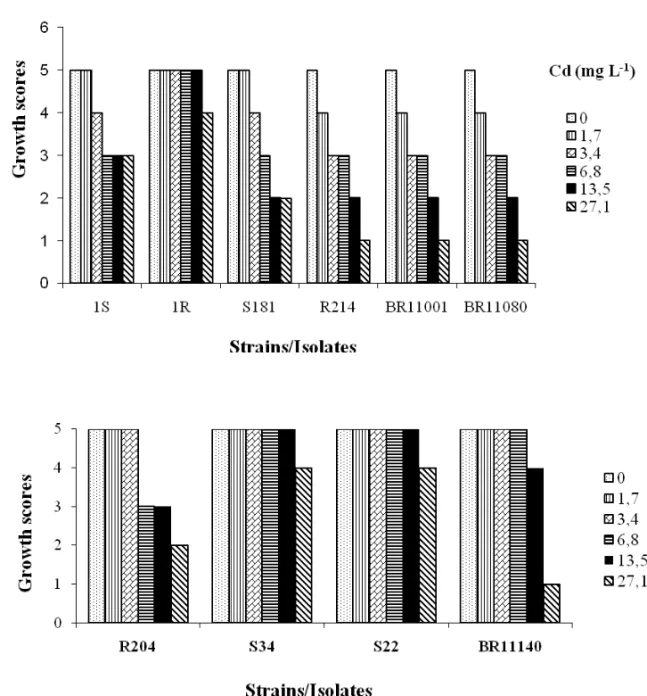
study had MTC of Cd+2 equal to 27.1 mg L-1(Fig. 2).
However isolates UFLA S34, UFLA S22 and UFLA 1R, which were more tolerant to Zn+2, had the highest
growth score (4) at this concentration while the others had a growth score of 3 (UFLA 1S), 2 (UFLA R204, UFLA S181) or 1 (type strains and UFLA R214). A. amazonense did not grow at Zn+2 concentration of
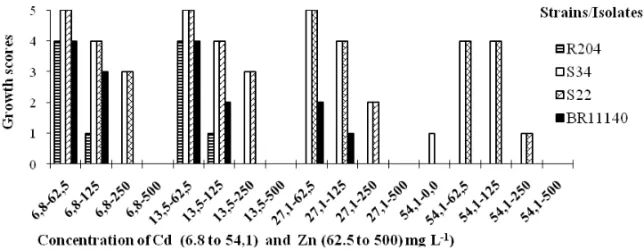
500 mg L-1 in the presence of different concentrations
of Cd+2(Fig. 3). When Zn+2concentrations were raised
at fixed Cd+2 concentrations growth was depressed and
the MTCs of Zn+2 were lower than when it was tested
separately, indicating an additive toxic effect of these metals forA. amazonense. However, at fixed Zn+2
con-centrations of 62.5 and 125 mg L-1increasing the Cd+2
concentration did not affect or had little effect on growth score of UFLA S34 and UFLA S22 indicating antago-nism of Zn+2to Cd+2at these combinations of
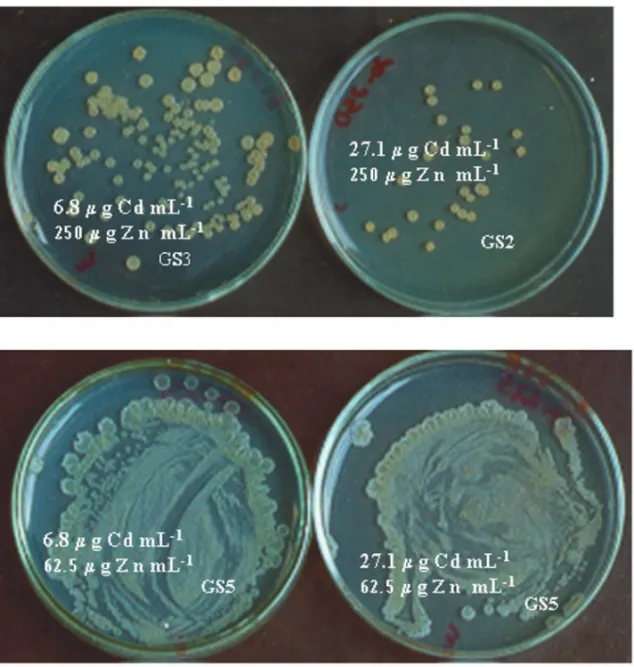
concentra-tions. Time required for appearance of isolated colonies was delayed and colony size decreased with increasing concentrations of combined metals (Fig. 4). Also, it was observed that color ofA. amazonense colonies shifted
from white to yellowish under high Zn+2and Cd+2
con-centrations. However, the white color was recovered when colonies grown in high heavy metal concentration medium were replicated to metal free medium, indicating a metal induced response.
The most tolerant A. amazonenseisolates (UFLA
S34, S22) to Zn+2 and Cd+2 growing at combined N
(potato dextrose media) were also the most tolerant in Nitrogen-fixing conditions (N-free semi-solid media), but in this medium, BR 11140Texhibited the same
tol-erance of isolates belonging to this species. Toltol-erance to Zn+2ofA. amazonensestrains/isolates in N
2fixing
TABLE II
Density (log most probable number g-1dry soil or fresh roots) of diazotrophic bacteria grown in media: Fam, NFb and JNFB in soil and roots samples collected at different
sites of a dumping site of zinc industry.
Site Soil Roots
Fam NFb JNFB Fam NFb JNFB
1 2.34±2.031 2.50±2.28 2.72±2.39 3.12±2.72 3.5±1.9 4.6±0.7
2 1.03±1.78 4.34±1.57 2.17±1.88 3.68±1.34 5.63±0.89 5.5±2.3
3 1.31±1.14 1.30±1.22 0 2.32±2.24 5.31±0.73 4.86±0.86
4 1.02±0.1 2.59±1.15 2.10±1.87 3.04±0.97 5.14±0.53 2.27±1.98
5 0.57±0.98 1.91±1.66 1.0±1.73 2.81±2.44 4.03±0.82 4.44±0.65
1mean standard deviation.
(a) (a)
(b)
Fig. 2 – Growth scores of associative diazotrophic bacteria isolated from heavy metal contaminated area and type strains in potato dextrose agar medium supplemented with different concentrations of Cd2+(mg L-1) ten days after inoculation. a)Azospirillum lipoferum(1S and BR 11080T) andA. brasilense(1R, S181, R214, BR 11001T); b)A. amazonense(R204, S34, S22, BR11140T). 0 = no visual growth, 1 = very reduced growth, 2 = low growth, 3 = intermediate growth, 4 = abundant growth, 5 = very abundant growth as compared to the growth of the strain/isolate in the same medium without heavy metal supplementation.
However, except for isolate UFLA 1R, A. brasilense/ A.lipoferum behaved in a different way to A. amazo-nense, i.e, they tolerated the same or higher Zn+2
con-centrations under N2 fixing conditions than with
com-bined Nitrogen (Table III, Figs. 1a and 2a). Strain BR 11001Thad the lowest MTC under N
2fixing conditions
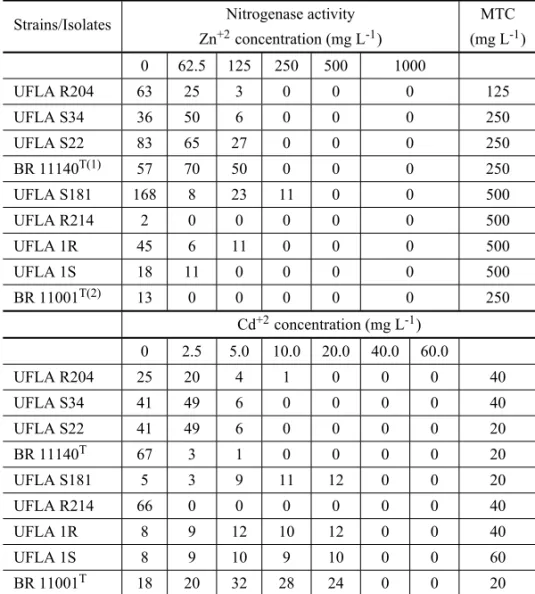
(Table III) as compared to media with combined Nitro-gen (Figs. 1a and 2a). NitroNitro-genase activity decreased as metal concentrations increased, but it varied depend-ing on both metal concentration and isolates/strains. In general, at the highest Zn+2 concentrations growth
was delayed as shown by no acetylene reduction and absence of pellicles after four days at concentrations where growth were observed only after 10 days (Table III). Isolate UFLA 1S was the only one found to tolerate the highest Cd+2concentrations. Growth was delayed as
indicated by acetylene reduction activity or pellicle pres-ence after 4 days at the highest Cd+2concentrations, i.e,
the same behavior as in the media with Zn+2. Although,
nitrogenase activity forA. amazonense decreased with
Fig. 3 – Growth scores ofAzospirillum amazonensetype strain (BR11140T) and isolates (R204, S34, S22) from heavy metal contaminated area in potato dextrose agar medium supplemented with different concentrations of Cd2++ Zn2+(mg L-1) ten days after inoculation. 0 = no visual growth, 1 = very reduced growth, 2 = low growth, 3 = intermediate growth, 4 = abundant growth, 5 = very abundant growth as compared to the growth of the strain/isolate in the same medium without heavy metal supplementation.
TOLERANCE TONACL
No type strain or isolate was able to grow in medium con-taining 80 g L-1NaCl. The type strain BR 11140Tgrew
only in media supplemented with 10 g L-1NaCl or lower,
therefore it was considered the most sensitive to saline stress. BR 11080T, BR 11340T, BR 9004 (Burkholderia
sp.), UFLA R214, R204 and S34 tolerated up to 20 g L-1
of NaCl, and they were classified as facultative halo-phytes. UFLA 1S, 1R, S181 and S22, BR 11175T and
BR 11001Tgrew in up to 30 g L-1NaCl, andAzospirillum irakense(KBC1T) grew in medium with 50 g L-1NaCl,
so they were considered tolerant to saline stress.
TOTALPROTEINPROFILES
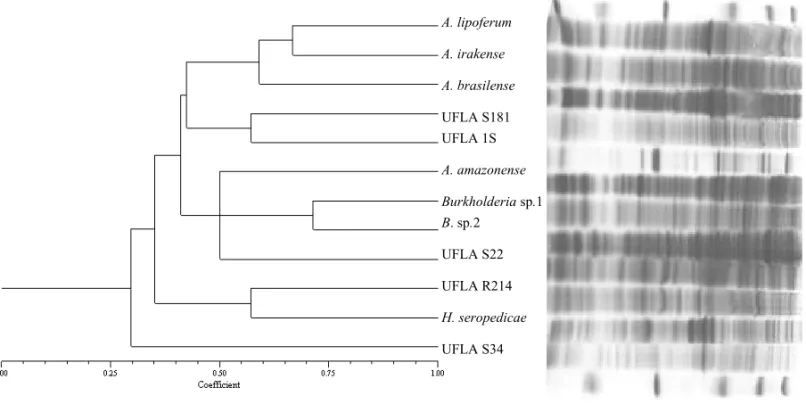
The protein profiles of isolates UFLA 1R and R204 were not revealed in the polyacrylamide gel. Figure 5 shows that no isolate was clustered with any type or reference strain of described species at similarity levels equal or above 75%. Strains belonging to genus Azospirillum
clustered together with type strains of these species at similarity levels of 43% (UFLA S181, 1S) and 50% (UFLAS22), except for UFLA R214 that clustered with
H. seropedicae(56% and UFLA S34 (30%), clustered
with all the other strains.
ANALYSES OF16SRDNA SEQUENCING
Comparison with the NCBI database (accessed Au-gust, 17th2006) revealed UFLA 1S sequence was more
closely related toAzospirilumsp. WAI-19 and DA2-3-1
(96%, corresponding to 251 of 259 bases) followed by
A. lipoferum strain B2 (95%, corresponding to 248 of 259 bases) and UFLAS181 sequence was more closely related to Azospirilum brasilense strain MTCC4036 (98%, corresponding to 715 of 729 bases). Sequences were submitted to NCBI database and received acces-sion numbers: DQ977745 (UFLA 1S) and DQ978776 (UFLA S181).
DISCUSSION
All the three semi-solid media tested were efficient to detect the presence of diazotrophs in the studied soils and roots samples from HM contaminated sites. Diazo-trophic bacteria densities were, in general, higher in root than soil samples. Considering that JNFB medium is reported to favor growth of Herbaspirillum spp. (Döbereiner et al. 1995), it could be inferred that these organisms occurred in high numbers both in soil and root samples. However, these findings are not in accor-dance with the fact thatHerbaspirillumspp. are obligate
endophytic organisms and therefore rarely occurring in soil (Baldani and Baldani 2005). However, Nóbrega et al. (2004) pointed out that JNFb medium also detects species other thanHerbaspirillumspp. such as Azospi-rillumspp., which was probably the case in the present study. In a previous study with soil samples from this area, Dias-Júnior et al. (1998) found noAzospirillum
rhi-Fig. 4 – Growth scores (GS) of UFLA S34 at different combinations of Zn+2and Cd+2concentrations
supplemented in dextrose agar medium. Figure shows colony color changing from white to yellow as well as growth decreasing with increasing concentrations of heavy metals. All plates received the some numbers of cells as inoculum. 2 = low growth, 3 = intermediate growth, 5 = very abundant growth as compared to the growth of the isolate in the same medium without heavy metal supplementation.
zosphere effect in soil samples might also have had a negative influence on diazotroph densities. The occur-rence of diazotrophs in relatively higher densities in roots than in soil samples is probably due to a protective and stimulant microenvironment in roots, as suggested for acidity stress onAzospirillumspp. (Döbereiner 1978). Density values found in the present study were similar to the range found in several reports for non-contaminated agricultural soils (Magalhães et al. 1979, Baldani and Döbereiner 1980, Magalhães and Döbereiner 1984) thus indicating adaptation of this bacterial group to the excess of heavy metal.
TheAzospirillumspp. isolates from contaminated
soil exhibited higher tolerance to Zn+2 and Cd+2 than
TABLE III
Nitrogenase activity (acetylene reduction: nmoles ethylene/culture/hour) measured four days after inoculation byAzospirillumspp. cultures and Maximum Tolerated concentration (MTC) for growth measured by pellicle formation ten days after inoculation in media supplemented with increasing
concentrations of Zn+2(Zn SO
4.7H2O) or with Cd+2(Cd SO4.8H2O).
Strains/Isolates Nitrogenase activity MTC
Zn+2concentration (mg L-1) (mg L-1)
0 62.5 125 250 500 1000
UFLA R204 63 25 3 0 0 0 125
UFLA S34 36 50 6 0 0 0 250
UFLA S22 83 65 27 0 0 0 250
BR 11140T(1) 57 70 50 0 0 0 250
UFLA S181 168 8 23 11 0 0 500
UFLA R214 2 0 0 0 0 0 500
UFLA 1R 45 6 11 0 0 0 500
UFLA 1S 18 11 0 0 0 0 500
BR 11001T(2) 13 0 0 0 0 0 250
Cd+2concentration (mg L-1)
0 2.5 5.0 10.0 20.0 40.0 60.0
UFLA R204 25 20 4 1 0 0 0 40
UFLA S34 41 49 6 0 0 0 0 40
UFLA S22 41 49 6 0 0 0 0 20
BR 11140T 67 3 1 0 0 0 0 20
UFLA S181 5 3 9 11 12 0 0 20
UFLA R214 66 0 0 0 0 0 0 40
UFLA 1R 8 9 12 10 12 0 0 40
UFLA 1S 8 9 10 9 10 0 0 60
BR 11001T 18 20 32 28 24 0 0 20
Type strains of (1)A. amazonenseand (2)A. brasilense.
800 mg L-1Zn+2. Angle et al. (1993) found tolerances
of rhizobia isolates from temperate regions only up to 2.5 mg L-1Cd+2and 500 mg L-1Zn+2. Associative
dia-zotrophic isolates in our study tolerated up to 1.000 mg L-1Zn+2and 60 mg L-1Cd+2.
Isolates UFLA S34 and UFLA S22 grew poorly or did not grow when 54.1 mg L-1Cd+2was tested alone,
but grew when this concentration was tested in combina-tion with 62.5 or 125 mg L-1Zn+2. This may be explained
by antagonistic effects between these metals, as was re-ported for ectomycorrhizal fungi (Colpaert and Assche 1992). These authors found that increasing Zn+2
con-centrations resulted in a reduction of the toxic effect of
Cd+2. It was found that only isolates UFLA S34 and
UFLA S22 tolerated the highest concentrations of com-bined Zn+2and Cd+2, which indicated that these isolates
can be promising for plant inoculation in phytoremedia-tion programs in multi-contaminated areas.
Yellow pigmentation associated with HM contam-ination occurred in a different way of previous reports. The dark pigment production by A. brasilense type strain in minimum culture medium with 2 mM Zn+2
(130.8 mg L-1) reported by Gowri and Srivastava (1996)
unpub-Burkholderiasp.1 A. amazonense UFLA 1S UFLA S181 A. brasilense A. irakense A. lipoferum
B. sp.2
UFLA S22
UFLA R214
H. seropedicae
UFLA S34
Fig. 5 – Dendrogram and total protein profiles of associative diazotrofics bacteria: MWM (molecular weight marker),A. lipoferum(BR11080T), A. irakense(KCB1T),A. brasilense(BR11001T), UFLA S181, UFLA 1S,A. amazonense(BR11040T),Burkholderiasp.1 (BR 9004),B.sp.2 (BR11340), UFLA S22, UFLA R214,H. seropedicae, (BR11175T), UFLA S34 e MWM.
lished results) it was found that pellets from centrifuged cultures ofA. brasilensetype strain and isolates grown
in dextrose potato liquid medium, supplemented with 125 and 250 mg Zn+2L-1, were darker than pellets from
cultures grown in medium without metal amendment. Studies regarding tolerance of associative diazo-trophs to heavy metals have been widely neglected. Strzelczyk et al. (1997) found variation of three Azospi-rillumisolates concerning their tolerance to Zn+2, Cd+2
and Cu+2. They also found similar tolerance to each one
of the three metals at concentrations ranging from 1 to 100 mg L-1, and at 500 mg L-1growth was completely
inhibited. Although we also found variation in tolerance of strains/isolates to Zn+2 and Cd+2, we found growth
of some isolates in up to 1.000 mg L-1Zn+2and 60 mg
Cd+2L-1. In our study, Cd+2was more toxic than Zn+2to
all strains/isolates tested, regardless culture conditions. This is in accordance with other results for rhizobia isolated from both temperate and tropical soils (Angle et al. 1993, Trannin et al. 2001a, Matsuda et al. 2002). Hayat et al. (2002) demonstrated soil populations of asymbiotic bacteria from a soil receiving oil refinery wastewater, as having tolerance to up to 400µg mL-1
(mg L-1) of both Cd and Zn, within the range found for
Zn but not for Cd, in our study, as well as by Angle et al. (1993), Trannin et al. (2001a) and Matsuda et al. (2002) when studying rhizobia.
It is well known that plants using Nitrogen from symbiosis with rhizobia are less tolerant to various stress than when they utilize combined Nitrogen (Trannin et al. 2001b). This was the case of allA. amazonensestrains
and isolates, andA. brasilense strain 1R, however the
other isolates/strains behaved in an opposite way. Fur-ther studies are necessary to explore this potential when these organisms are associated with plants.
in general, the most tolerant to HM, showing a relation-ship between tolerance to HM and to NaCl.
Bacterial diversity is a source of valuable genetic resources for biotechnology and microbiologists have just begun to access the complexity and the potential-ities of tropical diversity. The existence of associative diazotrophic bacteria in disturbed areas such as heavy metal contaminated sites, can indicate that even under adverse soil conditions these organisms can survive and establish associations with plants. Thus, tolerance of some associative diazotrophic isolates to heavy metals can be utilized for further studies, aiming rehabilitation of these sites, by improving functionality and sustain-ability of ecosystems. On the other hand, diazotrophic populations presenting low tolerance, can be used as quality indicators.
Species identification of UFLA 1S and S181 based on 16S rDNA sequencing confirmed previous identifica-tion based on cultural characteristics described by Magal-hães and Döbereiner (1984) and Döbereiner et al. (1995), i.e, their 16S rDNA sequences revealed they are really closest related toA lipoferumandA. brasilense.
How-ever, these two isolates are similar to these species at 95% and 98%, respectively. Similarity of 97% is usu-ally considered the boundary for species differentiation (Rosseló-Mora and Amann 2001). However, these au-thors also reported that different species can have iden-tical or nearly ideniden-tical 16S rDNA sequences. Further-more, protein profiles of isolates UFLA S181 and 1S have a dissimilarity equal or more than 75% with other
Azospirillum type strains, including A. lipoferum and A. brasilense. Many studies have shown different
spe-cies of different genera as having protein profiles at lev-els below 80% (Moreira et al. 1993, De Lajudie et al. 1994) and that, protein profiles similarity highly cor-related with DNA homology, i.e, strains with highly similar protein profiles share high DNA hybridization values and therefore belong to the same species (Van-damme et al. 1996). Thus, further studies could indicate if these isolates do belong to these species, or if they are sub-species or new species of this genus.
ACKNOWLEDGMENTS
To Fundação de Amparo à Pesquisa do Estado de Minas Gerais (FAPEMIG), Coordenação de Aperfeiçoamento
de Pessoal de Nível Superior (CAPES) and Conselho Nacional de Desenvolvimento Científico e Tecnológico (CNPq) for students fellowships, to CNPq for research fellowship and grant, and to FAPEMIG and Companhia Mineira de Metais (CMM) for financial support.
RESUMO
Objetivou-se avaliar a densidade de populações de bactérias diazotróficas associativas em amostras de solos e de raízes de gramíneas oriundas de sítios contaminados com metais pesa-dos, e caracterizar isolados destas populações através da análise fenotípica (tolerância aos metais pesados zinco e cádmio e à NaClin vitro, perfis protéicos), e genotípica (seqüenciamento de 16S rDNA), comparados às estirpes tipo das mesmas espé-cies. As densidades foram avaliadas nos meios NFb, Fam e LGI, comumente utilizados para culturas de enriquecimento de populações de bactérias diazotróficas associativas. As den-sidades encontradas em amostras de solo e raiz de sítios conta-minados foram semelhantes àquelas relatadas na literatura para solos agrícolas. Isolados deAzospirillumspp. de solos con-taminados e estirpes tipo oriundas de solos não concon-taminados variaram substancialmente com relação à tolerância a Zn+2e
Cd+2, sendo que Cd+2mais tóxico que Zn+2. Dentre os
isola-dos mais tolerantes (UFLA 1S, 1R, S181, S34, e S22), alguns (1R, S34 e S22) foram mais tolerantes a metais pesados que rizóbios isolados de solos de áreas tropicais e temperadas. A maioria dos isolados mais tolerantes a metais pesados tam-bém foi tolerante ao estresse salino, o que foi indicado por seu crescimento em meio sólido suplementado com 30 g L-1
de NaClin vitro. Cinco isolados apresentaram alta dissimila-ridade em perfis protéicos e o seqüenciamento do gene 16S rDNA em dois deles revelou que apresentam novas seqüências deAzospirillum.
Palavras-chave: Azospirillum, zinco, cádmio, contaminantes do solo, bactérias fixadoras de N2.
REFERENCES
ANGLEJS, MACGRATHSP, CHAUDRIAM, CHANEY RL
ANDGILLERKE. 1993. Inoculation effects on legumes grown in soil previously treated with sewage sludge. Soil Biol Biochem 25: 575–580.
BALDANIJI ANDBALDANIVL. 2005. History on the
BALDANIVLDANDDÖBEREINERJ. 1980. Host-plant spe-cificity in the infection of cereals withAzospirillumspp. Soil Biol Biochem 12: 433–439.
COLPAERTJVANDASSCHEJAV. 1992. The effects of cad-mium and the cadcad-mium-zinc interaction on the axenic growth of ectomycorrhizal fungi. Plant Soil 145: 237– 243.
DAHLIN S, WITTER E, MÄRTENSSON A, TURNER A ANDBÄÄTHE. 1997. Where’s the limit? Changes in
the microbiological properties of agricultural soils at low levels of metal contamination. Soil Biol Biochem 29: 1405–1415.
DE LAJUDIE P, WILLEMS A, POT B, DEWETTINCK D, MAESTROJUAN G, NEYRA M, COLLINS MD, DREY
-FUSB, KERSTERSKANDGILLISM. 1994. Polyphasic
taxonomy of rhizobia: emendation of the genus Sinorhi-zobiumand description ofSinorhizobium meliloticomb. nov.,Sinorhizobium sahelisp. nov.,Sinorhizobium teran-gasp.nov. Int J Syst Bacteriol 44: 715–733.
DIAS-JÚNIOR HE, MOREIRA FMS, SIQUEIRA JO AND
SILVA R. 1998. Metais pesados, densidade e atividade microbiana em solo contaminado por rejeitos de indústria de zinco. R Bras Ci Solo 22: 631–640.
DILWORTHMJ. 1966. Acetylene reduction by nitrogen-fixing preparations fromClostridium pasteurianum. Biochim Biophys Acta 127: 285–294.
DÖBEREINERJ. 1978. Influence of environmental factors on the occurrence ofSpirillum lipoferumin soils and roots. Ecol Bull 26: 343–352.
DÖBEREINERJ, BALDANI VLDANDBALDANIJI. 1995. Como isolar e identificar bactérias diazotróficas de plantas não-leguminosas. Brasília: EMBRAPA-SPI; Seropédica: EMBRAPA-CNPAB, 60 p.
EVERITTBS. 1993. Cluster analysis. New York : J. Wiley & Sons Inc, 170 p.
GILLERKE, WITTEREANDMCGRATHSP. 1998. Toxic-ity of heavy metals to microorganisms and microbial pro-cesses in agricultural soils: a review. Soil Biol Biochem 30: 1389–1414.
GOWRI PM ANDSRIVASTAVA S. 1996. Encapsulation as a response ofAzospirillum brasilensesp 7 to zinc stress. World J Microb Biot 12: 319–322.
HAYATS, AHAMADI, AZAMZMANDINAMA. 2002. Ef-fect of long-term application of oil refinary wasterwater on soil health with special reference to microbiological characteristics. Bioresour Technol 84: 159–163. HIRSCHPR, JONESMJ, MCGRATHSPANDGILLERKE.
1993. Heavy metals from past applications of sawage
slud decrease the genetic diversity ofRhizobium legumi-nosarumbiovar trifolii populations. Soil Biol Biochem 25: 1485–1490.
KIREDJIAN M, HOLMES B, KERSTERS K, GUILVOUT J
AND DELEY J. 1986. Alcaligenes piechaudii, a new species from human clinical specimens and the environ-ment. Int J Syst Bacteriol 36: 282–287.
KLAUBERG-FILHOO, SIQUEIRAJOANDMOREIRAFMS.
2002. Fungos micorrízicos arbusculares em solos de áreas poluídas com metais pesados. R Bras Ci Solo 26: 125–134.
LAEMMLIUK. 1970. Cleavage of structural proteins during assembly of the head of bacteriophage Y4. Nature 227: 680–685.
LORENZ SE, MCGRATH SP AND GILLER KE. 1992. Assessment of free-living nitrogen fixation activity as a biological indicator of heavy metal toxicity in soil. Soil Biol Biochem 4: 601–606.
MAGALHÃESFMMANDDÖBEREINERJ. 1984 Occurrence
ofAzospirillum amazonensein some Amazonian ecosys-tems. Rev Microbiol 15: 246–252.
MAGALHÃES FMM, PATRIQUIN D ANDDÖBEREINER J. 1979. Infection of field grown mayze withAzospirillum spp. Rev Bras Microbiol 39: 587–596.
MARQUES TCLLM, MOREIRA FMS ANDSIQUEIRAJO. 2000. Growth and metal concentration of seedlings of wood species in a heavy metal contaminated soil. Pesqui Agropecu Bras 35: 121–132.
MATSUDA A, MOREIRA FMS AND SIQUEIRA JO. 2002.
Tolerance of rhizobia genera from different origins to zinc, copper and cadmium. Pesqu Agropecu Bras 37: 343–355. MOREIRA FMS, GILLIS M, POT B, KERSTERS K AND
FRANCOAA. 1993. Characterization of rhizobia isolated from different divergence groups of tropical Leguminosae by comparative polyacrilamide gel eletrophoresis of their total proteins. Syst Appl Microbiol 16: 135–146. NÓBREGARSA, MOREIRAFMS, SIQUEIRAJOANDLIMA
AS. 2004. Caracterização fenotípica e diversidade de bac-térias diazotróficas associativas isoladas de solos em rea-bilitação após a mineração de bauxita. R Bras Ci Solo 28: 269–279.
ROHLFFJ. 2002. NTSYSpc: Numerical Taxonomy System, ver. 2.1. Setauket, New York: Exeter Publishing, Ltd. ROSSELÓ-MORA RANDAMMANNR. 2001. The species
degradado pela mineração de cassiterita na região amazô-nica. Universidade Estadual Paulista. (Tese de doutorado) 96 p.
SANTOS PEL, CRISTALESRB ANDMELLADO JC. 2001. Burkholderia, a genus rich in plant-associated nitrogen fixer with wide environmental geographic distribution. Appl Environ Microb 67: 2790–2798.
STRZELCZYK E, POKOJSKA-BURDZIEJ A AND LI CY.
1997. Effect of Cd+2, Zn+2and Cu+2on auxins production
byAzospirillumstrains. Acta Microbiol Pol 46: 263–270. TORTORAGJ, FUNKEBRANDCASECL. 2000.
Microbi-ologia. 6aed. Porto Alegre: Artmed.
TRANNINICB, MOREIRAFMSANDSIQUEIRAJO. 2001a. Tolerance of Bradyrhizobium and Azorhizobiumstrains and isolates to copper, cadmium and zincin vitro. R Bras Ci Solo 25: 305–316.
TRANNINICB, MOREIRAFMSANDSIQUEIRAJO. 2001b. Crescimento e nodulação deAcácia mangium, Enterolo-bium contortsiliquumeSesbania virgataem solo contami-nado com metais pesados. R Bras Ci Solo 25: 743–753. TYLERG. 1981. Heavy metals in soil biology and
biochem-istry. In: PAULEAANDLADD(Eds), Soil Biochemistry.
New York: Marcel Dekker, Inc., p. 371–414.
VANDAMMEP, POTB, GILLISM, DEVOSP, KERSTERSK ANDSWINGSJ. 1996. Polyphasic taxonomy, a