Printed version ISSN 0001-3765 / Online version ISSN 1678-2690 http://dx.doi.org/10.1590/0001-3765201620150144
www.scielo.br/aabc
Metabolic responses of channel cat
fi
sh (
Ictalurus punctatus
)
exposed to phenol and post-exposure recovery
FERNANDA D. MORAES, PRISCILA A. ROSSI, JULIANA S.L. FIGUEIREDO, FRANCINE P. VENTURINI, LUCAS R.X. CORTELLA and GILBERTO MORAES
Universidade Federal de São Carlos, Departamento de Genética e Evolução, Rodovia Washington Luiz, Km 235, 13565-905 São Carlos, SP, Brasil
Manuscript received on February 25, 2015; accepted for publication on June 19, 2015
ABSTRACT
Metabolic adjustments were studied in channel catfi sh Ictalurus punctatus exposed to 1.5 mg L-1
of phe-nol (10% LC50) for four days and recovered for seven days. Lower triacylglycerol (TGA) stores and increased muscle fat free acids (FFA) suggest fat catabolism in muscle. Remarkable liver FFA decrease (-31%) suggests liver fat catabolism as well. Increased muscular ammonia levels and ASAT (aspartate aminotransferase) and decreased plasma aminoacids suggest higher muscular amino acid uptake. Constant levels of glucose and increased liver glycogen stores, associated with lower amino acids in plasma, indicate gluconeogenesis from amino acids. This is supported by higher hepatic ALAT and ASAT. Higher hepatic LDH followed by lower plasma lactate may indicate that plasma lactate was also used as gluconeogenic substrate. Biochemical alterations were exacerbated during the post-exposure recovery period. Reduction in muscle and plasma protein content indicate proteolysis. A higher rate of liver fat catabolism was resulted from a remarkable decrease in hepatic TGA (-58%). Catabolic preference for lipids was observed in order to supply such elevated energy demand. This study is the fi rst insight about the metabolic profi le of I. punctatus to cope with phenol plus its ability to recover, bringing attention to the biological consequences of environmental contamination.
Key words: metabolic adjustments, enzymes, lipid stores, intermediary metabolism, recovery, xenobiotic.
Correspondence to: Fernanda Dias de Moraes E-mail: [email protected]
INTRODUCTION
Phenols and their derivatives are aromatic, organic compounds present in a wide variety of biotic and abiotic factors, and under numerous circumstances, they can be considered pollutants. Domestic and industrial effl uents are the major source of such pollutants in aquatic environments, causing dam-ages at several levels of biological organization
et al. 2008, Watthier et al. 2008, Porto and Ethur 2009).When toxic substances reach the fi sh, it can be absorbed through the skin, gills, intestine and mucous membranes. Into bloodstream, it spreads out to body compartments and causes several physiological disturbances as hematological and metabolic disorders (Hori et al. 2006, Avilez et al. 2008, Moraes et al. 2015). Depending on the environmental concentration, phenol can lead to death to fi shes (Gupta et al. 1982, Saha et al. 1999, Moraes et al. 2015). Multiple mechanism of action of phenol or some phenoli c compounds have been reported, including: drug antagonists (Roche and Bogé 2000), induction of genotoxic ity (Bolognesi et al. 2006), carcinogenesis and mutagenesis (Tsutsui et al. 1997, Yin et al. 2006), endocrine disruption (Kumar and Mukherjee 1988), and metabolic disruption (Hori et al. 2006).
The evaluation of metabolic parameters has currently been used as biomarkers of environmen-tal contamination by phenol (Hori et al. 2006, Ab-del-Hameid 2007, Avilez et al. 2008, Varadarajan et al. 2014), pesticides (Venkateswara Rao 2006, Aguiar et al. 2004, Sancho et al. 2009, Venturini et al. 2015) and metals (Pretto et al. 2014). Eval-uation of metabolic profi le can help to elucidate how metabolic disruption caused by xenobiotics
may affect fi sh physiology and behavioral state.
(Oost et al. 2003, Scott and Sloman 2004, Schlenk et al. 2008). The metabolism of protein in fi shes can be altered by phenol. Adjustments in the ac-tivities of alanine (ALAT) and aspartate (ASAT) aminotransferases and changes in tissular protein concentration are reported in fi sh exposed to phe-nol (Barse et al. 2006, Dangé 1986b, Gupta et al. 1983, Hori et al. 2006, Sannadurgappa et al. 2007). Phenolic compounds affect the lactate dehydro-genase (LDH) activity, altering the carbohydrate metabolism through the inter-conversion of lactate-pyruvate (Barse et al. 2006, Dangé 1986a, Gupta et al. 1983, Hori et al. 2006, Sannadurgappa et al. 2007). Adjustments in the lipid metabolism are also
observed in Oreochromis mossambicus exposed to
phenol ( Sannadurgappa et al. 2007).
Biological effects of phenol are relevant, par-ticularly when several derivatives of it should pres-ent similar effects. This is particularly relevant to
fi sh, which is able to uptake and retain different xenobiotic dissolved in water via active or passive processes (Fernández-Vega et al. 2015). Channel catfi sh Ictalurus punctactus is a freshwater fi sh re-sponsive to phenol contamination (Moraes et al. 2015). At the present days, it is distributed in sev-eral countries, including Brazil (FAO 2015), and it is easily maintained in the lab conditions. Besides,
I. punctatus have large amount of fat, which is sub-ject to phenols bioaccumulation, as reported to the catfi sh Clarias gariepinus, and Carassius caras-sius exposed to phenol and effl uents, respectively (Ibrahem 2012, Zheng et al. 2015).
Even at low levels, environmental contami-nation may result in no perceptible, immediate or acute consequences. Sublethal concentrations (as 10% of LC50) can be explored through biochemi-cal biomarkers to predict impairment at the high levels of organization. It is assumed that risks can be mitigated when contaminants are applied to aquatic environments at concentrations 10 - 50% of LC50 (Touart 1995). In addition, studies on the post-exposure recovery period (Aguiar et al. 2004, Begum 2004, Sancho et al. 2009, Pretto et al. 2014, Venturini et al. 2015) can elucidate the ability of
fi sh to reestablish the homeostasis, when the stress-or is discontinued.
the many biochemical responses, those observed at metabolic level are particularly relevant since energy is partially and insidiously shifted to attend the detoxifi cation processes. No data are available concerning the effects of phenol on metabolic activity of I. punctatus. Therefore, the evaluation of intermediary metabolism of I. punctatus exposed to phenol plus its ability to recover was the fi rst insight into the metabolic adaptability of the species to cope with this kind of stressor, allowing us to infer on the magnitude of the metabolic expenditures and losses.
MATERIALS AND METHODS
CHEMICALS
Phenol was purchased from Sigma-Aldrich and it had previously been dried into a vacuum desiccator at room temperature in the dark. All chemicals and reagents were purchased from Sigma-Aldrich, Merck or Mallinckrodt.
FISH MAINTENANCEAND EXPERIMENTAL DESIGN
The fi sh I. punctatus were obtained from a local commercial fi sh farm and, acclimated for 15 days in a water fl ow-through system of 2000 L fi ber tanks
at folowing: temperature 25-27 oC; pH 7.0-7.2;
[NH3-NH4+] 0.4-0.6 mg L-1; and dissolved oxygen 5.0-6.0 mg L-1. The
fi sh samples (37-48 g;
15.3-17.9 cm) were fed twice a day with commercial pellets until satiety. After acclimation, 48 fi sh were transferred to the experimental system wherein they equally distributed into eight 250L-tanks (n=6 fi sh/
tank) with the same water quality of a new fl
ow-through system and fed the same regimen. The
fi sh were kept undisturbed in this new condition
for seven days and the feeding was discontinued 24 hours before starting the phenol exposure to prevent fecal debris deposition over the assay. The experiment was carried out in duplicates in a semi-static system. Afterward, the water fl ow was ceased and phenol was added to four tanks to fi nal
concentration of 1.5 mg L-1 (10% of 96 hour LC50
for I. punctatus, Moraes et al. 2015). The four tanks remaining were kept with clean water and assigned as control. Over the exposure period, water was renewed each 24 hours, the phenol concentration was readjusted, and the water quality was preserved. This procedure was done in nearly 20 minutes and the whole semi-static exposure lasted four days. At the fourth day, four tanks (two exposures and two controls) were randomly pointed and the fi sh were netted to sample tissues and blood. In the other four tanks the water was kindly renewed to keep the fi sh undisturbed and the tanks returned to the
same initial fl ow-through system for seven more
days (post-exposure recovery). Ended this period, the fi sh were equally netted for blood and tissue sampling.
BLOODAND TISSUE SAMPLING
At the ending of each experimental spans (four days of exposure or seven days of recovery), the
fi sh were dived into 40 mg L-1 eugenol solution
for one minute (Inoue et al. 2003), blood was withdrawn from the caudal vein with heparinized sy ringes and t hen the fi sh were immediately killed by transecting the spinal cord. Liver and white muscle samples were quickly excised over a chilly glass plate, rinsed with cold saline solution and quickly plunged in liquid nitrogen. Total blood was centrifuged for three minutes at 13,400 x g and the pellets were discarded. Plasma and tissues were kept at -80 °C until analyses.
ENZYME ASSAYS
White muscle and liver samples were homogenized at 4 oC in a buffer containing 50% 10 mM phosphate buffer pH 7.0 plus 50% glycerol at a ratio 1:10 (w/w). For enzyzme extraction, a rotative high-speed homogenizer was used for tissue disruption.
To cool the sample down to 4 oC tubes were place
in ice bath. The tissue homogenates were fi rstly
and secondly the supernatants were centrifuged at
6,000 g for eigth minutes at 4 °C. The protein
concentrations were determined in the supernatants which were used as crude enzyme source. White muscle and liver ALAT (alanine aminotransferase) and ASAT (aspartate aminotransferase) were assayed kinetically (Bergmeyer et al. 1978); LDH (lactate dehydrogenase) and MDH (malate dehydrogenase) were used as auxiliary enzyme for
ALAT and ASAT assays, respectively. The fi nal
concentration of the reaction mixture was 500 mM alanine (ALAT) or 220 mM aspartate (ASAT), 10 mM 2-ketoglutaric acid and liver/muscle homogenate adjusted to 0.04/0.40 mg of protein to a fi nal volume of 1.0 mL with 100 mM Tris buffer, pH 7.5. All the reagents were previously diluted into 100 mM Tris buffer, pH 7.5. The reaction was
followed by NADH+H+ extinction, read at 340nm
and expressed in mIU per mg of protein. One IU
corresponded to 1.0 μmol of NADH oxidized per
minute (εo= 6.22 mM-1.cm-1). Enzyme activity of LDH (lactate dehydrogenase) was assayed according to Hochachka et al. (1978). The tissue homogenates were prepared as described above. The LDH reaction was carried out in a medium containing 5.0mM pyruvic acid, 0.1mM NADH, 42.5 mM TRIS buffer pH 7.5, and liver/muscle homogenate adjusted to 0.02/0.10 mg of protein to a final volume of 1.0 mL. The reaction was
followed by NADH+H+ extinction, read at 340nm
and expressed in mIU per mg of protein. One IU
corresponded to 1.0 μmol of NADH hydrolyzed
per minute (εo= 6.22 mM-1.cm-1). Liver and white muscle activities of ACP (acid phosphatase) and ALP (alkaline phosphatase) were assayed by endpoint method read at 405nm (Bergmeyer 1986). The reaction was based in hydrolyses of 120 mM p-nitrophenyl phosphate, in 50mM sodium citrate buffer pH 5.0 (ACP) or 50mM glycine buffer pH
8.5 plus 10mM MgCl2 (ALP) and liver/muscle
homogenate adjusted to 0.04/0.40 mg of protein to a fi nal volume of 1.0 mL. The reaction was stopped by 2M NaOH addition and the p-nitrophenolate
was optically determined at 405nm and expressed in mIU per mg of protein. One IU corresponded to
1.0 μmol of hydrolyzed p-nitrophenyl phosphate
hydrolyzed per minute (εo= 18,200 mM-1.cm-1)
METABOLITES
Metabolites were quantified in liver and white muscle acidic homogenates prepared in 20% tri-chloroacetic acid (TCA) or neutral homogenates made in distilled water. Plasma was only diluted in 20% TCA or water before using. Homogenates were performed in a rotative high-speed tissue dis-ruptor with three strokes of 20 seconds under ice bath. The homogenates were centrifuged for three minutes at 21,000 x g and the supernatant extracts were used. Ammonia (Gentzkow and Masen 1942), lactate (Harrower and Brown 1972) and pyruvate (Lu 1939) were photometrically quantifi ed in acid extracts. Free amino acids (Copley 1941), glucose (Bergmeyer 1986), free fatty acids (Novák 1965) and triacylglycerol (Stein and Myers 1995) were photometrically determined in extracts at neutral pH. Hepatic and muscular glycogen content was determined by the method of Bidinotto et al. (1997). The tissues were solubilized with 6.0N KOH in a boiling water bath for fi ve minutes, and the gly-cogen was precipitated by ethanol and K2SO4
sat-urated solution. After centrifugation at 2000 x g
for three minutes, the pellets were resuspended in distilled water and the glycogen was quantifi ed as glucosyl-glucose by phenol-sulfuric acid (Dubois et al. 1956).
PROTEIN
The homogenate and plasma protein concentrations were determined with Bradford reagent against bovine albumin solution as standard (Kruger 1994).
STATISTICAL APPROACH
controls) were tested for homogeneity concerning the respective replicates. The data were analyzed concerning the groups normality by Kolmogorov-Smirnov test and the differences among means were evaluated by Student’s t-test at the level of
P < 0.05. Each treatment (exposed to phenol and post-exposure recovery) was evaluated against the respective control group.
ETHICS
The conditions and experimental procedures of this study were approved by Ethic Committee for Animal Research of Federal University of São Carlos (CEEA no 039).
RESULTS
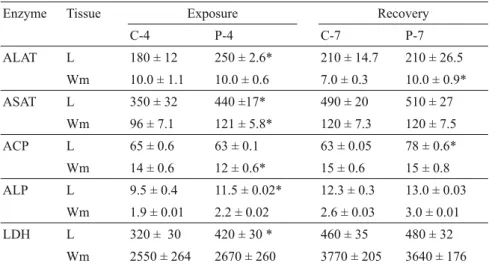
I. punctatus exposed to phenol did not exhibit any evident signs of poisoning. The metabolic profi le of I. punctatus depicted relevant tissular and plasmatic adjustments (Table I). All differences described in this section were statistical signifi cant. The liver glycogen stores enhanced after exposure, however, in white muscle it was not mobilized. The exposure to phenol caused a sinking of plasmatic
concentrations of amino acids, protein, free fatty acids (FFA), triacylglycerol (TAG) and lactate. After the post-exposure recovery period, plasma lactate concentration increased, while protein concentration decreased. The levels of glucose and TAG were fallen in the muscle after exposure, and pyruvate and protein just after the post-exposure recovery period. However, the levels of muscle ammonia and FFA were heightened, and this one was kept high even after post-exposure recovery period. The relevant changes in the liver were observed after the post-exposure recovery period. Except by decrease of the liver FFA levels after exposure, those of glucose and ammonia were increased after post-exposure recovery while the TAG level was dropped. The activities of the enzymes assayed depicted changes either after the exposure or the post-exposure recovery period (Table II). In the liver, the enzymatic activity of ALAT, ASAT, LDH and ALP were increased; ACP activity increased only after post-exposure recovery period. In white muscle, ACP activity was reduced after exposure. The activity of the ALAT was increased in white muscle after post-exposure recovery.
TABLE I
Concentration of metabolites in the Ictalurus punctatus exposed to sublethal concentration of phenol for 4 days (10% LC50) and post-exposure recovery for 7 days.
Metabolite Tissue Exposure Recovery
C-4 P-4 C-7 P-7
Glycogen (μ)
L 235.8 ± 12 274.4 ± 11* 53.4 ± 5.4 67.6 ± 6.2 Wm 8.4 ± 0.4 7.8 ± 0.05 14.0 ± 0.3 14.4 ± 0.2 Glucose (μ)
L 62.4 ± 1.3 66.2 ± 1.2 54.9 ± 1.2 59.1 ± 1.2* Wm 1.1 ± 0.05 0.9 ± 0.02* 1.2 ± 0.05 1.2 ± 0.03 P 2.3 ± 0.05 2.2 ± 0.1 1.5 ± 0.09 1.8 ± 0.2 Amino acids (μ)
L 36.8 ± 1.0 35.9 ± 0.6 44.0 ± 1.0 42.5 ± 1.3 Wm 8.8 ± 0.1 8.7 ± 0.3 14.2 ± 0.2 15.1 ± 0.5 P 5.3 ± 0.1 4.8 ± 0.05* 4.6 ± 0.1 4.5 ± 0.1 Ammonia (μ)
L 47.1 ± 2.5 50.9 ± 3.0 57.8 ± 2.1 78.5 ± 2.0* Wm 19.5 ± 0.6 21.0 ± 0.3* 17.2 ± 0.2 17.1 ± 0.3 P 1.4 ± 0.03 1.4 ± 0.03 2.5 ± 0.03 2.7 ± 0.1 FFA (μ)
--Metabolite Tissue Exposure Recovery
C-4 P-4 C-7 P-7
TAG (mg)
L 26.6 ± 0.08 25.0 ± 0.1 13.8 ± 1.1 7.3 ± 0.8* Wm 2.4 ± 0.1 2.0 ± 0.02* 1.1± 0.02 1.1 ± 0.02 P 2.5± 0.08 2.1 ± 0.05* 2.3 ± 0.05 2.3 ± 0.03 Pyruvate (μ)
L 0.7 ± 0.03 0.7 ± 0.03 0.9 ± 0.03 0.9 ± 0.03 Wm 0.7 ± 0.03 0.7 ± 0.03 0.7 ± 0.03 0.6 ± 0.01* P 0.30 ± 0.01 0.30 ± 0.005 0.24 ± 0.01 0.25 ± 0.005 Lactate (μ)
L 10.8 ± 0.5 10.3 ± 0.5 7.1 ± 0.6 6.1 ± 0.2 Wm 22.5 ± 0.8 23.6 ± 0.6 22.9 ± 0.4 21.3 ± 0.6 P 3.4 ± 0.2 2.8 ± 0.1* 3.0 ± 0.2 3.8 ± 0.1* Protein (mg)
L 65.5 ± 1.5 63.9 ± 1.6 65.5 ± 1.7 59.6 ± 2.6 Wm 19.7 ± 0.5 18.4 ± 0.7 15.6 ± 0.2 14.5 ± 0.3 * P 31.53 ± 0.9 27.89 ± 0.5 * 20.40 ± 1.1 15.16 ± 0.9* Metabolites concentrations are expressed in μmol (μ)
or mg (mg)
per g of tissueor per mL of plasma. C-4 control of exposure for 4 days; P-4 exposed for 4 days; C-7 control of recovery; P-7 recovered for 7days; L = liver; Wm = white muscle; P = plasma; FFA = free-fatty acids; TAG = triacylglycerol; Values are followed by mean ± SE (*) difference between the exposed group and the corresponding control is signifi cant at P<0.05 (n=12).
TABLE I (continuation)
TABLE II
Enzyme activities of aminotransferases, phosphatases and dehydrogenase in Ictalurus punctatus exposed to sublethal concentration of phenol for 4 days (10% of
LC50) and post-exposure recovery for 7 days.
Enzyme Tissue Exposure Recovery
C-4 P-4 C-7 P-7
ALAT L 180 ± 12 250 ± 2.6* 210 ± 14.7 210 ± 26.5
Wm 10.0 ± 1.1 10.0 ± 0.6 7.0 ± 0.3 10.0 ± 0.9*
ASAT L 350 ± 32 440 ±17* 490 ± 20 510 ± 27
Wm 96 ± 7.1 121 ± 5.8* 120 ± 7.3 120 ± 7.5
ACP L 65 ± 0.6 63 ± 0.1 63 ± 0.05 78 ± 0.6*
Wm 14 ± 0.6 12 ± 0.6* 15 ± 0.6 15 ± 0.8
ALP L 9.5 ± 0.4 11.5 ± 0.02* 12.3 ± 0.3 13.0 ± 0.03
Wm 1.9 ± 0.01 2.2 ± 0.02 2.6 ± 0.03 3.0 ± 0.01
LDH L 320 ± 30 420 ± 30 * 460 ± 35 480 ± 32
Wm 2550 ± 264 2670 ± 260 3770 ± 205 3640 ± 176 The specific activities of: ALAT (alanine aminotransferase), ASAT (aspartate aminotransferase), ACP (acid phosphatase), ALP (alkaline phosphatase) and LDH (lactate dehydrogenase) are expressed in mIU (mg of protein)-1
DISCUSSION
The intermediary metabolism of I. punctatus was
altered due to phenol exposure. A switch from anabolic to catabolic processes is commonly observed in stressed fi sh. It involves major changes in intermediary metabolism and may have important consequences for somatic growth (Pickering and Pottinger 1995). The energy demanded to cope with poisoning was clearly observed in white muscle of
I. punctatus. Increase in the glycolytic activity in white muscle of I. punctatus could be inferred by the presence of less glucose. This seems to be a general response of fi sh exposed to phenol (Hori et al. 2006, Abdel-Hameid 2007), and such decrease was to attend energetic expenditures caused by phenol. In this particular, a glycogen synthesis, to justify the glucose decrease, was not carried out since no glycogen increase was observed in the white muscle. It is expected over the muscular fermentative processes an increase of lactate concentration and LDH activity. Then, invariable activity of LDH enzyme and steady concentrations of lactate suggest that glucose oxidation has been the metabolic preference of I. punctatus. Although glycogen can provide the immediate energy requirements of fi sh under stress (Fernández-Vega et al. 2015), it was observed the maintenance of the glycogen bulks in the muscle of I. punctatus,
as also reported to O.mossambicus (Dangé 1986a)
and B. amazonicus (Hori et al. 2006) exposed to phenol. This metabolic scenario points out an exogenous source of glucose to the white muscle of
I. punctatus. Therefore, the metabolic preference of white muscle in I. punctatus seemed to be oxidative, in which glucose was certainly fundamental to the mitochondrial metabolic pathways, and lipid catabolism.
High level of fat catabolism have decreased the triacylglycerol stores (17%) followed by an
increase of FFA in white muscle of I. punctatus.
Lipids are the major energy reserves in fi sh and
their mobilization suggest high energy demands state (Fernández-Vega et al. 2015). Catabolism of such amount of lipid in I. punctatus refl ects a higher demand for ATP as a consequence of elevated stress and detoxifi cation process. Lipid catabolism
is also observed in O. mossambicus exposed to
phenol for 30 days (Sannadurgappa et al. 2007). However, not only glucose and lipids were required to cope with phenol poisoning. The increase in
the white muscle ammonia in I. punctatus was
a consequence of an increase in the amino acids catabolism. The activity increase of white muscle ASAT corroborates such assumption since this enzyme provides oxaloacetate to the oxidative metabolism. In spite of the amino acids steady-state, which is usual among tissues (Houlihan et
al. 1995), the plasma amino acids decreased in I.
punctatus. Decrease of plasma amino acids and increase of ammonia in the muscle indicate amino acids catabolism in the muscle. Alterations on muscle protein metabolism is clearly reported in catfi sh Rhamdia quelen exposed to cadmium for 7 days, whereas protein concentration decreased, and amino acids and ammonia concentrations increased (Pretto et al. 2014).
The exposure to phenol was likely effective
in expending metabolic energy to detoxifi cation
processes in the liver. The increase of liver glycogen
in fi sh exposed to phenol demands glucose input.
Considering that fi sh were kept starved the only
source of glucose backbones should be amino
acids. In I. punctatus, constant levels of liver
glucose and decrease of plasma amino acids are suggestive that gluconeogenesis has occurred from free amino acids supplied by peripheral tissues. This assumption is strengthened by the increase of hepatic ALAT and ASAT. Such increases of ALAT
and ASAT are usual biomarkers in fi sh exposed
acid due to increase of energy demand imposed by stressing conditions (Begum 2004). The oxaloacetic acid and α-ketoglutarate might have been channeled into the Krebs’s cycle, as proposed to C. batrachus
exposed to carbofuran, which presents ALAT and ASAT induction in the liver (Begum 2004). The
increase of hepatic LDH of I. punctatus would
also support gluconeogenesis from lactate in the liver cells, as reported in Brycon amazonicus and
Oreochromis aureus exposed to phenol (Abdel-Hameid 2007, Hori et al 2006). Increased hepatic
LDH and ALAT activity are also reported to O.
mossambicus exposed to 10% LC50 of phenol (Varadarajan et al. 2014). The rise in muscular
ALAT activity of Cyprinus carpio exposed to
4-tert-butylphenol suggests amino acid catabolism to support the hepatic gluconeogenesis (Barse et
al. 2006). Therefore, glucose synthesized de novo
in the liver of I. punctatus should be responsible for maintaining the ob served normoglycemia, and th is profile was enhanced in the post-exposure recovery period. Normoglycemia accompanied by hepatic gluconeogenesis is also reported in silver catfi sh Rhamdia quelen exposed to cadmium for 7 days (Pretto et al. 2014). Significant addition
of metabolic energy was required to I. punctatus
carried out phenol detoxification processes, which resorted to lipid catabolism in the liver to supply such demand. This explains the remarkable decrease (31%) of the liver content of FFA.
In the course of the post-exposure recovery pe-riod, the biochemical alterations were exacerbated.
The teleost Piaractus mesopotamicus exposed to
10% LC50 of trichlorfon also presented metabolic alterations over the post-exposure recovery period (Venturini et al. 2015). In I. punctatus, reduction in the muscle protein content was observed, indicating that proteolysis was necessary in the recovery period. R. quelen recovered for 7 days to cadmium exposure also presented muscle proteolysis (Pretto et al. 2014). Decrease of pyruvate concentration and increase of ALAT activity in the white muscle
are suggestive that alanine was synthesized and likely exported to the liver, performing the alanine cycle. The increased glucose concentration in the liver of I. punctatus indicates that rate of liver gluconeogenesis was maintained, and this fact was provided by amino acids backbones. Increased liver ammonia of I. punctatus indicates catabolism of amino acids, as also reported to the catfi shes
Clarias batrachus and R. quelen after post-exposure recovery of carbofuran and cadmium, respectively (Begum 2004, Pretto et al. 2014). High rates of fat catabolism were active in liver of I. punctatus and it is resulted from the remarkable decrease (58%) of liver TGA. Thus, depletion of energy stores, such as muscular proteolysis and hepatic lipolysis, was observed at the end of the recovery post-exposure period in the I. punctatus, indicating metabolic high
cost of compensatory responses of stressed fi sh,
as early proposed to Anguilla anguilla exposed to propanil (Fernández-Vega et al. 2015).
Proteolytic activities can be resultant from catabolic processes induced by higher metabolic demand and cleaning of dead cells or components of the poisoned cells. Consequently, increase of hydrolytic enzymes from lysosomes, such as ACP, or bounded to cell membrane, such as ALP, can be observed in plasma. Structural damages fol-lowed by leaking of cell components reduce the content of enzymes in poisoned cells. Hepatocytes
of rainbow trout Oncorhynchus mykiss exposed to
alkyphenols for 96 hours lost the cell membrane integrity (Tollefsen et al. 2007). The increase of plasmatic ALP and ACP reported in the African catfi sh Clarias gariepinus exposed to the phenyl derivative λ-cyhalohtrin and in the O. mossambicus
exposed to phenol is attributed to a leakage of hep-atic of enzymes into the blood (Okechukwu and
Auta 2007, Varadarajan et al. 2014). The profi le
of phosphatases activity observed in I. punctatus
metabolic processes of detoxifi cation, as already reported to C. carpio exposed to terc-buthylphenol (Barse et al. 2006).
In summary, the results indicate that I. puncta-tus is adversely affected by sublethal concentration of phenol. The increased rates of carbohydrates, proteins and fat oxidation were to at tend the meta-bolic demand, resultant from stress and detoxifi -cation processes. This fact is usually accepted in
other fi shes exposed to a number of xenobiotics
(Scott and Sloman 2004, Fernández-Vega et al. 2015). Since a long time, the preference for other fuels rather than carbohydrates is widely accepted in fi shes (Thi llart and Raaij 1995). I. punctatus pre-sented a catabolic preference for lipids to cope with phenol exposure in the liver. Proteins were hydro-lyzed in white muscle as a secondary metabolic source of energy. The energy level expended by
I. punctatus exposed to sublethal concentration of phenol was signifi cant enough to bring attention to the resultant biological consequences. Even after post-exposure recovery period, metabolic altera-tions were maintained, indicating that
compensa-tion or adaptacompensa-tion was not achieved by I.
puncta-tus. The injuries caused by sublethal concentration of phenol could have ecological implications. The metabolic losses due to phenol contamination can be refl ected in impairments on growth, disease re-sistance and reproduction.
ACKNOWLEDGMENTS
The authors are thankful to the Department of Ge-netic and Evolution, colleagues of the Laboratory of Adaptive Biochemistry at the Federal University of Sao Carlos for facilities and technical assistance. In particular, we would like to acknowledge the assistance of Antônio D. Silva by supporting
ex-periments in vivo. We also thank to Coordenação
de Aperfeiçoamento de Pessoal de Nível Superior (CAPES) and Conselho Nacional de Desenvolvim-ento Científi co e Tecnológico (CNPq) for fi nancial support.
RESUMO
Os ajustes metabólicos foram estudados em bagre do canal Ictalurus punctatus exposto a 1.5 mg L-1
de fenol (10% da CL50) por quatro dias e após recuperação por sete dias. Redução da concentração de triacilglicerol e aumento de ácidos graxos livres no músculo são indicativos de catabolismo de lipídeos. Redução de ácidos graxos livres (-31%) no fígado também indica catabolismo de lipídeos. Aumento da concentração de amônia e da atividade da aspartato aminotransferase (ASAT) no músculo, e a redução na concentração plasmática de aminoácidos sugerem aumento na captação muscular de aminoácidos. Níveis constantes de glicose e o aumento da reserva hepática de glicogênio, associados a baixos níveis de aminoácidos no plasma, indicam gliconeogênese a partir de aminoácidos. Este fato é respaldado pelo aumento de ALAT e ASAT. A indução da LDH hepática acompanhada da redução de lactato plasmático podem indicar que o lactato plasmático foi também utilizado como substrato para a gliconeogênese. As alterações bioquímicas foram exacerbadas após o período de recuperação. Reduções no conteúdo de proteína muscular e plasmática indicam proteólise. O aumento do catabolismo lipídico no fígado foi resultado de uma expressiva redução da concentração hepática de TGA (-58%). Uma preferência catabólica por lipídeos foi observada na tentativa de suprir a elevada demanda energética. Este estudo é o primeiro a abordar o perfi l metabólico de I. punctatus frente à exposição ao fenol e sua capacidade de recuperação, trazendo a atenção para as consequências biológicas da contaminação ambiental.
Palavras-chave: ajustes metabólicos, enzimas, reservas de lipídeos, metabolismo intermediário, recuperação, xenobiótico.
REFERENCES
ABDEL-HAMEID NAH. 2007. Physiological and histopatho-logical alterations induced by phenol exposure in Oreo-chromis aureus juvenile s. Turk J Fish Aqua Sci 7: 131-138. AGUIAR LH, MORAES G, AVILEZ IM, ALTRAN AE AND
CORRÊA CF. 2004. Metabolic al effects of Folidol 600 on the neotropical freshwater fish matrinxa, Brycon cephalus. Environ Res 95: 224-230.
Brycon amazonicus (Teleostei; Characidae). Comp Biochem Phys C 148: 136-142.
BARSE AV, CHAKRABARTI T, GHOSH TK, PAL AK AND
JADHAO SB. 2006. One-tenth dose of CL50 of 4-tert-butyl-phenol causes endocrine disruption and metabolic changes in Cyprinus carpio. Pestic Biochem Phys 86: 172-179. BEGUM G. 2004. Carbofuran insecticide induced biochemical
alteration in liver and muscle tissues of the fish Clarias ba-tr achus and recovery response. Aquat Toxicol 66: 83-92. BERGMEYER HU. 1986. Methods of enzymatic analysis, 3rd
ed., Deerfield Beach: VCH.
BERGMEYER HU, SCHEIBE P AND WAHLEFELD AW. 1978. Optimization of methods for aspartate aminotransferase and alanine aminotransferase. Clin Chem 24(1): 58-73 . BIDINOTTO PM, MORAES G AND SOUZA RHS. 1997. Hepatic
glycogen and glucose in eight tropical fresh water teleost fish: a procedure for field determinatio ns of micro samples. Boletim Técnico CEPTA 10: 53-60.
BOLOGNESI C, PERRONE E, ROGGIERI P, PAMPANIN DM AND
SCIUTTO A. 2006. Assessment of micronuclei induction in peripheral erythrocytes of fish to xenobiotics under controlled conditions. Aquat Toxicol 78: 93-98.
BRASIL. 2005. Ministério do Meio Ambiente. Conselho Nacional do Meio Ambiente - CONAMA. Portaria n. 357, de 17 de março 2005. Diário Oficial [da] República Federativa do Brasil. Poder Executivo, Brasília, DF. CETESB - COMPANHIA AMBIENTALDO ESTADO DE SÃO
PAULO. 2014a. Águas superficiais, Variáveis de qualidade de água. Acessed 13/10/14. http://www.cetesb.sp.gov.br/ agua/aguas-superficiais/34-variaveis-de-qualidade-das-aguas---old.
CETESB - COMPANHIA AMBIENTALDO ESTADO DE SÃO
PAULO. 2014b. Qualidade das águas superficiais no estado de São Paulo 2013 [recurso eletrônico] / CETESB. - São Paulo: CETESB, 2014, 434 p. (Série Relatórios / CETESB, ISSN 0103-4103). Acessed 27/04/15. http://www.cetesb. sp.gov.br/agua/aguas-superficiais/35-publicacoes-/-relatorios>.
COPLEY NG. 1941. Alloxan and ninhydrin test. Analyst 66: 492-493.
DANGÉ AD. 1986a. Changes in carbohydrate metabolism in tilapia, Oreochromis (Sarotherodon) mossambicus, during short-term exposure different types of pollutants. Environ Pollut A 41: 165-177.
DANGÉ AD. 1986b. Metabolic effect of naphthalene, toluene or phenol intoxication in the cichlid fish, Oreochromis mossambicus: changes in aminotransferase activities. Environ Pollut A 42: 311-323.
DUBOIS M, GILLES KA, HAMILTON JK, ROBERTS PA AND
SMITH F. 1956. Colorimetric method for determination of sugars and related substances. Anal Chem 28: 350-358. FAO - FOODAND AGRICULTURE ORGAN IZATIONOFTHE
UNITED NATIONS. 2015. Cultured Aquatic Species
Information Programme. Ictalurus punctatus. Cultured Aquatic Species Information Programme. Stickney, R.R. In: FAOFisheries and Aquaculture Department [online]. Rome. Updated 1 January 2004. [Cited 24 April 2015]. http://www.fao.org/fishery/culturedspecies/Ictalurus_ punctatus/en.
FERNÁNDEZ-VEGA C, SANCHO E AND FERRANDO MD. 2015. Energy reserves mobilization in the yellow eel as herbicide exposure effect. Chemosphere 135: 94-100. GENTZKOW CJ AND MASEN JM. 1942. An accurate method
for the determination of blood urea nitrogen by direct nesslerization. J Biol Chem 143: 531-544.
GUPTA PK, MU JUMDAR VS, RAO OS AND DURVE VS. 1982. Toxicity of Phenol, Pentachlorophenol and Sodium Pentachlorophenolate to a Freshwater Teleost Lebistes reticulatus (Peters). Acta hydroch hydrob 10(2): 177-181. GUPTA S, DALELA RC AND SAXENA PK. 1983. Effect of
phenolic compounds on in vivo activity of transaminases in certain tissues of the fish Notopterus notopterus. Environ Res 32: 8-13.
HARROWER JR AND BROWN CH. 1972. Blood lactic acid. A micromethod adaptes to field collection of microliter samples. J Appl Physiol 32: 224-228.
HOCHACHKA PW, GUPPY M, GUDERLY HE, STOREY KB AND
HULBERT WC. 1978. Metabolic biochemistry of water vs air breathing fishes: muscle enzymes and ultrastructure. Can J Zoo 56: 736-750.
HORI TSF, AVI LEZ IM, INOUE LK AND MORAES G. 2006. Metabolical changes induced by chronic phenol exposure in matrinxã Brycon amazonicus (teleostei: characidae) juveniles. Comp Biochem Physiol C 143: 67-72.
HOULIHAN DF, CARTER CG AND MCCARTHY ID. 1995. Protein synthesis in fish. In: Hochachka PW and Mommsen TP (Eds), Biochemistry and molecular biology of fishes,
vol 4, Amsterdam, BV: Elsevier Science, p. 191-220. IBRAHEM MD. 2012. Experimental exposure of African catfish
Clarias gariepinus (Burchell, 1822) to phenol: clinical evaluation, tissue alterations and residue assessment. J Adv Res 3: 177-183.
INOUE LAKA, SANTOS-NETO C AND MORAES G. 2003. Clove oil as anaesthetic for juveniles of matrinxã Brycon amazonicus (Gunther, 1869). Ciênc Rural 33: 943-947. KRUGER NJ. 1994. T he Bradford method for protein
quantification. In: Walker JM (Ed),Methods in Molecular Biology, vol 32, Totowa: Humana Press Inc, p . 15-21. KUMAR V AND MUKHERJEE D. 1988. Phenol and sulfide
induced changes in the ovary and liver of sexually maturing common carp, Cyprinus c arpio. Aquat Toxicol 13: 53-60. LU GD. 1939. The metabolism of piruvic acid in normal and
vitamin B-deficient state: I. A rapid specific and sensitive method for the estimation o f blood pyruvate. Biochem J 33: 249-254.
MOENS LN, SMOLDERS R, VAN DER VEN K, VAN
Effluent impact assess ment using microarray-based analyses in common carp: A systems toxicology approach. Chemosphere 67: 2293-2304.
MORAES FD, FIGUEIREDO JSL, ROSSI P, VENTURINI FP AND
MORAES G. 2015. Acute toxicity and sublethal effects of phenol on hematological parameters of channel catfish
Ictalurus punctatus and pacu Piaractus mesopotamicus. Ecotoxicol Environ Contam 10(1): 31-36.
NOVÁK M. 1965. Colorimetric ultramicro method for the determination of free fatty acids. J Lipid Res 6: 431-433. OKECHUKWU EO AND AUTA J. 2007. The e ffects of
sub-lethal doses of Lambda-cyhalothrin on some biochemical characteristics of the African catfish Clarias gariepinus. J Biol Sci 7: 1473-1477.
OOST R, BEYER J AND VERMEULEN NPE. 2003. Fish bioac-cumulation and biomarkers in environmental risk assess-ment: a review. Environ Toxicol Phar 13: 57-149.
PICKERING AD AND POTTINGER TG. 1995. Biochemical effects of stress. In: Hochachka PW and Mommsen TP (Eds), Biochemistry and molecular biology of fishes vol 5, Elsevier Science B.V, p. 349-379.
PORTO LCS AND ETHUR EM. 2009. Elementos traço na água e em vísceras de peixes da Bacia Hidrográfica Butuí-Icamaquã, Rio Grande do Sul, Brasil. Cienc Rural, Santa Maria 39(9): 2512-2518.
POSSA RD, ALVES MDS, COLONETI L, CORDEIRO R AND
RODRIGUES MR. 2008. Estimativa da qualidade de água do Rio Barro Preto utilizando os parâmetros fenóis, DQO e DBO. Synergismus scyentifica UTFPR, Pato Branco 03(4).
PRETTO A, LORO VR, MORSCH VM, MORAES BS, MENEZES
C, SANTI A AND TONI C. 2014. Alterations in carbohydrate and protein metabolism in silver catfish (Rhamdia quelen) exposed to cadmium. Ecotox Environ Saf 100: 188-192. ROCHE H AND BOGÉ G. 2000. In vivo effects of phenolic
compounds on blood parameters of a marine fish ( Dicen-trarchus labrax). Comp Biochem Phys C 125: 345-353. SAHA NC, BH UNIA F AND KAVIRAJ A. 1999. Toxicity of
phe-nol to fish and aquatic ecosystems. B Environ Contam Tox 63: 195-202.
SANCHO E, FERNÁNDEZ-VEGA C, ANDREU E AND
FERRANDO MD. 2009. Effects of propanil on the European eel Anguilla anguilla and post-exposure recovery using selected biomarkers as effect criteria. Ecotox Environ Safe 72: 704-713.
SANNADURGAPPA D, RAVINDRANATH NH AND ALADAKATTI
RH. 2007. Toxicity, bioaccumulation and metabolism of phenol in the freshwater fish. J Bas Clin Physiol Pharmacol 18: 65-77.
SCHLENK D, HANDY R, STEINERT S , DEPLEDGE MH AND
BENSON W. 2008. Biomarkers. In: Di Giulio RT and Hinton DE (Eds), The Toxicology of Fishes, Boca Raton, FL: CRC Press, p. 683-731.
SCOTT GR AND SLOMAN KA. 2004. The effects of environ-mental pollutants on complex fish behavior: integrating behavioral and physiological indicators of toxicity. Aquat Toxicol 68: 369-392.
STEIN EA AND MYERS GL. 1995. National Cholesterol Edu-cation Program recommendations for triglyceride mea-surement: executive summary. Clin Chem41: 1421-1426. THILLART G AND RAAIJ M. 1995. Endogenous fuels; non-invasive versus non-invasive approaches, In: Hochachka PW and Mommsen TP (Eds), Biochemistry and molecular biology of fishes, vol 4. Elsevier Science B.V: Amsterdam, p. 191-220.
TOLLEFSEN KE, BLIKSTAD C, EIKVAR S, FINNE EF AND
GREGERSEN IK. 2007. Cytotoxicity of alkylphenols and alkylated non-phenolics in a primary culture of rainbow trout (Onchorhynchus mykiss) hepatocytes. Ecotox Environ Safe 69: 64-73.
TOUART LW. 1995. The federal insecticide, fungicide, and rodenticide act. In: Rand GM (Ed), Fundamentals of aquatic toxicology, 3rd
ed., Boca Raton, FL: CRC Press, p. 657-668.
TSUTSUI T, HAYASHI N, MAIZUMI H, HUFF J AND BARRET
JC. 1997. Benzene-, catechol-, hydroquinone- and phenol-induced cell transformation, gene mutations, chromosome aberrations, aneuploidy, sister chromatid exchanges and unscheduled DNA synthesis in Syrian hamster embryo cells. Mutat Res 373: 113-123.
VARADARAJAN R, SANKAR HSH, JOSE J AND PHILIP B. 2014. Sublethal effects of phenolic compounds on biochemical, histological and ionoregulatory parameters in a tropical teleost fish Oreochromis mossambicus (Peters). Int J Sci Res Pub 4(3): 1-12.
VENKATESWARA RAO J. 2006. Sublethal effects of an organophosphorus insecticide (RPR-II) on biochemical parameters of tilapia, Oreochromis mossambicus. Comp Biochem Physiol C 143: 492-498.
VENTURINI FP, MORAES FD, CORTELLA LRX, ROSSI PA, CRUZ C AND MORAES G. 2015. Metabolic effects of trichlorfon (Masoten®
) on the neotropical freshwater fish pacu (Piaractus mesopotamicus). Fish Physiol Biochem 41: 299-309.
WATTHIER EK, DIAS CA, LOSS E, RODRIGUES MB AND
MOREIRA J. 2008. Caracterização e avaliação do índice de qualidade da água da jusante do rio Ligeiro - Pato Branco – PR. Synergismus scyentifica UTFPR, Pato Branco 03(4). YIN D, GU Y, LI Y, WANG X AND ZHAO Q. 2006. Pentachlo-rophenol treatment in vivo elevates point mutation rate in zebrafish p53 gene. Mutat Res 609(1): 92-101.