Quantifying the Artistic Experience with
Perceptive Sketching Tools: Cognitive
Technologies to Support Creativity Researchers
Nicholas Davis & Ellen Yi-Luen Do
Georgia Institute of Technology, EUA [email protected]; [email protected]
Abstract
Creativity research has gradually moved away from controlled laboratory settings to more naturalistic and real world domains. As a result, new research methods are required to systematically analyze the artistic experience that includes the artist’s perception, behavior, and conception throughout the creative process. We use research findings from the Cognitive Science literature to create a framework called Perceptual Logic to categorize different types of artistic experience. This framework is applicable to open-ended artistic creativity. Empiri-cally validating such a framework requires new tools that provide insight into the naturalistic creative process. We describe the initial design of a set of digital sketching tools that enables creativity researchers to quantitatively analyze the artistic experience. These tools focus spe-cifically on understanding how visual digital artists perceive and interact with their drawings and paintings throughout their creative process.
1. Introduction
This paper applies modern cognitive science concepts to provide a foundation for understanding artistic creativity. The situated, embodied, and distributed cognition theories in cognitive science emphasize the importance of examining human cognition as a system that arises through an individual’s interaction with the environment (Beer, 2010). This new approach is based on research showing how humans use affordances and constraints in the environment to guide action (Nersessian, 2005). Intelligent action emerges through interacting with and interpreting features of the environment. Further-more, the environment can be manipulated and restructured to distribute and transform the nature of cognitive processing (Hutchins, 1995a). Considered in this light, artistic creativity is a particularly interesting domain given its reliance on embodied reasoning processes occurring in real time. Art, like design, is a conversation with the materials with which individuals work (Schön, 1992). As goals and intentions evolve throughout the creative process, the way in which the visual features of a painting are perceived and the types of affordances and constraints they offer may evolve as well. However, current research methods and tools used in creativity research make it difficult to collect quan-titative data about the relationship between perception and action in artistic creativity (Mace & Ward, 2002).
There are generally four different methods of studying creativity that emphasize different components and define creativity in slightly different ways. One can either con-sider creativity as occurring in a person, a process, a product, or in the environment (Mayer, 1999). The type of traits that a creative person exhibits can be studied through
administering psychometric tests and questionnaires (Sternberg, 2006). These types of definitions result in a profile of the stereotypical creative person that includes personality traits, such as the ability to overcome obstacles, take risks, tolerate ambiguity, and gener-ate intrinsic motivation (Sternberg, 2006). The creative process can be studied through laboratory tests that involve isolated problem solving tasks that include idea generation, invention, and other creative tasks, such as those experiments performed by Finke et al. (Finke et al., 1992). Finke et al. developed a model of creative cognition called Geneplore that tried to identify the underlying cognitive mechanisms responsible for creativity. Geneplore includes two essential phases of creativity, namely generating ideas and ex-ploring those ideas in more depth (Finke et al., 1992). One can also study the product of creativity and evaluate that product based on it novelty, value, and unexpectedness (Ma-her, 2010); (Sternberg, 2006). And finally, one can take a systems perspective to analyze how the environment and society shape the creative process (Csikszentmihalyi, 1999).
Creativity researchers are now advocating a move away from the laboratory setting and into real world situations where individuals are engaged in creative activities (Li, 1997); (Mace & Ward, 2002); (Nersessian, 2002). Researchers that advocate this meth-od explain that laboratory settings are too artificial and do not capture the richness of real world creative practices (Li, 1997); (Mace & Ward, 2002); (Nersessian, 2008). Creativity fieldwork uses a plurality of ethnographic data collection methods such as interview, observation, artifact analysis, and think out loud protocols to triangulate the cognitive processes and mechanisms involved in the creative process. Naturalistic data informs researchers about the situated nature of creativity and how real world constraints affect the creative process. One of the critical drawbacks of this approach is that it relies heav-ily on self-report, retrospective data, and inherently subjective qualitative data analysis (Mace & Ward, 2002). Although qualitative data analysis provides a unique and valuable contribution to creativity research, investigators cite the inherent subjectivity in both data collection and analysis as a known limitation and important research area in the field (Mace & Ward, 2002).
There are many models of creativity in Cognitive Science. These models rely on a variety of methods including computational modeling (Leclerc, 2004); (Newell, 1972); (Boden, 2004), ethnography (Mace & Ward, 2002); (Li, 1997); (Yokochi & Okada, 2005), cognitive neuroscience (Gabora, 2010); (Ostrofsky et al., 2011) and protocol analysis (Suwa & Tversky, 1997). Each approach has its merits. For example, computational mod-els have predictive and generative power and lead to creative machines that can solve practical problems, but the inherent assumptions about cognition and lack of attention to real world data present real problems. Ethnography goes in the opposite direction and focuses exclusively on the specific situation, but data analysis introduces biases in coding and analyzing data that make generalization difficult. Cognitive neuroscience models, such as the Honing Theory (Gabora, 2010) are biologically plausible, but also require artificial psychological experiments and protocol analysis type studies to validate their tenants. And finally, protocol analysis provides a report of the artist’s conception of his or her process, but that may or may not reflect the actual cognitive processes. In fact,
it is an open question to what extent the artist is aware of his or her own process, and how this awareness facilitates creativity.
The question that motivates the current research program is how to develop a model of artistic creativity that has the sensitivity of qualitative analysis and the rigor and objectivity of quantitative analysis. The approach we will take is a type of data trian-gulation that includes data from perceptual processes, artistic behavior, and the artist’s conception of his/her artistic behaviors. Here, we mean perceptual processes to include eye movements as well as the manner of attending to the visual stimuli (i.e. narrowly or broadly focused on the visual stimuli). Artistic behaviors are the actions the artist takes in working on his or her artwork, such as the act of drawing lines (or the pause between those lines). These behaviors can be described quantitatively using characteristics such as the speed with which lines were drawn, where and when they were drawn, the ori-entation, and other physical attributes. And, finally, the artist’s conception of the work involves a reflective conceptual component that represents how the artist thinks about and feels about his or her work. The research tools we describe and subsequent models derived from them are based on visual artists working on digital drawing and painting.
Although the focus on digital drawing and painting is necessarily narrow, the real contribution of the current article is identifying a new area of inquiry in creativity research, namely artistic experience, and proposing a new method for empirically investigating this domain. We describe the design of two tools that we feel are capable of quantitative experiential analysis. Although researchers in the field may choose to change the exact implementation details, the basic premise behind the technology and the technical strat-egy employed represents a significant step forward in creativity research tools.
The research method we propose builds upon design based research methods em-ployed in the field of Creativity Support Tools (CST) (Barab, 2004). Since CSTs are de-signed to facilitate creativity, they systematically intervene in the creative process in order to change or improve the process in some way (Schneiderman, 2007). If the intervention has the desired effect, support is provided for the guiding theory. CSTs are usually digital tools that have the capability to track all behavior within the program, which opens up a new data stream for analysts to observe detailed historical data and draw the type of con-clusions required to empirically test theories of creativity. Viewing creativity support tools through this lens creates a new brand of tools called Creativity Research Support Tools, which intentionally intervene in the creative process in some manner to inform and in-vestigate models of creativity rather than specifically support creativity. In subsequent sections we describe how a certain genre of Creativity Research Support Tools called Per-ceptive Sketching Tools have the potentially to enable quantitative experiential analysis. We begin the remainder of the article by synthesizing research on creative cognition to develop the basic tenets of a theoretical framework for describing artistic experience called Perceptual Logic. Next, we examine how this framework can potentially extend and inform the concepts it uses from Cognitive Science. This framework introduces a need for empirical validation, which is then addressed through the description of research methods and tools for quantitative experiential analysis.
2 Creative Cognition
There are various strands of creativity research that propose two ways of seeing and interpreting the world. Our analysis of artistic creativity draws heavily on this notion and proposes an experiential dimension between the interrelation of perception and concep-tion. A similar line of thinking has been developed in our work that used these theoretical conjectures to develop a program designed to learn artistic style and use that style to participate in computational collaborative art (Davis et al., 2011).
2.1 Perceptual Modes
Design creativity and sketching research has observed a perceptual spectrum rang-ing from what is termed seerang-ing-as to what has been called seerang-ing-that (Goldschmidt, 1991). Seeing-as refers to interpreting a set of lines on the page as a figure that is only present in the imagination, and using the sketch as a form of interactive imagery or sketch-thinking to explore that mental figure (Goldschmidt, 1991). Seeing-that describes a situation in which a designer uses the visual features of a drawing to make structural inferences that pertain to reality, such as the function of a door and the implications of its size relative to the room. Suwa & Tversky build upon this seeing-as/seeing-that dis-tinction when they studied the way in which architects perceive and interpret sketches (Suwa & Tversky, 1997). They found that expert architects were better at reading a sketch, which means that they were able to surmise a greater amount of functional details based on visual information. Reading off non-visual elements from perceptual qualities corre-sponds to seeing-that a relationship exists between the visual properties of a sketch and the functional properties of that element in reality. The second major finding was that expert architects employ a recognizable attention shifting strategy in which they work on one area in depth, generating a wealth of non-visual interpretation, and then shift their focus to another region of the drawing (Suwa & Tversky, 1997). When a shift in attention occurs, there is a spike in the generation of non-visual information.
Architects acquire a visual lexicon of geometric shapes and develop a form-function association that provides insight as to the purpose and meaning those shapes can have in physical reality, which represents the seeing-that form of perception (Suwa & Tversky, 1997). Sketches can also be re-interpreted from a conceptual point of view to see visual elements as some other entity, such as the mood of a space, the flow of an imagined crow, or an architectural theme. Thus, we can conclude that at the very minimum, there are two modes of perception, which can be described as focusing on either the visual or conceptual components of a sketch, and this focus influences how that sketch will be perceived.
2.2 Cognitive Modes
There is a large body of creativity research that proposes two cognitive modes that constitute creative cognition. These modes have been called convergent and divergent thinking (Guilford, 1962), vertical and horizontal thinking or transformations (Goel, 1995; Suwa & Tversky, 1997), explorative and generative (Finke et al., 1992), and analytic and associative (Gabora, 2010). All of these terms describe thinking as deep and focused in
one domain or broad and shallowly focus on many domains, respectively. Gabora makes an important contribution to this discussion by taking a neuroscience perspective and looking at these cognitive modes in terms of how they are accessing memory. She uses terminology from neural networks to describe the neuronal activation patterns of these different modes of cognition and the implication this has for creativity (Gabora, 2010). The degree to which one focuses on a particular topic or task increases the spikiness of the memory activation function, meaning that more detailed information related to the task at hand will be retrieved, such as causal and procedural information. Conversely, when attention is defocused, there is a flat activation function, meaning that many dis-parate domains will be considered, possibly increasing happenstance or serendipitous combinations that lead to creative solutions to problems.
Gabora’s Honing Theory of Creativity describes the creative process as an oscil-lation between focused analytic thought and defocused associative thought (Gabora, 2010). Defocused thought provides novel but possibly impractical suggestions which are honed and refined through analytic reasoning and applications. This neurobiological theory of creativity utilizes a connectionist neural network notion of memory activation whose constraints differs in each cognitive mode. The constraints of this type of neural network correspond to the degree of similarity an item must share with what is consid-ered the memory probe. The memory probe is the particular piece of information that is being used to query memory, such as a relevant component of a problem. The items that are remembered during a recall procedure are those that meet the threshold based on the initial constraints of the recall activity, i.e. they are similar enough to the memory probe. In the associative mode of cognition, the constraints placed upon the network relative to the memory probe are loose, which creates a shallow memory activation pat-tern that activates superficial features of many related domains. Conversely, in the ana-lytic mode of cognition, the constraints placed on the network are tighter, which results in a more focused activation in one domain that includes detailed information such as the logical and causal relations of items in that domain.
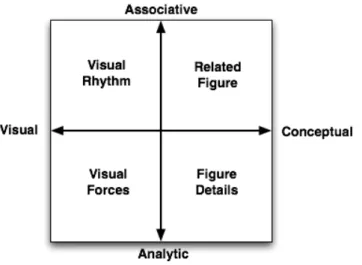
Synthesizing this diverse range of creativity research demonstrates a growing con-sensus in the field that there are two modes of perception and cognition. The two modes of perception are referred to as seeing-as and seeing that. Seeing as is more imaginative and conceptual. It could be described as an efferent type of perception where the content of the mind is used as a template through which external stimuli are interpreted. On the other end of the spectrum is seeing-that, which is more afferent and based in the visual forms of the world activating some meaning in the mind. The cognitive modes are analytic (deep focused activation) and associative (broad de-focused activation). We have combined these two modes of perception and cognition to construct the Axes of Perceptual Logic as the basis of our framework for describing the conscious coordination of perception and cognition (see Axes of Perceptual Logic in Figure 1).
Figure 1 shows how the modes of cognition and modes of perception combine to form what we refer to as the two Axes of Perceptual Logic. The horizontal axis corresponds
to the perceptual mode, which ranges from attending to the visual elements to consider-ing the environment conceptually. The vertical axis represents the cognitive modes that Gabora describes as associative and analytic, which describes a wide and broad activa-tion pattern versus a narrow and deep activaactiva-tion, respectively.
3 Object Affordances
Combining these two types of creativity theories suggests that creative cognition consists of ways of thinking about the world and ways of seeing the world, and both these continuums are closely connected to the body and knowledge of how to act in the world. The situated, embodied, dynamic (SED) framework in cognitive science has found that perception and conception are largely interrelated and mutually influential (Beer, 2010). Perception is not a passive reception of sense data, but rather an interpretation of the world in terms of one’s relation to it. The Axes of Perceptual Logic exemplify this distinc-tion because different locadistinc-tions on the axes correspond to different ways of perceiving the same stimuli. One’s experience of an object may vastly change based on the features one is attending to and the mode of cognition one is engaging in.
As Gibson put forth in his ecological approach to visual perception, objects in the world are perceived in terms of how they can be used and interacted with (Gibson, 1979). Gibson found that objects are perceived in terms of their affordances, or the way in which humans can manipulate and use that object. For Gibson, affordances were a fixed part of the world determined by the configuration of our body with relation to objects in the world. His theory had a large impact on the field of cognitive science because it solidified the link between perception and action that now plays a central role in recent cognitive theories. Norman took the notion of affordances and applied it to design and thought about how affordances change based on how people think about the tools they use (Nor-man, 1999). His main contribution to the idea of affordances was noting that they were dynamic based on one’s goals and intentions, which led him to come up with a new kind of affordance called a perceived affordance (Norman, 1999). Perceived affordances are those actions that the individual perceives to be possible regardless of whether they are, such as clicking a button on a computer screen. In reality, one can click anywhere on the screen. The real affordance (as Norman refers to it) of the screen is clicking anywhere, but the button helps the user perceive that clicking on a particular location has a value. Simi-larly, other design considerations can help the observer perceive that interacting with an object in a certain manner will have a certain effect. By combining additional informa-tion, such as conventions, previous knowledge, and one’s own experience interacting with similar items, one can deduce what the proper interaction is.
3.1 Mentally Simulating Affordances
Since they are affected by intention, we can surmise that perceived affordances have at least some component occurring in conscious thought. This note is important because here we wish to discuss the experiential aspect of object affordances that is under developed in the literature on affordances. We propose that one way to deduce a perceived affordance is through mentally simulating what would happen if one were to
interact with an object. The mental simulation draws upon prior knowledge and conven-tions to draw inferences. The content of this simulation can be very imaginative, but in general there will be a temporal element of the simulation because mentally animating actions happen in mentally simulated time, meaning that time is a requisite for mental simulation. Considering this element of time more deeply can bring us to a novel insight about the nature of affordances.
In a mental simulation, one either imagines potential interactions that will hap-pen in the future or previous interactions that haphap-pened in the past. Time has to be included, and these are the two temporal choices that exist. One can mentally animate a simulation with mental time that is devoid of this temporal contextualization, but it would be much more difficult to draw meaningful inferences from such a mental simu-lation. These two temporal directions yield significantly different inferences for the in-dividual performing the mental simulation. The first instance, where the future poten-tialities of the object are considered, falls under the category of Norman’s affordances (referred to as affordance for now on) because all actions that one can imagine doing with this object will occur in the future. Potential interactions are by their nature a fu-ture possibility. Conversely, and this is the novel addition to the theory of affordances, one can think about what happened for this object to be in the current state that it is, namely the history of an object. Leyton refers to this quality as the process history of an object (Leyton, 1992).
Leyton proposes that objects in the world are a memory store. He claims that the asymmetrical features of objects store information about causal forces in the world. For example, seeing a dent on a car inform you that a large object forcibly hit the car to cause that dent. Causal information can be extracted from the object, and it is therefore contained in it. What Leyton doesn’t consider, however, is that any object, regardless of its asymmetries contains a process history. Some may be more obvious than others due to their asymmetries and irregularities, but information can still be gleaned through mental simulation regardless of the form of the object. Asymmetries only acquire meaning if one knows what the symmetrical version looks like and works backwards from there. Without this knowledge there would be no comparison and therefore no baseline from which to deduce what kind of causal force was at play. With any object, though, one can mentally simulate a potential history that could justify why the object is in its current state. For example, one could surmise that a bike is parked next to the tree because its owner is somewhere nearby.
Summing this up, we have expanded upon the notion of object affordance and con-nected this theory with that of Leyton’s process history to come up with a holistic notion of object conceptualization that considers its potential future as well as its process his-tory. For the purpose of our analysis, these events are all happening consciously through mental simulation. That is not to say that it couldn’t happen unconsciously, but the hypothesis is that, at least initially, deducing affordances and process histories through mental simulations require conscious effort.
3.2 Temporal Dimension of Affordances
The theoretical conjecture here is that object affordances and process histories are really two sides of one perceptual system and should both be surmised under a more general term that corresponds to how we use perception to reason about the world. We therefore propose a new term to describe this perceptual system called perceptual logic. Perceptual logic is not like the logic defined by logical positivists for it is based on learned experience and linked to perception rather than the manipulation of symbols defined by formal rules. It can be informed by knowledge gathered through symbolic means, but it is primarily a function of perceptual experience.
One of the features of perceptual logic is its dynamism based on one’s current focus and intention. This intention can be based on a visual level or a conceptual level depending on what one is focusing on. In the car example, one may think about the dent in terms of what type of objects hit it, or one can think about the intention behind hitting it. We can think about the situation conceptually and surmise that it could have been an angry ex-girlfriend with a baseball bat. It is possible to abstract both types of information from objects in the world. One is more physical and based on the physical causal forces, and the other is conceptual and based on the intentional and social causal forces that may have caused the object to be in this particular state.
What implication does this have for art? By proposing that perceptual logic is large-ly a conscious effort to mentallarge-ly simulate interactions with an object (causative and po-tential), we are putting forth a notion that an object affordance can be something to be figured out and determined through perceptual problem solving. In that way, it may be the case that artworks present the artist with a perceptual logic puzzle for them to figure out. How is it such a puzzle is solved? The artist simulates both the process history of a certain segment of an artwork and also considers different potential actions that balance harmony in a region. The artistic decision that balances the greatest number or most important groups of perceptual logic will be selected.
3.3 Object Profiles
One question that arises is whether perceptual logic is the simulating ability, or the ability to judge affordances based on previous experience. The ability to populate a mental or physical simulation and also the skill to evaluate its plausibility are both impor-tant. In the process of becoming expert, one builds up object profiles that contain likely histories and futures based on situations one has previously encountered (Noë, 2004). For example, a pen no longer has to be thought about in order to operate it. The interac-tion is purely routinized because we are generally pen experts. It is for that reason that affordances seem to be an intrinsic part of objects in the world. In most cases, we have built up dense object profiles that provide us with automatic information about how to interact with them.
Heidegger’s notion of ready-to-hand versus present-at-hand is relevant in this dis-cussion (Ihde, 2003). Ready-to-hand means that one no longer consciously thinks about
how to interact with an object. A hammer, for example, fades into the background and the act of nailing becomes the focus. The hammer becomes an extension of the ‘body schema’ as Gallagher calls it (Gallagher, 1986). Conversely, if a problem arises, there is a breakdown and the tool becomes present-to-hand once again. There is a coherent object profile that is stable in the mind that guides interaction until a situation arises in which that profile has to be challenged. Problem solving requires challenging the stable repre-sentation of an object. A pen may be required to reach an object stuck in a small crevice for instance. In that case, the stable profile may actually be a hindrance and cause what psychologists refer to as functional fixedness, which is defined as the inability to look past an entrenched function for an object (Yonge, 1966).
Just as regular objects build up profiles, so too might certain types of lines or aes-thetic combinations for the artist. When s/he looks at a painting, certain choices may be obvious, sometimes painfully so, and may even seem to force themselves onto the artist. At other times, the artist is confronted with a choice, an open ended puzzle un-like one they have encountered before, and they must analyze the art piece and carefully consider each of the motivating factors that play a role in this decision. This situation can easily arise when contributions are made using a different perceptual logic. For ex-ample, if a figural element, such as a face is evaluated for its visual merits, such as the quality of its lines, it will face a different kind of scrutiny that can create a tension; this tension creates what we refer to as a perceptual logic puzzle. To solve these perceptual puzzles one simulates different kinds of interaction with the art piece. Simulations can be augmented through embodied movement that simulates the direction, flow, and ways in which visual forces are interacting to more thoroughly understand the problem and search for the solution.
3.4 Physical vs. Conceptual Affordances
In this discussion, we have proposed two categories of affordances, namely physi-cal affordances that deal specifiphysi-cally with the sensory data or shape of an object, and conceptual affordances that deal with the meaning of an object. Other researchers have proposed the term cognitive affordances and cultural conventions to describe affordanc-es that are more than purely structural. The difference between cognitive affordancaffordanc-es and the conceptual affordances we propose here is that conceptual affordances do not have to be learned or socially established (Norman, 1999). Conceptual affordances can be manually attributed or uncovered in real time by mentally simulating conceptual aspects of a situation consciously.
A few examples will help explicate the idea of conceptual affordances. One example comes from the domain of art, and the other example is taken from everyday activities. In art, one can consider a line independently of any object of which it is a part. The thick-ness, color, and direction can all be considered and each one of these features may afford some correction based on what kinds of lines the artist prefers. This will prompt some corrective measure, or possibly a response line to create a sense of local harmony be-tween these two lines. In addition, that line can be part of some larger figure, which may
have a deeper conceptual significance. For example, it may be an abstract representation of a face, or it could somehow signify an explosion, or any other guiding semantic theme that organizes artistic decisions. This conceptual guide can prompt one to place lines according to the basic idea for that figure without considering any of the physical and visual features of harmony at different granularities of the piece. Therefore, if the artist decides that s/he is beginning to see a face in the art piece, and subsequently decides to reinforce that notion of a face by putting an ear next to the face and a nose in the center, then these elements have been added without regard to the visual aesthetic balance of the piece. Rather they have been added to create a conceptual cohesion and thematic direction to the piece. From this point forward, the artist can consider these two different facets of the art piece, namely the purely visual and the conceptual, in order to simulate potential actions. Each different point of view has a slightly different set of perceptual logic that affords different artistic choices.
Let us now take the example of an individual interacting with a physical object like a stapler. At a basic level, s/he can consider how to physically interact with that object. Maybe she wants to staple a document, prop open a door, or hold up a wobbly desk. Based on the current intention, these different types of desires will be evaluated with respect to the physical dimensions and structural configurations of the stapler. versely, she can also change what the stapler means to her on a conceptual level. Con-sider the following scenario where a woman places her stapler on the corner of her desk and thinks to herself, “whenever I see that stapler on the corner of the desk, I should sit back and truly appreciate my place in the universe.” By attaching this new meaning and significance to the stapler in relation to her environment, she is changing its conceptual significance and therefore changing how she will perceive that object in the future. It is a conceptual affordance and this serves to organize her behavior. It is a conceptual mark that triggers a resulting thought in her mind. The human-stapler-desk corner becomes what Hutchins refers to as a distributed cognitive system (Hutchins, 1995b). The differ-ence between what we are proposing and what Hutchins described is that we are explicit-ly looking at one’s conscious experience with objects and the lived experience of mentalexplicit-ly simulating their future potentials and process histories in order to assign a significance and some kind of meaning to them. The meaning associated with the object can then go on to organize behavior as more traditional accounts of distributed cognition describe.
Figure 2 represents the temporal dimensions of perceptual logic that extend into the past to simulate process histories and forecast into the future as affordances. The two temporal dimensions can have distinct content based on the focus of attention, which results in different inferences from mental simulation. For the present analysis, we are considering conscious mental simulation, which means that the human agent is imagining some state of affairs that can potentially happen in the future or could have possibly happened in the past and then drawing inferences from that simulation.
By considering the temporal and cognitive dimension of mental simulations, we have identified four distinct yet related cognitive processes where before there were de-scribed as disjointed cognitive processes. The current theory unifies Leyton’s theory of
process histories with Gibson’s theory of conceptual affordances. The new theory of per-ceptual logic proposes four distinct cognitive skills that result from mental simulation:
Physical Process History: Mentally simulating a historical explanation for the physical form of an object. In-ferences deal with the physical causal forces that gave rise to the current state of affairs for a given ob-ject. An example would be looking at a dent and knowing that a blunt object hit the surface to cause it. Conceptual Process History: Mentally simulating a historical explanation for the meaning or significance
of an object. Inferences deal with social, cultural, or logical knowledge that help decipher meaning from an object. An example would be looking at money on a table and inferring that this particular money is repayment for a loan given to one’s roommate.
Physical Affordance: Mentally simulating a future interaction with an object that focuses on the physical form of an object. Inferences include the potential ways that one can interact with that object in the future, i.e. the classic notion of object affordances. An example would be looking at a hammer and thinking about it in terms of swinging it.
Conceptual Affordance: Mentally simulating a future interaction with an object that focuses on the meaning of an object. Inferences include the significance an object could have or its possible future meaning. An example would be tying a string around one’s finger and then assigning that string a specific significance like reminding one’s self to go to the store to buy bread.
Perceptual logic is a general framework for understanding how mental simulation influences the conceptualization of objects. It is particularly useful as a framework for ana-lyzing artistic experience because it neatly delineates different ways of seeing and thinking about objects that influence how one can potentially act on them. Although these conjec-tures are theoretically motivated by the cognitive science literature, they are not empirically founded. However, in developing the framework of perceptual logic, we have identified im-portant research questions about the nature of experience and how perception and mental simulation relate to action. These research questions require a new breed of methods and technologies to study them. Next, we will describe the preliminary design of two such tools that may enable quantitative experiential analysis in artistic creativity.
4 Perceptive Sketching Tools
The problem these technologies address is the inherent subjectivity in naturalistic artistic creativity research methods. Naturalistic methods are those methods that observe real creative processes rather than artificial laboratory experiments. Artistic creativity re-search, and creativity research in general, rely on qualitative data collection tools, such as ethnographic observation and self-reports. There are attempts to quantify some aspects of these empirical studies by coding video recordings of the creative activities, categorizing artistic behaviors, and also coding the self-report data (Yokochi & Okada, 2005). However, a large part of the experience of the artist, such as his or her perceptual and visual strate-gies, remains unexplored due to methodological limitations. Furthermore, coding proce-dures and self-reports introduce subjectivity in the analysis, not to mention the amount of resources video analysis and coding require (Mace & Ward, 2002).
4.1 Perceptive Sketch System Design
Perceptive Sketch is a digital drawing tool that collects data about the user’s artis-tic behavior and perceptual and visual strategies. It is named perceptive sketch for two
reasons. First, it is a perceptive piece of software in that in records and interprets visual input coming from the artist. Second, it objectively records the perceptual strategies that artists use in their sketches.
Perceptive Sketch provides approximate eye tracking data in a drawing program without the bulky and expensive hardware associated with eye tracking studies. Similar to ViewSer (Lagun & Agichtein, 2011), the program blurs out an entire image except for a circular window of clarity around the mouse. This window of clarity essentially functions like a simulated field of vision. In order to understand what the image is, the user must move the mouse around the image like shining a flashlight in a dark room (See Figure 3). Lugan et al. found that constraining vision in this way accurately approximated eye track-ing results (Lagun & Agichtein, 2011). It is true that hidtrack-ing the artist’s digital canvas in this manner may alter the creative process of the artist, but the tool creates a data source that is closer to naturalistic creativity than artificial, laboratory based experiments, and it enables quantiative experiential analysis.
In the Perceptive Sketch drawing program shown in Figure 3, there are three differ-ent perceptive modes available to the user: local, regional, and global. Holding down the right mouse button gradually increases the size of the visual field from the smallest (left image) that shows only local visual forms to the medium size visual field that displays regional relationships (middle image). Double right clicking temporarily dispels the filter revealing the global relationships of the image (right image). This interaction design enables Perceptive Sketch to collect traditional eye tracking data such as where and when a user is looking, and it also goes one step further to collect perceptual data about how users are looking at an artwork, such as local, regional, or global ways of perceiving the artwork. This provides perceptual and cognitive data about how users distribute their at-tention. For example, a small focused visual fields might mean that the artist is attending to fine grained details, a medium sized defocused visual field could signify that s/he is examining interactions between lines in the artwork, and if the blur filter is dispelled, we could infer that the artist is considering the overall conceptual theme of the image and figures that may have emerged in the artwork. By aggregating this data throughout the entire artistic creative process, the analyst will begin to be able to understand the rela-tionship between artistic behavior and perceptual patterns. Perceptive Sketch is both a data collection and data visualization tool. As such, there has to be methods for analysts to make sense of data. Figure 4 shows an example of how perceptual strategies can be visualized for an artist’s entire creative process.
In order to determine perceptual patterns, a visualization scheme needs to be in place to help detect patterns. For example, the left image shows an individual that is more focused on the global relationships of his/her drawing because more time is spent in the global mode. The figure on the right shows a more detail-oriented individ-ual because s/he spends more time perceiving local details. Additional cognitive infer-ences may be drawn from these perceptual patterns as well. For example, the image on the right shows an increase in the amount of time spent in in the global mode toward
the end of the creative process, which may indicate a process of reflection and evalua-tion that requires a global perspective of the artwork. The inferences we described are meant to be exemplary of the types of interpretations that might be available with these types of visualization.
In addition to perceptual patterns, Perceptive Sketch also collects data about artis-tic behavior, such as line length, position, speed, and orientation. Visualizing artisartis-tic be-havior data alongside perceptual data as shown in Figure 5 may also enable researchers to make novel discoveries about the creative process. The Behavioral Pattern aspect of the image represents the length of lines an artist drew throughout the creative process. Lines that cover more distance on the canvas will have a higher value on the y-axis, and lines that took longer to draw will have a larger width on the x-axis of time. Several cog-nitive insights can be gained through this visualization. For example, we can conclude that the short lines drawn at the end of the creative process were detail lines and finish-ing touches based on their size and the amount of time they took to complete. This is supported by the fact that the individual was primarily in the global mode of perception when they drew the lines. Comparing data sources like length, position, color, and shape in a similar manner as presented here will allow interesting analyses that investigate how perceptual patterns relate to creative behavior.
4.2 Supporting Creativity Researchers
Perceptive Sketching Tools offer techniques to offload several components of the cognitive processes in creativity research. The goal is not to replace the researcher, but rather to offload cognitive tasks that are more efficiently performed through computa-tional means. This frees up cognitive resources for the research to analyze and interpret the data rather than spending an inordinate amount of time collecting and coding data.
In this section, we will outline the cognitive mechanisms that perceptive sketch supports through the process of cognitive offloading. The first cognitive process that we will consider is the act of coding performed by the researcher. The process of cod-ing includes several procedures, such as recordcod-ing behavior, determincod-ing a codcod-ing scheme, and applying the coding scheme to recognize data points that fit a particular code. Perceptive Sketch provides methods to offload each of these processes in differ-ent ways. An example of the type of cognitive effort involved in coding artistic creativity research is described in Yokochi (Yokochi & Okada, 2005). In his analysis of the artistic creative process, he captured the artistic creative process through video camera and then coded each artistic behavior to analyze how the artist navigated around the can-vas throughout the creative process. Perceptive Sketch offers a solution to automati-cally accomplish this type of coding.
4.2.1 Pattern Recognition
Because it is a digital canvas, Perceptive Sketch can easily record artistic behavior in a database. It can also record data associated with each artistic behavior such as line length, location, time, speed, and pressure. These features can be used as metrics of the
coding scheme created by the researcher. The algorithms that analyze artistic behaviors have to be designed in such a way that they make meaningful categorizations of artistic contributions. Designing these algorithms is another way that researchers can offload part of their pattern recognition cognitive process. Computers are well equipped to ana-lyze large data sets and categorize them using a set of heuristics. Humans can perform this feat (on a reasonably constrained data set), but the task is tedious and requires a significant amount of cognitive resources. The uniquely human cognitive effort in the Perceptive Sketch system is defining the coding scheme. This entails deciding what as-pects are important to distinguish between different artistic contributions. Once the ana-lyst picks a coding scheme and encodes it into the Perceptive Sketch system, Perceptive Sketch can automatically code artistic behavior. The design decisions that underlie the coding algorithms crystallize the researchers conclusions about what features are impor-tant to consider when distinguishing categories of artistic behavior. At this stage in the design, the human is responsible for manually encoding these decisions. The system is not responsible for creating or understanding the coding scheme, but rather applying it to sort and code a large data set.
4.2.2 Information Visualization
Another way in which this system offloads cognition is the way in which data is presented to the researcher. Data will not be represented in its raw form, but rather visu-alized using information visualization techniques that make it easy for the researcher to spot patterns, trends, and other ways of interpreting the data. Visualizing artistic behav-ior and perceptual and visual strategies alongside each other can encourage researchers to explore the data and try to make sense of it. Rather than spending their time coding data, Perceptive Sketch transforms the cognitive task to one of exploration and discov-ery in order to interpret and make inferences about patterns and processes in artistic creativity.
4.3 Recording Creative Experience: CreatEx
Perceptive Sketch records the percept-action pairings of the artist, but the con-ceptual component of the artistic experience is not recorded. That task is left to another tool called CreatEx. CreatEx is designed to supplement Perceptive Sketch by encouraging the user to journal their process and share their conception of the artwork in a manner similar to a think out loud protocol. Additionally, the program takes periodic snapshots to capture the progress of the artwork. By aggregating images and explanations from different stages of the creative process, CreatEx constructs an interactive visualization depicting the creative trajectory of an artwork. The philosophy motivating this project is a conviction that the creative process is as much a part of the artwork as the final product. CreatEx introduces a new way to perceive and engage artworks through learning about the creative experience that an artist goes through in fabricating a work of art. CreatEx can be used as a reflexive tool for artists to reflect on their creative process as well as a tool to encourage and explain the creative process to non-artists. The prototype shown
in figures 4 & 5 show the rudimentary interaction design for CreatEx. The final version would include a data collection component that occurs alongside Perceptive Sketch and would allow the user to record text, images, videos, or other forms of media that he or she is considering as sources of inspiration at that point in the creative process. The final CreatEx would then depict a visualization of the artistic decisions, visual and perceptual strategies, and conceptual evolution of the art piece at various key points in time.
5 Conclusions
This paper applied concepts from the embodiment paradigm in cognitive science to lay the foundation for a framework to describe ways of seeing and thinking about the world called Perceptual Logic. This framework is based on the idea of affordances be-cause it describes ways humans perceive and interact with objects in the environment. However, it extends the idea of affordances because it considers how object conceptu-alization can include mentally simulating the process history of objects as well as their future interaction potential. Mental simulation introduces an experiential component of affordances that has gone largely unexplored in cognitive science. Applying this frame-work to artistic creativity, we showed that different categories of Perceptual Logic change the types of artistic contributions that are afforded as well as the metrics by which those contributions are evaluated.
By introducing this framework, we identified the need for new methods and technol-ogies to empirically investigate artistic experience. We have presented the basic design of a set of Perceptive Sketching Tools that record components of the artistic experience, such as perception, artistic actions, and the artist’s evolving conception of the artwork. Perceptive Sketching Tools are Creativity Research Support Tools meant to enable a new type of research method that we have termed quantitative experiential analysis. The need for quantitative experiential analysis has arisen because creativity research has gradually shifted away from the laboratory and into real world settings. This transition has enriched the depth and detail of creativity research, but it has also introduced a large amount of subjectivity in the research process. We feel that developing a systematic method for un-derstanding the experience of creators will push the field of creativity research forward.
References
Barab, S. (2004). Design-Based Research: Putting a Stake in the Ground Journal of the Learning Sciences, 13, 1-14. Journal of the Learning Sciences, 13(1), 1-14.
Beer, R. (2010). Dynamical systems and embedded cognition. In K. Frankish & W. Ramsey (Eds.), The
Boden, M. A. (2004). The Creative Mind. Journal of the American Art Therapy Association (Vol. 21, pp. 184-190). Abacus.
Csikszentmihalyi, M. (1999). Society, culture, and person: A systems view of creativity. The nature of creativity: Contemporary psychological perspectives. Handbook of creativity, 313-335. Cambridge University Press.
Davis, N., & Do, E. Y.-luen. (2011). Computing Harmony with PerLogicArt : Perceptual Logic Inspired Collaborative Art. Architecture, 185-194.
Finke, R. A., Ward, T. B., & Smith, S. M. (1992). Creative cognition: Theory, research, and applications. MIT press Cambridge, MA.
Gabora, L. (2010). Revenge of the “Neurds”: Characterizing Creative Thought in Terms of the Structure and Dynamics of Memory. Creativity Research Journal, 22(1), 1–13. Routledge.
Gallagher, S. (1986). Body image and body schema: A conceptual clarification. Journal of Mind and Behavior. Institute of Mind and Behavior.
Gibson, J. J. (1979). The ecological approach to visual perception (p. 332). Hillsdale: Lawrence Earlbaum. Goel, V. (1995). Sketches of thought. The MIT Press.
Goldschmidt, G. (1991). The Dialectics of Sketching. Creativity research journal, 4(2), 123–143. Routledge. Guilford, J. P. (1962). Creativity: Its measurement and development. A source book for creative thinking,
151-167. Charles Scribner’s Sons New York.
Hutchins, E. (1995a). How a Cockpit Remembers Its Speeds. Cognitive Science, 19(3), 265-288. Hutchins, E. (1995b). Cognition in the Wild. MIT press Cambridge, MA.
Ihde, D. (2003). Heidegger’s Philosophy of Technology. In R. C. Scharff & V. Dusek (Eds.), Philosophy of
technology: the technological condition: An Anthology. Malden: Blackwell Publishing.
Lagun, D., & Agichtein, E. (2011). ViewSer: a tool for large-scale remote studies of web search result
examination. Proceedings of the 2011 annual conference extended abstracts on Human factors in computing
systems (pp. 2035-2040).
Leclerc, J. (2004). ACE : A Model of the Cognitive Strategies of a Contemporary Artist Modeling an Artistic Practice. October.
Leyton, M. (1992). Symmetry, causality, mind. The MIT Press.
Li, J. (1997). Creativity in horizontal and vertical domains. Creativity Research Journal, 10(2-3), 107-132. Taylor & Francis.
Mace, M.-anne, & Ward, T. (2002). Modeling the Creative Process : A Grounded Theory Analysis of Creativity in the Domain of Art Making. Creativity Research Journal, 14(2), 179-192.
Maher, M. L. (2010). Evaluating Creativity in Humans , Computers , and Collectively Intelligent Systems.
DESIRE10: Creativity and Innovation in Design (pp. 22-28). Aurhus, Denmark.
Mayer, R. E. (1999). Fifty Years of Creativity Research. In R. J. Sternberg (Ed.), Handbook of creativity (p. 449). Cambridge Univ Pr.
Nersessian, N.J. (2002). The cognitive basis of model-based reasoning in science. In P. Carruthers, S. Stich, & M. Siegal (Eds.), The Cognitive Basis of Science (pp. 178-211). Open Court.
Nersessian, N.J. (2005). Interpreting scientific and engineering practices: Integrating the cognitive, social, and cultural dimensions. In M. Gorman, R. Tweney, D. Gooding, & A. Kincannon (Eds.), Scientific and
Technological Thinking (pp. 17–56). Lawrence Erlbaum.
Newell, A. (1972). Human problem solving. Prentice-Hall, Englewood Cliffs.
Norman, D. A. (1999). Affordance, conventions, and design. interactions, 6(3), 38-43. ACM. doi:10.1145/301153.301168
Noë, A. (2004). Action in perception. the MIT Press.
Ostrofsky, J., Kozbelt, A., & Seidel, A. (2011). Perceptual constancies and visual selection as predictors of realistic drawing skill. Psychology of Aesthetics, Creativity, and the Arts.
Schneiderman, B. (2007). Accelerating Discovery and Innovation. Communications of the ACM, 50(12). Schön, D. A. (1992). Designing as reflective conversation with the materials of a design situation.
Knowledge-Based Systems, 5(1), 3-14. Elsevier.
Sternberg, R. J. (2006). The nature of creativity. Creativity Research Journal, 18(1), 87-98. Taylor & Francis. Suwa, M., & Tversky, B. (1997). What do architects and students perceive in their design sketches? A protocol
analysis. Design Studies, 18(4), 385-403.
Yokochi, S., & Okada, T. (2005). Creative Cognitive Process of Art Making: A Field Study of a Traditional Chinese Ink Painter. Creativity Research Journal, 17(2-3), 241-255.
Yonge, G. D. (1966). Structure of experience and functional fixedness. Journal of Educational Psychology, 57(2), 115. American Psychological Association.
Figure 1: Axes of Perceptual Logic
Figure 2: Temporal dimensions and mental simulation giving rise to physical and conceptual affordances as well as physical and conceptual process histories.
Figure 4: Visualizing Perceptual Strategies in the Creative Process
Figure 6: CreatEx interface depicting the state of the painting at 25% of completion