Received: 30 August, 2012. Accepted: 2 March, 2013
ABSTRACT
Swamp forests are associated with soils that are saturated or inundated because of a high water table. In Brazil, little is known about the plant ecology of such forests. In this paper, we aimed to describe the phytosociological structure of the tree layer of swamp forests in Restinga de Jurubatiba National Park, in the northern part of the state of Rio de Janeiro, and to evaluate the floristic similarities between these forests and some other possibly related types of vegetation formations in Brazil. The sampling included 84 species, within 62 genera and 34 families. The Shannon diversity index was 3.42, and the Shannon evenness index was 0.77. The forests studied showed an oligarchic struc-ture; Tapirira guianensis, Calophyllum brasiliense and Protium icicariba were the most important species. Oligarchy, or monodominance, and relatively low species richness are the norm in the swamp forests of southeastern Brazil and result from the strong selective character of the saturated/inundated soils. In comparison with local areas of restinga
(coastal woodland), Atlantic Forest sensu stricto, other swamp forests and flooded riparian forests, the similarity was low (Jaccard similarity coefficient < 0.25). In addition to the similar ecological conditions, geographic proximity was a key factor determining the patterns of similarity found. Our results indicate that the swamp forests of southeastern Brazil do not represent a distinguishable floristic unit, due to sources of local variation, notably migration and the establishment of adaptive species from neighboring vegetation formations (some 70% of the species surveyed).
Key words: Atlantic Forest biome, Jaccard similarity coefficient, phytogeography, phytosociology, coastal sand plain
Structure and phytogeographic relationships
of swamp forests of Southeast Brazil
Bruno Coutinho Kurtz1,4, Jorge Caruzo Gomes1 and Fabio Rubio Scarano2,3
1 Instituto de Pesquisas Jardim Botânico do Rio de Janeiro, Diretoria de Pesquisa Científica, Rio de Janeiro, RJ, Brazil
2 Universidade Federal do Rio de Janeiro, Centro de Ciências da Saúde, Instituto de Biologia, Departamento de Ecologia, Laboratório de Ecologia Vegetal,
Rio de Janeiro, RJ, Brazil
3 Conservation International, Rio de Janeiro, RJ, Brazil 4 Author for correspondence: [email protected]
Introduction
Swamp forests comprise vegetation that develops on soils saturated or inundated by the water table (WCMC 1992; Scarano 2006). In Brazil, such forests are known by a variety of local names (Dorneles & Waechter 2004). These forests are naturally fragmented and are associated with hydromorphic soils, occurring near springs, on the banks of rivers or lakes and within natural topographic depressions (Ivanauskas et al. 1997; Toniato et al. 1998; Jacomine 2004). They are widely distributed throughout the neotropics and present interfaces with various types of vegetation formations, including different types of forests and grasslands (Teixeira & Assis 2011).
Until recently, little was known about the plant ecology of swamp forests in Brazil. However, in the last 20 years, many local surveys have been conducted in the
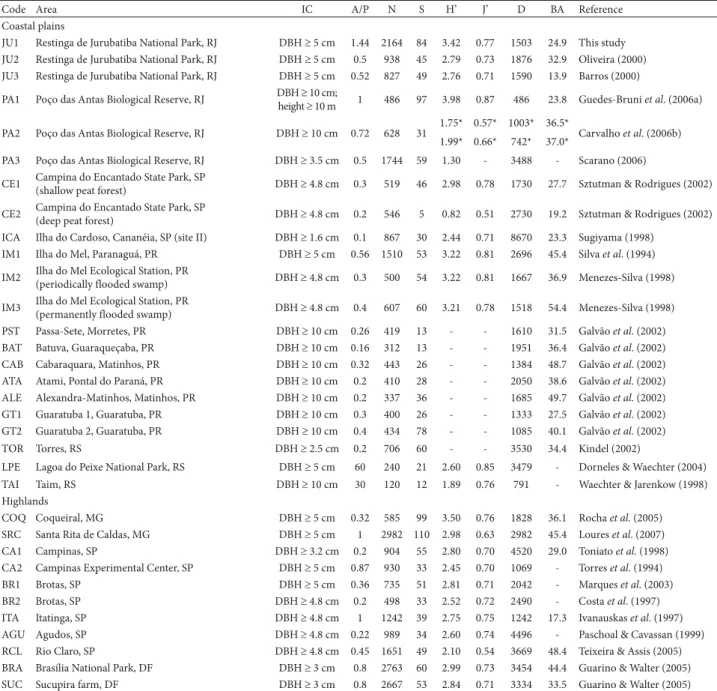
southeas-tern, southern and central-west regions of Brazil (Teixeira & Assis 2011; Tab. 1). This increase of local floristic data has made it possible to conduct a number of large-scale phytogeographic analyses, in which swamp forests have been compared with flooded riparian forests (Rodrigues & Nave 2004; Silva et al. 2007) or with each other (Teixeira & Assis 2011). However, the authors of such studies have focused their analyses on swamp forests located on the Brazilian Highlands, evaluating only two areas of swamp forest in the coastal plains, where a number of local surveys have already been conducted (Tab. 1).
A number of studies have defined the overall structural and floristic patterns of Brazilian swamp forests: low diver-sity; the predominance of one or a few species—including the flooded-forest specialist species Calophyllum brasiliense
Cambess., Symphonia globulifera L.f. and Tabebuia cassinoi-des (Lam.) DC., in areas of the coastal plain of the state of
Table 1. Quantitative parameters of the tree/shrub-tree layer of swamp forests in southern and southeastern Brazil.
Code Area IC A/P N S H’ J’ D BA Reference
Coastal plains
JU1 Restinga de Jurubatiba National Park, RJ DBH 5 cm 1.44 2164 84 3.42 0.77 1503 24.9 This study JU2 Restinga de Jurubatiba National Park, RJ DBH 5 cm 0.5 938 45 2.79 0.73 1876 32.9 Oliveira (2000) JU3 Restinga de Jurubatiba National Park, RJ DBH 5 cm 0.52 827 49 2.76 0.71 1590 13.9 Barros (2000)
PA1 Poço das Antas Biological Reserve, RJ DBH 10 cm;
height 10 m 1 486 97 3.98 0.87 486 23.8 Guedes-Bruni et al. (2006a)
PA2 Poço das Antas Biological Reserve, RJ DBH 10 cm 0.72 628 31 1.75* 0.57* 1003* 36.5* Carvalho et al. (2006b) 1.99* 0.66* 742* 37.0*
PA3 Poço das Antas Biological Reserve, RJ DBH 3.5 cm 0.5 1744 59 1.30 - 3488 - Scarano (2006)
CE1 Campina do Encantado State Park, SP
(shallow peat forest) DBH 4.8 cm 0.3 519 46 2.98 0.78 1730 27.7 Sztutman & Rodrigues (2002)
CE2 Campina do Encantado State Park, SP
(deep peat forest) DBH 4.8 cm 0.2 546 5 0.82 0.51 2730 19.2 Sztutman & Rodrigues (2002) ICA Ilha do Cardoso, Cananéia, SP (site II) DBH 1.6 cm 0.1 867 30 2.44 0.71 8670 23.3 Sugiyama (1998)
IM1 Ilha do Mel, Paranaguá, PR DBH 5 cm 0.56 1510 53 3.22 0.81 2696 45.4 Silva et al. (1994)
IM2 Ilha do Mel Ecological Station, PR
(periodically flooded swamp) DBH 4.8 cm 0.3 500 54 3.22 0.81 1667 36.9 Menezes-Silva (1998)
IM3 Ilha do Mel Ecological Station, PR
(permanently flooded swamp) DBH 4.8 cm 0.4 607 60 3.21 0.78 1518 54.4 Menezes-Silva (1998) PST Passa-Sete, Morretes, PR DBH 10 cm 0.26 419 13 - - 1610 31.5 Galvão et al. (2002) BAT Batuva, Guaraqueçaba, PR DBH 10 cm 0.16 312 13 - - 1951 36.4 Galvão et al. (2002) CAB Cabaraquara, Matinhos, PR DBH 10 cm 0.32 443 26 - - 1384 48.7 Galvão et al. (2002) ATA Atami, Pontal do Paraná, PR DBH 10 cm 0.2 410 28 - - 2050 38.6 Galvão et al. (2002) ALE Alexandra-Matinhos, Matinhos, PR DBH 10 cm 0.2 337 36 - - 1685 49.7 Galvão et al. (2002) GT1 Guaratuba 1, Guaratuba, PR DBH 10 cm 0.3 400 26 - - 1333 27.5 Galvão et al. (2002) GT2 Guaratuba 2, Guaratuba, PR DBH 10 cm 0.4 434 78 - - 1085 40.1 Galvão et al. (2002)
TOR Torres, RS DBH 2.5 cm 0.2 706 60 - - 3530 34.4 Kindel (2002)
LPE Lagoa do Peixe National Park, RS DBH 5 cm 60 240 21 2.60 0.85 3479 - Dorneles & Waechter (2004)
TAI Taim, RS DBH 10 cm 30 120 12 1.89 0.76 791 - Waechter & Jarenkow (1998)
Highlands
COQ Coqueiral, MG DBH 5 cm 0.32 585 99 3.50 0.76 1828 36.1 Rocha et al. (2005) SRC Santa Rita de Caldas, MG DBH 5 cm 1 2982 110 2.98 0.63 2982 45.4 Loures et al. (2007) CA1 Campinas, SP DBH 3.2 cm 0.2 904 55 2.80 0.70 4520 29.0 Toniato et al. (1998) CA2 Campinas Experimental Center, SP DBH 5 cm 0.87 930 33 2.45 0.70 1069 - Torres et al. (1994)
BR1 Brotas, SP DBH 5 cm 0.36 735 51 2.81 0.71 2042 - Marques et al. (2003)
BR2 Brotas, SP DBH 4.8 cm 0.2 498 33 2.52 0.72 2490 - Costa et al. (1997)
ITA Itatinga, SP DBH 4.8 cm 1 1242 39 2.75 0.75 1242 17.3 Ivanauskas et al. (1997)
AGU Agudos, SP DBH 4.8 cm 0.22 989 34 2.60 0.74 4496 - Paschoal & Cavassan (1999)
RCL Rio Claro, SP DBH 4.8 cm 0.45 1651 49 2.10 0.54 3669 48.4 Teixeira & Assis (2005) BRA Brasília National Park, DF DBH 3 cm 0.8 2763 60 2.99 0.73 3454 44.4 Guarino & Walter (2005) SUC Sucupira farm, DF DBH 3 cm 0.8 2667 53 2.84 0.71 3334 33.5 Guarino & Walter (2005)
IC – inclusion criterion; A/P – sample area (ha)/number of points; N – number of live trees surveyed; S – number of species; H’ – Shannon diversity index; J’ – Shannon evenness index; D – total density (trees.ha−1); BA – basal area (m2.ha−1); RJ – (state of) Rio de Janeiro; DBH – diameter at breast height; SP – (state of) São Paulo; PR – (state of) Paraná; RS – (state of) Rio Grande do Sul; MG – (state of) Minas Gerais; DF – Distrito Federal (Federal District) of Brasília.
*Values for the two sites studied.
Rio de Janeiro (Scarano et al. 1997); and flora that is heavily influenced by the surrounding vegetation (e.g., Teixeira & Assis 2011). However, in comparison with other vegetation formations in Brazil, little is known about these wetlands. As previously mentioned, the few large-scale comparisons conducted to date have focused mainly on the swamp forests of the Brazilian Highlands. Therefore, there is a need for not only additional local surveys but also for further phytogeogra-phic analyses that include swamp forests on the coastal plain. Within the Atlantic Forest biome, especially in the coastal plains, many swamp forests have been cleared
as the swamp forests, are not always treated with such care (Scarano 2009, Ribeiro et al. 2011).
Our paper focuses on a particular set of swamp forests in southeast Brazil, namely those that appear on marine sand deposits within areas of restinga (coastal woodland), which are ecosystems associated with the Atlantic Forest (Scarano 2009). These Quaternary deposits are covered by a mosaic of vegetation, ranging from sparse herbaceous to dense forest vegetation (Araujo et al. 1998).
The objective of this study was to describe the phyto-sociological structure of the tree layer of the swamp forests in southeastern Brazil, as well as to determine the extent to which they are floristically similar to local areas of open
restinga, Atlantic Forest sensu stricto, other swamp forests, and flooded riparian forests. We also sought to determine whether those swamp forests presented phytogeographic relationships with the other vegetation formations.
Material and methods
Study area
Our study area was within Restinga de Jurubatiba National Park (22°08’-22°19’S; 41°17’-41°43’W), which is located on the northern coast of the state of Rio de
Janei-ro, in southeastern Brazil (Fig. 1). The park encompasses portions of the municipalities of Macaé, Carapebus and Quissamã, covering an area of 14,839 ha, and preserves one of the most important remnants of the restinga ecosystem in Brazil (Esteves 1998; Rocha et al. 2004).
The study area is in the southern portion of an extensi-ve Quaternary coastal plain, the origin of which is closely related to the evolution of the Paraíba do Sul River delta. This portion of the plain is composed mainly of Pleistocene marine sands; Holocene marine deposits are scarce and limited to a narrow strip near what is now the shoreline. The Pleistocene terraces are limited inwards by Tertiary sediments of the Barreiras Formation (Martin et al. 1993). This great coastal plain has been extensively drained and inhabited by humans since the seventeenth century. An ex-tensive network of artificial canals—initially constructed to transport agricultural products and timber but subsequently used in order to increase the amount of arable land—lowe-red the water table level and dried up many local lagoons and swamps. In addition, levees were built along the Paraíba do Sul River to prevent flooding on part of the plain (Martin
et al. 1993; Soffiati 1998).
Restinga de Jurubatiba National Park is also a research station for the Brazilian Long-Term Ecological Research Program (Barbosa et al. 2004; Rocha et al. 2004). In re-cent years, a number of plant ecology studies have been
conducted within the park (Scarano et al. 2004). Mean annual precipitation is 1164 mm and rainfall is strongly seasonal, with monthly averages ranging from 41 mm in winter (June) to 189 mm in summer (December). The mean annual temperature is 22.6°C, with monthly averages ran-ging from a maximum of 29.7°C, in January, to a minimum of 20.0°C, in July (Henriques et al. 1986).
The swamp forests studied are among some ten types of vegetation formations found in the study area (Araujo
et al. 1998) and occur in swales between successive ancient beach ridges, expanding over branches of local lagoons. The swamp forests are subjected to flooding due to a rise in the water table during the rainy season (October-March). The most typical shape of such forests is that of long strips pa-rallel to the coastline, varying in width (but mostly narrow), abruptly or gradually giving way to areas of open restinga
on either side (Fig. 1). Although the restinga studied was formed predominantly during the Pleistocene, the condi-tions did not become conducive to swamp formation until more recently, a result of the silting of lagoons formed by Holocene marine sand damming of waters (Martin et al. 1993). These swamp forests are subjected to two flooding gradients related to variations in topography. First, there is a gradient over the cross section, in which the forest bottom (i.e., the center, which is topographically lower) is more intensely flooded than are the edges, which seldom flood, and there are changes in physico-chemical characteristics of the soil, the hydromorphic conditions resulting in increased accumulation of organic matter (> 2 m thick in the bottom, Araujo et al. 1998). Second, there is a flooding gradient related to the distance from the lagoons. These flooding gradients are responsible for physiognomic and structural variation within short distances (< 100 m). At the canopy level (a height of approximately 20 m), the most common tree species are Tapirira guianensis Aubl., Calophyllum brasi-liense and Symphonia globulifera. The understory is typically not very dense. The main understory species are Protium icicariba (DC.) Marchand and Geonoma schottiana Mart., which proliferate along the forest edges and bottoms, res-pectively. The trees within swamp forest often have slender trunks, with diameters that rarely exceed 50 cm.
According to local inhabitants, these swamp forests were intensively exploited in the past, mainly for the collection of firewood. In addition, some tree species were extracted for their timber or other products, such as hearts of palm from Euterpe edulis Mart. The interviewees reported that the extraction was more pronounced on the firm ground along the forest edges than on the unstable peaty soil of the bottoms. Nevertheless, some of the swamps have been completely deforested. Until recently, there were reports of illegal burning of swamp forests, which during dry periods destroyed a significant area of those forests, mainly due to the difficulties in controlling the burning of dry peat. As a result, the local swamp forests are now a mosaic of different successional stages.
Sampling
The study was conducted between 2002 and 2004 at eight randomly chosen sites of periodically flooded swamp forests associated with different lagoons (Fig. 1). Aiming to include a wide range of environmental conditions, we established three sets of three 4 × 50 m quadrats at each site: one set at each edge and one in the bottom. Therefore, we established a total of 72 quadrats (nine per site), cor-responding to a total sampling area of 1.44 ha. Edges and bottoms were distinguished by topographic, edaphic and physiognomic characteristics. We measured diameter at breast height (DBH, 1.3 m above the ground) and sampled only those trees with a DBH 5 cm. For trees that forked or branched below 1.3 m, only the branches with a DBH 5 cm were measured. We used the elongated quadrats in order to match the long, narrow shape of the swamps (the longer side followed the main axis of the swamps). The dimensions of the quadrats were adapted, from Gentry (1982), to our inclusion criterion.
The botanical material was identified on the basis of the specialized literature, by comparison with specimens in the collections of the Herbarium of the Research Institute of the Rio de Janeiro Botanical Garden (code, RB) and, when possible, through consultation with specialists. Voucher specimens were deposited in the RB. Species were classified in accordance with the Angiosperm Phylogeny Group III guidelines (APG III 2009), and the classification of genera by family followed Souza and Lorenzi (2008).
Phytosociological structure
For each species, we calculated the relative values of density, frequency, dominance and importance value (Mueller-Dombois & Ellenberg 1974). The Shannon diver-sity and evenness indices (H’ and J’, respectively), using the natural logarithm, followed Zar (1996). The calculations were performed with the FITOPAC program, version 1.6 (Shepherd 2006).
Phytogeographic relationships
coefficients 0.25 indicate floristic similarity between the units compared. The names of all species were reviewed in accordance with the List of Species of the Brazilian Flora (Lista de Espécies da Flora do Brasil 2012) or by consulting specialists. In addition, we calculated the percentages of species within the study area that had also been registered in the same types of vegetation formations used for comparison by the Jaccard similarity coefficient.
Results
Phytosociological structure
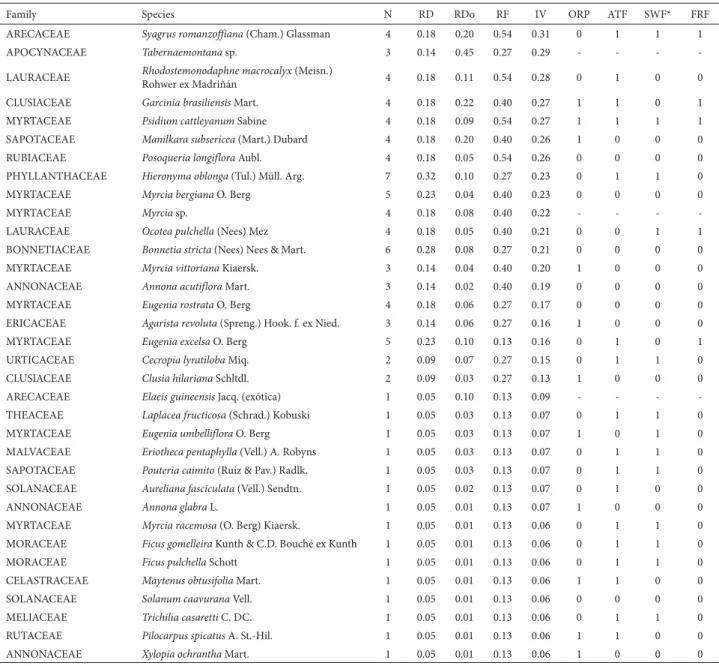
We surveyed 2164 live trees, belonging to 84 species, 62 genera and 34 families (Tab. 3). Of those 84 species, six (7.1%) accounted for nearly half (48.8%) of the
individu-als surveyed. Those six species were Tapirira guianensis,
Protium icicariba, Geonoma schottiana, Euterpe edulis,
Calophyllum brasiliense and Tabebuia cassinoides. The most important was T. guianensis, which, together with
C. brasiliense and P. icicariba, accounted for ≈34% of total importance value. Conversely, 15 (17.9%) of the 84 species (including Elaeis guineensis, an exotic palm species of Afri-can origin), were represented by a single individual. The H’ was 3.42, and the J’ was 0.77.
Of the 84 species surveyed, 40 (47.6%) belonged to one of six families: Myrtaceae (n = 14); Lauraceae (n = 7); Clusiaceae (n = 6); Arecaceae (n = 5); Annonaceae (n = 4); and Moraceae (n = 4). As can be seen in Tab. 3, the most species-rich genera were Myrcia (7 species); Eugenia
(4 species), Ficus (4 species), Ocotea (3 species) and Protium
(3 species).
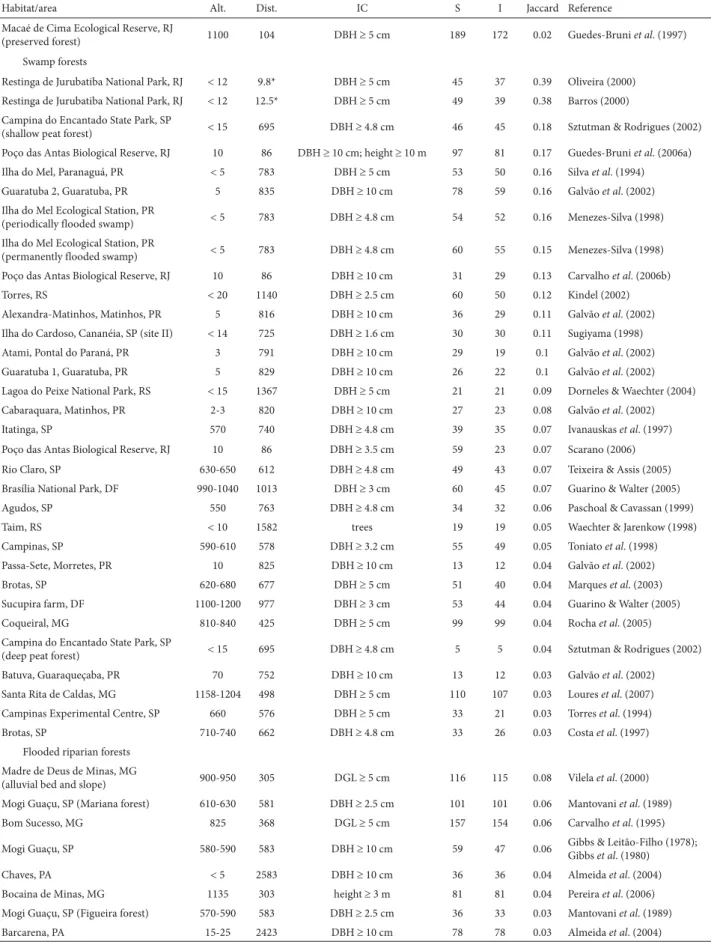
Table 2. Jaccard similarity coefficients between the swamp forests studied in Restinga de Jurubatiba National Park, in the state of Rio de Janeiro, and other vegetation formations in Brazil.
Habitat/area Alt. Dist. IC S I Jaccard Reference
Open restinga
Restinga de Jurubatiba National Park, RJ
(Clusia scrub) 12 - height 0.5 m 61 59 0.21 Araujo et al. (2004)
Restinga de Jurubatiba National Park, RJ
(Clusia scrub) 12 - woody vegetation 35 31 0.17 Zaluar (1997)
Restinga de Jurubatiba National Park, RJ
(Ericaceae scrub) 12 - CD 0.5 m 43 34 0.15 Montezuma (1997)
Atlantic Forest sensu stricto
Poço das Antas Biological Reserve, RJ 12-200 86 DBH 10 cm; height 10 m 169 129 0.11 Guedes-Bruni et al. (2006b) Bacia do Rio São João/Mico
Leão Dourado Environmental Protection Area, RJ
30-400 106 DBH 5 cm 161 141 0.06 Carvalho et al. (2006a)
Itatiaia National Park, RJ 1067 319 DBH 10 cm; height 10 m 150 114 0.06 Guedes-Bruni (1998) Praia do Sul State Biological Reserve, RJ
(25-year-old forest) 140 307 DBH 2.5 cm; height 2 m 70 61 0.06 Oliveira (2002) Paraíso State Ecological Station, RJ 200 146 DBH 5 cm 138 115 0.06 Kurtz & Araujo (2000) Praia do Sul State Biological Reserve, RJ
(50-year-old forest) 260 292 DBH 2.5 cm; height 2 m 63 50 0.06 Oliveira (2002)
Campos dos Goytacazes, RJ 50 49 DBH 10 cm 125 95 0.05 Moreno et al. (2003)
Tijuca Mountain, RJ 500-700 199 DBH 2.5 cm; height 2 m 203 169 0.05 Oliveira et al. (1995) Santa Lúcia Biological Station, ES
(mountaintop) 820-855 271 DBH 6.4 cm 238 107 0.05 Thomaz & Monteiro (1997)
Santa Lúcia Biological Station, ES
(valley bottom) 650-660 271 DBH 6.4 cm 228 116 0.05 Thomaz & Monteiro (1997)
Macaé de Cima Ecological Reserve, RJ
(30-year-old forest) 1000 104 DBH 5 cm 155 122 0.05 Pessoa et al. (1997)
Campos dos Goytacazes, RJ 250 49 DBH 10 cm 145 109 0.04 Moreno et al. (2003)
Magé, RJ (disturbed forest) 30 160 DBH 5 cm 90 70 0.04 Guedes (1988)
Santa Lúcia Biological Station, ES
(mountainside) 675-700 271 DBH 6.4 cm 221 107 0.04 Thomaz & Monteiro (1997)
Serra da Capoeira Grande
Environmental Protection Area, RJ 60-150 234 DBH 4.8 cm 69 63 0.04 Peixoto et al. (2004) Ilha Grande State Park, RJ
(climax forest) 280 292 DBH 2.5 cm; height 2 m 134 101 0.03 Oliveira (2002)
Habitat/area Alt. Dist. IC S I Jaccard Reference Macaé de Cima Ecological Reserve, RJ
(preserved forest) 1100 104 DBH 5 cm 189 172 0.02 Guedes-Bruni et al. (1997)
Swamp forests
Restinga de Jurubatiba National Park, RJ 12 9.8* DBH 5 cm 45 37 0.39 Oliveira (2000) Restinga de Jurubatiba National Park, RJ 12 12.5* DBH 5 cm 49 39 0.38 Barros (2000) Campina do Encantado State Park, SP
(shallow peat forest) 15 695 DBH 4.8 cm 46 45 0.18 Sztutman & Rodrigues (2002) Poço das Antas Biological Reserve, RJ 10 86 DBH 10 cm; height 10 m 97 81 0.17 Guedes-Bruni et al. (2006a)
Ilha do Mel, Paranaguá, PR 5 783 DBH 5 cm 53 50 0.16 Silva et al. (1994)
Guaratuba 2, Guaratuba, PR 5 835 DBH 10 cm 78 59 0.16 Galvão et al. (2002)
Ilha do Mel Ecological Station, PR
(periodically flooded swamp) 5 783 DBH 4.8 cm 54 52 0.16 Menezes-Silva (1998) Ilha do Mel Ecological Station, PR
(permanently flooded swamp) 5 783 DBH 4.8 cm 60 55 0.15 Menezes-Silva (1998)
Poço das Antas Biological Reserve, RJ 10 86 DBH 10 cm 31 29 0.13 Carvalho et al. (2006b)
Torres, RS 20 1140 DBH 2.5 cm 60 50 0.12 Kindel (2002)
Alexandra-Matinhos, Matinhos, PR 5 816 DBH 10 cm 36 29 0.11 Galvão et al. (2002) Ilha do Cardoso, Cananéia, SP (site II) 14 725 DBH 1.6 cm 30 30 0.11 Sugiyama (1998)
Atami, Pontal do Paraná, PR 3 791 DBH 10 cm 29 19 0.1 Galvão et al. (2002)
Guaratuba 1, Guaratuba, PR 5 829 DBH 10 cm 26 22 0.1 Galvão et al. (2002)
Lagoa do Peixe National Park, RS 15 1367 DBH 5 cm 21 21 0.09 Dorneles & Waechter (2004)
Cabaraquara, Matinhos, PR 2-3 820 DBH 10 cm 27 23 0.08 Galvão et al. (2002)
Itatinga, SP 570 740 DBH 4.8 cm 39 35 0.07 Ivanauskas et al. (1997)
Poço das Antas Biological Reserve, RJ 10 86 DBH 3.5 cm 59 23 0.07 Scarano (2006)
Rio Claro, SP 630-650 612 DBH 4.8 cm 49 43 0.07 Teixeira & Assis (2005)
Brasília National Park, DF 990-1040 1013 DBH 3 cm 60 45 0.07 Guarino & Walter (2005)
Agudos, SP 550 763 DBH 4.8 cm 34 32 0.06 Paschoal & Cavassan (1999)
Taim, RS 10 1582 trees 19 19 0.05 Waechter & Jarenkow (1998)
Campinas, SP 590-610 578 DBH 3.2 cm 55 49 0.05 Toniato et al. (1998)
Passa-Sete, Morretes, PR 10 825 DBH 10 cm 13 12 0.04 Galvão et al. (2002)
Brotas, SP 620-680 677 DBH 5 cm 51 40 0.04 Marques et al. (2003)
Sucupira farm, DF 1100-1200 977 DBH 3 cm 53 44 0.04 Guarino & Walter (2005)
Coqueiral, MG 810-840 425 DBH 5 cm 99 99 0.04 Rocha et al. (2005)
Campina do Encantado State Park, SP
(deep peat forest) 15 695 DBH 4.8 cm 5 5 0.04 Sztutman & Rodrigues (2002)
Batuva, Guaraqueçaba, PR 70 752 DBH 10 cm 13 12 0.03 Galvão et al. (2002)
Santa Rita de Caldas, MG 1158-1204 498 DBH 5 cm 110 107 0.03 Loures et al. (2007) Campinas Experimental Centre, SP 660 576 DBH 5 cm 33 21 0.03 Torres et al. (1994)
Brotas, SP 710-740 662 DBH 4.8 cm 33 26 0.03 Costa et al. (1997)
Flooded riparian forests Madre de Deus de Minas, MG
(alluvial bed and slope) 900-950 305 DGL 5 cm 116 115 0.08 Vilela et al. (2000) Mogi Guaçu, SP (Mariana forest) 610-630 581 DBH 2.5 cm 101 101 0.06 Mantovani et al. (1989)
Bom Sucesso, MG 825 368 DGL 5 cm 157 154 0.06 Carvalho et al. (1995)
Mogi Guaçu, SP 580-590 583 DBH 10 cm 59 47 0.06 Gibbs & Leitão-Filho (1978);
Gibbs et al. (1980)
Chaves, PA 5 2583 DBH 10 cm 36 36 0.04 Almeida et al. (2004)
Bocaina de Minas, MG 1135 303 height 3 m 81 81 0.04 Pereira et al. (2006)
Mogi Guaçu, SP (Figueira forest) 570-590 583 DBH 2.5 cm 36 33 0.03 Mantovani et al. (1989)
Barcarena, PA 15-25 2423 DBH 10 cm 78 78 0.03 Almeida et al. (2004)
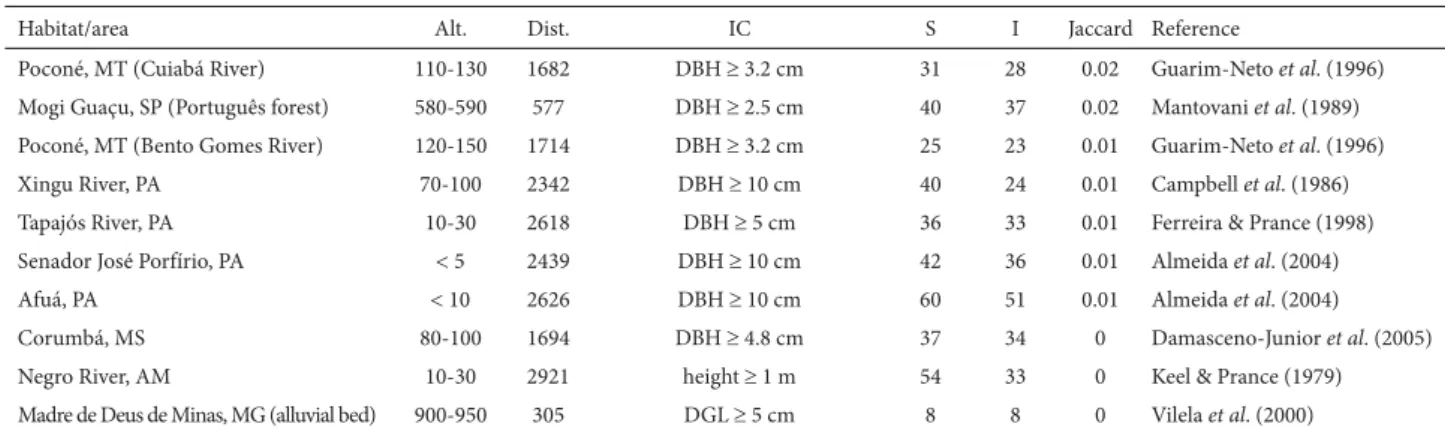
Table 2. Continuation.
Table 2. Continuation.
Habitat/area Alt. Dist. IC S I Jaccard Reference
Poconé, MT (Cuiabá River) 110-130 1682 DBH 3.2 cm 31 28 0.02 Guarim-Neto et al. (1996) Mogi Guaçu, SP (Português forest) 580-590 577 DBH 2.5 cm 40 37 0.02 Mantovani et al. (1989) Poconé, MT (Bento Gomes River) 120-150 1714 DBH 3.2 cm 25 23 0.01 Guarim-Neto et al. (1996)
Xingu River, PA 70-100 2342 DBH 10 cm 40 24 0.01 Campbell et al. (1986)
Tapajós River, PA 10-30 2618 DBH 5 cm 36 33 0.01 Ferreira & Prance (1998)
Senador José Porfírio, PA 5 2439 DBH 10 cm 42 36 0.01 Almeida et al. (2004)
Afuá, PA 10 2626 DBH 10 cm 60 51 0.01 Almeida et al. (2004)
Corumbá, MS 80-100 1694 DBH 4.8 cm 37 34 0 Damasceno-Junior et al. (2005)
Negro River, AM 10-30 2921 height 1 m 54 33 0 Keel & Prance (1979)
Madre de Deus de Minas, MG (alluvial bed) 900-950 305 DGL 5 cm 8 8 0 Vilela et al. (2000)
Alt. – approximate altitude (meters above sea level); Dist. – approximate distance from the park (km); IC – inclusion criterion; S – number of species; I – identified species used for Jaccard calculation; RJ – (state of) Rio de Janeiro; CD – crown diameter; DBH – diameter at breast height; ES – (state of) Espírito Santo; SP – (state of) São Paulo; PR – (state of) Paraná; RS – (state of) Rio Grande do Sul; DF – Distrito Federal (Federal District) of Brasília; MG – (state of) Minas Gerais; DGL – diameter at ground level; PA – (state of) Pará; MT – (state of) Mato Grosso; MS – (state of Mato Grosso do Sul); AM – (state of) Amazonas.
* Mean distance to the eight swamp forests studied.
The total density and basal area were 1503 trees.ha−1 and 24.9 m2.ha−1, respectively. Although we identified a few trees of considerable size (possible remnants of the original struc-ture of the local swamp forests)—including Calophyllum brasiliense (height/diameter, 30 m/53 cm), Ficus organensis
(28 m/88 cm), Tapirira guianensis (28 m/51 cm), Symphonia globulifera (28 m/37.7 cm) and Tabebuia cassinoides (23 m/60.5 cm)—the mean height and diameter were relati-vely low (9.4 ± 4.4 m and 11.8 ± 8.5 cm, respectirelati-vely). In addition, 16.5% of the individuals surveyed (concentrated at the edges) were forked or branched below 1.3 m, which is partly the result of past cuts. We also surveyed 211 dead, still standing trees (8.9% of the total), which collectively had a basal area of 2.6 m2.ha−1.
Phytogeographic relationships
The swamp forests studied were found to bear little similarity to the types of vegetation formations used for comparison (Tab. 2). In most cases, the Jaccard similarity coefficients were lower than 0.25; as expected, the highest values were obtained only when our data were compared with those of two other surveys conducted in swamp forests within our study area (Jaccard, 0.39 and 0.38, respectively). Our swamp forests were more similar to, or at least as similar as, open restinga formations within the park, such as the so-called Clusia scrub (Jaccard of 0.21-0.17) and Ericaceae scrub (Jaccard, 0.15), as they were to other swamp forests of the coastal plains of the states of Rio de Janeiro, São Paulo and Paraná (Jaccard, 0.18-0.03). Conversely, the swamp forests in our study area presented very low similarity to other swamp forests, including those in the Brazilian Highlands (in the Federal District of Brasilia, the state of Minas Gerais and the state of São Paulo: Jaccard, 0.07-0.03) and those in the coastal plains from the sou-thernmost Brazilian state of Rio Grande do Sul (Jaccard,
0.12-0.05), especially in the southernmost portion of those plains (Taim wetland: Jaccard, 0.05). The Jaccard similarity coefficients for comparisons between our swamp forests and areas of Atlantic Forest sensu stricto in the states of Rio de Janeiro and Espírito Santo or various flooded riparian forests in Brazil were consistently quite low (0.11-0.02 and 0.08-0, respectively).
Despite the low Jaccard similarity coefficients, many of the species surveyed in the swamp forests of Restinga de Jurubatiba National Park were also registered in the types of vegetation formations used for comparison (Tab. 3 and 4). Some 70% of the species were shared with neighboring vegetation formations, including open restinga within the park (33.3%) and the Atlantic Forest sensu stricto in the states of Rio de Janeiro and Espírito Santo (53.1%). Consi-dering the floodplain forests, many species were common to other swamp forests (54.3%) and flooded riparian forests (37%). In addition, excluding the flooded-forest specialist species Calophyllum brasiliense, Symphonia globulifera and
Tabebuia cassinoides, the great majority (78%) of the spe-cies common to other swamp forests also occurred in the Atlantic Forest sensu stricto. In the case of species common to flooded riparian forests, the percentage was also very high (78.6%, Tab. 3).
Discussion
Phytosociological structure
The results indicated an oligarchic structure in the swamp forests studied. In addition to the known flooded-fo-rest specialist species (Calophyllum brasiliense, Symphonia globulifera and Tabebuia cassinoides), some species common to neighboring areas of dry restinga (Tapirira guianensis and
Table 3. Tree species (diameter at breast height ≥ 5 cm) surveyed in swamp forests of Restinga de Jurubatiba National Park, in the state of Rio de Janeiro, Brazil, ordered by importance value, phytosociological parameters and occurrence (1/0) in some other vegetation formations in Brazil (based on the surveys presented in Tab. 2).
Family Species N RD RDo RF IV ORP ATF SWF* FRF
ANACARDIACEAE Tapirira guianensis Aubl. 356 16.45 31.05 8.91 18.80 1 1 1 1
CLUSIACEAE Calophyllum brasiliense Cambess. 103 4.76 15.16 5.13 8.35 0 0 1 1
BURSERACEAE Protium icicariba (DC.) Marchand 203 9.38 4.82 5.94 6.71 1 0 0 0
ARECACEAE Euterpe edulis Mart. 143 6.61 2.50 3.10 4.07 0 1 1 1
CLUSIACEAE Symphonia globulifera L.f. 84 3.88 4.41 3.91 4.07 0 0 1 1
ARECACEAE Geonoma schottiana Mart. 150 6.93 1.04 4.18 4.05 0 1 1 1
BIGNONIACEAE Tabebuia cassinoides (Lam.) DC. 101 4.67 3.56 2.70 3.64 0 0 1 0
PERACEAE Pera glabrata (Schott) Poepp. ex Baill. 61 2.82 3.07 3.51 3.13 1 1 1 1
ELAEOCARPACEAE Sloanea guianensis (Aubl.) Benth. 74 3.42 2.60 2.97 3.00 0 1 1 0
MYRTACEAE Calyptranthes brasiliensis Spreng. 70 3.23 1.42 4.05 2.90 1 0 1 1
HUMIRIACEAE Humiria balsamifera (Aubl.) J. St.-Hil. 51 2.36 3.89 1.89 2.71 1 0 0 1
LAURACEAE Persea aurata Miq. 48 2.22 1.43 3.10 2.25 0 0 0 0
MYRTACEAE Myrcia ilheosensis Kiaersk. 68 3.14 1.08 2.16 2.13 1 0 1 0
MALVACEAE Pseudobombax grandiflorum (Cav.) A. Robyns 42 1.94 2.01 2.16 2.04 0 1 1 1
MYRTACEAE Blepharocalyx salicifolius (Kunth) O. Berg 39 1.80 1.32 2.02 1.72 0 0 1 1
MELASTOMATACEAE Miconia cinnamomifolia (DC.) Naudin 38 1.76 0.91 2.29 1.65 0 1 1 1
MALPIGHIACEAE Byrsonima sericea DC. 27 1.25 1.28 1.62 1.38 1 0 0 0
LAURACEAE Ocotea notata (Nees) Mez 31 1.43 1.05 1.48 1.32 1 0 0 0
NYCTAGINACEAE Guapira opposita (Vell.) Reitz 27 1.25 0.87 1.48 1.20 1 1 1 1
FABACEAE Andira nitida Mart. ex Benth. 16 0.74 1.06 1.62 1.14 0 0 0 0
SIMAROUBACEAE Simarouba amara Aubl. 15 0.69 1.36 1.35 1.13 0 1 1 1
AQUIFOLIACEAE Ilex theezans Mart. ex Reissek 26 1.20 0.73 1.35 1.09 1 1 1 1
APOCYNACEAE Aspidosperma ramiflorum Müll. Arg. 23 1.06 0.72 1.48 1.09 0 1 0 1
MORACEAE Ficus organensis (Miq.) Miq. 8 0.37 1.85 0.94 1.06 0 1 1 0
APOCYNACEAE Aspidosperma pyricollum Müll. Arg. 20 0.92 0.57 1.21 0.90 0 0 0 1
LAURACEAE Aniba firmula (Nees & Mart.) Mez 17 0.79 0.86 0.94 0.86 0 1 1 1
MYRSINACEAE Myrsine rubra M.F. Freitas & Kin.-Gouv. 15 0.69 0.46 1.21 0.79 0 0 0 0
ANNONACEAE Xylopia sericea A. St.-Hil. 14 0.65 0.46 1.21 0.77 0 1 1 0
RUBIACEAE Amaioua intermedia Mart. 15 0.69 0.25 1.35 0.76 1 1 1 1
ARECACEAE Bactris setosa Mart. 16 0.74 0.10 1.35 0.73 0 0 1 0
MYRTACEAE Myrcia multiflora (Lam.) DC. 11 0.51 0.50 1.08 0.69 1 1 1 1
EUPHORBIACEAE Alchornea triplinervia (Spreng.) Müll. Arg. 12 0.55 0.25 1.21 0.67 0 1 1 1
FABACEAE Ormosia arborea (Vell.) Harms 9 0.42 0.52 0.81 0.58 1 1 1 1
MYRTACEAE Eugenia bahiensis DC. 11 0.51 0.28 0.94 0.58 0 0 0 0
LAURACEAE Ocotea lobbii (Meisn.) Rohwer 11 0.51 0.31 0.81 0.54 0 0 0 0
SAPINDACEAE Cupania emarginata Cambess. 9 0.42 0.24 0.94 0.53 1 1 0 0
MORACEAE Ficus clusiifolia Schott 4 0.18 0.99 0.40 0.53 0 1 1 0
CLUSIACEAE Clusia criuva Cambess. 11 0.51 0.31 0.67 0.50 0 0 1 0
BURSERACEAE Protium heptaphyllum (Aubl.) Marchand 10 0.46 0.16 0.81 0.48 1 1 1 1
BIGNONIACEAE Jacaranda bracteata Bureau & K. Schum. 10 0.46 0.28 0.67 0.47 0 1 0 0
RUTACEAE Esenbeckia grandiflora Mart. 17 0.79 0.19 0.40 0.46 0 0 0 0
BURSERACEAE Protium brasiliense (Spreng.) Engl. 9 0.42 0.15 0.67 0.41 0 0 0 0
SAPINDACEAE Matayba guianensis Aubl. 6 0.28 0.13 0.81 0.41 0 1 1 1
FABACEAE Inga laurina (Sw.) Willd. 4 0.18 0.58 0.40 0.39 0 0 1 1
LAURACEAE Nectandra psammophila Nees 7 0.32 0.26 0.54 0.37 0 0 0 0
PERACEAE Chaetocarpus myrsinites Baill. 7 0.32 0.12 0.67 0.37 1 0 0 0
CLUSIACEAE Tovomita fructipendula (Ruiz & Pav.) Cambess. 8 0.37 0.06 0.67 0.37 0 1 0 1
MYRTACEAE Myrcia recurvata O. Berg 5 0.23 0.09 0.67 0.33 0 1 0 0
AQUIFOLIACEAE Ilex pseudobuxus Reissek 6 0.28 0.14 0.54 0.32 0 0 1 0
MYRSINACEAE Myrsine guianensis (Aubl.) Kuntze 6 0.28 0.13 0.54 0.32 0 1 1 0
Family Species N RD RDo RF IV ORP ATF SWF* FRF
ARECACEAE Syagrus romanzoffiana (Cham.) Glassman 4 0.18 0.20 0.54 0.31 0 1 1 1
APOCYNACEAE Tabernaemontana sp. 3 0.14 0.45 0.27 0.29 - - -
-LAURACEAE Rhodostemonodaphne macrocalyx (Meisn.)
Rohwer ex Madriñán 4 0.18 0.11 0.54 0.28 0 1 0 0
CLUSIACEAE Garcinia brasiliensis Mart. 4 0.18 0.22 0.40 0.27 1 1 0 1
MYRTACEAE Psidium cattleyanum Sabine 4 0.18 0.09 0.54 0.27 1 1 1 1
SAPOTACEAE Manilkara subsericea (Mart.) Dubard 4 0.18 0.20 0.40 0.26 1 0 0 0
RUBIACEAE Posoqueria longiflora Aubl. 4 0.18 0.05 0.54 0.26 0 0 0 0
PHYLLANTHACEAE Hieronyma oblonga (Tul.) Müll. Arg. 7 0.32 0.10 0.27 0.23 0 1 1 0
MYRTACEAE Myrcia bergiana O. Berg 5 0.23 0.04 0.40 0.23 0 0 0 0
MYRTACEAE Myrcia sp. 4 0.18 0.08 0.40 0.22 - - -
-LAURACEAE Ocotea pulchella (Nees) Mez 4 0.18 0.05 0.40 0.21 0 0 1 1
BONNETIACEAE Bonnetia stricta (Nees) Nees & Mart. 6 0.28 0.08 0.27 0.21 0 0 0 0
MYRTACEAE Myrcia vittoriana Kiaersk. 3 0.14 0.04 0.40 0.20 1 0 0 0
ANNONACEAE Annona acutiflora Mart. 3 0.14 0.02 0.40 0.19 0 0 0 0
MYRTACEAE Eugenia rostrata O. Berg 4 0.18 0.06 0.27 0.17 0 0 0 0
ERICACEAE Agarista revoluta (Spreng.) Hook. f. ex Nied. 3 0.14 0.06 0.27 0.16 1 0 0 0
MYRTACEAE Eugenia excelsa O. Berg 5 0.23 0.10 0.13 0.16 0 1 0 1
URTICACEAE Cecropia lyratiloba Miq. 2 0.09 0.07 0.27 0.15 0 1 1 0
CLUSIACEAE Clusia hilariana Schltdl. 2 0.09 0.03 0.27 0.13 1 0 0 0
ARECACEAE Elaeis guineensis Jacq. (exótica) 1 0.05 0.10 0.13 0.09 - - -
-THEACEAE Laplacea fructicosa (Schrad.) Kobuski 1 0.05 0.03 0.13 0.07 0 1 1 0
MYRTACEAE Eugenia umbelliflora O. Berg 1 0.05 0.03 0.13 0.07 1 0 1 0
MALVACEAE Eriotheca pentaphylla (Vell.) A. Robyns 1 0.05 0.03 0.13 0.07 0 1 1 0
SAPOTACEAE Pouteria caimito (Ruiz & Pav.) Radlk. 1 0.05 0.03 0.13 0.07 0 1 1 0
SOLANACEAE Aureliana fasciculata (Vell.) Sendtn. 1 0.05 0.02 0.13 0.07 0 1 0 0
ANNONACEAE Annona glabra L. 1 0.05 0.01 0.13 0.07 1 0 0 0
MYRTACEAE Myrcia racemosa (O. Berg) Kiaersk. 1 0.05 0.01 0.13 0.06 0 1 1 0
MORACEAE Ficus gomelleira Kunth & C.D. Bouché ex Kunth 1 0.05 0.01 0.13 0.06 0 1 1 0
MORACEAE Ficus pulchella Schott 1 0.05 0.01 0.13 0.06 0 1 1 0
CELASTRACEAE Maytenus obtusifolia Mart. 1 0.05 0.01 0.13 0.06 1 1 0 0
SOLANACEAE Solanum caavurana Vell. 1 0.05 0.01 0.13 0.06 0 0 0 0
MELIACEAE Trichilia casaretti C. DC. 1 0.05 0.01 0.13 0.06 0 1 1 0
RUTACEAE Pilocarpus spicatus A. St.-Hil. 1 0.05 0.01 0.13 0.06 1 1 0 0
ANNONACEAE Xylopia ochrantha Mart. 1 0.05 0.01 0.13 0.06 1 0 0 0
N – number of trees surveyed; RD – relative density; RDo – relative dominance; RF – relative frequency; IV – importance value (%); ORP – open restinga within the park; ATF – Atlantic Forest sensu stricto (in the states of Rio de Janeiro and Espírito Santo); SWF – swamp forests in southern and southeastern Brazil; FRF – flooded riparian forests.
*The surveys of Barros (2000) and Oliveira (2000) conducted in swamp forests within the park were excluded. Table 3. Continuation.
Table 4. Percentage of species in the swamp forests of Restinga de Jurubatiba National Park, in the state of Rio de Janeiro, that were also registered in other vegetation formations in Brazil and the corresponding Jaccard similarity coefficient intervals.
Vegetation formation N Jaccard %
Neighboring vegetation formation 20 0.21-0.02 70.4
Open restinga within the park 3 0.21-0.15 33.3
Atlantic Forest sensu stricto of RJ and ES 17 0.11-0.02 53.1
Swamp forests of southern and southeastern Brazil* 30 0.18-0.03 54.3
Flooded riparian forests 18 0.08-0 37.0
N – number of surveys used in the analysis.
and Geonoma schottiana) showed high densities and are very important to the structure of the forests studied (Tab. 3). This indicates the generalist character of these species in relation to the water content of the soil.
In a swamp forest, the saturation or inundation of the soil, caused by a rise in the water table, exerts strong selective pressure (Marques et al. 2003; Rocha et al. 2005; Toniato 2006), determining the floristic composition and structure of the forest. The saturated soil restricts the number and abundance of shrub and tree species that are able to establish themselves, whereas it favors occupation by flooded-forest specialists, as well as some generalist species (Marques et al. 2003). A higher degree and longer duration of saturation in the superficial soil layers translates to greater selective pres-sure. As a result, swamp forests frequently show oligarchy, or monodominance (Araujo et al. 1998; Galvão et al. 2002; Scarano 2006), which are common in habitats subjected to extreme environmental conditions (Richards 1979; Scarano 2002). In fact, species richness, diversity and evenness are lower in swamp forests than in adjacent or nearby forests located on drier soils and thereby spared the direct influence of the water table level (Ivanauskas et al. 1997; Sztutman & Rodrigues 2002; Carvalho et al. 2006b).
In our study area, the species richness and diversity were relatively high when compared with those of other swamp forests (Tab. 1), which is attributable to the broad range of environmental conditions included in our sample, especially as regards the phreatic flooding regime (from none up to several months) as a result of small topographic variations. This situation enabled the establishment of species with different ecological requirements—from flooded-forest specialists to generalists, and even species common to the drier soils present in neighboring vegetation formations (see below). However, the considerable differences in abundance of these species led to the low evenness value.
The total density and basal area were low when compa-red with those reported in other studies using identical or comparable inclusion criteria (Tab. 1); even studies using the more rigid inclusion criterion of DBH ≥ 10 cm (Galvão
et al. 2002; Carvalho et al. 2006b) indicated values for basal area much higher. Some other swamp forests (IM1, IM2 and IM3) located in areas of restinga, like those studied here, also showed values for basal area that were higher than that found in our study area. These results are possibly related to the history of use of our swamp forests, as mentioned earlier, although some of their equivalents used for comparison have also been subjected to explotation (e.g., PA2, PST and BAT). The number of dead trees we found represented only a small part of the renewal dynamics of the local swamps, given that our analysis did not include fallen trees that were still alive nor mass mortalities caused by sporadic events. These seem to be particularly applicable to swamp forests. As an example, soon after the end of our survey, an extre-mely strong wind that lasted for only a few minutes was responsible for a sharp decline in the number of trees at
site E. This was attributable to the instability of peaty soils and the shallow root systems of the trees, in response to the proximity of the water table. Trees located along the upper stretches of the forest edge, where there is less accumulation of peat, were less affected. On the other hand, the combina-tion of heavy rains and the fact that the sandbar separating the Preta lagoon from the sea failed to open subjected site C and the neighboring swamps to an exceptional high water level and long-term flooding (2005-2006), coinciding with the massive death of trees.
These examples illustrate the great fragility of swamp forests, as has been reported (e.g. Scarano et al. 1998; Jaco-mine 2004). They are particularly sensitive to changes in the flood regime, and when these occur due to human activity and become permanent, in addition to rapid degradation, the forests show no natural recovery (Scarano et al. 1998). In fact, the narrowing of river channels, the construction of embankments and the installation of drainage systems have been responsible for the virtual disappearance of the swamps on the coastal plains in the state of Rio de Janeiro. Fortunately, since the establishment of Restinga de Juru-batiba National Park in 1998, the human activities that were damaging the local swamp forests (cutting, burning and hunting) have diminished and are currently almost nonexistent.
Phytogeographic relationships
The floodplain forests of Brazil (including flooded riparian forests and swamp forests) occur under a variety of ecological conditions—including those related to cli-mate, geology, geomorphology, soil, water, flooding and adjacent floras—which induce variations in their floristic composition, physiognomy, structure and dynamics (Prance 1979; Mantovani 1989; Ivanauskas et al. 1997; Parolin et al. 2004; Rodrigues & Shepherd 2004; Scarano 2006). Studies using multivariate techniques have further indicated that swamp forests differ floristically from floo-ded riparian forests, mainly due to differences in flooding regimes (Rodrigues & Nave 2004; Silva et al. 2007). Even within a single site, differences in topography, flooding intensity and soil conditions affect the spatial distribution of species and promote phytosociological variation (Keel & Prance 1979; Vilela et al. 2000; Sztutman & Rodrigues 2002; Damasceno-Junior et al. 2005; Scarano 2006; Teixeira
et al. 2008). The floristic differences related to this great heterogeneity of ecological conditions were responsible for the low similarity between various Brazilian floodplain forests and the swamp forest studied here, as well as for the relatively high species richness found in our study area, in comparison with other swamps (Tab. 1).
Atlan-tic Forest sensu stricto in the mountain chains and flooded riparian forests at the regional or national level. Therefore, like ecological conditions, geographic proximity represents a key determinant of floristic composition. In addition, des-pite the low similarity between our swamp forests and areas of Atlantic Forest sensu stricto, a high proportion (53.1%) of species we found is shared with this forest. Furthermore, in comparison with other swamp forests, those studied here were found to be most similar to those located in the coastal plains of southeast Brazil (in the states of Rio de Janeiro, São Paulo and Paraná), which are geographically and cli-matically more similar than are swamp forests elsewhere. Moreover, in those coastal plains, the similarity decreased in relation to swamp forests that showed lower species richness, which are often degraded or early successional forests, such as the Passa-Sete and Batuva locations studied by Galvão et al. (2002), or related to specific edaphic conditions, such as those observed in the deep peat forest studied by Sztutman & Rodrigues (2002). All of this leads to the assumption that the swamp forests of southeastern Brazil do not consist of a distinguishable floristic unit. We argue that this is related to potential sources of local variation, notably migration and establishment of adaptive species from neighboring vegetation formations. Topographic variations at the local level and successional stage would control the establishment of these species at a given site.
Our results clearly indicate that the floristic composition of the studied swamp forests is largely related to the surroun-ding vegetation, i.e., areas of dry restinga and Atlantic Forest (≈70% of the species surveyed are shared with those vegeta-tion formavegeta-tions). A similar pattern has often been reported for other floodplain forests in Brazil (Gibbs & Leitão-Filho 1978; Ivanauskas et al. 1997; Marques et al. 2003; Rodrigues & Shepherd 2004; Carvalho et al. 2006b; Scarano 2006; Teixeira & Assis 2011). This calls attention to the ecological plasticity of some tree species that occur in the surroundings of floodplain forests. Marques et al. (2011) studied the coastal lowland vegetation of southern and southeastern Brazil. Using detrended correspondence analysis, the authors showed that swamp forests did not form a distinct group and tended to be more similar to neighboring terra firme forests and scru-blands. This result supports our previous assumption that the swamp forests of southeastern Brazil do not consist of a distinguishable floristic unit.
Another interesting result of the present study is that a high proportion (78%) of the species shared with other swamp forests also occurred in the Atlantic Forest sensu stricto. This clearly indicates that the floristic connection be-tween the swamp forests studied here and their equivalents in southern and southeastern Brazil is primarily attributable to Atlantic Forest species.
The fact that the flora of our study area, like those of other swamp forests (B.C. Kurtz, unpublished data), did not consist predominantly of flooded-forest specialists (even in the more severely flooded bottoms) is at first
surprising. Higher plants, like any other aerobic organism, need an adequate supply of oxygen for the performance of vital functions, such as cell division (Hendry & Crawford 1994). However, even terrestrial plants, such as trees, are capable of surviving under conditions of a partial or total lack of oxygen, and there is considerable interspecific va-riation regarding the length of time they can do so, ranging from hours to years (Crawford 1992). In order to colonize a floodplain habitat, a given plant must first overcome the hazards of dispersal, germination and youth, resorting to biochemical, physiological, morphological or anatomic mechanisms in order to tolerate or avoid the deleterious effects of oxygen deprivation during growth (Scarano 2006).
The wide range of environmental conditions in our study area, particularly in relation to the phreatic flooding regime conditioned by topographic variations, allowed for the establishment of species with different ecological requirements—including generalist species from the neigh-boring areas of dry restinga or Atlantic Forest (e.g., Tapirira guianensis, Protium icicariba, Euterpe edulis, Geonoma schottiana, Pera glabrata, Sloanea guianensis, Calyptran-thes brasiliensis, Pseudobombax grandiflorum, Miconia cinnamomifolia, Simarouba amara, Ficus organensis, Aniba firmula, Xylopia sericea, Myrcia multiflora and Alchornea triplinervia)—and contributed decisively to the high local species richness. Even apparently flood-intolerant species (Jacaranda bracteata, Clusia hilariana and Eugenia excelsa) were established on the seldom-flooded or unflooded pa-tches along the forest edges. In fact, some studies evaluating broad flooding regimes, related to topographic variations, also showed high species richness in Brazilian floodplain forests, including swamps (Rocha et al. 2005; Guedes-Bruni
et al. 2006a; Teixeira et al. 2008) and flooded riparian forests (e.g. Carvalho et al. 1995; Vilela et al. 2000).
The ecological succession in swamp forests, which is controlled by the phreatic flooding regime, is also responsi-ble for floristic changes. This can be observed on the coastal plain of southeastern Brazil, where early successional stages, which correspond to permanently flooded sites, are frequen-tly dominated by Tabebuia cassinoides (Gentry 1992; Araujo
These changes included a decline in T. cassinoides dominan-ce and an increase in the importandominan-ce of other tree species, especially Calophyllum brasiliense.
Despite recent advances, knowledge of the ecology of swamp forests in Brazil continues too limited, and there is a need for additional information on their floristic com-position, dynamics and phytogeographic relationships. Further local surveys should be encouraged, especially in the northern and northeastern regions, for which there is total lack of quantitative data. Such surveys will enable new phytogeographic analyses including various sets of sites.
Acknowledgments
We thank the Instituto Brasileiro do Meio Ambiente e dos Recursos Naturais Renováveis (IBAMA, Brazilian Institute for the Environment and Renewable Natural Resources), for issuing the necessary working permits; the staff of Restinga de Jurubatiba National Park, for the logistical support pro-vided; the Espaço Cultural José Carlos de Barcellos, as well as the local governments of the municipalities of Quissamã and Carapebus, for providing logistical support to the field work; Adriana Q. Lobão, Alexandre Quinet, Ana Joffily, Andre M.A. Amorim, Ariane L. Peixoto, Carine G.P. Qui-net, Claudine M. Mynssen, Claudio N. Fraga, Cyl Farney C. Sá, Daniela Sampaio, Douglas C. Daly, Elsie F. Guimarães, Flávio França, Genise V. Somner, Haroldo C. Lima, Inês Cordeiro, João L.M. Aranha Filho, João Marcelo A. Braga, Jorge Pedro P. Carauta, Jose Fernando A. Baumgratz, Lucia d’A.F. Carvalho, Luiz Carlos S. Giordano, Marcela S. Kropf, Marcelo C. Souza, Marcus A.N. Coelho, Maria de Fátima Freitas, Mario Gomes, Marli P. Morim, Massimo G. Bovini, Milton Groppo, Nilda Marquete, Pedro Fiaschi, Ricardo C.C. Reis, Rita B. Lima, Roberto L. Esteves, Ronaldo Marquete and William A. Rodrigues, for assisting in the identification of the botanical material and the review of the scientific names; and the anonymous referees for their constructive criticism of the manuscript. This study received financial support from the Brazilian Long-Term Ecological Research (LTER) program, Site 5, Petrobras, and the Research Institute of the Rio de Janeiro Botanical Garden, as well as from the Brazilian Conselho Nacional de Desenvolvimento Científico e Tecnológico (CNPq, National Council for Scientific and Technological Development; research grant to FRS) and the
Fundação de Amparo a Pesquisa do Estado do Rio de Janeiro
(FAPERJ, Foundation for the Support of Research in the State of Rio de Janeiro; research grant to FRS).
References
Aguiar, A.P.; Chiarello, A.G.; Mendes, S.L. & Matos, E.N. 2003. The Cen-tral and Serra do Mar corridors in the Brazilian Atlantic forest. Pp. 118-132. In: Galindo-Leal, C. & Câmara, I.G. (Eds.). The Atlantic forest of South America: biodiversity status, threats and outlook. Washington D.C., Island Press.
Almeida, S.S.; Amaral, D.D. & Silva, A.S.L. 2004. Análise florística e estru-tura de florestas de várzea no estuário amazônico. Acta Amazonica 34: 513-524.
APG III. 2009. An update of the Angiosperm Phylogeny Group classifica-tion for the orders and families of flowering plants: APG III. Botanical Journal of the Linnean Society 161: 105-121.
Araujo, D.S.D.; Scarano, F.R.; Sá, C.F.C.; Kurtz, B.C.; Zaluar, H.L.T.; Mont-ezuma, R.C.M. & Oliveira, R.C. 1998. Comunidades vegetais do Parque Nacional da Restinga de Jurubatiba. Pp. 39-62. In: Esteves, F.A. (Ed.).
Ecologia das lagoas costeiras do Parque Nacional da Restinga de Jurubatiba e do município de Macaé (RJ). Rio de Janeiro, Universi-dade Federal do Rio de Janeiro.
Araujo, D.S.D.; Pereira, M.C.A. & Pimentel, M.C.P. 2004. Flora e estrutura de comunidades na restinga de Jurubatiba – síntese dos conhecimentos com enfoque especial para a formação aberta de Clusia. Pp. 59-76. In: Rocha, C.F.D.; Esteves, F.A. & Scarano, F.R. (Orgs.). Pesquisas de longa duração na Restinga de Jurubatiba: ecologia, história natural e conservação. São Carlos, RiMa.
Barbosa, F.A.R.; Scarano, F.R.; Sabará, M.G. & Esteves, F.A. 2004. Brazilian LTER: ecosystem and biodiversity information in support of decision-making. Environmental Monitoring and Assessment 90: 121-133. Barros, M.J. 2000. Estrutura de uma mata inundável de restinga do
Parque Nacional da Restinga de Jurubatiba, município de Cara-pebus, Rio de Janeiro. Dissertação de Mestrado, Rio de Janeiro, Universidade Federal do Rio de Janeiro.
Campbell, D.G.; Daly, D.C.; Prance, G.T. & Maciel, U.N. 1986. Quantitative ecological inventory of terra firme and várzea tropical forest on the Rio Xingu, Brazilian Amazon. Brittonia 38: 369-393.
Carvalho, D.A.; Oliveira-Filho, A.T.; Vilela, E.A.V. & Gavilanes, M.L. 1995. Estrutura fitossociológica de mata ripária do alto rio Grande (Bom Suc-esso, estado de Minas Gerais). Revista Brasileira de Botânica 18: 39-49. Carvalho, F.A.; Nascimento, M.T. & Braga, J.M.A. 2006a. Composição
e riqueza florística do componente arbóreo da Floresta Atlântica submontana na região de Imbaú, município de Silva Jardim, RJ. Acta Botanica Brasilica 20: 727-740.
Carvalho, F.A.; Nascimento, M.T.; Braga, J.M.A. & Rodrigues, P.J.F.P. 2006b. Estrutura da comunidade arbórea da Floresta Atlântica de baixada periodicamente inundada na Reserva Biológica de Poço das Antas, Rio de Janeiro, Brasil. Rodriguésia 57: 503-518.
Costa, F.R.C.; Schlittler, F.H.M.; Cesar, O. & Monteiro, R. 1997. Aspectos florísticos e fitossociológicos de um remanescente de mata de brejo no município de Brotas, SP. Arquivos de Biologia e Tecnologia 40: 263-270.
Crawford, R.M.M. 1992. Oxygen availability as an ecological limit to plant distribution. Advances in Ecological Research 23: 93-185. Damasceno-Junior, G.A.; Semir, J.; Santos, F.A.M. & Leitão-Filho, H.F.
2005. Structure, distribution of species and inundation in a riparian forest of Rio Paraguai, Pantanal, Brazil. Flora 200: 119-135. Dorneles, L.P.P. & Waechter, J.L. 2004. Fitossociologia do componente
arbóreo na floresta turfosa do Parque Nacional da Lagoa do Peixe, Rio Grande do Sul, Brasil. Acta Botanica Brasilica 18: 815-824. Esteves, F.A. (Ed.). 1998. Ecologia das lagoas costeiras do Parque
Na-cional da Restinga de Jurubatiba e do município de Macaé (RJ). Rio de Janeiro, Universidade Federal do Rio de Janeiro.
Ferreira, L.V. & Prance, G.T. 1998. Structure and species richness of low-diversity floodplain forest on the Rio Tapajós, Eastern Amazonia, Brazil. Biodiversity and Conservation 7: 585-596.
Galvão, F.; Roderjan, C.V.; Kuniyoshi, Y.S. & Ziller, S.R. 2002. Composição florística e fitossociologia de caxetais do litoral do estado do Paraná - Brasil. Floresta 32: 17-39.
Gentry, A.H. 1982. Patterns of Neotropical plant species diversity. Pp. 1-84. In: Hecht, M.K.; Wallace, B. & Prance, G.T. (Eds.). Evolutionary biology, vol. 15. New York, London, Plenum Press.
Gentry, A.H. 1992. Bignoniaceae – Part II (Tribe Tecomeae). In: Flora Neotropica. Monograph 25(2). New York, The New York Botani-cal Garden.
Gibbs, P.E.; Leitão-Filho, H.F. & Abbott, R.J. 1980. Application of the point-centred quarter method in a floristic survey of an area of gallery forest at Mogi-Guaçu, SP, Brazil. Revista Brasileira de Botânica 3: 17-22. Guarim-Neto, G.; Guarim, V.L.M.S.; Moraes, E.C.C. & Ferreira, L.A.D.
1996. Fitossociologia de matas ciliares no Pantanal mato-grossense.
Boletim do Museu Paraense Emílio Goeldi, Série Botânica 12: 251-263.
Guarino, E.S.G. & Walter, B.M.T. 2005. Fitossociologia de dois trechos inundáveis de matas de galeria no Distrito Federal, Brasil. Acta Bo-tanica Brasilica 19: 431-442.
Guedes, R.R. 1988. Composição florística e estrutura de um trecho de mata perturbada de baixada no município de Magé, Rio de Janeiro. Archivos do Jardim Botânico do Rio de Janeiro 29: 155-200.
Guedes-Bruni, R.R. 1998. Composição, estrutura e similaridade florística de dossel em seis unidades fisionômicas de Mata Atlântica no Rio de Janeiro. Tese de Doutorado, São Paulo, Universidade de São Paulo. Guedes-Bruni, R.R.; Pessoa, S.V.A. & Kurtz, B.C. 1997. Florística e estrutura do componente arbustivo-arbóreo de um trecho preservado de floresta montana na Reserva Ecológica de Macaé de Cima. Pp. 127-145. In: Lima, H.C. & Guedes-Bruni, R.R. (Eds.). Serra de Macaé de Cima: diversidade florística e conservação em Mata Atlântica. Rio de Janeiro, Instituto de Pesquisas Jardim Botânico do Rio de Janeiro. Guedes-Bruni, R.R.; Silva Neto, S.J.; Morim, M.P. & Mantovani, W. 2006a.
Composição florística e estrutura de trecho de Floresta Ombrófila Densa Atlântica aluvial na Reserva Biológica de Poço das Antas, Silva Jardim, Rio de Janeiro, Brasil. Rodriguésia 57: 413-428.
Guedes-Bruni, R.R.; Silva Neto, S.J.; Morim, M.P. & Mantovani, W. 2006b. Composição florística e estrutura de dossel em trecho de Floresta Ombrófila Densa Atlântica sobre morrote mamelonar na Reserva Biológica de Poço das Antas, Silva Jardim, Rio de Janeiro, Brasil.
Rodriguésia 57: 429-442.
Hendry, G.A.F. & Crawford, R.M.M. 1994. Oxygen and environmental stress in plants - an overview. Proceedings of the Royal Society of Edinburgh 102B: 1-10.
Henriques, R.P.B.; Araujo, D.S.D. & Hay, J.D. 1986. Descrição e classifi-cação dos tipos de vegetação da restinga de Carapebus, Rio de Janeiro.
Revista Brasileira de Botânica 9: 173-189.
Ivanauskas, N.M.; Rodrigues, R.R. & Nave, A.G. 1997. Aspectos ecológicos de um trecho de floresta de brejo em Itatinga, SP: florística, fitos-sociologia e seletividade de espécies. Revista Brasileira de Botânica 20: 139-153.
Jacomine, P.K.T. 2004. Solos sob matas ciliares. Pp. 27-31. In: Rodrigues, R.R. & Leitão-Filho, H.F. (Eds.). Matas Ciliares: conservação e re-cuperação. 2 ed. São Paulo, Editora da Universidade de São Paulo, FAPESP.
Keel, S.H.K. & Prance, G.T. 1979. Studies of the vegetation of a white-sand black-water igapó (Rio Negro, Brazil). Acta Amazonica 9: 645-655. Kindel, A. 2002. Diversidade e estratégias de dispersão de plantas
vasculares da floresta paludosa do Faxinal, Torres – RS. Tese de Doutorado, Porto Alegre, Universidade Federal do Rio Grande do Sul. Kurtz, B.C. & Araujo, D.S.D. 2000. Composição florística e estrutura do
componente arbóreo de um trecho de Mata Atlântica na Estação Ecológica Estadual do Paraíso, Cachoeiras de Macacu, Rio de Janeiro, Brasil. Rodriguésia 51: 69-111.
Lista de Espécies da Flora do Brasil. 2012. In: http://floradobrasil.jbrj.gov. br/2012 (consulted in March 2012).
Loures, L.; Carvalho, D.A.; Machado, E.L.M. & Marques, J.J.G.S.M. 2007. Florística, estrutura e características do solo de um fragmento de floresta paludosa no sudeste do Brasil. Acta Botanica Brasilica 21: 885-896. Magurran, A.E. 1988. Ecological diversity and its measurement.
Prince-ton, Princeton University Press.
Mantovani, W. 1989. Conceituação e fatores condicionantes. Pp. 11-19. In: Barbosa, L.M. (Coord.). Anais do Simpósio sobre Mata Ciliar. Campinas, Fundação Cargill.
Mantovani, W.; Rossi, L.; Romaniuc-Neto, S.; Assad-Ludewigs, I.Y.; Wanderley, M.G.L.; Melo, M.M.R.F. & Toledo, C.B. 1989. Estudo fitossociológico de áreas de mata ciliar em Mogi-Guaçu, SP, Brasil. Pp. 235-267. In: Barbosa, L.M. (Coord.). Anais do Simpósio sobre Mata Ciliar. Campinas, Fundação Cargill.
Marques, M.C.M.; Silva, S.M. & Salino, A. 2003. Florística e estrutura do componente arbustivo-arbóreo de uma floresta higrófila da bacia do rio Jacaré-Pepira, SP, Brasil. Acta Botanica Brasilica 17: 495-506. Marques, M.C.M.; Swaine, M.D. & Liebsch, D. 2011. Diversity distribution
and floristic differentiation of the coastal lowland vegetation: implica-tions for the conservation of the Brazilian Atlantic Forest. Biodiversity and Conservation 20: 153-168.
Martin, L.; Suguio, K. & Flexor, J.M. 1993. As flutuações de nível do mar durante o quaternário superior e a evolução geológica de “deltas” brasileiros. Boletim do Instituto de Geociências-USP 15: 1-186. Menezes-Silva, S. 1998. As formações vegetais da planície litorânea da
Ilha do Mel, Paraná, Brasil: composição florística e principais car-acterísticas estruturais. Tese de Doutorado, Campinas, Universidade Estadual de Campinas.
Mittermeier, R.A.; Gil, P.R.; Hoffman, M.; Pilgrim, J.; Brooks, T.; Mitter-meier, C.G.; Lamoreux, J. & Fonseca, G.A.B. 2005. Hotspots revisited: Earth’s biologically richest and most endangered terrestrial ecore-gions. Chicago, The University of Chicago Press.
Montezuma, R.C.M. 1997. Estrutura da vegetação de uma restinga de Ericaceae no município de Carapebus – RJ. Dissertação de Mestrado, Rio de Janeiro, Universidade Federal do Rio de Janeiro.
Moreno, M.R.; Nascimento, M.T. & Kurtz, B.C. 2003. Estrutura e com-posição florística do estrato arbóreo em duas zonas altitudinais na Mata Atlântica de encosta da região do Imbé, RJ. Acta Botanica Brasilica 17: 371-386.
Mueller-Dombois, D. & Ellenberg, H. 1974. Aims and methods of vegeta-tion ecology. New York, John Wiley & Sons.
Myers, N.; Mittermeier, R.A.; Mittermeier, C.G.; Fonseca, G.A.B. & Kent, J. 2000. Biodiversity hotspots for conservation priorities. Nature 403: 853-858.
Oliveira, R.C. 2000. Estrutura do componente arbóreo da mata periodicamente inundada do Parque Nacional da Restinga de Jurubatiba, Rio de Janeiro, Brasil. Dissertação de Mestrado, Rio de Janeiro, Universidade Federal do Rio de Janeiro.
Oliveira, R.R. 2002. Ação antrópica e resultantes sobre a estrutura e com-posição da Mata Atlântica na Ilha Grande, RJ. Rodriguésia 53: 33-57. Oliveira, R.R.; Zaú, A.S.; Lima, D.F.; Silva, M.B.R.; Vianna, M.C.; Sodré,
D.O. & Sampaio, P.D. 1995. Significado ecológico da orientação de encostas no maciço da Tijuca, Rio de Janeiro. Pp. 523-541. In: Esteves, F.A. (Ed.). Estrutura, funcionamento e manejo de ecossistemas brasileiros. Oecologia Brasiliensis, vol 1. Rio de Janeiro, PPGE-UFRJ. Parolin, P.; De Simone, O.; Haase, K.; Waldhoff, D.; Rottenberger, S.; Kuhn, U.; Kesselmeier, J.; Kleiss, B.; Schmidt, W.; Piedade, M.T.F. & Junk, W.J. 2004. Central Amazonian floodplain forests: tree adaptations in a pulsing system. Botanical Review 70: 357-380.
Paschoal, M.E.S. & Cavassan, O. 1999. A flora arbórea da mata de brejo do ribeirão do Pelintra, Agudos – SP. Naturalia, São Paulo 24: 171-191. Peixoto, G.L.; Martins, S.V.; Silva, A.F. & Silva, E. 2004. Composição
florística do componente arbóreo de um trecho de Floresta Atlântica na Área de Proteção Ambiental da Serra da Capoeira Grande, Rio de Janeiro, RJ, Brasil. Acta Botanica Brasilica 18: 151-160.
Pereira, I.M.; Oliveira-Filho, A.T.; Botelho, S.A.; Carvalho, W.A.C.; Fontes, M.A.L.; Schiavini, I. & Silva, A.F. 2006. Composição florística do compartimento arbóreo de cinco remanescentes florestais do maciço do Itatiaia, Minas Gerais e Rio de Janeiro. Rodriguésia 57: 103-126. Pessoa, S.V.A.; Guedes-Bruni, R.R. & Kurtz, B.C. 1997. Composição flo-rística e estrutura do componente arbustivo-arbóreo de um trecho secundário de floresta montana na Reserva Ecológica de Macaé de Cima. Pp. 147-167. In: Lima, H.C. & Guedes-Bruni, R.R. (Eds.). Serra de Macaé de Cima: diversidade florística e conservação em Mata Atlântica. Rio de Janeiro, Instituto de Pesquisas Jardim Botânico do Rio de Janeiro.
Prance, G.T. 1979. Notes on the vegetation of Amazonia III. The termi-nology of Amazonian forest types subject to inundation. Brittonia 31: 26-38.
Ribeiro, M.C.; Martensen, A.C.; Metzger, J.P.; Tabarelli, M.; Scarano, F. & Fortin, M.J. 2011. The Brazilian Atlantic Forest: a shrinking bio-diversity hotspot. Pp. 405-434. In: Zachos, F.E. & Habel, J.C. (Eds.).
Biodiversity Hotspots: distribution and protection of conservation priority areas. Heidelberg, Springer.
Richards, P.W. 1979. The tropical rain forest: an ecological study. Cam-bridge, Cambridge University Press.
Rocha, C.F.D.; Esteves, F.A. & Scarano, F.R. (Orgs.). 2004. Pesquisas de longa duração na Restinga de Jurubatiba: ecologia, história natural e conservação. São Carlos, RiMa.
Rocha, C.F.D.; Bergallo, H.G.; Van Sluys, M.; Alves, M.A.S. & Jenkins, C. 2006. Corredores ecológicos e conservação da biodiversidade: um estudo de caso na Mata Atlântica. Pp. 317-342. In: Rocha, C.F.D.; Bergallo, H.G.; Van Sluys, M. & Alves, M.A.S. (Eds.). Biologia da conservação: essências. São Carlos, RiMa.
Rocha, C.T.V.; Carvalho, D.A.; Fontes, M.A.L.; Oliveira-Filho, A.T.; Van Den Berg, E. & Melo-Marques, J.J.G.S. 2005. Comunidade arbórea de um continuum entre floresta paludosa e de encosta em Coqueiral, Minas Gerais, Brasil. Revista Brasileira de Botânica 28: 203-218. Rodrigues, R.R. & Nave, A.G. 2004. Heterogeneidade florística das matas
ciliares. Pp. 45-71. In: Rodrigues, R.R. & Leitão-Filho, H.F. (Eds.).
Matas ciliares: conservação e recuperação. 2 ed. São Paulo, Editora da Universidade de São Paulo, FAPESP.
Rodrigues, R.R. & Shepherd, G.J. 2004. Fatores condicionantes da vegetação ciliar. Pp. 101-107. In: Rodrigues, R.R. & Leitão-Filho, H.F. (Eds.).
Matas ciliares: conservação e recuperação. 2 ed. São Paulo, Editora da Universidade de São Paulo, FAPESP.
Scarano, F.R. 2002. Structure, function and floristic relationships of plant communities in stressful habitats marginal to the Brazilian Atlantic rainforest. Annals of Botany 90: 517-524.
Scarano, F.R. 2006. Plant community structure and function in a swamp forest within the Atlantic rain forest complex: a synthesis. Rodriguésia 57: 491-502.
Scarano, F.R. 2009. Plant communities at the periphery of the Atlantic rain forest: rare-species bias and its risks for conservation. Biological Conservation 142: 1201-1208.
Scarano, F.R.; Ribeiro, K.T.; Moraes, L.F.D. & Lima, H.C. 1997. Plant es-tablishment on flooded and unflooded patches of a freshwater swamp forest in southeastern Brazil. Journal of Tropical Ecology 14: 793-803. Scarano, F.R.; Rios, R.I. & Esteves, F.A. 1998. Tree species richness, diver-sity and flooding regime: case studies of recuperation after anthropic impact in Brazilian flood-prone forests. International Journal of Ecology and Environmental Sciences 24: 223-235.
Scarano, F.R.; Cirne, P.; Nascimento, M.T.; Sampaio, M.C.; Villela, D.M.; Wendt, T. & Zaluar, H.L.T. 2004. Ecologia vegetal: integrando ecos-sistema, comunidades, populações e organismos. Pp. 77-97. In: Rocha, C.F.D.; Esteves, F.A. & Scarano, F.R. (Orgs.). Pesquisas de longa duração na Restinga de Jurubatiba: ecologia, história natural e conservação. São Carlos, RiMa.
Shepherd, G.J. 2006. FitopacShell 1.6.4. Manual, versão preliminar. Departamento de Botânica, Universidade Estadual de Campinas. Silva, A.C.; Van Den Berg, E.; Higuchi, P. & Oliveira-Filho, A.T. 2007.
Comparação florística de florestas inundáveis das regiões Sudeste e Sul do Brasil. Revista Brasileira de Botânica 30: 257-269.
Silva, S.M.; Britez, R.M.; Souza, W.S. & Joly, C.A. 1994. Fitossociologia do com-ponente arbóreo da floresta de restinga da Ilha do Mel, Paranaguá, PR. Pp. 33-48. In: Anais do III Simpósio de Ecossistemas da Costa Brasileira: subsídios a um gerenciamento ambiental, vol. 3. São Paulo, ACIESP. Soffiati, A. 1998. Aspectos históricos das lagoas do norte do estado do
Rio de Janeiro. Pp. 3-35. In: Esteves, F.A. (Ed.). Ecologia das lagoas costeiras do Parque Nacional da Restinga de Jurubatiba e do mu-nicípio de Macaé (RJ). Rio de Janeiro, UFRJ.
Souza, V.C. & Lorenzi, H. 2008. Botânica sistemática: guia ilustrado para identificação das famílias de Fanerógamas nativas e exóticas no Brasil, baseado em APG II. 2 ed. Nova Odessa, Instituto Plantarum. Sugiyama, M. 1998. Estudo de florestas da restinga da Ilha do Cardoso,
Canané-ia, São Paulo, Brasil. Boletim do Instituto de Botânica 11: 119-159. Sztutman, M. & Rodrigues, R.R. 2002. O mosaico vegetacional numa
área de floresta contínua da planície litorânea, Parque Estadual da Campina do Encantado, Pariquera-Açu, SP. Revista Brasileira de Botânica 25: 161-176.
Teixeira, A.P. & Assis, M.A. 2005. Caracterização florística e fitossociológica do componente arbustivo-arbóreo de uma floresta paludosa no município de Rio Claro (SP), Brasil. Revista Brasileira de Botânica 28: 467-476. Teixeira, A.P.; Assis, M.A.; Siqueira, F.R. & Casagrande, J.C. 2008. Tree
species composition and environmental relationships in a Neotropical swamp forest in Southeastern Brazil. Wetlands Ecology and Manage-ment 16: 451-461.
Teixeira, A.P. & Assis, M.A. 2011. Floristic relationships among inland swamp forests of Southeastern and Central-Western Brazil. Revista Brasileira de Botânica 34: 91-101.
Thomaz, L.D. & Monteiro, R. 1997. Composição florística da Mata Atlântica de encosta da Estação Biológica de Santa Lúcia, município de Santa Teresa – ES. Boletim do Museu de Biologia Mello Leitão, Nova Série 7: 3-48.
Toniato, M.T.Z. 2006. O regime hidrológico em matas de brejo: reflexos na estrutura e diversidade. Pp. 385-387. In: Mariath, J.E.A. & Santos, R.P. (Orgs.). Os avanços da Botânica no início do século XXI: mor-fologia, fisiologia, taxonomia, ecologia e genética. Porto Alegre, Sociedade Botânica do Brasil.
Toniato, M.T.Z.; Leitão-Filho, H.F. & Rodrigues, R.R. 1998. Fitossociologia de um remanescente de floresta higrófila (mata de brejo) em Campi-nas, SP. Revista Brasileira de Botânica 21: 197-210.
Torres, R.B.; Matthes, L.A.F. & Rodrigues, R.R. 1994. Florística e estrutura do componente arbóreo de mata de brejo em Campinas, SP. Revista Brasileira de Botânica 17: 189-194.
Vilela, E.A.; Oliveira-Filho, A.T.; Carvalho, D.A.; Guilherme, F.A.G. & Appolinário, V. 2000. Caracterização estrutural de floresta ripária do alto rio Grande, em Madre de Deus de Minas, MG. Cerne 6: 41-54. Waechter, J.L. & Jarenkow, J.A. 1998. Composição e estrutura do
com-ponente arbóreo nas matas turfosas do Taim, Rio Grande do Sul.
Biotemas 11: 45-69.
WCMC – World Conservation Monitoring Centre. 1992. Global biodiver-sity: status of the Earth’s living resources. London, Chapman & Hall. Zaluar, H.L.T. 1997. Espécies focais e a formação de moitas na restinga
aberta de Clusia, Carapebus, RJ. Dissertação de Mestrado, Rio de Janeiro, Universidade Federal do Rio de Janeiro.
Zar, J.H. 1996. Biostatistical analysis. 3 ed. New Jersey, Prentice Hall.